Non-Visual Pathway - Visual Neurophysiology and Perception Spring 2026
 Call Kai
 Learn
Learn Practice Test
 Spaced Repetition
 Match
Match Flashcards
 Knowt Play
1/85

There's no tags or description
Looks like no tags are added yet.
Name | Mastery | Learn | Test | Matching | Spaced | Call with Kai |
|---|
No analytics yet
Send a link to your students to track their progress
86 Terms
Is vision just VAs?
No -- VAs only assess a small portion of vision near the central VF
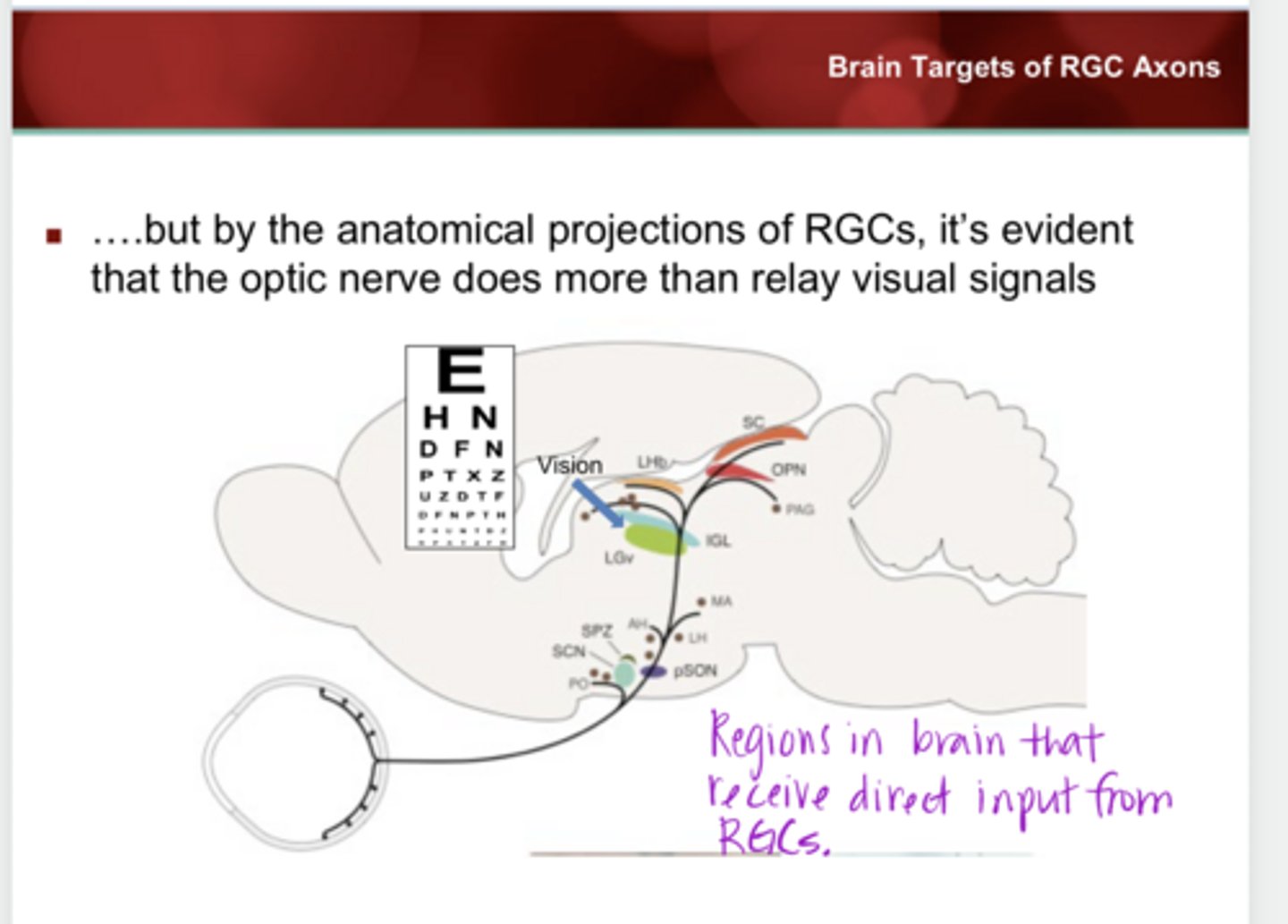
Does the optic nerve do MORE than just relay visual signals?
Yes -- this is evident by the anatomical projections of the RGCs to different areas of the brain
What is the function of the pulvinar?
-involved in visual attention, hand reaching tasks?
-filters out distracting stimuli to focus on stimulation of interest
What is the function of the superior colliculus?
saccade generation; coordinates head, neck and eye movements to help direct them to the visual stimuli
What is the lateral habenula?
-emotion, pain processing, learning (affected in depression)
-thought to play a role in mediating reflex avoidance to a threat captured in vision
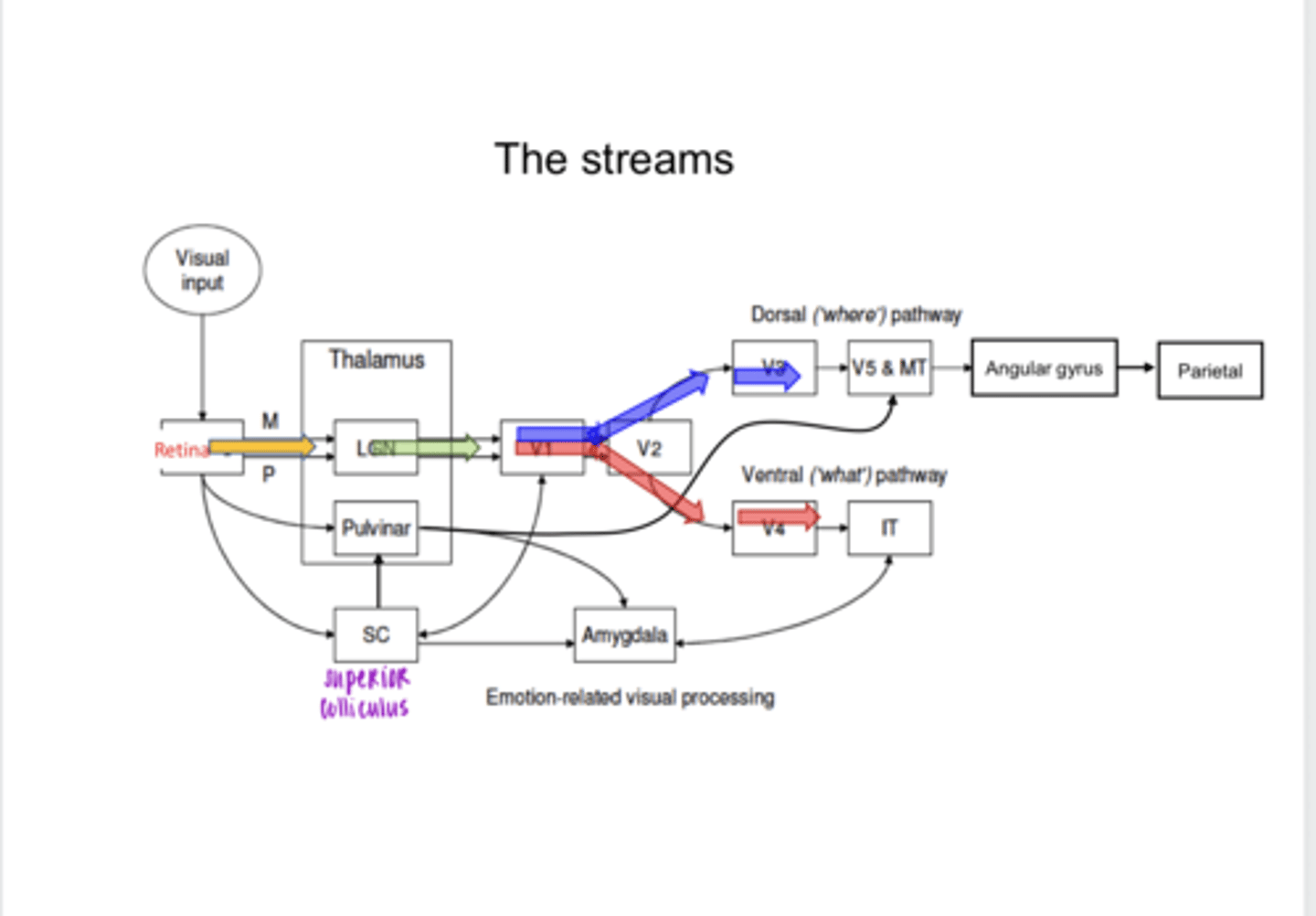
The Streams (Pic)
The Streams (Pic)
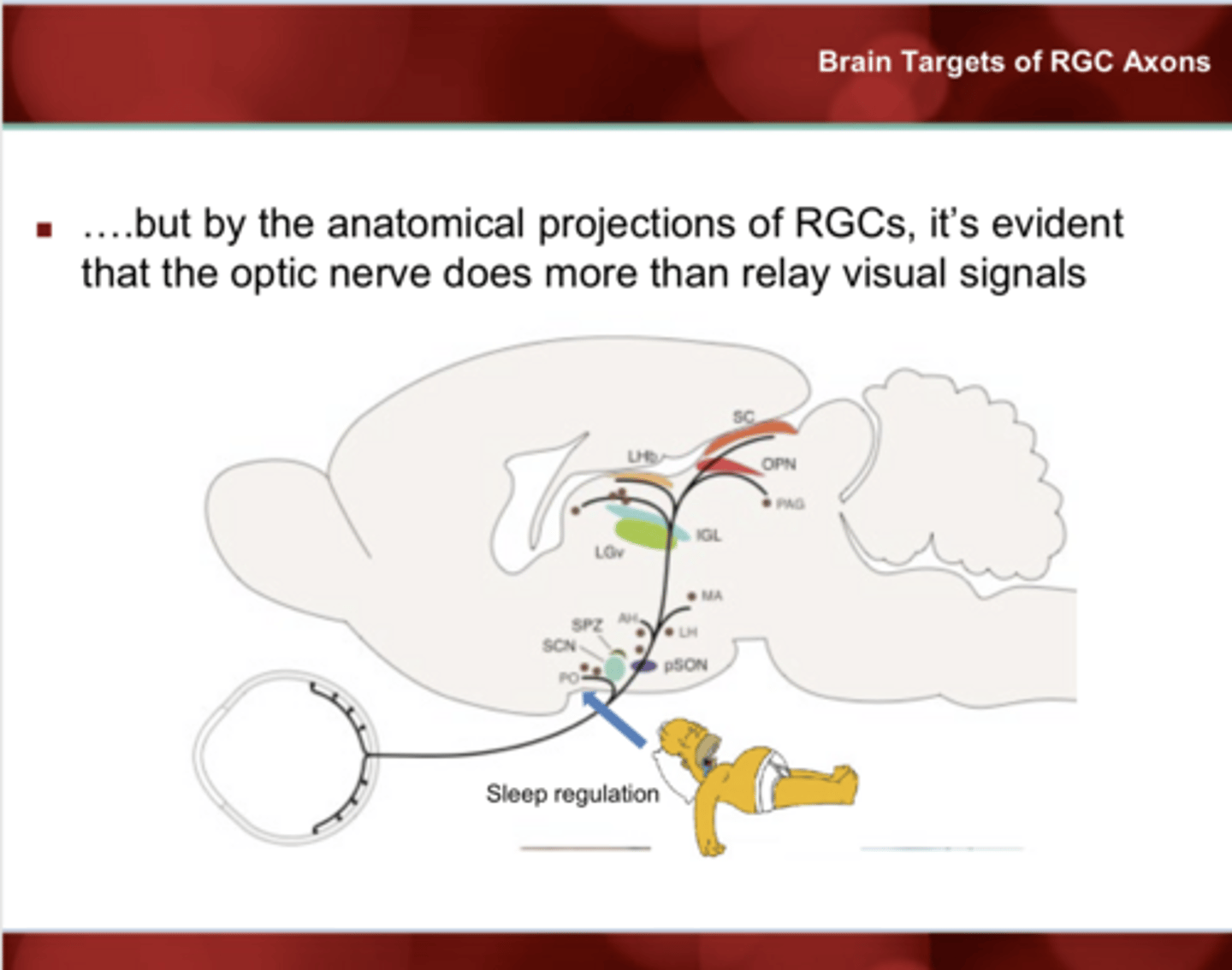
Non-LGN Targets of RGC Axons
What is the function of the ventrolateral pre-optic nucleus?
sleep regulation
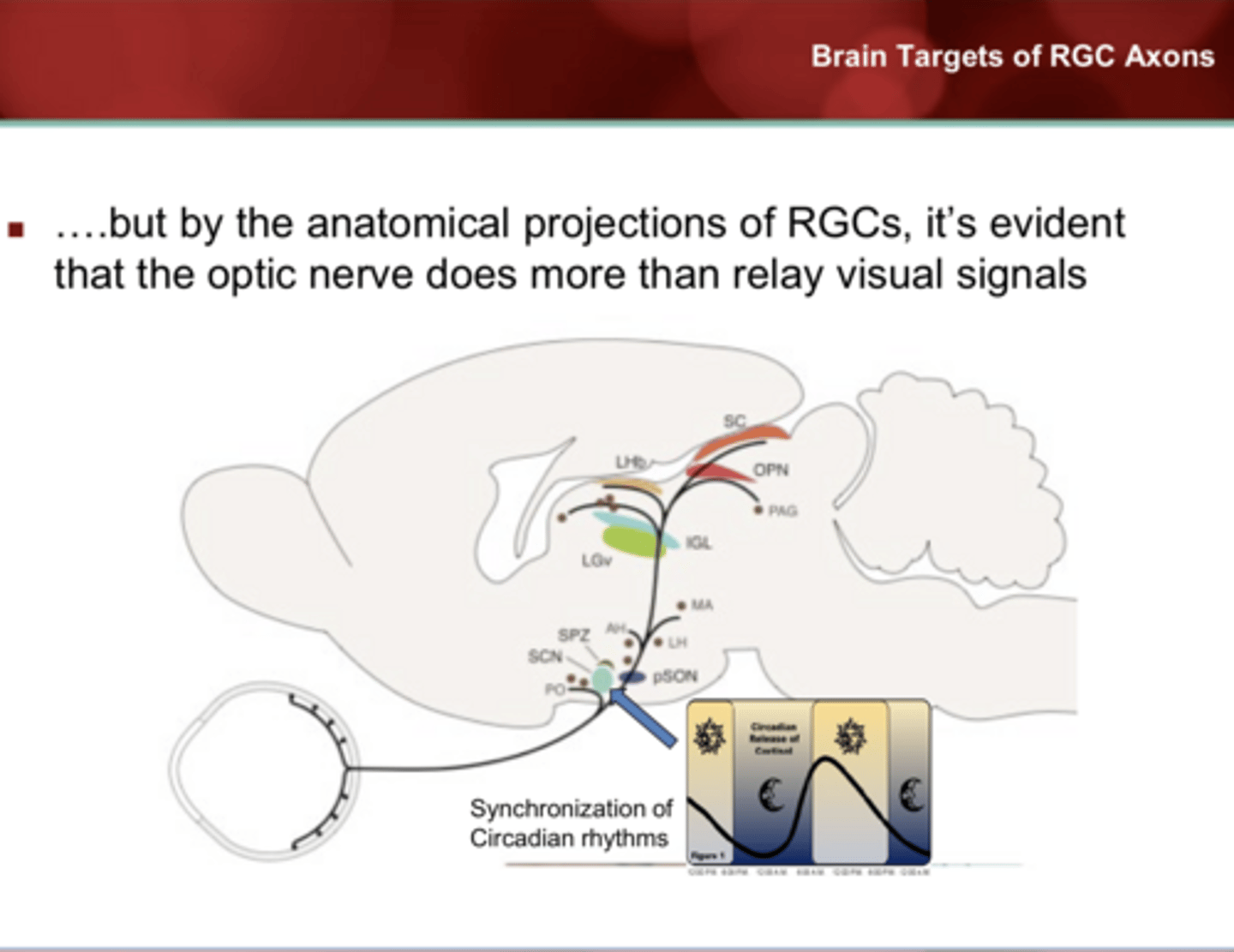
Non-LGN Targets of RGC Axons
What is the function of the suprachiasmatic nucleus?
synchronizing the circadian rhythm
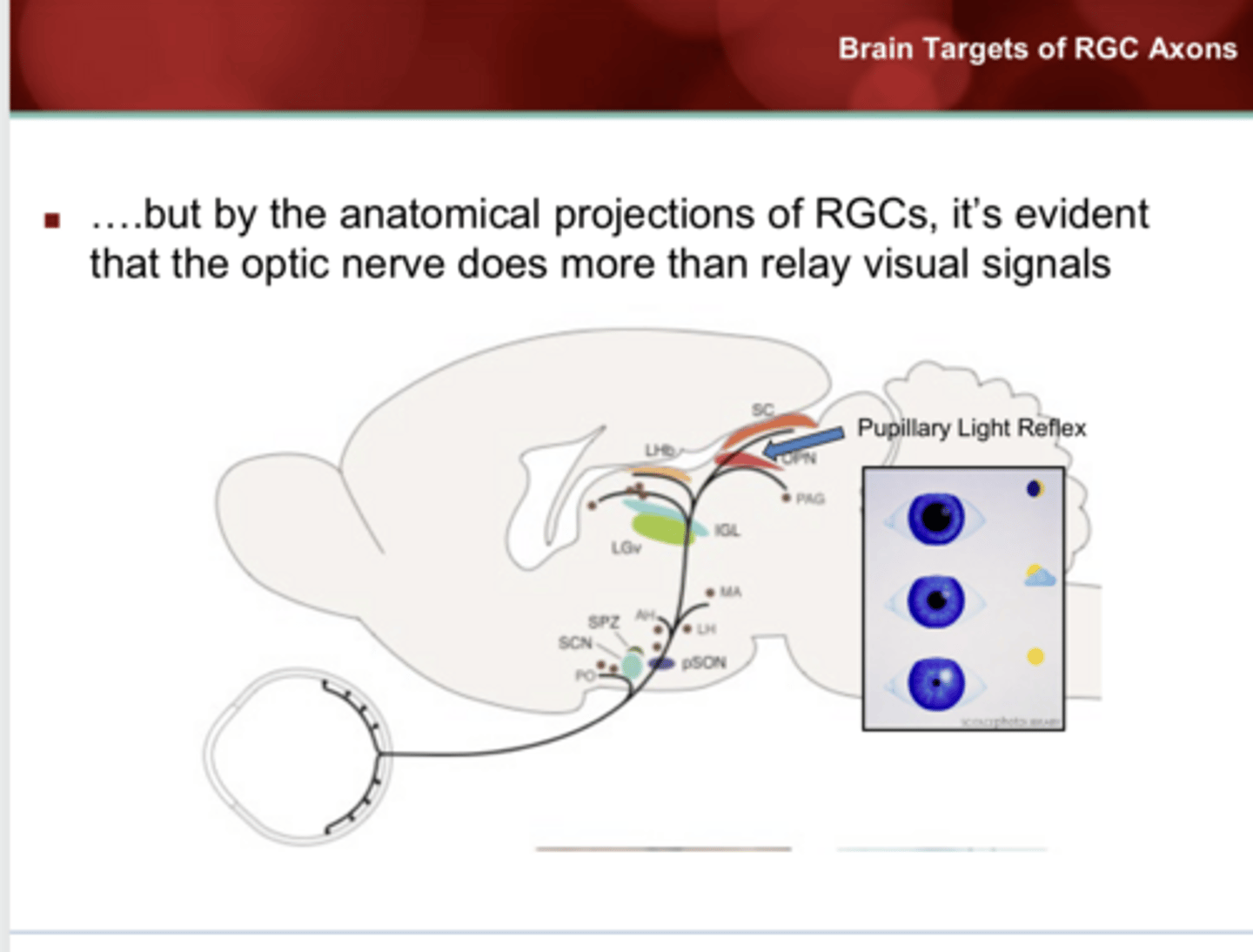
Non-LGN Targets of RGC Axons
What is the function of the pretectum (olivary pretectal nucleus)?
pupillary light reflex
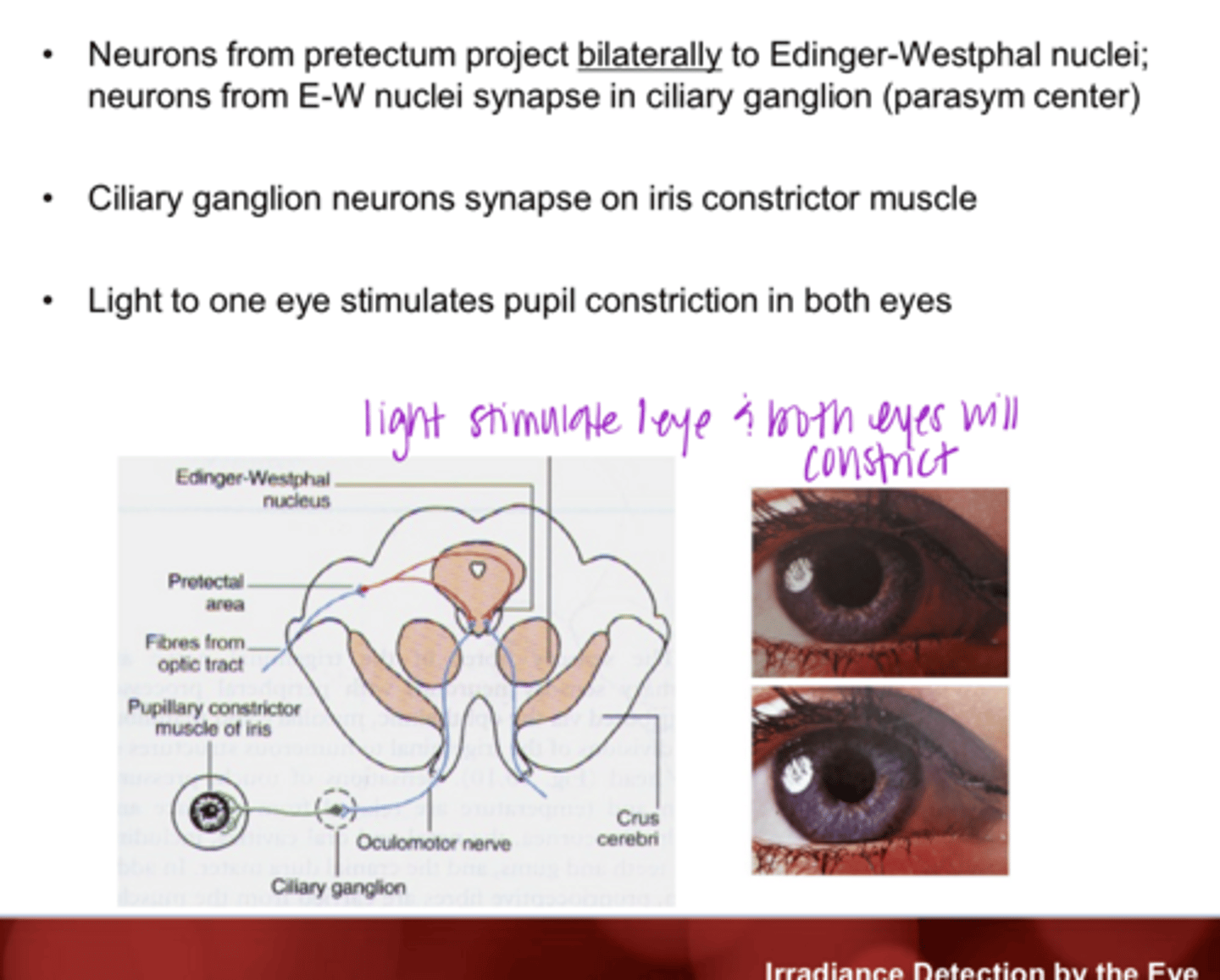
Neurons from the pretectum project _______
bilaterally
Where do the neurons from the pretectum project to?
the E-W nucleus
Where do the neurons from the E-W nucleus go?
they synapse in the ciliary ganglion (parasympathetic center)
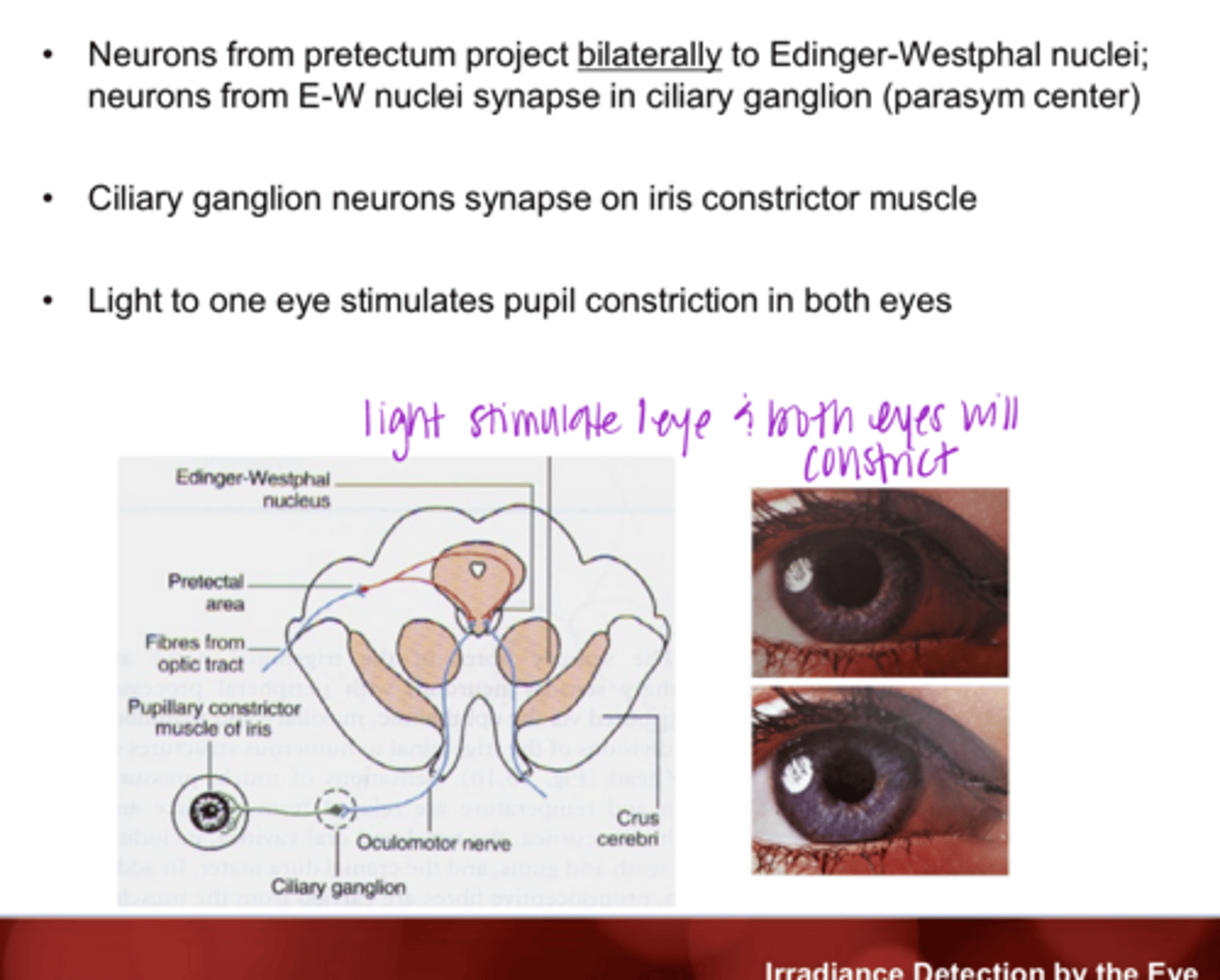
Neurons from the ciliary ganglion will synapse where?
on the iris constrictor muscle of each eye
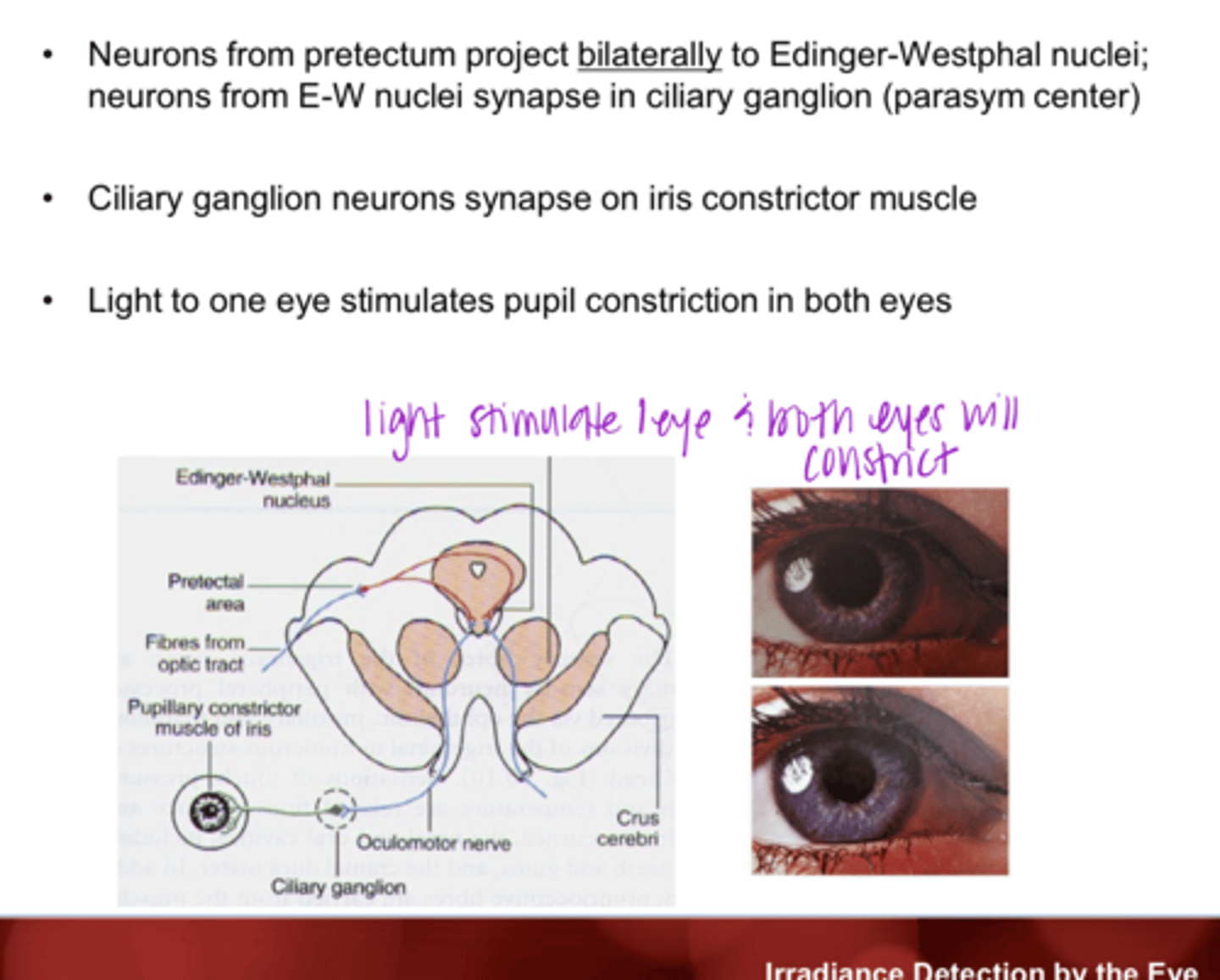
True or False:
Light shone in one eye will stimulate pupil constriction in both eyes
true
the human visual system's capability to detect and interpret shapes, lines, and orientations, primarily processing relative light intensities and colors rather than absolute intensity
pattern vision
In addition to the role in vision, the eye provides the brain with what?
info regarding environmental brightness -- "irradiance detection"
Irradiance information is used to regulate what?
the pupil size and our body's circadian rhythm
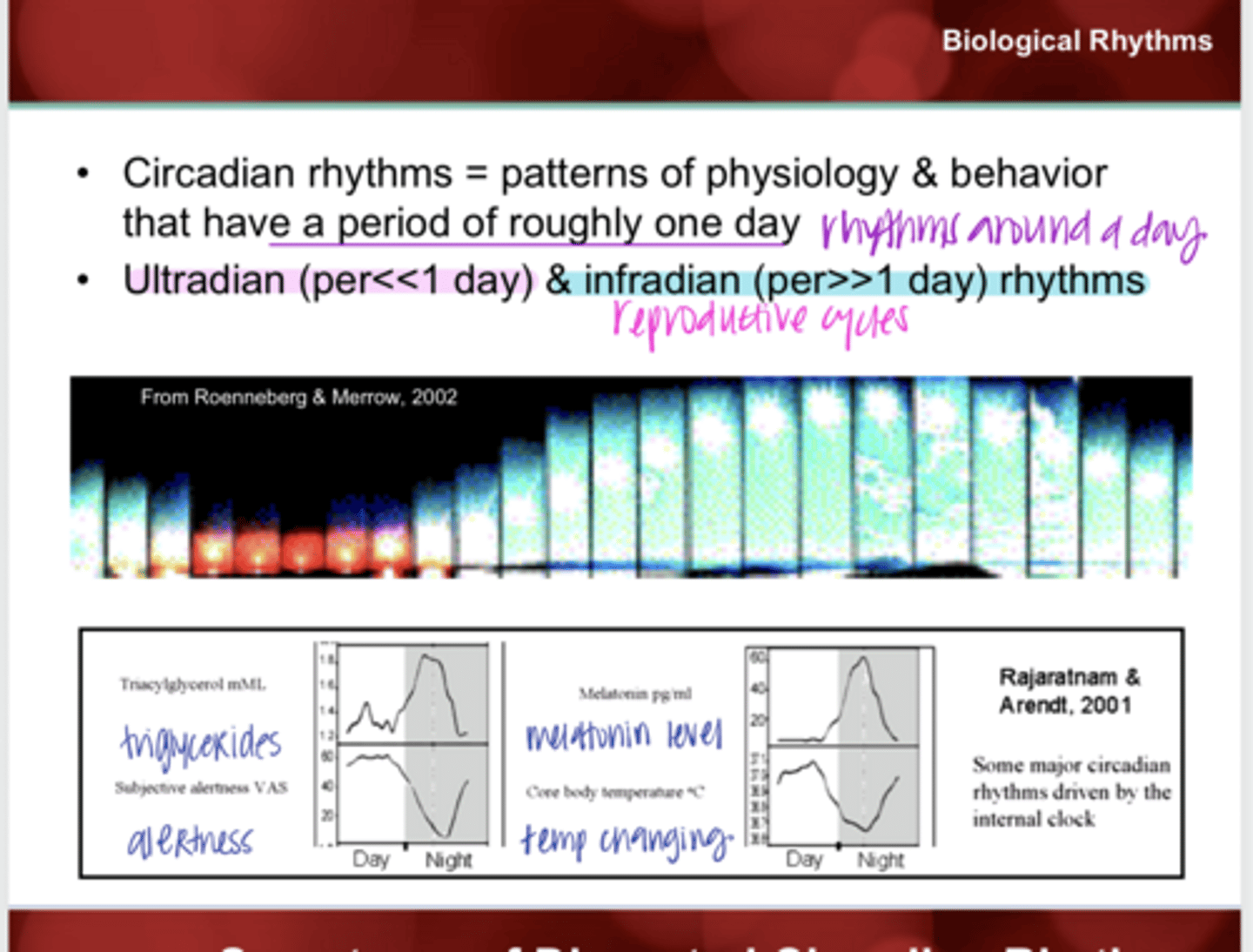
What is a circadian rhythm?
patterns of physiology and behavior that have a period of roughly one day
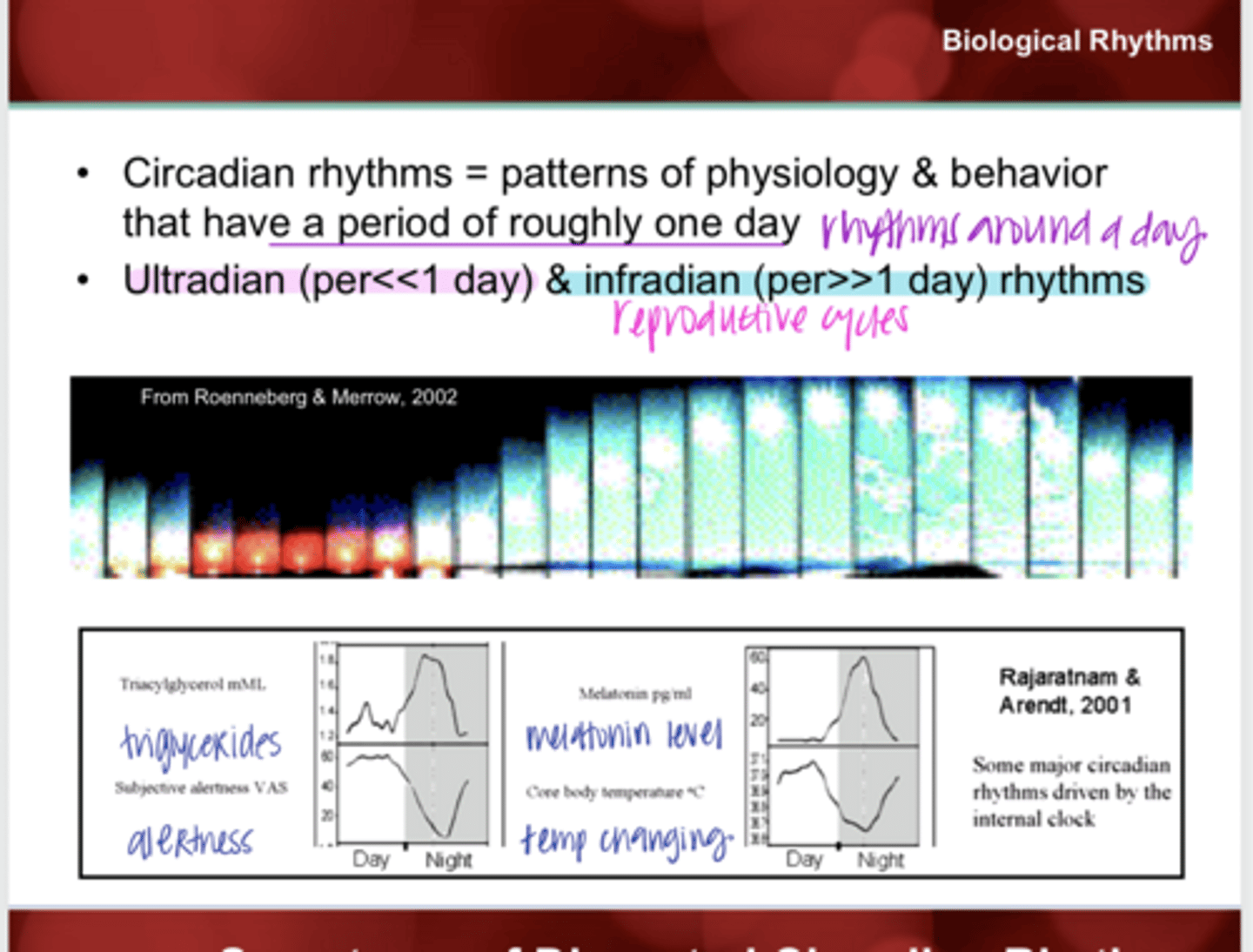
Ultraradian cycle
patterns of physiology and behavior that have a period of LESS THAN ONE DAY
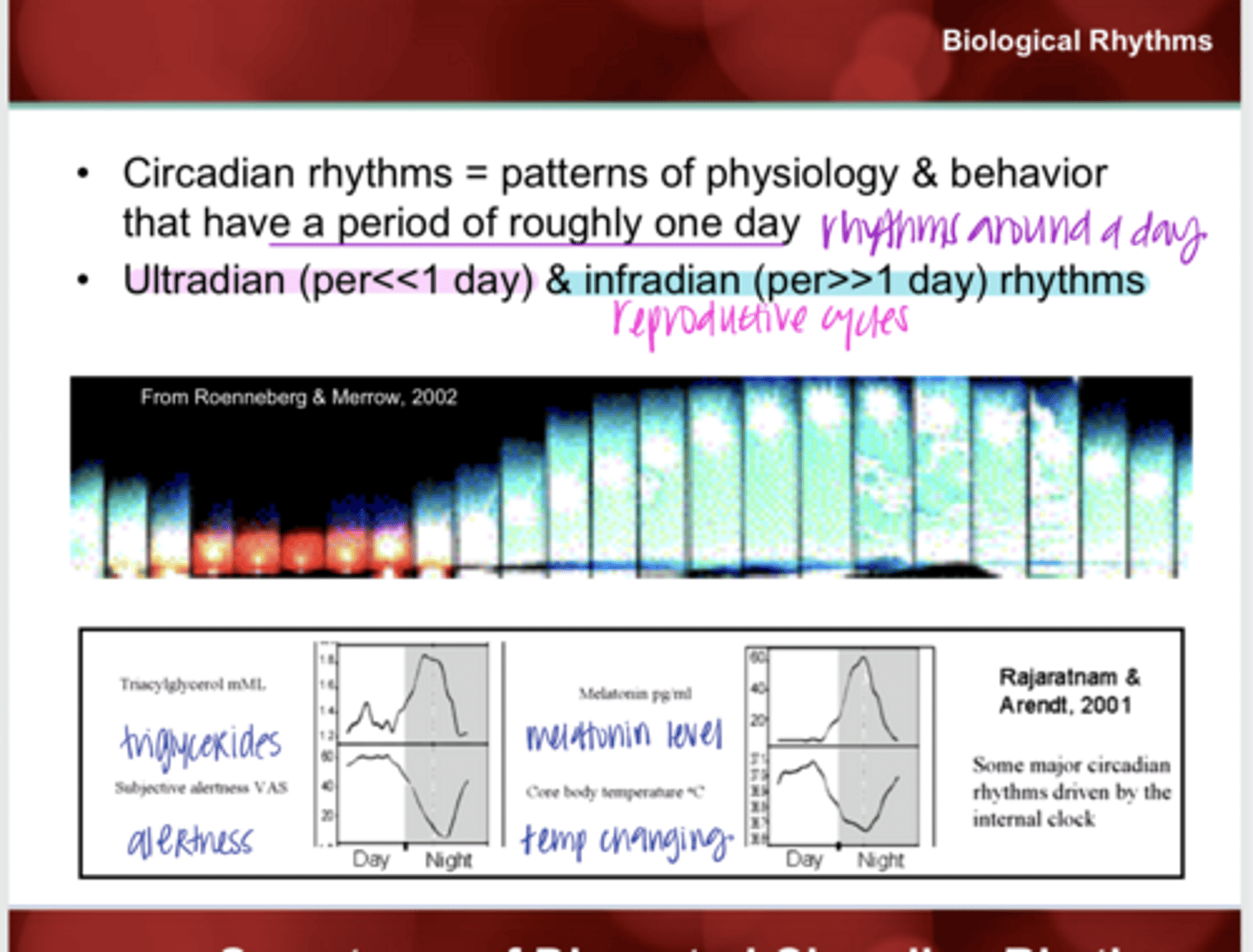
Infraradian cycle
patterns of physiology and behavior that have a period of MORE THAN 1 DAY
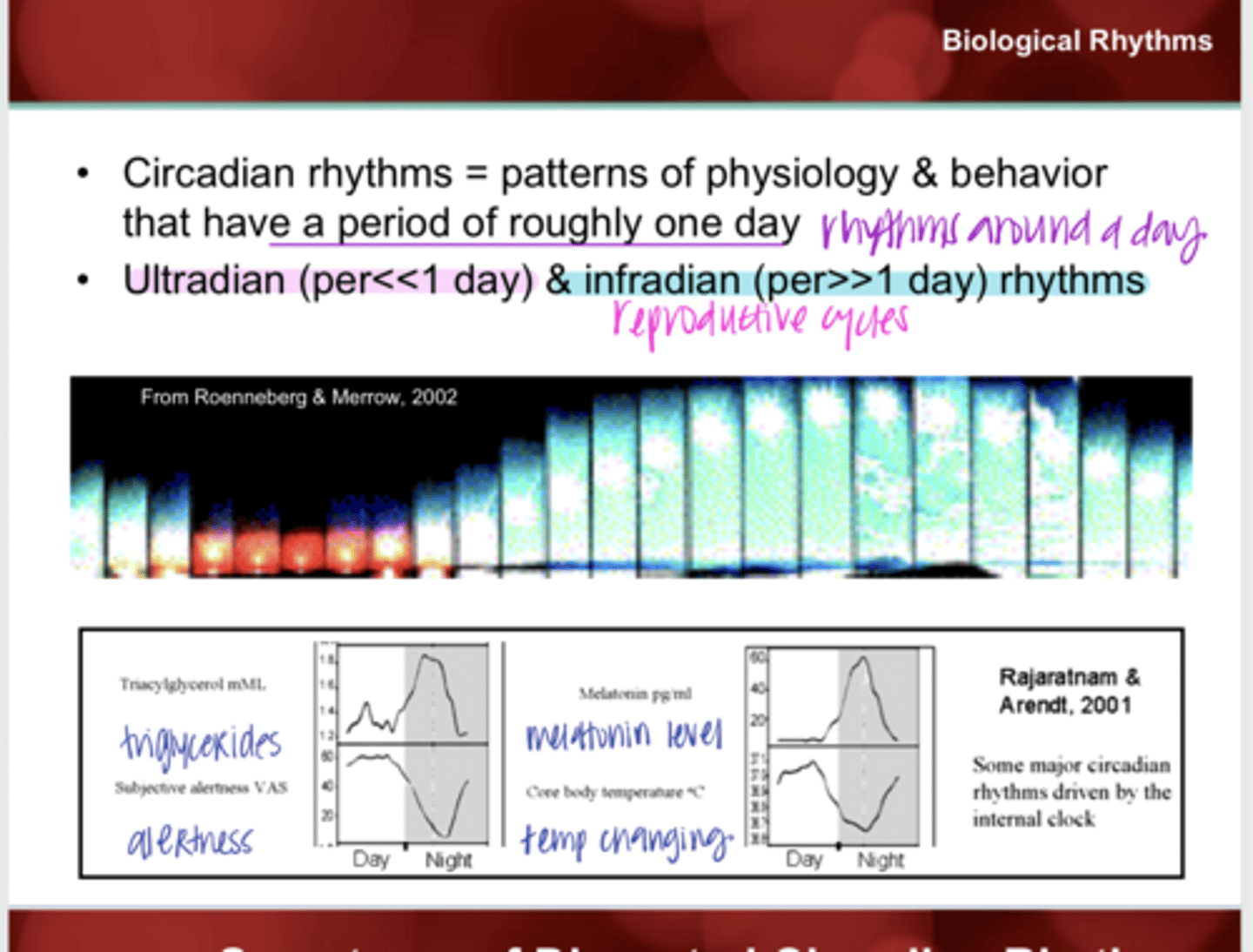
What are the examples given of major circadian rhythms driven by the internal clock of the body?
-Triglycerol
-Subjective alertness
-Melatonin level
-Core body temp
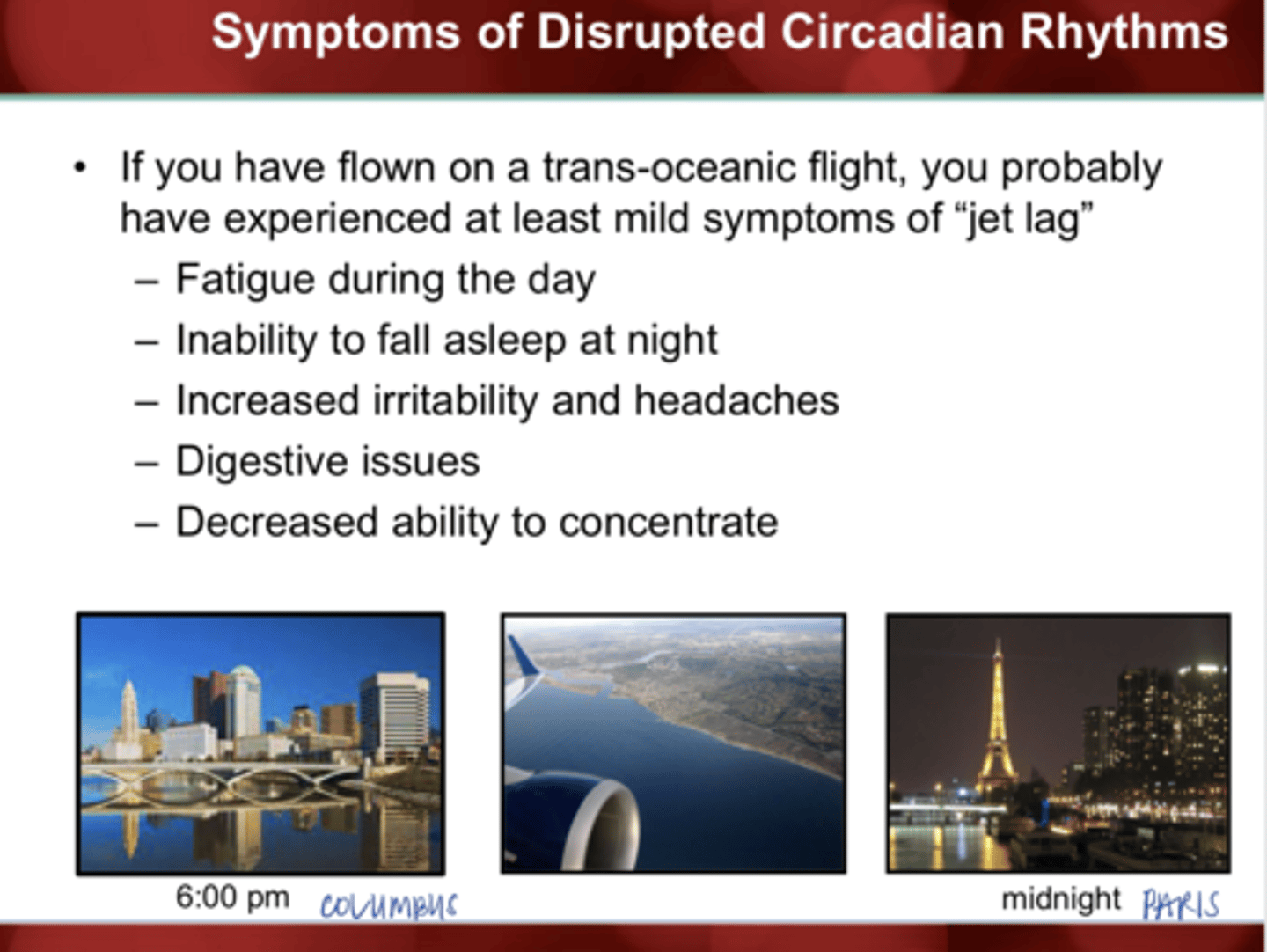
What are the symptoms of "jet lag" and crossing time zones w/ disrupted circadian rhythms?
-fatigue during the day
-inability to fall asleep
-increased irritability and HAs
-digestive issues
-decreased ability to concentrate
What is the issue with jet lag?
you are suddenly expected to be awake when you are usually still asleep creating a disconnect between the external time and the body's internal time
Will both the external time and body's internal time resynchronize after some time?
Yes -- ~1 day per time zone crossed
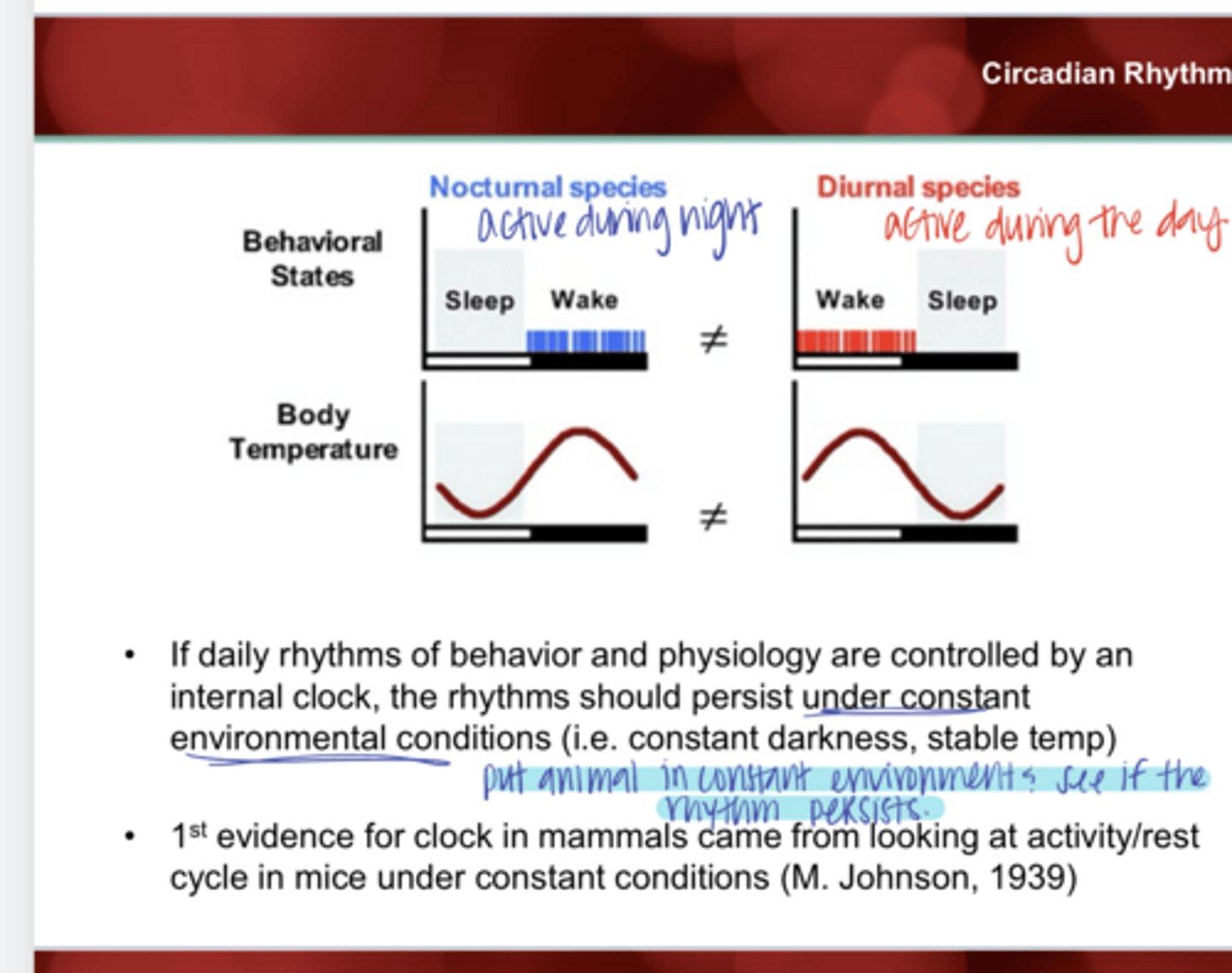
True or False:
If daily rhythms of behavior and physiology are controlled by an internal clock, the rhythms should persist under constant environmental conditions (constant darkness, stable temp)
true
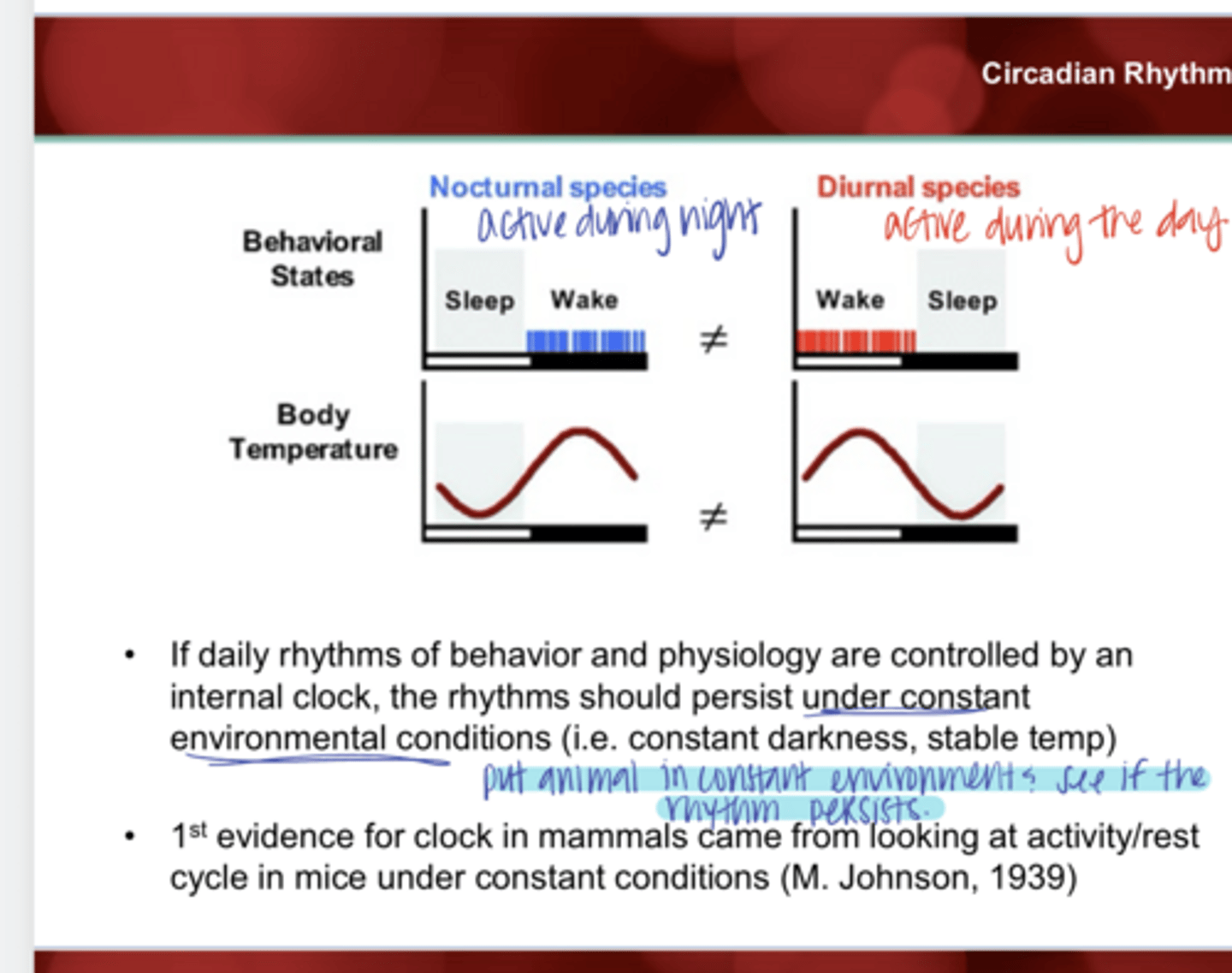
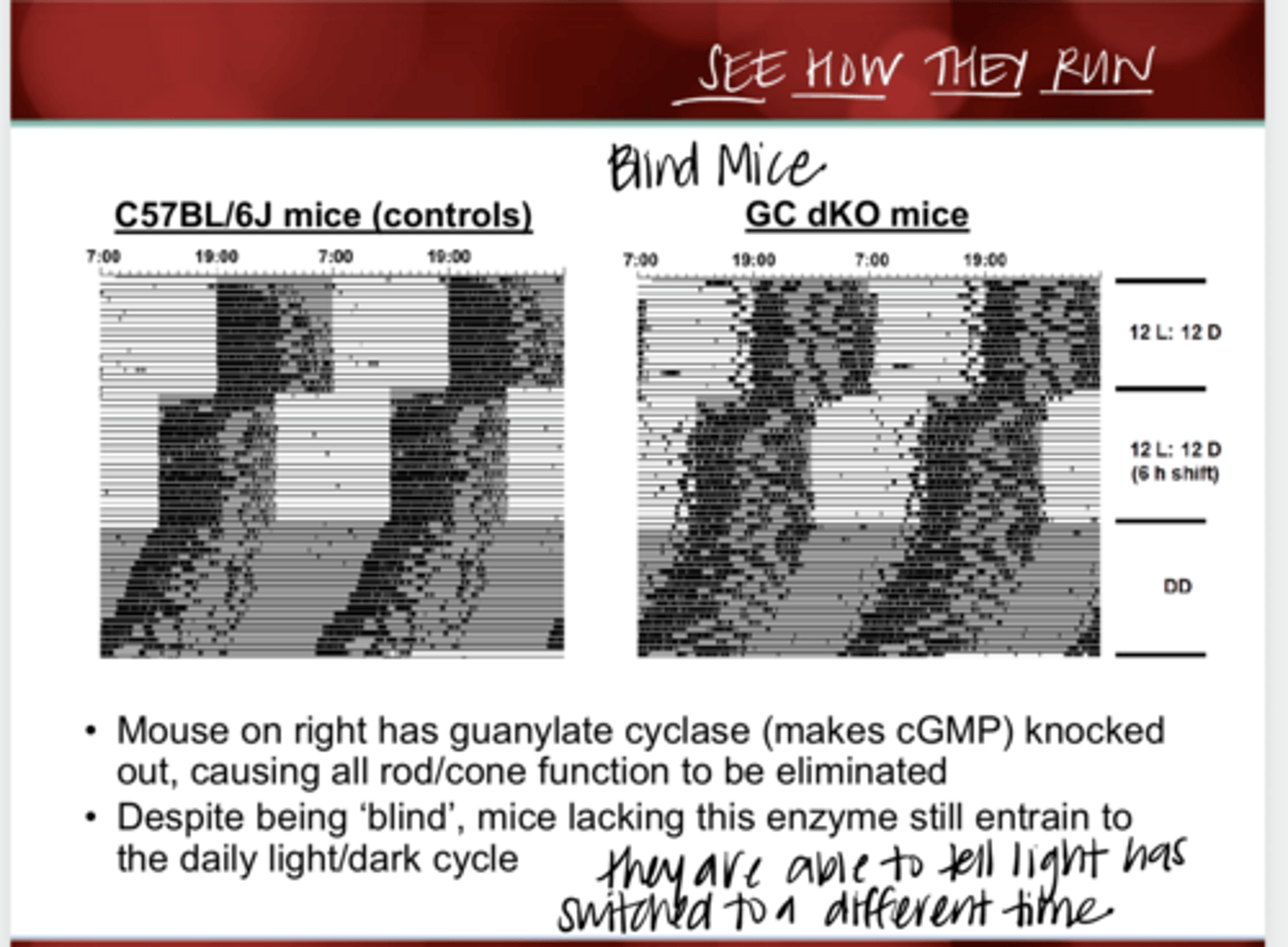
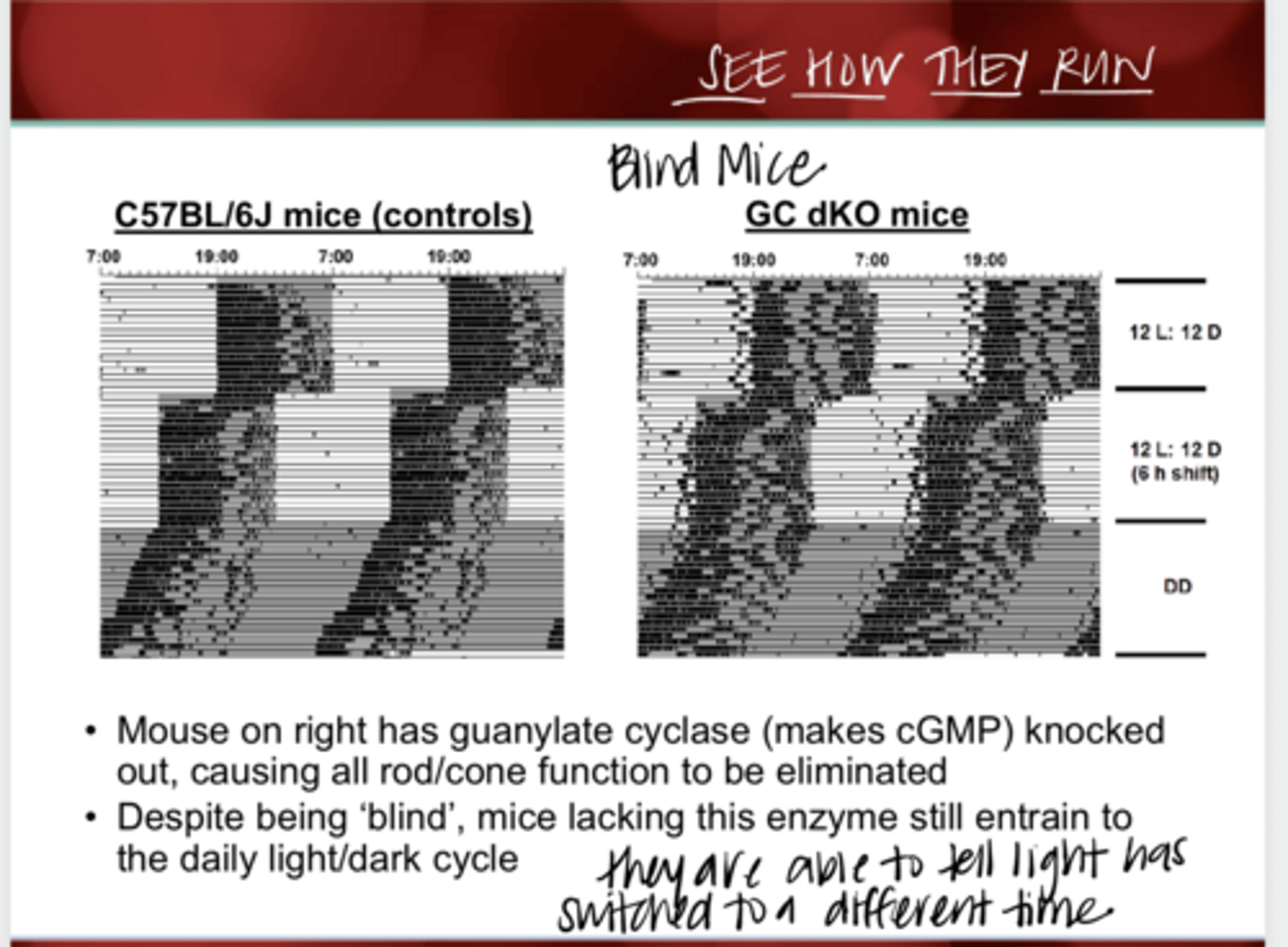
What was the 1st evidence for a internal clock in mammals?
looking at activity/rest cycle in mice under constant conditions
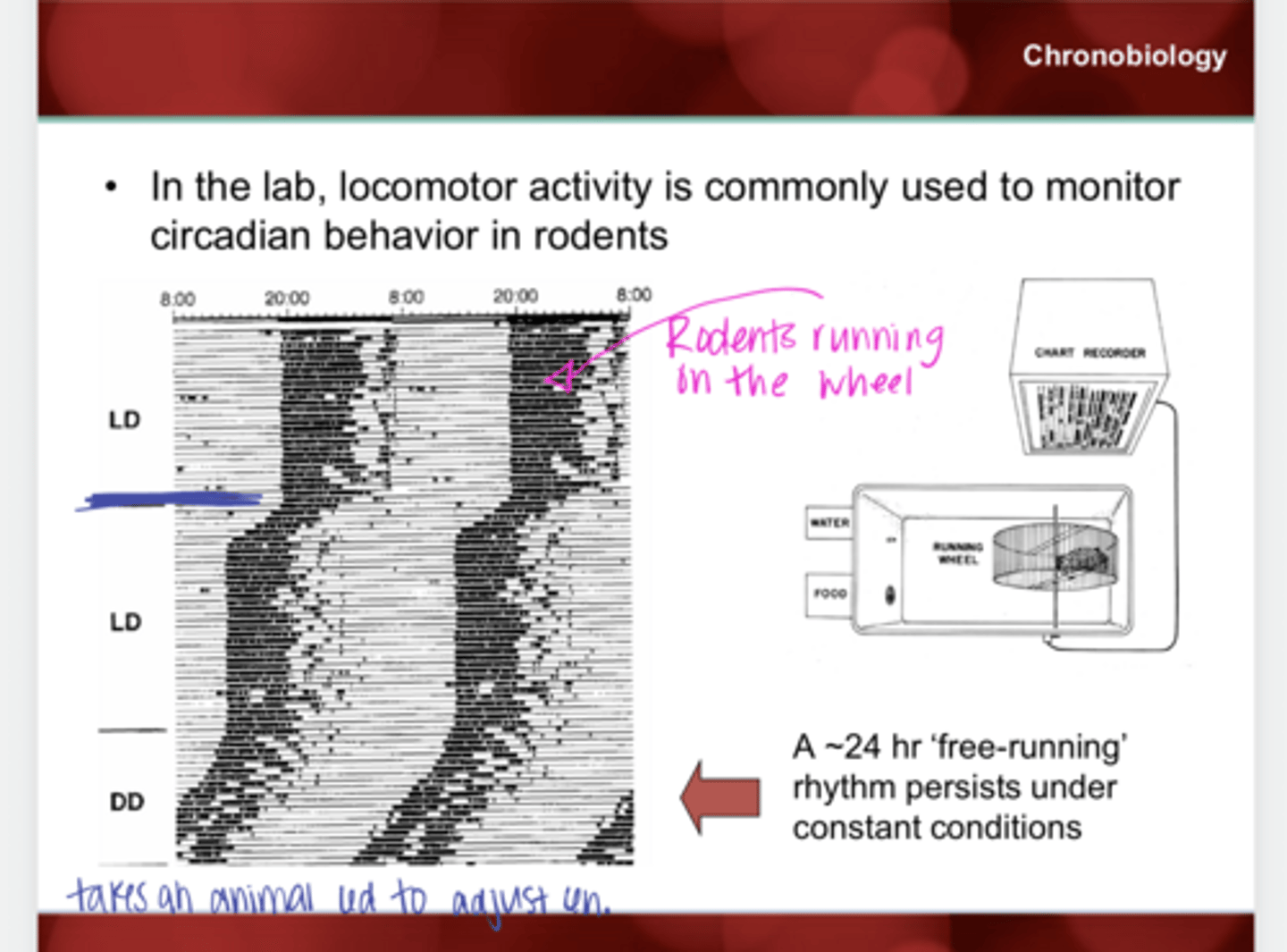
In the lab ______ activity is commonly used to monitor circadian behavior in rodents
locomotor
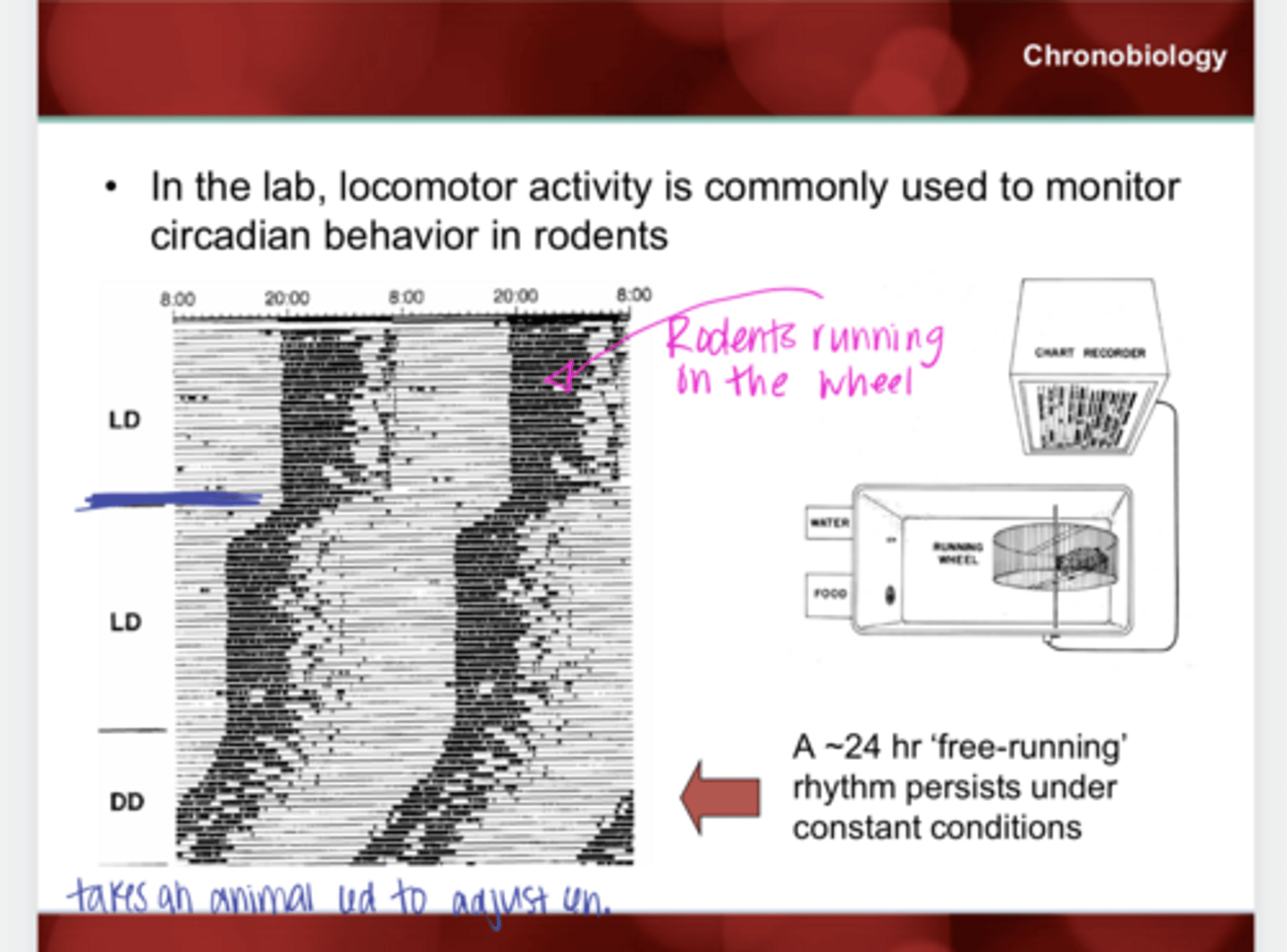
Under constant conditions, a ~24hr _______ rhythm persists under constant conditions
free-running
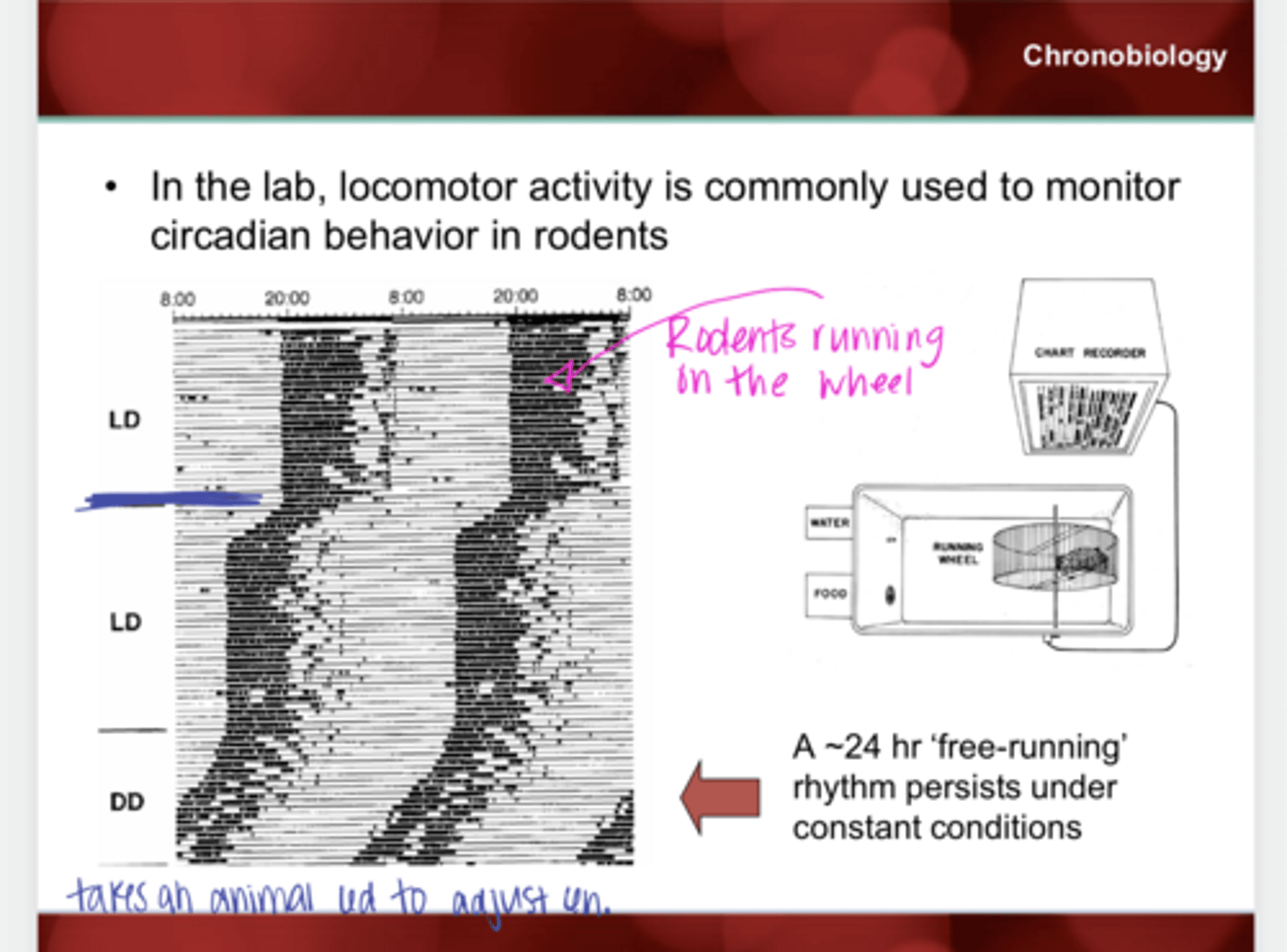
When lights are turned on 6 HOURS EARLIER, what do the mice do?
Gradually (~1h earlier per day) will start running probably d/t internal clock
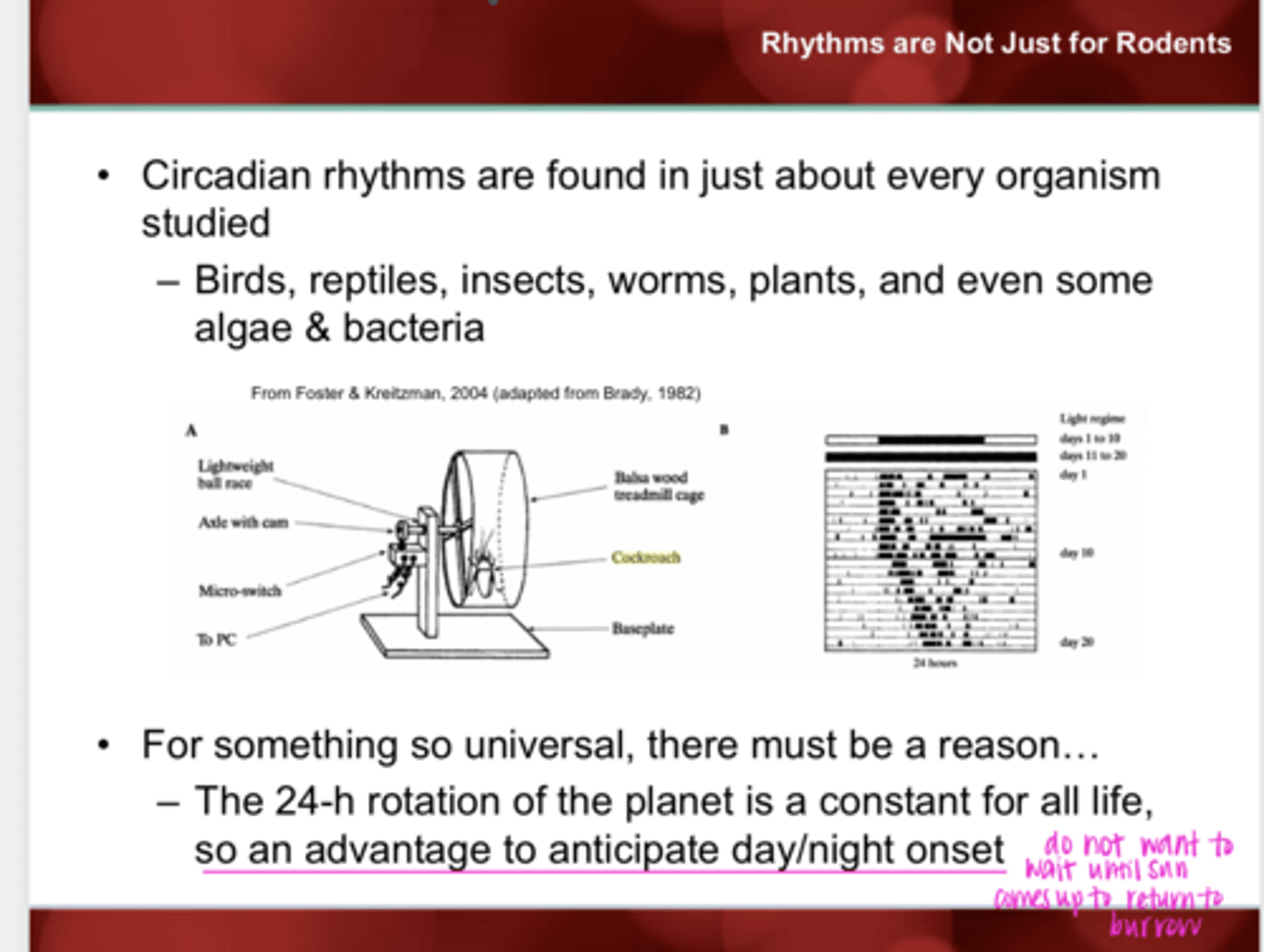
What is the reason for circadian rhythm?
24h rotation of the planet is a constant for all life, so an advantage to anticipate night/day onset
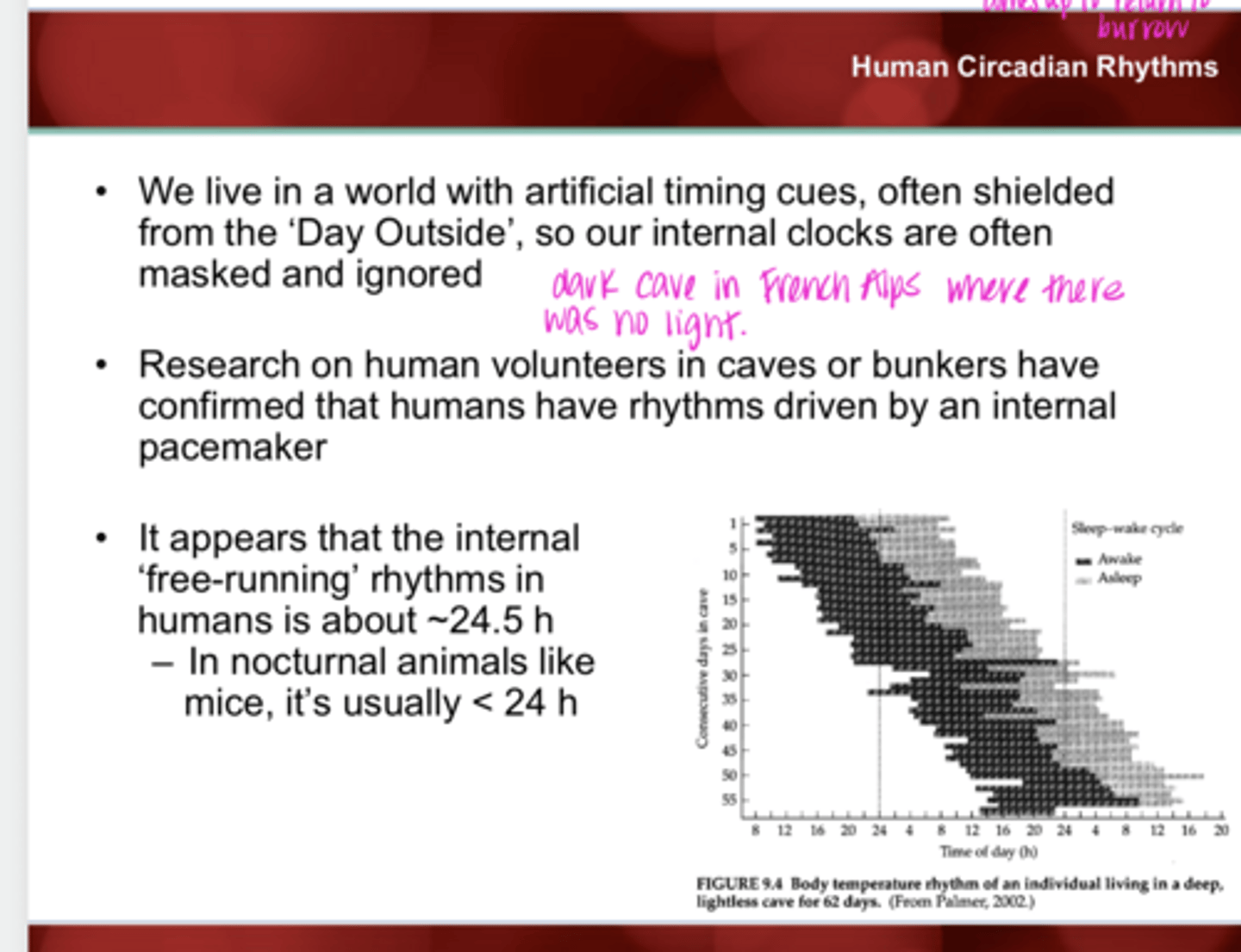
Are our internal clocks often masked and ignored?
Yes -- we live in a world with artificial timing cues & are often shielded from the "Day Outside"
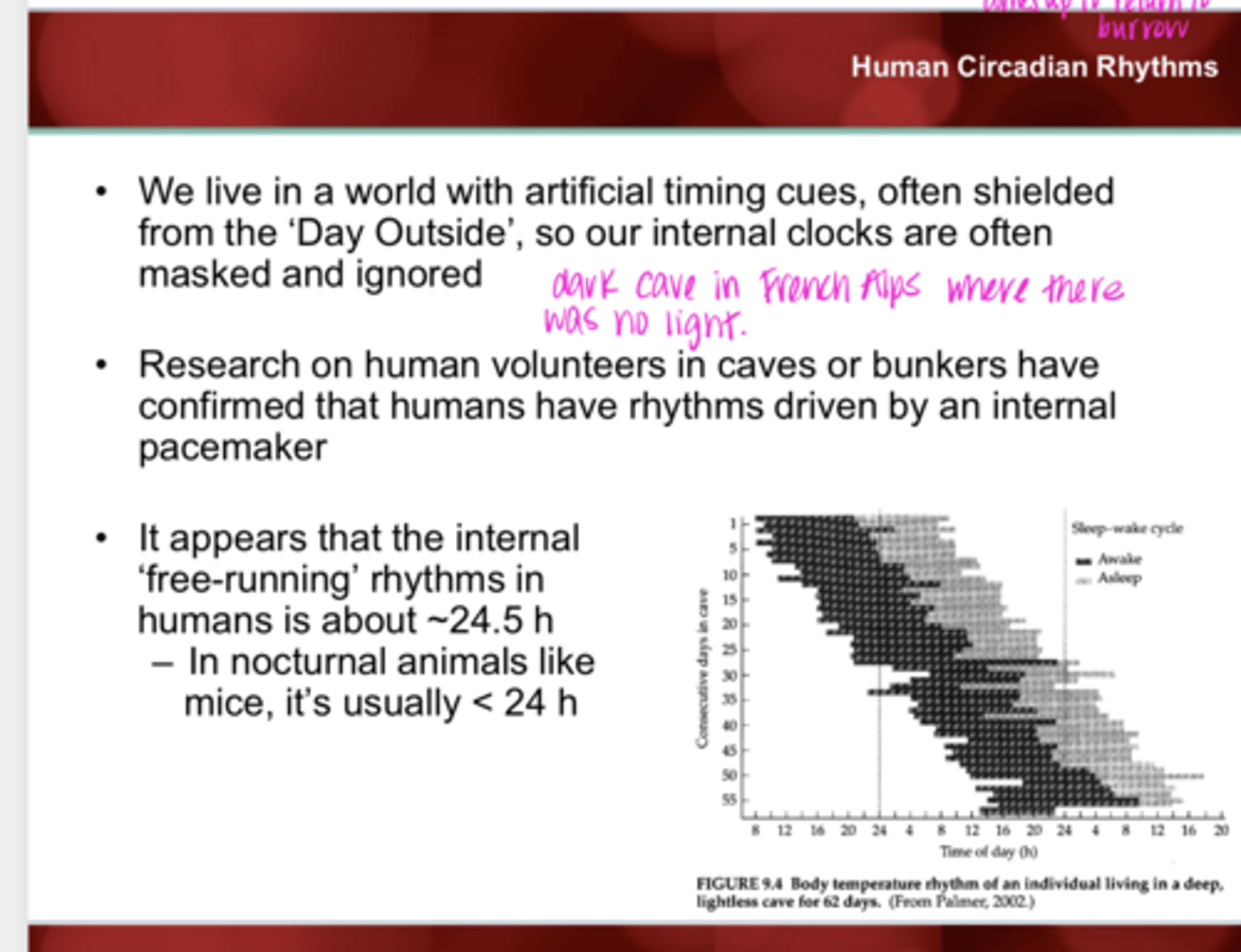
Research on human volunteers in ____ have confirmed that humans have rhythms driven by an internal pacemaker
caves/bunkers
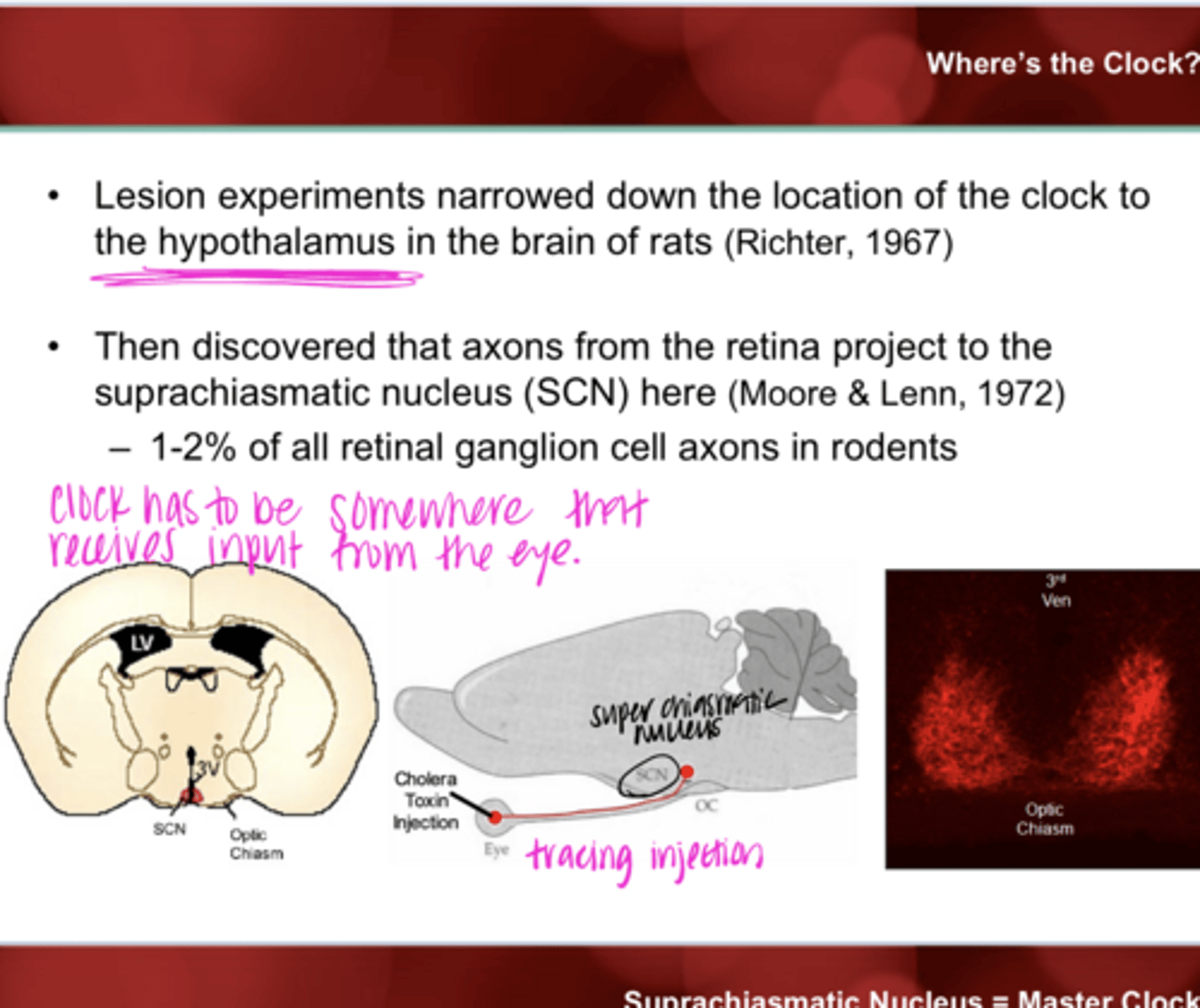
Where is the internal clock?
hypothalamus in the brain -- suprachiasmatic nucleus (SCN)
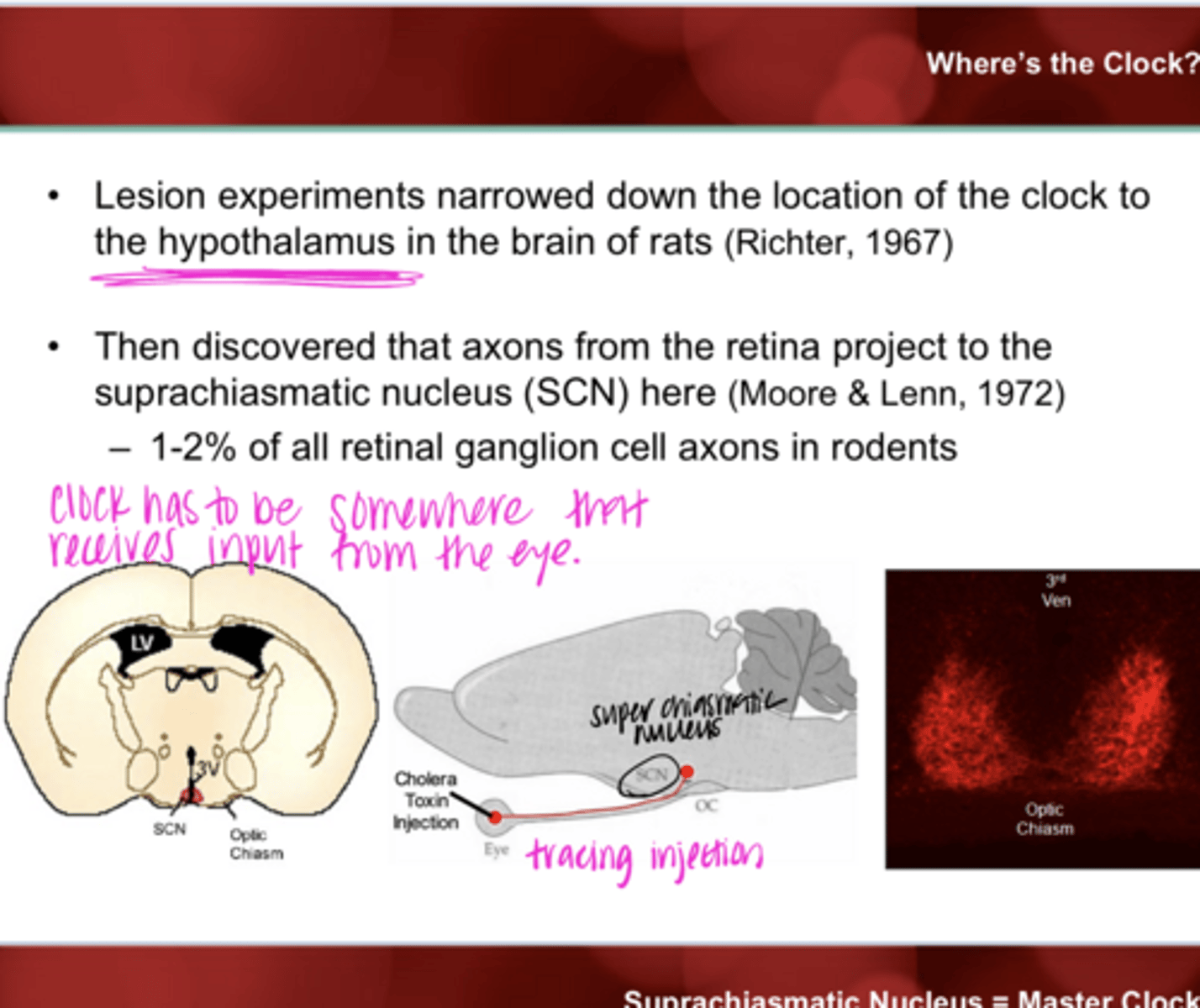
Axons from the retina project to the _____ in the hypothalamus and are likely linked to the circadian rhythm
suprachiasmatic nucleus (SCN)
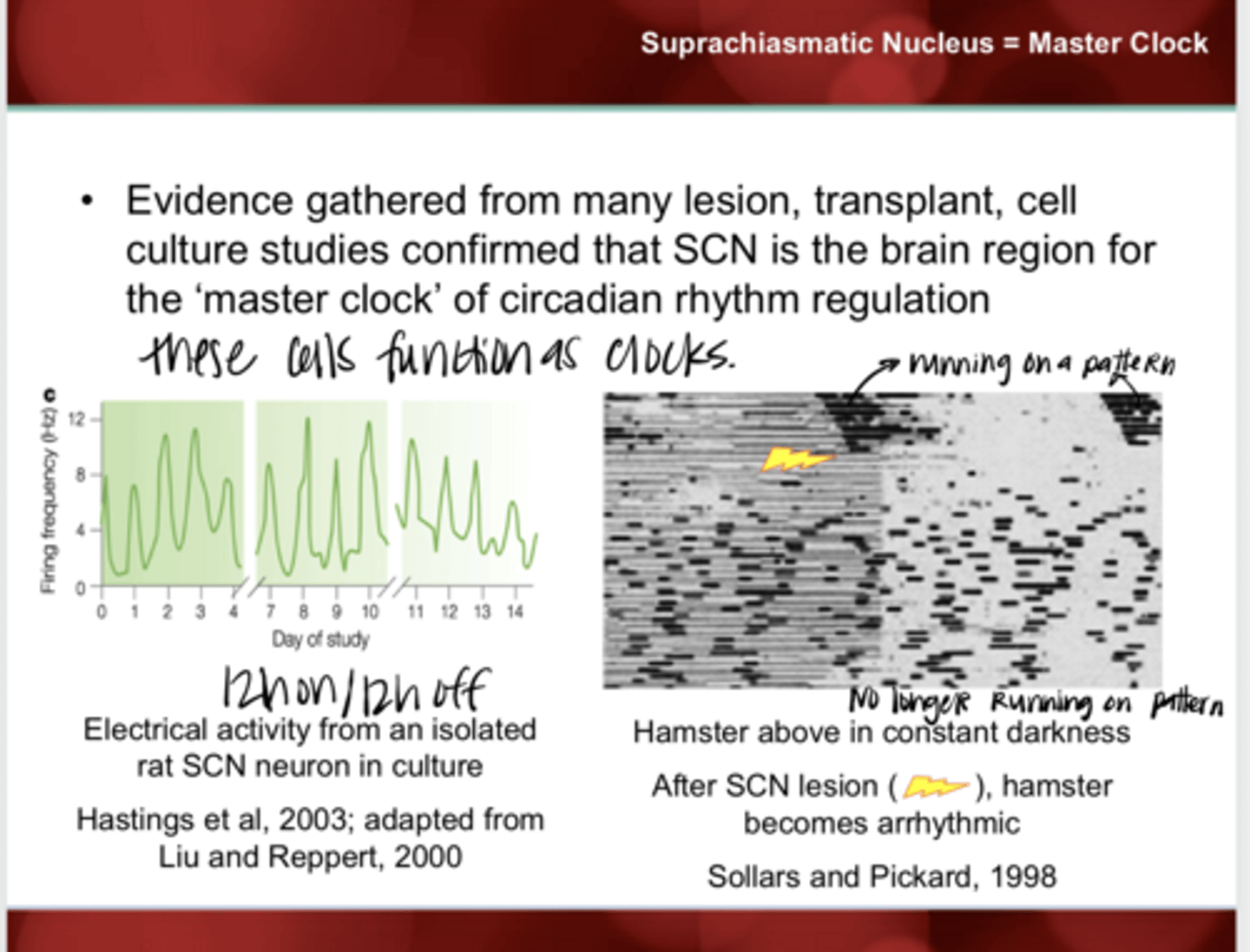
What happens when a lesion to the suprachiasmatic nucleus (SCN) is made in a rat?
becomes arrhythmic in constant darkness -- no longer runs in a pattern throughout the day
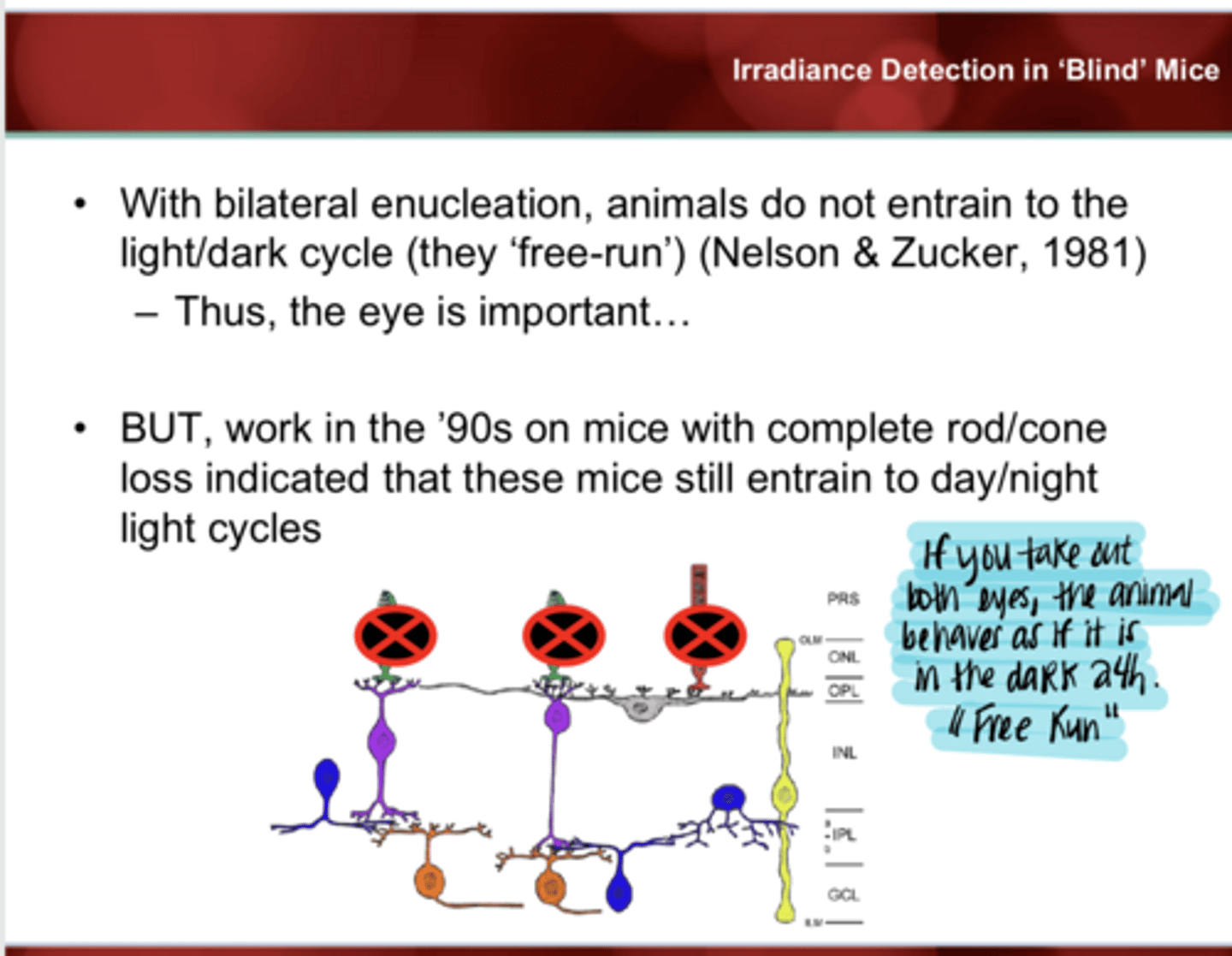
With bilateral enucleation, what happens to the circadian rhythm of animals?
animals DO NOT entrain to the light/dark cycle (they will free run)
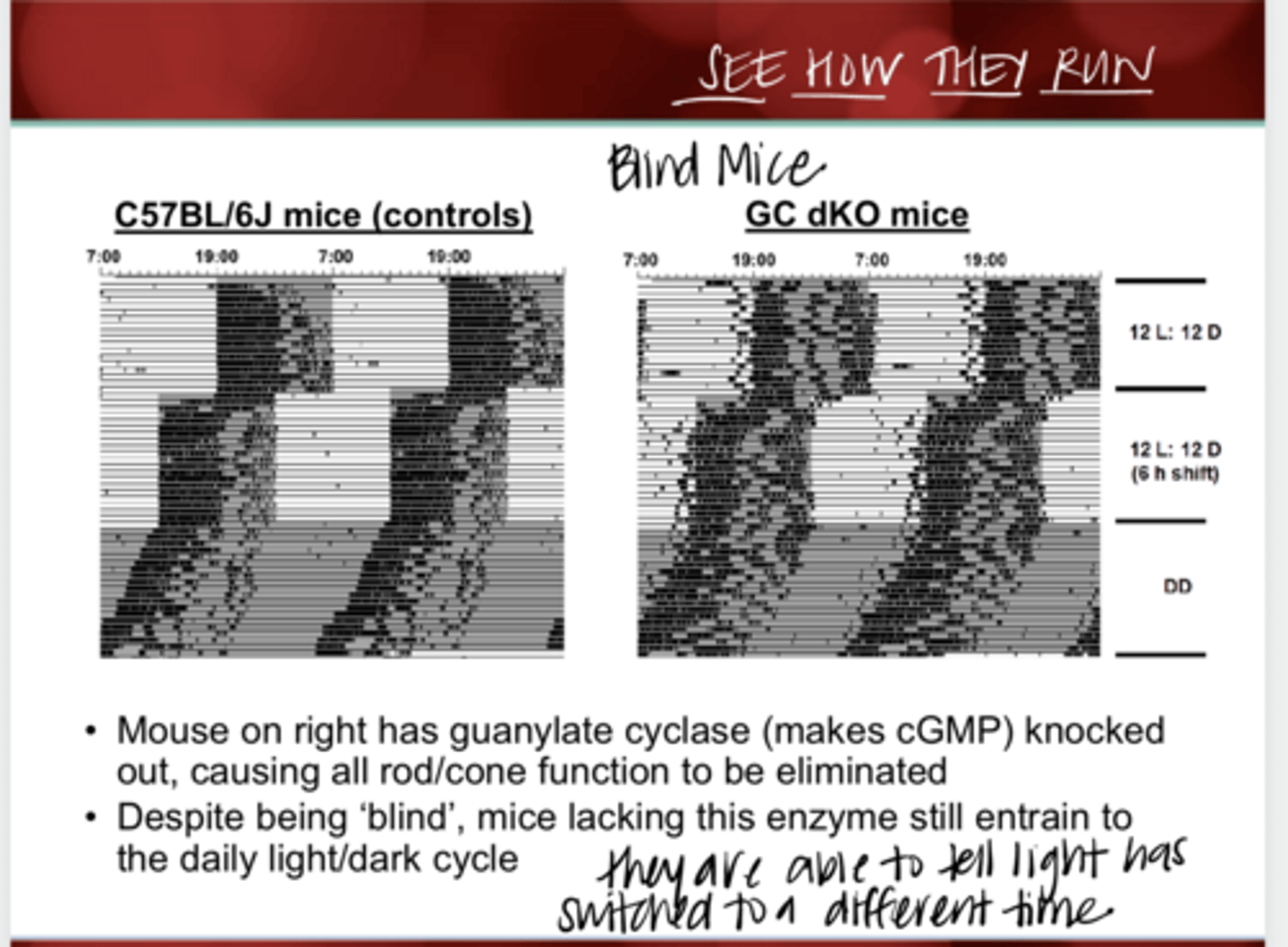
With complete rod/cone loss by knocking out cGMP, what happens to the circadian rhythm in mice?
they DO entrain to the day/night light cycles
Are rods/cones necessary for irradiance detection?
No
Do some blind patients (w/ Leber's congenital amaurosis) appear to exhibit normal or near-normal circadian rhythm entrainment?
Yes -- they do not free run
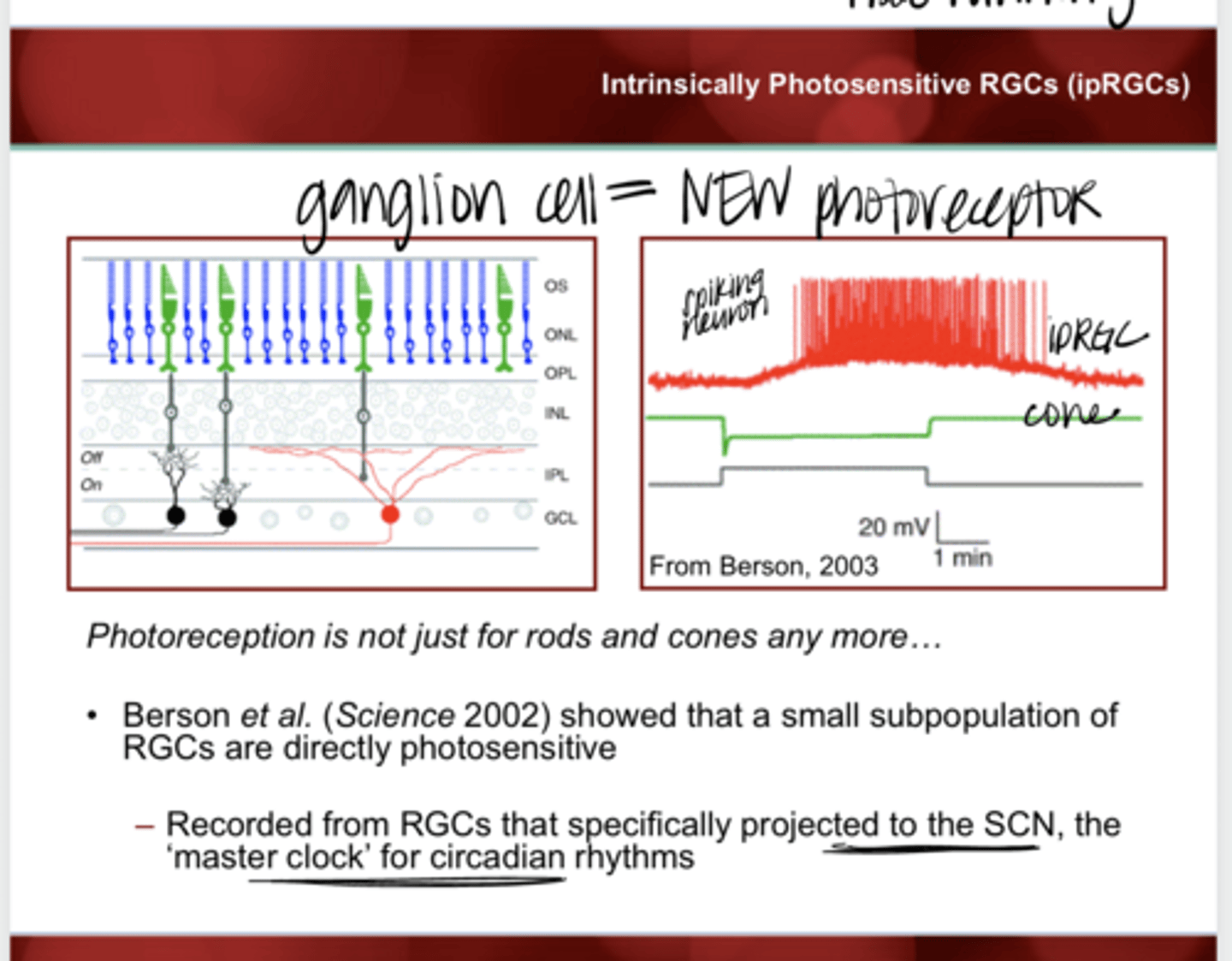
True or False:
A small population of RGCs are directly photosensitive
true
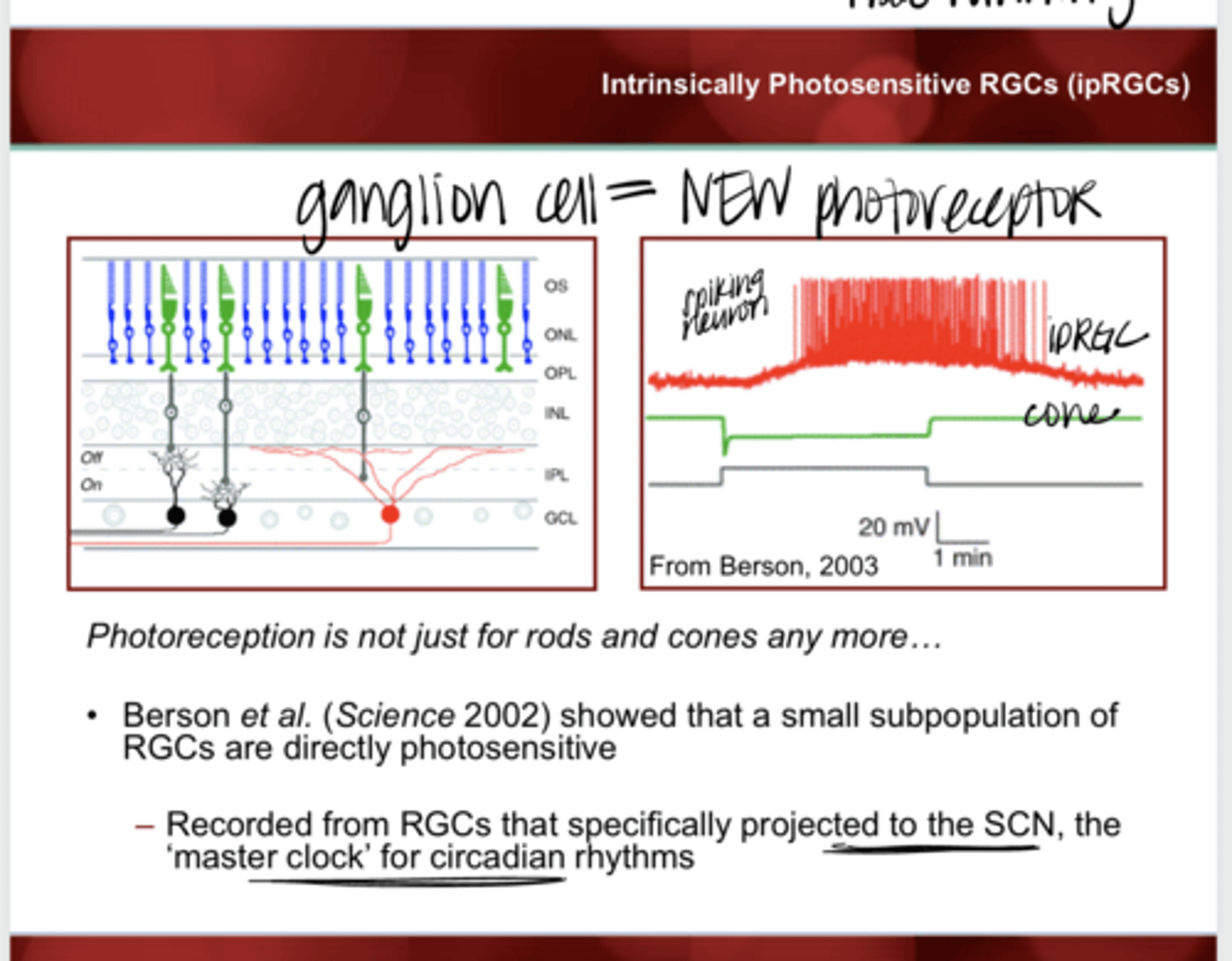
What RGCs are directly photosensitive?
the RGCs that specifically project to the SCN (master clock for circadian rhythm)
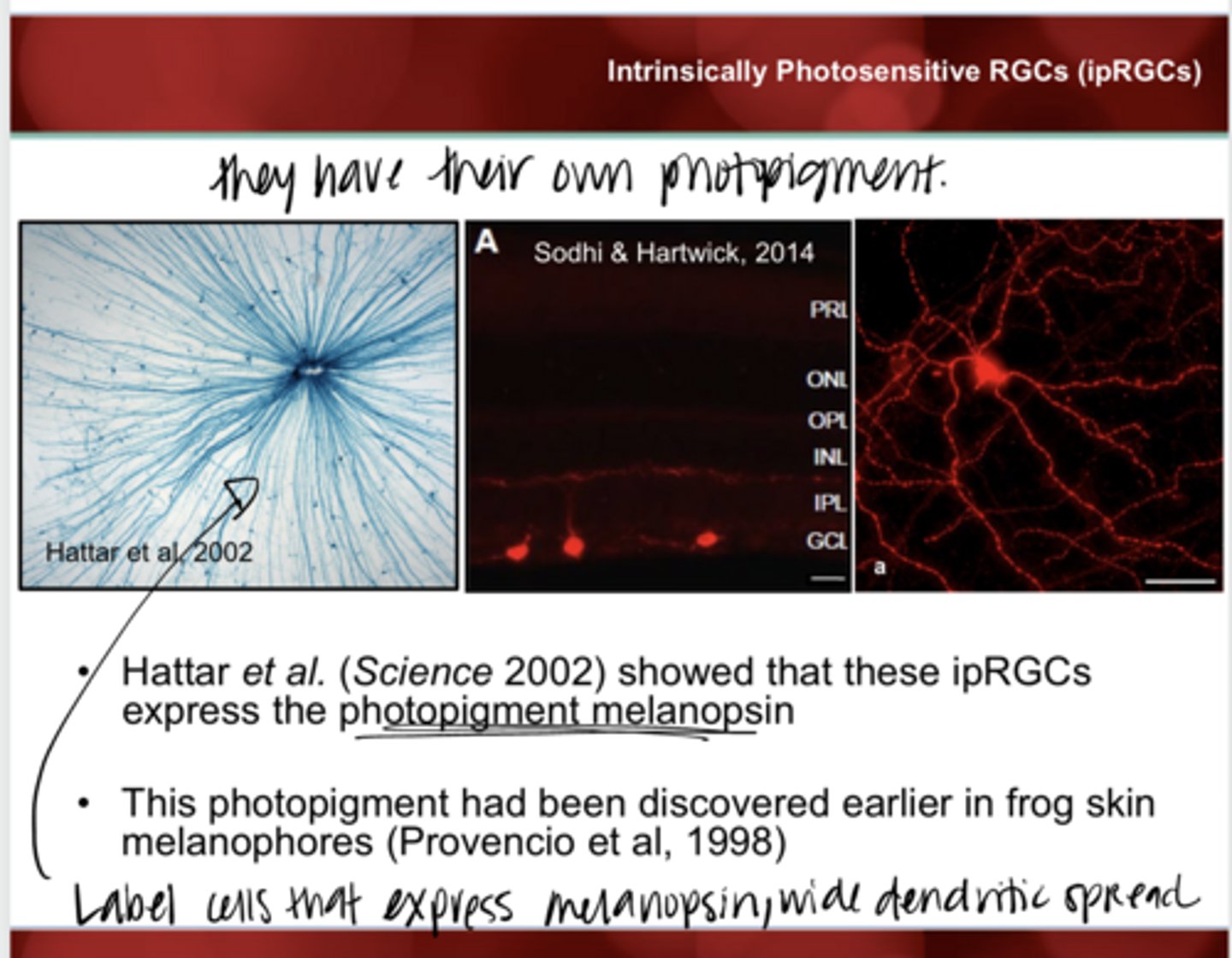
ipRGCs express what?
melanopsin photopigment
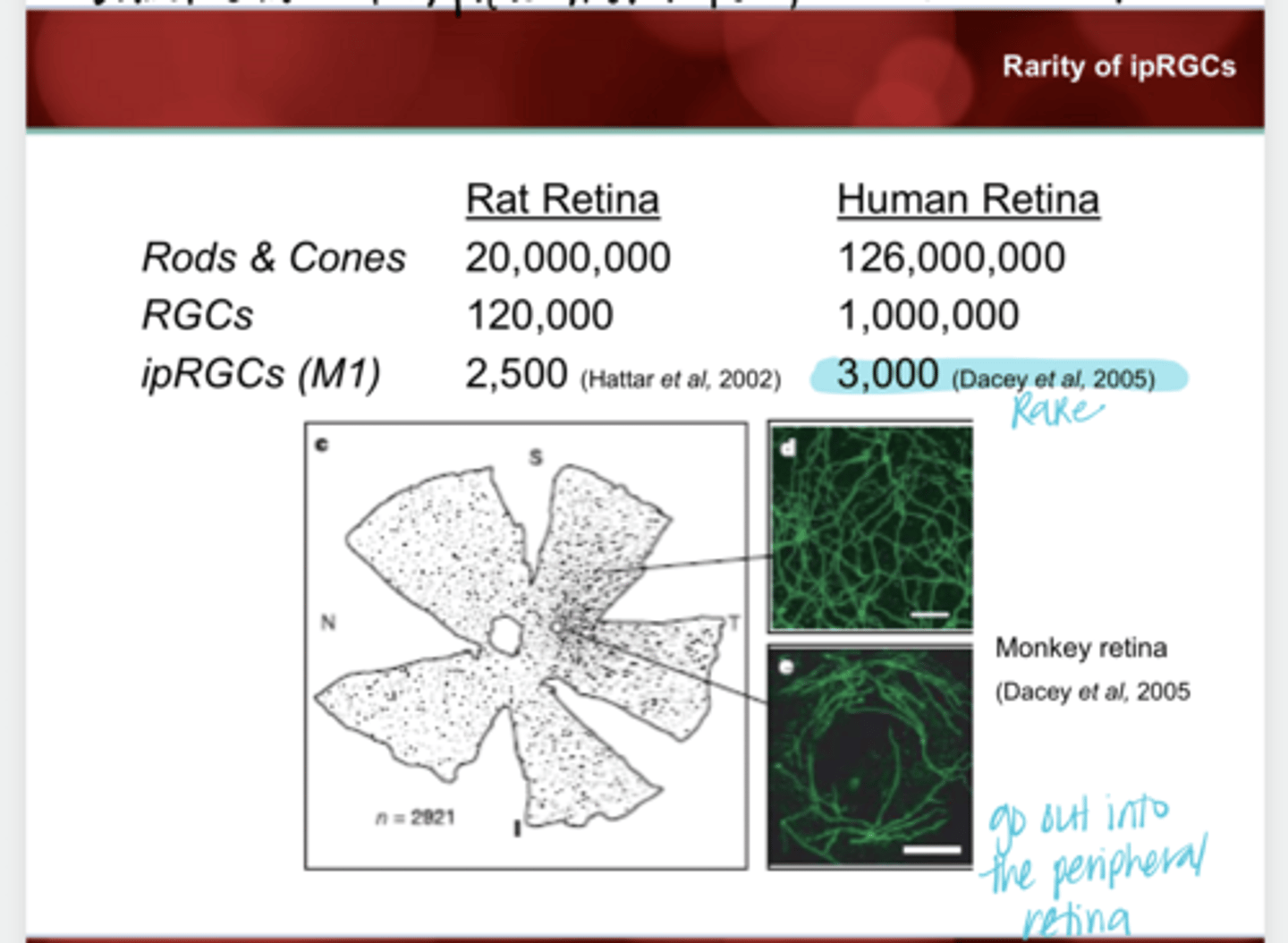
How many ipRGCs in the retina?
Not many -- 3000?
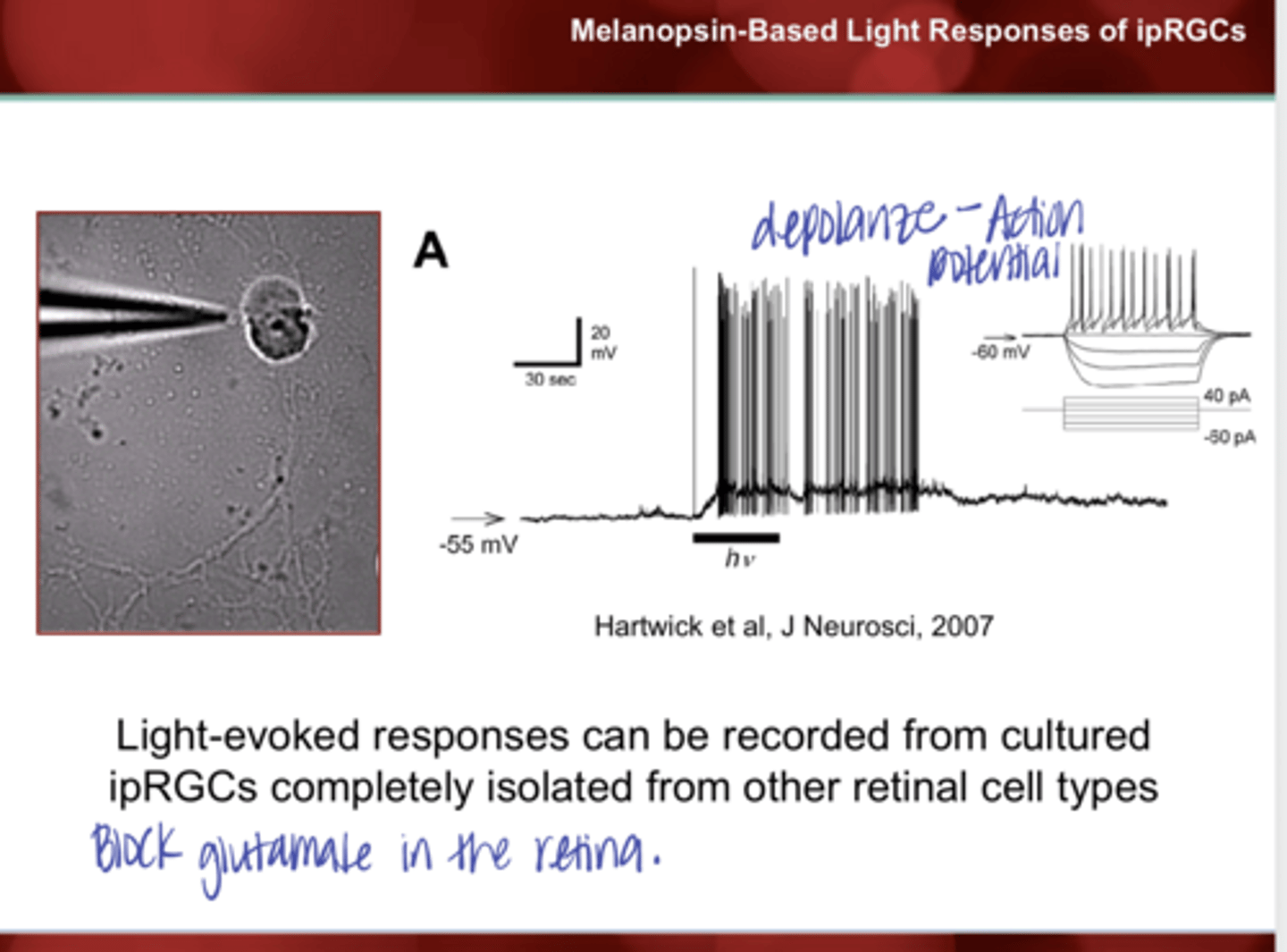
Can light-evoked responses be recorded from cultured ipRGCs completely isolated from other retinal cell types?
Yes -- when all the glutamate is blocked in the retina
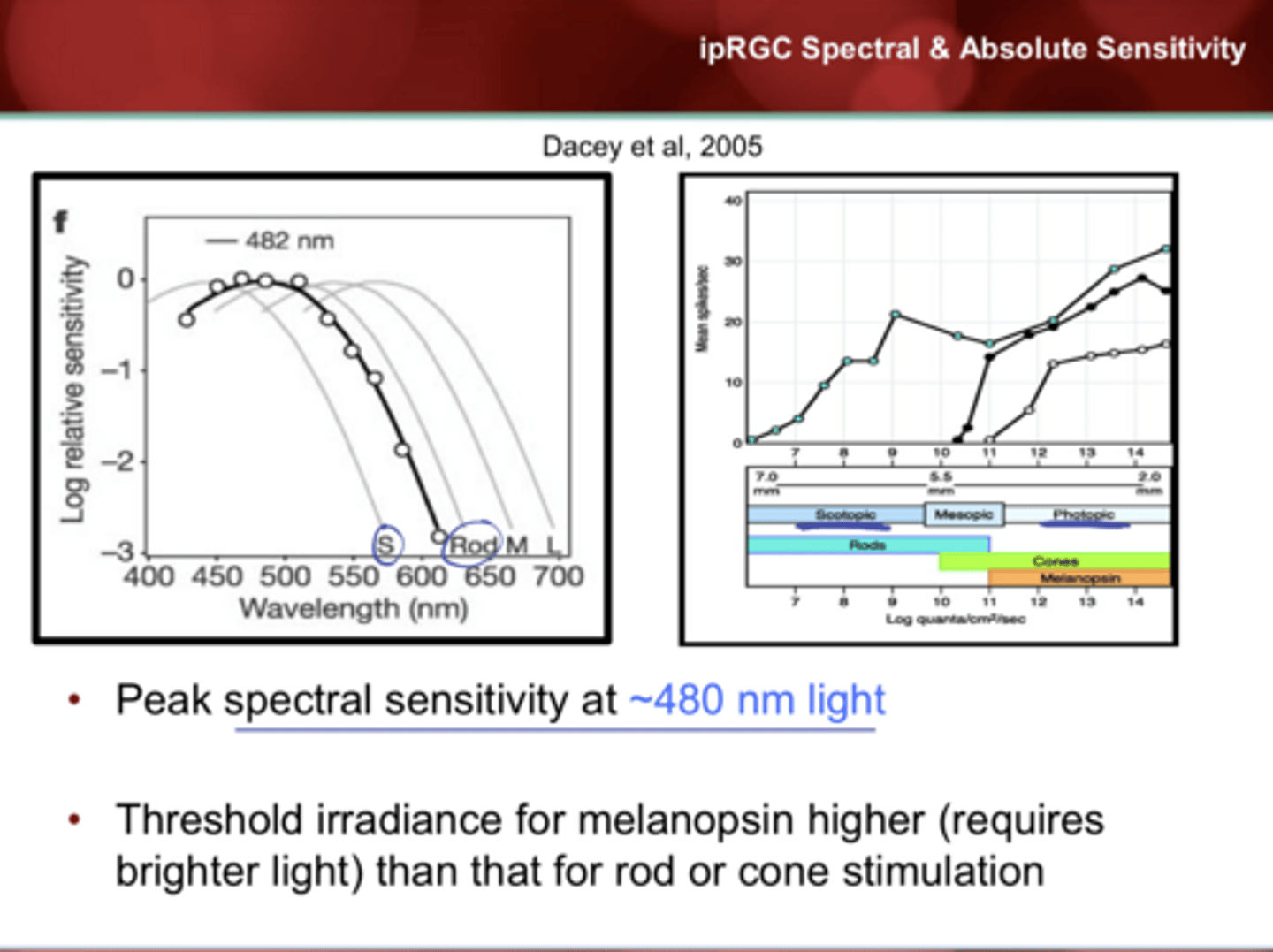
What is the peak spectral sensitivity of ipRGCs?
~480nm
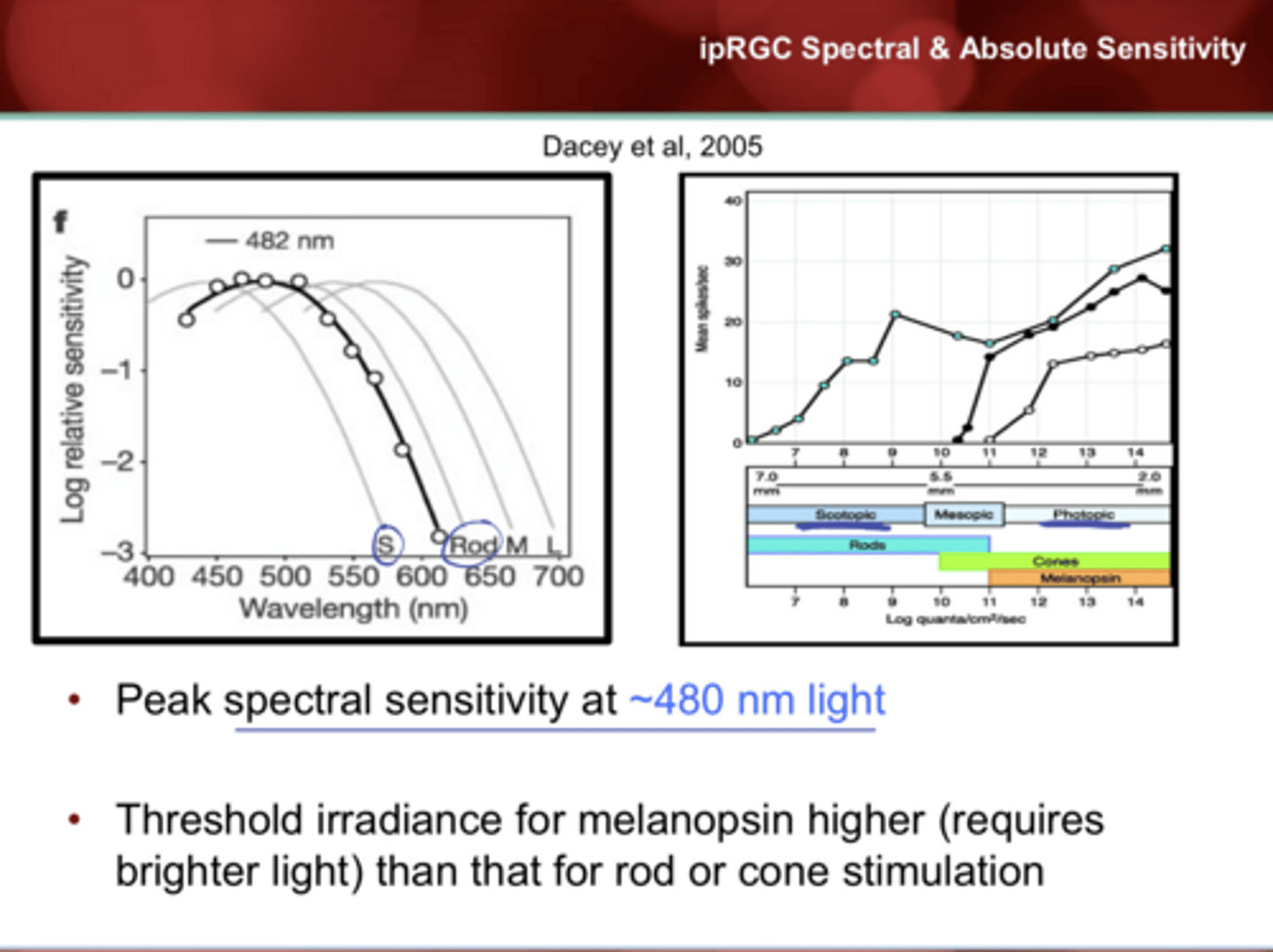
Which is higher?
Threshold irradiance for melanopsin activation or that for rod/cone stimulation. What does this mean?
Threshold irradiance for melanopsin activation -- requires a brighter light to stimulate.
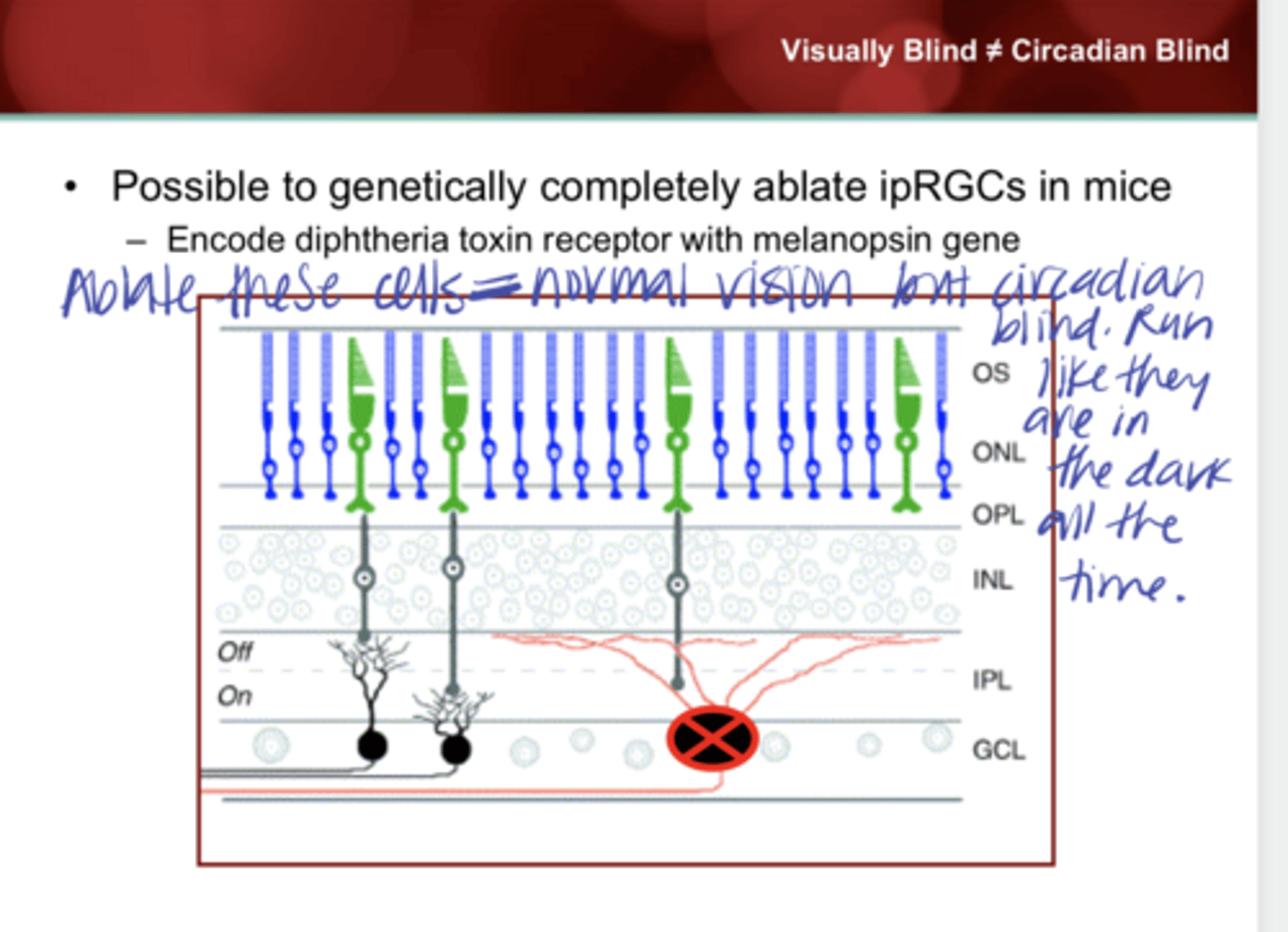
Is it possible to genetically completely ablate ipRGCs in mice? How?
Yes -- by encoding diphtheria toxin receptor with the melanopsin gene
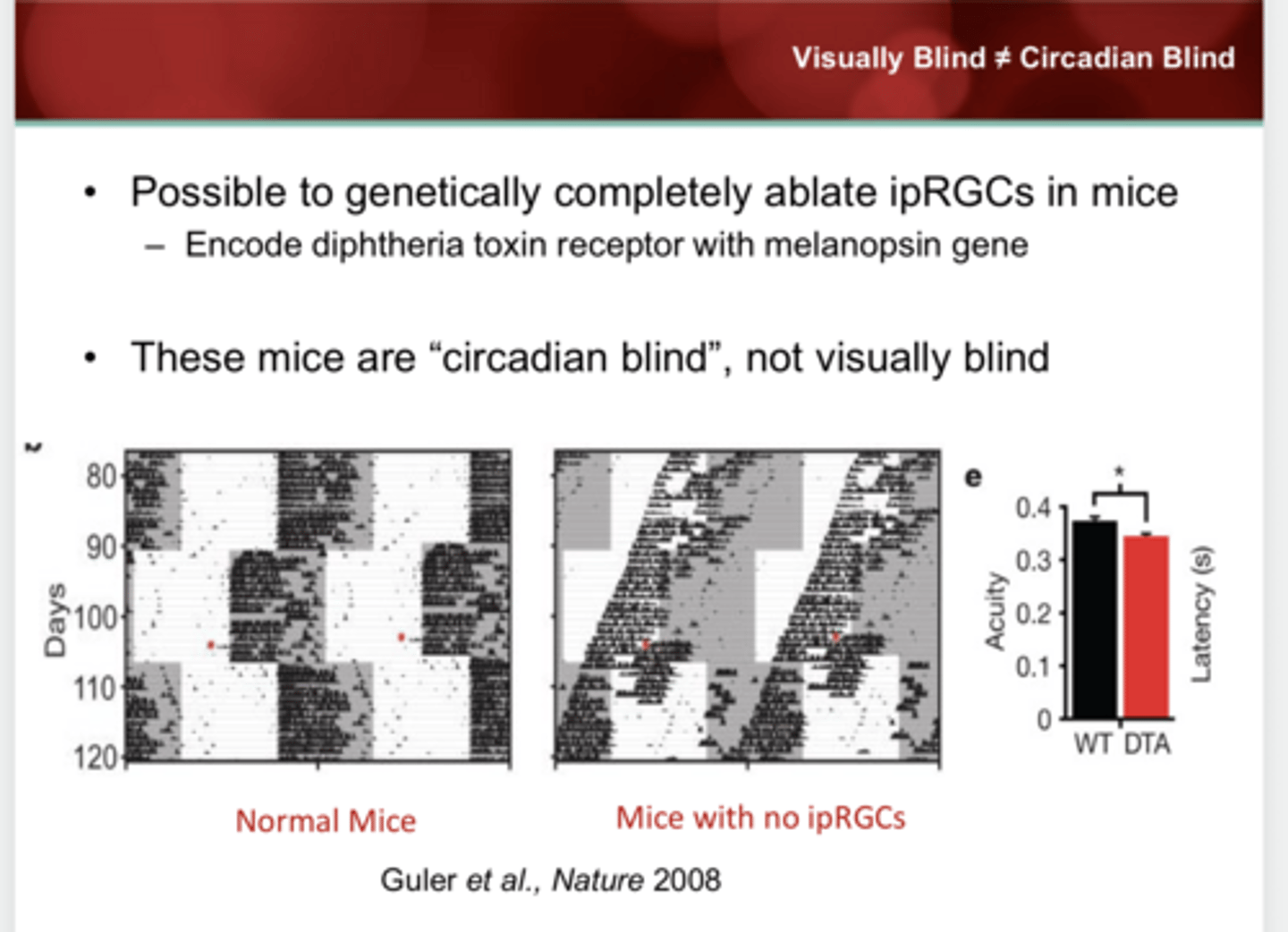
What is the result of ablating ipRGCs in the retina?
Normal vision for the patient but no circadian rhythm. Animal will react as if in the dark at all times.
"Circadian blind", not "visually blind"
True or False:
Since the discovery of ipRGCs, there has been a major paradigm shift in the understanding of retinal function
Pattern vision v irradiance detection
true
Exposure to ____ light (430-480nm range) wakes us up in the morning by signaling the brain to suppress the sleep hormone melatonin and produce the hormone cortisol, which increases wakefulness
blue
ipRGCs are most sensitive to what color/wavelength of light?
blue light (480nm)
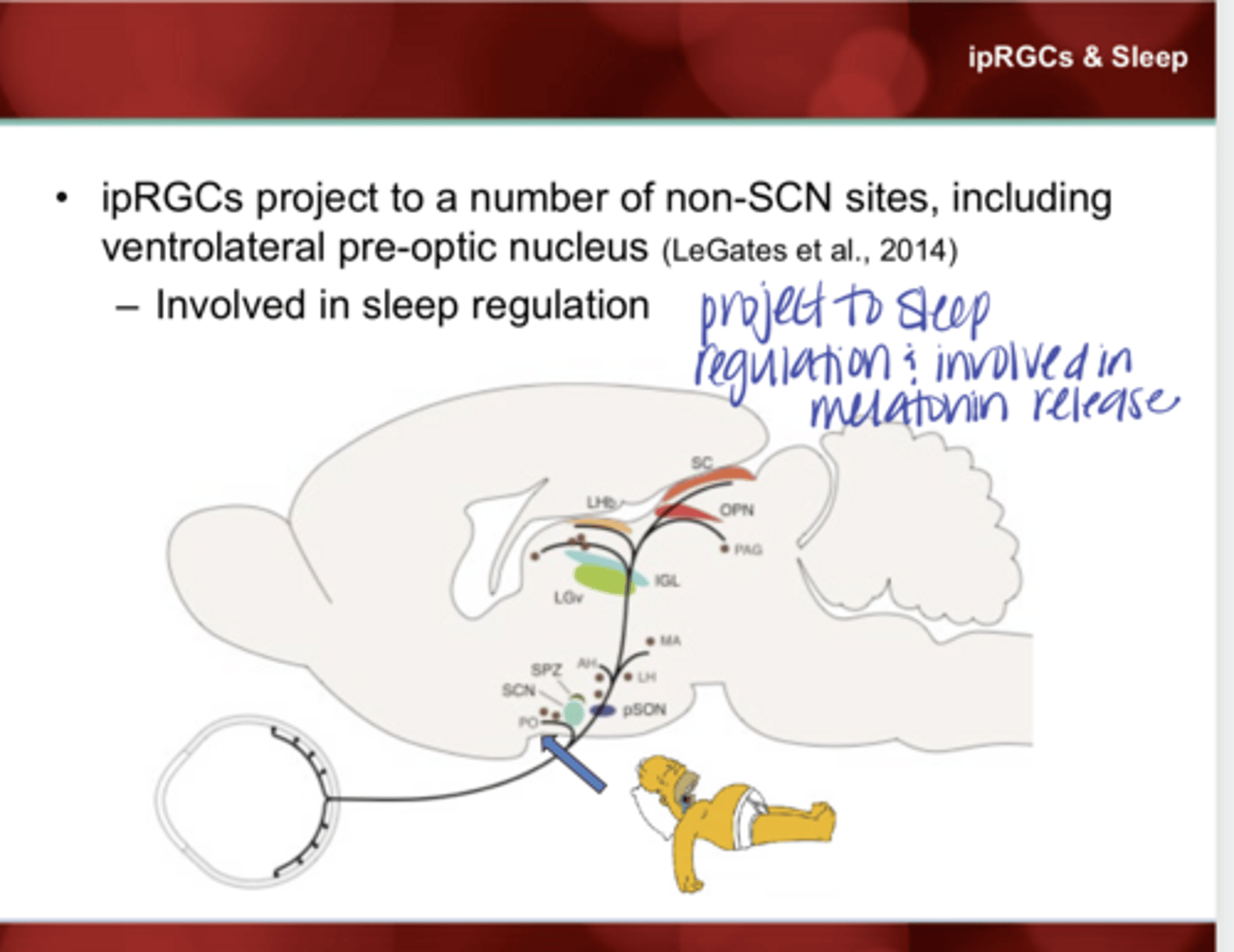
True or False:
ipRGCs project to a number of non-SCN sites
true
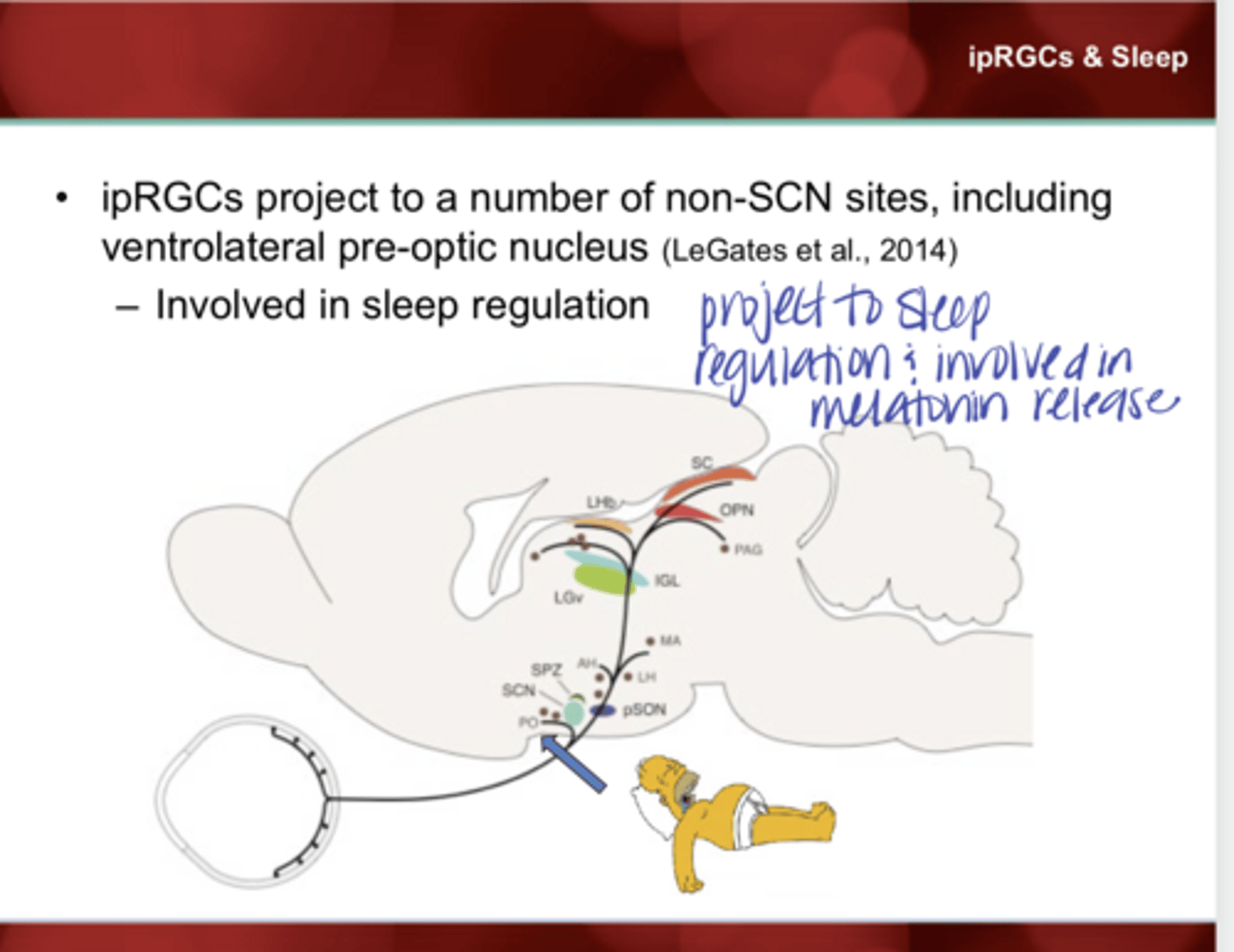
Do ipRGCs project to the pre-optic nucleus?
No
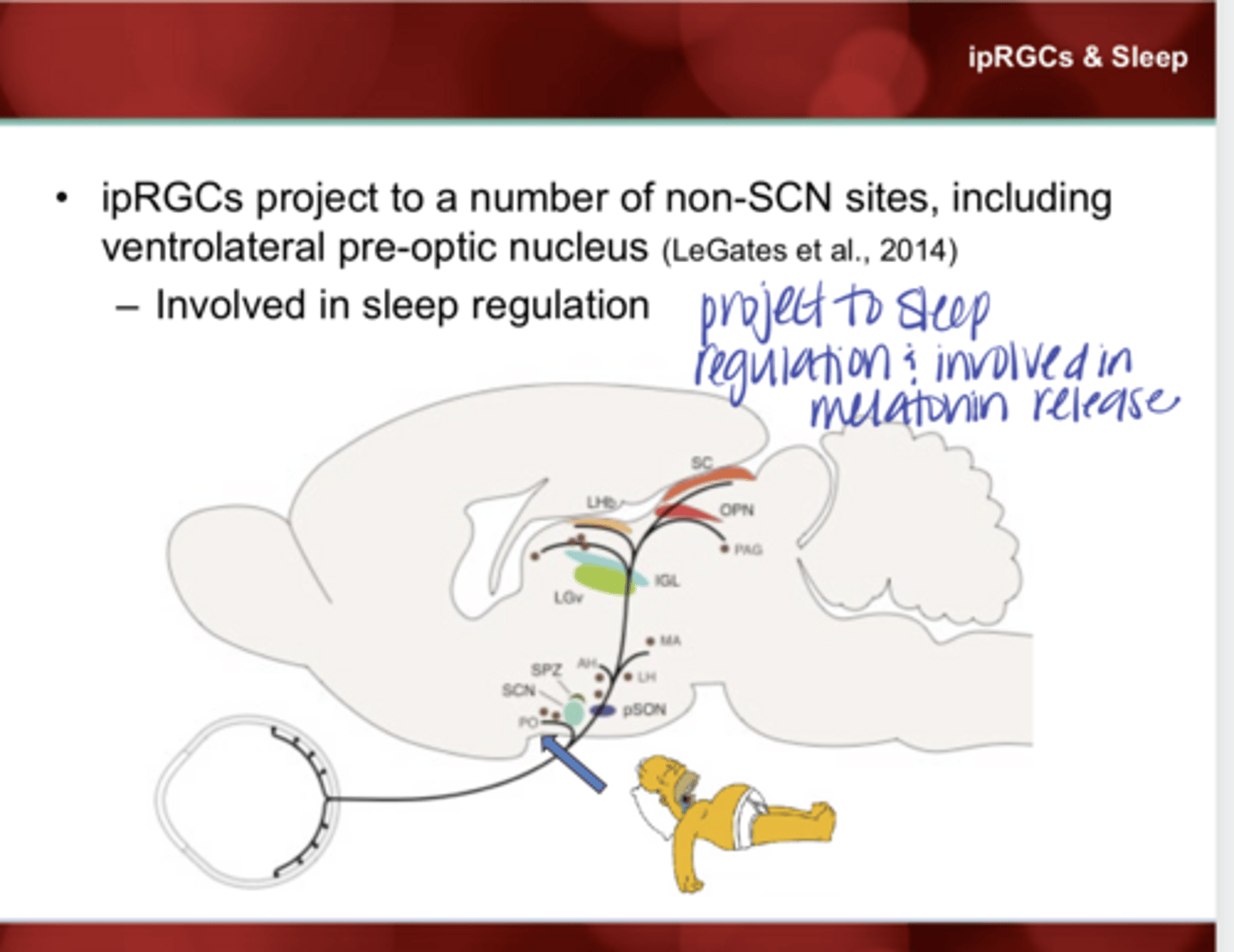
What are ipRGCs that project to the pre-optic nucleus involved in?
sleep regulation
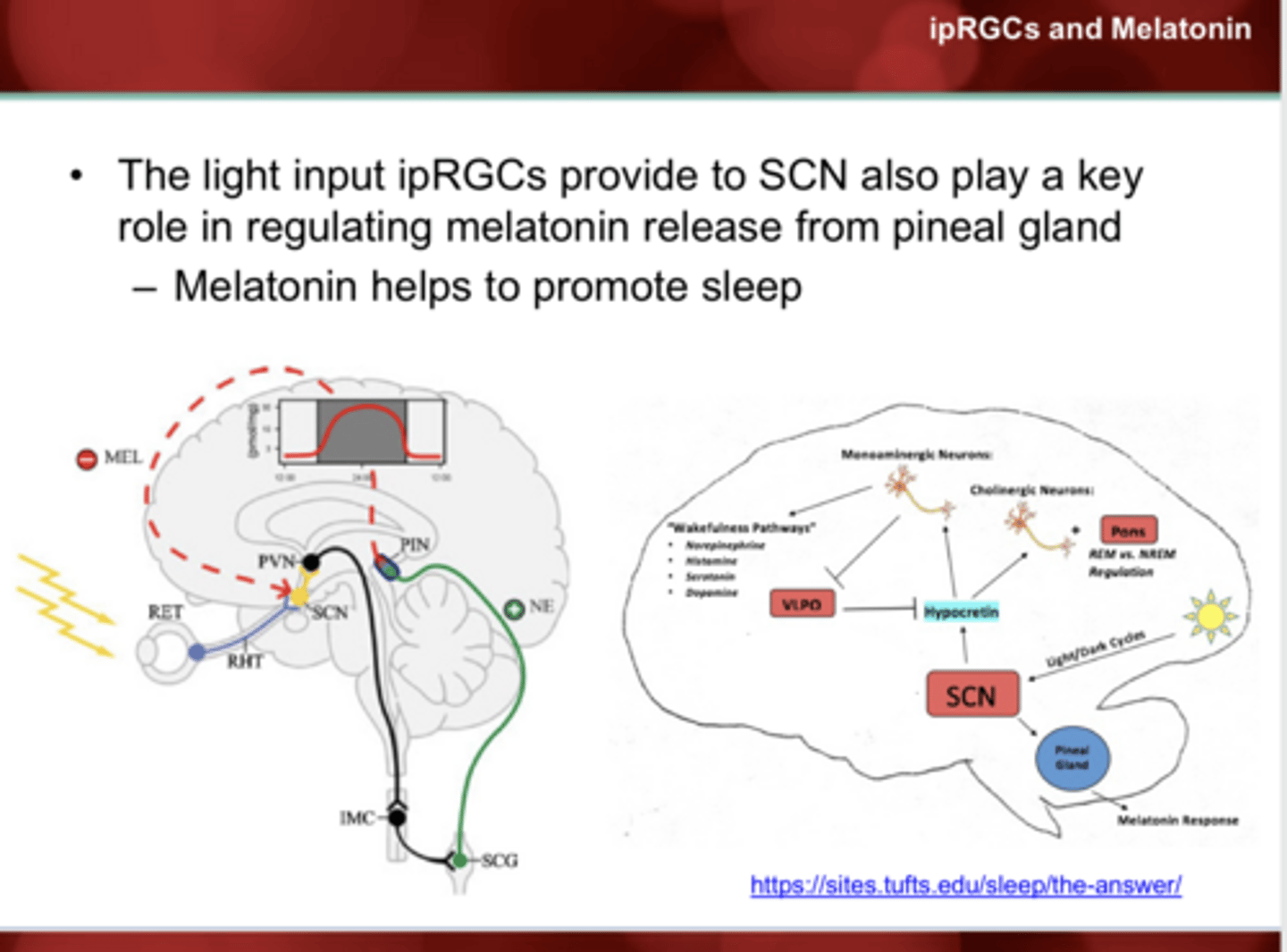
Do ipRGCs project to the SCN?
Yes
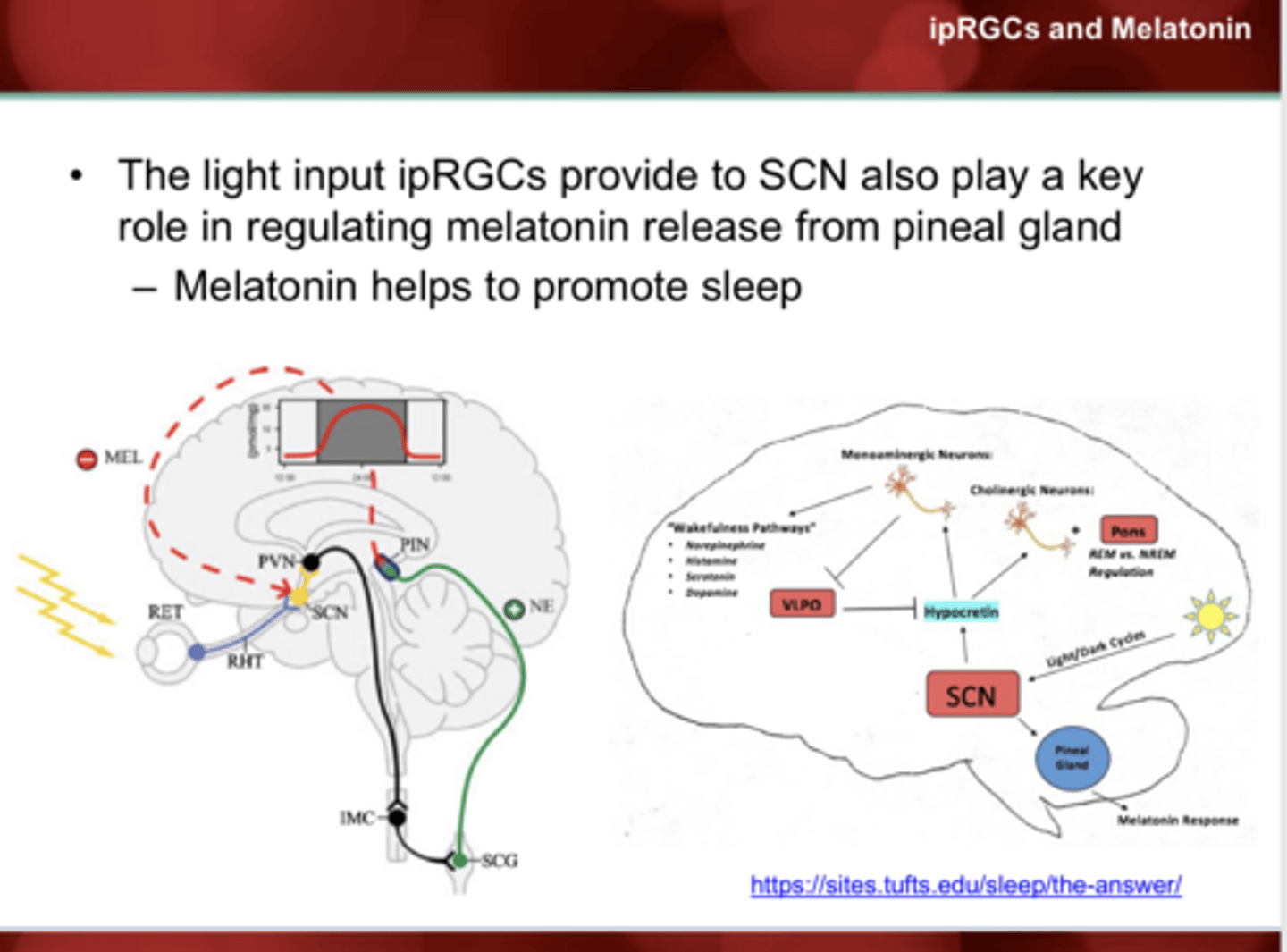
What are ipRGCs that project to the SCN involved in?
key role in regulating melatonin release from the pineal gland and promoting sleep
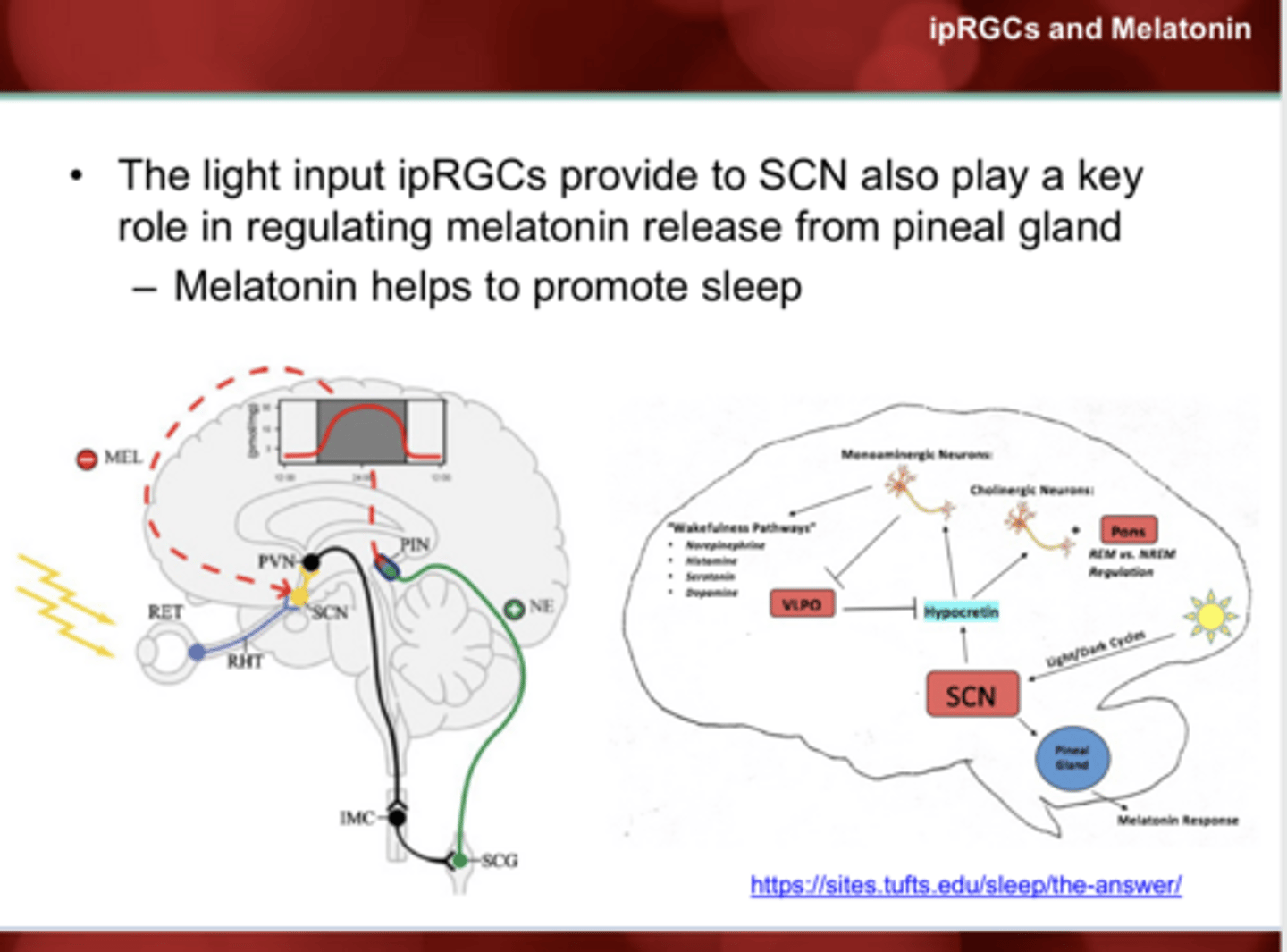
Light suppresses _____ at night
melatonin
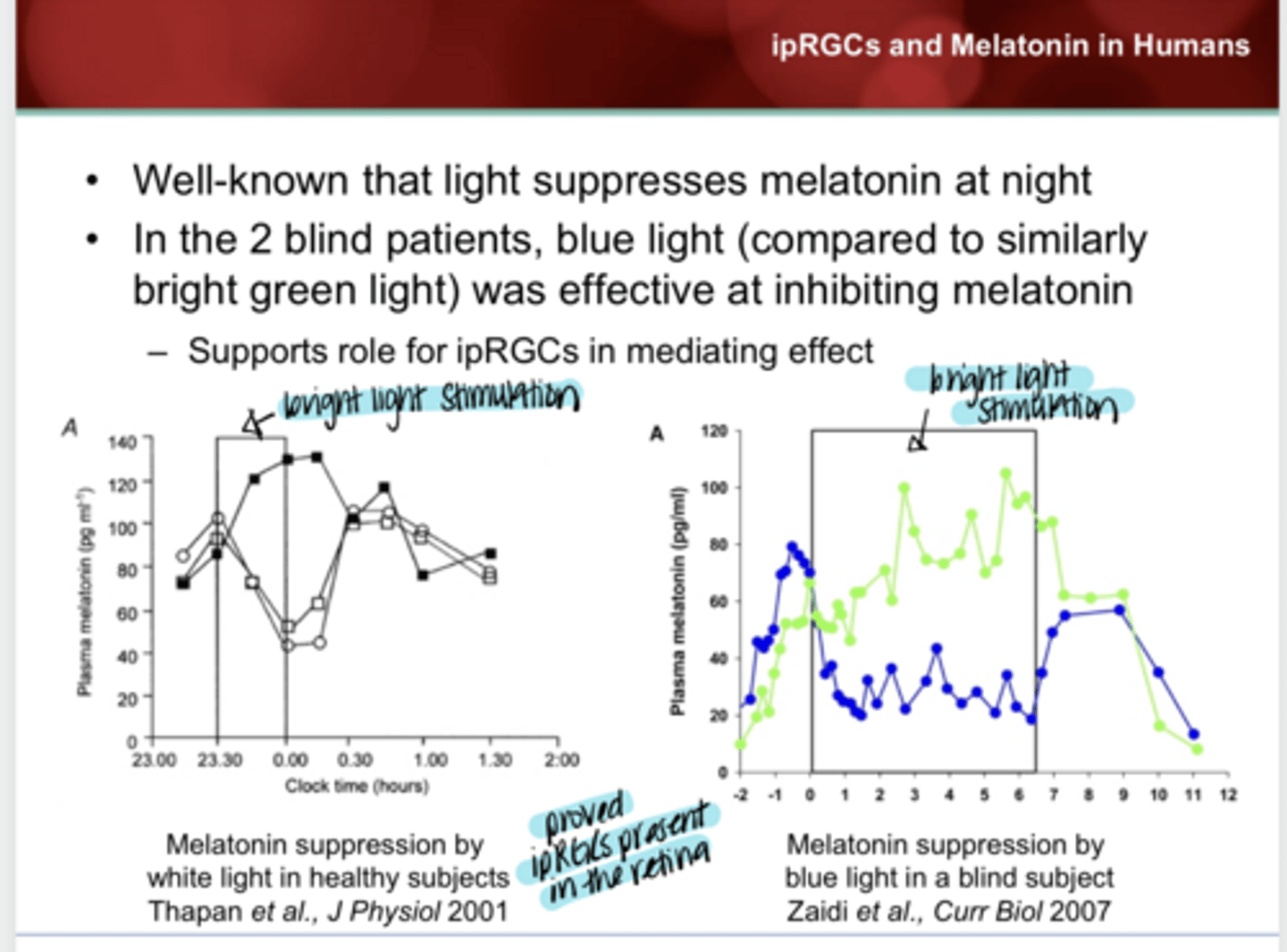
In 2 blind patients, _____ light was effective at inhibiting melatonin
blue
**supports the role of ipRGCs mediating effect of the circadian rhythm
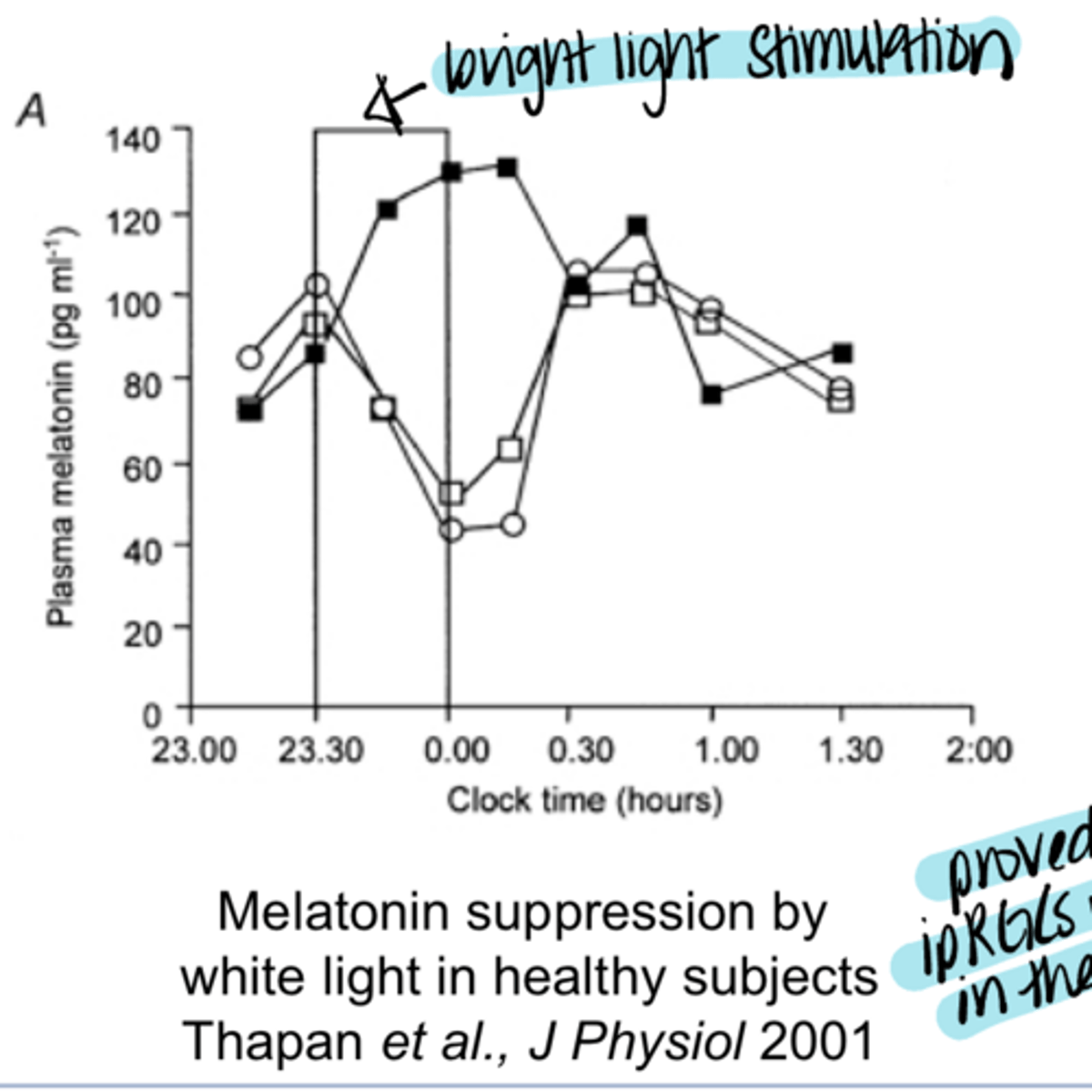
Melatonin Suppression by White Light in Healthy Subjects (Pic)
Melatonin Suppression by White Light in Healthy Subjects (Pic)
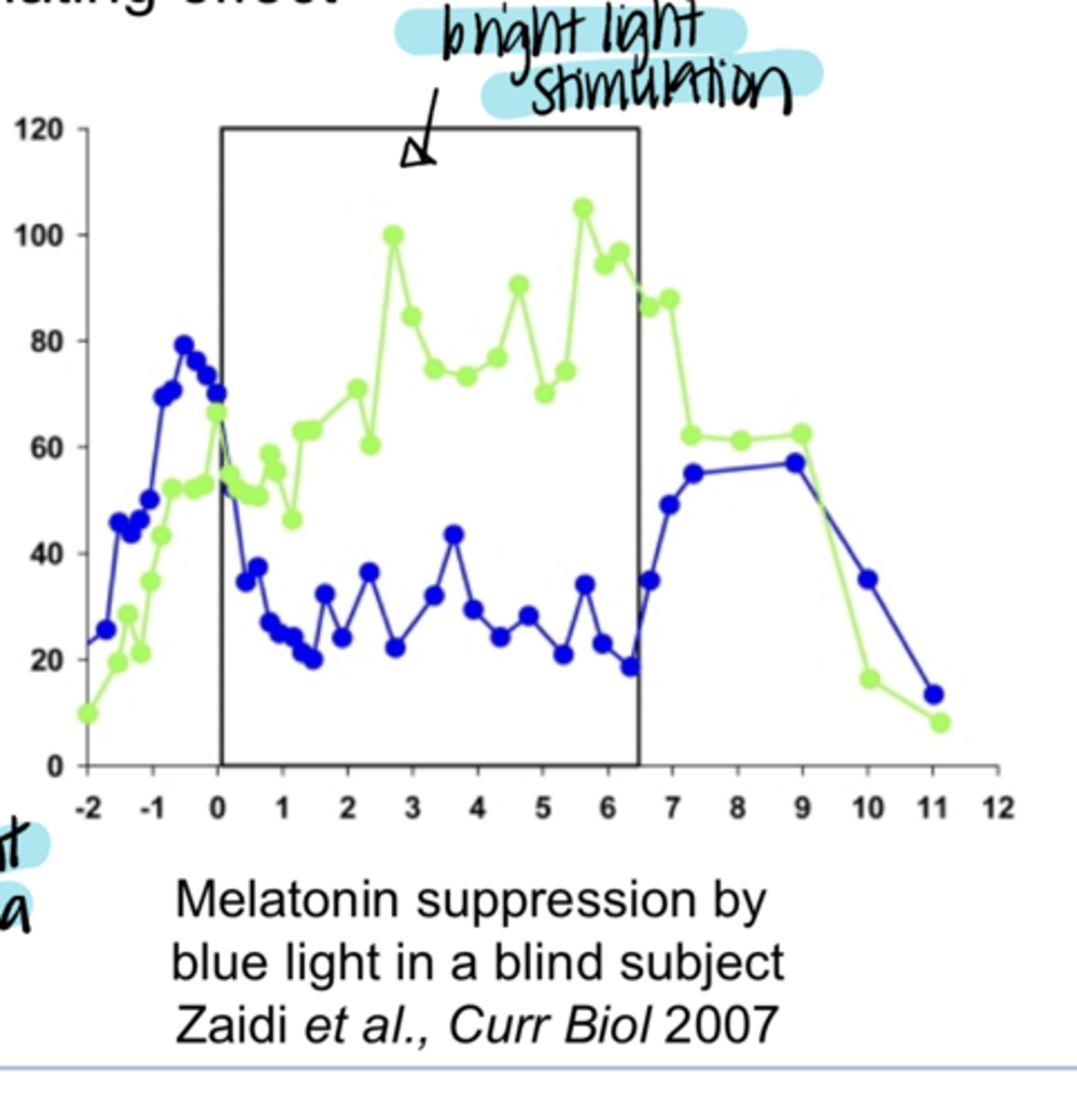
Melatonin Suppression by Blue Light in Blind Subject (Pic)
Melatonin Suppression by Blue Light in Blind Subject (Pic)
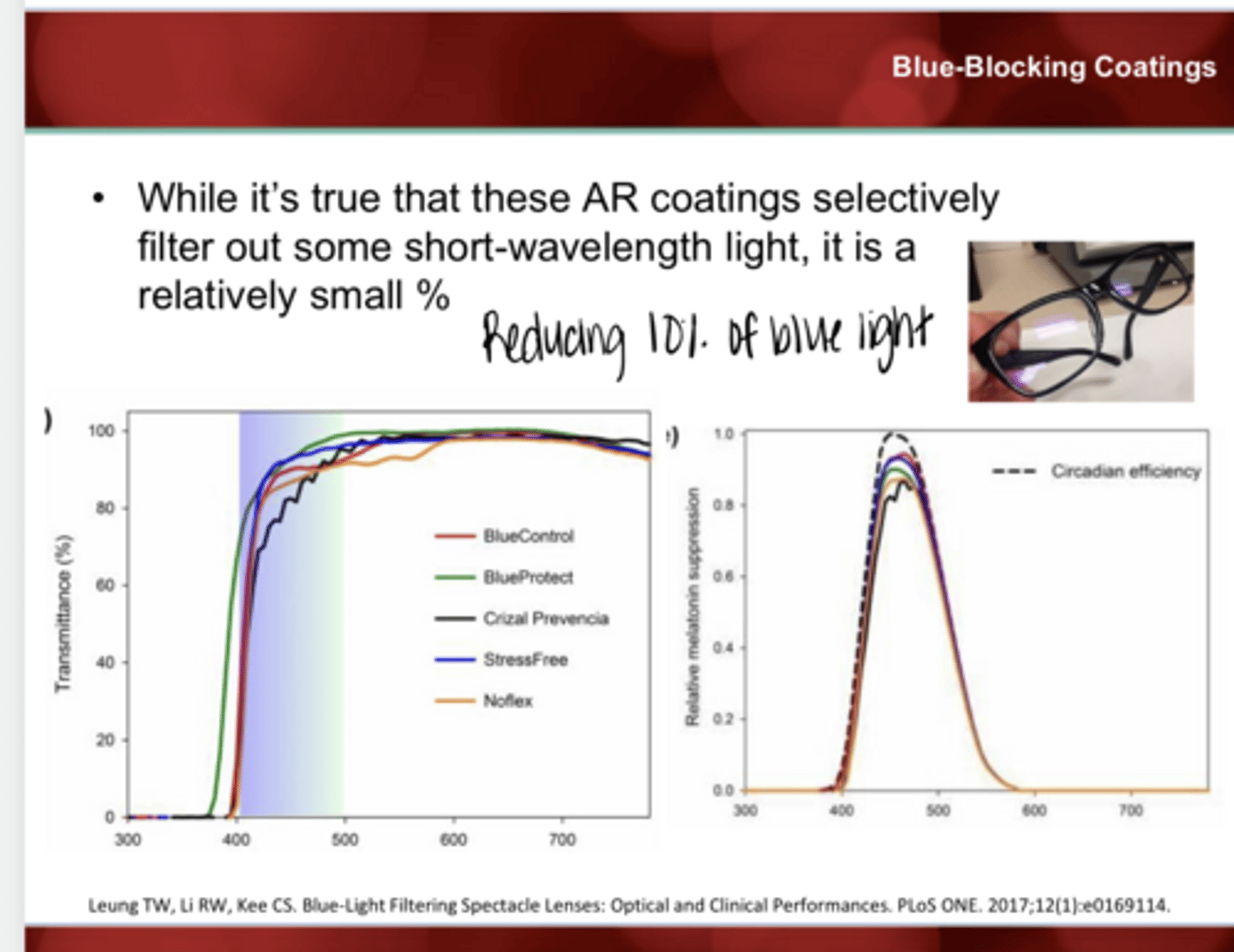
Do blue light blocking filters, filter out blue light effectively?
No -- they do filter out SOME small wavelength light but it is a relatively small %
Conclusions on Blue Light Blocking Filters
-lack of properly controlled studies
-no convincing evidence that these coating improve contrast sensitivity, symptoms of eyestrain, or sleep quality
-no evidence to indicate that these lenses conserve macular health (prevent mac degen)
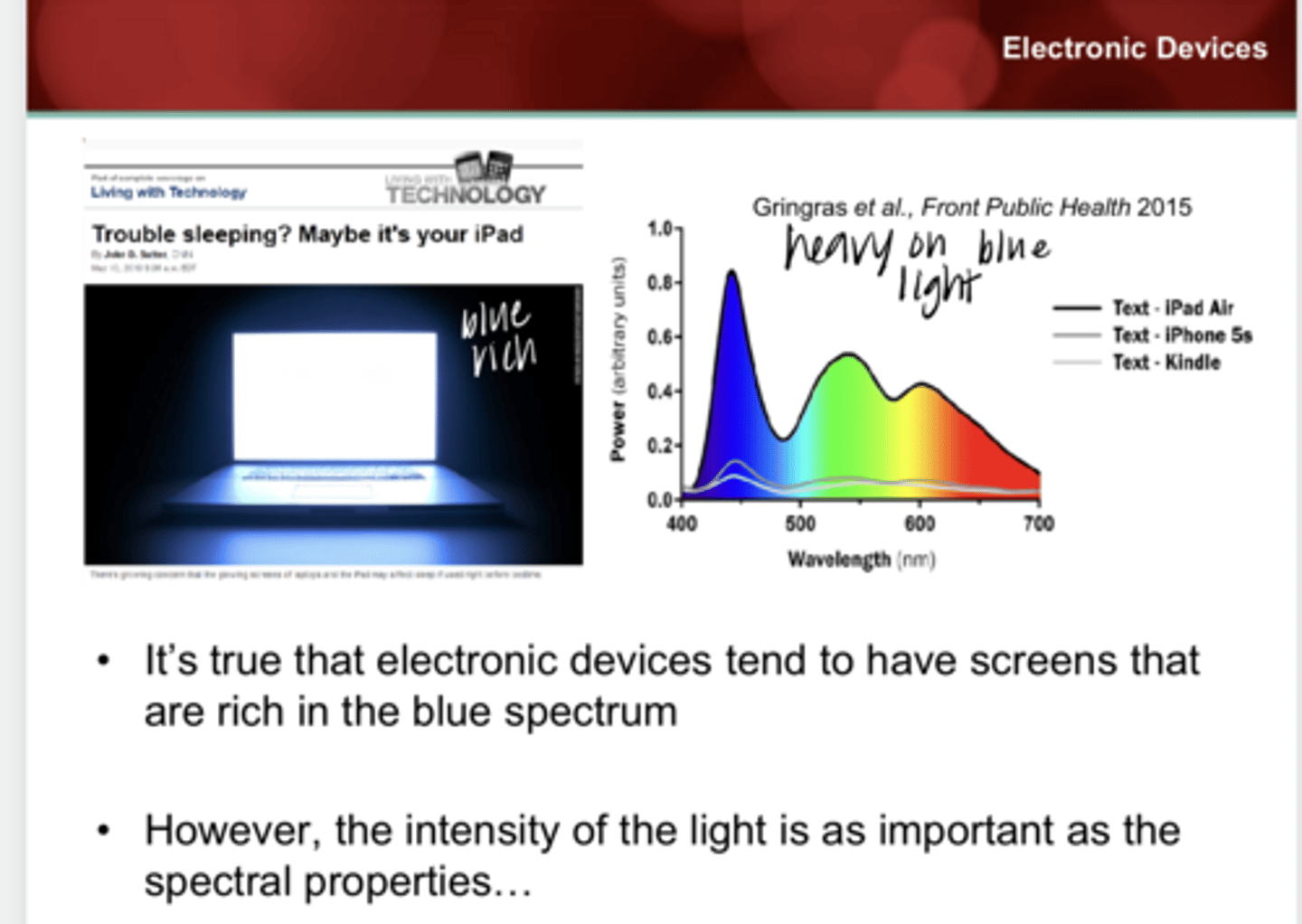
Electronic devices tend to have screens that are rich in the ___ spectrum
blue
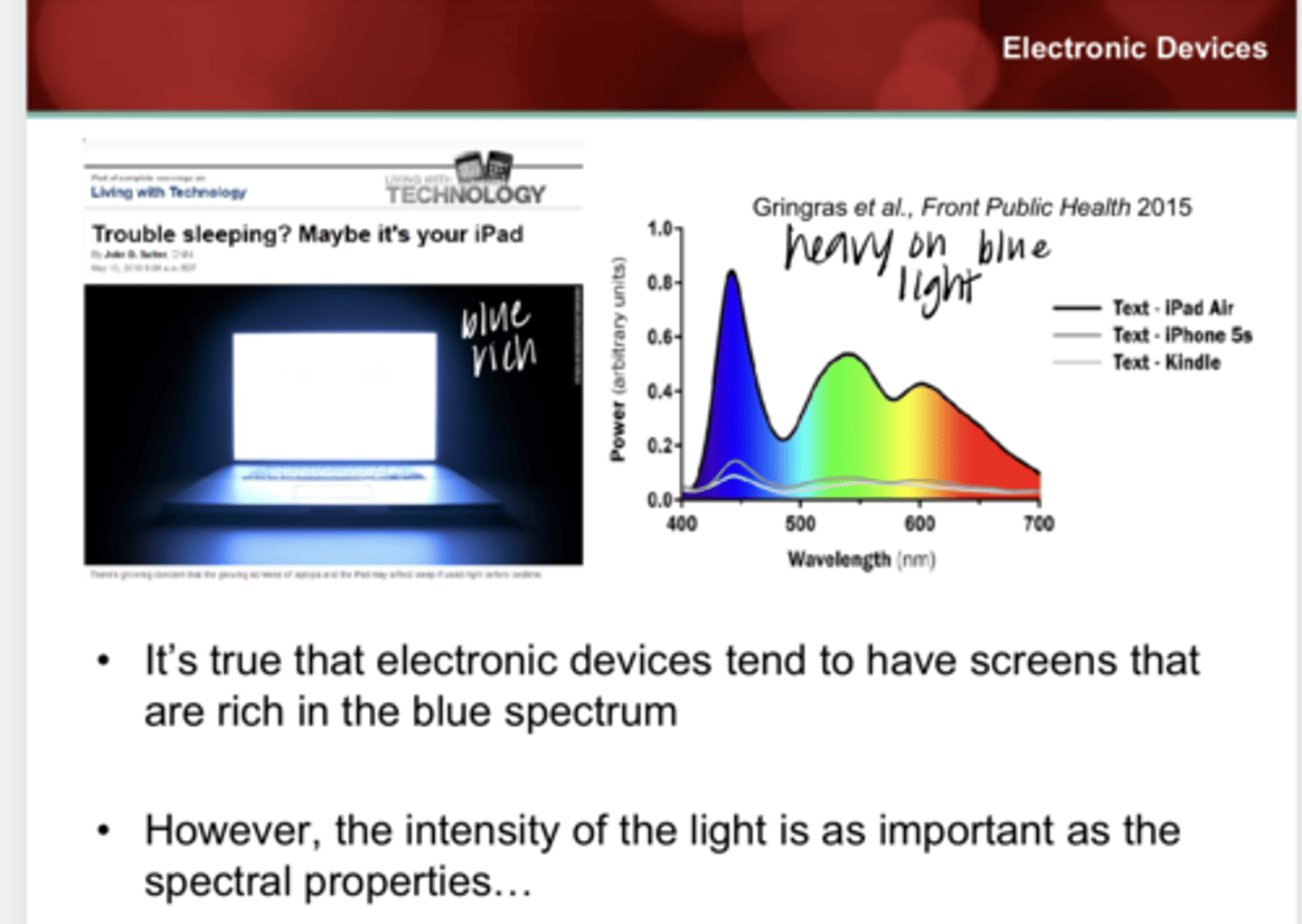
Is the intensity of light from the electronic device screens as important as the spectral properties
Yes
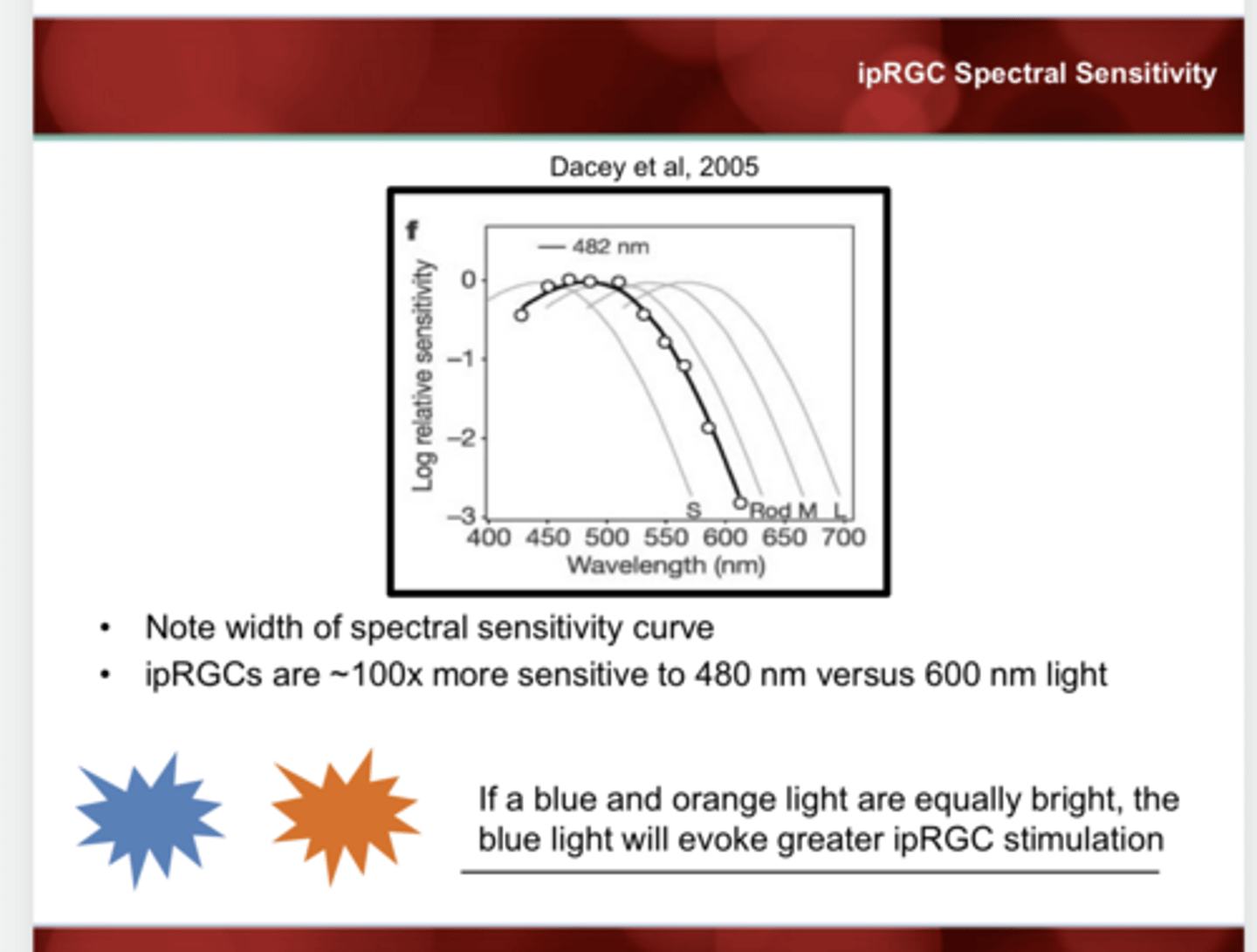
Where is the melanopsin curve located on a spectral sensitivity curve?
Between S cones and Rods
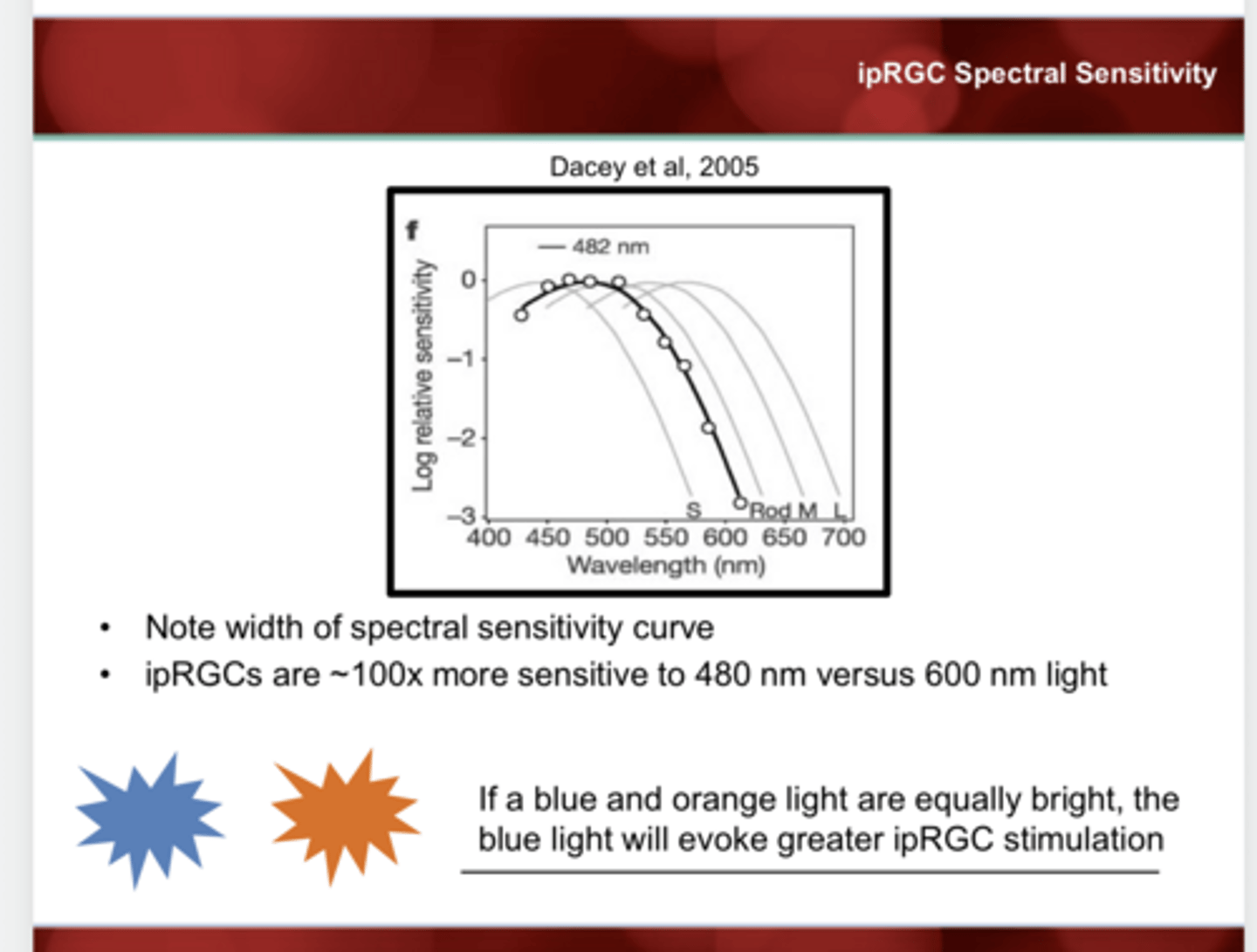
ipRGCs are ____x more sensitive to 480nm v 600nm light
100
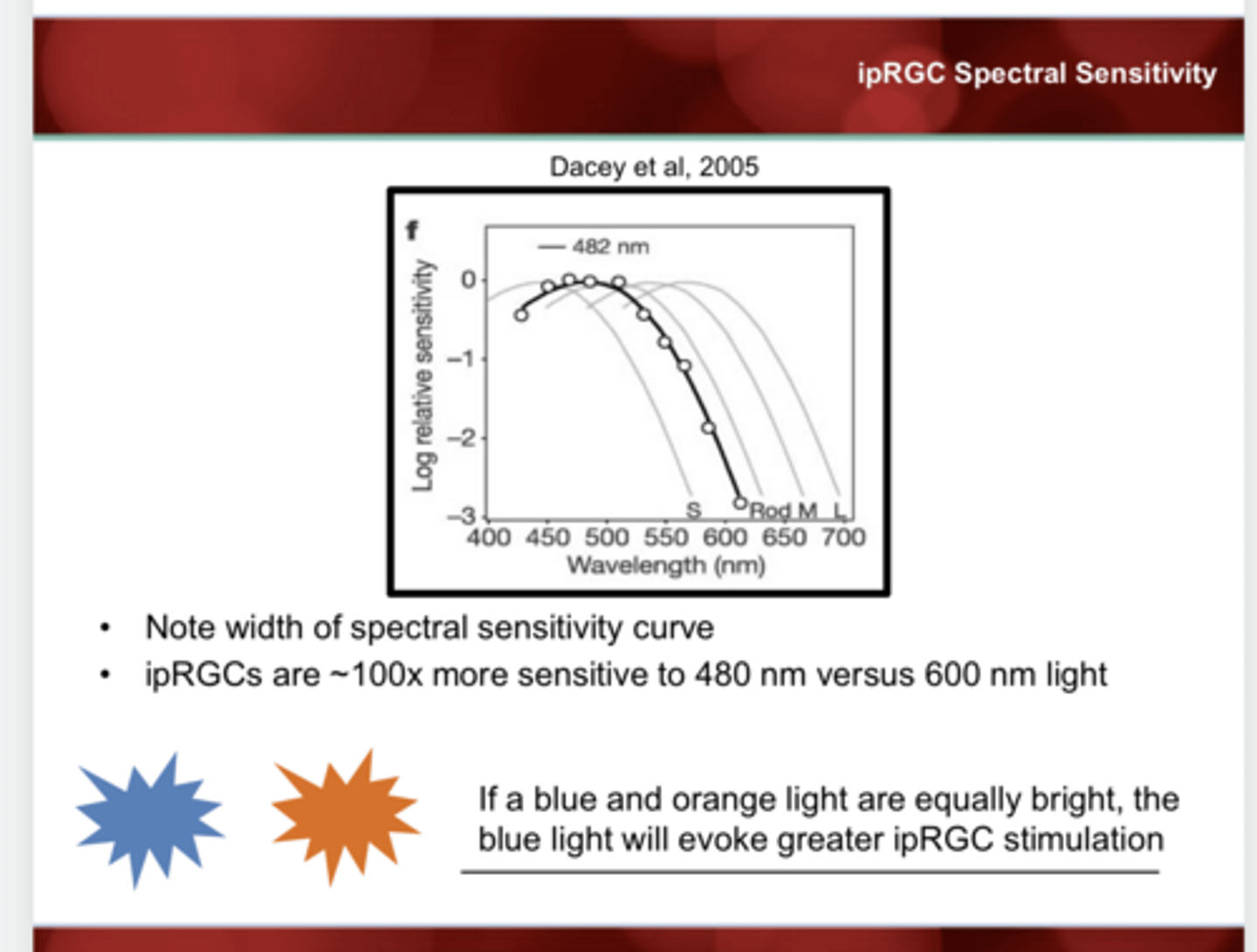
If blue and orange light are equally bright, the (blue/orange) light will evoke greater ipRGC stimulation
blue
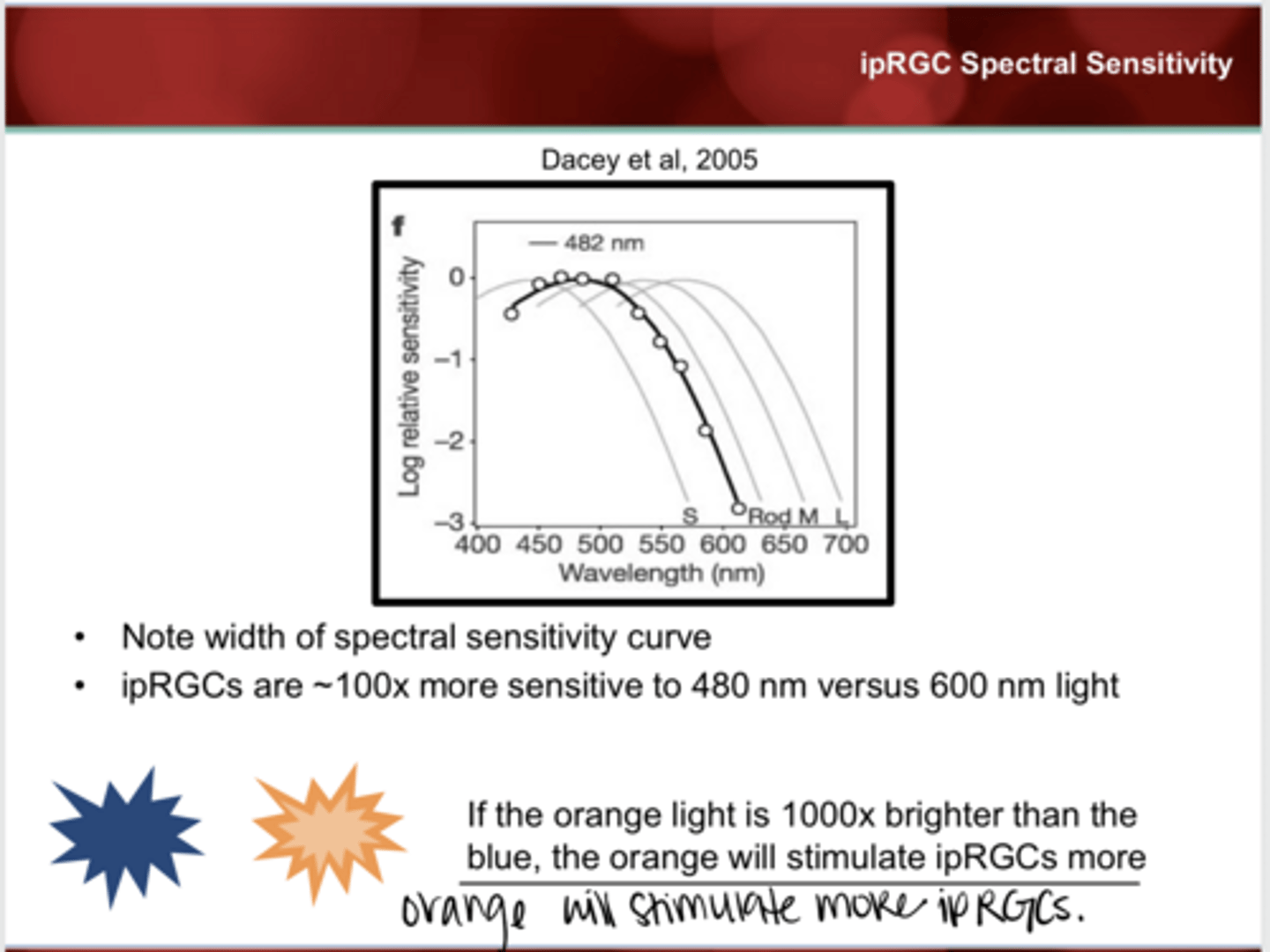
if the orange light is 1000x as bright as the blue light, the (blue/orange) light will evoke greater ipRGC stimulation
orange
True or False:
Relatively bright lights are needed to stimulate melanopsin
true
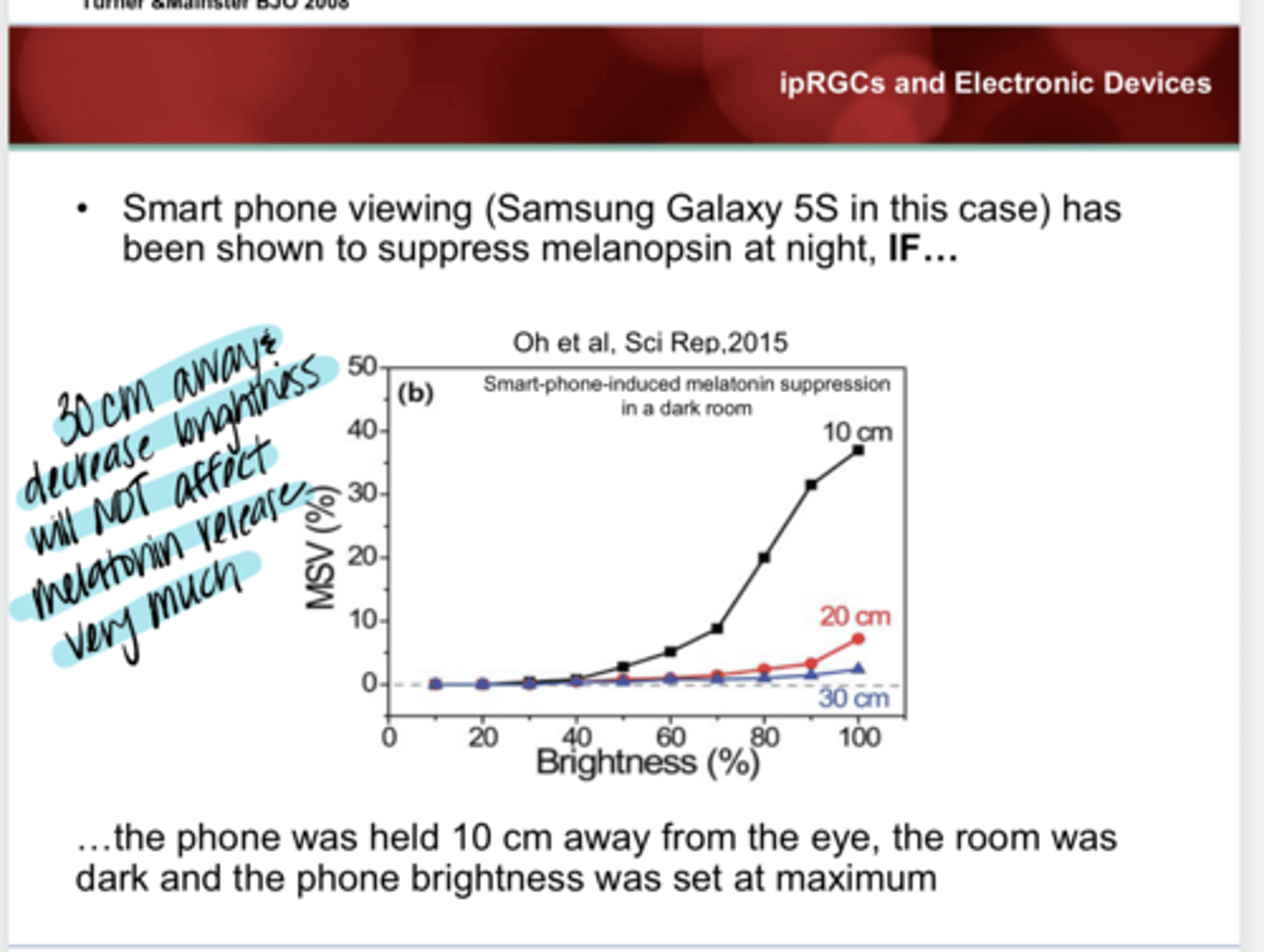
When do smartphones suppress melanopsin at night?
If the phone is held 10cm from eye and the room was dark and phone is at max brightness
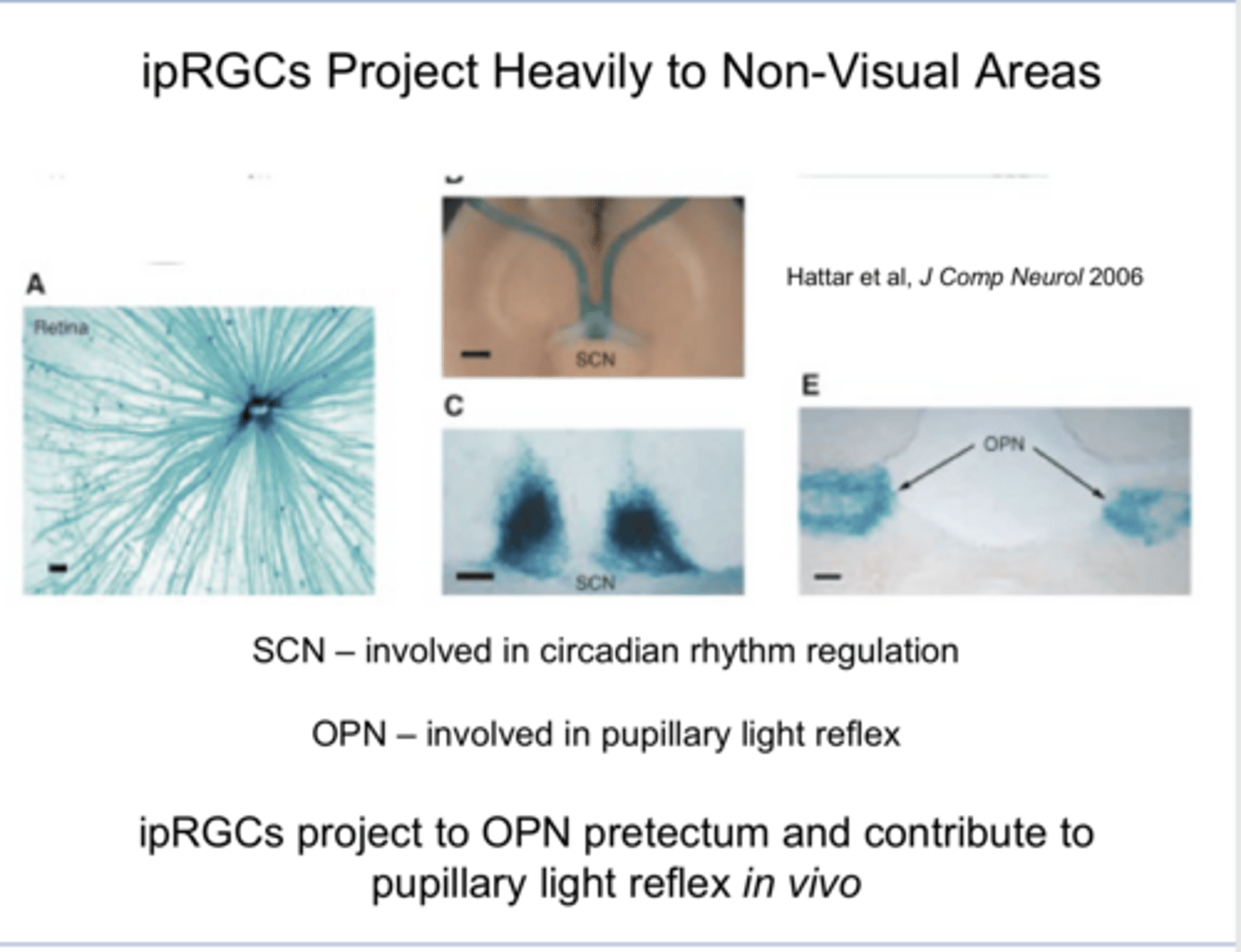
ipRGCs project to the OPN pretectum and contribute to the _____ in vivo
pupillary light reflex
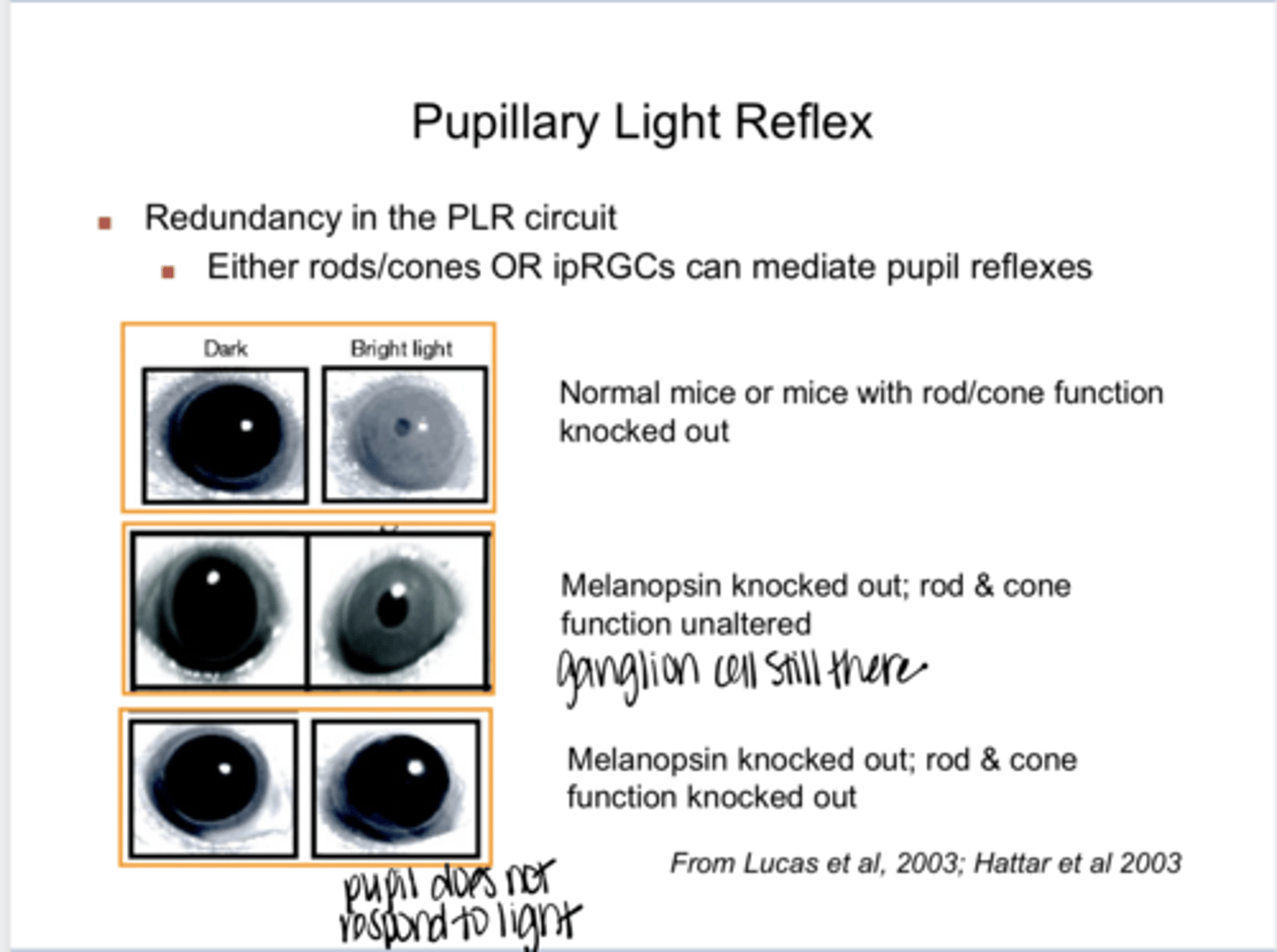
Can either rods/cones or ipRGCs mediate pupil reflexes?
Yes

Pupil Function in Normal Mice & Mice with Rod/Cone Function Knocked Out (Pic)
Pupil Function in Normal Mice & Mice with Rod/Cone Function Knocked Out (Pic)
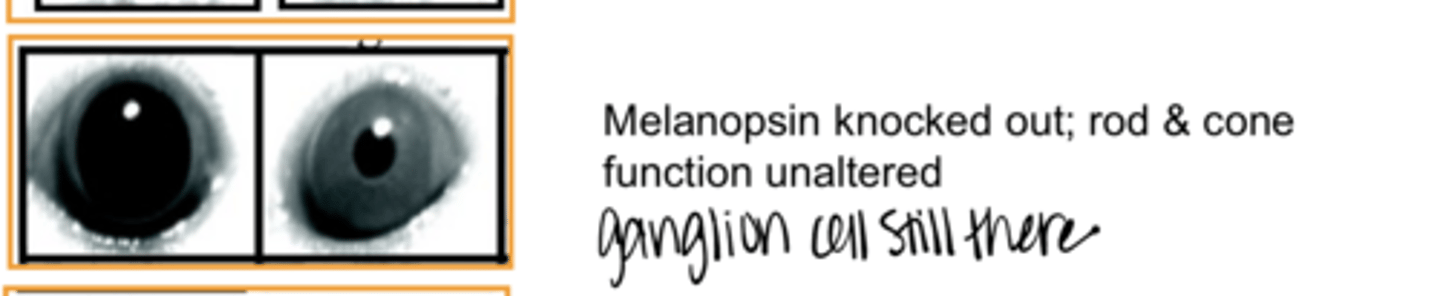
Pupil Function in Mice with Melanopsin Knocked Out & Rod/Cone Function Unaltered (Pic)
Pupil Function in Mice with Melanopsin Knocked Out & Rod/Cone Function Unaltered (Pic)
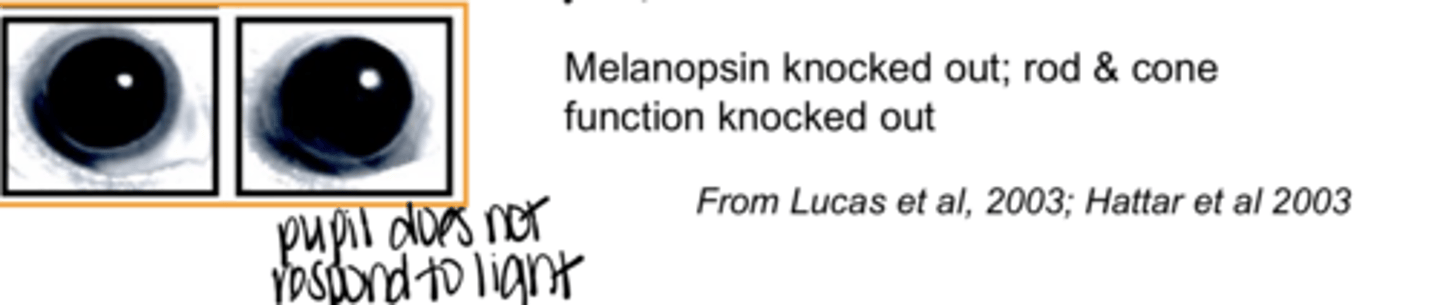
Pupil Function in Mice with Melanopsin and Rod/Cone Function Knocked Out (Pic)
Pupil Function in Mice with Melanopsin and Rod/Cone Function Knocked Out (Pic)
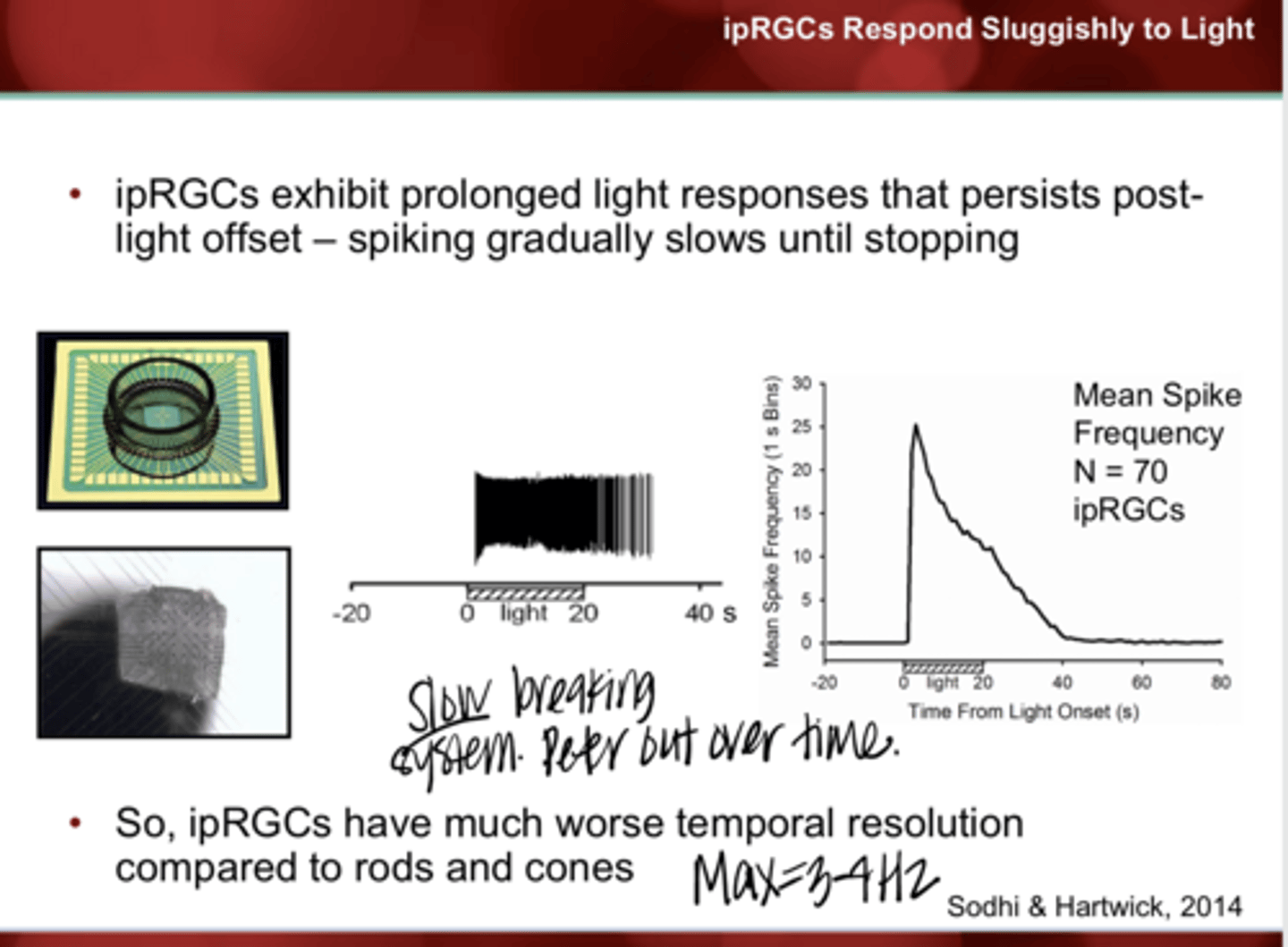
ipRGCs exhibit what for prolonged periods of time?
Prolonged light responses that persist post-light offset. The spiking gradually will slow until stopping
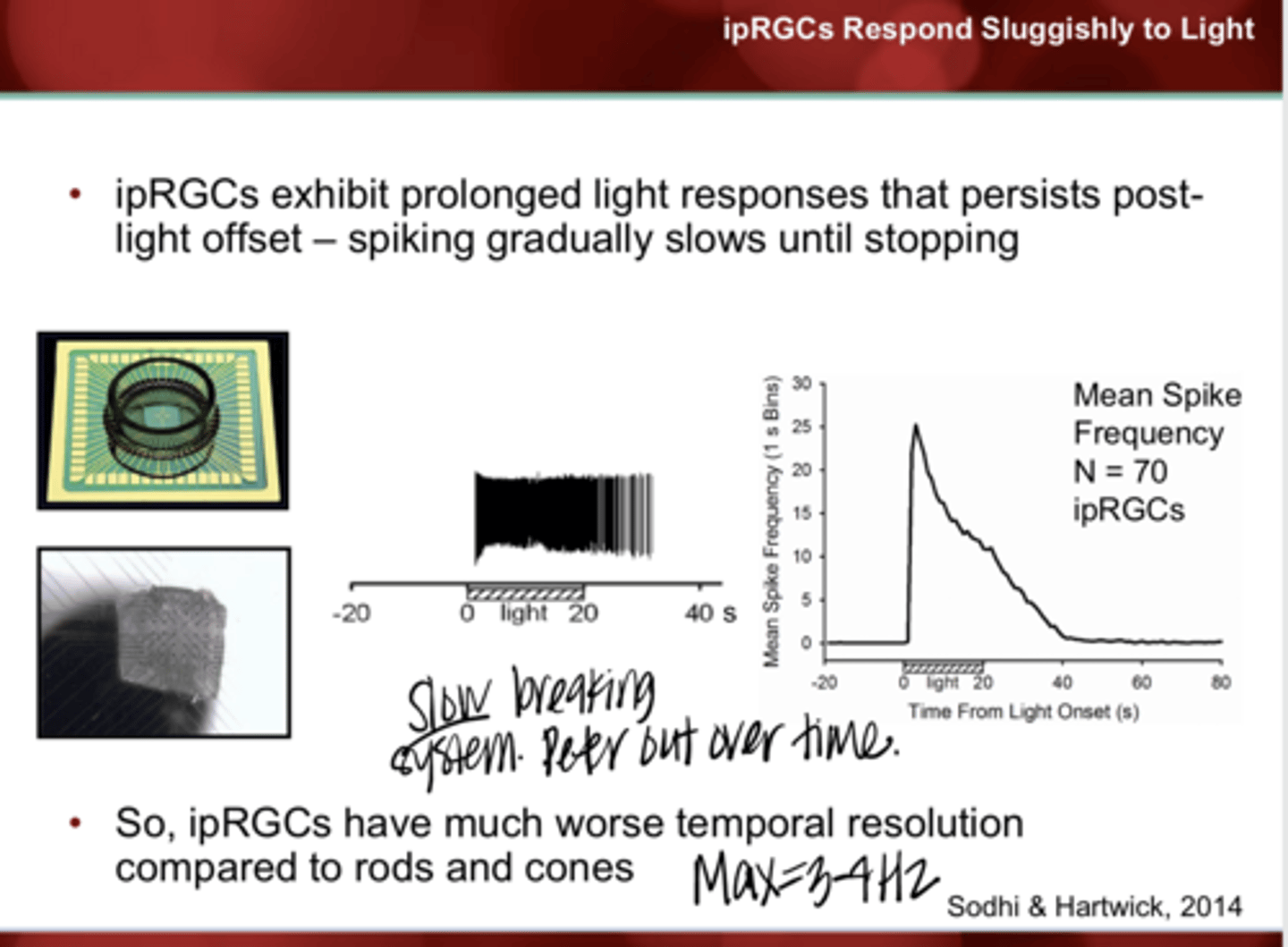
ipRGCs have (better/worse) temporal resolution than rods/cones
worse
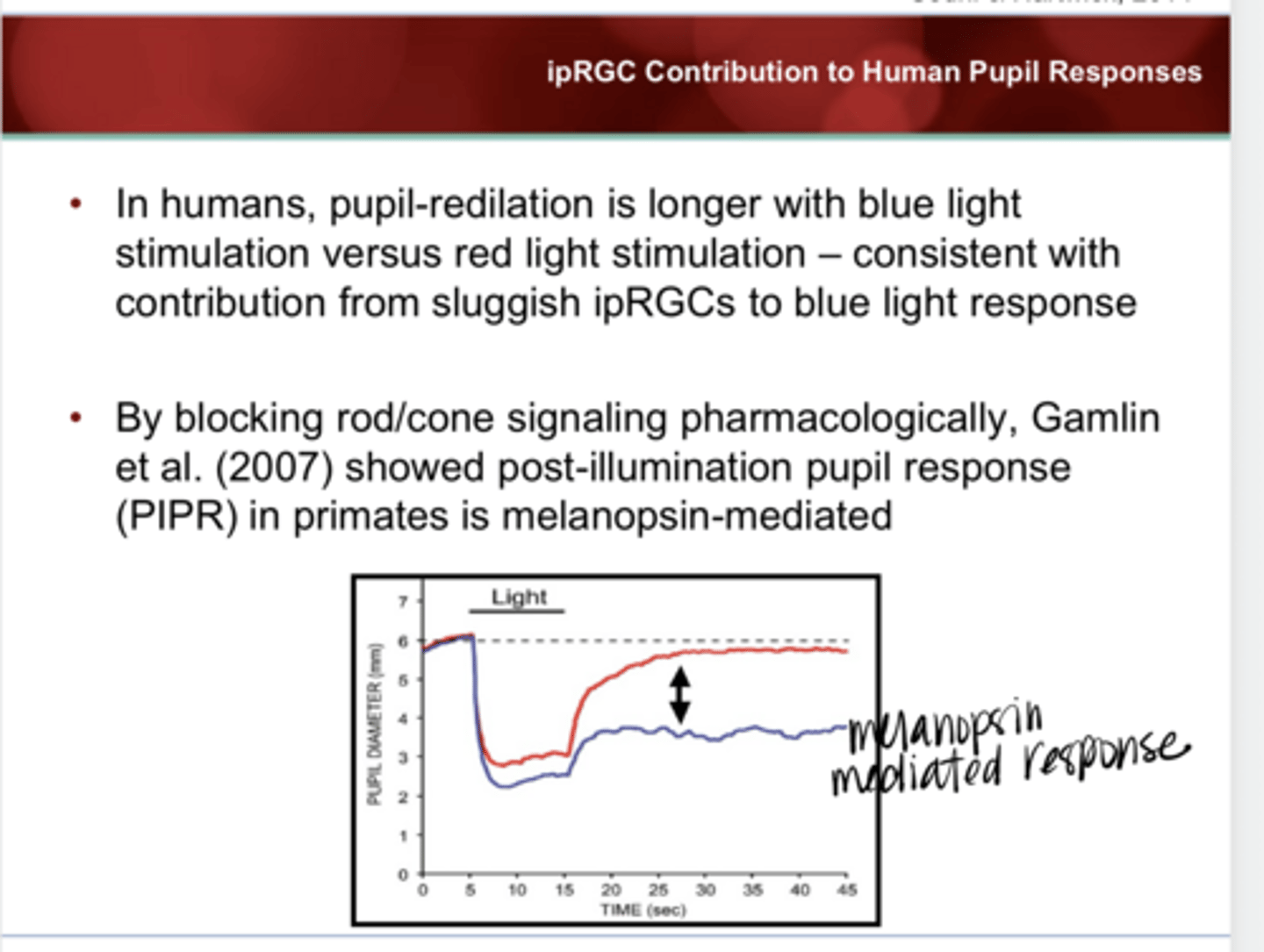
In humans, the pupil-redilation is longer with ____ light stimulation than ____ light stimulation
blue; red
**This is consistent with contribution from slugglish ipRGCs to blue light response
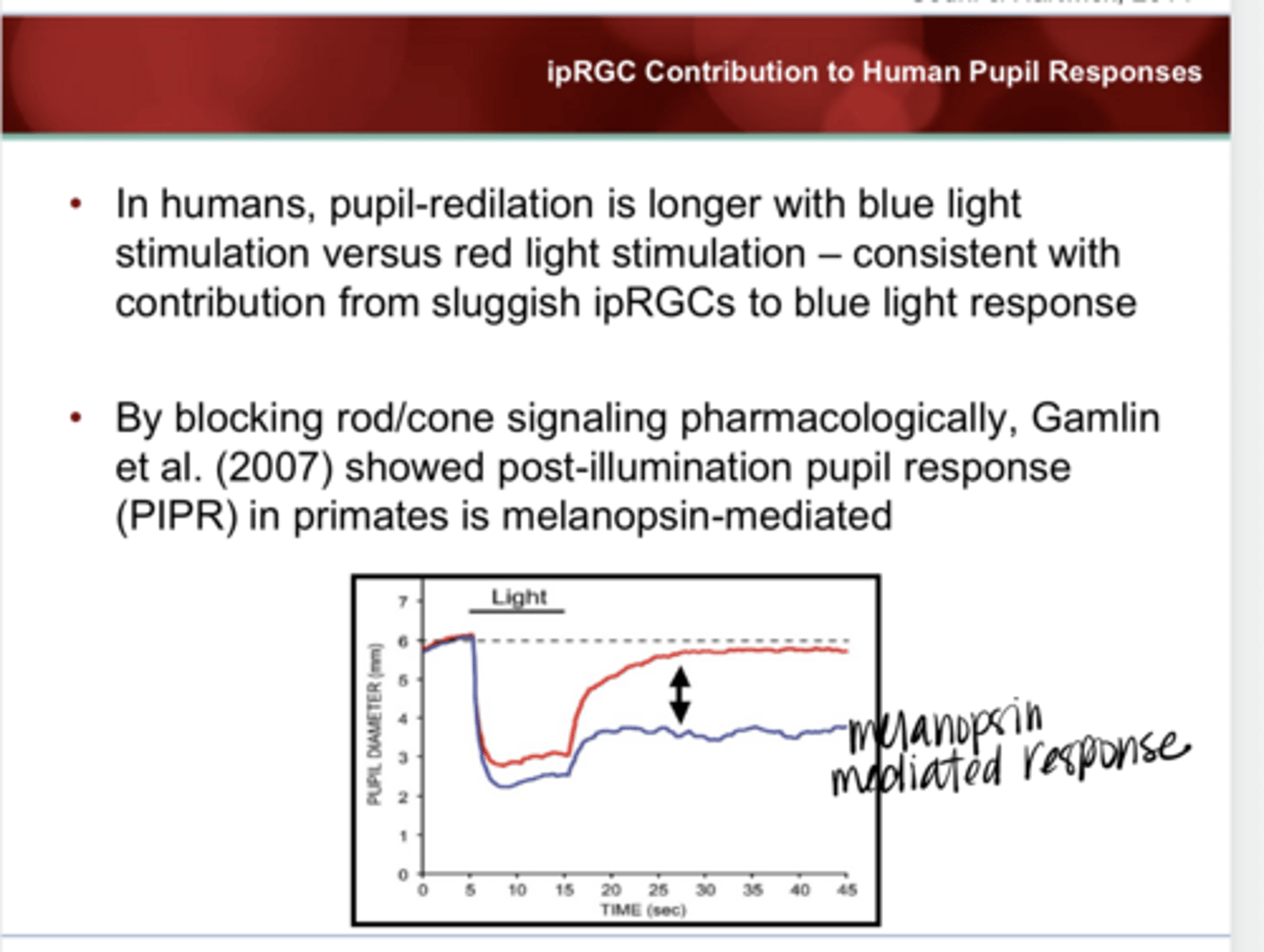
By blocking rod/cone signaling pharmacologically, post-illumination pupil response in primates is ____ related
melanopsin
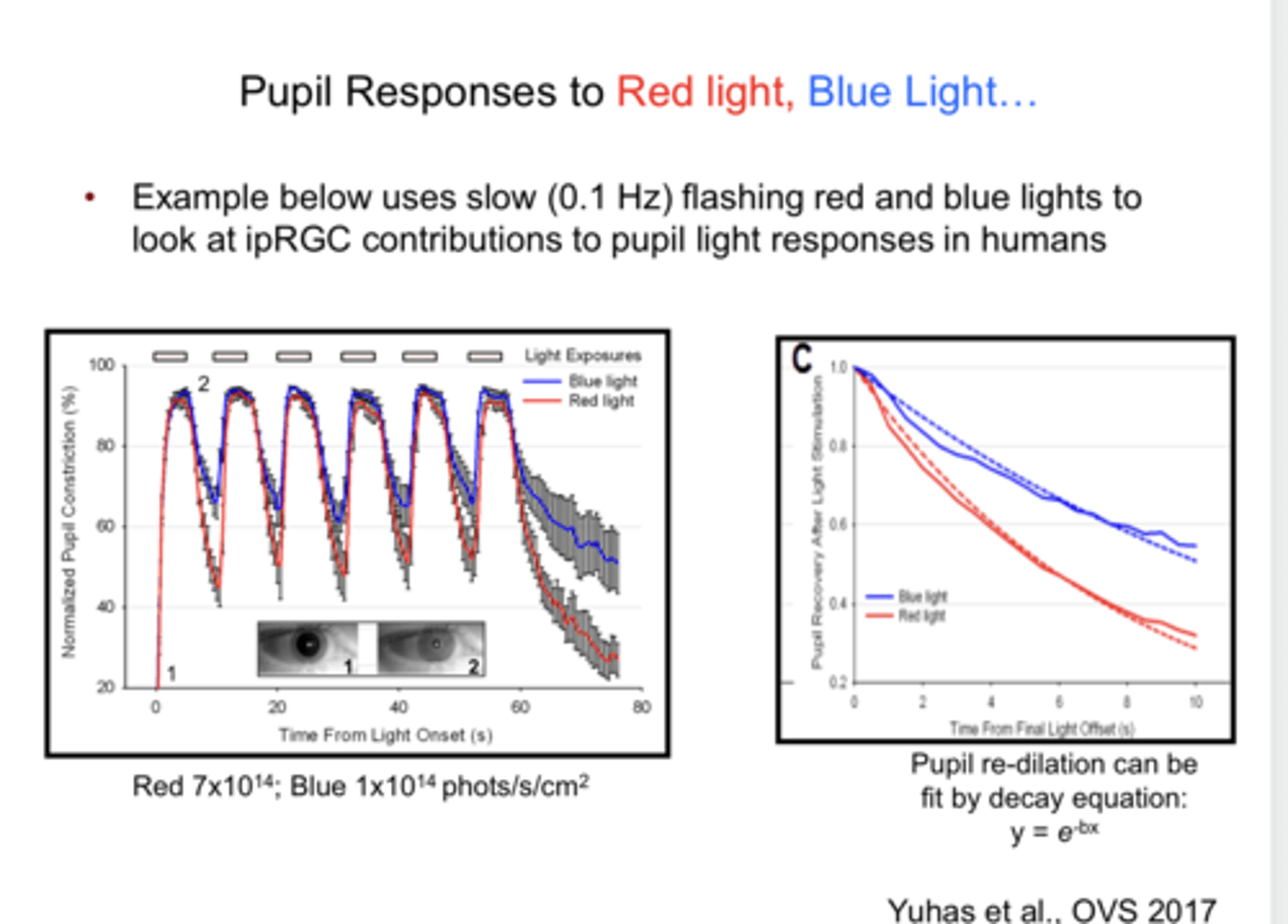
Pupil Responses to Red Light & Blue Light (Pic)
SUMMARY: Although we seem to live in a 24h society, our behaviors and physiology, like all animals, exhibits daily rhythms that are generated (externally/internally)
internally
SUMMARY: Where is the central clock that regulated daily rhythms located?
in the SCN in the hypothalamus
SUMMARY: ipRGCs are most sensitive to ____ light
blue
SUMMARY: What is the function of ipRGCs?
signal information about ambient light levels to the SCN and play a major role in synchronizing circadian and sleep/wake rhythms
SUMMARY: Can understanding biological clocks and associated rhythms have medical implications in regards to human health and the treatment of certain diseases?
Yes
SUMMARY: Can eye diseases disrupt both pattern vision and irradiance detection in some patients?
Yes