chemical kinetics
0.0(0)
Studied by 4 people Call Kai
 Learn
Learn Practice Test
 Spaced Repetition
 Match
Match Flashcards
 Knowt Play
Card Sorting
1/30

Earn XP
Description and Tags
Last updated 1:29 PM on 2/8/23
Name | Mastery | Learn | Test | Matching | Spaced | Call with Kai | Chat |
|---|
No analytics yet
Send a link to your students to track their progress
31 Terms
1
New cards
the rate of a chemical reaction
the increase in concentration of products or the decrease in concentration of reactants per unit time
2
New cards
how does the rate of reaction change during a reaction?
The rate of a reaction is not constant during a reaction, but is greatest at the start and decreases as the reaction proceeds.
3
New cards
6 techniques used for measuring the rate of reaction
1. change in volume of gas produced
2. change in mass
3. change in light transmission: spectrophotometry/colorimetry
4. change in concentration measured by titration
5. change in concentration measured using conductivity
6. clock reactions and non-continuous methods
4
New cards
change in volume of gas produced
* useful when one product is a gas
* using a gas syringe
* using water displacement from an inverted burette with a gas that has low solubility in water
* using a gas syringe
* using water displacement from an inverted burette with a gas that has low solubility in water
5
New cards
\
change in light transmission: spectrophotometry/colorimetry
change in light transmission: spectrophotometry/colorimetry
* one of the reactants or products is coloured and gives characteristic absorption in the visible region (wavelengths about 320–800 nm)
* an indicator can be added to generate a coloured compound that can then be followed in the reaction
* a colorimeter or spectrophotometer works by passing light of a selected wavelength through the solution and measures the intensity of the light transmitted by the reaction components
* as the concentration of the coloured compound increases, it absorbs proportionally more light, so less is transmitted.
* an indicator can be added to generate a coloured compound that can then be followed in the reaction
* a colorimeter or spectrophotometer works by passing light of a selected wavelength through the solution and measures the intensity of the light transmitted by the reaction components
* as the concentration of the coloured compound increases, it absorbs proportionally more light, so less is transmitted.
6
New cards
change in mass
* keeping the mixture on a scale
* not useful when the evolved gas is hydrogen, as it will not produce too much of a change in mass
* not useful when the evolved gas is hydrogen, as it will not produce too much of a change in mass
7
New cards
change in concentration measured by titration
* titrating against a known ‘standard’
* samples taken out from the mixture at regular time intervals
* samples taken out from the mixture at regular time intervals
8
New cards
change in concentration measured using conductivity
* electrical conductivity of a solution depends on the total concentration of its ions and on their charges
* using a conductivity meter which involves immersing inert electrodes in the solution
* using a conductivity meter which involves immersing inert electrodes in the solution
9
New cards
clock reactions and non-continuous methods
something observable which can be used as an arbitrary ‘end point’ by which to stop the clock
10
New cards
collision theory - what factors are necessary for a collision to be successful
* energy of collision - activation energy is required to overcome the repulsion between the particles and often break bonds
* geometry of collision - proper orientation of particles that react together is a determining factor whether the reaction will take place
* not all collisions are successful!
* geometry of collision - proper orientation of particles that react together is a determining factor whether the reaction will take place
* not all collisions are successful!
11
New cards
factors affecting the rate of reaction
1. temperature
2. concentration
3. particle size
4. pressure
5. catalyst
12
New cards
temperature
* greater temperature = greater kinetic energy
* more particles will overcome the activation energy
* greater collision frequency
* increased rate of reaction
* more particles will overcome the activation energy
* greater collision frequency
* increased rate of reaction
13
New cards
pressure
* for gases
* higher pressure = higher rate of reaction
* gas is compressed, which increases its concentration, so there is a greater chance that particles will collide
* higher pressure = higher rate of reaction
* gas is compressed, which increases its concentration, so there is a greater chance that particles will collide
14
New cards
particle size
* decreasing the particle size increases the rate of reaction
* greater surface area
* greater chance for collisions
* greater surface area
* greater chance for collisions
15
New cards
concentration
* increased concentration = more frequent successful collisions
* they are closer together so there is greater chance they will collide
* they are closer together so there is greater chance they will collide
16
New cards
catalyst
* a substance that increases the rate of a chemical reaction without itself undergoing permanent chemical change
* lowers activation energy, so more particles have enough energy to collide
* lowers activation energy, so more particles have enough energy to collide
17
New cards
The rate constant k is a constant for…
a particular reaction at a specified temperature
18
New cards
the order of a reaction with respect to a particular reactant
the power to which its concentration is raised in the rate equation
19
New cards
the overall order of reaction
the sum of the individual orders for all reactants.
20
New cards
units of rate for zero-order reaction
mol dm–3 s–1
21
New cards
units of rate for first-order reaction
s-1
22
New cards
units of rate for second-order reaction
mol–1 dm3 s–1
23
New cards
units of rate for third-order reaction
mol–2 dm6 s–1
24
New cards
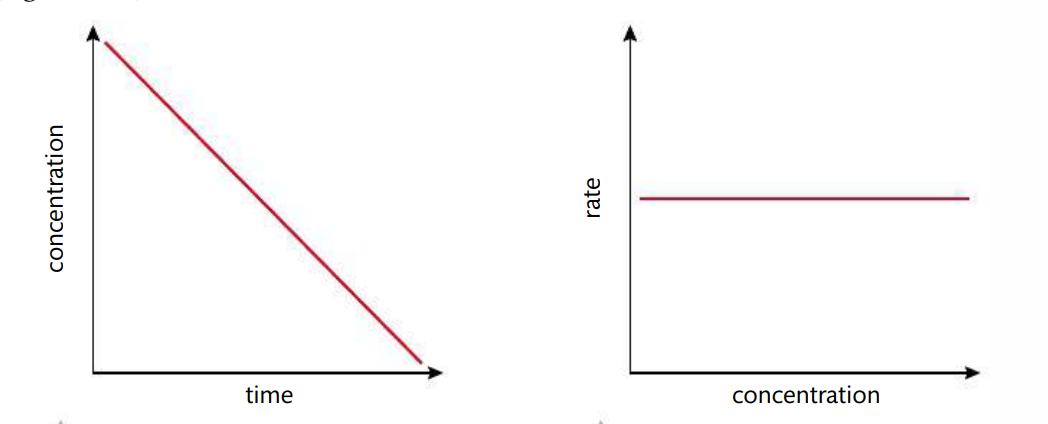
concentration/time and rate/concentration graphs for reaction with rate=k (0-order)
\
25
New cards
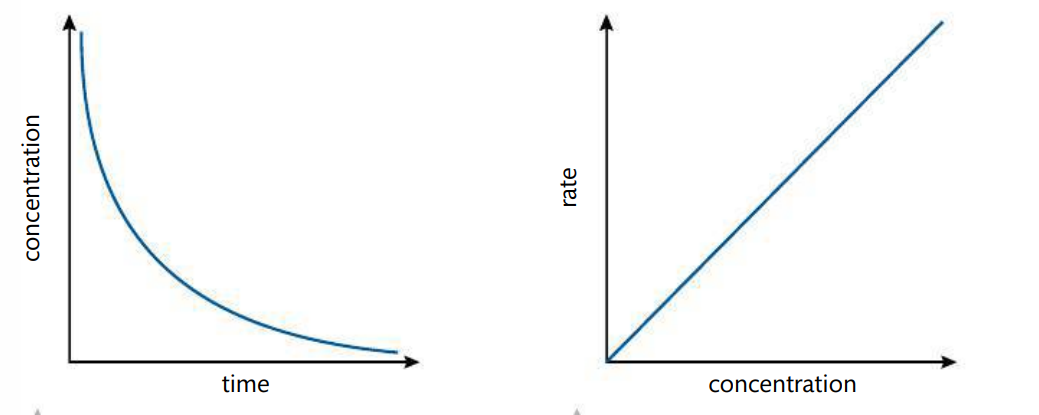
concentration/time and rate/concentration graphs for reaction with rate=k\[A\] (1-order)
26
New cards
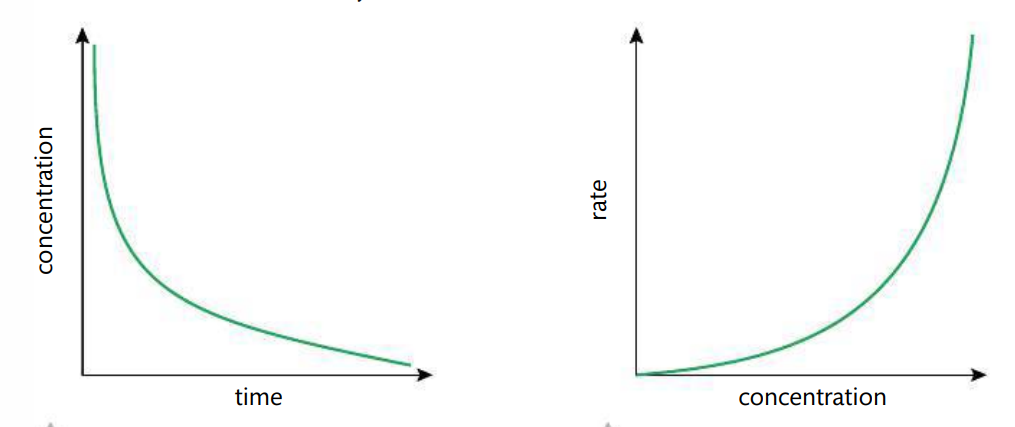
concentration/time and rate/concentration graphs for reaction with rate=k\[A\]^2 (2-order)
27
New cards
effect of doubling \[A\] for a zero-order, first- and second-order reaction
* 0: no change
* 1: rate doubles
* 2: rate x4
* 1: rate doubles
* 2: rate x4
28
New cards
effect of increasing \[A\] x3 for a zero-order, first- and second-order reaction
* 0: no change
* 1: rate x3
* 2: rate x9
* 1: rate x3
* 2: rate x9
29
New cards
effect of increasing \[A\] x4 for a zero-order, first- and second-order reaction
* 0: no change
* 1: rate x4
* 2: rate x16
* 1: rate x4
* 2: rate x16
30
New cards
the rate-determining step of a reaction
the slowest step of the mechanism, determines the rate of the whole reaction, its transition state has the highest energy
31
New cards
The value of A, the Arrhenius constant, indicates…
the frequency of collisions and the probability that collisions have proper orientations.