Ap pre calc flashcard study guide
 Call Kai
 Learn
Learn Practice Test
 Spaced Repetition
 Match
Match Flashcards
 Knowt Play
1/98

There's no tags or description
Looks like no tags are added yet.
Name | Mastery | Learn | Test | Matching | Spaced | Call with Kai |
|---|
No analytics yet
Send a link to your students to track their progress
99 Terms
A function is concave up when:
Rate of change is increasing
A function is concave down when:
Rate of change is decreasing
A function is increasing on an interval if:
As the input values increase, the output valuesalso increase in that interval.
A function is decreasing on an interval when:
As input values increase, the output values decrease
Average rate of change on an interval formula
f(b)-f(a)/b-a
The slope of a function at any given point gives
The rate of change of the function
A positive rate of change indicates that the function output is:
Increasing
A negative rate of change indicates that the function output is:
Decreasing
Point of inflection:
A point on the graph of a function where the concavity changes, indicating a maximum or minimum rate of change.
One-to-one function
Function where each input has a unique output
A relative minimum occurs when a function
Changes from decreasing to increasingA
A relative maximum occurs when a function:
Changes from increasing to decreasing
Absolute minimum:
The least output of a function (not negative infinity)
Absolute maximum:
The greatest output of a function (not infinity)
Multiplicity
The number of times a factor occurs in a polynomial function
A polynomial of degree n has:
Exactly n complete zeroes (real or imaginary)
If x=a is a real zero of polynomial with an odd multiplicity, then
The graph of the polynomial passes through the x-axis at x=a
If x = a is a real zero of a polynomial with an even multiplicity, then
The graph of the polynomial is tangent to the x-axis at x=a (bounces off the x-axis)
Odd function:
F(-x)=-F(x)
Even function:
F(-x)= F(x)
End behavior of a polynomial f with an even degree and a negative leading coefficient
lim f(x) = −∞
x→∞
lim f(x) = −∞
x→-∞
End behavior of a polynomial f with an odd degree and a positive leading coefficient
lim f(x) = ∞
x→∞
lim f(x) = −∞
x→-∞
End behavior of a polynomial f with an odd degree and a negative leading coefficient
lim f(x) = −∞
x→∞
lim f(x) = ∞
x→-∞
End behavior of a polynomial f with an even degree and a positive leading coefficient
lim f(x) = ∞
x→∞
lim f(x) = ∞
x→-∞
If a rational function, f, has a horizontal asymptote at y = b, then...
The ratio of leading terms
is a constant, b,
lim f(x) = b
x→∞
and,
lim f(x) = b
x→-∞
To determine the end behavior of a rational function...
Analyze the ratio of leading terms
A rational function has a zero at x = a if...
x = a is a zero of the numerator but NOT the denominator
A rational function has a hole at x = a if...
x = a is a zero of the numerator AND the denominator
A rational function has a vertical asymptote at x = a if...
x = a is a zero of the denominator but NOT the numerator
For rational functions, a slant asymptote occurs when...
The degree of the numerator is exactly one more than the degree of the denominator
If a rational function, f, has a
vertical asymptote at x = a,
then lim f(x) = _______
x→a-
lim f(x) = _______
x→a+
±∞ ; ±∞
If a rational function, f,
has a hole at (a, L) then
lim f(x) = ____.
x→a-
lim f(x) = ____.
x→a+
L
A function f(x) = abx demonstrates exponential growth if...
b > 1
A function f(x) = abx demonstrates exponential decay if...
0 < b < 1
Key features of y = logbx where b > 1
Domain: x > 0
• Range: all real numbers
• Vertical asymptote at x = 0
• Increasing and concave down over entire domain
Key features of y = bx where b > 1
Domain: all real numbers
• Range: y > 0
• Horizontal asymptote at y = 0
• Increasing and concave up over entire domain
bx+c =
bx ⋅ bc
bx-c =
bx/bc
ea ln b =
ba
logb(1) =
0
logb(b) =
1
logb(mn)
logb m + logb n
logbmk=
k logbm
logb(m/n)
logb m − logb n
Pythagorean Identities
sin2 θ + cos2 θ = 1
1 + cot2 θ = csc2θ
tan2 θ + 1 = sec2 θ
sec θ =
csc θ =
cot θ =
1/cos θ
1/sin θ
1/tan θ
=cos θ/sin θ
sin(α ± θ)
sin α cos θ ± sin θ cos α
cos(α ± θ)
cos α cos θ ∓ sin α sin θ
sin(2θ)
2 sin θ cos θ
cos(2θ)
cos2 θ − sin2 θ
= 2 cos2 θ − 1
= 1 − 2 sin2 θ
Given (x, y) in Cartesian (rectangular) coordinates, determine polar coordinates, (r, θ)
r = root x2 + y2
θ = tan-1 (y/x)
(*Add π if angle is in Q2 or Q3)
Given (r, θ) in polar coordinates, determine Cartesian coordinates, (x, y)
x = r cos θ
y = r sin θ
A polar function r = f(θ) is decreasing if...
As θ increases, r decreases.
A polar function r = f(θ) is increasing if...
As θ increases, r increases.
The distance between a point on a polar function r = f(θ) and the origin is decreasing if...
r is positive and decreasing or r is negative and increasing. (|r| is decreasing)
The distance between a point on a polar function r = f(θ) and the origin is increasing if...
r is positive and increasing or r is negative and decreasing. (|r| is increasing)
A function is linear if over equal-length input intervals, output values ______.
Change by a constant amount.
A function is quadratic if over equal-length input intervals, output values ______.
Change by a constant second difference.
A function is exponential if as input values change ____, output values change ____.
additively; multiplicatively
A function is logarithmic
if as input values change ____, output values change _____.
multiplicatively; additively
The average rates of change of a linear function are...
Constant
The average rates of change of a quadratic function...
Are changing at a constant rate OR follow a linear pattern
tan θ gives the ______ of the terminal ray of θ.
Slope
Domain and range of y = arcsin x
Domain: [−1,1]
Range: [-π/2,π/2)
Domain and range of y = arccos x
Domain: [−1,1]
Range: [0, π]
Domain and range of y = arctan x
Domain: (−∞, ∞)
Range: (-π/2,π/2)
f(x) = tan x has vertical asymptotes at...
x =
π/2 + πk, where k is an integer
f(x) = cot x has vertical asymptotes at ...
x = πk, where k is an integer
Determine the amplitude, period,
midline, and phase shift of
f(x) = a sin(b(x − c)) + d
Amplitude = |a|
Period = 2π/b
Midline: y = d
Phase shift: c units to the right
y = tan(bx) has a period of...
π/b
Key features of y = sin x
• Domain: all real numbers
• Range: [–1, 1]
• Period: 2π
• Amplitude: 1
• Midline: y = 0
• Passes through (0, 0)
Key features of y = cos x
• Domain: all real numbers
• Range: [–1, 1]
• Period: 2π
• Amplitude: 1
• Midline: y = 0
• Passes through (0, 1)
f(x) + c
Vertical translation c units up if c > 0 or c units down if c < 0
f(x − c)
Horizontal translation c units to the right if c > 0 or c units to the left if c < 0
f(cx)
Horizontal dilation by a
factor of 1/c
cf(x)
Vertical dilation by a factor of c
−f(x)
Reflection over the x-axis
f(−x)
Reflection over the y-axis
What does the constant e represent?
The base rate of growth for all continually growing processes e ≈ 2.718
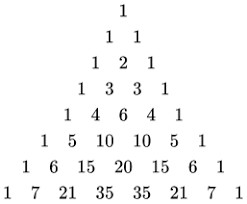
Pascal’s Triangle
A positive residual indicates that the predicted value is an ___________.
Underestimate
A negative residual indicates that the predicted value is an ___________.
Overestimate
Explicit rule for nth term of a geometric sequence given common ratio r, and the ak term
an = ak ⋅ rn-k
Explicit rule for nth term of an arithmetic sequence given common difference d, and the ak term
an = ak + d(n − k)
A model is considered appropriate for a data set if the residual plot...
Appears without pattern
Residual
Actual value – Predicted value
Error (in a model)
Predicted value – Actual value
f and g are inverse functions if...
f(g(x)) = g(f(x)) = x
In a semi-log plot where the y-axis is logarithmically scaled, exponential functions will appear
linear
If the y-axis is logarithmically scaled, then...
Equal-sized increments on the y-axis represent proportional changes in the output variable
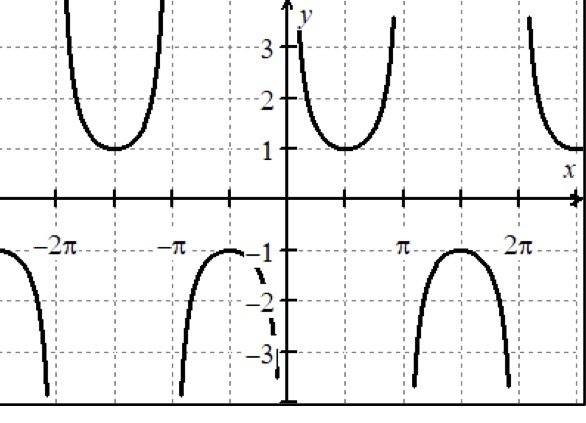
What graph is this?
y=csc x
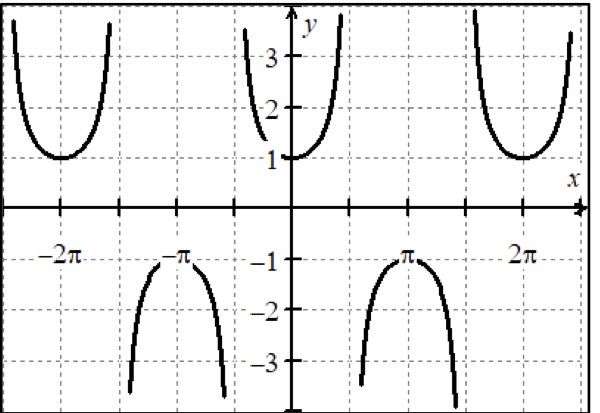
What graph is this?
y=sec x
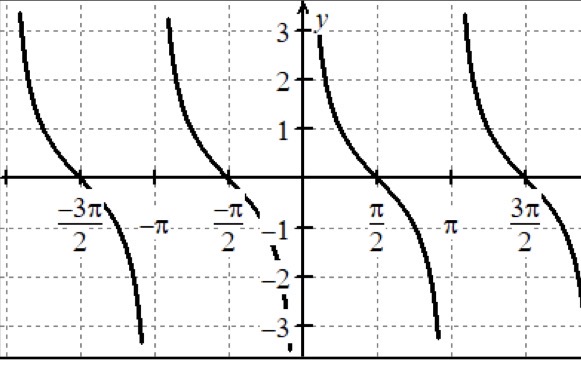
What graph is this?
y=cot x
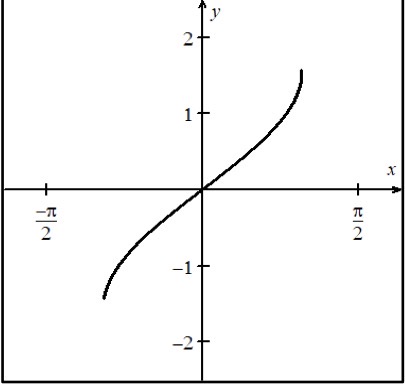
What graph is this?
y=arcsin x
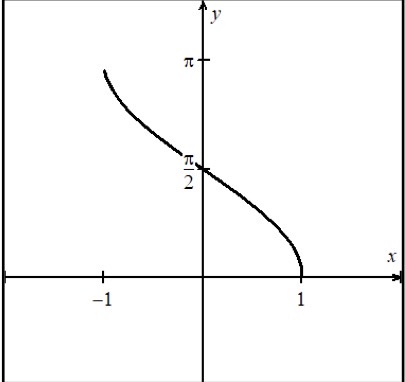
What graph is this?
y=arccos x
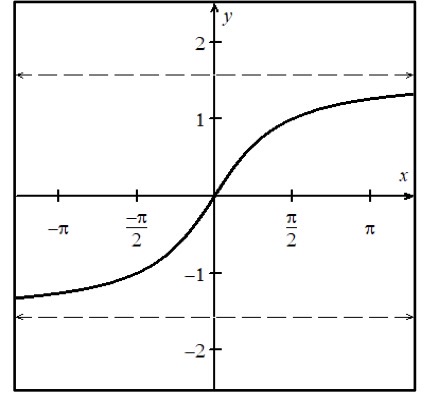
What graph is this?
y=arctan x
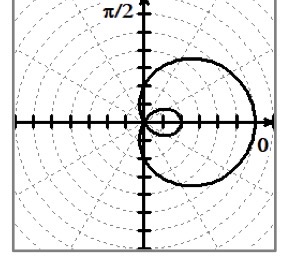
How does this graph occur?
When b>a
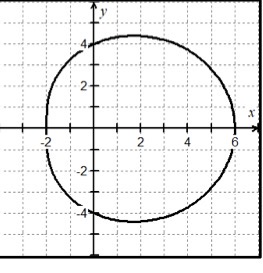
How does this graph occur?
When a>b
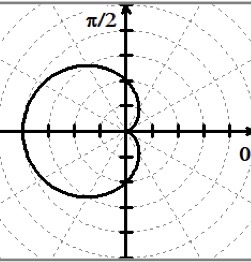
How does this graph occur?
When a=b