C6: Transaction Processing and Financial Reporting Systems
 Call Kai
 Learn
Learn Practice Test
 Spaced Repetition
 Match
Match Flashcards
 Knowt Play
1/93

There's no tags or description
Looks like no tags are added yet.
Name | Mastery | Learn | Test | Matching | Spaced | Call with Kai |
|---|
No analytics yet
Send a link to your students to track their progress
94 Terms
True
Processing more transactions at a lower unit cost makes batch processing more efficient than real-time systems.
False
The process of acquiring raw materials is part of the conversion cycle.
True
Directing work-in-process through its various stages of manufacturing is part of the conversion cycle.
True
The portion of the monthly bill from a credit card company is an example of a turn-around document.
False
The general journal is used to record recurring transactions that are similar in nature.
False
Document flowcharts are used to represent systems at different levels of detail.
False
Data flow diagrams represent the physical system.
True
System flowcharts are often used to depict processes that are handled in batches.
False
Program flowcharts depict the type of media being used (paper, magnetic tape, or disks) and terminals.
True
System flowcharts represent the input sources, programs, and output products of a computer system.
True
Program flowcharts are used to describe the logic represented in system flowcharts.
True
Batch processing systems can store data on direct access storage devices.
False
Backups are automatically produced in a direct access file environment.
False
The box symbol represents a temporary file.
True
Auditors may prepare program flowcharts to verify the correctness of program logic.
True
A control account is a general ledger account which is supported by a subsidiary ledger.
True
The most significant characteristic of direct access files is access speed.
False
Real time processing is used for routine transactions in large numbers.
False
Batch processing is best used when timely information is needed because this method processes data efficiently.
False
An inverted triangle with the letter “N” represents a file in “name” order.
True
Real-time processing in systems that handle large volumes of transactions each day can create operational inefficiencies.
False
Operational inefficiencies occur because accounts unique to many concurrent transactions need to be updated in real time.
True
Operational inefficiencies occur because accounts common to many concurrent transactions need to be updated in real time.
True
Batch processing of non-critical accounts improves operational efficiency.
False
Batch processing of accounts common to many concurrent transactions reduces operational efficiency.
True
The block code is the coding scheme most appropriate for a chart of accounts.
False
Sequential codes may be used to represent complex items or events involving two or more pieces of related data.
True
Block codes restrict each class to a pre-specified range.
True
For a given field size, a system that uses alphabetic codes can represent far more situations than a system with that uses numeric codes.
False
Mnemonic codes are appropriate for items in either an ascending or descending sequence, such as the numbering of checks or source documents.
True
The most common means of making entries in the general ledger is via the journal voucher.
True
Individuals with access authority to general ledger accounts should not prepare journal vouchers.
True
The journal voucher is the document that authorizes entries to be made to the general ledger.
True
Each account in the chart of accounts has a separate record in the general ledger master file.
C
Which system is not part of the expenditure cycle?
a. cash disbursements
b. payroll
c. production planning/control
d. purchases/accounts payable
D
Which system produces information used for inventory valuation, budgeting, cost control, performance reporting, and make-buy decisions?
a. sales order processing
b. purchases/accounts payable
c. cash disbursements
d. cost accounting
A
Which of the following is a turn-around document?
a. remittance advice
b. sales order
c. purchase order
d. payroll check
B
The order of the entries made in the ledger is by
a. transaction number
b. account number
c. date
d. user
ANS: B
A
The order of the entries made in the general journal is by
a. date
b. account number
c. user
d. customer number
C
In general, a special journal would not be used to record
a. sales
b. cash disbursements
c. depreciation
d. purchases
A
Which account is least likely to have a subsidiary ledger?
a. sales
b. accounts receivable
c. fixed assets
d. inventory
D
Subsidiary ledgers are used in manual accounting environments. What file is comparable to a subsidiary ledger in a computerized environment?
a. archive file
b. reference file
c. transaction file
d. master file
A
A journal is used in manual accounting environments. What file is comparable to a journal in a computerized environment?
a. archive file
b. reference file
c. transaction file
d. master file
C
In a computerized environment, a list of authorized suppliers would be found in the
a. master file
b. transaction file
c. reference file
d. archive file
D
Which of the following is an archive file?
a. an accounts payable subsidiary ledger
b. a cash receipts file
c. a sales journal
d. a file of accounts receivable that have been written off
C
Which document is not a type of source document?
a. a sales order
b. an employee time card
c. a paycheck
d. a sales return receipt
A
The most important purpose of a turnaround document is to
a. serve as a source document
b. inform a customer of the outstanding amount payable
c. provide an audit trail for the external auditor
d. inform the bank of electronic funds deposits
A
Which type of graphical documentation represents systems at different levels of detail?
a. data flow diagram
b. document flowchart
c. system flowchart
d. program flowchart
A
Data flow diagrams
a. depict logical tasks that are being performed, but not who is performing them
b. illustrate the relationship between processes, and the documents that flow between them and trigger activities
c. represent relationships between key elements of the computer system
d. describe in detail the logic of the process
C
System flowcharts
a. depict logical tasks that are being performed, but not who is performing them
b. illustrate the relationship between database entities in systems.
c. represent relationships between key elements of both manual and computer systems.
d. describe the internal logic of computer applications in systems. .
B
When determining the batch size, which consideration is the least important?
a. achieving economies by grouping together large numbers of transactions
b. complying with legal mandates
c. providing control over the transaction process
d. balancing the trade off between batch size and error detection
A
In contrast to a real-time system, in a batch processing system
a. there is a lag between the time when the economic event occurs and the financial records are updated
b. relatively more resources are required
c. a greater resource commitment per unit of output is required
d. processing takes place when the economic event occurs
D
In contrast to a batch processing system, in a real-time system
a. a lag occurs between the time of the economic event and when the transaction is recorded
b. relatively fewer hardware, programming, and training resources are required
c. a lesser resource commitment per unit of output is required
d. processing takes place when the economic event occurs
C
The type of transaction most suitable for batch processing is
a. airline reservations
b. credit authorization
c. payroll processing
d. adjustments to perpetual inventory
D
The type of transaction most suitable for real-time processing is
a. recording fixed asset purchases
b. recording interest earned on long-term bonds
c. adjusting prepaid insurance
d. recording a sale on account
D
Which step is not found in batch processing using sequential files?
a. control totals
b. sort runs
c. edit runs
d. immediate feedback of data entry errors
B
Both the revenue and the expenditure cycle can be viewed as having two key parts. These are
a. manual and computerized
b. physical and financial
c. input and output
d. batch and real-time
C
All of the following can provide evidence of an economic event except
a. source document
b. turn-around document
c. master document
d. product document
C
Which method of processing does not use the destructive update approach?
a. batch processing using direct access files
b. real-time processing
c. batch processing using sequential files
d. all of the above use the destructive update approach
B
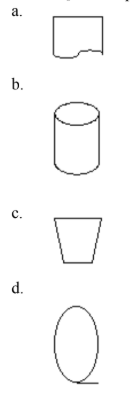
Which symbol represents a data store?
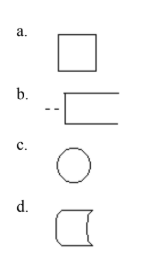
D
Which symbol represents a manual operation?
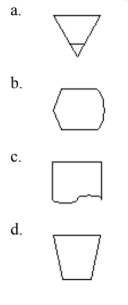
A
Which symbol represents accounting records?
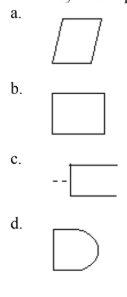
B
Which symbol represents a document?
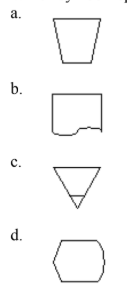
D
Which symbol represents a magnetic tape (sequential storage device)?
A
Which symbol represents a decision?
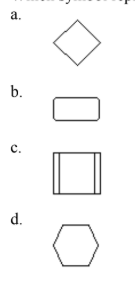
C
The characteristics that distinguish between batch and real-time systems include all of the following except
a. time frame
b. resources used
c. file format
d. efficiency of processing
A
A file that stores data used as a standard when processing transactions is
a. a reference file
b. a master file
c. a transaction file
d. an archive file
D
Sequential storage means
a. data is stored on tape
b. access is achieved through an index
c. access is direct
d. reading record 100 requires first reading records 1 to 99
C
Real-time processing would be most beneficial in handling a firm’s
a. fixed asset records
b. retained earning information
c. merchandise inventory
d. depreciation records
C
Which accounting application is least suited to batch processing?
a. general ledger
b. vendor payments
c. sales order processing
d. payroll
A
Which accounting application is best suited to batch processing?
a. general ledger
b. updating inventory reductions to the subsidiary ledger
c. sales order processing
d. credit checking
B
Operational inefficiencies occur because
a. accounts both common and unique to many concurrent transactions need to be updated in real time.
b. accounts common to many concurrent transactions need to be updated in real time.
c. accounts unique to many concurrent transactions need to be updated in real time.
d. None of the above are true statements
C
Operational efficiencies can be improved by
a. updating accounts both common and unique to many concurrent transactions in real time.
b. updating accounts both common and unique to many concurrent transactions in batch mode.
c. updating accounts unique to many concurrent transactions in real time and updating common accounts in batch mode.
d. None of the above are true statements
B
The coding scheme most appropriate for a chart of accounts is
a. sequential code
b. block code
c. group code
d. mnemonic code
C
A common use for sequential coding is
a. creating the chart of accounts
b. identifying inventory items
c. identifying documents
d. identifying fixed assets
A
The most important advantage of sequential coding is that
a. missing or unrecorded documents can be identified
b. the code itself lacks informational content
c. items cannot be inserted
d. deletions affect the sequence
B
When a firm wants its coding system to convey meaning without reference to any other document, it would choose
a. an alphabetic code
b. a mnemonic code
c. a group code
d. a block code
C
The most important advantage of an alphabetic code is that
a. meaning is readily conveyed to users
b. sorting is simplified
c. the capacity to represent items is increased
d. missing documents can be identified
C
Which statement is not true?
a. The journal voucher is the only source of input into the general ledger.
b. A journal voucher can be used to represent summaries of similar transactions or a single unique transaction.
c. Journal vouchers are not used to make adjusting entries and closing entries in the general ledger.
d. Journal vouchers offer a degree of control against unauthorized general ledger entries.
D
Entries into the General Ledger System (GLS) can be made using information from
a. the general journal
b. a journal voucher which represents a summary of similar transactions
c. a journal voucher which represents a single, unusual transaction
d. all of the above
C
Which statement is not correct? The general ledger master file
a. is based on the firm’s chart of account
b. contains a record for control accounts
c. is an output of the Financial Reporting System (FRS)
d. supplies information for management decision making
B
What type of data is found in the general ledger master file?
a. a chronological record of all transactions
b. the balance of each account in the chart of accounts
c. budget records for each account in the chart of accounts
d. subsidiary details supporting a control account
A
Which report is not an output of the Financial Reporting System (FRS)?
a. variance analysis report
b. statement of cash flows
c. tax return
d. comparative balance sheet
D
Which steps in the Financial Accounting Process are in the correct sequence?
a. record the transaction, post to the ledger, prepare the adjusted trial balance, enter adjusting entries, prepare financial statements
b. record the transaction, prepare the unadjusted trial balance, record adjusting journal entries, record closing entries, prepare financial statements
c. record the transaction, post to the ledger, record adjusting entries, prepare the unadjusted trial balance, prepare financial statements
d. record the transaction, post to the ledger, prepare the adjusted trial balance, prepare financial statements, record closing entries
C
Which statement is not correct?
a. the post-closing trial balance reports the ending balance of each account in the general ledger
b. one purpose of preparing the unadjusted trial balance is to ensure that debits equal credits
c. financial statements are prepared based on the unadjusted trial balance
d. the unadjusted trial balance reports control account balances but omits subsidiary ledger detail
B
What account appears on the post closing trial balance?
a. income summary
b. machinery
c. rent expense
d. interest income
B
Financial statements are prepared from the
a. trial balance
b. adjusted trial balance
c. general ledger
d. general journal
C
Risk exposures in the General Ledger and Financial Reporting Systems include all of the following except
a. loss of the audit trail
b. unauthorized access to the general ledger
c. loss of physical assets
d. general ledger account out of balance with the subsidiary account
D
Which situation indicates an internal control risk in the General Ledger/Financial Reporting Systems (GL/FRS)?
a. the employee who maintains the cash journal computes depreciation expense
b. the cash receipts journal voucher is approved by the Treasurer
c. the cash receipts journal vouchers are prenumbered and stored in a locked safe
d. the employee who maintains the cash receipts journal records transactions in the accounts receivable subsidiary ledger
C
With a limited work force and a desire to maintain strong internal control, which combination of duties performed by a single individual presents the least risk exposure?
a. maintaining the inventory ledger and recording the inventory journal voucher in the general ledger
b. recording the inventory journal voucher in the general ledger and maintaining custody of inventory
c. maintaining the cash disbursements journal and recording direct labor costs applied to specific jobs
d. preparing the accounts payable journal voucher and recording it in the general ledger
D
XBRL
a. is the basic protocol that permits communication between Internet sites.
b. controls Web browsers that access the Web.
c. is the document format used to produce Web pages.
d. was designed to provide the financial community with a standardized method for preparing
e. is a low-level encryption scheme used to secure transmissions in higher-level (HTTP) format.
C
An XBRL taxonomy:
a. is the document format used to produce web pages.
b. is the final product (report).
c. is a classification scheme.
d. is a tag stored in each database record.
e. none of the above is true.