5: How does the JCC work?
 Call Kai
 Learn
Learn Practice Test
 Spaced Repetition
 Match
Match Flashcards
 Knowt Play
1/43

There's no tags or description
Looks like no tags are added yet.
Name | Mastery | Learn | Test | Matching | Spaced | Call with Kai |
|---|
No analytics yet
Send a link to your students to track their progress
44 Terms
what formula is used to break down a sphero cylindrical Rx into meridional powers
meridional power= S + ( C x sin²feta)
S is sphere power in D
C is cylinder power in D
when feta is 90 degrees, sine 90 = 1² = 1
so meridional power is S+C
when feta is 45: sin (45) = 0.7071²= 0.5

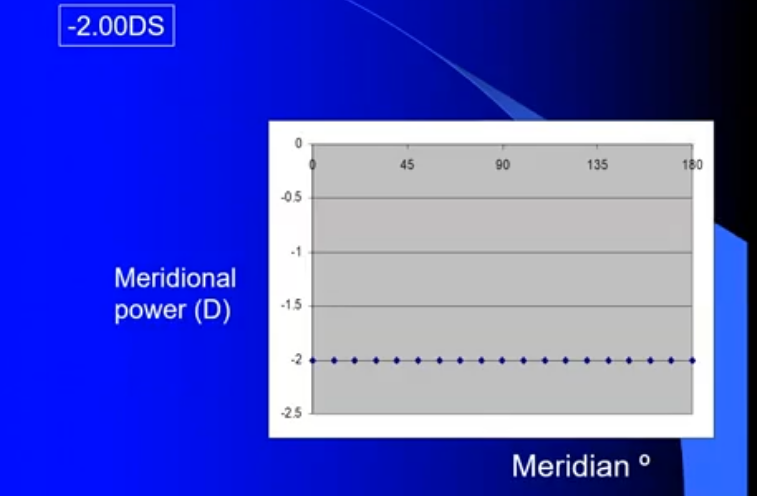
graphical representation of lens power… spherical lens
a -2.00 spherical lens
along every merdian it shows a power of -2.00DS which is shown as a straight line
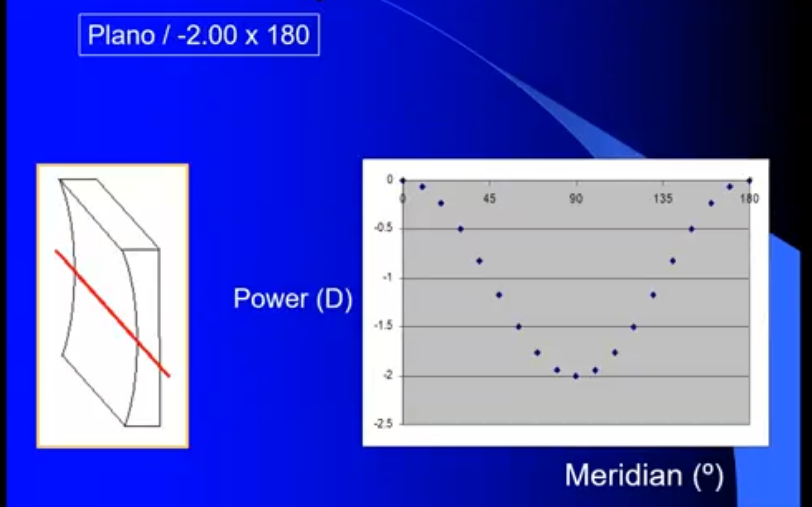
graphical representation of lens power… cylindrical lens
plano cylinder
at 180 its power is 0 which is shown at the top right and left, this is represented as the S
at 90 degrees, in middle of graohy the power is -2.00D which is represented as the S+C
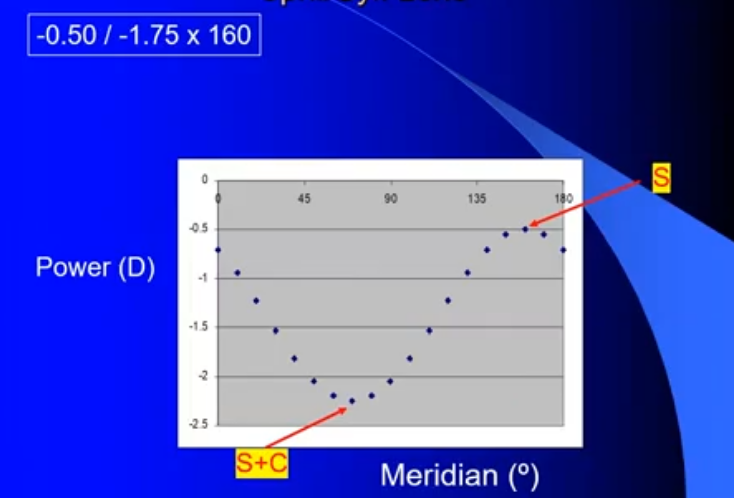
graphical representation of lens power: sph/cyl lens
along 160 the power is -0.50
along 70 the S+C is -2.25 (cyl alone is -1.75)
-3.00/-1.00 × 155
along 155 the eye is myopic by -3.00
along 65 the eye is myopic by -4.00
but need to know what is the ametropia along 90 degrees, or 120 degrees in an eye with principle meridians of 65 and 155, to know how JCC works - doe using the meridional power equation
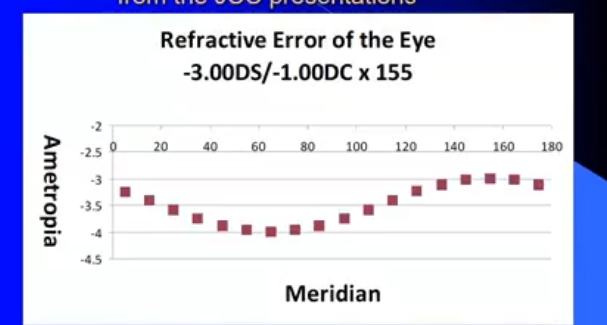
shows ametropia at different meridians
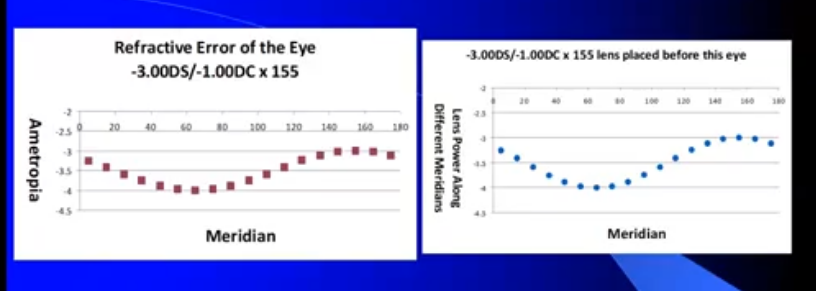
to check accuracy of when placing the -3.00/-1.00 × 155 lens in front of the eye the dots must allign for a residual refractive error of 0 which indicates that the eye is fully corrected
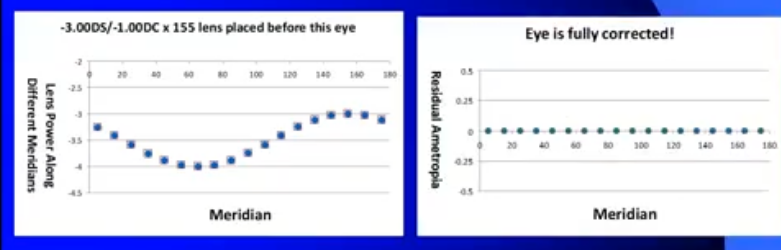
using graphical rep of ametropia and lens power to understand how JCC works
-3.00/-0.75 × 170 starting point
-3.00/-0.75 × 155 end point of axis determination
residual ametropia- difference between actual ametropia in each meridian and the combined power of the jcc and trial frame lenses in each meridian
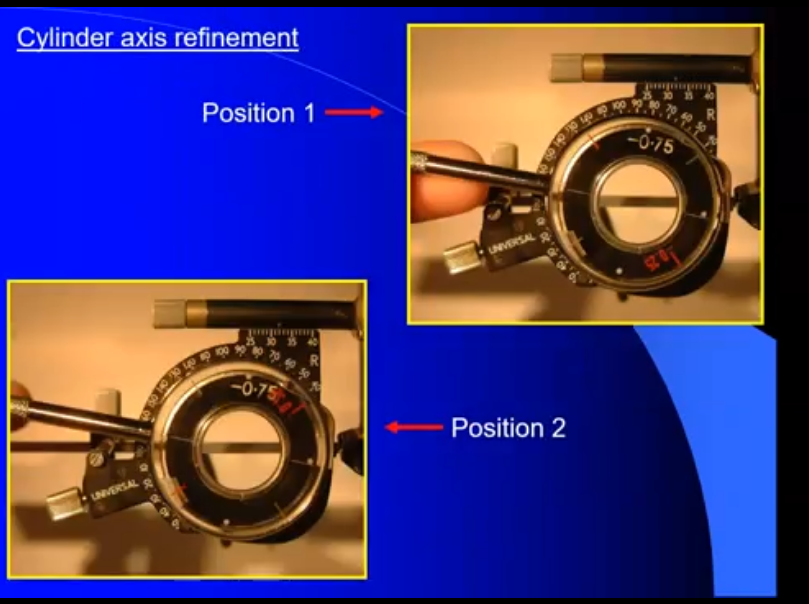
cylinder axis refinement for -3.00/-0.75 × 170
handle along axis of trial frame cylinder
in position 1 the JJ: +0.25/-0.50 × 125 : this is because the red markings are 45 degrees awar from the cyl axis so 170-45 = 125
in position 2 the JCC is +0.25/-0.50 × 35 - which is 45 degrees away from the cyl axis on the other side
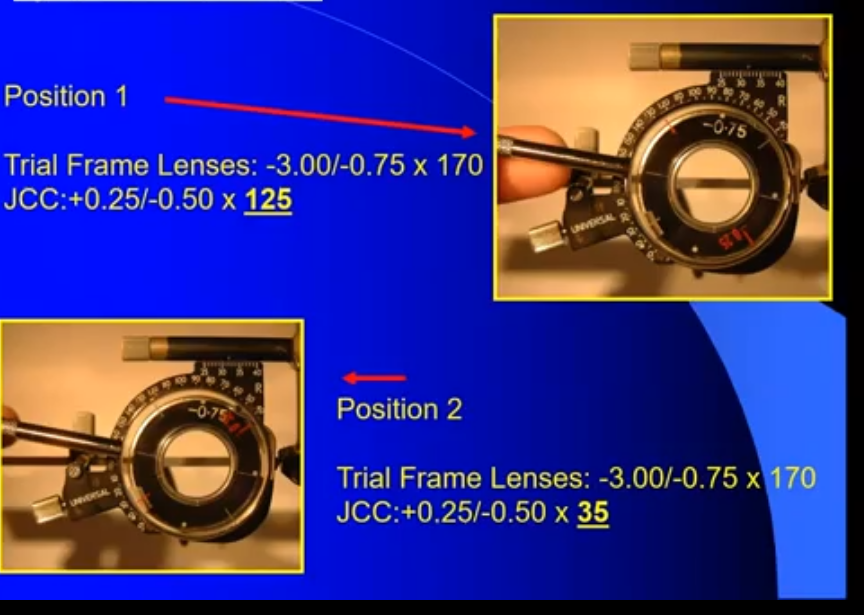
combined power of the rial frame lenses and JCC
in position 1
lens in trial frame: -3.00 /-0.75 × 170
JCC: +0.25/-0.50 × 125
in position 2
lens in trial frame: -3.00/-0.75 × 170
JCC: +0.25/-0.50 × 35
examine whether more of ametropia is corrceted with postiion 1 or
what is the combined power of the following 2 lenses
+1.00/-1.00 × 160
+0.50 /-0.75 × 160
principal meridians are the same
so add sph and the cyls
combined power = +1.50/-1.75 × 160
also known as the resultant
add together the following 2 lenses
-3.00/-0.75 × 170
+0.25/-0.50 × 125 ( JCC in position 1)
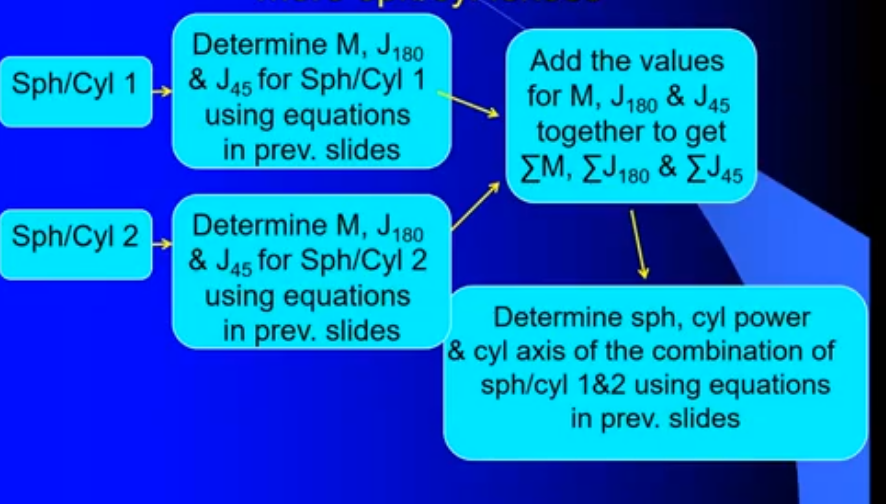
done via astigmatic decomposition
astigmatic decomposition
based on dividing up a prescription so that it can be represented by 3 terms
M
J180
J45
what is M
S + C/2
J180
-0.5 x C x cos(2A)
A being the axis
take the axis of the cylinder then double this
then take the cosine of this vale. then multiply it by minus half of the cylinder
J45
-0.5 x C x sin(2A)
astigmatic decomp of +4.25/-1.50 × 20
M= +4.25 + (-1.50/2) = +3.50D
J180 = -0.5 x ( -1.50 ) x cos (40) = + 0.575D
J45 = -0.5 x (-1.50) x sin (40) = +0.482 D
a JCC with the minus axis lined up with 180 gives
M= plano
J180 = +0.25 as its axis is -0.25 so power along this is +0.25D
J45= plano
a JCC with the minus axis lined up with 90
M= plano
J180= -0.25
J45 = plano
a JCC with minus axis lined up with 45
M= plano
J180= plano
J45 = +0.25
a jcc with minus axis lined up with 135 gives
M= plano
J180 = plano
J45= -0.25
resultant values of astigmatic decomp
need to separately work out the
resultant sphere
resultant cylinder
resultant axis
resultant sphere
take the sum of all the J180 terms and square it and do the same for the J45. Add the two together and take the square root of this and add it to the sum of the M terms

resultant cylinder
take the sum of all the J180 terms and square it. do the same for the J45 and add the two together, take the square root of this and multiply it by -2

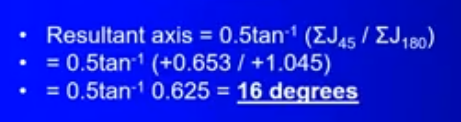
resultant axis
divide the sum of all the J45 terms by the sum of all the J180 terms; clc 0.5 the arctan of this

express the combination of the following lenses
+4.25/-1.50 × 20
-2.50/-1.00 × 10
sum of the components
M= +3.50 + - 3.00 = +0.50
J180 = +0.575 +0.470 = 1.045
J45 = 0.482 +0.171 = +0.653
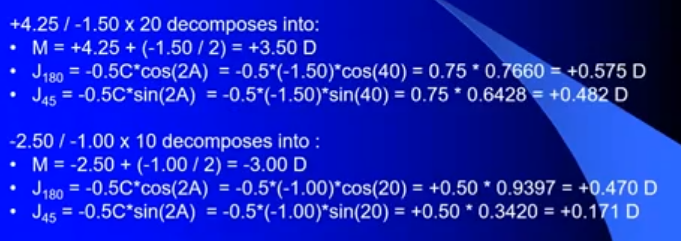
converting the decomposed terms to standard clinical notation
resultant sphere
M = +0.50
J180 = +1.045
J45= +0..653
= +1.732D

converting decomposed to standard
resultant cylinder
= -2.464D
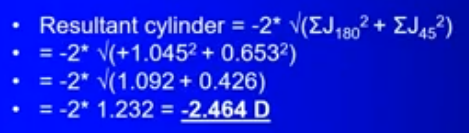
resultant axis decomp to standard
so the resultant prescription from combination of +4.25/-1.50 × 20 & -2.50/-1.00 × 10 is =
+1/73 /-2.46 × 16
steps in astigmatic decomp to determine the combined sph/cyl Rx of 2 or more sph/cyl lenses
what is the sum of
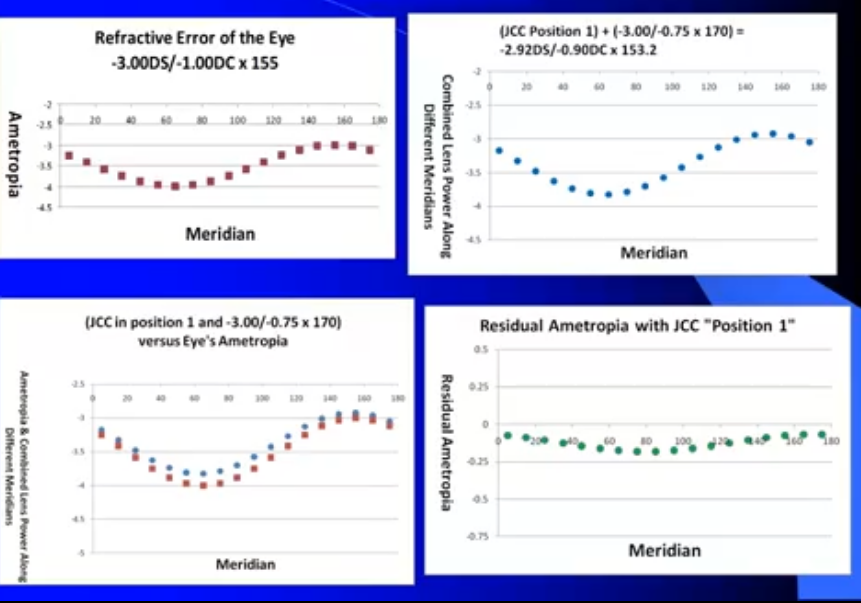
-3.00/-0.75 × 170
+0.25/-0.50 x 125 (JCC in position 1)
= 2.92 /-0.90 × 153.2
this is being offered to correct ametropia of -3.00/-1.00 × 155
powers are similar so does qell in terms of correcting the eye
residual error is still not 0
position 2:
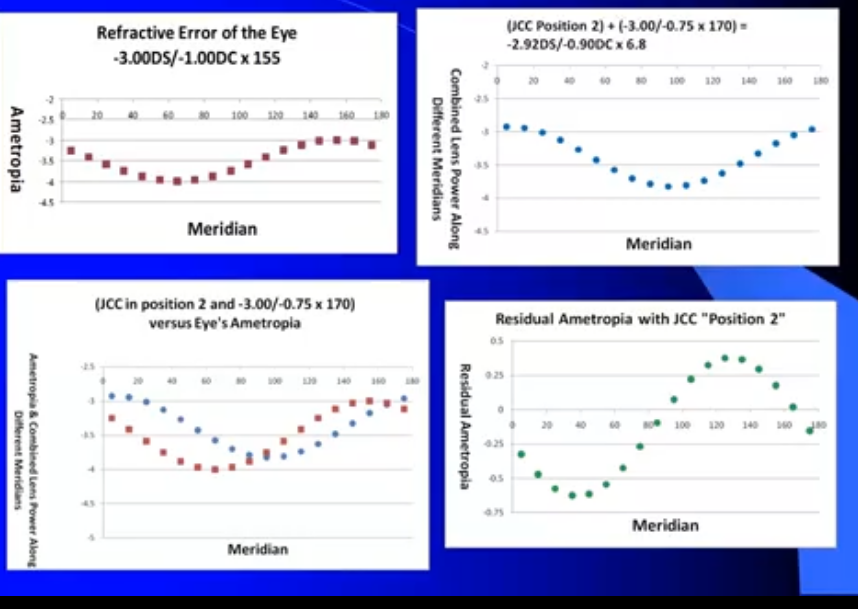
-3.00/-0.75 × 170
+0.25/-0.50 × 35
= -2.92/-0.90 × 6.8
this is being offerred to correct ametropia of -3.00/-1.00 × 155
lost of residual error
so px more likely to prefer posotion 1 as residual error closer to 0 than position 2
what is done after woking out that position 1 was preferred
rotate the cylinder axis towards the negative axis markings of the jCC
moved by 20 degrees
so it is now -0.75 × 150
power oc cyl= rotated by certain by amount of degrees
re position the JCC handle along the trial frame cylinder axis
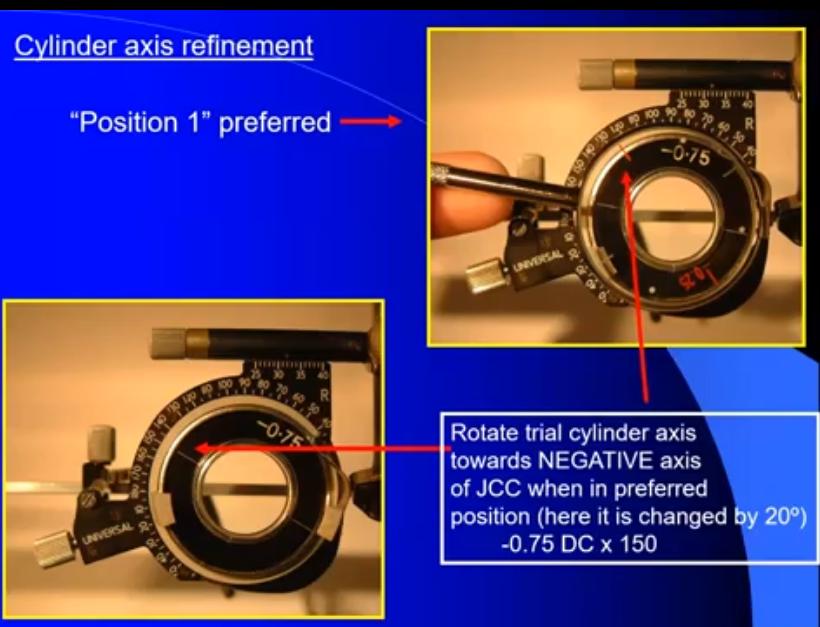
handle now at -0.75 × 150
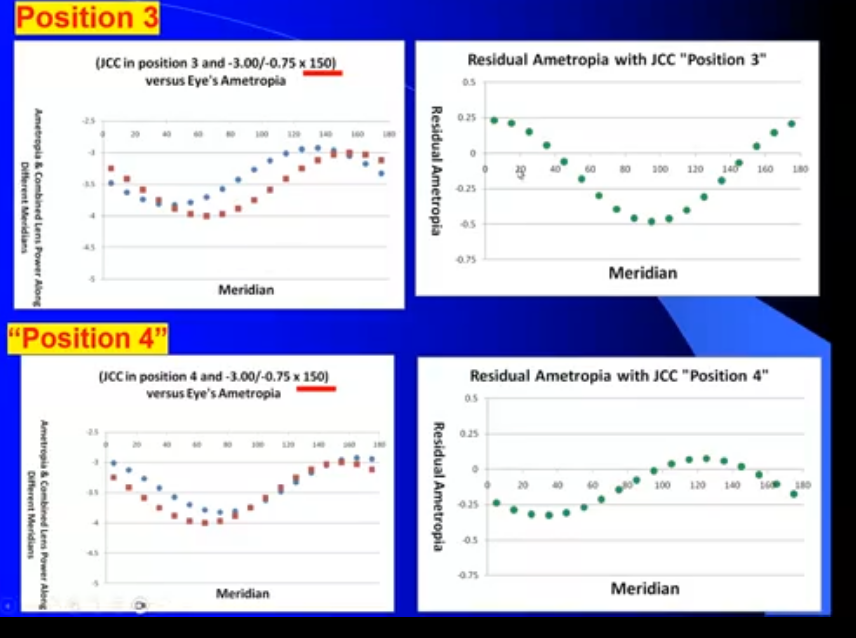
at position 3: -3.00/-0.75 × 150
JCC: +0.25 /-0.50 × 105
position 4:
trial frame lenses -3.00/-0.75 × 150
JCC= +0.25/-0.50 × 105
work out astigmatic decomp again to work out which position would be better
position 3 & 4
square dots correspond to the refractive error of the eye
blue dots correspond to the refractive error being delivered to each meridian
px would prefer posiion 4 as much less residual error, still varying but less than position 3
what is done after working out position 4 was better
rotate the trial cylinder towards negatuve markings of JCC by 10 degrees -0.75 × 160
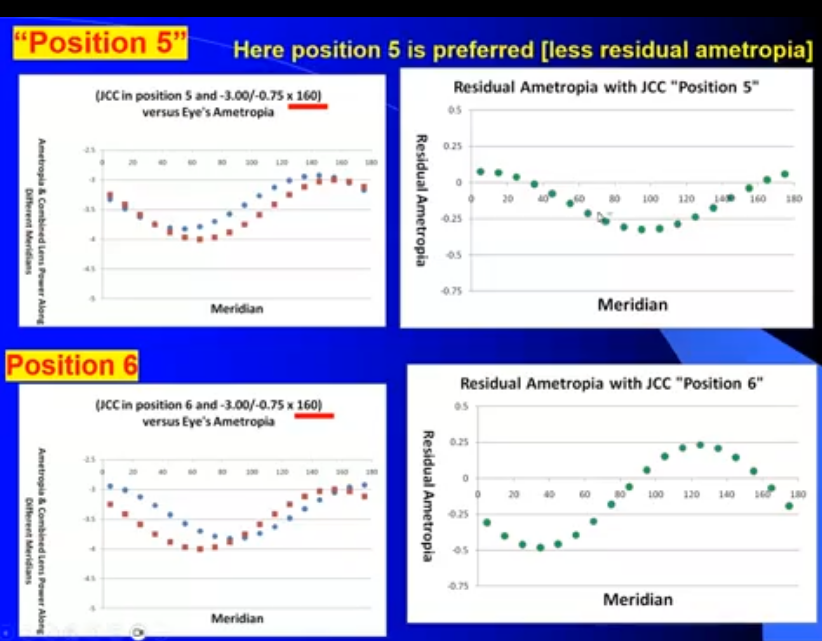
now at position 5:
trial frame lenses; -3.00 / -0.75 × 160
JCC: +0.25 / -0.50 × 115
position 6:
-3.00 /-0.75 × 160
JCC: +0.25 / -0.50 × 25
positions 5 & 6
position 5 is preffered as less residual ametropia
both getting close together
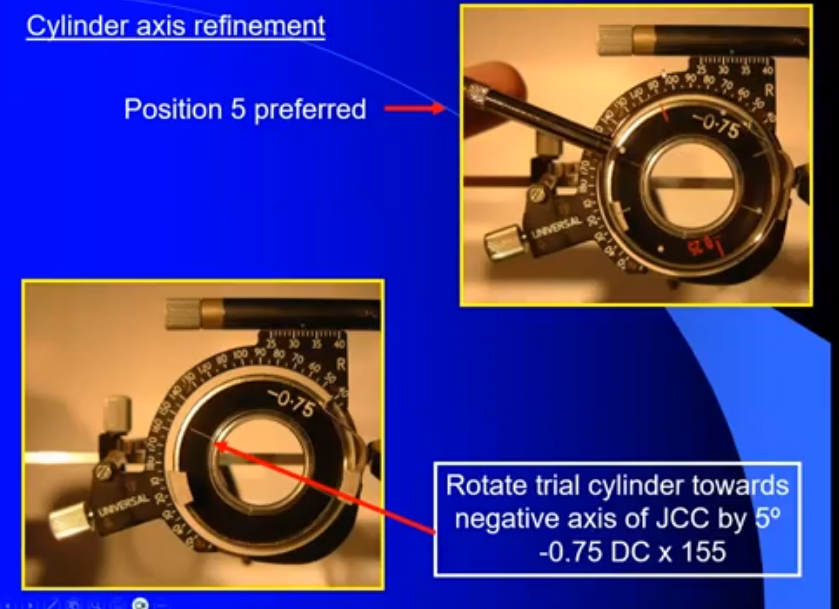
what is done now that we know positoin 5 was preferred
rotate the trial cylinder towards the negative axis of JCC by 5 degrees
now at -0.75 × 155
position 7;
-3.00/-0.75 × 155
+0.25 /-0.50 × 20
position 8:
-3.00 /-0.75 × 155
+0.25 / -0.50 × 110
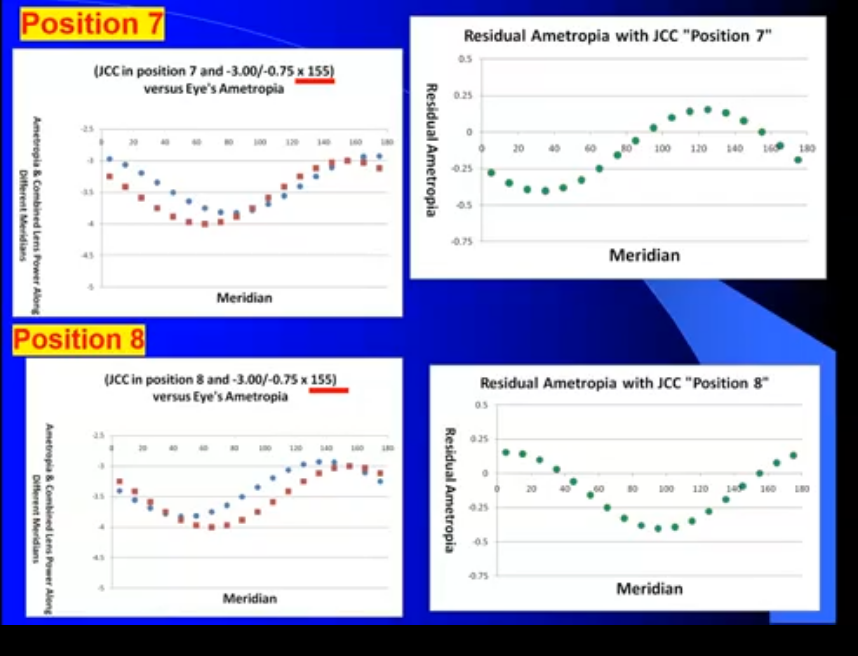
position 7 & 8
px will repsond saying they look the same
leave the axis in the same position
cylinder end point is -0.75 ×155
still have residual error but this is why we correct the cyl power
checking the cylinder power
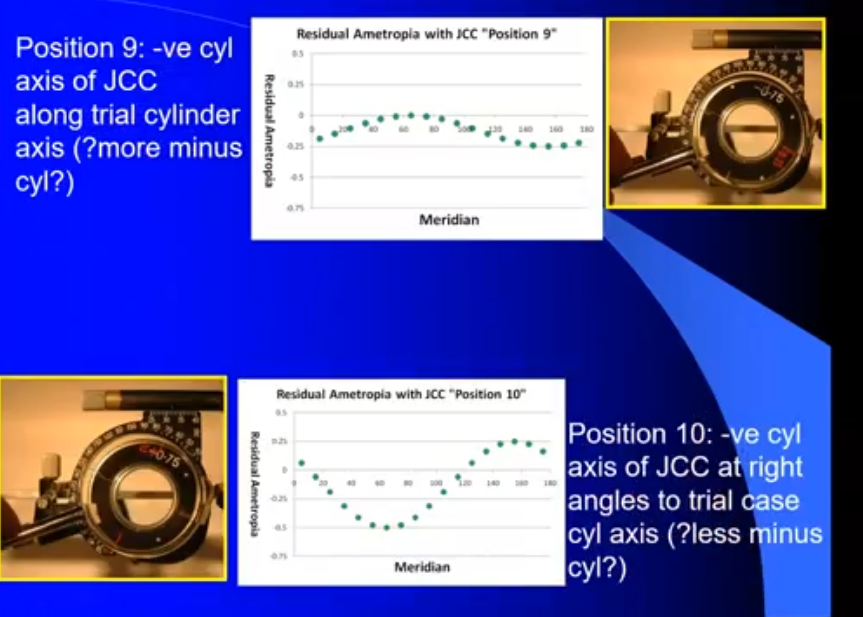
axis markings of JCC ( principal meridians) are lined along the axis of trial frame cyclinder
red markings along axis= want more minus power
position 9 & 10
dont need to work out astigmatic decomp as the principal meridians are established from cylinder axis
px prefers postion 9 as the dots are positioned closer to 0 and fluctuates less
so would give more minus as 9 is where the red markings are lined up with the trial axis
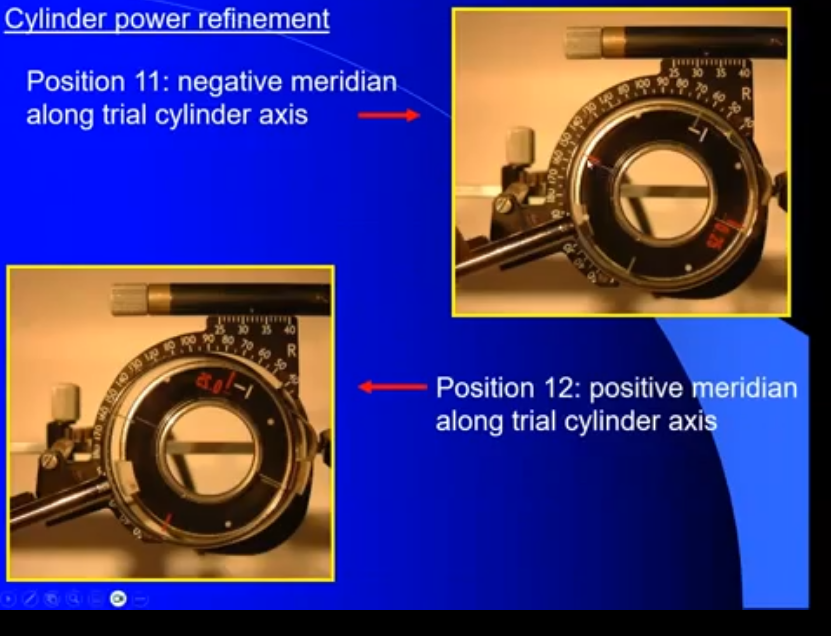
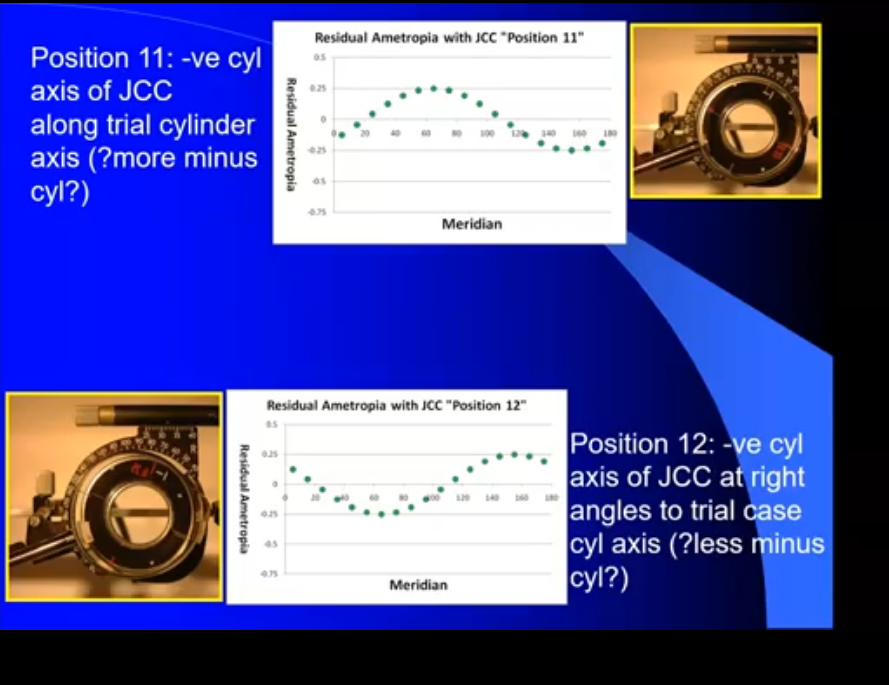
position 11 and 12
given -1.00 as in position 9 and 10 the px preffered the minus
px says there is no preference nd it is the same
so leave it as a -1.00 × 155
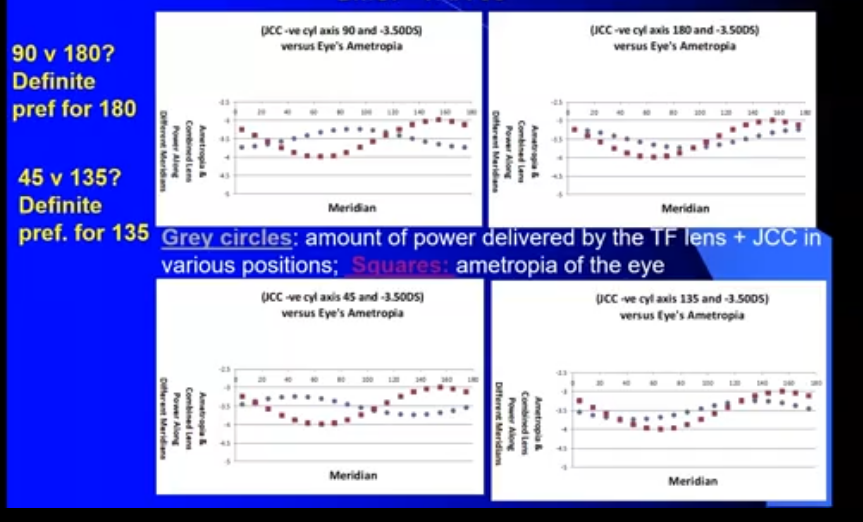
JCC when no cylinder is in place after ret
JCC held at 90 and 180: px will prefer to 180
JCC then held at 45 and 135 and px prefers when jcc held at 135
so cyl axis is placed between 135 and 180 and start with a -0.25