Social Psychology - Exam 4
 Call Kai
 Learn
Learn Practice Test
 Spaced Repetition
 Match
Match Flashcards
 Knowt Play
1/91

There's no tags or description
Looks like no tags are added yet.
Name | Mastery | Learn | Test | Matching | Spaced | Call with Kai |
|---|
No analytics yet
Send a link to your students to track their progress
92 Terms
Hostile aggression
•Driven by anger
•Intent is to harm
•Motive is emotional
•Usually spontaneous
•More common in males
Instrumental aggression
•Goal Oriented
•A means to an end
•Motive is strategic
•Usually premeditated
•Preferred by females
Condry & Ross Experiment
Same aggressive child behavior shown to participants.
If participants thought the child was a boy, aggression seen as “normal.”
If thought to be a girl, behavior seen as emotional/problematic.
Shows gender stereotypes influence judgments of aggression.
Freud’s Theory of Aggression
Eros = life instinct.
Thanatos = death/destructive instinct linked to aggression.
Id = impulsive desires.
Ego = compromise/mediator.
Superego = morality/conscience.
displaced aggression
Redirecting aggression toward a safer target.
Example: angry at boss → yell at family member.
sublimination
Redirecting aggressive impulses into socially acceptable activities
Example: sports, art, competition.
What is the evolutionary explanation for aggression?
Aggression evolved because it increased survival and reproductive success.
Uxoricide
The killing of a wife by her husband
Research shows a higher risk when men fear infidelity or jealousy
Paternity Confidence
A male’s certainty that a child is biologically his.
Cuckolding
Raising another man’s child unknowingly.
What brain structure is strongly linked to aggression?
Amygdala
What part of the brain helps regulate aggressive impulses?
prefrontal cortex
What hormone is associated with aggression?
Testosterone
What neurotransmitter is linked to impulsive aggression when levels are low?
Serotonin
(Low serotonin linked to impulsive aggression)
Bandura’s Bobo Doll Study
Children watched adults behave aggressively toward doll.
Children imitated aggressive behavior.
supports social learning theory
Social learning theory & the steps
- The theory that much social behavior is learned through observing and imitating others.
Observe model
Imitate
Reinforcement increases repetition
How can media influence aggression?
Media/game violence can model aggressive behavior and desensitize people to violence.
Relative Deprivation
Feeling deprived compared to others
(subjective feeling that you have less than you deserve)
Catharsis
emotional release obtained though recalling and reliving past events, expressing emotions, etc.
Is catharsis effective at reducing aggression?
no, research generally shows catharsis increases rather than decreases aggression.
Ways to Reducing Aggression
Reduce frustration
Teach nonviolent conflict resolution
Improve communication
Reduce violent media
Need to belong
The Human need for close relationships and social connections. Related to Maslow’s hierarchy: belongingness is a basic psychological need.
Proximity
People near us become more likely friends/partners.
Geographic distance
Physical distance between people (how close they live, work, or spend time near each other).
functional distance
How often paths cross naturally (stairs, mailboxes, etc.)
mere-exposure effect
the tendency for people to develop a preference for things or people simply because they are familiar with them through repeated exposure. (Repeated exposure increases liking)
Hatfield “Computer Dance” Study
Researchers paired college students for a blind date-style dance using a “computer matching” system. Participants believed they were matched based on personality traits and interests, but the actual pairings were random.
After the dance, participants evaluated how much they liked their date and whether they wanted to see them again.
Even when people believe they are choosing based on personality or compatibility, physical attractiveness strongly shapes initial romantic attraction.
Matching Hypothesis
people are most likely to form relationships with others who are similar to them in physical attractiveness.
What is the physical attractiveness stereotype?
The belief that attractive people possess more positive/desirable traits
“what is beautiful is good.”
What did Snyder’s study demonstrate? (Self-fulfilling prophecy)
In the study, men spoke on the phone with women they believed were either attractive or unattractive (based on fake photos). When men thought the woman was attractive, they behaved more warmly and positively. As a result, the women responded in a friendlier and more confident way.
This showed that expectations about attractiveness can influence behavior, causing attractive people to actually develop more socially positive behaviors because they are treated more positively by others.
What makes an attractive face?
Symmetry – symmetrical faces are often seen as healthier and genetically fit
Averageness – faces that resemble the average of many faces are often rated as more attractive
Youthfulness - Clear skin and healthy appearance
What makes an attractive body?
For Women
Men often rate traits linked to fertility and health as attractive, such as:
waist-to-hip ratio (often around 0.7)
sizable breast
shorter than them
For Men
Women often rate traits associated with strength, protection, or resources as attractive, such as:
broad shoulders
athletic build (not to muscular)
taller than them
According to evolutionary theory, what do men often prioritize in attraction?
signs of fertility and health in women for reproduction
According to evolutionary theory, what do women often prioritize in attraction?
signs of strength, stability, or access to resources
Evolutionary vs. Pure Biological Explanations
Pure biological explanations focus on immediate physical causes such as hormones, genetics, and brain chemistry. These explain how attraction responses happen biologically.
Evolutionary explanations focus on why certain preferences may have developed over human history.
Do Opposites Attract?
No, research strongly supports similarity.
Complementarity
the idea that people are attracted to others whose traits “complete” or balance their own (for example, a dominant person with a submissive person).
We Like Those Who Like Us - Berscheid Research
Knowing someone likes us increases attraction toward them
Triangular Theory of Love
Intimacy – emotional closeness, trust, sharing, and connection
Passion – physical attraction, sexual desire, excitement
Commitment – the decision to maintain the relationship long-term
Types of love
Infatuation
Companionate love
Consummate love
the ideal type of love in long-term romantic relationships
consummate love - intimacy, passion, commitment
Helping behavior
any action or Intentional behavior that benefits another person
example: helping someone carry groceries, giving directions, & donating money
Altruism
helping is motivated by a genuine concern for another person’s welfare, without expecting personal reward or benefit
Darley & Latané’s 5-Step Decision Tree of Helping
A person must:
Notice the event
Interpret it as an emergency
Take responsibility
Know how to help
Decide to actually help
If the person fails at any step, helping may not occur.
Bystander Effect
the tendency for people to be less likely to help when other people are present
(The more bystanders there are, the less likely any one individual is to intervene)
Pluralistic Ignorance
People look to others; if nobody reacts, assume no emergency
ex; If several people witness someone collapse but nobody reacts immediately, each person may assume others think the situation is not serious.
Diffusion of Responsibility
In large groups, we fail to accept personal responsibility, Everyone assumes someone else will help
Instead of thinking:
“I need to help,”
they think:
“Someone else will probably do it.”
Egoistic Motivation
Helping is motivated by self-interest or personal benefit
examples: helping to gain praise, avoiding guilt, improving mood, expecting rewards or reciprocity
Social Exchange Theory
Helping behavior is motivated by a cost-benefit analysis. People help when the perceived rewards outweigh the costs.
Empathy-Altruism Hypothesis
Empathy can create truly altruistic helping
kin selection
to help genetic relatives because helping them increases the survival of shared genes
ex; risking your safety to save a sibling or child
Reciprocal Altruism
helping others with the expectation that they may help you in the future
Norm of Reciprocity
the expectation that people should help those who have helped them
Social Responsibility Norm
people should help those who are dependent on us or unable to help themselves.
ex; helping children; helping elderly individuals
Social Justice Norm
the belief that people should receive outcomes they deserve and that fairness matters
“Minding Your Own Business” Norm
Norm suggests people should avoid interfering in others’ personal affairs
This can reduce helping because individuals fear:
embarrassment
offending someone
misinterpreting the situation
How does guilt affect helping behavior?
the feeling of guilt often increases helping
How does positive mood affect helping?
People in a good mood are often more likely to help others.
(feel-good, do-good effect)
How does negative mood affect helping?
Being in a negative mood can sometimes increase helping if helping may improve the person’s mood
age difference in helping
research generally finds that helping behavior tends to increase with age in some areas because older adults may
Who are people more likely to help?
People are more likely to help others who are similar to themselves
Who do we help? Gender Differences
Men are more likely to engage in heroic or physically risky helping (such as emergency rescues).
Women are more likely to provide long-term caregiving and emotional support.
How can we increase helping?
1. Reduce the ambiguity of the need for help
2. Enhance feelings of personal responsibility
3. Teach norms supporting helpful behavior
4. And SLOW DOWN
Stereotype (cognitive)
a generalization about the "typical" characteristics of members of a particular group
prejudice (feeling)
an negative attitude/feeling/judgment toward an individual that is based solely on their membership in a certain group
ex; disliking someone because of their race, religion, or gender
Discrimination (behavior)
unfair behavior or actions directed toward people because of their group membership
ex; refusing to hire someone because of their ethnicity
numerical majority
the group with the largest number of people in a population
power majority
the group with the greatest social, political, or economic power, regardless of number
individual discrimination
Discrimination carried out by one person toward another.
ex; manager refusing to hire someone based on prejudice
institutional discrimination
Discrimination built into social institutions, policies, or systems that disadvantage certain groups.
ex; unequal school funding, discriminatory housing policies, biased criminal justice practices
blatant racism
Open, direct, and obvious racist beliefs or actions.
Examples:
racial slurs
openly supporting segregation
latent racism
more complex, indirect, hidden, or subtle forms of racism
Examples:
avoiding interaction with certain groups
supporting policies that disadvantage groups while claiming neutrality
privilege
unearned advantages, benefits, or opportunities that people receive because of their membership in a particular social group.
Examples:
White privilege
Male privilege
Heterosexual privilege
sex
refers to the biological and physiological characteristics that define men and women (chromosomes)
gender
refers to the socially constructed roles, behaviors, activities, and attributes that a given society considers appropriate for men and women
gender stereotypes
generalized beliefs about how men and women are “supposed” to behave
Masculine Stereotype
– Assertive
– Dominant
– Aggressive
– Competitive
– Analytical: scientifically minded
– Problem solvers
– Athletic
– Spatially oriented
Feminine Stereotype
– Emotional
– Tender
– Compassionate
– Understanding
– Kind
– Helpful
–Talkative
Who subscribes to and who suffers because of stereotypes?
BOTH men and Women
Implicit Association Test (IAT)
A test measuring automatic unconscious associations using reaction times.
Example:
pairing “White faces + good words”
pairing “Black faces + good words”
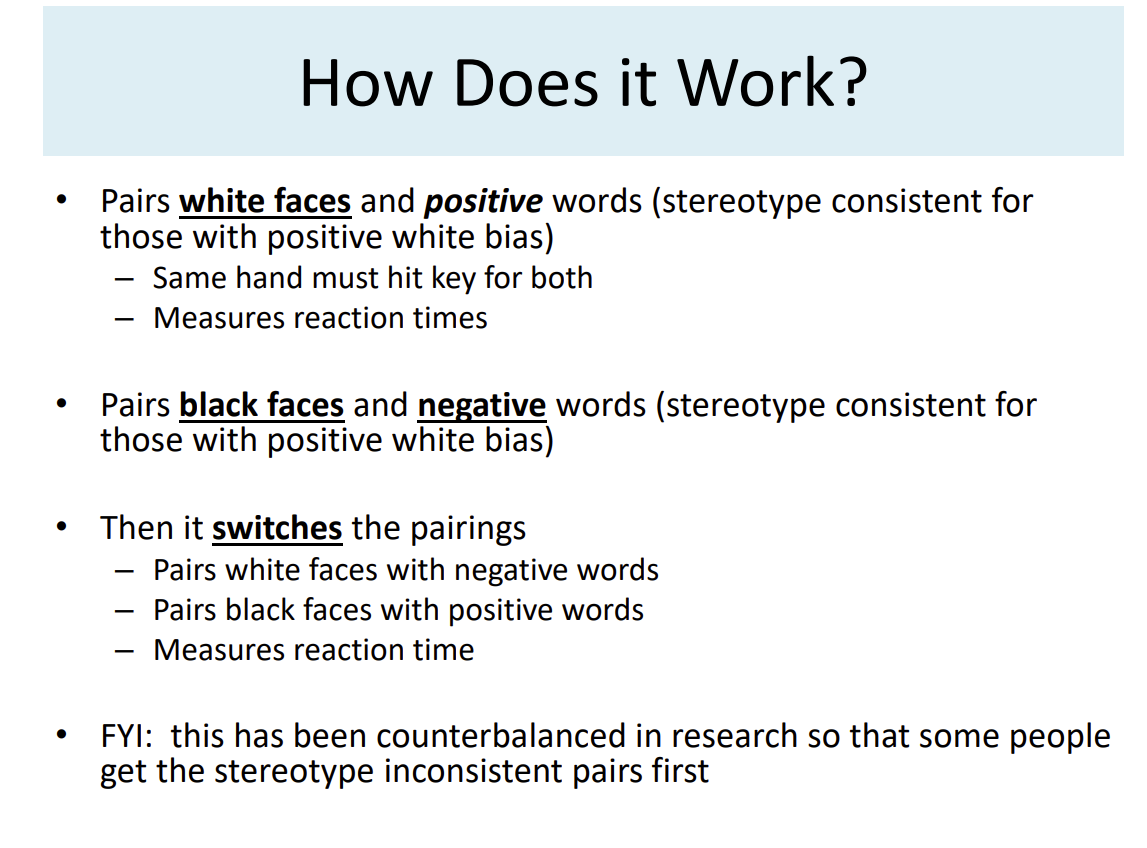
IAT Research Findings
found that many people in the United States—both White and non-White participants—show an automatic preference for White faces over Black faces at an implicit level, even when they consciously reject prejudice.
socialization
the process through which people learn cultural norms, beliefs, values, and behaviors
social learning
We learn by watching others
Steps of Social Learning
1. Observe Model
2. Imitate Model
3. Reinforcement
4. Learned behavior will be repeated for future reinforcement
subtyping
Creating exceptions to stereotypes without changing the stereotype
Example: saying “She’s different from most women” instead of changing the stereotype about women.
out-group homogeneity effect
Seeing members of other groups as more similar than they really are
“they are all alike”
Dutton & Aron Study (“Bridge Study”)
Research by Donald Dutton and Arthur Aron studied how physiological arousal affects attraction.
Study
Men crossed either:
a scary, high suspension bridge
a stable, safe bridge
After crossing, they met an attractive female researcher.
Findings
Men who crossed the scary bridge were more likely to:
contact the researcher later
report attraction
Conclusion
This demonstrated misattribution of arousal:
people may mistakenly interpret physical arousal (fear) as romantic attraction.
Darley & Batson Study (“Good Samaritan Study”)
Research by John Darley and Daniel Batson examined situational influences on helping.
Study
Seminary students walked to give a talk, sometimes about the Good Samaritan parable.
Researchers manipulated whether participants believed they were:
late
on time
early
On the way, participants encountered a person apparently in distress.
Findings
Students who were rushed were much less likely to help.
Conclusion
Situational factors (like time pressure) strongly influence helping behavior, sometimes more than personal beliefs or values.
What did the Dutton & Aron bridge study demonstrate?
People can misattribute physiological arousal to attraction.
What did the Darley & Batson Good Samaritan study show?
People in a hurry are less likely to help others.
stereotype threat
fear or anxiety people experience when they are at risk of confirming a negative stereotype about a group they belong to
ex; If women are reminded of the stereotype that “women are worse at math” before taking a math test, they may perform worse because of stress and pressure caused by the stereotype—not because of actual ability differences.
What did Steele & Aronson’s stereotype threat research find?
Black students performed worse on tests described as measuring intelligence, but equally well when tests were described as non-diagnostic.