helping behaviour
 Call Kai
 Learn
Learn Practice Test
 Spaced Repetition
 Match
Match Flashcards
 Knowt Play
1/18

There's no tags or description
Looks like no tags are added yet.
Name | Mastery | Learn | Test | Matching | Spaced | Call with Kai |
|---|
No analytics yet
Send a link to your students to track their progress
19 Terms
alturism
behaviour that has the goal of benefiting other people with no reward, driven by empathic motivation
evolutionary perspective
prosocial behaviour helps groups survive
any gene promoting alturism should be extinct
evolutionary - kinship selection
we are more likely to do things that further genes even at the expense of our own well being, theres a evolutionary urge to favour those with closer genetic relation
Krupp 2008- pubic goods game
motivations for helping - empathy alturism Batson
alturism is a motivation in helping behaviour, if someone is empathatic they will help them regardless of what they gain from it
study- P watched students get shocks and could offer to take the shocks themselvesm
motivations for helping - alturism egoism Cialdini
witnessing distress causes bad mood who wants to reverse the mood
actions are based on self interest
negative self relief model
humans have a innate drive to reduce their negative moods
helping behaviour helps mood
people help for ego reasons rather than alturistic reasons
bystander effect
likelihood anyone helping in a emergency decreases as the number of other bystanders increases
number effect
larger the number of bystanders the less likley anyone will help
diffusion of responsibiltity
responsibility divided by bystanders, more people less individual responsibility
pluralistic ignorace
emergency bystanders look to others in reacting to the event
each person fails to react, they look at non reacting others and view it as not needing a reponse
audience inhibition / self efficacy
bystander may fear embarrassment by their actions, lower that behaviour
strong when bystanders feel they lack the ability to help
beliefs about the ability to carry out certain actions needed for a specific goal
Latane & Darley 1970
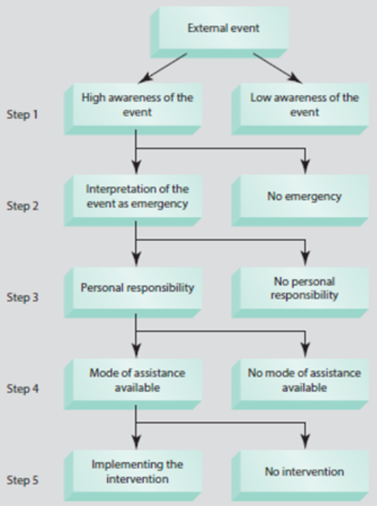
cost and reward of helping
Observing an emergency creates arousal in the bystander which is unpleasant, the bystander responds by considering the costs and rewards of helping/not helping.
The arousal- cost-reward model. A motivational construct as a vicarious model.
Cognitive decision-making components for the calculation of cost and reward of actions. Includes the concept of we-ness.
common ingroup identity model Gaertner
if members of a group see themselves as members of a common group, hostility and bias between groups is reduced and prosocial behaviour increasedo
ingroup help Levine
football shirt study- shared identity which increases helping behaviour
outgroup help
people likley to help when seen as ingroup members
when social identity is salient, people act in terms of norms/values of the group
we help others fit into out groups expectations of social behaviour
disasters
panic, helplessness and disorder shows increased social support due to shared identity
the way authorities respond can help/hinder this shared identity
volunteering
form of sustained helping behaviour, individual motivations and anticipations, personal rewards and acomplishmentss
social cure paragdim (grey, stevenson)
good for our health, showing shared identity has acceptance and belongying