Unit 4 FRQ Notes
 Call Kai
 Learn
Learn Practice Test
 Spaced Repetition
 Match
Match Flashcards
 Knowt Play
1/6

There's no tags or description
Looks like no tags are added yet.
Name | Mastery | Learn | Test | Matching | Spaced | Call with Kai |
|---|
No analytics yet
Send a link to your students to track their progress
7 Terms
Describe the soil profile of a desert
Deserts have no o horizon, little bit of a horizon consisting of sand, a b horizon a bit thicker than the a horizon comprised of sand and clay, and the c horizon a bit smaller than b but a bit bigger than a comprised of coarse sand
Describe the soil profile of a prairie
a prairie has a thin o horizon layer made of humus with a thick a horizon layer made of humus, sand, and clay and a b horizon made of sand and a c horizon made of coarse sand
Describe the soil profile of a temperate rain forest
has a small layer of humus in the o horizon, a thicker a horizion layer of humus, sand, and clay, a b horizion layer of clay, and a c horizon layer of sand
in order from greatest bulk density to least greatest, list clay sand and humus
humus, clay, sand
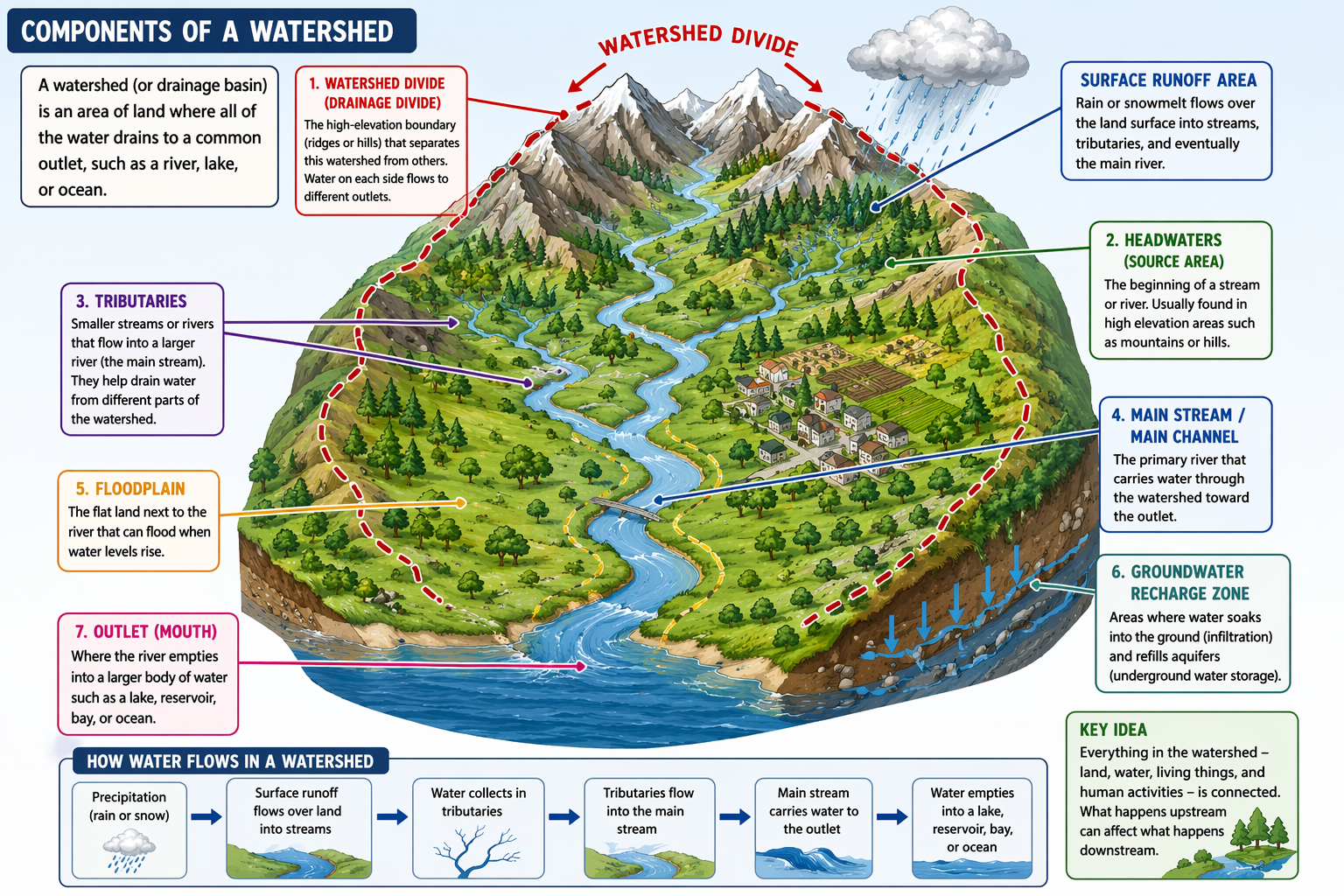
What is a watershed?
An area of land that catches rain and snowmelt, channeling all drainage, via surface streams, rivers, and underground, an groundwater, to a common outlet, such as a lake, river, bay, or ocean.
Why are watersheds useful?
They act as natural systems that collect, filter, and store water, providing essential drinking water, supporting habitats for wildlife, and preventing flooding.
What are the components of a watershed?
Divide (drainage divide)
The high-elevation boundary (ridges or hills) that separates one watershed from another. Water on each side flows into different systems.Tributaries
Smaller streams or rivers that flow into a larger river.Main stream / main channel
The primary river that carries water out of the watershed.Headwaters (source area)
The beginning of a stream or river, usually in higher elevation areas.Floodplain
The flat area next to a river that can flood when water levels rise.Groundwater recharge zone
Areas where water infiltrates into the soil and refills aquifers.Outlet (mouth)
Where the river empties into a larger body of water (lake, ocean, etc.).Surface runoff area
Land where water flows over the ground into streams after rain or snowmelt