Monetary Policy
 Call Kai
 Learn
Learn Practice Test
 Spaced Repetition
 Match
Match Flashcards
 Knowt Play
1/54

There's no tags or description
Looks like no tags are added yet.
Name | Mastery | Learn | Test | Matching | Spaced | Call with Kai |
|---|
No analytics yet
Send a link to your students to track their progress
55 Terms
What is monetary policy?
Set of actions taken by the central bank to influence level of economic activity through changes to the amount of money in circulation and the price of money
What are 4 things monetary policy is used to influence?
Savings and bank lending
Currency markets
Market interest rates
Inflation
What is the Demand for money (MD)?
The amount people wish to hold as cash as opposed to other assets
What is the supply of money (MS)?
The amount of money in circulation in the economy
What is the main tool used to change the demand for money?
Interest rates
What are interest rates essentially?
The opportunity cost of holding money
What are the axes on the MD/MS diagram?
Interest rate
Money holdings
What does the diagram look like?
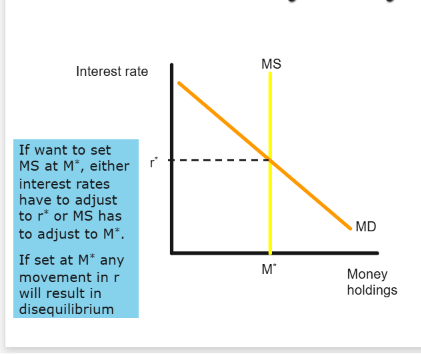
Why is the MD curve downward sloping?
The higher the interest rate the less demand for money
Why is the MS curve perfectly inelastic?
Money supply is not influenced by market it is set by the central bank
What are the 4 functions of money?
Medium of exchange
Standard of deferred payment
Store of wealth
Measure of Value
What is narrow money?
Notes and coins in circulation - monetary base
What is broad money?
Notes and coins plus money held in bank and building society accounts
What is the term for the fact that narrow money is more easily spendable?
Liquidity
What are 3 examples of borrowing interest rates?
Mortgages
Credit card interest
Interest rates on gov and corp bonds
What is the MPC?
Monetary Policy Committee
What does the MPC discuss for 2 days each month?
What interest rates should be
What are short term interest rates used to control?
Inflation
What is the ‘official rate’?
The rate at which the Bank of England will lend to the financial system and influences structure of all other interest rates
What is the inflation target set by the government?
2%
What is the real rate of return on savings?
Money rate of interest - rate of inflation
What can lead to an increase in real interest rates?
Price deflation
What type of monetary policy involves high interest rates to restrict spending?
Tight
What is another term for this type of policy?
Deflationary
What is loose/ expansionary monetary policy?
When interest rates are kept low to encourage spending
What are 3 features of expansionary monetary policy?
Fall in real interest rates
Measures to expand supply of credit - cost of borrowing reduces - increased spending
Depreciation of the exchange rate - exports rise - injection - employment rises - income rises - spending increases
What are three features of deflationary monetary policy
Higher interest rates on loans and savings
Tightening of credit supply
Appreciation of the exchange rate
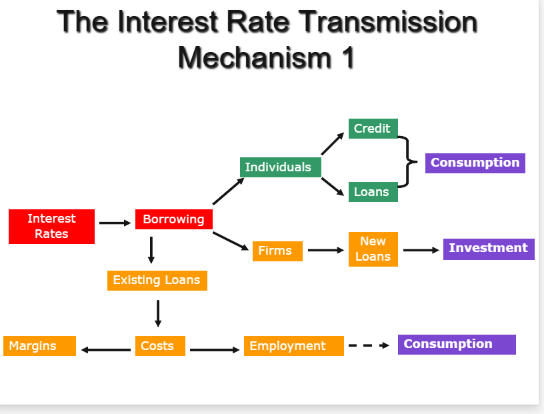
Interest Rate Transmission Mechanism 1
What is the interest rate transmisson mechanism 1 focused on?
Loans
How does a fall in interest rates directly increase individual’s consumption?
Cost of borrowing falls
Accessibility of credit rises
Interest rates on loans fall
More loans - more consumption - increased AD
How does a fall in interest rates cause increased investment?
Interest on new loans falls
Firms take out more loans
Invest in capital with these loans
I rises - AD rises - Inflation rises
What type of existing loan must firms have to be effected by a fall in the base rate?
Variable firms
How does the fall in cost of existing loans held by firms lead to increased consumption?
Lower interest payments
Costs reduced
Employment/ incomes rise
Consumption increases
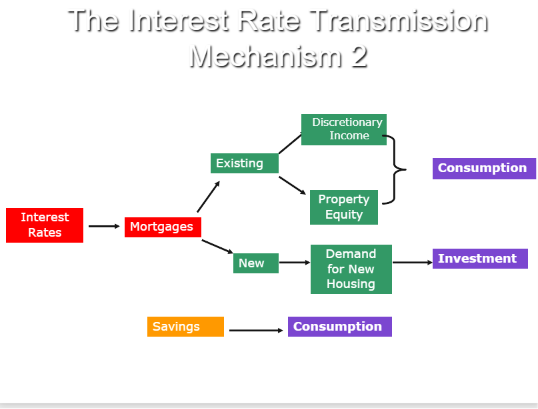
Interest Rate Transmission Mechanism 2
What is the interest rate transmission mechanism 2 focused on?
Mortgages
What is property equity?
Value of house - remaining mortgage debt
What is discretionary income?
The money remaining from an individual's take-home pay after taxes and essential living expenses
What are the two ways in which a fall in interest rates effect individuals with existing mortgages causing AD to rise?
Interest rates fall - mortgage rates fall
Interest payments fall - increased discretionary income - consumption rises - AD rises
Interest payments fall - demand for housing rises - house price increases - property equity rises - wealth effect - increased consumption
How does a fall in mortgage rates cause increased investment?
Interest rates fall - mortgage rates fall - increased demand for housing - increased profit motive for developers - increased investment by firms to supply housing
What is the interest rate transmission mechanism 3 focused on?
Exchange rates
How does a rise in interest rates cause a Balance of Payment deficit reducing AD?
Interest rates rise - Uk bond yields and interest payments on UK savings rise - more demand for pound (needed to buy UK assets)
Exchange rate appreciates - price of M falls and price of X rises - more demand for M - value of M exceeds value of X - BoP deficit - leakage from circular flow - AD falls
What is the most common evaluation point for the impact of interest rate changes on AD?
Time lags
What are 3 reasons why a fall in interest rates and therefore mortgage rates may not have an impact?
Mortgage rates do not always follow base rate - banks may lose profit if they increase rate
Many home - owners on fixed rate mortgages
People in rented property unaffected
What are two reasons why Investment may not increase due to a fall in interest rates?
Many loans for capital spending are on fixed rates
Firms may have spare capacity so have no need to increase capital
Why might a fall in interest rates actually reduce consumption?
Value of savings reduces - lower confidence etc
Why might a fall in interest rates not cause inflation to rise?
Economy may have spare capacity so a rise in AD would cause no inflationary pressure
What is the liquidity trap?
When low interest rates and a high amount of cash balances in the economy fail to stimulate AD
Why does the liquidity trap occur?
If interest rates are already low there is little expected demand and so firms do not increase investment
What is the only way AD can be stimulated at this point?
Increased gov borrowing to spend directly or make tax cuts
How does a fall in interest rates redistribute income?
Income of borrowers with loans / debt rises while lenders and savers lose out
What method is used by the Bank of England to avoid a recession while in a liquidity trap?
Quantitative Easing
What is Quantitative Easing (QE)
When the central bank creates new money electronically and uses it to buy financial assets, mainly government bonds
How does QE work?
Central bank creates money electronically
Uses new money to buy gov bonds from commercial banks
Increased demand for bonds - bond price increases - fixed rate so interest rate (yield) falls
Firms can also reduce interest rate on their bonds causing banks to lower rates