Chapter 5: Photosynthesis
 Call Kai
 Learn
Learn Practice Test
 Spaced Repetition
 Match
Match Flashcards
 Knowt Play
1/43

Name | Mastery | Learn | Test | Matching | Spaced | Call with Kai |
|---|
No analytics yet
Send a link to your students to track their progress
44 Terms
Define Photosynthesis as a Process
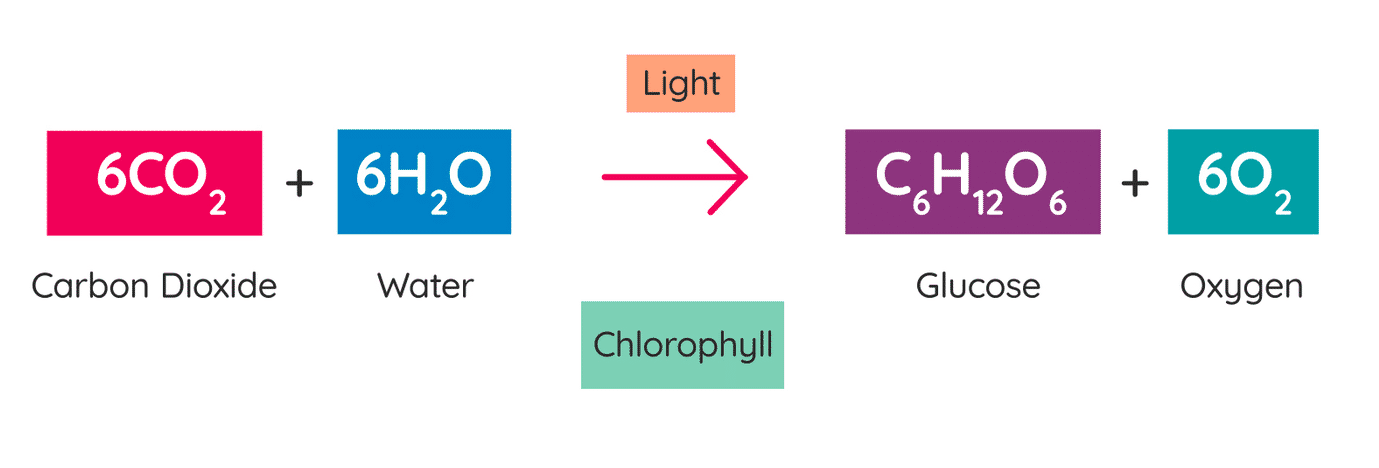
Photosynthesis is the process that involves capturing light energy and converting it into usable chemical energy, by using light energy to power the production of glucose.
NOTE: Photoautotrophs are organisms capable of photosynthesis (eg. plants, algae, and cyanobacteria)
State the Chemical Formula of Photosynthesis
Briefly Define Stomata
Stomata are small pores on the leafs surface that open and close to regulate gas exchange, allowing CO2 to diffuse into the leaf for use in photosynthesis.
Briefly Define Mesophyll Cells
Mesophyll cells are the primary photosynthetic cells in the leaves of photosynthesising plants, and contain high numbers of chloroplasts.
Briefly Define Chloroplasts
Chloroplasts are membrane-bound organelles only found in plant and photoautotroph cells. They are the site of photosynthesis within plant cells, responsible for the conversion of light energy into usable chemical energy.
Breifly Define Thylakoids and Grana
Thylakoids are flattened sac-like structures inside the chloroplast. Each thylakoid is made up of a chlorophyll-containing membrane enclosing a lumen. Stacks of thylakoids are called grana (granum singular).
Briefly Define Chlorophyll
Chlrorophyll primary green pigment found in the thylakoids of chloroplasts and is responsible for initiating photosynthesis by capturing light energy.
State the Purpose of NADPH in Photosynthesis
NADPH is a coenzyme that helps power reactions in the light independent stage by donating electrons and hydrogen ions.
State the Purpose of ATP in Photosynthesis
ATP is a high-energy coenzyme that, when broken down into ADP and Pi, releases energy to help facilitate reactions in the light independent stage.
State the Location of the Light Dependent Stage
The light dependent stage occurs in the chlorophyll-filled thylakoid membranes (which make up the chloroplast’s grana).
Outline the Purpose of the Light Dependent Stage
The light dependent stage is the first stage photosynthesis, occuring when light is present. It’s purpose is to generate high energy coenzymes NADH and ATP, to power the formation of glucose in the light independent stage/Calvin cycle.
Identify the Inputs and Outputs of the Light Dependent Stage
Inputs:
12 H2O
12 NADP+
18 ADP + Pi
Outputs:
6 O2
12 NADPH
18 ATP
Outline the Steps of the Light Dependent Stage
Sunlight energises an electron within chlorophyll
Water is split into O2 and H+ ion (electron from H donated to chlorophyll)
The energised electron and H+ ion lead to the production of the coenzymes NADPH and ATP
The oxygen is released out of the chloroplast, and the coenzymes are ready for the second stage of photosynthesis
State the Location of the Light Independent Stage
The light independent stage occurs in the stroma of the chloroplasts.
Outline the Purpose of the Light Independent Stage
Energised by NADPH and ATP, the light independent stage uses CO2 to form glucose that the cell/organism can store and use for energy.
Identify the Inputs and Outputs of the Light Independent Stage
Inputs:
6 CO2
12 NADPH
18 ATP
Outputs:
Glucose (C6H12O6)
12 NADP+
18 ADP + Pi
6 H2O
Outline the Steps of the Light Independent Stage
CO2 taken in through the stomata is fixed by Rubisco
The carbon enters a cyclic reaction powered by NADH and ATP
Eventually, a specific 3 carbon molecule is produced that goes on to contribute to the formation of glucose
Define Rubsico
Rubisco is an enzyme involved in the initial carbon fixation during the light-independent stage of photosynthesis.
Outline the Cycle of Carbon Molecules in the Calvin Cycle
Carbon fixation - Rubisco converts 3xCO2 and 3xRuBP into 6x3-PGA.
Reduction - NADPH donates electrons (reduces) to an intermediate three-carbon molecule to produce 6 G3P
Regeneration - 1xG3P leaves the cycle and the remaining 5xG3P are converted back to RuBP molecules needed to start the cycle again
Repeat - after 2 cycles, the 2xG3P molecules go into glucose
Describe the Major Flaw with Rubsico
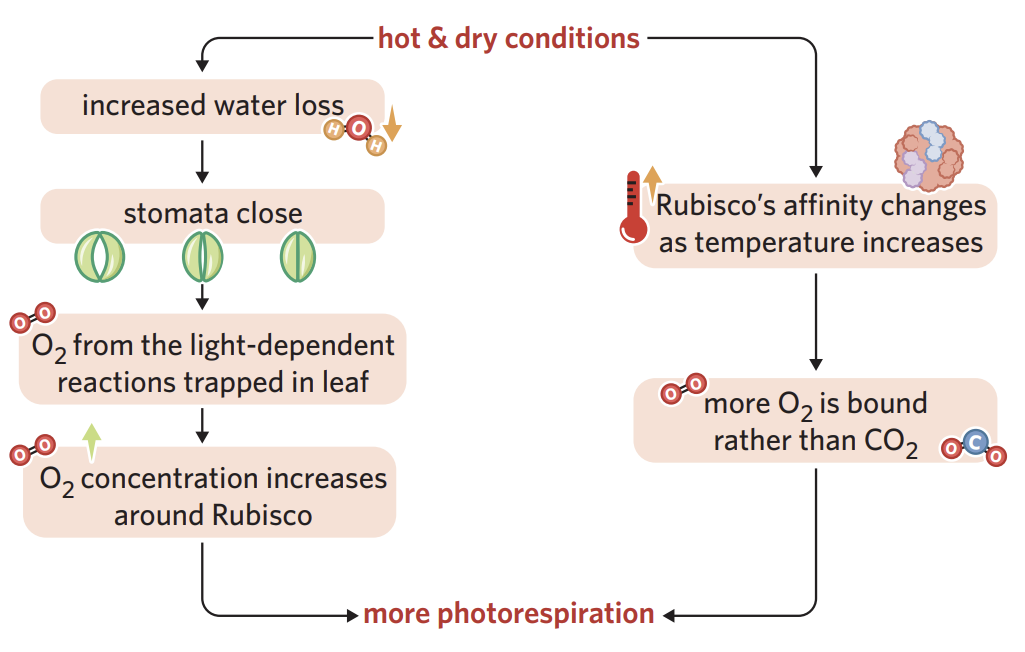
A major flaw with Rubisco is its ability to bind to O2 instead of CO2 as a substrate, a process known as photorespiration, which fails to initiate the Calvin cycle and thus prevents the facilitation of photosynthesis by that enzyme.
Identify the 2 Key Factors that Influence Photorespiration Rates
Major influences on the rate of photorespiration are temperature and substrate concentration (specifically CO2 and O2 concentrations).
Explain how Hot & Dry Conditions Increase Photorespiration Rates
Explain how Substrate Concentrations Affect Photorespiration Rates
High concentrations of CO2 or O2 will make Rubisco more likely to collide with and bind to that substrate. Thus the ideal conditions surrounding Rubisco enzymes are high CO2 concentrations and low O2 concentrations.
Define C3 Plants
C3 plants are plants with no evolved adaptations to minimise photorespiration. They are found in moderate or cool and wet environments, which are the ideal conditions to lessen photorespiration without adapted photosynthesis.
Outline the Adaptation of C4 Plants
C4 plants have an unchanged light-dependent stage but have adapted their light-independent stages, so that the initial carbon fixation and the rest of the Calvin cycle is separated over 2 different cells - the mesophyll and bundle-sheath cells.
Outline the Habitats that C4 Plants are Best Suited to
The adaptations to minimise photorespiration make C4 plants best adapted for hot and sunny climates.
Outline the Steps of the Light-Independent Stage in C4 Plants
Atmospheric CO2 enters the mesophyll cells and is fixed by PEP carboxylase
The carbon is used to create oxaloacetate which is then converted into malate
Malate is transported into bundle-sheath cells, where it breaks down and releases CO2 which is fixed by Rubsico which initiates the rest of the cycle
Pyruvate from the breakdown of malate is transported back to the mesophyll cell and is converted into PEP with the help of ATP ready for CO2 fixation again
Explain how C4 Plants’ Adaptations Limit Photorespiration
Since CO2 is actively pumped into bundle-sheath cells which are the site of Rubisco-facilitated carbon fixation, a high CO2 concentration is maintained around Rubisco. Additionally, Rubisco is separated from the O2 produced by the light-dependent stage.
Outline the Adaptation of CAM Plants
CAM plants have an unchanged light-dependent stage but have adapted their light-independent stages, so that the initial carbon fixation and the rest of the Calvin cycle is separated over time.
Outline the Habitats that CAM Plants are Best Suited to
The adaptations to minimise both photorespiration and water loss make CAM plants best adapted for very hot and dry climates.
Outline the Steps of the Light-Independent Stage in CAM Plants
NIGHT
Stomata open to bring in CO2 which is fixed by PEP carboxylase to create oxyloacetate and then malate or another organic moleucle
The malate or other molecule is stored in a vacuole in the mesophyll cell
DAY
Stomata close to limit water loss
Controlled release of stored carbons allows photosynthesis to occur during the day (when light is available)
Explain how CAM Plants’ Adaptations Limit Photorespiration
By opening stomata at night water loss is limited which reduces photorespiration (stomata can stay open at night and O2 can diffuse out) and the controlled release of molecules out of vacuoles ensures a high concentration of CO2 is maintained near Rubisco.
List 5 Factors that Affect Photosynthesis Rates
Light (intensity and colour)
Temperature
pH
CO2 concentration
Enzyme inhibition
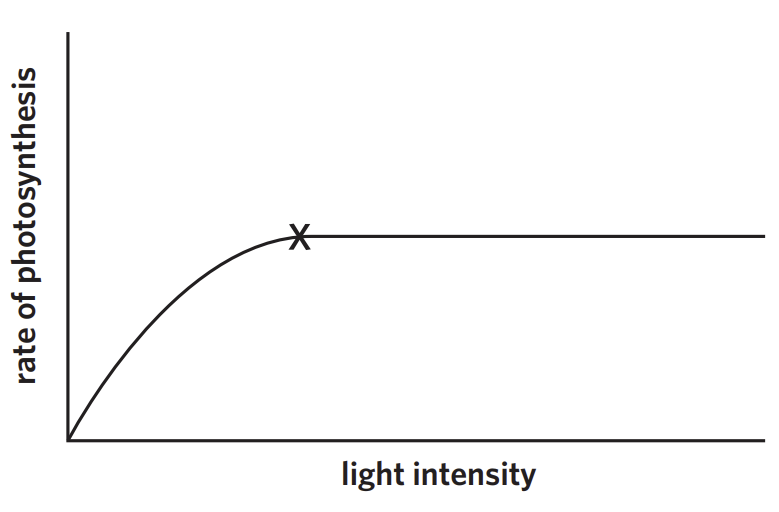
Describe the Impact of Light Intensity on Photosynthesis Rates
As light availability increases, the rate of photosynthesis increases as more of the chlorophyll are energised within more plant cells. The rate will eventually plateau due to enzyme saturation or another limiting factor.
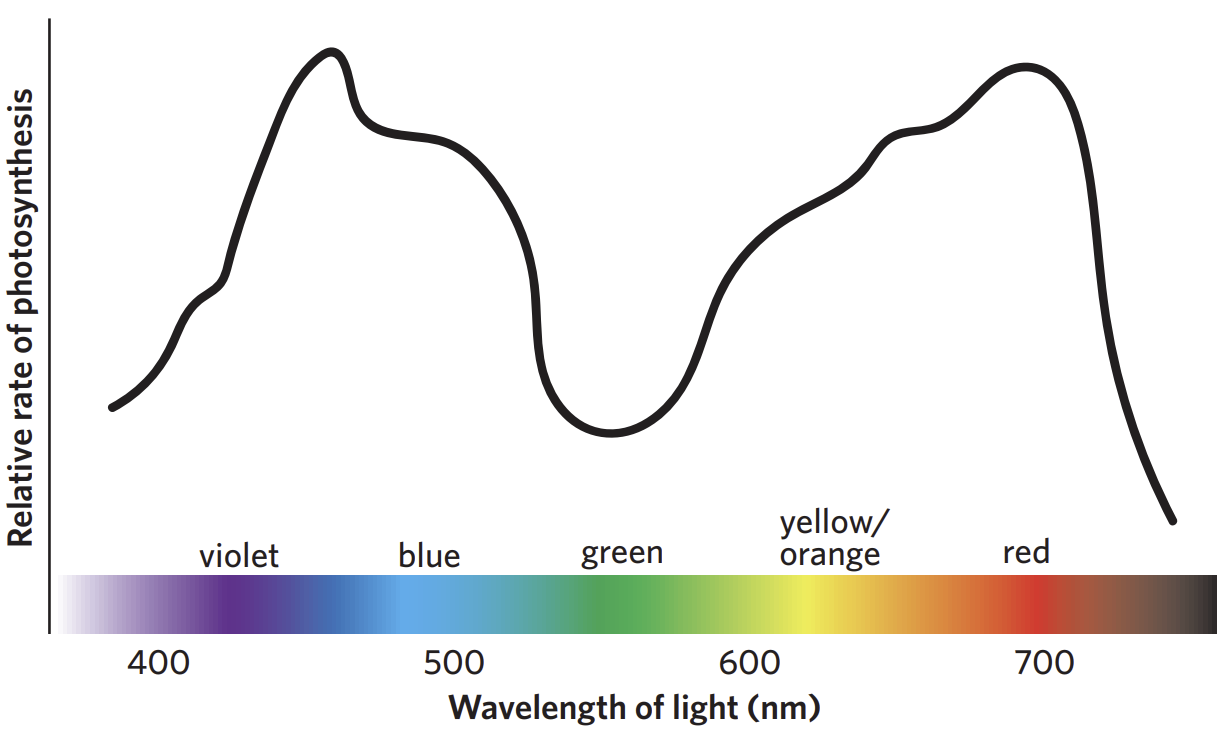
Describe the Impact of Light Colour on Photosynthesis Rates
Since chlorophyll is a green pigment, it reflects predominantly green light and better absorbs other wavelengths. The greatest rates of photosynthesis occur when the palnts are exposed to violet or red light, which chlorophyll will mostly absorb, not reflect.
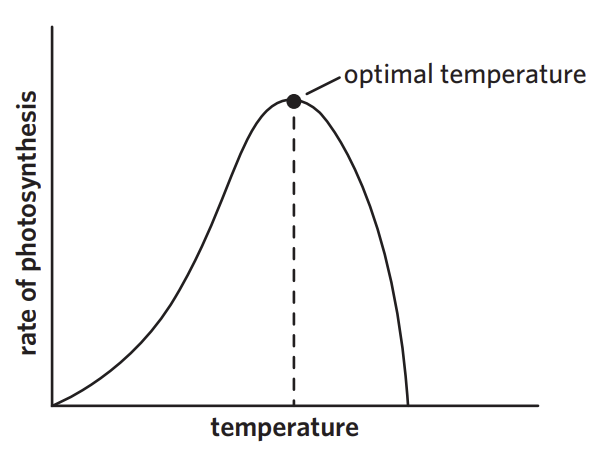
Describe the Impact of Temperature on Photosynthesis Rates
The rate of photosynthesis is highest at the optimal temperature for the enzymes catalysing the various reactions in the process of photosynthesis.
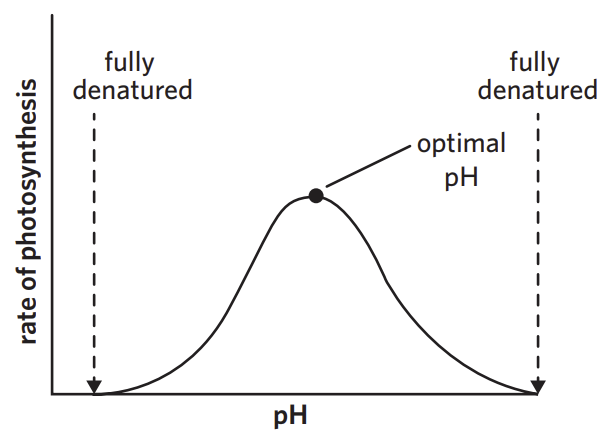
Describe the Impact of pH on Photosynthesis Rates
The rate of photosynthesis is highest at the optimal pH for the enzymes catalysing the various reactions in the process of photosynthesis.
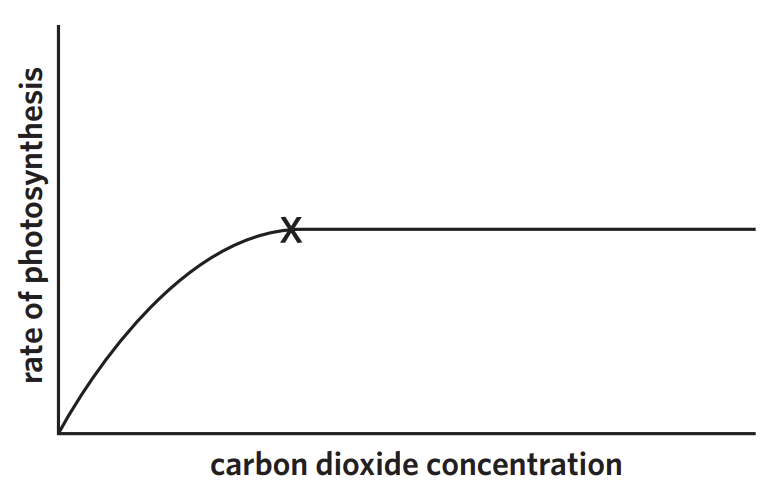
Describe the Impact of CO2 Concentration on Photosynthesis Rates
As CO2 concentration increases, the rate of photosynthesis increases as Rubsico is less likley to bind to O2 and enzyme-substrate collisions will be more frequent. The rate will eventually plateau due to enzyme saturation or another limiting factor.
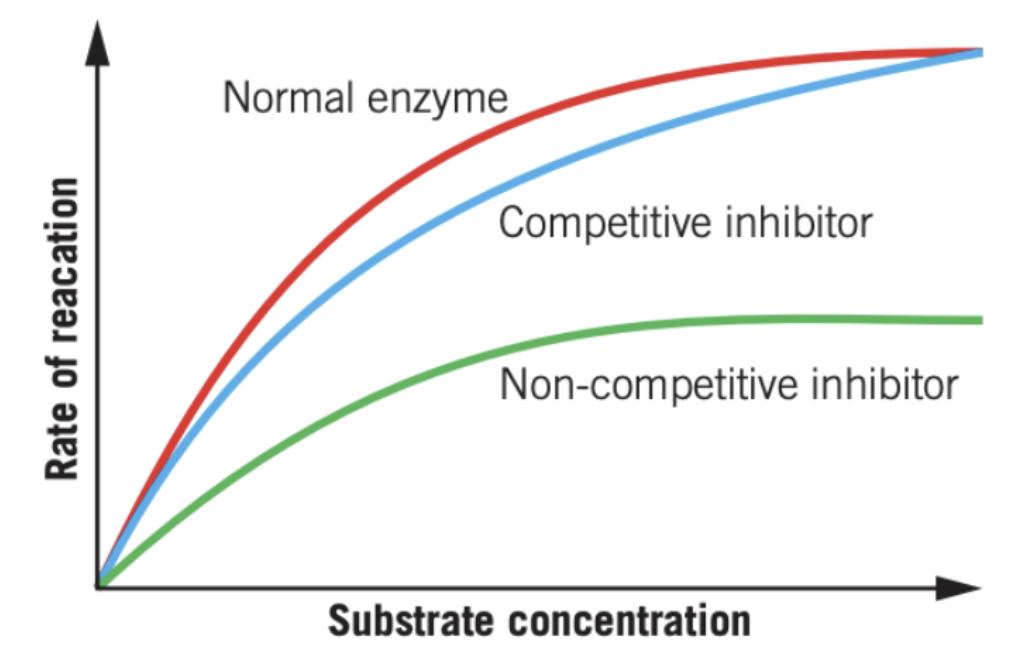
Describe the Impact of Enzyme Inhibition on Photosynthesis Rates
In general, the presence of inhibitors of enzymes involved in photosynthesis will lower rates of photosynthesis. Different inhibitors will have different affects on the rate.
Briefly Describe How Plant Types are Affected Differently by these Factors
Light, pH and enzyme inhibition affects all plants equally
C4 and CAM plants are less susceptible to changes in temperature and CO2 concentrations affecting photosynthesis rates than C4 plants due to their adaptations
Briefly Explain how CRISPR-Cas9 can be Used to Modify Crop Species
CRISPR-Cas9 technology can be used to genetically modify an organisms genome, by cutting through DNA at target gene sequences. This can be used to change or remove unwanted or disadvantageous alleles within the organism’s genome, to result in improved or desired phenotypes.
Explain the Need for Improving Photosynthetic Efficiences and Yield of Crops
Agricultural productivity must increase to meet growing demands
Climate change threates to seriously reduce crop yields
Arable land is already largely exhausted
Cleaing more land or applying intensive farming practices to increase yields in (particualrly in unsuitable environments) is not sustainable and could worsen climate change
List 5+ Ways that CRISPR-Cas9 could Modify Crops for Agricultural Purposes
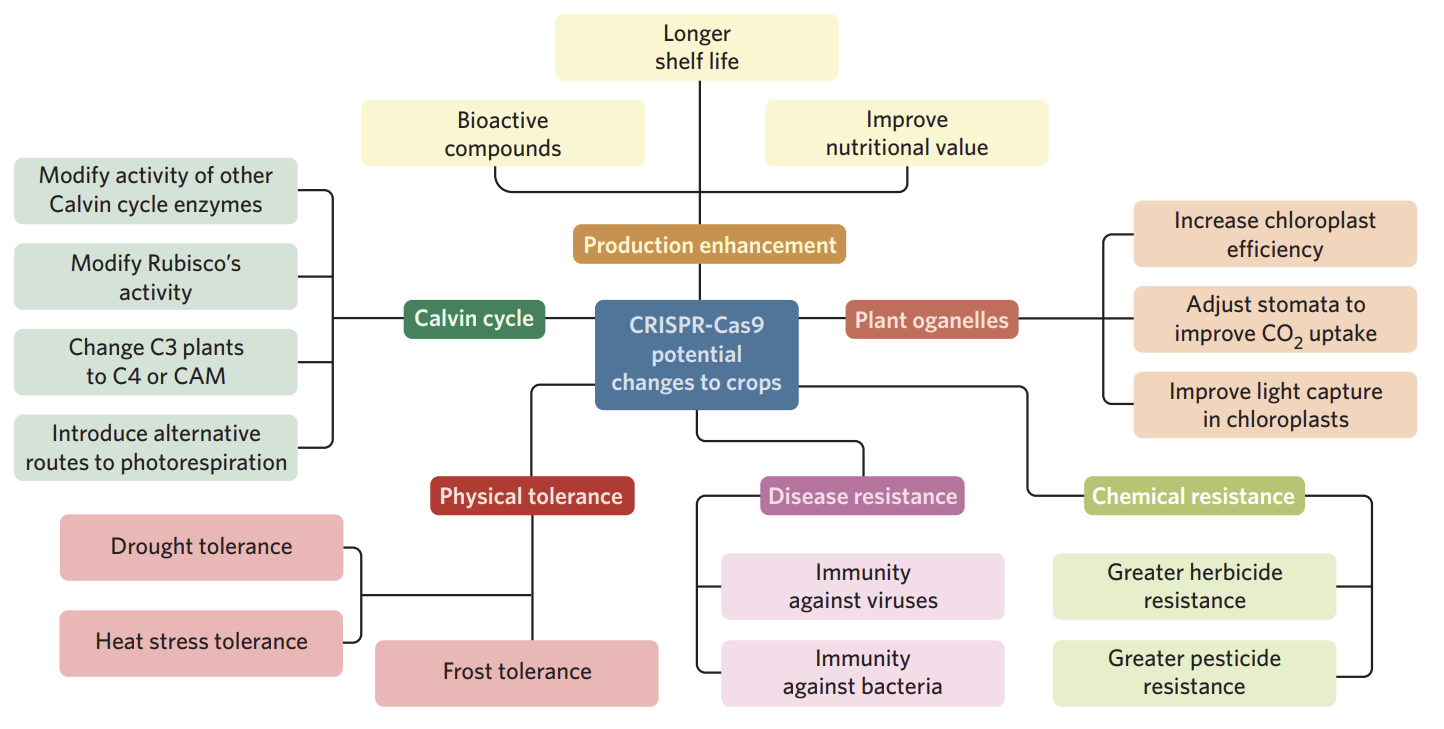
Outline the Steps Involved in Genetically Modifying a Crop Species Photosynthetic Pathway
The entire photosynthetic process of the target species must be understood in order to gain an understanding of the genome and how different genes have different roles in contributing to photosynthesis and growth
High-level computer models can be used to model the photosynthetic pathway of the species and identify inefficiencies
CRISPR-Cas9 technologies can be used for the targetted modification of genes responsible for the identified inefficiencies