Autonomic Nervous System section 2 unit 2 PT.1
 Call Kai
 Learn
Learn Practice Test
 Spaced Repetition
 Match
Match Flashcards
 Knowt Play
1/54

There's no tags or description
Looks like no tags are added yet.
Name | Mastery | Learn | Test | Matching | Spaced | Call with Kai |
|---|
No analytics yet
Send a link to your students to track their progress
55 Terms
Parasympathetic Nervous System (PNS)
meaning
Cholinergic- "Rest and Digest" 😌🍽
Think of the parasympathetic nervous system as your body's relaxation mode . It turns on when you're safe, calm, eating, or sleeping.
1. Restoration of Energy Stores
What it means:
Your body is saving and rebuilding energy.
✅ Slows the heart down
✅ Uses less energy
✅ Stores nutrients from food
Easy memory:
"Recharge your battery." 🔋
Parasympathetic Nervous System
what it does
2. Balance
What it means:
Keeps the body calm and steady after stress.
Example:
After running → heart rate slows
After being scared → body calms down
Easy memory:
"Brings the body back to normal." ⚖
3. Stimulates One Specific Body Part/System
Unlike the sympathetic system ("fight or flight"), which affects many organs at once, the parasympathetic system usually works on one organ at a time .
Example:
Digesting food → mainly digestive system
Making tears → mainly eyes
Easy memory:
"Targeted action, not whole-body action." 🎯
Parasympathetic Nervous System
4. Neurotransmitter (NT) = Acetylcholine (ACh)
A neurotransmitter is a chemical messenger that carries signals between nerves.
In the parasympathetic system:
Preganglionic neuron → releases ACh
⬇
Ganglion (relay station)
⬇
Postganglionic neuron → releases ACh
⬇
Target organ
Simple Flow:
🧠 Brain/Spinal Cord
⬇ ACh
🔄 Ganglion
⬇ ACh
❤ Stomach, lungs, eyes, etc.
Parasympathetic = ACh → ACh
Parasympathetic Nervous System
what it does side by side
Organ | Effect |
|---|---|
Eyes 👀 | Pupils constrict |
Heart ❤ | Heart rate decreases |
Lungs 🫁 | Airways constrict slightly |
Stomach 🍔 | Digestion increases |
Salivary glands 🤤 | More saliva |
Bladder 🚽 | Helps you urinate |
Parasympathetic = Rest, Digest, ACh
R = Rest
D = Digest
ACh = Acetylcholine at both ganglia and postganglionic endings
Think:
"When I'm relaxing after a meal, my parasympathetic system uses ACh to help me rest and digest." 😌🍽🔋
Parasympathetic Nervous System
Vagus Nerve (Cranial Nerve X)
What is the vagus nerve?
The Vagus Nerve is the 10th cranial nerve (CN X) .
It is the body's main parasympathetic nerve ("Rest and Digest" nerve).
Easy Memory:
👉 Vagus = Vacation nerve 😌
When the vagus nerve is active, your body is in relaxation mode .
Where Does It Go?
The vagus nerve travels from the brain to many organs:
🗣 Larynx = voice box (helps with speaking)
👄 Pharynx = throat (helps with swallowing)
❤ Heart
🫁 Lungs
🩸 Blood vessels
🍔 Digestive organs (stomach, intestines)
Think:
"The vagus nerve visits the throat, heart, lungs, and stomach."
Vagus Nerve
What Does It Do?
Parasympathetic responses
slows heart
bronchoconstriction-The vagus nerve makes them slightly narrower.
increases GI activity- time to digest food
decreases blood pressure- HR decreases BP decrease
Vagus Nerve
Other Jobs of the Vagus Nerve
🤢 Gag Reflex
Helps trigger the gag reflex when something touches the back of your throat.
🗣 Speaking
Controls muscles of the voice box.
Without it, speaking becomes difficult.
😓 Sweating
Helps regulate some body functions involved with sweating.
Vagus Nerve
Vasovagal Response
Sudden stimulation → drop in HR and BP, “vasovagal,” can result in syncope
Sometimes the vagus nerve gets stimulated too much.
Examples:
Seeing blood
Fear
Pain
Standing too long
The vagus nerve suddenly says:
"Slow everything down!"
What Happens?
❤ Heart rate drops
🩸 Blood pressure drops
⬇
🧠 Less blood reaches the brain
⬇
😵 Person faints
This is called:
Vasovagal Syncope
Vaso = blood vessels
Vagal = vagus nerve
Syncope = fainting
vagus nerve side by side
Vagus Nerve Effect | What Happens? |
|---|---|
❤ Heart | Slows heart rate |
🩸 Blood Pressure | Decreases BP |
🫁 Lungs | Bronchoconstriction |
🍔 Digestive System | Increases digestion |
🤢 Throat | Gag reflex |
🗣 Voice Box | Speaking |
😵 Too Much Stimulation | Vasovagal syncope (fainting) |
Vagus nerve = Rest and Digest nerve that slows the heart, lowers blood pressure, helps digestion, and can cause fainting if overstimulated. 😌❤🍔😵
Parasympathetic Effects
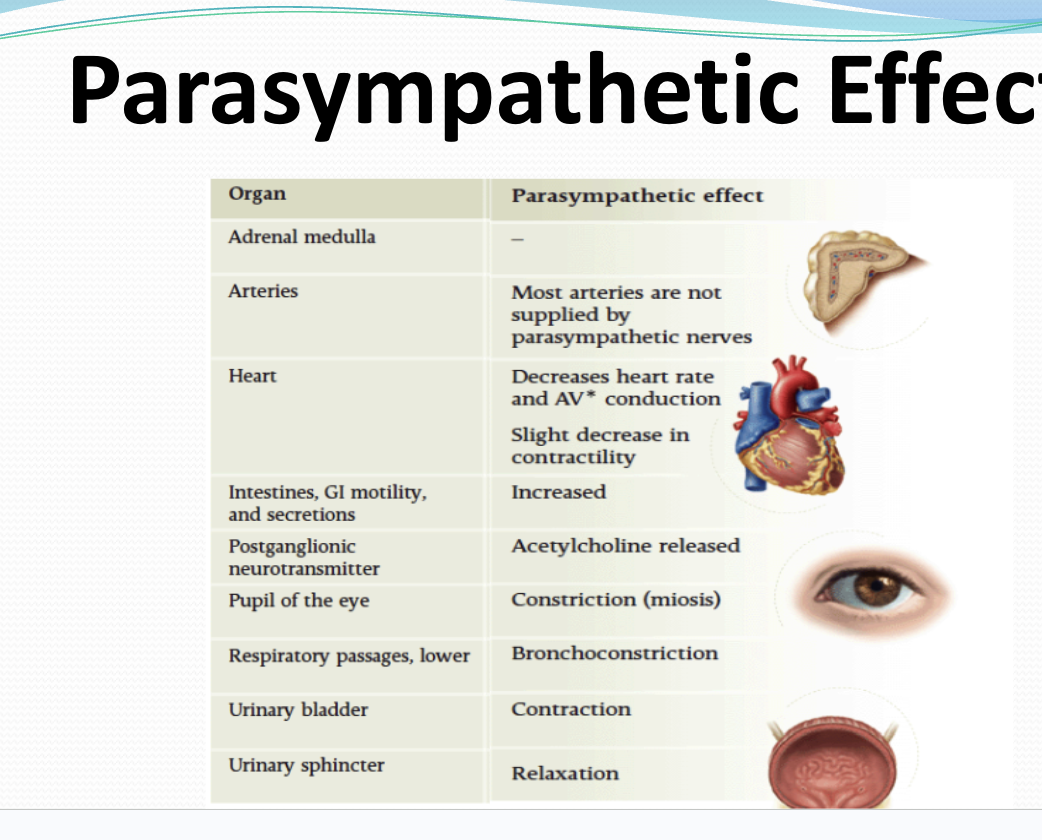
Parasympathetic Nervous System Effects
"Rest and Digest" 😌🍔
Its job is to slow things down, relax the body, digest food, and help you pee and poop.
Neurotransmitter:
🧪 ACh (Acetylcholine)
Released by parasympathetic nerves
Also called cholinergic
ACH is released (cholinergic)
Easy Memory:
👉 Parasympathetic = ACh = Rest and Digest
❤ Heart Effects Decreased Heart Rate
Heart beats slower.
Why?
Your body is resting and doesn't need to pump blood as fast.
Decreased Conduction
Electrical signals move slower through the heart.
Decreased Contractility
The heart squeezes less forcefully.
Easy Memory:
❤ Slow, Slow, Slow
Slower heart rate
Slower electrical signals
Weaker contractions
Parasympathetic Nervous System Effects
2
👀 Miosis What is Miosis?
Pupil constriction (pupils get smaller).
Example: When relaxing or in bright light.
👀 Miosis = Mini pupils
🫁 Bronchoconstriction What's happening?
Airways become a little narrower.
Why? The body is resting, not running from danger.
Easy Memory:
🫁 Resting lungs = smaller airways
🍔 Increased Digestion
The stomach and intestines become more active.
✅ More movement of food
✅ Better digestion
time to digest lunch
🚽Urinary Bladder Contraction - SQUEEZE
🚽 Urinary Sphincter Relaxation- 🚽 Door opens
🚽 Increased Urination
Bladder squeezes + sphincter relaxes= More urination
💩 Increased Defecation
"Go to the bathroom"
Parasympathetic Nervous System Effects
VESSEL
Most arteries are NOT controlled by the parasympathetic system.
The parasympathetic system mainly affects:
❤ Heart
🫁 Lungs
🍔 Digestive system
🚽 Bladder
Not most arteries.
Parasympathetic Nervous System Effects
SIDE BY SIDE
Body Part | Parasympathetic Effect |
|---|---|
❤ Heart | Slower heart rate |
👀 Eyes | Miosis (small pupils) |
🫁 Lungs | Bronchoconstriction |
🍔 Stomach/Intestines | Increased digestion |
🚽 Bladder | Contracts |
🚽 Urinary Sphincter | Relaxes |
🚽 Urination | Increases |
💩 Defecation | Increases |
Parasympathetic = "SLUDD"
S = Small pupils (Miosis) 👀
L = Lower heart rate ❤
U = Urination
D = Digestion 🍔
D = Defecation 💩
Think:
"Rest, digest, pee, and poop." 😌🍔🚽💩
3 Types of Cholinergic Receptors (Easy Version)
First, What is a Cholinergic Receptor?
A cholinergic receptor is a receptor that responds to Acetylcholine (ACh) .
Think of it like:
🧪 ACh = Key
🔒 Receiver = Lock
When ACh fits into the receptor, something happens.
Important:
✅ All 3 receptors are activated by ACh
muscarinic:
nicotinic 1 (Nn):
nicotinic 2 (Nm):
3 Types of Cholinergic Receptors (Easy Version)
1. Muscarinic Receptors (M)
Where are they?
Found on:
❤ Heart
🫁 Smooth muscle (lungs, intestines, bladder)
🧴 Glands (salivary glands, digestive glands)
At parasympathetic postganglionic nerve endings
What happens when stimulated?
❤ Heart rate decreases
🫁 Bronchoconstriction
🍔 Digestion increases
🧃 Digestive secretions increase
🚽 Urination increases
👀 Pupils constrict (miosis)
M = Maintenance Mode
When you're resting
❤ Heart slows
🍔 Digest food
🚽 Pee
👀 Small pupils
Everything is Rest and Digest .
3 Types of Cholinergic Receptors (Easy Version)
2. Nicotinic 1 (Nn)
Where are they?
At the ganglia of:
✅ Sympathetic nervous system
✅ Parasympathetic nervous system
Think of them as the relay station receivers .
What do they do?
They help pass the message from:
Preganglionic neuron
⬇
Ganglion
⬇
Postganglionic neuron
Easy Memory: Nn = Nerve to Nerve
🧠 Nerve → Nerve
They help nerves talk to other nerves.
3. Nicotinic 2 (Nm)
3 Types of Cholinergic Receptors
Where are they?
At the neuromuscular junction
This is where:
🧠 Nerve meets 💪 Skeletal muscle
Part of the Somatic Nervous System (voluntary movement).
What happens when stimulated?
💪 Skeletal muscle contracts
Examples:
✅ Walking
✅ Writing
✅ Smiling
✅ Lifting weights
Nm = Nerve to Muscle
🧠 Nerve → Muscle
ACh tells the muscle:
"Contract!"
💪 Muscle contracts.
3 Types of Cholinergic Receptors
side by side
Receptor | Location | Easy Job |
|---|---|---|
Muscarinic (M) | Heart, smooth muscle, glands | Rest and Digest |
Nicotinic 1 (Nn) | Autonomic ganglia | Nerve → Nerve |
Nicotinic 2 (Nm) | Neuromuscular junction | Nerve → Muscle |
M = Muscarinic = Maintenance Mode 😌
❤ Slow heart
🍔 Digest food
🚽 Urinate
👀 Small pupils
Nn nicotinic 1 = Nicotinic Neuron 🧠➡🧠
Nerve talks to nerve
Nm nicotinic 2 = Nicotinic Muscle 🧠➡💪
Nerve tells muscle to contract
ACh activates all cholinergic receptors:
Muscarinic = Rest and Digest
Nn = Nerve to Nerve
Nm = Nerve to Muscle 💪
Neurotransmission of Parasympathetic Nerves
Step 1: First Neuron (Preganglionic Neuron)
🧠 Brain or spinal cord
⬇
🏃 Preganglionic neuron
⬇
🔄 Ganglion (relay station)
At the ganglion, the first neuron releases:
🧪 Acetylcholine (ACh)
This ACh tells the second neuron:
"Okay, your turn! Carry the message."
Neurotransmission of Parasympathetic Nerves
Step 2: Second Neuron (Postganglionic Neuron)
🔄 Ganglion
⬇
🏃 Postganglionic neuron
⬇
❤ Heart, 🍔 stomach, 🫁 lungs, 🚽 bladder
At the organ, the second neuron ALSO releases:
🧪 Acetylcholine (ACh)
This ACh tells the organ what to do.
Examples:
❤ Heart → slow down
🍔 Stomach → digest food
🚽 Bladder → urinate
👀 Eyes → pupils constrict
BRAIN
↓
Preganglionic Neuron
↓ releases ACh
GANGLION
↓
Postganglionic Neuron
↓ releases ACh
TARGET ORGAN
What Your Notes Mean "NT released at ganglia is ACh"
Means:
The preganglionic neuron releases ACh at the ganglion.
🧠 → ACh → Ganglion
"NT released at postganglionic nerve endings is ACh"
Means:
The postganglionic neuron releases ACh onto the organ.
Ganglion → ACh → ❤🍔🫁🚽
Parasympathetic = ACh → ACh
🧠 → ACh → Ganglion
Ganglion → ACh → Organ
Both neurons use Acetylcholine .
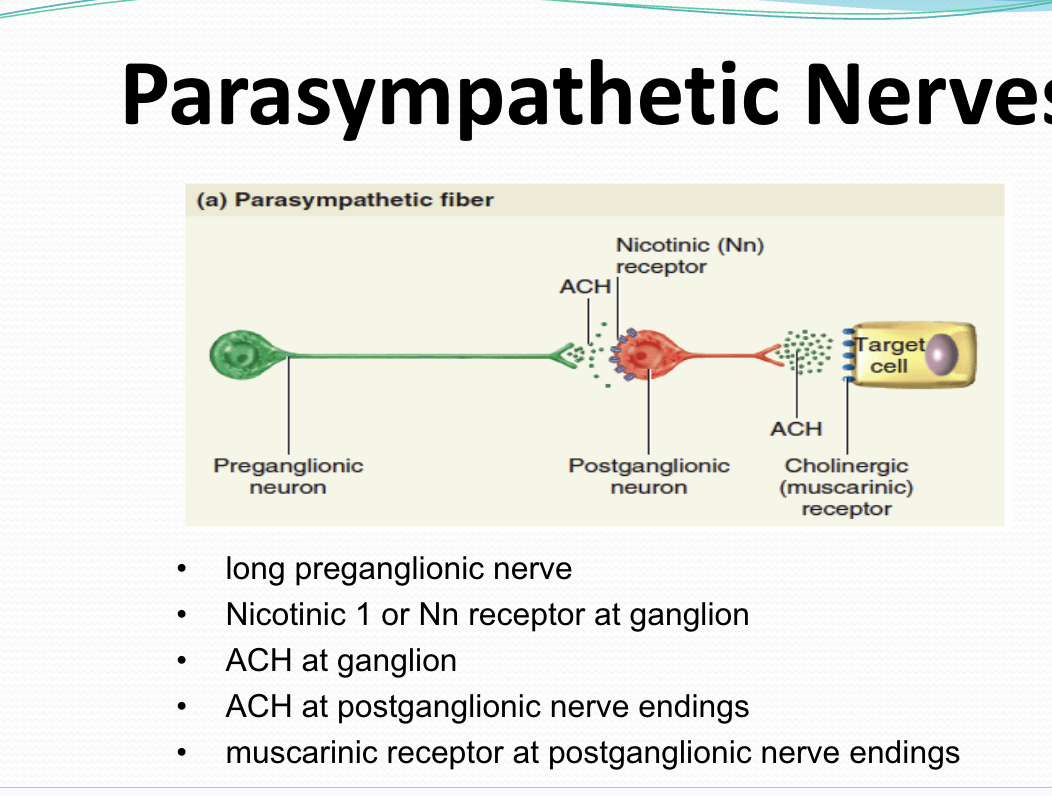
Parasympathetic Nerves steps
Parasympathetic Nervous System
✅ Long preganglionic neuron
✅ ACh released at ganglion
✅ Nn receptor at ganglion
✅ ACh released at organ
✅ Muscarinic receptor on organ
BRAIN
↓
Long Preganglionic Neuron
↓ releases ACh
Nn Receptor (Ganglion)
↓
Short Postganglionic Neuron
↓ releases ACh
Muscarinic Receptor (Organ)
↓
Rest and Digest Effect
Quick Memory Trick
"ACh → Nn → ACh → Muscarinic"
🧠 → ACh → Nn
⬇
ACh → Muscarinic
⬇
😌 Rest and Digest (slow heart, digest food, pee, poop)
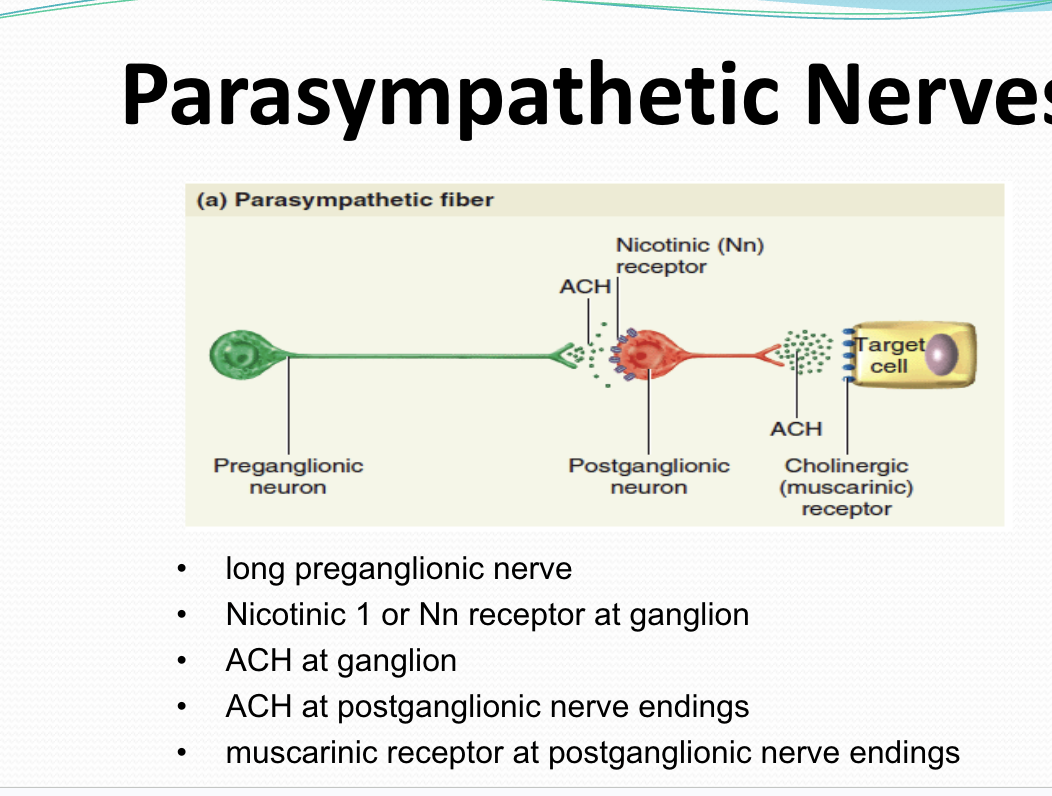
Step 7: Muscarinic Receptor on the Organ
The organ has:
🔵 Muscarinic receptors
Your notes say:
Muscarinic receptor at postganglionic nerve endings
This means the target organ (heart, lungs, stomach, bladder, etc.) has muscarinic receptors that receive the ACh.
Easy Memory
Muscarinic = Rest and Digest receptor
When ACh binds to muscarinic receptors:
❤ Heart slows
🍔 Digestion increases
🚽 Urination increases
👀 Pupils constrict
🫁 Bronchoconstriction
ANS Drug Effects
Parasympathomimetic vs
Parasympatholytic |
|---|
Parasympathomimetic | Parasympatholytic |
|---|---|
Mimics ACh | Blocks ACh |
Cholinergic agonist | Cholinergic antagonist |
Rest and Digest ON | Rest and Digest OFF |
↓ Heart rate | ↑ Heart rate |
Small pupils | Large pupils |
↑ Digestion | ↓ Digestion |
↑ Urination | ↓ Urination |
MIMETIC = MIMICS 😌
Parasympathomimetic
= Acts like ACh
= Rest and Digest
LYTIC = BLOCKS 🚫
Parasympatholytic
= Blocks ACh
= Opposite of Rest and Digest
One-Line Memory
✅ Parasympathomimetic = "Do more Rest and Digest.
🚫 Parasympatholytic = "Block Rest and Digest."
Cholinergics/Parasympathomimetics
side by side
Problem | What the Drug Does |
|---|---|
👀 Large pupil | Constricts pupil (miosis) |
👀 High eye pressure | Lowers eye pressure |
🚽 Can't pee | Helps bladder contract |
💩 Constipation | Increases intestinal movement |
Direct Cholinergic Agonists = "Fake ACh"
They stimulate muscarinic receptors and cause:
👀 Miosis
👀 ↓ Eye pressure
🚽 Urination
💩 More bowel movement
Think:
"See, Pee, and Poop"
👀 See (glaucoma)
🚽 Pee (urinary retention)
💩 Poop (intestinal stasis)
That's the easiest way to remember what these drugs do. 😊
Cholinergics/Parasympathomimetics
First, what are they?
These drugs act like Acetylcholine (ACh) .MIMICS
They turn on the parasympathetic nervous system ("Rest and Digest").
Easy Memory:
🧪 Drug = Fake ACh
The drug claims to be ACh and activates parasympathetic receptors.
Directly stimulate/bind to muscarinic receptors
What does that mean?
Normally:
ACh ➡ Muscarinic receptor ➡ Effect
With these drugs:
💊 Drug ➡ Muscarinic receptor ➡ Same effect
The drug acts like ACh.
Direct-Acting Cholinergic Agonists
acetylcholine
pilocarpine (Pilocar®)
bethanechol
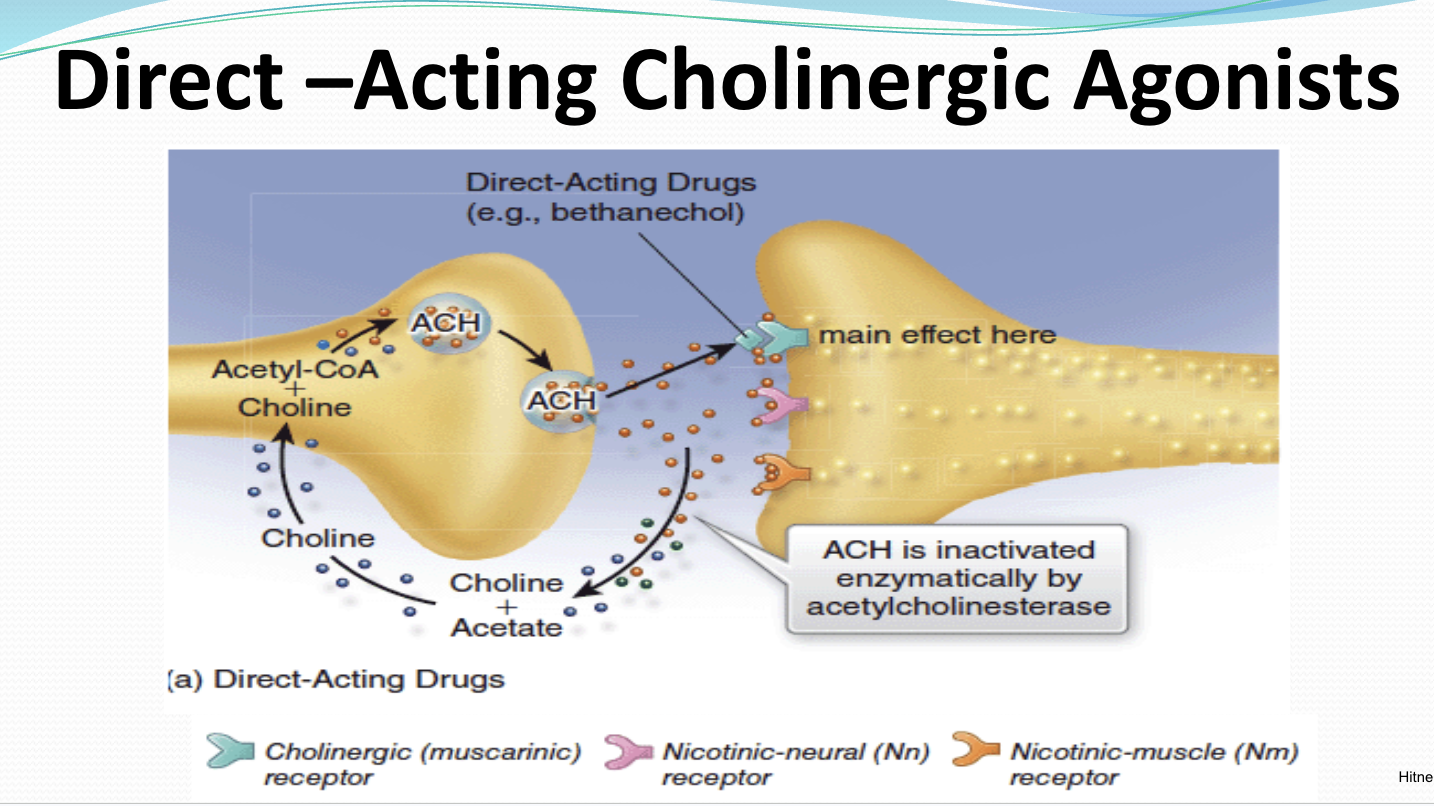
Direct-Acting Cholinergic Agonists = "Fake ACh"
💊 Drug pretends to be ACh
⬇
🔒 Binds directly to Muscarinic receiver
⬇
😌 Rest and Digest turns ON
Think:
👀 Small pupils
🚽 Pee
💩 Poop
❤ Slow heart
That's the main idea of this entire diagram. 🎯
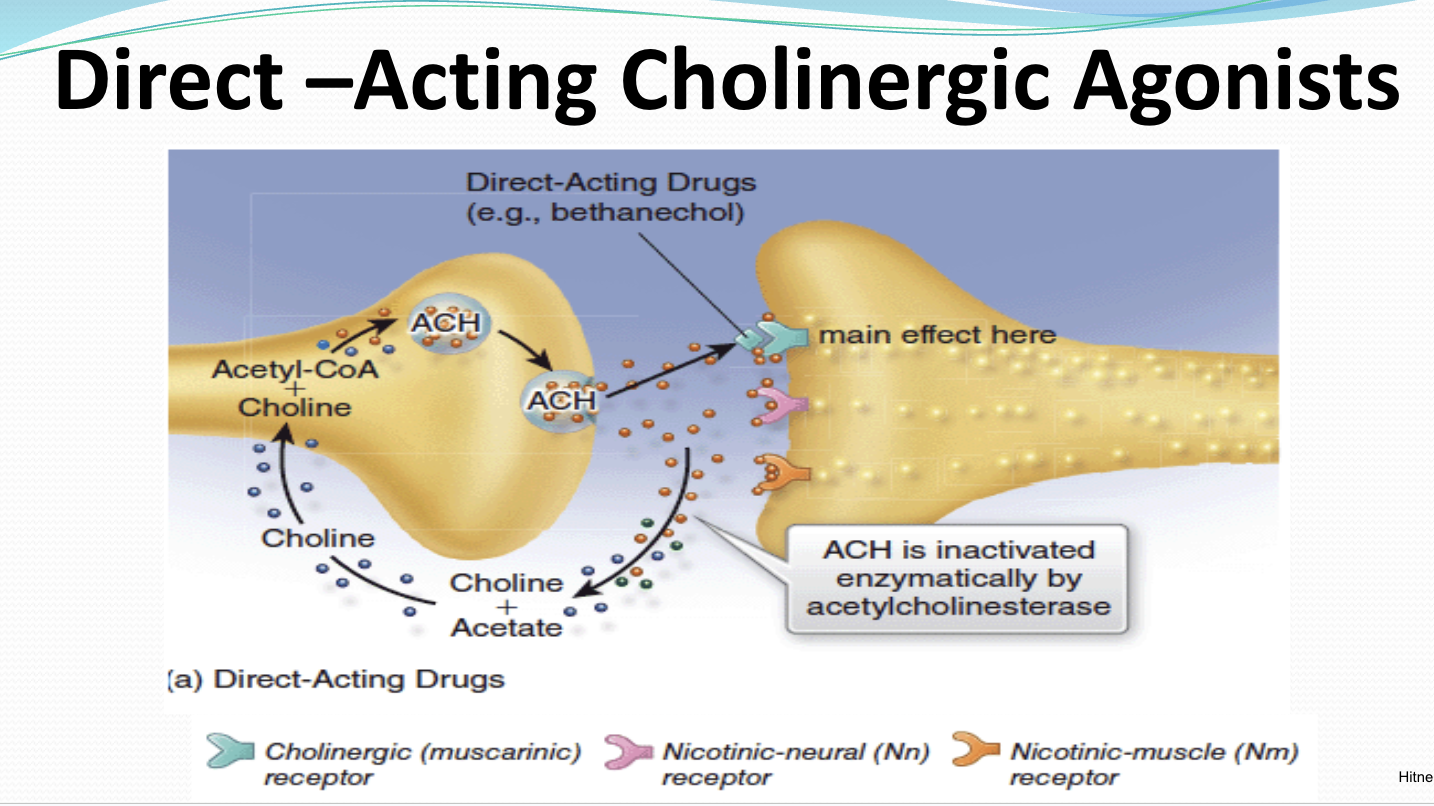
Normal Pathway
vs
Direct-Acting Cholinergic Agonist Pathway
Normal Pathway
Nerve makes ACh
↓
ACh released
↓
Muscarinic receptor
↓
Rest and Digest effects
↓
ACh destroyed by acetylcholinesterase
Direct-Acting Cholinergic Agonist Pathway
Drug (Bethanechol)
↓
Directly binds Muscarinic receptor
↓
Acts like ACh
↓
Rest and Digest effects
Normal: ACh → Muscarinic receptor → Effect
Drug: Drug → Muscarinic receptor → Same effect
Why Do Indirect-Acting Drugs Help?
They increase ACh.
More ACh means a better chance of stimulating the remaining receptors.
inhibit acetylcholinesterase, the enzyme that destroys ACH in the synapse
increases ACH
Result:
💪 Improved muscle strength
Antidote for Cholinergic Poisoning
Too much ACh can be dangerous.
Symptoms may include:
🚽 Too much urination
💩 Diarrhea
🤤 Excessive saliva
❤ Very slow heart rate
Antidote = Atropine
Atropine blocks muscarinic receptors.
***Antidote for cholinergic poisoning - atropine
Think:
Too much ACh
↓
Give atropine
↓
Blocks ACh effects
Indirect –Acting Cholinergic Agonists
Term | Easy Meaning |
|---|---|
Acetylcholinesterase | Enzyme that destroys ACh ✂ |
Indirect-acting agonist | Blocks ACh destruction |
Result | More ACh |
Urinary retention | Helps patient pee 🚽 |
Ileus | Helps intestines move 💩 |
Myasthenia gravis | Helps weak muscles 💪 |
Atropine | Antidote for too much ACh |
Direct-Acting Drug
💊 Acts like ACh
Indirect-Acting Drug
💊 Protects ACh
Myasthenia Gravis
💪 Weak muscles because the body attacks Nm receptors
Atropine
🚫 Blocks ACh when there is too much
👉 Indirect-acting cholinergic agonists block acetylcholinesterase, causing more ACh to stay in the synapse and produce stronger parasympathetic effects.
Indirect-Acting Cholinergic Agonists
neostigmine - reverses actions of rocuronium bromide which causes respiratory paralysis from anesthesia
What Do Indirect-Acting Drugs Do?
Indirect-Acting Cholinergic Agonists
They block acetylcholinesterase .
SW:
🚫 Acetylcholinesterase blocked
⬇
ACh is NOT destroyed
⬇
More ACh stays in the synapse
⬇
Stronger parasympathetic effects
Indirect = Protects ACh
Instead of acting like ACh, it keeps ACh alive longer.