GA Exam 2 - Wrist + Hand

0.0(0)
Studied by 0 people
call kaiCall Kai
learnLearn
examPractice Test
spaced repetitionSpaced Repetition
heart puzzleMatch
flashcardsFlashcards
GameKnowt Play
Card Sorting

1/40

encourage image

There's no tags or description

Looks like no tags are added yet.

Last updated 6:44 PM on 5/1/26
Name
Mastery
Learn
Test
Matching
Spaced
Call with Kai

No analytics yet

Send a link to your students to track their progress

41 Terms
1
New cards
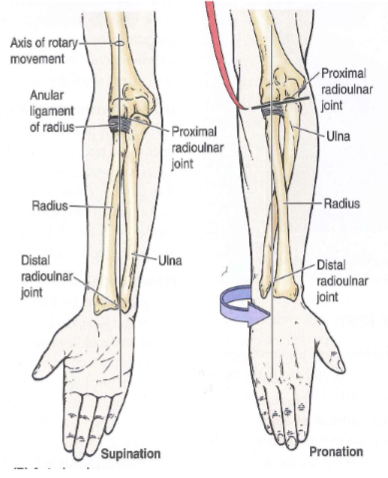
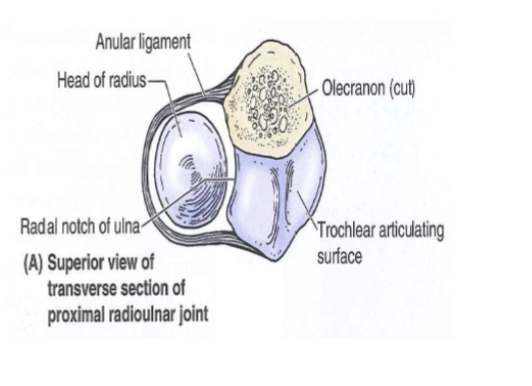
<p>Proximal radioulnar joint</p>

Proximal radioulnar joint

  • Synovial joint

  • Head of the radius
    articulates with the radial
    notch of the ulna

  • Radius is held in place by
    the anular ligament
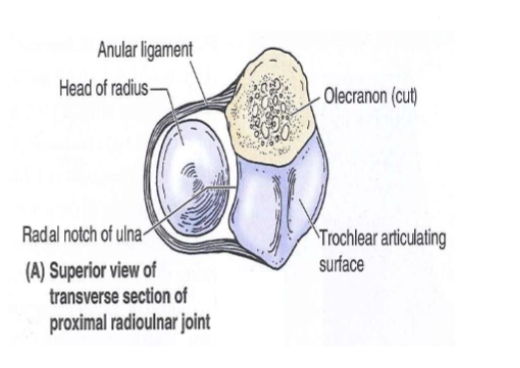
<ul><li><p>Synovial joint</p></li><li><p>Head of the radius<br>articulates with the radial<br>notch of the ulna</p></li><li><p>Radius is held in place by<br>the<strong> anular ligament</strong></p></li></ul><p></p>
2
New cards
<p>Movements of radioulnar joint</p>

Movements of radioulnar joint

During pronation and supination the radial head rotates within the anular ligament
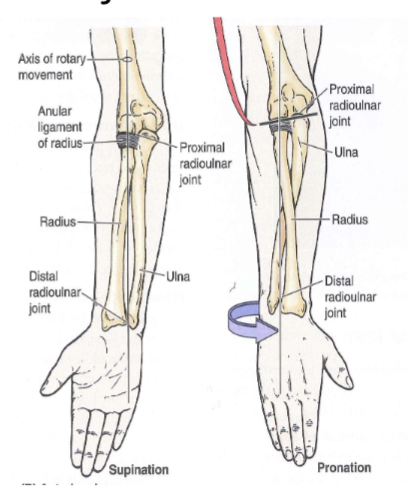
<p><span><span>During pronation and supination the radial head rotates within the anular ligament</span></span></p><p></p>
3
New cards

pronator teres

look at lab practical quizlet
4
New cards
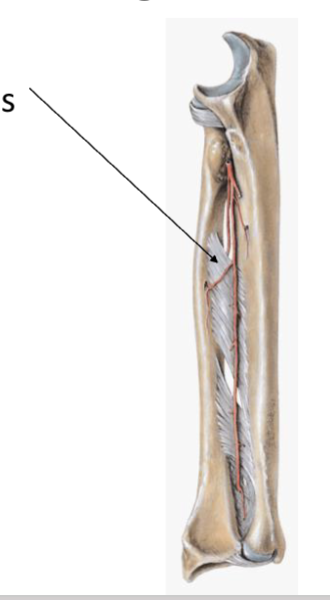
<p>interosseous membrane </p>

interosseous membrane

  • connects radius and ulna along their diaphysis

  • Forms the radioulnar syndesmosis joint

5
New cards

Distal radioulnar joint

  • Head of Ulna articulates
    with the ulnar notch on
    the radius

  • Fibrocartilagenous articular disc (a.k.a. triangular ligament)
    connects

6
New cards

Volar

palkm

7
New cards

Thenar

base of thumb

8
New cards

Hypothenar

base of pinkie

9
New cards

Muscles of Pronation and Supination

  • Supination: supinator and biceps brachii (esp during resistance)

  • Pronation: pronator quadratus and pronator teres

10
New cards

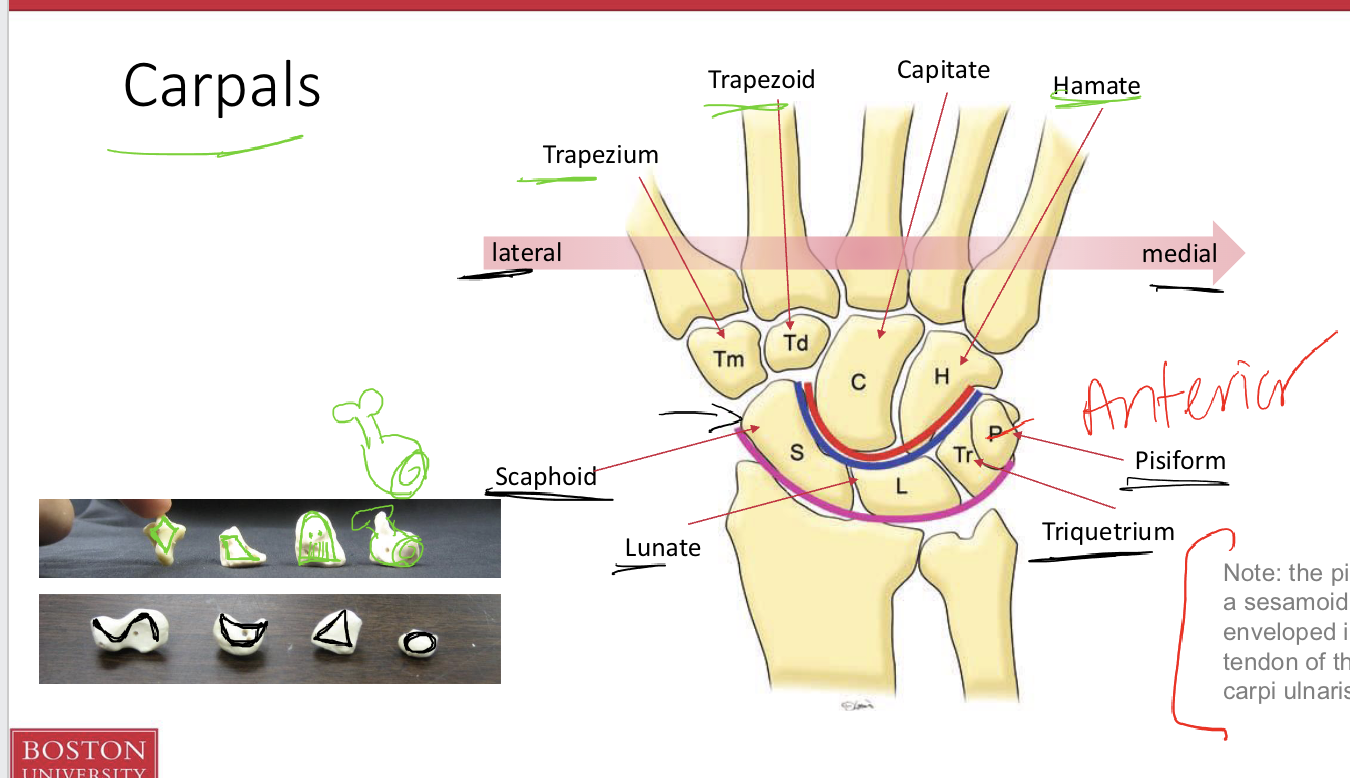
Pisiform is a _____ bone

sesamoid bone

11
New cards

Carpals Lateral to medial

knowt flashcard image
12
New cards

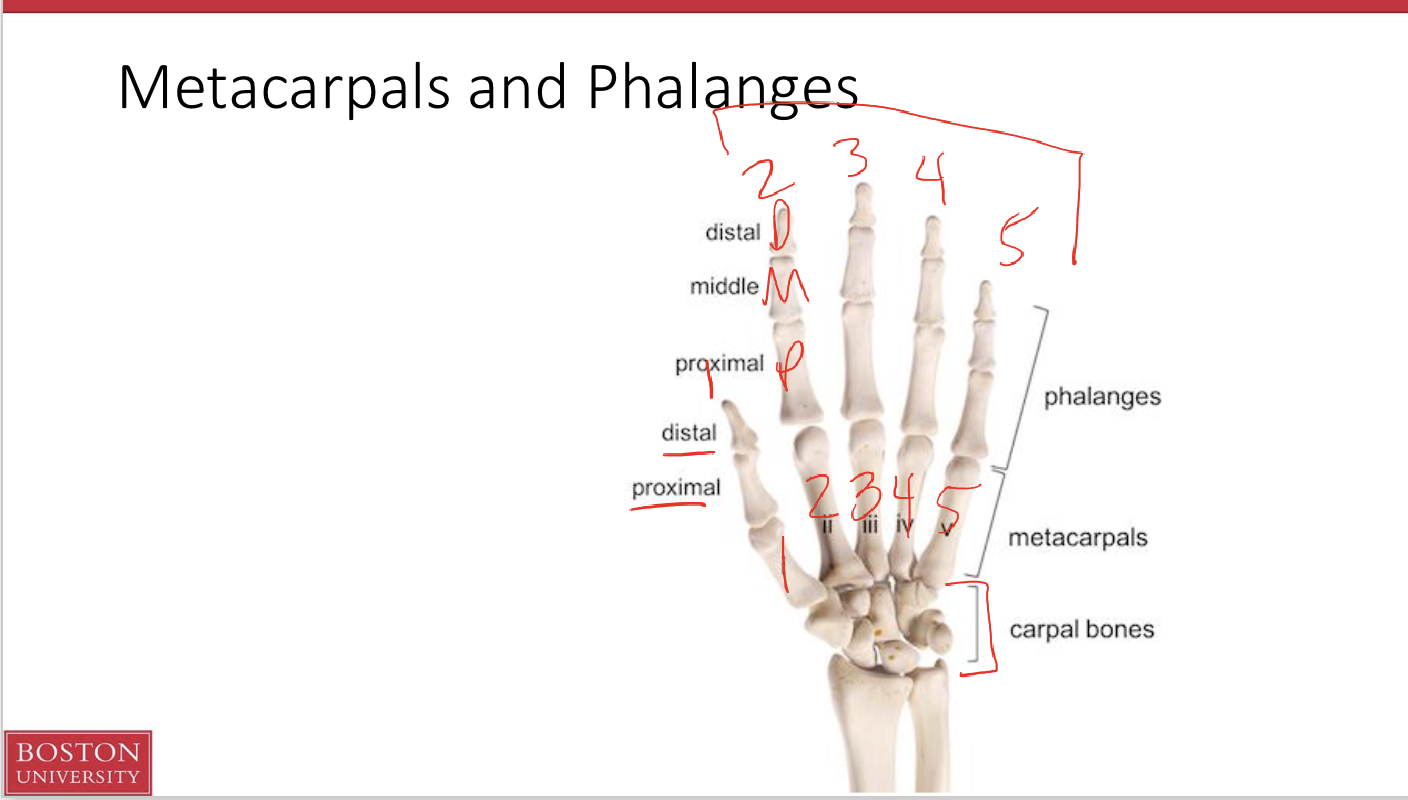
Metacarpals and Phalanges

knowt flashcard image
13
New cards

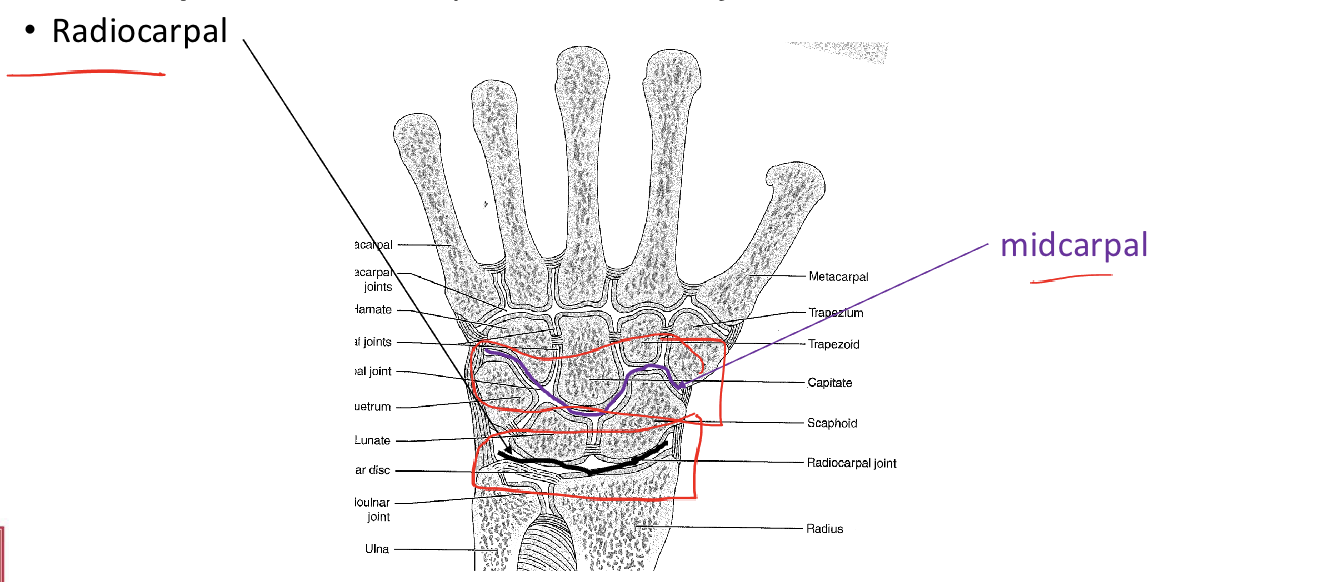
Wrist complex contains 2 proximal-distal joints:

  • Radiocarpal

  • Midcarpal

<ul><li><p><span>Radiocarpal</span></p></li><li><p><span>Midcarpal</span></p></li></ul><p></p>
14
New cards

Proximal and Distal components of the Radiocarpal joint

Proximal components:
Radius, articular disc (triangular ligament)

Distal components:
Scaphoid, lunate, triquetrum
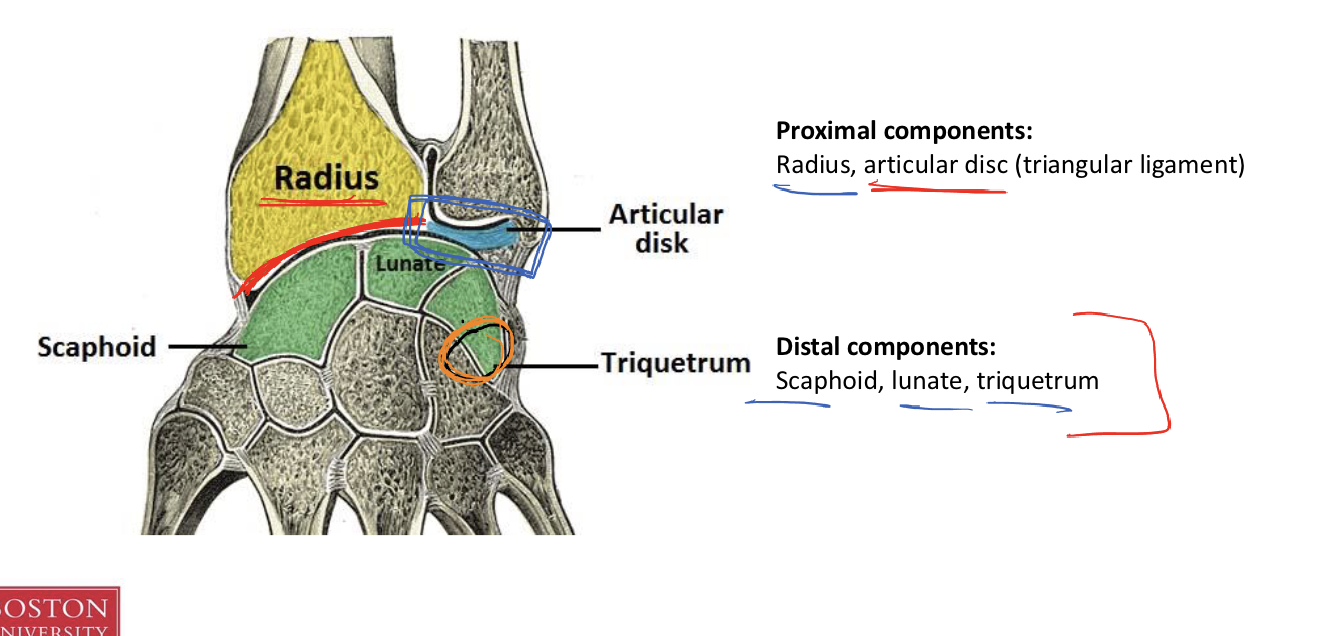
<p><span>Proximal components:<br>Radius, articular disc (triangular ligament)<br></span></p><p><span><strong>Distal components:</strong><br>Scaphoid, lunate, triquetrum</span></p>
15
New cards

Proximal and Distal components of the Midcarpal joint

Distal components:
Trapezium, trapezoid, capitate, hamate

Proximal components:
Scaphoid, lunate, triquetrium
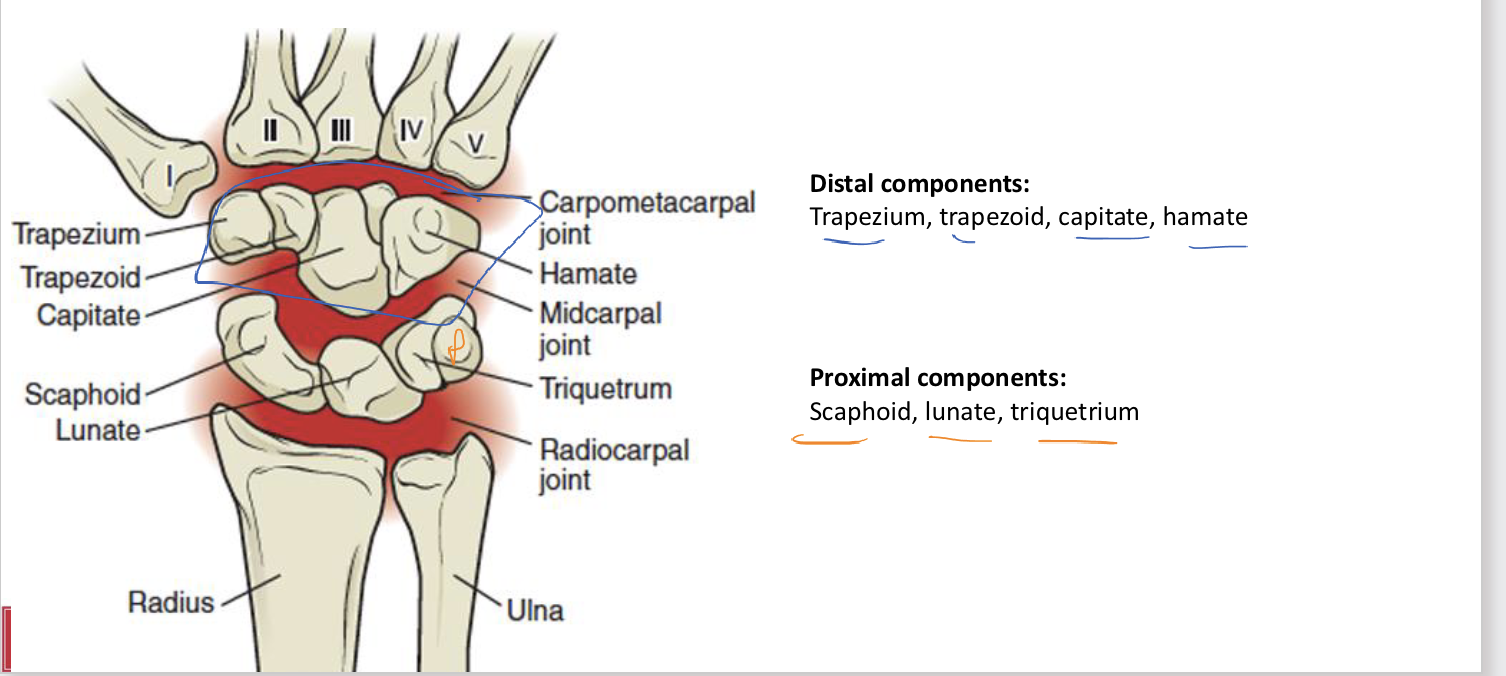
<p><span><strong>Distal components:</strong><br>Trapezium, trapezoid, capitate, hamate</span></p><p></p><p><span><strong>Proximal components:</strong><br>Scaphoid, lunate, triquetrium</span></p>
16
New cards
<p><span>The carpal tunnel</span></p>

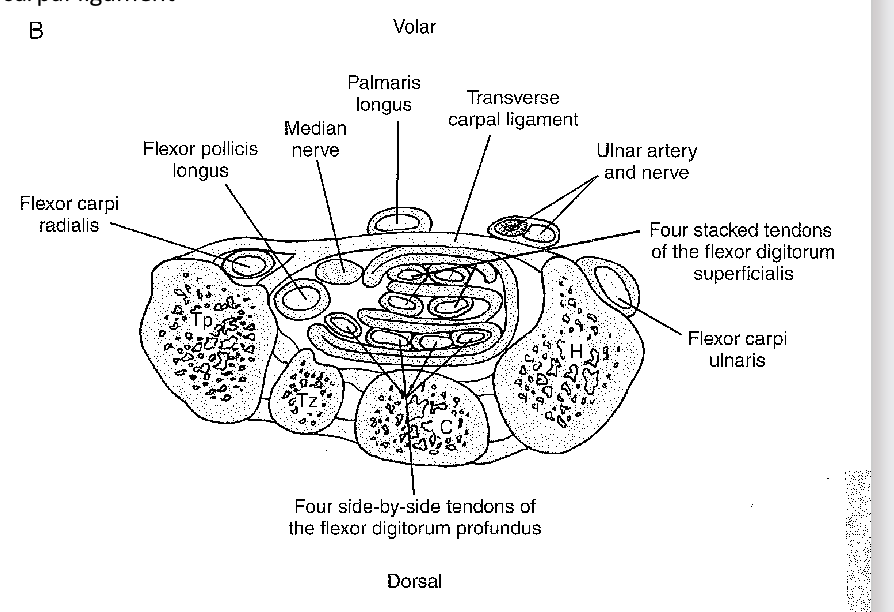
The carpal tunnel

  • A large, fibrous ligament stretches over the volar side of the wrist—transverse carpal ligament or flexor retinaculum

  • Forms a tunnel with the carpals (carpal tunnel) through which tendons pass
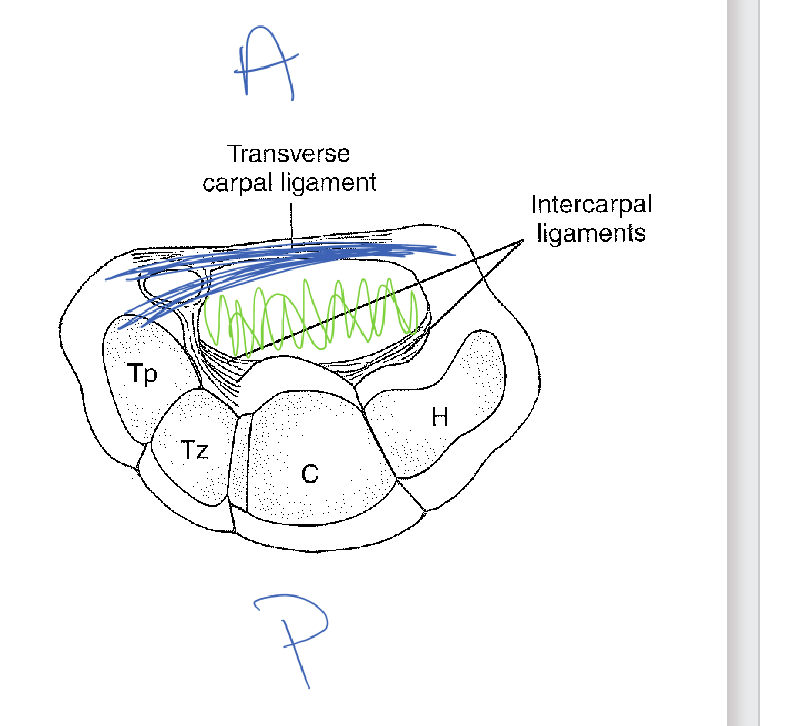
<ul><li><p>A large, fibrous ligament stretches over the volar side of the wrist—<strong>transverse carpal ligament</strong> or <strong>flexor retinaculum</strong></p></li></ul><p></p><ul><li><p>Forms a tunnel with the carpals <strong>(carpal tunnel)</strong> through which tendons pass</p></li></ul><p></p>
17
New cards

Intercapal joints

Joints between carpals
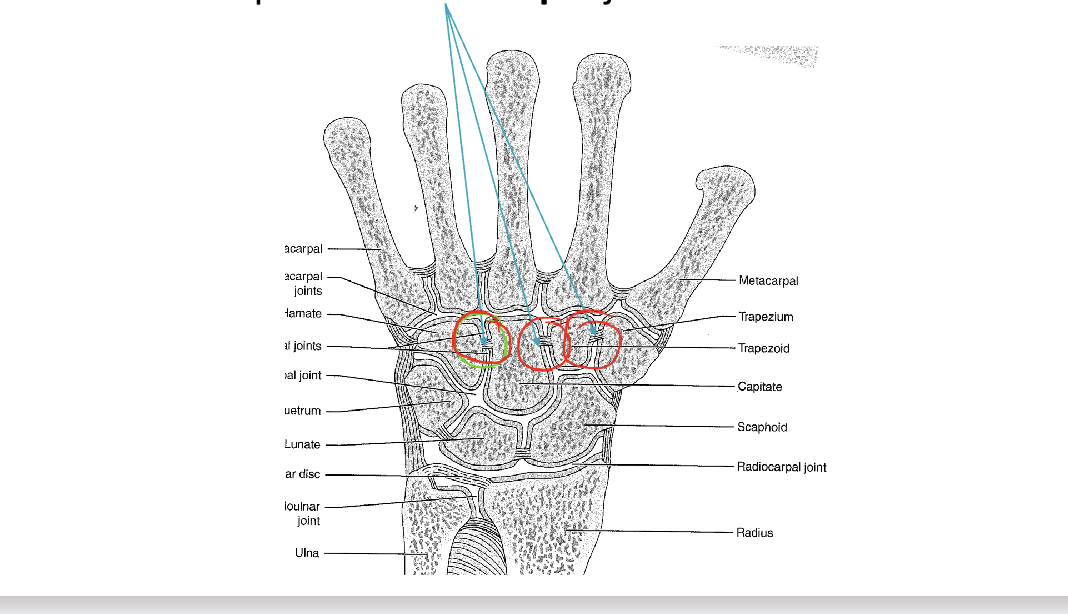
<p><span>Joints between carpals</span></p>
18
New cards

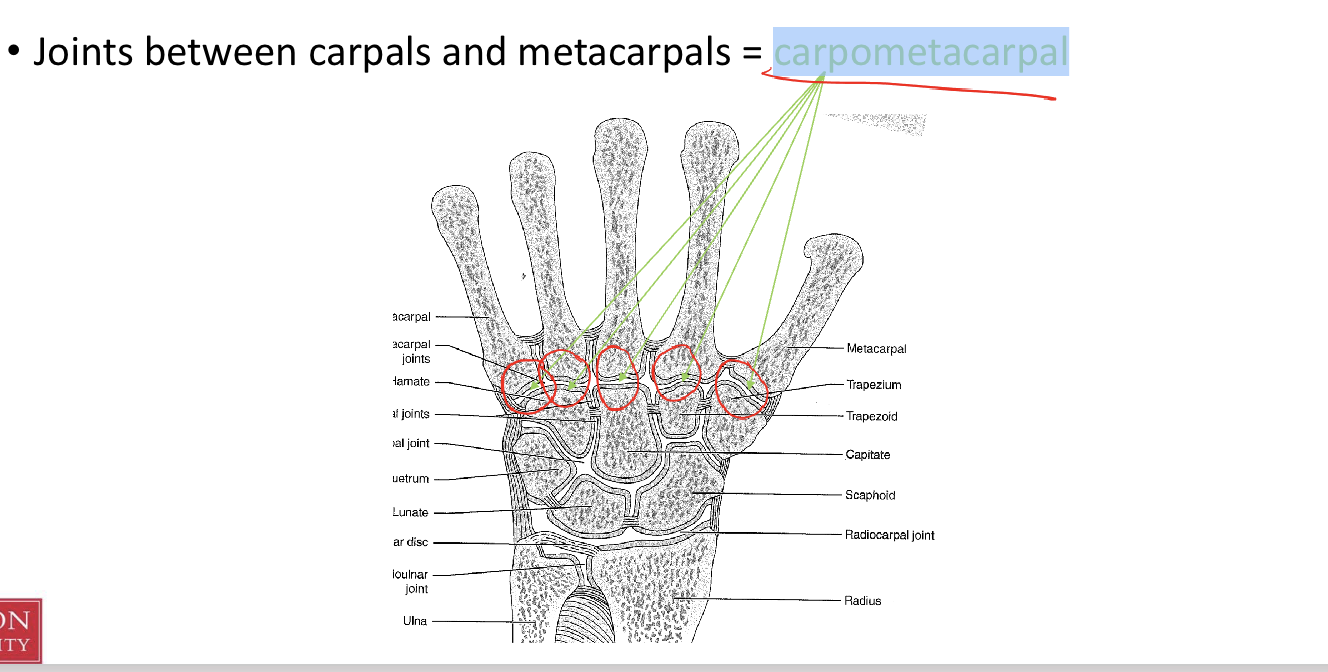
Carpometacarpal joints


Joints between carpals and metacarpals

***All carpometacarpal joints are capable of flexion/extension***

  • for the thumb,

    • has it’s own synovial joint and a greater ROM (abduction, adduction, flexion, extension, opposition)

  • For the fingers

    • share one synovial cavity

  • Metacarpals of the third and fourth fingers

    • have limited ROM,

  • fifth metacarpal have more ROM than 3rd + 4th.

  • The relatively immobile second and third joints

    • provide a stable axis for opposition

<p><br>Joints between carpals and metacarpals</p><p></p><p> ***All carpometacarpal joints are capable of flexion/extension***</p><p></p><ul><li><p><span>for the<strong> thumb,  </strong></span></p><ul><li><p><span>has it’s <strong>own synovial joint</strong> and a <strong>greater ROM</strong> (abduction, adduction, flexion, extension, opposition)</span></p></li></ul></li></ul><p></p><ul><li><p><span>For the<strong> fingers</strong></span></p><ul><li><p><span><strong> </strong>share <strong>one synovial cavity</strong></span></p></li></ul></li></ul><p></p><ul><li><p><span>Metacarpals of the <strong>third </strong>and <strong>fourth fingers </strong></span></p><ul><li><p><span>have <strong>limited ROM</strong>, </span></p></li></ul><p></p></li><li><p><span><strong>fifth metacarpal </strong>have <strong>more ROM </strong>than <strong>3rd + 4th</strong>. </span></p></li></ul><p></p><ul><li><p><span>The <strong>relatively immobile</strong> <strong>second</strong> and <strong>third joints</strong> </span></p><ul><li><p><span>provide a <strong>stable axis</strong> for <strong>opposition</strong></span></p></li></ul></li></ul><p></p>
19
New cards

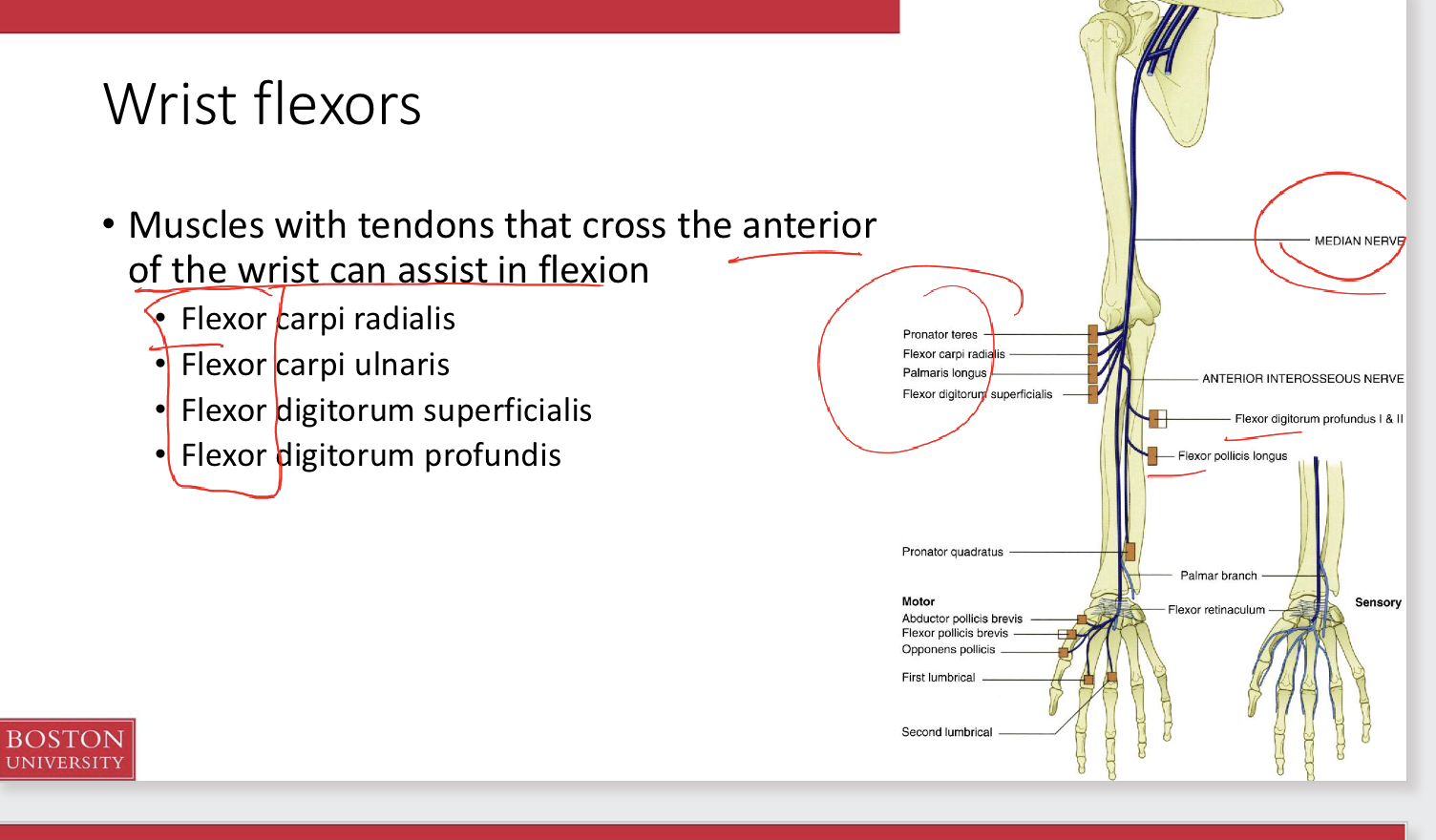
Wrist flexors

Muscles with tendons that cross the anterior of the wrist can assist in flexion


• Flexor carpi radialis
• Flexor carpi ulnaris
• Flexor digitorum superficialis
• Flexor digitorum profundis

  • Flexor pollicis longus

  • pronator teres

<p><span>Muscles with tendons that cross the <strong>anterior</strong> of the wrist can assist in<strong> flexion</strong></span></p><p></p><p><span><br>• Flexor carpi radialis<br>• Flexor carpi ulnaris<br>• Flexor digitorum superficialis<br>• Flexor digitorum profundis</span></p><ul><li><p>Flexor pollicis longus</p></li><li><p>pronator teres</p></li></ul><p></p>
20
New cards

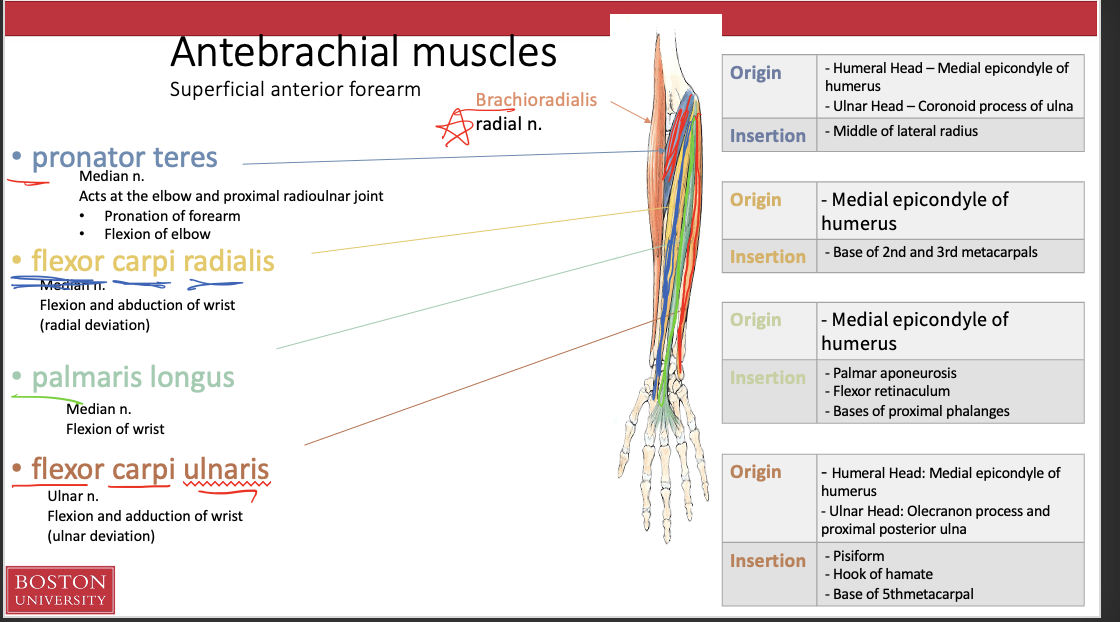
Antebrachial muscles (superficial anterior forearm)

  • Pronator teres

  • Flexor carpi radialis

  • palmaris longus

  • flexor carpi ulnaris

<ul><li><p>Pronator teres</p></li><li><p>Flexor carpi radialis</p></li><li><p>palmaris longus</p></li><li><p>flexor carpi ulnaris</p></li></ul><p></p>
21
New cards

Antebrachial muscles (intermediate anterior forearm)
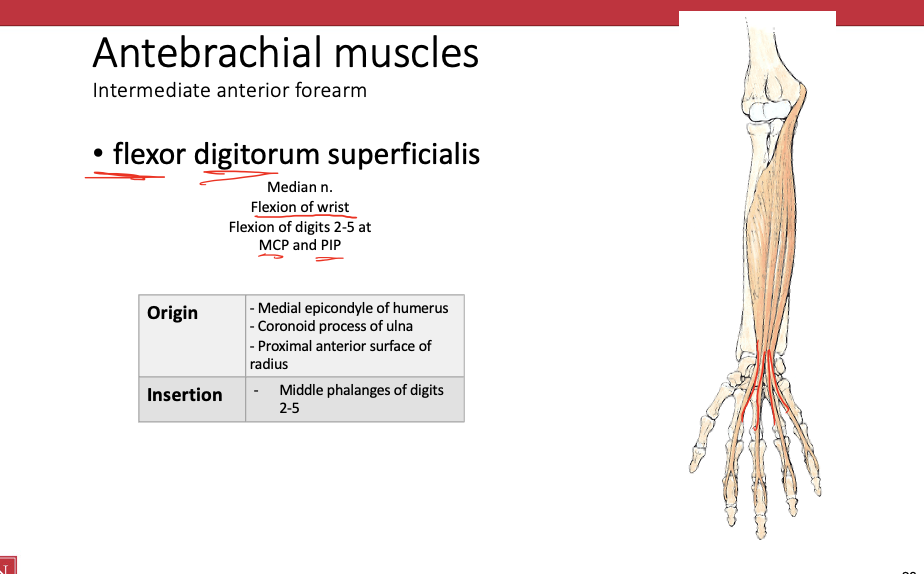
knowt flashcard image
22
New cards

Antebrachial muscles (Deep anterior forearm)
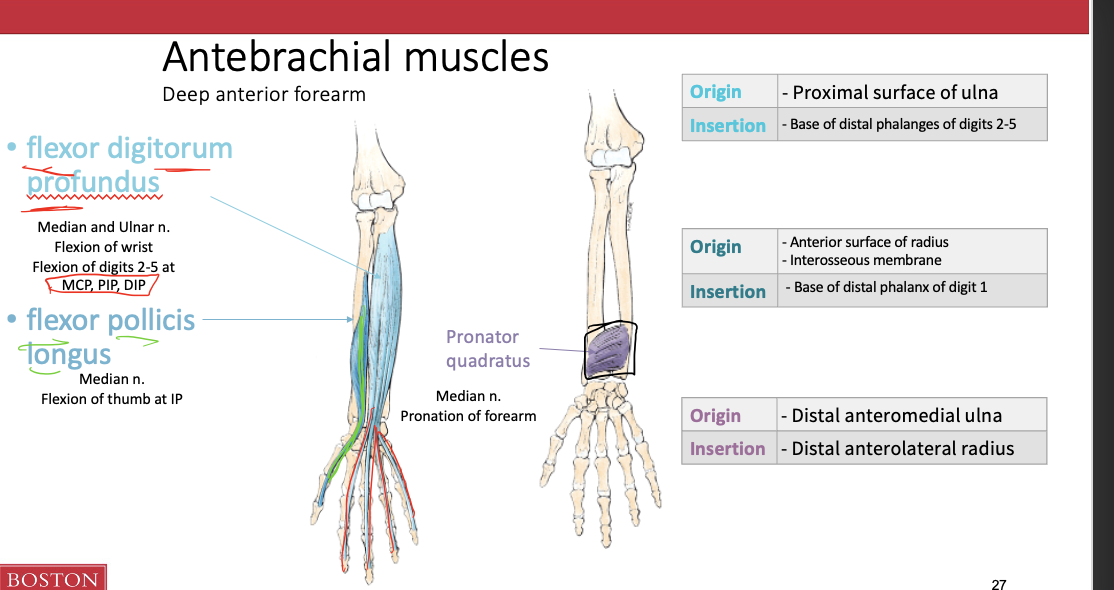
knowt flashcard image
23
New cards

Median nerve

supplies the majority of the anterior compartment of the forearm

  • exceptions:

    • brachioradialis b/c it is lateral → radial nerve

    • flexor carpi ulnaris, and flexor digitorum profundi b/c = medial → ulnar nerve
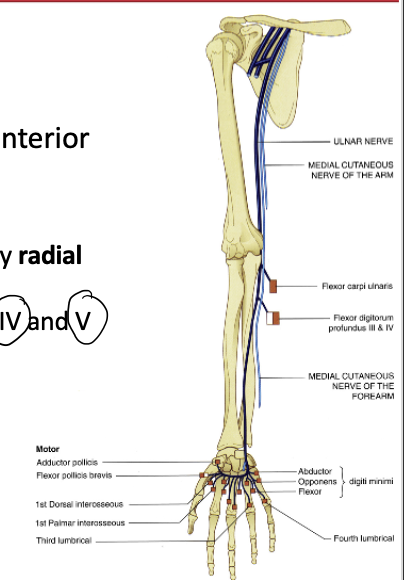
<p><span>supplies the majority of the <strong>anterior compartment of the forearm</strong></span></p><ul><li><p><strong>exceptions: </strong></p><ul><li><p><strong><mark data-color="#NaNNaNNaN" style="color: inherit;">brachioradialis </mark>b/c it is <mark data-color="#NaNNaNNaN" style="color: inherit;">lateral → radial nerve</mark></strong></p></li></ul><p></p><ul><li><p><strong><mark data-color="blue" style="background-color: blue; color: inherit;">flexor carpi ulnaris</mark>, </strong>and<strong><mark data-color="blue" style="background-color: blue; color: inherit;"> flexor digitorum profundi  </mark>b/c = <mark data-color="blue" style="background-color: blue; color: inherit;">medial → ulnar nerve</mark></strong></p></li></ul><p></p></li></ul><p></p>
24
New cards

Wrist extensors

Muscles with tendons that cross the posterior aspect of the wrist can assist in extension


• Extensor carpi radialis longus
• Extensor carpi radialis brevis
• Extensor carpi ulnaris
• Extensor digitorum
• Extensor indicis
• Extensor digiti minimi

25
New cards

Antebrachial muscles (superficial posterior forearm)
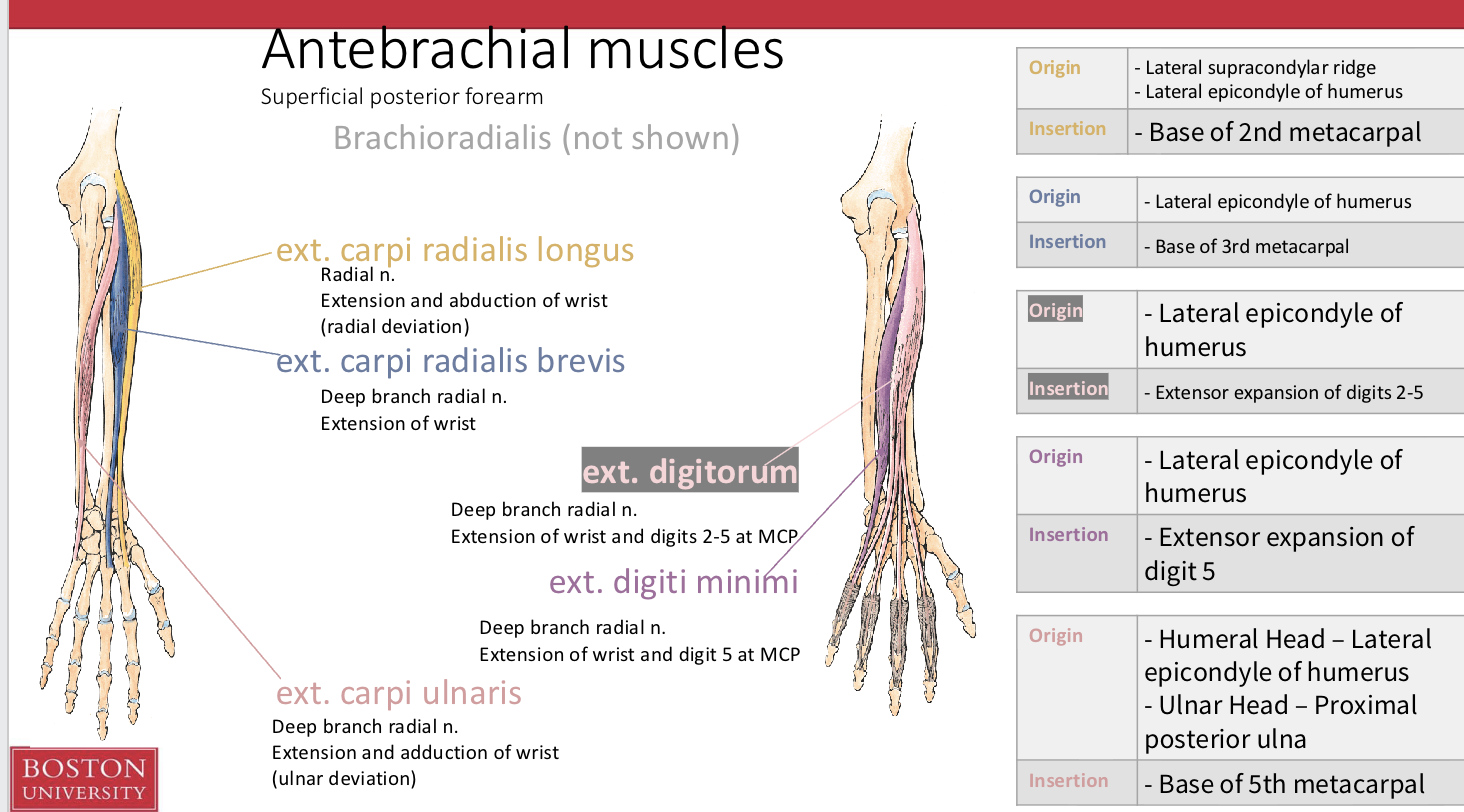
<p></p>
26
New cards
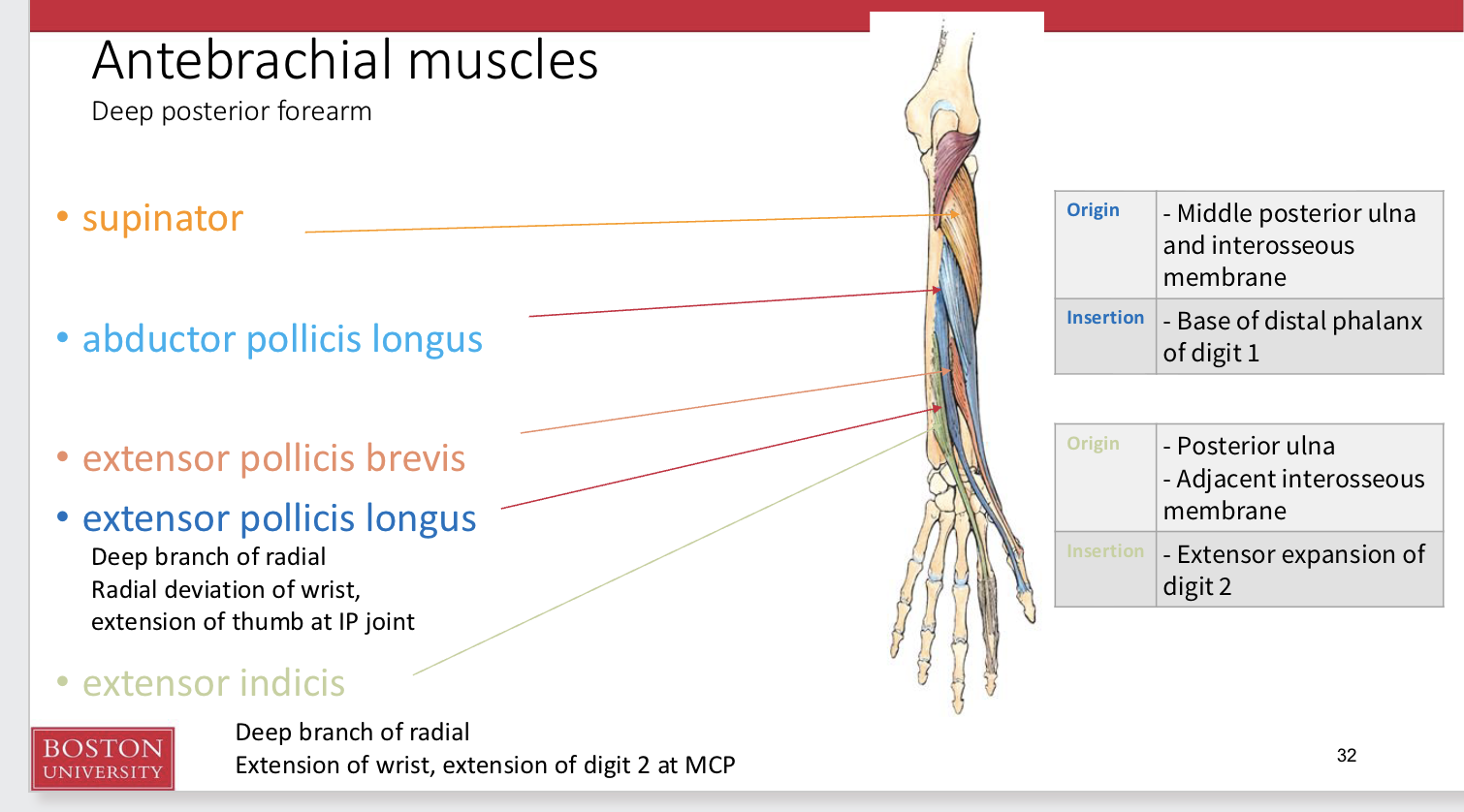
<p>Antebrachial muscles (<strong>Deep posterior forearm</strong>)</p>

Antebrachial muscles (Deep posterior forearm)
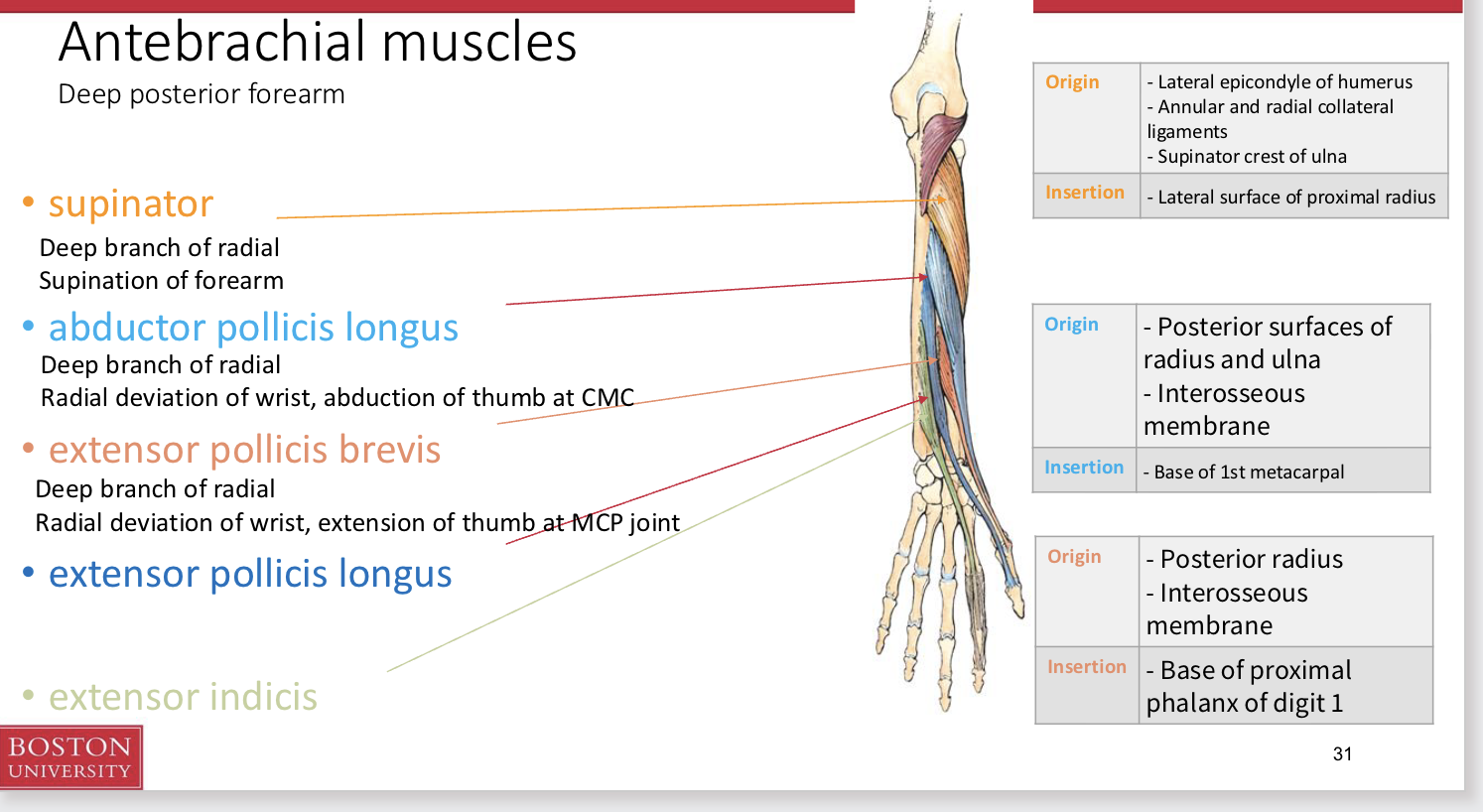
knowt flashcard image
27
New cards

Wrist Adductors and Abductors

ADDuctors

  • Muscles with tendons that cross the ULNAR side of the wrist ADDuct

    • Flexor carpi ulnaris

    • Extensor carpi ulnaris

ABDuctors

  • Muscles with tendons that cross the RADIAL side of the wrist ABDuct

    • Flexor carpi radialis

    • Extensor carpi radialis

  • Thumb (pollicis) muscles with tendons that cross the RADIAL side of the wrist assist in ABDuction
    • Abductor pollicis longus
    • Extensor pollicis longus
    • Extensor pollicis brevis

28
New cards

Wrist motion in general

No muscular forces are applied directly to the proximal carpals

  • (scaphoid, lunate, triquetrium)

These bones essentially serve as a mechanical link between the radius
and distal carpals


They tend to collapse anteriorly when force is applied, but are
stabilized by the intercarpal ligaments

29
New cards

What things passes via carpal tunnel

Tendons of:
• Flexor digitorum profundus
• Flexor digitorum superficialis
• Flexor pollicis longus

Median nerve
- Pass through the carpal tunnel

Flexor carpi radialis is embedded within the tendon


Palmaris longus


Flexor carpi ulnaris are outside the tendon

30
New cards

Anterior Palmar aponeurosis

  • Distally, the flexor retinaculum gives way to the palmar aponeurosis

  • This fascia covers the tendons, blood supply, nerves and muscles

  • It connects on it’s distal side to the superficial transverse metacarpal ligament
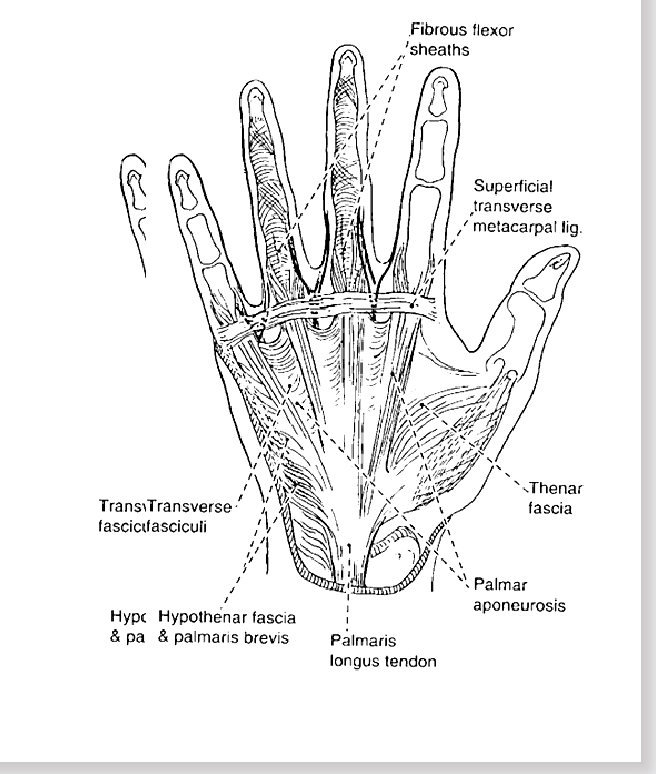
<ul><li><p><span><strong> Distally</strong>, the <strong>flexor retinaculum</strong> gives way to the palmar aponeurosis</span></p></li><li><p><span>This fascia covers the<strong> tendons</strong>, <strong>blood supply, nerves</strong> and <strong>muscles</strong></span></p></li><li><p><span>It connects on it’s<strong> distal </strong>side to the <strong>superficial transverse metacarpal ligament</strong></span></p></li></ul><p></p>
31
New cards

Posterior palmar aponeurosis

  • Similarly on the posterior side, the ligaments of all of the extrinsic finger extension muscles pass through the extensor retinaculum

  • Its function is to hold the tendons in place and not let them wander medially/laterally

32
New cards

Carpometacarpal joints

****All carpometacarpal joints are capable of flexion/extension*****

For the thumb

  • has it’s own synovial joint and a greater ROM

  • ex movem → (abduction, adduction, flexion, extension, opposition)

For the fingers

  • share one synovial cavity


Metacarpals of the third and fourth fingers have

  • limited ROM but fifth metacarpal have more ROM

The relatively immobile second and third joints

  • provide a stable axis for opposition

<p><strong>****All carpometacarpal joints</strong> are capable of <strong>flexion/extension*****</strong></p><p></p><p></p><p><span>For the <strong>thumb</strong></span></p><ul><li><p><span> has it’s own <strong>synovial joint </strong>and a <strong>greater ROM </strong></span></p></li><li><p><span><strong>ex movem → </strong>(abduction, adduction, flexion, extension, opposition)<br></span></p></li></ul><p><span>For the <strong>fingers</strong> </span></p><ul><li><p><span>share <strong>one synovial cavity</strong><br></span></p></li></ul><p><span><br><strong>Metacarpals</strong> of the<strong> third </strong>and<strong> fourth fingers</strong> have</span></p><ul><li><p><span><strong>limited ROM </strong></span>but        <strong>fifth metacarpal </strong>have <strong>more ROM</strong></p></li></ul><p></p><p><span>The relatively immobile <strong>second </strong>and <strong>third joints</strong> </span></p><ul><li><p><span>provide a <strong>stable axis</strong> for <strong>opposition</strong></span></p></li></ul><p></p>
33
New cards
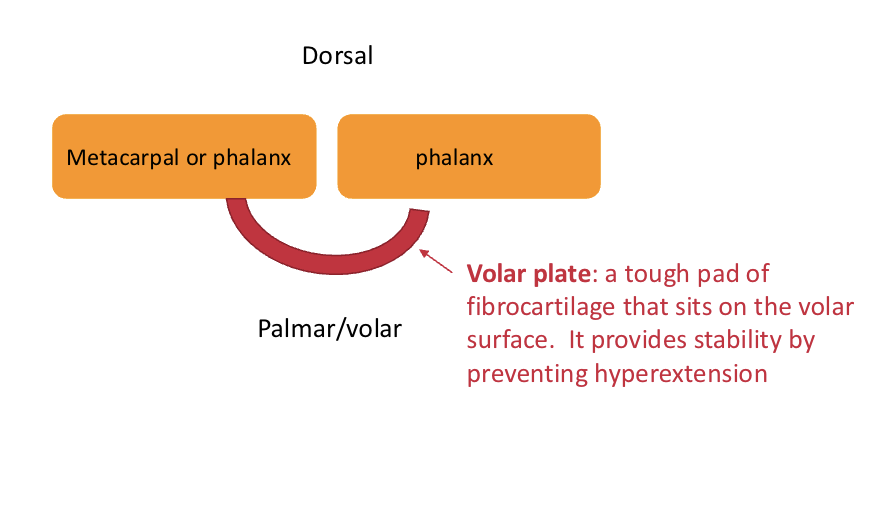
<p><span>Finger joint layout basics</span></p>

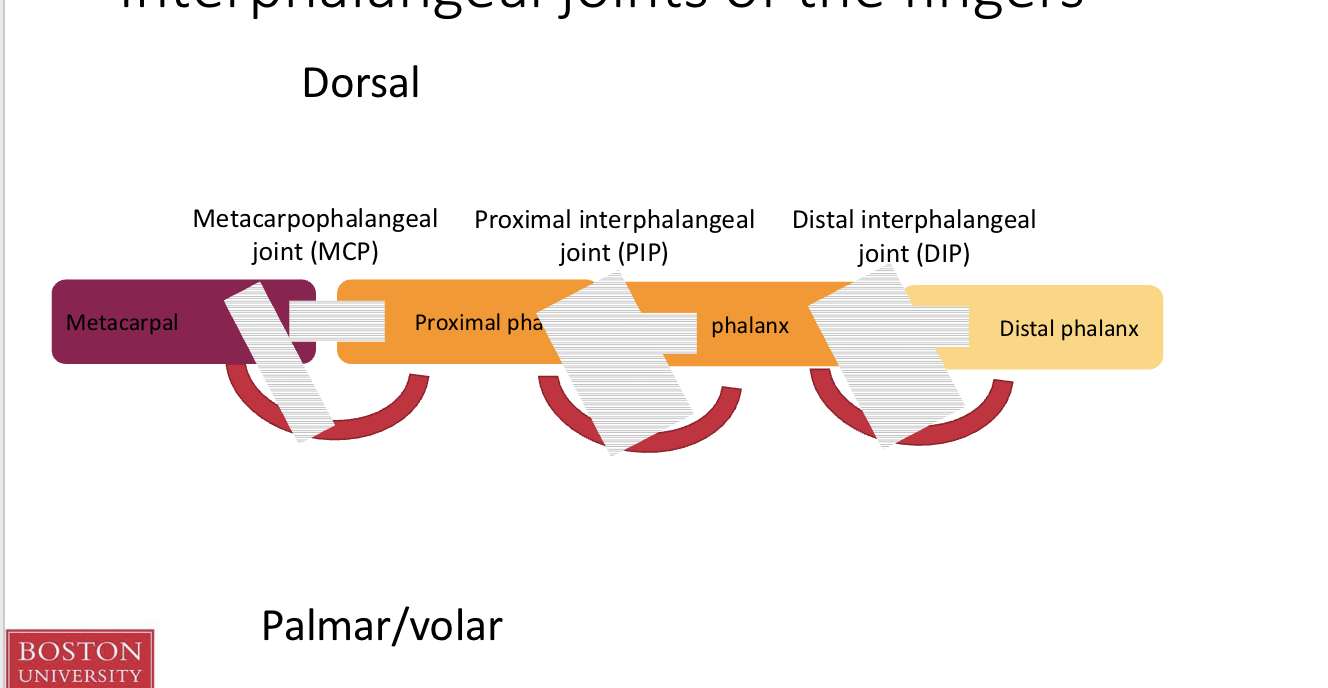
Finger joint layout basics

knowt flashcard image
34
New cards
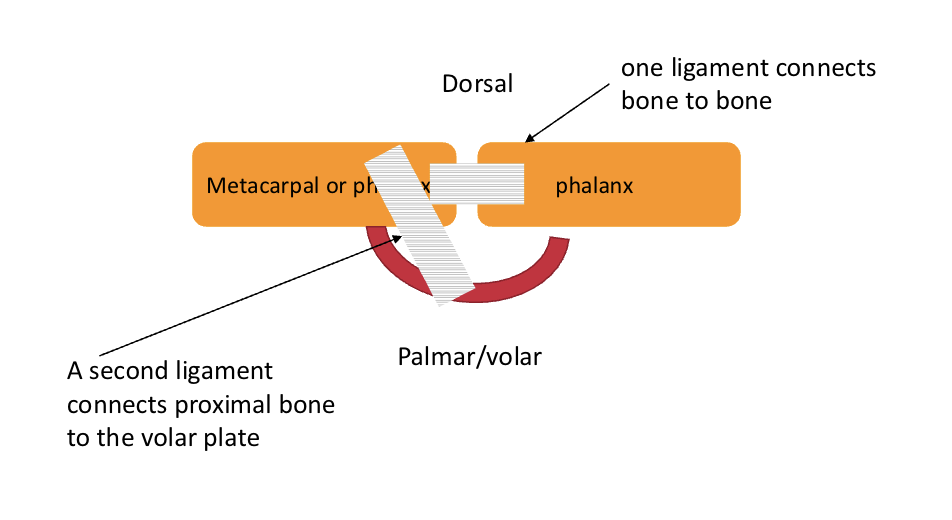
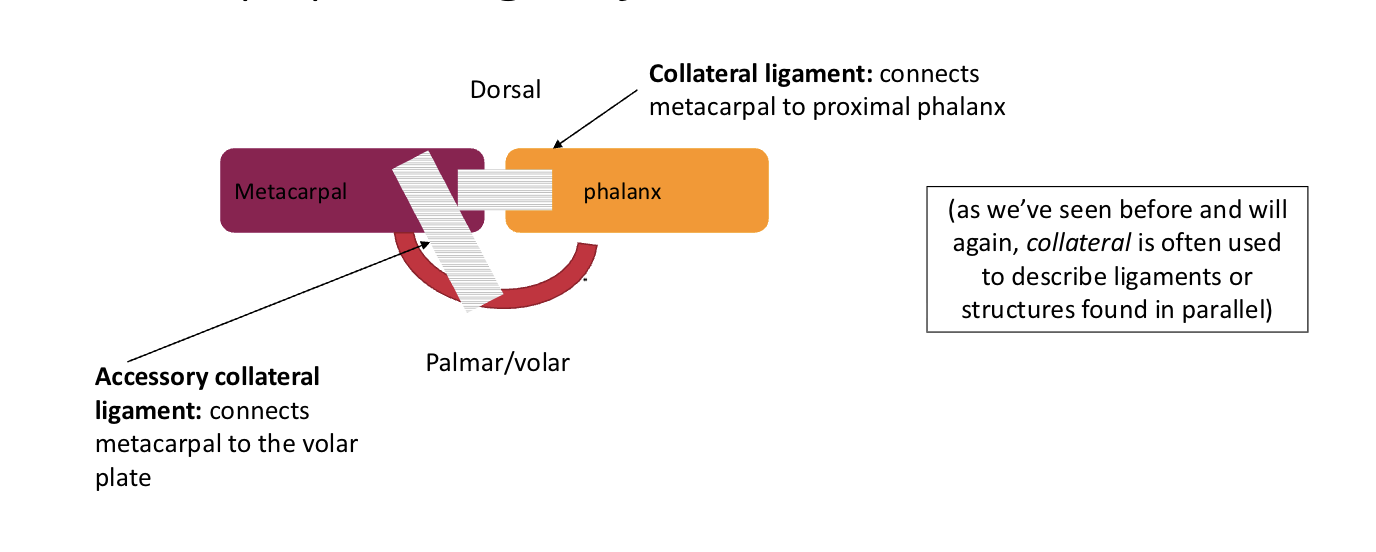
<p><span>Metacarpophalangeal joints </span></p>

Metacarpophalangeal joints

Components:

  • Volar plateprevents hyperextension

  • Collateral ligament connects metacarpal to proximal phalanx

  • Accessory collateral ligament connects metacarpal to volar plate
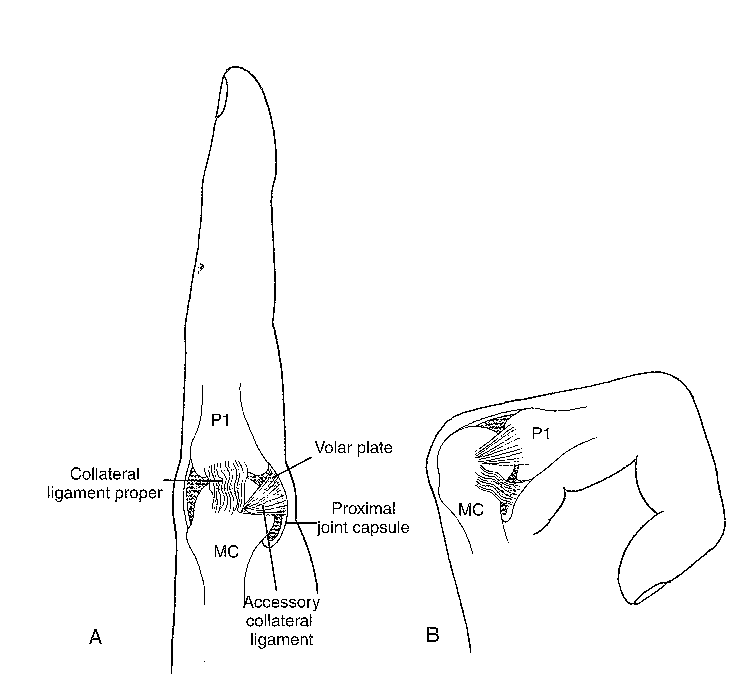
<p><strong><mark data-color="yellow" style="background-color: yellow; color: inherit;">Components:</mark></strong></p><ul><li><p><span><strong>Volar plate</strong> → <strong>prevents</strong> <strong>hyperextension</strong></span></p></li><li><p><span><strong>Collateral ligament </strong>connects <strong>metacarpal</strong> to <strong>proximal phalanx</strong></span></p></li><li><p><span><strong>Accessory collateral ligament </strong>connects <strong>metacarpal </strong>to <strong>volar plate</strong></span></p></li></ul><p></p><p></p><p></p>
35
New cards

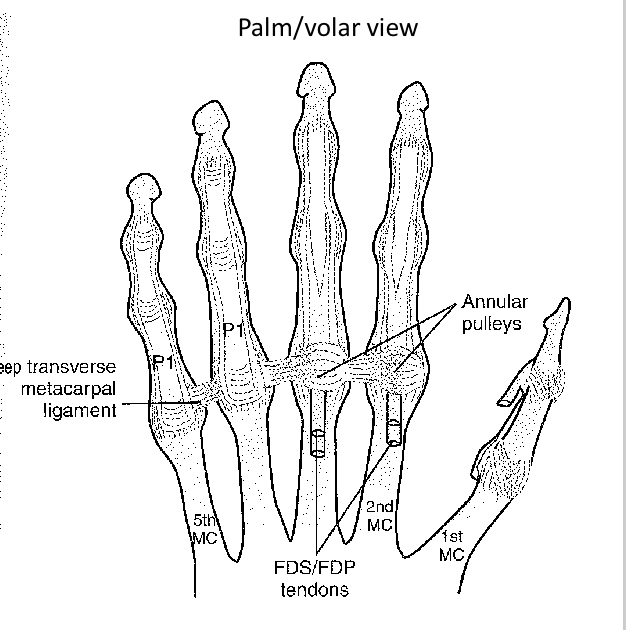
Metacarpophalangeal joints are connected to each other by the deep transverse metacarpal ligament

  • Deep transverse metacarpal ligament passes connects the volar plates of the metacarpophalangeal joints

  • Flexor tendons pass over it

<ul><li><p><span>Deep transverse metacarpal ligament passes connects the volar plates of the metacarpophalangeal joints</span></p></li><li><p><span>Flexor tendons pass over it</span></p></li></ul><p></p>
36
New cards
<p><span>Interphalangeal joints</span></p>

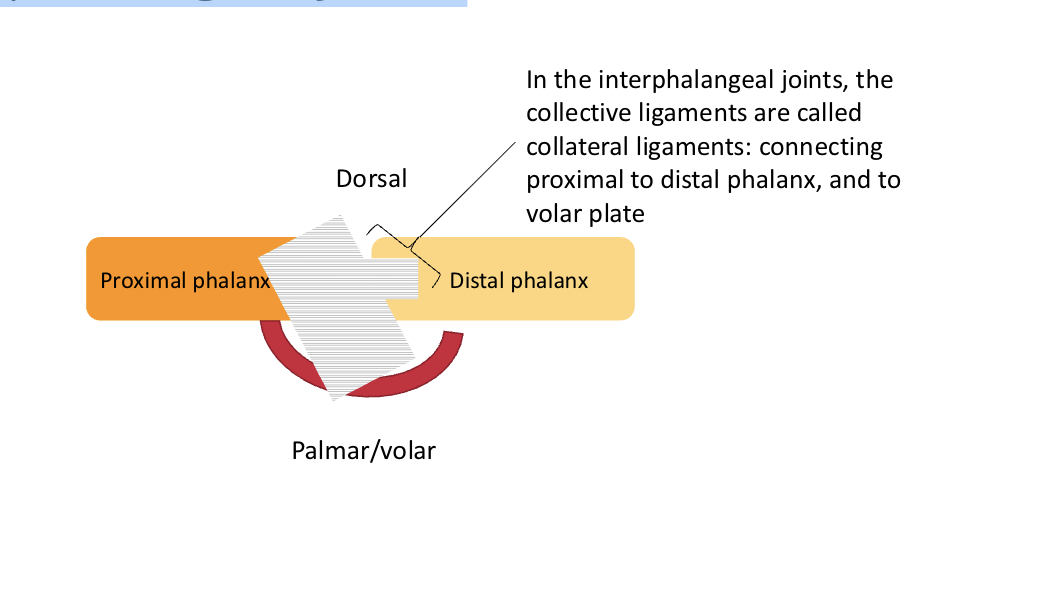
Interphalangeal joints

knowt flashcard image
37
New cards

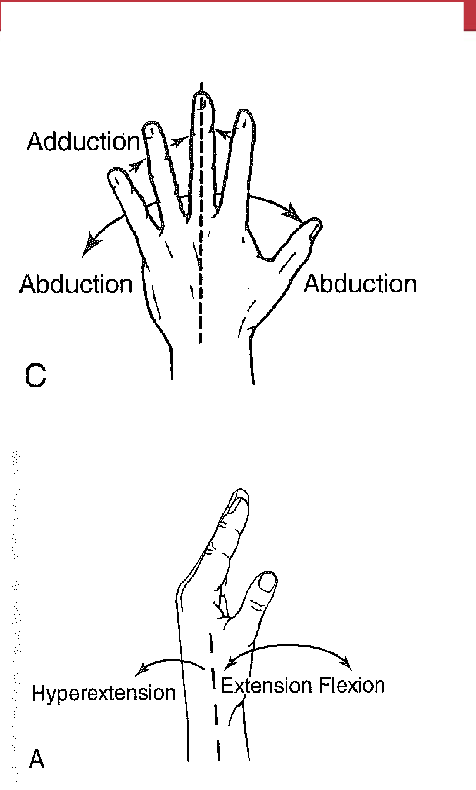
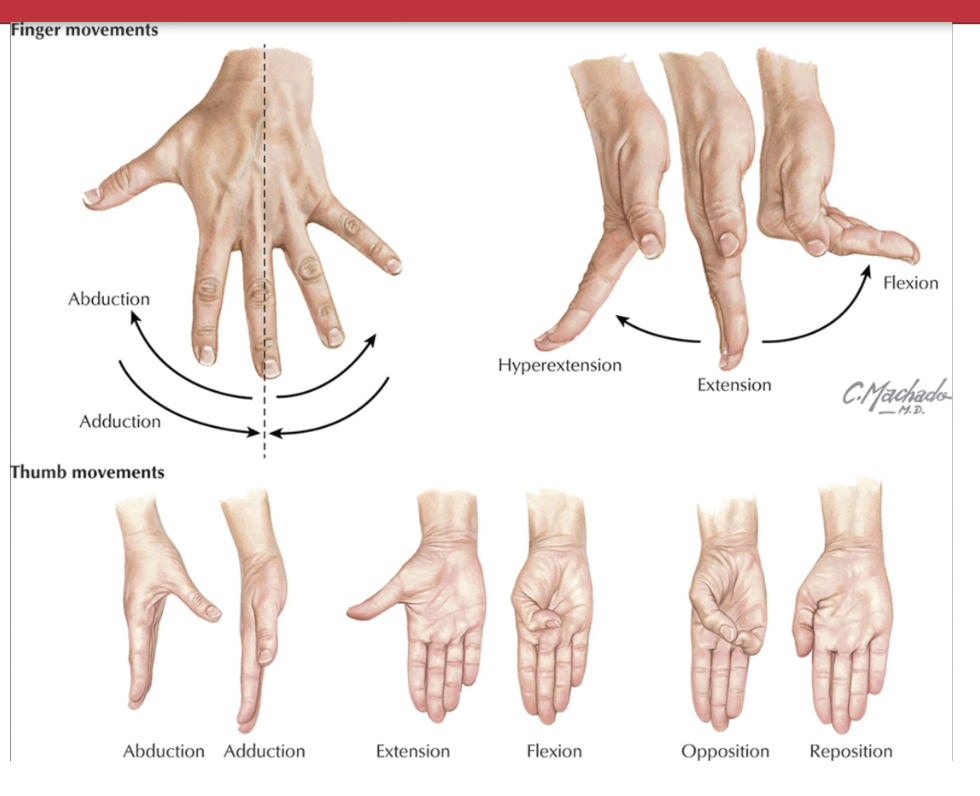
Movements of finger and thumb

knowt flashcard image
38
New cards
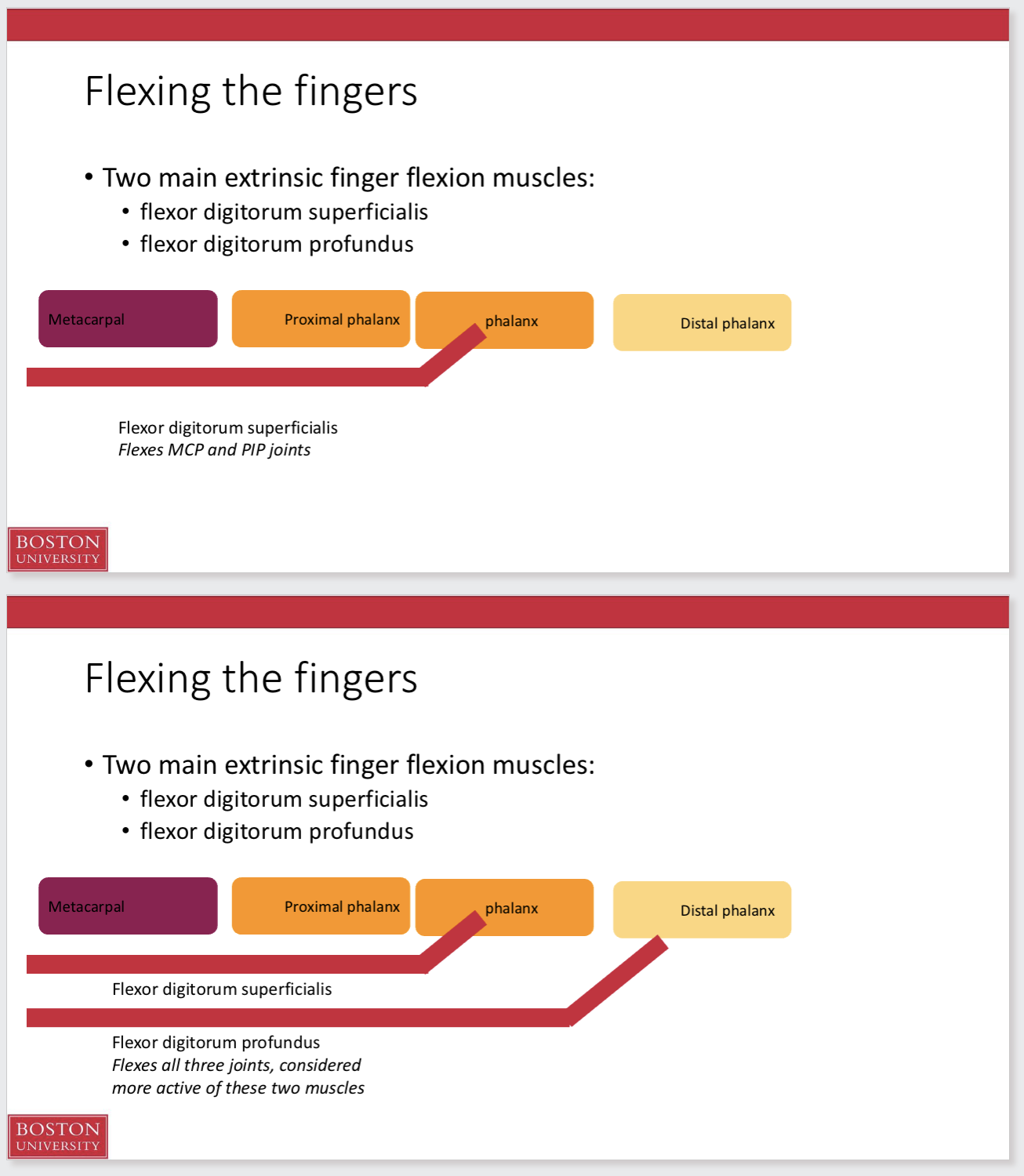
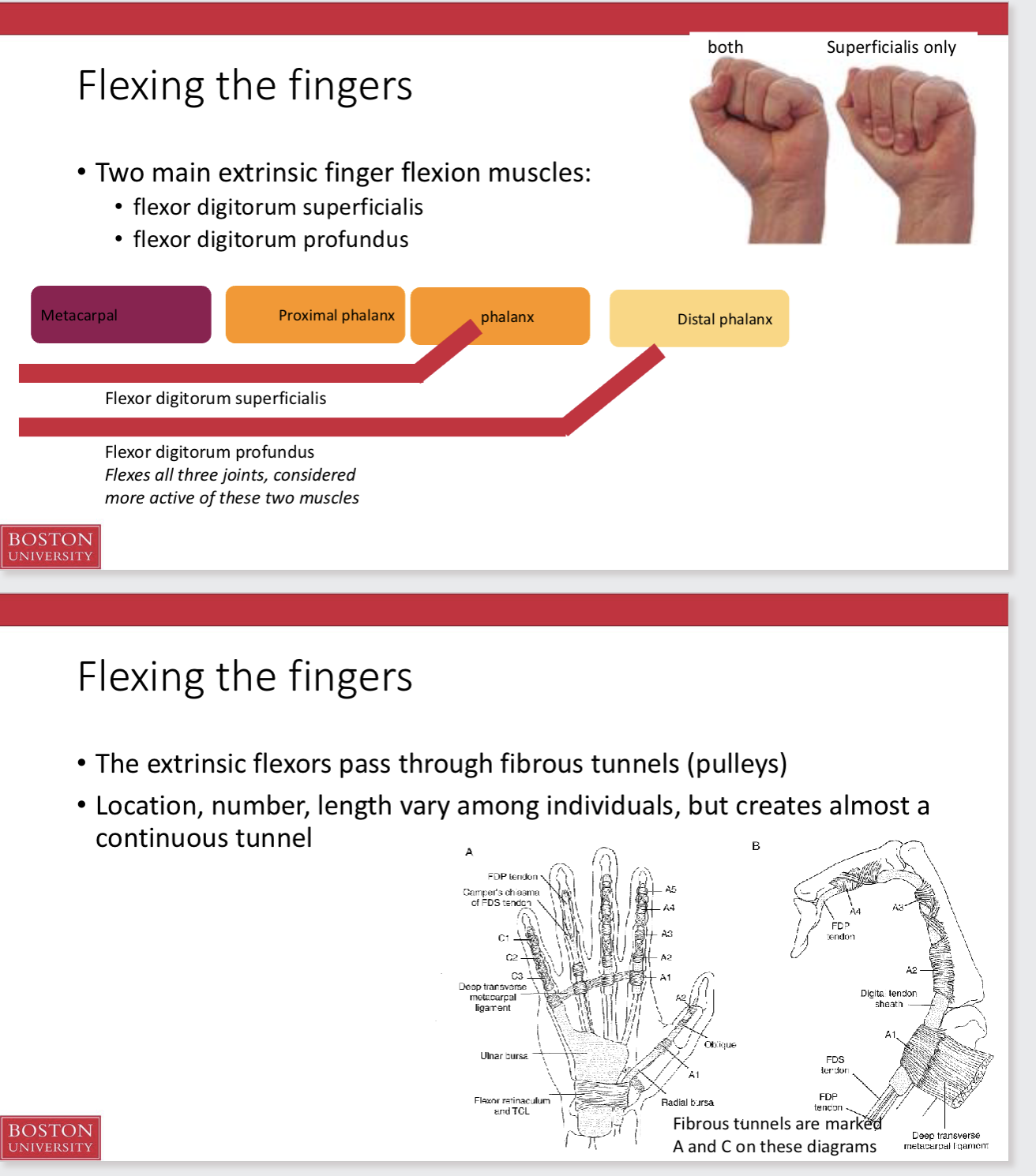
<p>Flexing the fingers</p>

Flexing the fingers

knowt flashcard image
39
New cards

Extending the fingers


Intrinsic muscles of the hands:
• Lumbricals insert on the extensor hoods, aiding in extension

Interossei muscles:

  • insert onto the extensor hoods and contributing to finger extension and ab/adduction
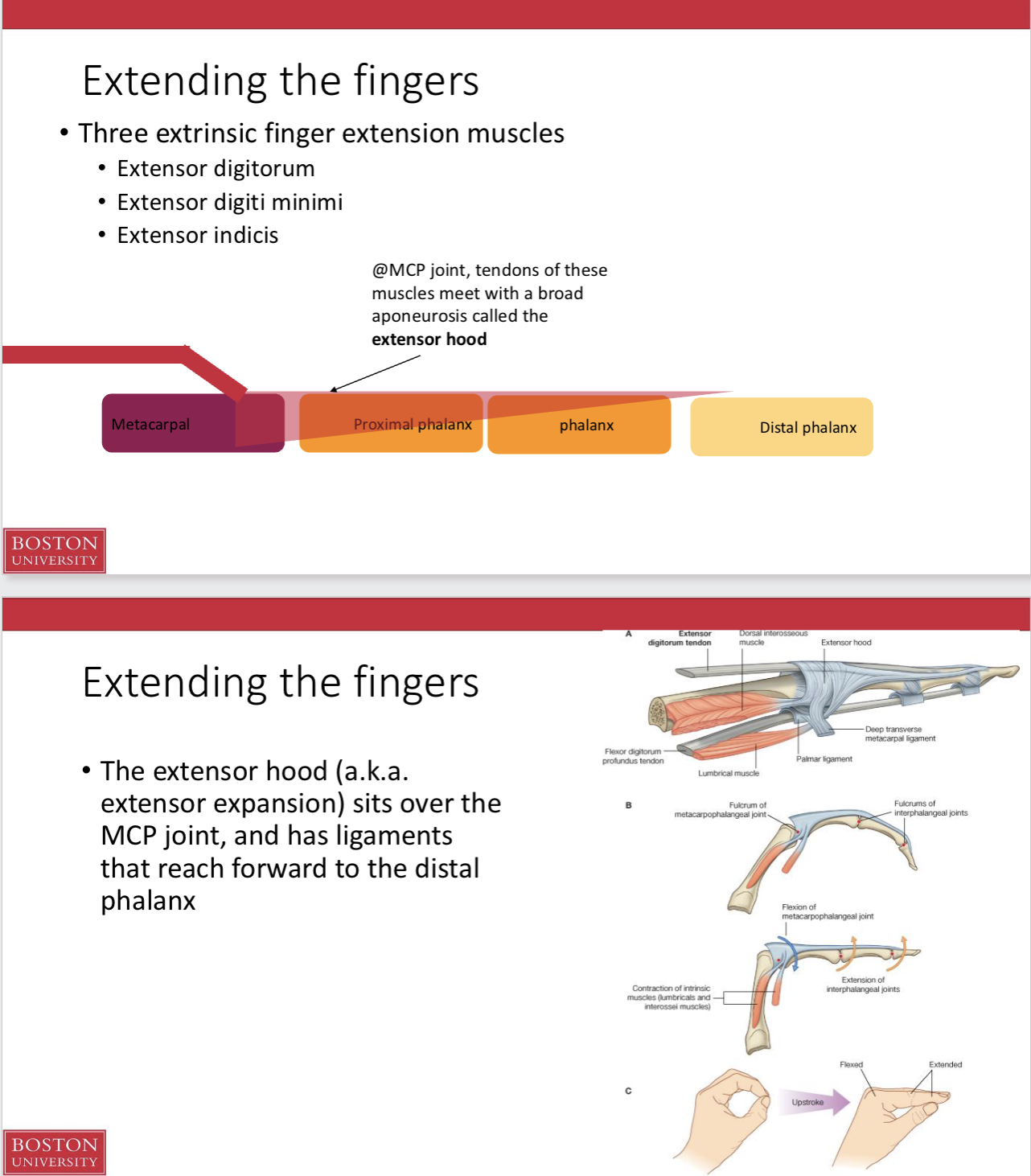
<p><span><br><strong>Intrinsic muscles of the hands:</strong><br>• Lumbricals insert on the <strong>extensor hoods</strong>, aiding in<strong> extension</strong></span></p><p></p><p><span><strong>Interossei muscles</strong>:</span></p><ul><li><p><span>insert onto the<strong> extensor hoods</strong> and contributing to <strong>finger extension</strong> and<strong> ab/adduction</strong></span></p></li></ul><p></p>
40
New cards

Finger abduction and adduction

  • The dorsal interossei muscles contribute to abduction

  • The palmar interossei contribute to adduction

DAB/ PAD

41
New cards

Intrinsic muscles of the thumb and little finger:

Intrinsic muscles of the thumb:

  • Abductor pollicus brevis

  • Flexor pollicus brevis

  • Opponens pollicus

  • Adductor pollicus

Intrinsic muscles of the little finger:
• Abductor digiti minimi
• Flexor digiti minimi
• Opponens digiti minimi