PUBLIC HEALTH
 Call Kai
 Learn
Learn Practice Test
 Spaced Repetition
 Match
Match Flashcards
 Knowt Play
1/5

There's no tags or description
Looks like no tags are added yet.
Name | Mastery | Learn | Test | Matching | Spaced | Call with Kai |
|---|
No analytics yet
Send a link to your students to track their progress
6 Terms
SAQ 1
Phase of Natural History of Disease (PH3)
- Pre-pathogenesis
- Pathogenesis
- Post-pathogenesis
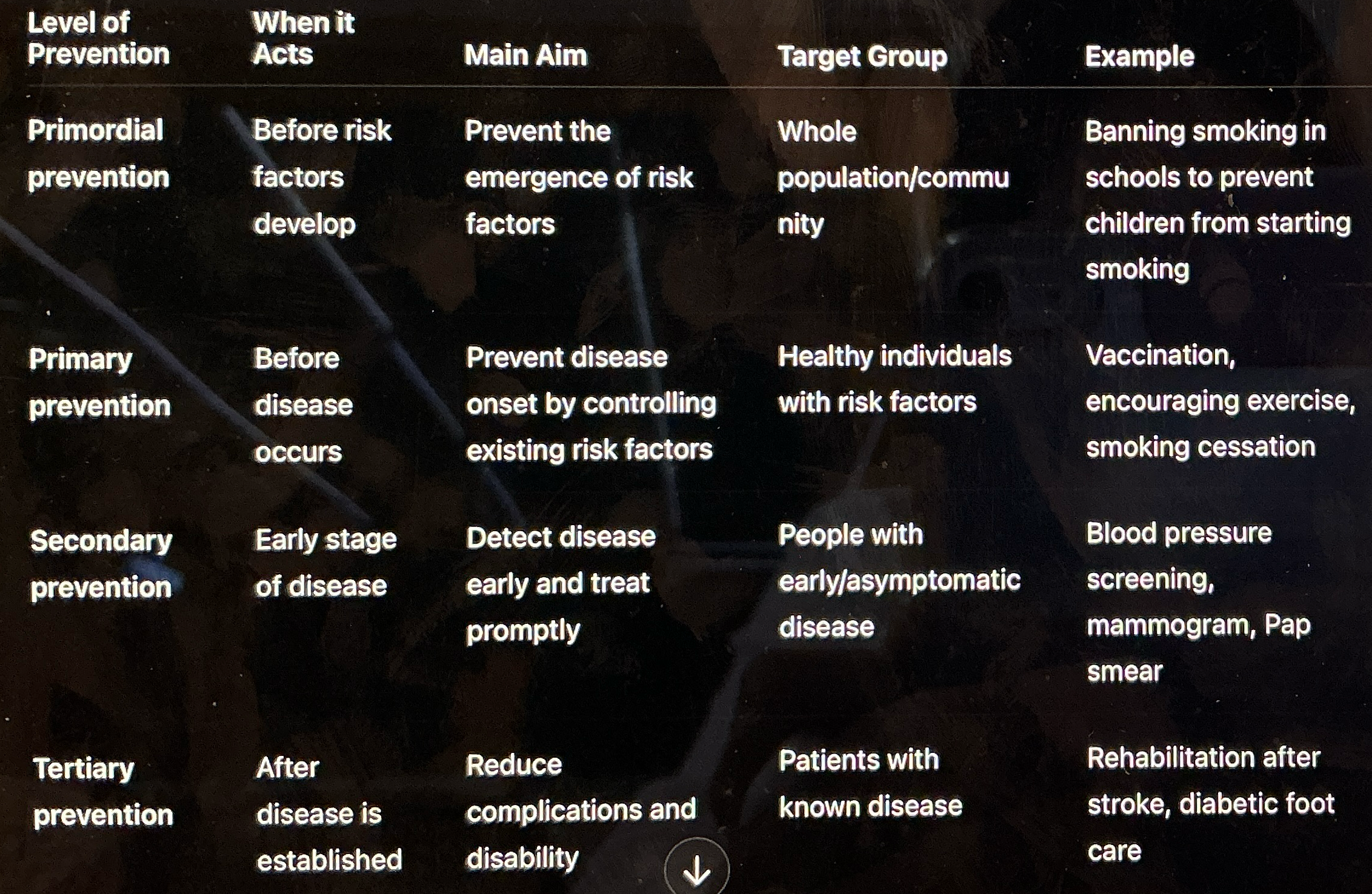
Phase of Prevention that Health Promotion acts upon (PH7)
- Primary prevention - bcs health promotion itself is a way to maintain the healthiness and well-being
Five strategies of Ottawa Charter in health promotion with example (PECSH) - PH7
1) Build healthy public policy - implementing higher taxes on cigarettes to reduce smoking
2) Create supportive environments - developing public parks and cycling lanes to encourage physical activity
3) Strengthen community action - community-led exercise or healthy eating program
4) Develop personal skills - health education program teaching healthy diet and exercise habits.
5) Reorient health services - Clinics providing preventive counselling instead of focusing only on rx.
Most common modifiable factors in development of chronic diseases + examples of health promotion interventions (PH14)
1) Tobacco use - anti-smoking campaigns through media and schools // smoking cessation programs and counselling services
2) Unhealthy diet - nutrition education and promotion of healthy eating habits
3) Physical inactivity - organizing community exercise programs // health education encouraging regular physical activity and active lifestyles
4) Harmful alcohol use - implementing policies and programs for responsible alcohol consumption
Advantage and weakness of those interventions
- Advantage - increase public awareness about the harmful effects of smoking and may reduce smoking rates
- Weakness - behavior change may take a long time, and some individuals may continue smoking despite awareness campaigns
SAQ 2 (MALARIA)
Epidemiological triangle for Malaria - PH2
- Agent - Plasmodium parasite (Falciparum, vivax, malariae)
- Host - Human with factors of low immunity, travellers, children, pregnant women
- Environment - Tropical climate, stagnant water, forested areas, poor sanitation and presence of vector breeding sites
- Vector - Female Anopheles mosquito transmits the disease
Surveillance system for Malaria - PH10
1) Passive surveillance - cases detected when patient come to health facilities for rx.
2) Active surveillance - health authorities actively search for cases in communities or high-risk groups (including contact screening and screening in endemic areas)
- National Malaria Surveillance System
Stages of Disease Control - PH22
- Eradication
- Control
- Pre-elimination
- Elimination
- Prevention of Malaria Re-establishment
→ Malaysia achieved elimination of zero indigenous human malaria in 2018. Currently in prevention of Malaria re-establishment for human malaria, but still faces challenges with zoonotic malaria (Plasmodium knowlesi)
Malaria disease control + activities based on 4C concept
- Carriers (Case detection) - early dx using blood film or rapid diagnostic test (RDT) and screening high-risk groups and travellers from endemic countries
- Case (Case rx) - prompt rx with antimalarial drugs and hospital admission & monitoring for severe malaria cases
- Contact (Contact tracing) - investigate family members or close contact of confirmed cases and active surveillance around affected villages or workplaces
- Community (Containment + Epidemiological investigations) - health education on mosquito bite prevention and community clean-up campaigns to eliminate mosquito breeding sites
PH18 - Causation
Types of causal relationships
- Common-cause relationships
- Common-effect relationships
- Causal chains
- Causal homeostasis
Types of causal relationships effects
- Direct causal effects - effects that go directly from one variable to another // exposure to harmful chemical → illnesses
- Indirect causal effects - the relationships between two variables is mediated by one or more variables // poor air quality → resp. issues, but the direct cause might be common environmental factor such as pollution
Bradford Hill Criteria for Judging Causality (Strong Consistent Stories Take Biological Proof, Coherence, Experiments, Analogies)
Odd Ratio (OR) = AD/BC
- make a table pm (the first variable told) and pb (second variable)
- from left to right a → b → c → d
- decide the cut off value
- conclusion - person with cut off value is x times more likely to pb as compared to vice versa
SAQ 3
Person’s variables of descriptive epidemiology (ASOSELR) - PH4
- Age - Incidence and prevalence vary with age // E.g. measles in children and HTN in adult
- Sex - Some diseases differ between males and females // E.g. prostate CA in male and cervical CA in female
- Ethnicity - Disease occurrence may vary by ethnic or racial group // E.g. high thalassemia in certain ethnic groups
- Occupation - Certain jobs expose workers to hazards // E.g. scoliosis
- Socioeconomic status - Income and education influence nutrition, healthcare access and disease risk
- Lifestyle - Smoking, alcohol intake, physical activity and diet affect disease occurrence
- Religion - Cultural practices may influence lifestyle and health behaviour
Difference between Active vs Passive Surveillance - PH3
- Health authorities actively search for disease cases vs Health facilities routinely report cases voluntarily or as required
- Investigators contact hospitals, clinics or communities to obtain data vs Healthcare providers send reports to health authorities
- More expensive vs less expensive
- More complete and accurate vs May have underreporting
- Requires more staff and sources vs require fewer sources
- Faster detection of outbreaks vs Slower detection
- Used during outbreaks or eradication programs vs Used during routine disease monitoring
- E.g. Dengue, COVID-19 vs TB (report to MoH) and infectious diseases (by hospitals)
Sentinel Surveillance - PH10
- Definition - Monitoring through selected sites (hospitals, clinics) to gather high-quality, targeted data of specific diseases or health events
- Purpose
→ to monitor trends
→ to detect early outbreaks
→ to evaluate interventions
- Application - Influenza, HIV/AIDS, TB, Polio Surveillance
- Disadvantages
→ not fully representative (doesn’t include whole population)
→ selection bias
→ misses cases outside selected sites
- Important for HIV/AIDS at the Border Crossings - d/t may introduce/carry HIV from diff region
→ increase movement of people since it is for trading, traveling, seeking asylum
→ high-risk populations as it is the are with lots of migrant, sex and truck workers
→ limited access to healthcare causing underdiagnosis and delayed rx
Notifiable Disease Surveillance
- Definition - A system where specific diseases are legally mandated to be reported to PH authorities to monitor, control and prevent outbreaks
- Purpose - same as Sentinel Surveillance
- Example
→ CD: TB, measles, HIV/AIDS, COVID-19
→ NCD: cancers, congenital disorders
→ Zoonotic: Rabies, anthrax
- Process
→ Diagnosis and detection by healthcare provider
→ Mandatory reporting to local health authority
→ Data collection and aggregation
→ Outbreak response - investigation, alert and interventions
→ Feedback to stakeholders - for action and policy planning
Differences between Prevalence vs Incidence
- Total existing cases (new + old) vs Only new cases
- Use to determine burden of disease vs use for risk and spread monitoring
- Timeframe is only a snapshot or period vs Specific time window
- Inclusion is all people with disease vs only those newly diagnosed
- Usefulness for chronic disease management vs acute disease tracking
PH8 and PH25 - Occupational Health + Environmental Health
Type of Hazards
- Chemical
- Physical
- Biological - Viruses (H1N1, HIV, Hep B), Bacteria (TB)
- Ergonomic - Shift work, night shifts, manual handling, poor posture
- Psychosocial - Stress, burnout, workplace violence and SH
Health impacts of each type of hazards
- Chemical → poisoning, respiratory prob, skin irritation, organ damage, long term diseases such as cancer // e.g. pesticides poisoning, lead poisoning
- Physical → injuries, burns, hearing loss, heat stroke, radiation sickness // e.g. excessive noise hearing loss, ionizing radiation sickness
- Biological → infectious diseases, food poisoning, allergic rxn, outbreaks of illness // e.g. salmonella food poisoning, influenza virus flu outbreak
- Ergonomic → msk disorder, back pain, joint injuries and repetitive strain injuries
Examples of Physical Hazards
- Prolonged exposure to industrial noise
- Radiation exposure risks
- Heat stress among outdoor workers
- Continuous vibration from machinery
- Cold environments
Examples of Chemical Hazards
- Inhalation of toxic industrial fumes
- Skin exposure to pesticides or solvents|
- Heavy metal exposure
- Inhalation of silica dust or coal dust
- Chronic chemical exposure
Hierarchy of Control
- Elimination
- Substitution
- Isolation
- Engineering controls
- Administrative controls
- Personal Protective Equipment (PPE)
Workplace Health Protection - involves strategies to prevent workers from being exposed to harmful environmental factors and to ensure their well-being in the workplace
- Measures
→ Engineering control - proper ventilation system, noise barriers, safety guards on machinery
→ Administrative control - policies and procedures such as shift rotation, rest breaks, training and work schedules
→ PPE - helmets, gloves, respirators, earplugs, and safety goggles
→ Health surveillance - ongoing monitoring of workers’ health to detect early signs of illness or injury (regular hearing test)
Medical surveillance under OSH (USECHH) regulation 2000 can only be done by an Occupational Health Doctor (OHD) registered with the Department of Occupational Safety and Health (DOSH)
Occupational Disease
- Responsibility of reporting to nearest DOSH office by - employer and the attending registered medical practitioner
- Timeframe - formal notification must be made within 7 days from the date of dx
Name of notification form - JKKP7 Form (Notification of Occupational Poisoning and Occupational Disease)
Agencies involved in Environmental Health in Malaysia
- MoH
- Department of Environment (DoE)
Environmental Health Legislation
- The Environmental Quality Act (EQA) 1974 - to prevent, control and reduce environmental pollution
- Food Act 1983 - protect PH by ensuring food safety and hygiene and prevent the sale of contaminated or unsafe food.
Role of EHO in ensuring occupational safety
1) Hazard identification and risk assessment
2) Regulatory compliance - ensure organizations follow occupational health and safety laws and standards
3) Workplace inspections and audits
4) Training and education
5) Health surveillance
6) Emergency response and investigation - manage workplace emergencies, investigate accidents and prepare reports to recommend preventive measures to avoid similar incidents in the future
Water sources and drinking water attributes
- Surface water
- Ground water
- Rainwater
Wastewater and how it is generated
- Wastewater is a used water that contains waste materials and contaminants, making it unsuitable for immediate reuse.
- Domestic wastewater (bathing, washing, toilets, cooking)
- Industrial wastewater (manufacturing, mining, food processing, chemical production)
- Agricultural wastewater (fertilizers, pesticides and animal waste)
Steps of water rx
1) Screening - removes large objects such as leaves, sticks and rubbish
2) Coagulation and flocculation - chemical is added to clump small particles into larger particles (flocs)
3) Sedimentation - heavy flocs settle at the bottle of the tank
4) Filtration - water passes thru sand/gravel filters to remove remaining particles
5) Disinfection - chlorine or other disinfectants kill microbes
6) Storage and distribution - treated H20 is stored and supplied to consumers
Parameters to assess water quality with examples (Good attributes of Good Drinking Water)
- Physical parameter
→ clear and colorless
→ odorless
→ turbidity - measure of cloudiness or haziness of water caused by suspended particles (microbes, pollutants, organic matter)
- Chemical parameter
→ pH level - determine acidity or alkalinity, affecting the solubility of minerals and the efficiency of disinfectants // ideal for drinking water is 6.5 - 8.0 // if acidic, may corrode pipes // if alkaline, water may taste unpleasant
→ heavy metals - free from harmful particles (lead, mercury and arsenic)
- Biological parameter
→ Coliform bacteria (Fecal coliform) - presence of fecal coliform may suggests possible contamination by harmful pathogens // > 5 coliform bacteria per 100ml shouldn’t be consumed without rx as it may contain harmful microbes
PH5 - Outbreak investigations (COVID-19)
Relationship between epidemiological triangle
- The agent is the virus that can be transmitted thru respiratory droplets and has a short incubation period indicating high virulency
- The host are people of all ages, but younger people is more susceptible
- The environment are poor housing, poor ventilation, big crowds and unprotected close contacts
Cholera outbreak - Common source epidemics (Single point exposure)
Measure of disease control in an epidemic
1) Control the source of infxn
→ case finding, early dx (case confirmation) and rx of cases, isolation and notification + surveillance of cases (contact/family)
2) Control measures
3) Reducing or eliminating reservoirs
4) Breaking the transmission route
→ ensure safe and clean water supply
→ proper sewage disposal and sanitation
→ promote hand and food hygiene
→ disinfection of contaminated materials
5) reducing the number of susceptible individuals
→ health education on prevention methods
→ vaccination
→ encourage use of clean drinking water and proper personal hygiene