International business (Engelska metod-kurs)
 Call Kai
 Learn
Learn Practice Test
 Spaced Repetition
 Match
Match Flashcards
 Knowt Play
1/64

There's no tags or description
Looks like no tags are added yet.
Name | Mastery | Learn | Test | Matching | Spaced | Call with Kai |
|---|
No analytics yet
Send a link to your students to track their progress
65 Terms
flat world view
globalization has “leveled the playing field” so that countries, firms, and individuals can compete more equally across borders. In other words, geography matters less, and global economic competition becomes more direct, intense, and interconnected.
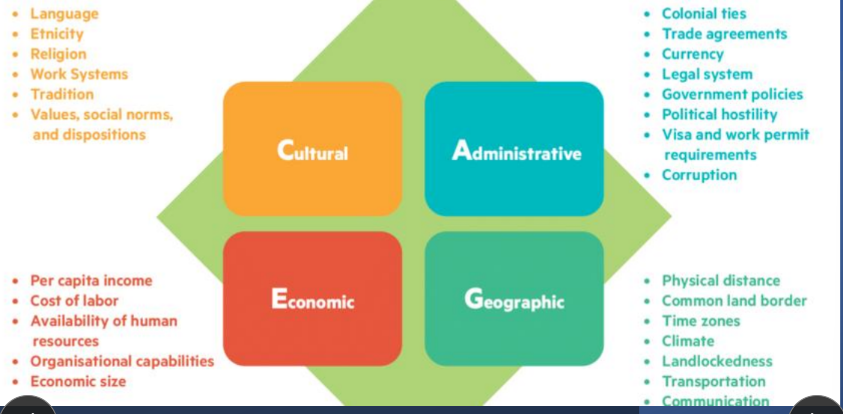
CAGE framework
The world is not flat, but semiglobalized and multidomestic. It is a framework used to analyze how differences between countries create frictions that limit globalization. Looks at:
Cultural, Administrative, Geographic, and Economic distance.
Forces of globalization
cost
market
competitive
techonological
political
factors determining market entry strategy
vision
attitude towards risk
type of product, value or cost of product
transport requirements and procedure
current competition and consumer needs
host country socio-political situation
desire of control
committed investment
exporting
Exporting refers to the selling and sending of goods or services to another country.
A country’s export policy impact the country's economy. Trade policies like tariff, trade barriers, taxes or import and subsidies can impact the export.
export advantages vs disadvantages
Advantages:
No investment in foreign production facilities are needed
Low cost
High efficiency
Favorable government policy
Foreign currency
Disadvantages:
High labor cost in home country
High transportation cost and long lead time (not suitable for agri products)
Tariff barriers can make export costly and risky
Foreign exchange risk (because of fluctuations)
Foreign agent’s loyalty concerns
Regulation from government
turnkey projects
Contracter agrees to handle every detail of the project for a foreign client, including the training of operation personnel. At completion of the contract foreign client is handed the “key” to the plant that is ready for full operations. low risk, but higher profit potential than export.
turnkey projects advantages vs disadvantages
Advantages:
Less risk
Less investment
More revenue (short term)
Good in case of limited FDIs
Market expansion
Sharing of expertise (or technology)
Disadvantages:
Lack of authority the owner has over the construction and design
Not suitable for all types of companies and products
Lot of dependency
Possible revenue loss
Unintended competion (Oil & Gas industry)
The potential loss of a competitive advantage
licensing
An arrangement where a licensor grants the rights to intangible property to the licensee for a specified period and in return licensor receive a royalty fee from the licensee.
licensing advantages vs disadvantages
Advantages:
Income without overhead
Potentially better marketing
The ability to enter foreign market more easily
The diffusion of conflict
Less risk
Disadvantages:
Risk of IF thefts
No guarantee of revenue
Risk of diminishing reputation
Potential conflicts
franchising
Franchising is basically a specialized form of licensing in which the franchisor sells intellectual rights to the franchisee and also insists that they agree to abide by the strict rule regarding how they do business.
franchising advantages vs disadvantages
Advantages:
Fast expansion
Can adopt host country culture easily
Disadvantages:
Less capable of supporting competition attack in the foreign country
Quality control (less control)
joint venture
A joint venture is a business arrangement in which two or more parties agree to pool their resources for the purpose of accomplishing a specific task. Each of the participants is responsible for the profit or loss and cost associated with it.
joint venture advantages vs disadvantages
Advantages:
Gaining support from local partner
Sharing risk and cost
Less government intervention
Disadvantages:
Risk of losing core technology
Option 1: holding majority ownership in the venture
Option 2: “wall off” a partner’s technology that’s central to the core competence of the firm
Not having total control
Possible clash between partners
wholly owner subsidiary
Option 1: set up new operation in the foreign country (= Greenfield venture)
Option 2: acquire an established firm in the host country (= Acquisition)
wholly owner subsidiary advantages vs disadvantages
Advantages:
Less risk of losing core technology
Tight control
Attaining an economy of scale
Disadvantages:
Huge sunk cost and high risk
Lack of local support (sometimes)
acquisition
An acquisition is defined as a corporate transaction in which company purchase a portion of another company’s share or asset.
acquisition advantages vs disadvantages
Advantages:
Quick to execute
Allows a firm to prempt competition
Less risky than Greenfield venture
Major reasons of failure:
Firm overpay for the acquisition
There may be cultural clash
Challenges are underestimated
greenfield venture
When a company establishes a subsidiary in other country, building its operation from the ground.
greenfield venture advantages vs disadvantages
Advantages:
It gives the firm much greater ability to build the kind of subsidiary company
It is simple to establish a set of operating routine in a new subsidiary than it is to convert the operating routine as an acquired unit
Disadvantages:
High cost and long term commitment
More vulnerable
anarchism
A political philosophy that advocates for the abolition of all involuntary, hierarchical government and state control in favor of a society based on voluntary association, self-determination, and mutual aid
authoritarian
Governments centralize all control in the hands of one strong leader or a small group of leaders, who have full authority
These leaders are not democratically elected and are not politically, economically, or socially accountable to the people in the country
Favoring a concentration of power in a leader
democracy
The most common form of government around the world today
Democratic governments derive their power from the people of the country, either by direct referendum (called a direct democracy) or by means of elected representatives of the people (a representative democracy)
full democracies
countries in which not only basic political freedoms and civil liberties are respected, but which also tend to be underpinned by a political culture conductive to the flourishing of democracy. The functioning of government is satisfactory. Media are independent and diverse. There is an effective system of checks and balances. The judiciary is independent and judicial decisions are enforced. There are only limited problems in the functioning of democracies.
flawed democracies
these countries also have free and fair elections and, even if there are problems (such as infringements on media freedom), basic civil liberties are respected. However, there are significant weaknesses in other aspects of democracy, including problems in governance, and underdeveloped political culture and low levels of political participation.
hybrid regimes
elections have substantial irregularities that often prevent them from being both free and fair. Government pressure on opposition parties and candidates may be common. Serious weaknesses are more prevalent than in flawed democracies – in political culture, functioning of government and political participation. Corruption tends to be widespread and the rule of law is weak. Civil society is weak. Typically, there is harassment of and pressure on journalists, and the judiciary is not independent.
authoritarian regimes
in these states, state political pluralism is absent or heavily circumscribed. Many countries in this category are outright dictatorships. Some formal institutions of democracy may exist, but these have little substance. Elections, if they do occur, are not free and fair. There is disregard for abuses and infringements of civil liberties. Media re typically state owned or controlled by groups connected to the ruling regime. There is repression of criticism of the government and pervasive censorship. There is no independent judiciary.
specific tariffs
which are levied as a fixed charge
ad valorem tariffs
which are calculated as a percentage of the value. Many governments will charge ad valorem tariffs as a way to regulate imports and raise revenues
subsidies
a form of government payment to a producer. Types of subsidies include tax breaks or low-interest loans; both of which are common. Subsidies can also be cash grants and government-equity participation, which are less common because they require a direct use of government resources
import quotas and VER
import quotas and voluntary export restraints (VER) are two strategies to limit the amount of imports into a country. The importing government directs import quotas, while VER are imposed at the discretion of the exporting nation in conjunction with the importing one
currency controls
governments may limit the convertibility of one currency (usually its own) into others, usually in an effort to limit imports. Additionally, some governments will manage the exchange rate at a high level to create an import disincentive
local content requirements
many countries continue to require that a certain percentage of a product or an item be manufactured or “assembled” locally. Some countries specify that a local firm must be used as the domestic partner to conduct business
antidumping rules
· dumping occurs when a company sells product below market price often in order to win market share and weaken a competitor
export financing
governments provide financing to domestic companies to promote exports
free trade zone
many countries designate certain geographic areas as free-trade zones. These areas enjoy reduced tariffs, taxes, customs, procedures, or restrictions in an effort to promote trade with other countries
administrative policies
these are the bureaucratic policies and procedures governments may use to deter imports by making entry or operations more difficult and time consuming
civil law system
Nations with civil law systems have comprehensive, frequently updated legal codes
Most importantly, case law is a secondary source in these jurisdictions
Most of the law is statutory law created by legislatures and not by judges following precedent
Usually an inquisitorial system, where an investigating judge is actively involved in investigating the facts of a case
Juries are rarely used; a judge or panel of judges will decide the facts and the law to be applied
Prosecutors and defense attorneys may play a more limited role
Victims may be parties and have rights regarding their involvement, which may include having their own attorneys and filing the initial charges
e.g. France, Germany
common law systems
Common law systems, while they often have statutes, rely more on precedent, judicial decisions that have already been made
Usually an adversarial system, where the judge acts as an impartial referee between opposing parties to a case
A jury may determine the facts, and a judge will decide the law to be applied
There is an active role for prosecutors and defense attorneys
Victims have a role as witnesses and may have rights as a victim to receive information and limited participation – however, victims are not a party in criminal cases
In this system, much of the law is made by the judges’ decisions, called precedent
e.g. the UK and US
customary law systems
Customary law systems are based on patterns of behavior (or customs) that have come to be accepted as legal requirements or rules of conduct within a particular country
The laws of customary legal systems are usually unwritten and are often dispensed by elders, passed down through generations
Oftentimes, customary law practices can be found in mixed legal system jurisdictions, where they’ve combined with civil or common law
religious law systems
Religious legal systems are systems where the law emanates from texts or traditions within a given religious tradition
Religious law is also known as theocratic law and is based on religious guidelines. The most commonly known example of religious law is Islamic law, also known as Sharia.
developed economy
Also known as advanced economies, are characterized by postindustrial countries – typically with high per capita income, competitive industries, transparent legal and regulatory environments, and well-developed commercial infrastructure
Developed countries also tend to have high human development index (HDI) rankings – long life expectancies, high-quality health care, equal access to education, and high incomes. In addition, these countries often have democratically elected governments
developing economy
The residents of these economies tend to have lower discretionary income to spend on nonessential goods (i.e. goods beyond food, housing, clothing, and other necessities)
Developing country status in the WTO brings certain rights. There are for example provisions in some WTO Agreements which provide developing countries with longer transition periods before they are required to fully implement the agreement and developing countries can receive technical assistance
Developing countries sometimes find that their economies improve and gradually they become emerging markets
emerging country
The definition of an emerging market has been simply a country that was once a developing country but has achieved rapid economic growth, modernization, and industrialization.
capital market
A capital market is basically a system in which people, companies, and governments with an excess of funds transfer those funds to people, companies, and governments that have a shortage of funds
Capital markets carry out the desirable economic function of directing capital to productive uses
Two types: primary market and secondary market
primary market
The primary market is where new securities (stocks and bonds are the most common) are issued. For example, IPOs. If a corporation or government agency needs funds, it issues (sells) securities to purchasers in the primary market. Since the primary market is limited to issuing only new securities, it is valuable but less important than the secondary market¨
secondary market
The vast majority of capital transactions take place in the secondary market. The secondary market includes stock exchanges (the New York Stock Exchange, the London Stock Exchange, and the Tokyo Nikkei), bond markets, and futures and options markets, among others.
direct finance
If a company bought a security issued by another company through capital markets
indirect finance
involves a financial intermediary between the borrower and the saver. For example, if the company deposited the money in a savings account, and then the savings bank lends the money to a company (or a person), the bank is an intermediary.
venture capital
to the investment made in an early- or growth- stage company. Venture capitalist (also known as VC) refers to the investor
eurocurrecny markets
Any currency deposited in a bank outside the country where that currency is issued
Note – “Euro” does NOT mean the euro currency. It is a historical term from Europe.
Example: US dollars in a UK bank →Eurodollars
Japanese yen in a German bank → Euroyen
Euros in a Singapore bank → still Eurocurrency
fewer regulations, better interest rates and more flexibility, but higher risk
foreign bonds
Issued in a domestic market by a foreign entity, in that country’s currency
Example: A Swedish firm issues bonds in the US in USD
eurobonds
issued in a currency different from the country where they are issued
Example: bond issued in London in USD
why firms issue international bonds?
These are debt instruments issued in a foreign market or currency. They:
Access larger investor base
Borrow in preferred currency
Potentially lower interest rates
Lower regulations
Reduce risk by expanding, diversifying financing
why is cost of capital different across countries?
interest rate differences (developed countries → lower rates)
inflation (developing countries→higher inflation, leads to higher required returns)
risk levels (political, economic instability, currency volatility)
market efficiency (developed markets→ lower risk premium, less developed markets → higher cost)
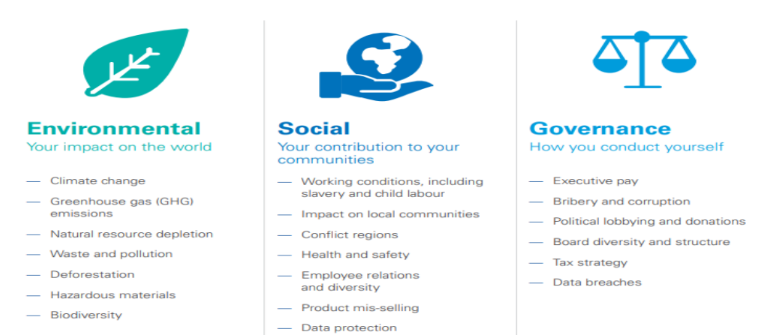
ESG
Non-financial information is often defined as Environmental, Social, and Corporate Governance (ESG) information, referring to the three central components in measuring the sustainability and societal impact of a company.
centralized depository
A multinational company can make the most of its cash reserves by holding cash balances at a central location. two advantages:
Pooling cash reserves reduces the total amount of cash that the company needs to hold, because the amount of cash held on hand as a precautionary measure against the unexpected can be pooled and thus reduced – it’s unlikely that all the worst cases will happen simultaneouslythe company earns a higher interest on higher amounts of cash, because cash from across the company is pooled
fronting loan
A fronting loan is a loan made between a parenting company and its subsidiary through a financial intermediary such as a bank
The advantage is that the parent can gain some tax benefits and bypass local laws that restrict the amount of funds that can be transferred abroad
Process: the parent deposits the total amount of the loan in the bank. The bank then lends the money to the subsidiary. For the bank, the loan is risk free, because the parent has provided the money to the bank. The bank charges the subsidiary a slightly higher interest rate on the loan than it pays to the parent, thus making a profit
transfer pricing
A firm might design a product in one country, manufacture it in a second country, assemble it in a third country, and then sell it around the world.
Each time the good or service is transferred between subsidiaries, one subsidiary sells it to the other. The question is, what price should be paid?
The transfer price is the price that one subsidiary (or subunit of the company) charges another subsidiary (or subunit) for a product or service supplied to the subsidiary
The firm may charge its foreign subsidiary a high price, thus extracting more money out of the country. The firm would use a cost-plus markup method for arriving at the transfer price, rather than using market prices
IMF (international monetary fund
To promote international monetary cooperation consultation and collaboration on international monetary problems
to facilitate the expansion and balanced growth of international trade, high levels of employment and real income
to promote exchange stability, to maintain orderly exchange arrangements among members, and to avoid competitive exchange
To assist elimination of foreign exchange restrictions which hamper the growth of world trade
to achieve sustainable growth
to promote financial stability
world bank
The World Bank has one central purpose: to promote economic and social progress in developing countries by helping raise productivity so that their people may live a better and fuller life
Poverty reduction and sustainable growth in the poorest countries
provide solutions to the special challenges of post-conflict countries and fragile states
The World Bank provides low-interest loans, interest-free credits, and grants to developing countries. There’s always a government (or “sovereign”) guarantee of repayment subject to general conditions
Does not interfere with monetary policies or exchange rates, unlike the IMF
the role of central banks in international business
regulating the market (key interest rate)
managing foreign currency reserves
controlling the supply of money in circulation
foreign direct investment (FDI)
Refers to an investment in or the acquisition of foreign assets with the intent to control and manage them
Companies can make an FDI in several ways, including purchasing the assets of a foreign company; investing in the company or in new property, plants, or equipment; or participating in a joint venture with a foreign company, which typically involves an investment of capital or
FDI is primarily a long-term strategy
Inward FDI = refers to investments coming into the country
Outward FDI = the investments made by companies from that country into foreign
prod and cons FDI
Pros
Promotes stable long-term lending
Provides technology to developing countries
Provides financing to developing countries
Diversifies investors portfolios
Cons
Not suitable for strategically important industries
Ivestors may have less moral attachment
Unethical access to local markets
how governments encourage FDI
financial incentives
infrastructure
administrative processes and regulatory environment
incest in education
politcal, economic, and legal stability