U1: Bones & Joints of Shoulder Region
 Call Kai
 Learn
Learn Practice Test
 Spaced Repetition
 Match
Match Flashcards
 Knowt Play
1/38

There's no tags or description
Looks like no tags are added yet.
Name | Mastery | Learn | Test | Matching | Spaced | Call with Kai |
|---|
No analytics yet
Send a link to your students to track their progress
39 Terms
what is the glenohumeral joint (GH)
a ball & socket joint
that is formed bw the humeral head / glenoid fossa
considered highly mobile
movements permitted by the GH joint
flexion / extension
abduction / adduction
medial / lateral rotation
what is the scapulothoracic joint (ST)
a pseudojoint (“false” joint)
that is formed bw the scapula / thoracic cage (ribs)
considered highly mobile
movements permitted by the ST joint
elevation / depression
protraction / retraction
superior / inferior rotation
what is the scapula
a flat, triangular bone
considered free-floating
found over the posterior rib cage
function of the scapula
forms the scapular/pectoral girdle w/ the clavicle + proximal humerus
acts as muscle attachment
forms the GH joint
features/borders of the scapula
glenoid fossa
coracoid process
acromion process
subscapular fossa
supraspinous fossa
infraspinous fossa
spine of scapula
lateral border
vertebral border
inferior angle
superior angle
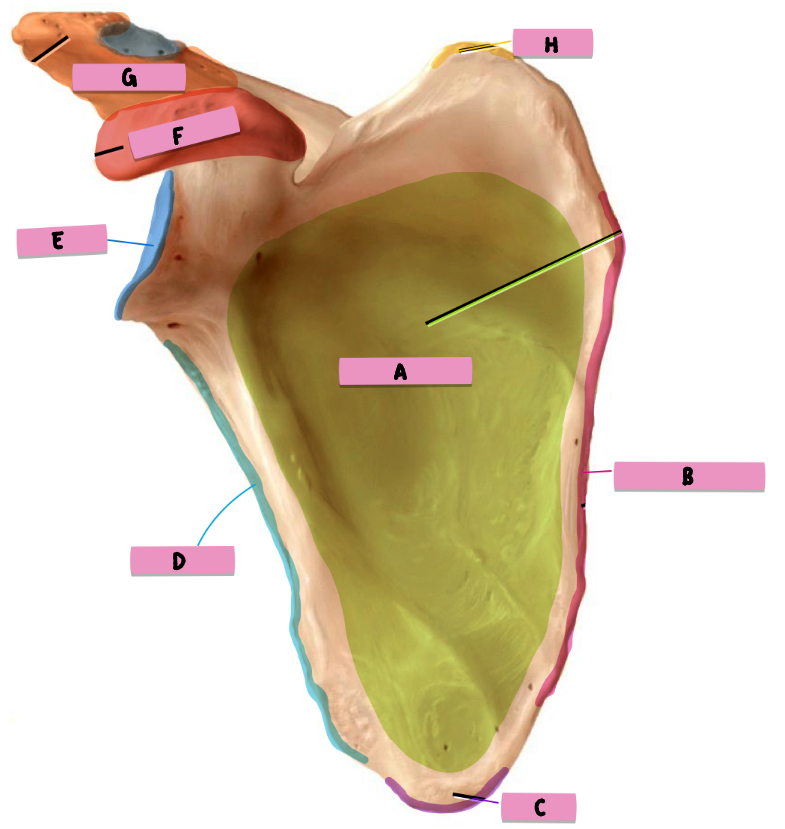
label the features (ANT scapula)
A - subscapular fossa
B - vertebral border (medial)
C - inferior angle
D - lateral border
E - glenoid fossa
F - coracoid process
G - acromion process
H - superior angle
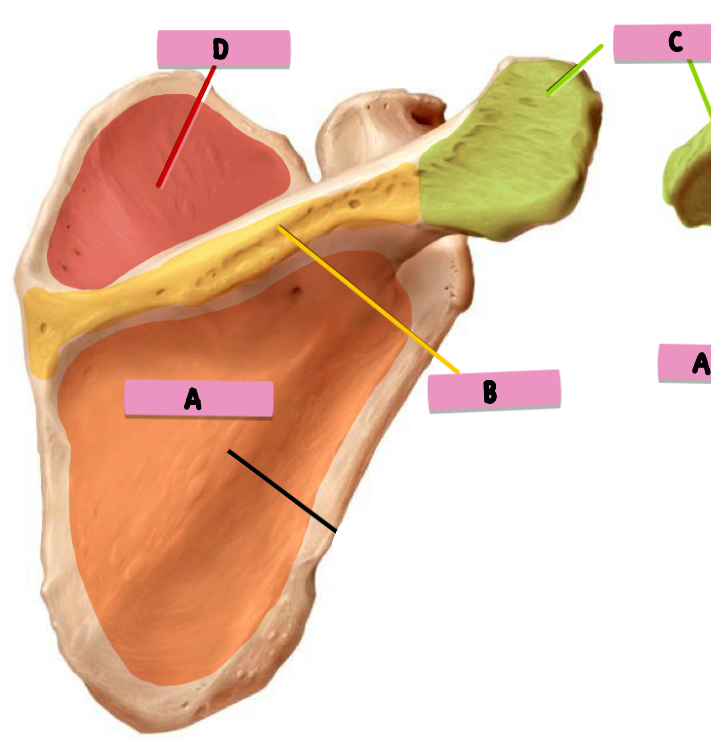
label the features (POST scapula)
A - infraspinous fossa
B - spine of scapula
C - acromion process
D - supraspinous process
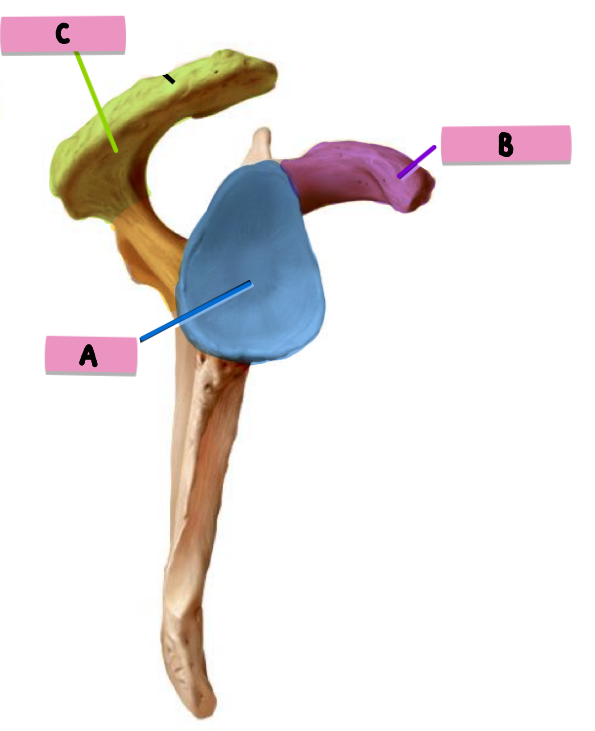
label the features (LAT scapula)
A - glenoid fossa
B - coracoid process
C - acromion process
what is the clavicle
the s-shaped long bone
which holds the upper limb away from trunk
features of the clavicle
acromial end
sternal end
conoid tubercle
impression for costoclavicular ligament
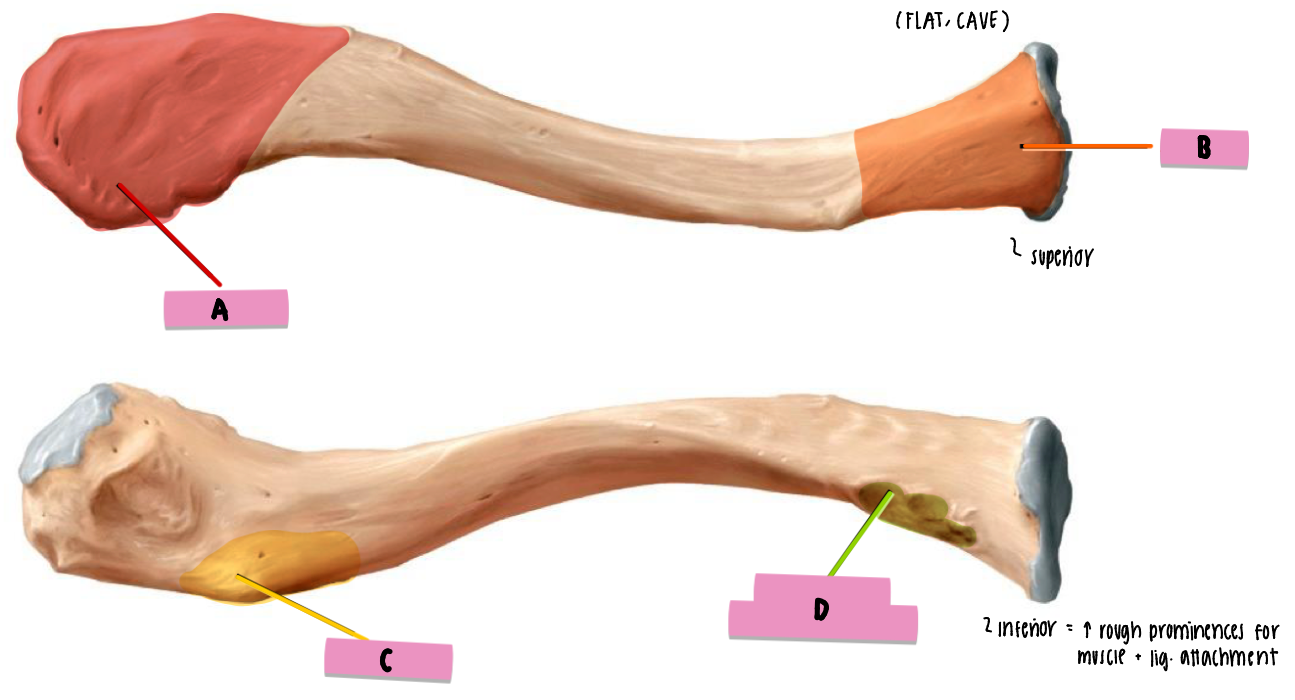
label the following (clavicle)
A - acromion end
B - sternal end
C - conoid tubercle
D - impression for costoclavicular ligament
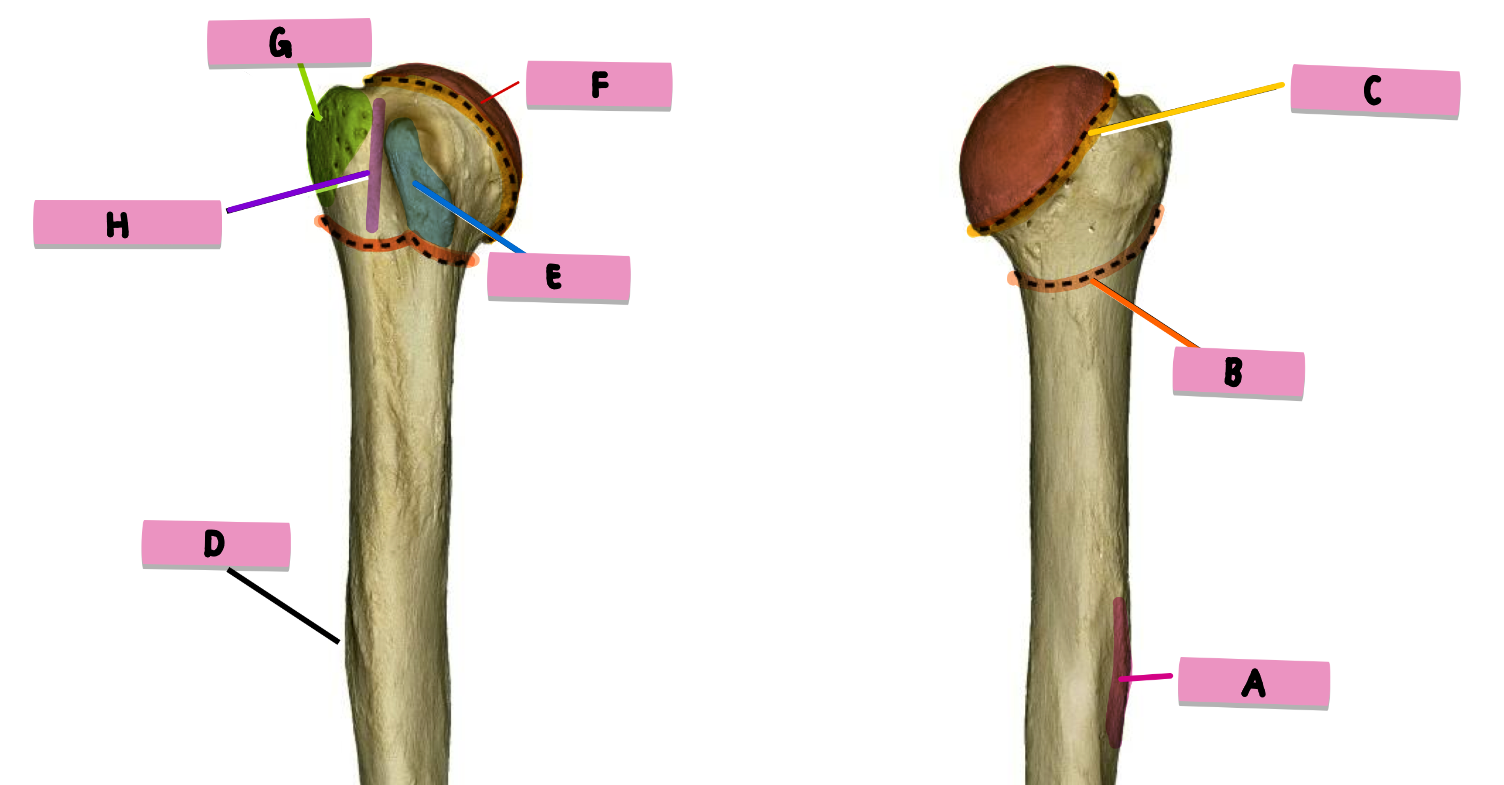
label the features (ant/post - proximal humerus)
A - deltoid tuberosity
B - surgical neck
C - anatomical neck
D - humeral shaft
E - lesser tuberosity
F - head of humerus
G - greater tuberosity
H - intertubecular groove
features of the GH joint
inferior capsule
glenoid labrum
synovium
superior capsule
bursa
biceps brachii tendon
what is the glenoid labrum
a ring of fibrocartilage
which is attached to the rim of the glenoid fossa
which deepens the glenoid fossa (stability)
what is the synovium
thin CT membrane
which lines the inferior capsule
produces synovial fluid
which is for nutrition + preventing friction
what is the inferior/superior capsule
a fibrous capsule
which surrounds the GH joint
which stabilizes the GH joint
what is bursa
small synovial fluid-filled sacs
which reduce friction bw tendons / bones
or tendons / overlying ligaments
types of bursa (in the GH joint)
subacromial bursa
subscapular bursa
location of the subacromial bursa
located inferior to the acromion process
location of the subscapular bursa
superficial to the GHJ capsule/ligaments
what is the superior glenohumeral ligament
found bw the glenoid labrum → lesser tuberosity
which prevents anterior humeral translation
what is the middle glenohumeral ligament
runs to the anatomical neck of humerus
which prevents anterior humeral translation
which resists ER
what is the inferior glenohumeral ligament
a weak, loose structure
which prevents inferior humeral translation
what is the coracohumeral ligament
found bw the coracoid process / greater tuberosity
which reinforces the GH capsule
which prevents inferior humeral translation
what is the coracoacromial ligament
found bw the coracoid process / acromion
which prevents superior humeral translation
what is the transverse humeral ligament
a ligament
which keeps the biceps brachii tendon tethered to intertubecular groove
prevents if from popping out
what is the acromioclavicular joint (AC)
a planar joint
which wants to be stable
movements permitted by the AC joint
superior / inferior rotation
medial / lateral rotation
anterior / posterior tilt of scapula
what is the acromoclavicular ligament
ligament which..
connects acromion + clavicle
prevents separation of AC joint
is intrinsic to the AC joint
what is the coracoclavicular ligament
ligament which..
has 2 parts:
(1) conoid - coracoid process → conoid tubercle of clavicle
(2) trapezoid portion
which prevents superior clavicular translation
what is the coracoclavicular joint (CC)
not an actual joint
but there’s a ligament holding it together
what is the sternoclavicular joint (SC)
a planar joint
found bw sternum / clavicle
movements permitted by the SC joint
glide anterior / posterior (protraction/retraction)
glide superior / inferior (elevation/depression)
limited rotation
ligaments which support the SC joint
interclavicular ligament
costoclavicular ligament
anterior / posterior sternoclavicular ligament(s)
what is the interclavicular ligament
found bw the medial ends of both clavicles (across the sternum)
which is extrinsic
which prevents inferior gliding of clavicle (depression)
what is the costoclavicular ligament
found bw the 1st rib / clavicle (inferiorly)
which is extrinsic
which prevents superior gliding of clavicle (elevation)
what is the anterior/posterior sternoclavicular ligament
found bw the ant/post sternum / clavicle
which is intrinsic
which prevents ant/post gliding of clavicle