Landlord-Tenant Law
 Call Kai
 Learn
Learn Practice Test
 Spaced Repetition
 Match
Match Flashcards
 Knowt Play
1/38

There's no tags or description
Looks like no tags are added yet.
Name | Mastery | Learn | Test | Matching | Spaced | Call with Kai |
|---|
No analytics yet
Send a link to your students to track their progress
39 Terms
Sources of Landlord-Tenant Law
The lease agreement, statute statutes, state common law
Statute of Frauds
Must be written and signed by the party to be charged
Lease Meaning
the landlord grants right of exclusive possession of the property to the tenant for a term with a reversion
Lease Contents
(1) Premises
(2) Amount of Rent
(3) Exclusive Use and Occupancy for a time
License
Limited right to use the real property of another
Types of Leases
Term of Years, Periodic, Tenancy at Will, and Tenancy at Sufferance
Term of Years
The lease terminates are a pre-selected date with no notice required to terminate
Periodic
Lease continues for successive periods of equal length, unless one party notifies the other of its intention to terminate
TRADITIONAL — notice to terminate equal to the period of the periodic tenancy capped at 6 months and must terminate on anniversary
MODERN — 30 to 60 days notice required
Tenancy at Will
The lease exists for no fixed period until one party informs the other of termination.
Terminates at death, waste, new lease, or attempted transfer
Mostly abolished, as state law requires 30 days notice, converting to a month-to-month tenancy
URLTA conveys to a month-to-month period tenancy unless tenancy is week-to-week, then it is week-to-week
Tenancy at Sufferance
When a tenant overstays lease, may be treated as trespasser or tenant at sufferance.
If latter, the old rental rates, tenant duties, and landlord obligations control.
Converts to a periodic tenancy. Some cap at old lease terms capped at a year, some set at rental payment period
Tenant Obligations
Not materially alter the preimses
Generally forbidden from subleases in residential leases
Cannot use for other purposes
Landlord Remedies
Eviction, Money Damages, Acceleration of Rent, Restoration of Premises
BUT duty to mitigate
Landlord’s Obligations
(1) Delivery Possession
(2) Quiet Enjoyment
(3) Minimum Level of Habitability
Obligation to Deliver
American Rule: Must deliver RIGHT to possess
English Rule: Must deliver ACTUAL possession
Quiet Enjoyment
default rule is that a landlord does not have the right to enter the tenant’s property
Constructive Eviction
(1) Substantial interference of a kind that would cause a reasonable person in the tenant’s position to be forced to leave the premise ASAP
(2) Tenant notified landlord and gave reasonable time to cure
(3) Tenant actually vacated
(4) Resulted from breach of express or implied covenant or warranty
Minimum Level of Habitability HISTORICAL
ONLY RESIDENTIAL
Caveat emptor, unless active concealment, affirmative misrepresentation, or fiduciary duty
Minimum Level of Habitability MODERN
ONLY RESIDENTIAL
Must disclosure defects that materially affect the value AND not readily knowable
Homes sold by Contractor
Implied warranty of craftsmanship
Discovering an Issue
No right to enter premises, must be negotiated for
Equitable Conversation
If there is casualty on the property before closing, Buyer must follow through and is liable for the initial contract price, as long as the Seller has clean hands
MASSACHUSETTS RULE: The Seller bears the risk of loss, so the Buyer can back out of the contract due to casualty
UNIFORM VENDOR AND PURCHASER RISK ACT: Risk lies with the party in possession of the property
NC APPROACH: Seller bears risk, Buyer may back out
When can Withhold Rent
ONLY with implied warranty of habitability
Remedies at Law
Benefit of the Bargain: Difference between contract price and the fair market price at the time of breach
Reliance: Money spent in reliance on the bargain
Expectation: Money expected to be gained and lost
Liquidated: Specified amounts specified in advance for breach of contract; enforced if difficult to ascertain at the time and reasonable
Equitable Remedies
NEED CLEAN HANDS
In real estate, presumed no remedy at law
Specific Performance, Reformation, and Rescission
REFORMATION requires mutual mistake or fraud
RESCISSION requires fraud or material misrepresentation even absent a writing
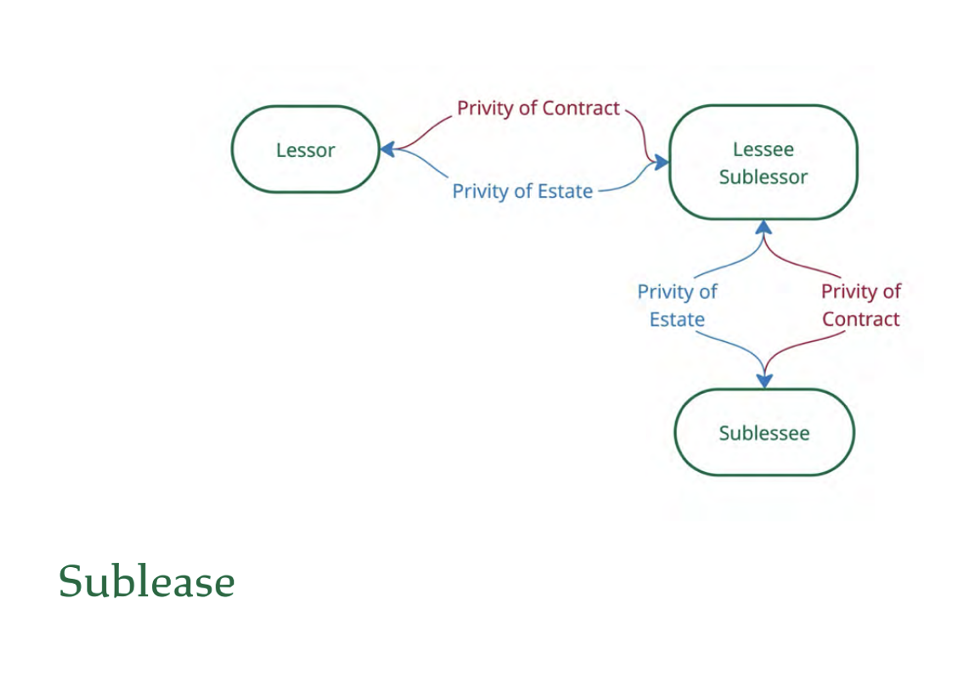
Privity of Estate
When two or more parties have possessory interest in the same real property
Real Covenant
respect the use of land is in a written contract but creates a real covenant which binds and benefits the original parties and the subsequent owners of the parcels impacts
Equitable Servitude
same as a real covenant but subject to equitable relief
Privity of Contract
Relationship between parties to a contract
Contains personal covenants
Personal Covenants
binding upon the original parties and assigns (if assignees expressly assumed the contract).
Privity of Contract Remedies
monetary damages unless the non-breaching party can prove no adequate remedy at law
Sublease
Assignment
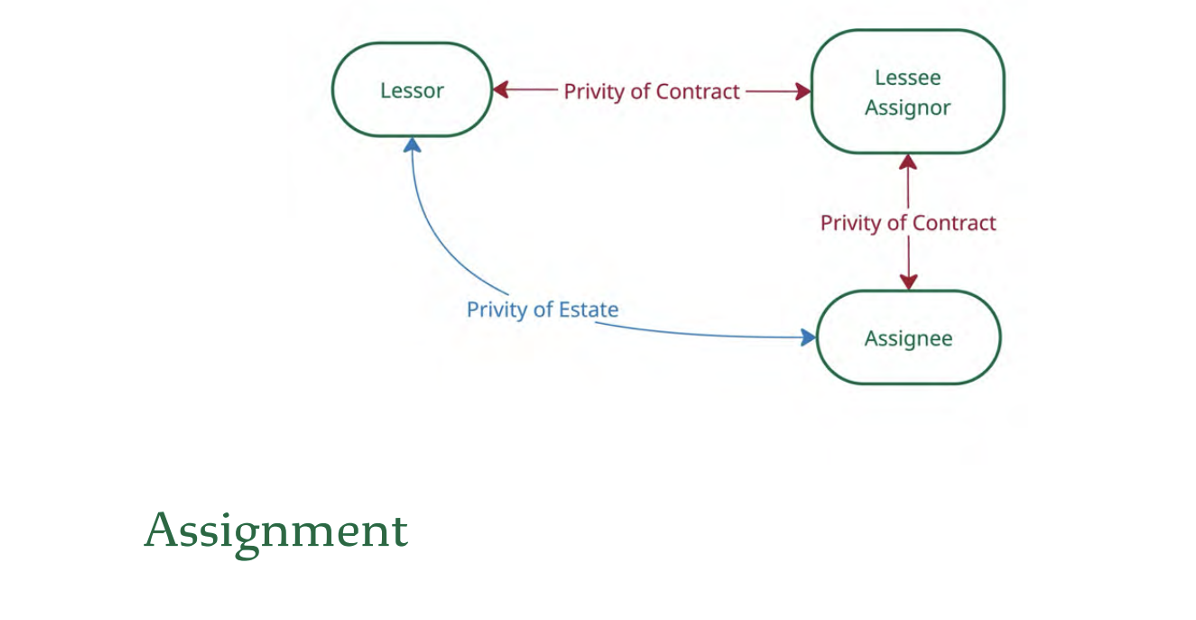
ONLY SUBJECT TO NOVATION
Novation
the substitution of one party for another in the contract with the assent of the parties. This relieves the tenant of all liability
Attornment
The recognition of a relationship between the landlord and a subtenant. This creates privity of contract between landlord and subtenant but the tenant retains liability. This also requires consent of the parties.
Real Covenant Elements
Elements: (1) intent, (2) touch and concern, (3) horizontal privity, (4) vertical privity, (5) Notice (ONLY FOR BURDENS)
Real Covenant Horizontal Privity
Successive – “the covenant must be part of a transaction that also includes the transfer of an interest in land that is either benefited or burdened by the covenant”
Mutual -- both have legal interest in the land impacted
Landlord-Tenant
Real Covenants Remedies
Monetary Damages, but Property Right
Equitable Servitude Elements
(1) Intent
(2) Connection to land
(3) Notice (ONLY FOR BURDENS)
Equitable Servitudes Remedies
Equitable relief because it is a property right