VCE Psychology Unit 3 AoS2- Learning & Memory
 Call Kai
 Learn
Learn Practice Test
 Spaced Repetition
 Match
Match Flashcards
 Knowt Play
1/91

There's no tags or description
Looks like no tags are added yet.
Name | Mastery | Learn | Test | Matching | Spaced | Call with Kai |
|---|
No analytics yet
Send a link to your students to track their progress
92 Terms
CLASSICAL CONDITIONING
What is Classical Conditioning?
Classical conditioning refers to a type of learning that occurs through the repeated association of two different stimuli.
How is it determined when classical conditioning has occurred?
Learning has occurred when a particular stimulus consistently produces a response that it did not previously produce.
What is a stimuli?
an object or event
What is a response?
an action
Classical Conditioning as two types of responses:
- unconditioned: unlearned or reflex
- conditioned: learned or associated
What are the key terms in Classical Conditioning
- neutral stimulus (NS): does not produce a response (eg. bell before training)
- unconditioned stimulus (UCS): naturally causes a response (eg. food causes salivation)
-unconditioned response (UCR): a natural, automatic reaction to the US (eg. salivating when seeing food)
- conditioned stimulus: a previously neutral stimulus that now causes a response when paired with the UCS (eg. bell after training)
- conditioned response: a learned response to the CS (salivating to bell)
What are the three phases of classical conditioning?
before conditioning, during conditioning, after conditioning
Phase 1: before condition
Neutral stimulus (NS) produces no relevant response; unconditioned stimulus (UCS) elicits The unconditioned response (UCR)
example:
- NS: bell > no salivation/irrelevant response
- UCS: food > UCR (salivation)
Phase 2: during conditioning
Neutral stimulus (NS) is repeatedly paired with the unconditioned stimulus (UCS) to produce unconditioned response (UCR)
example:
- NS (bell) + UCS (food) = UCR (salivation)
Phase 3: after conditioning
Neutral stimulus (NS) becomes a conditioned stimulus (CS), CS produces a conditioned response (CR), which is usually similar to the previously unconditioned response (UCR)
example:
- CR: salivation to sound of bell
OPERANT CONDITIONING
What is operant conditioning?
Operant conditioning is a type of learning whereby the consequences of behaviour determine the likelihood that it will be performed again in the future.
Operant conditioning = behaviour + consequence.
what is the difference between operant conditioning and classical conditioning?
Both classical and operant conditioning are types of associative learning but operant conditioning is voluntary and conscious.
What is the three-phase model of operation conditioning
(Antecedent) "what happed before": anything (object, event, circumstance) that triggers a response
(Behaviour) "what happens": the learner’s action to the antecedent
(Consequence) "what happens after": the event that occurs after the behaviour
Eg: Whenever I wear jeans from ‘Levi’ I get lots of compliments.
A = Levi jeans in my wardrobe
B = wear Levi jeans
C = get lots of compliments
What are the 4 types of consequences
1. Positive Reinforcement
2. Negative Reinforcement
3. Positive Punishment
4. Negative Punishment
Define reinforcement
Any events that strengthens the likelihood of a response occurring again
What is positive reinforcement?
when a pleasant stimulus is added to encourage behaviour
eg. studying is reinforced by getting an A+
What is negative reinforcement?
when an unpleasant stimulus s removed to encourage behaviour
eg. eating is reinforced by the removal of hunger
Define punishment
Any events that weaken the likelihood of a response occurring again?
What is positive punishment?
When an unpleasant stimulus is added to discourage behaviour
eg. A barking dog is punished with a smack
What is negative punishment (cost response)?
When a pleasant stimulus is removed to discourage behaviour
eg. a naughty child is punished by taking their toys away
OBSERVATIONAL LEARNING
What is observational learning
a social-cognitive approach to learning that occurs when someone observes a model's actions and the consequences (positive or negative) of those actions (vicarious) to guide future behaviour.
Reinforcement can be....
-External: money, grades, praise, status
-Internal: pride, joy, spiritual
-Vicarious: happen to someone else
-Direct: happen to you
What makes us more likely to pay attention and imitate a model?
-High status
-Likeable
-Similar in age/gender
-Familiar
-Visible
What are the five stages of processes in observational learning
-attention
-retention
-reproduction
-motivation
-reinforcement
what is the process of attention in observational learning
To learn by observing. The person must pay attention to the models, behaviour and its consequences.
attention is affected by...
-observer factors: interests, perceptual, ability, motivation, distractors
-model factors: attractiveness, similarities, status, success
-behaviour factors: important distinctiveness relevant to observer
example of attention
example: a cricket player will be able to pay more attention on a professional, then amateur because the professionals behaviour is more relevant and valuable
what is the process of retention in observational learning
The person must be able to remember the model's behaviour
- create meaningful/mental representation of actions
- making meaningful through strategies like visual imagery and verbal description
example of retention
example: the cricketer may visualise, and verbally describe a professionals, batting, stance and swing to aid memory
what is the process of reproduction in observational learning
The person must have the physical and cognitive ability to be able to reproduce the behaviour
-limitations in skills, ability or biology can restrict performance
-practice and feedback are required to refine limitation
example of reproduction
Even with a clear mental image of a cricket shot, reproducing it with elite position is unlikely without matching physical skills and practice
what is the process of motivation in observational learning
The observer must be motivated to continue imitating the behaviour. It is shaped by:
-usefulness of relevance of behaviour
- expectation of rewards or benefits
what is the process of reinforcement in observational learning
Reinforcement influences motivation, types include:
-External: money, grades, praise, status
-Internal: pride, joy, spiritual
-Vicarious: happen to someone else
-Direct: happen to you
* punishment observed in a model can discourage imitation
What is self-efficacy and personal factors (according to Bandura)?
refers to an observer's self-confidence and self-esteem, affecting attention, retention, reproduction, motivation, and reinforcement
High vs Low self-efficacy
high self-efficacy: leads individuals to approach challenges with confidence, persist through difficulties, and recover quickly from setbacks.
low self-efficacy: causes individuals to doubt their abilities, avoid difficult tasks, and give up easily when faced with obstacles.
How is aggressive behaviour learned?
learnt through observation, and a cognitive representation is formed
The performance of an aggressive act is influenced by vicarious (indirect) and direct reinforcements
ATKINSON AND SHIFFRIN MULTISTORE MODEL OF MEMORY
What is memory?
The processing encoding storage, and retrieval of information acquired through learning
What are the processes involved in memory?
-encoding: processing and converting information into a useable form
-storage: retaining information
-retrieval: information recovered from memory when needed
What does the multi-store model of memory propose?
that there are three independent stores that process information in different ways, and vary in function, capacity, and duration
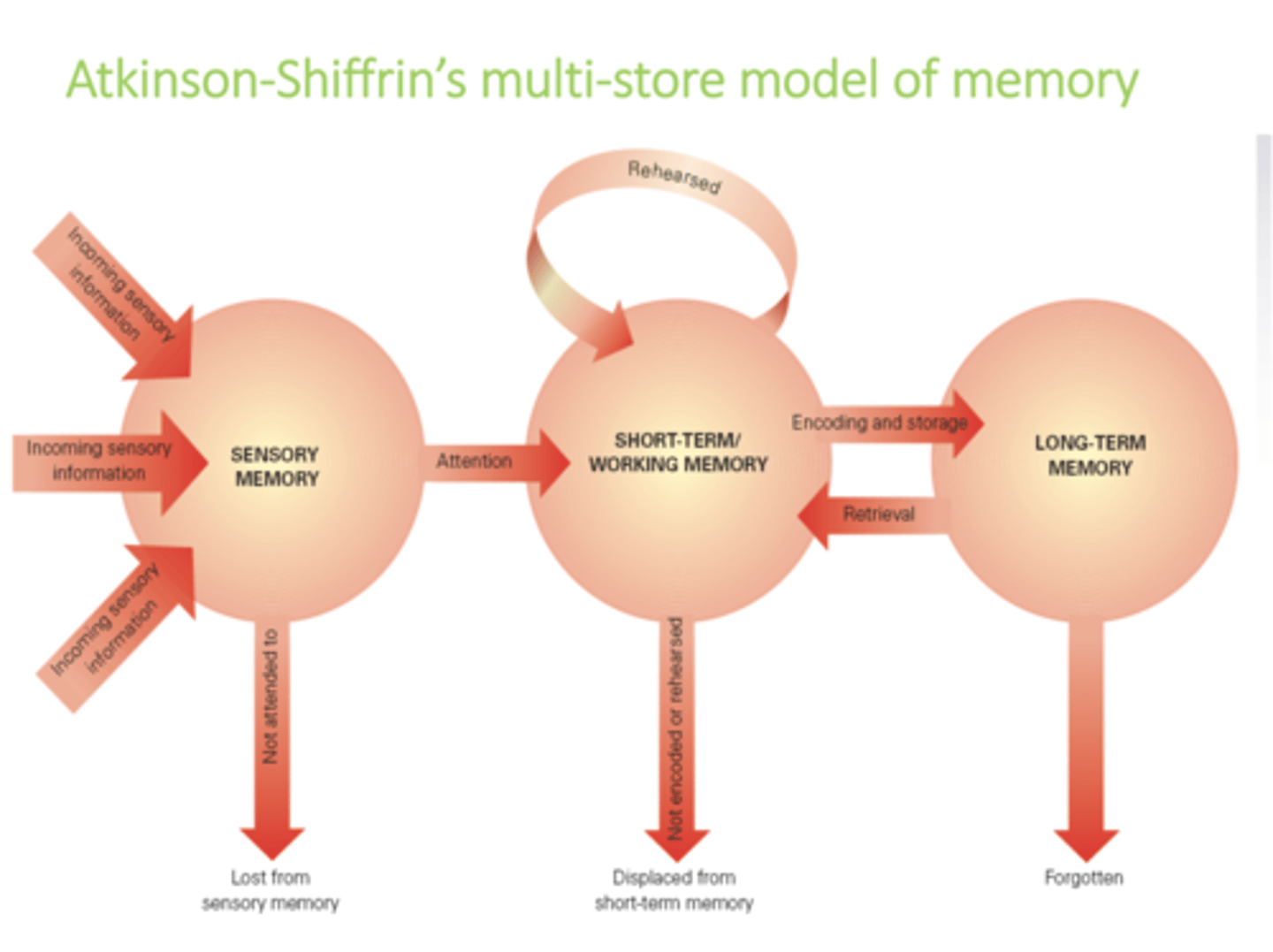
Sensory memory
-function: receive sensory information from the environment and briefly holds sensory input
-duration: 0.2-4 seconds
-capacity: virtually unlimited
-encodong: unprocessed, exact copies of sensory input
-types: iconic memory (visual, 0.2-04 seconds), echoic (auditory, 3-4 seconds)
-entry points: 1, through the sensory receptors
What happens to sensory memory when it is not attended to
-the memory will be lost
-this allows for continuity of perception (eg. movies, sparklers)
Short Term (Working) Memory
-function: holds memory temporarily for use and processing
-duration: 18-20 seconds (significant decline after 12 seconds)
-capacity: 5-9 items
-encoding: mostly acoustic
-entry points: 2, attention from sensory memory and retrieval from long-term memory
How does information leave the short term memory?
-decay: memory fade, if it is not rehearsed
-displacement: new information pushes out existing information if capacity is exceeded
Why does the short term memory have two entry points?
- Information from the sensory memory is received and processed
-information from the long-term memory is retrieved and updated
What are some memory techniques for short-term memory?
- rehearsal: extend the duration in the short-term memory
- chunking: increases short-term memory capacity by grouping information
Long-term memory
- function: stores large amount of information for long periods
- duration: relatively permanent
- capacity: unlimited
- encoding: mainly semantic
-entry points: through encoding and storage of the short term memory
types of long term memory
explicit: conscious recall of facts or events:
- semantic (facts, general knowledge)
- episodic (personal life events)
implicit: unconscious and shown through actions or behaviours
-procedural (motor skills and actions)
-emotional responses (conditionaed emotional reactions)
Strengths and weaknesses in the multi store model
strengths
- clear distinction between memory store
- describes memory flow and processes
- explains forgetting memories
weaknesses
- oversimplified
- lacks biological basis (no brain structure or neural processes)
- doesn't account for all types of retrieval or rehearsal mechanism
BRAIN REGIONS INVOLVED IN LONG TERM MEMORIES
What are explicit memories?
- Explicit memories are conscious, and you can express them
-when explicit memories are used, there are deliberate and conscious attempts to retrieve information
What are the types of explicit memories?
-episodic memory: memory of personal experiences (episodes)
-semantic memory: of general knowledge and self facts
What are implicit memories?
- explicit memories are unconscious, and hard to describe in words, but can be expressed through actions
-they do not require conscious or intentional retrieval
What are the types of implicit memories?
- procedural memory: memory of actions, skills, habits, and routines (e.g. how to tie shoelaces)
- conditioned emotional memory: involuntary responses like fear, disgust, anger, and excitement
What are the brain regions involved in long-term memory?
- cerebellum
- basal ganglia
- hippocampus
- amygdala
- neocortex
What is the role of the cerebellum?
Encodes, stores, and retrieves procedural memories (implicit), such as motor skills and reflexes.
any classically conditioned memory is stored here
eg. Riding a bike or typing on a keyboard without thinking
What is the role of the basal ganglia?
Encodes and retrieves habitual or procedural memories
eg. Brushing your teeth automatically each morning
What is the role of the hippocampus?
encode: all explicit memories.
binds different elements of our experiences into an integrated memory trace and feeds into the neocortex (hippocampus has layers).
this connection between the hippocampus and neocortex helps with the retrieval of episodic memories.
does not store
eg. Remembering last birthday party (episodic)
What is the role of the amygdala?
encodes: emotional responses that have been marked as important signals
storage: nothing is stored
retrieval: when a memory marked as important signals is recalled, the amygdala is reactivated
eg. Feeling fear when recalling a car accident you were in
What is the role of a neocortex?
does not encode
Stores explicit memories in respective lobes of the brain
retrieves semantic memory by activating the lobe of where they are stored
eg. seeing colour blue, occipital lobe is acitvated
AUTOBIOGRAPHICAL MEMORY, ALZHEIMERS AND APHANTASIA
What is autobiographical memory?
- the component of explicit memory that represents memories of our personally experienced events and self-knowledge.
- It consists of semantic and episodic memories.
- the event is reconstructed by using our episodic memory to re-experience it, and our semantic memory for self-facts about that time period.
Example of Autobiographical memory
memory of the autobiographical event of a 16th birthday party
- episodic: conversations with people at the party, feeling happy, dancing to music, taste of cake
- semantic: location of the party, what flavour the cake was, who was invited, what music was played
What is possible imagined future?
- involves projecting yourself forward in time to pre-experience an event that may occur in the future (mental time travel).
- relies episodic and semantic memory.
- this hypothetical event is constructed by using our semantic memory for schemas (knowledge) to set the scene and our episodic memory to experience it in 'first person mode'.
What Aphantasia
People with aphantasia lack mental imagery.
Visual imagery is crucial for the episodic component of autobiographical memory.
Aphantasics often report severely deficient autobiographical memory and the inability to imagine the future.
What is Alzheimer's disease
a neurodegenerative disease that results in the progressive deterioration of neurons, causing memory loss, cognitive decline, and changes in behaviour and personality.
Neural effects of Alzheimer's disease
Amyloid plaques: Protein clumps that form on axon terminals, blocking communication between neurons.
Neurofibrillary tangles: Twisted tau proteins inside neurons, disrupting function.
Reduced acetylcholine: A neurotransmitter crucial for memory and learning.
What is anterograde amnesia and retrograde amnesia
anterograde amnesia: The inability to form new episodic and semantic memories (the future)
retrograde amnesia: the inability to retrieve previously stored episodic and semantic memories (the past)
Spread of Alzheimer's: Hippocampus
Begins in the hippocampus
resulting in anterograde amnesia for episodic and semantic memories and retrograde amnesia for episodic memories only.
The person can’t learn new things and forgets where they put objects.
Autobiographical memories are affected (the episodic component).
Spread of Alzheimer's: Neocortex
Spreads to the neocortex resulting in retrograde amnesia for all explicit memories
The person might not recognise a loved one or forget a past memory.
Autobiographical memories are affected (the episodic and semantic components).
Spread of Alzheimer's: Cerebellum
Spreads to other areas of the brain such as the cerebellum (procedural memories) and the brain stem (vital functions).
loss of motor coordination and inability to regulate vital functions, such as breathing and heart rate regulation.
Alzheimer's affects autobiographical memory, especially the episodic component (first-person experience), this means...
Retrieval of personal past events becomes more factual (semanticised) and less vivid/visual.
People with Alzheimer’s struggle to create possible imagined futures, as this relies on episodic + semantic memory.
tend to "live in the past".
MNEUMONICS
what is mnemonics?
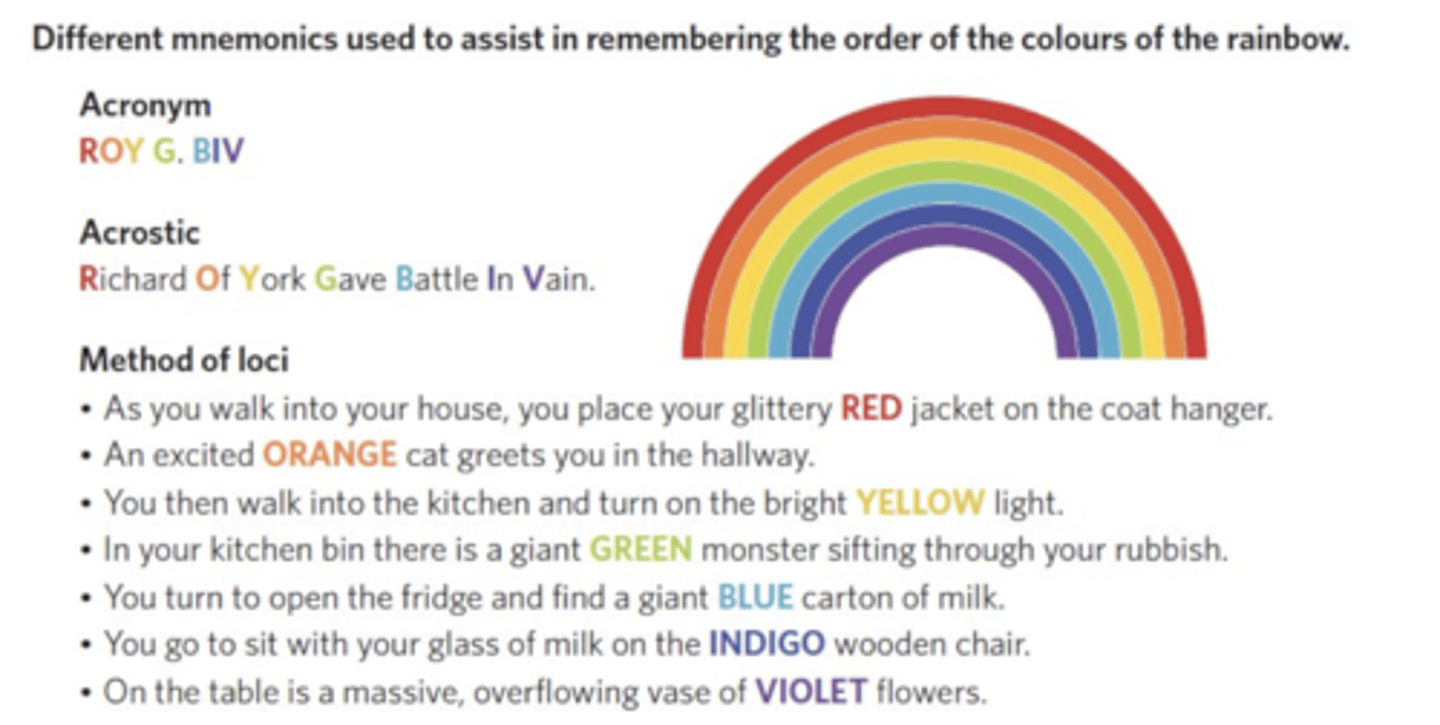
devices or techniques used to aid encoding, storage, and retrieval of information
what is acrostics
uses an invented sentence where the first letter of each word is a cue to an idea you need to remember.
eg. "never eat soggy weetbix" > north east south west
what is an acronym
uses a pronounceable word formed from the first letters of a sequence of words.
BRASS is an acronym for how to shoot a rifle- Breath, Relax, Aim, Sight, Squeeze.
What is the method of loci
the items that needs to be remembered are converted into mental images and associated with specific positions or locations.
eg. to remember a shopping list, each product could be imagined at a different location along a familiar street.
Example of mneumonics
What are songlines?
Songlines are sung narratives used by Elders to pass down vital survival knowledge about Country, such as food sources, seasons, and laws. They are Song narratives that use multi-modal performances conducted on country to form a journey.
How are Songlines used for navigation across Country?
Knowledgeable individuals can navigate by singing the Songline, which describes landmarks like waterholes, allowing them to follow paths embedded in the land.
At each location, a song, dance, or story is performed to retrieve specific information relevant to that place (e.g., when crocodile eggs are ready to eat).
How do Songlines demonstrate the memory processes of encoding, storage, and retrieval?
Encoding: through listening, repeating, and practising the song
Storage: knowledge is embedded in the song and held by the Elder
Retrieval: by singing the song at relevant locations
The information is stored in the song like we store information in our phones
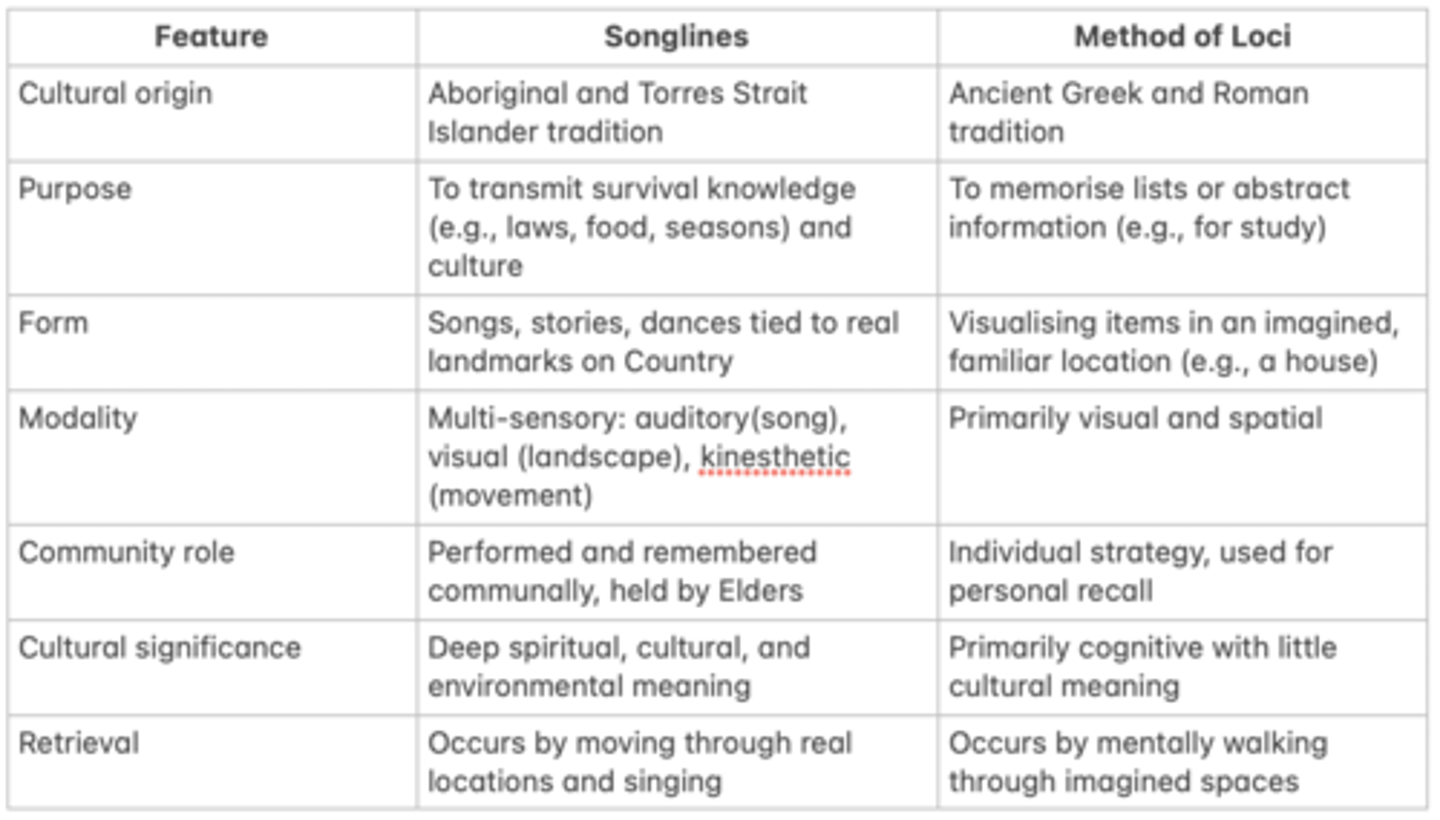
compare and contrast songlines and the method of loci
Both Songlines and the method of loci use spatial cues to encode and retrieve information, but Songlines are culturally embedded, multisensory, and tied to real-world locations and survival, while the method of loci is an internalised, individualised strategy used mainly for academic or practical memory tasks.
songlines and the method of loci: similarities
Spatial structure: Both use locations or paths (real or imagined) to organise information.
Aid in retrieval: Both rely on retracing a path (mentally or physically) to retrieve memories.
Encoding technique: Both involve linking information to specific places, improving recall.
Mnemonics: Both are types of mnemonic devices
Sequential recall: Both help with recalling information in order
songlines and the method of loci: differences
Multi-modal system of knowledge: Storytelling
the oral transmission of knowledge, where information about laws, survival, Dreaming, morals, and history is embedded in stories passed down through generations.
eg. Sharing Dreaming stories to communicate complex knowledge relating to the natural world and survival
Multi-modal system of knowledge: Images and Symbols
Symbols and images are used in rock art, paintings, carvings, and ceremonial designs to represent people, places, animals, events, or knowledge.
eg. A dot painting showing concentric circles and tracks might represent a campsite or waterhole — a person familiar with the symbols can recall when to visit that site and what food is available there in different seasons.
Kinship
structures refer to social organisation in which everyone is related to each other in defined ways.
determines an individual rights to story and imagery
structure for scaffolding knowledge transmission
knowledge is literally embedded in kinship
What is Aboriginal ways of knowing?
Aboriginal ways of knowing is holistic and relational to Country, and incorporate physical, spiritual and cultural knowledge which is encoded through multi-modal performances.
eg. oral traditions, storytelling, song, dance, ceremony, visual symbols.
Still learning (28)
You've started learning these terms. Keep it up!