Legal Unit 3 AOS 2 Civil justice system
 Call Kai
 Learn
Learn Practice Test
 Spaced Repetition
 Match
Match Flashcards
 Knowt Play
1/117

There's no tags or description
Looks like no tags are added yet.
Name | Mastery | Learn | Test | Matching | Spaced | Call with Kai |
|---|
No analytics yet
Send a link to your students to track their progress
118 Terms
Civil Justice System
A set of methods, processes and institutions that provide mechanisms for people to assert their legal rights, and to help people resolve civil disputes.
It includes dispute resolution bodies and processes such as:
bodies that provide information and advice about civil disputes and people's legal rights, such as a community legal centre (CLC)
pre-trial procedures (such as providing documents that are relevant to the dispute to the other side before trial)
dispute resolution methods (such as mediation, conciliation and arbitration)
dispute resolution bodies (such as complaints bodies, tribunals and courts)
the ordering and enforcement of remedies.
Key purposes of the civil justice system are to:
Enable a person to enforce their legal rights or take action over legal wrongs
Determine whether the defendant has a liability to that person
Award a remedy where the defendant has been found liable.
To return the person to the position they were in before the loss or harm occurred.
Dispute resolution bodies
Complaints bodies eg. Consumer Affairs Victoria (CAV): Complaints bodies investigate complaints from people about the conduct of other parties, and may also offer dispute resolution services.
Tribunals eg. the Victorian Civil and Administrative Tribunal (VCAT): Can resolve a broad range of disputes. Tribunals are less formal and generally quicker and less expensive than courts in resolving disputes.
The Courts
Pre-trial procedures
Steps taken by the parties before trial to try to resolve the dispute before hearing or trial.
They include:
Pleadings (documents filed and exchanged between the plaintiff and the defendant, setting out the claims and defences).
The two main documents in the pleadings stage are; the statement of claim and the defence
Discovery of documents (the parties to get copies of each other's documents that are relevant)
Exchange of evidence (the parties exchange the evidence that will be given at trial).
Lay evidence (where people give evidence about what happened/what they saw)
Expert evidence (where experts give evidence about their professional opinion)
Mediation: The judge may order the parties attend mediation by a certain date to try to resolve the dispute before trial.
Parties in a civil dispute
Plaintiff- the party who commences a civil action and who claims that their rights have been infringed or a wrong has occurred. The plaintiff is also known as the aggrieved party or wronged party
Defendant- the party who is alleged to have infringed the plaintiff's rights or is alleged to be responsible for the wrongdoing.
Sometimes there can be multiple plaintiffs, and multiple defendants.
The parties to a civil dispute can be:
an individual or a group of individuals
a corporation, otherwise known as a company- a separate legal entity from the directors or individuals who run the company, which can sue and be sued.
the Commonwealth or a state, or a government agency or body (such as a local council).
Plaintiff
The party who makes a legal claim against the defendant and claims that their rights have been infringed or that a wrong has occurred.
The plaintiff is also known as the aggrieved party or wronged party
Defendant
A party who is alleged to have breached a civil law and infringed the plaintiff's rights and is being sued by a plaintiff.
Types of civil disputes
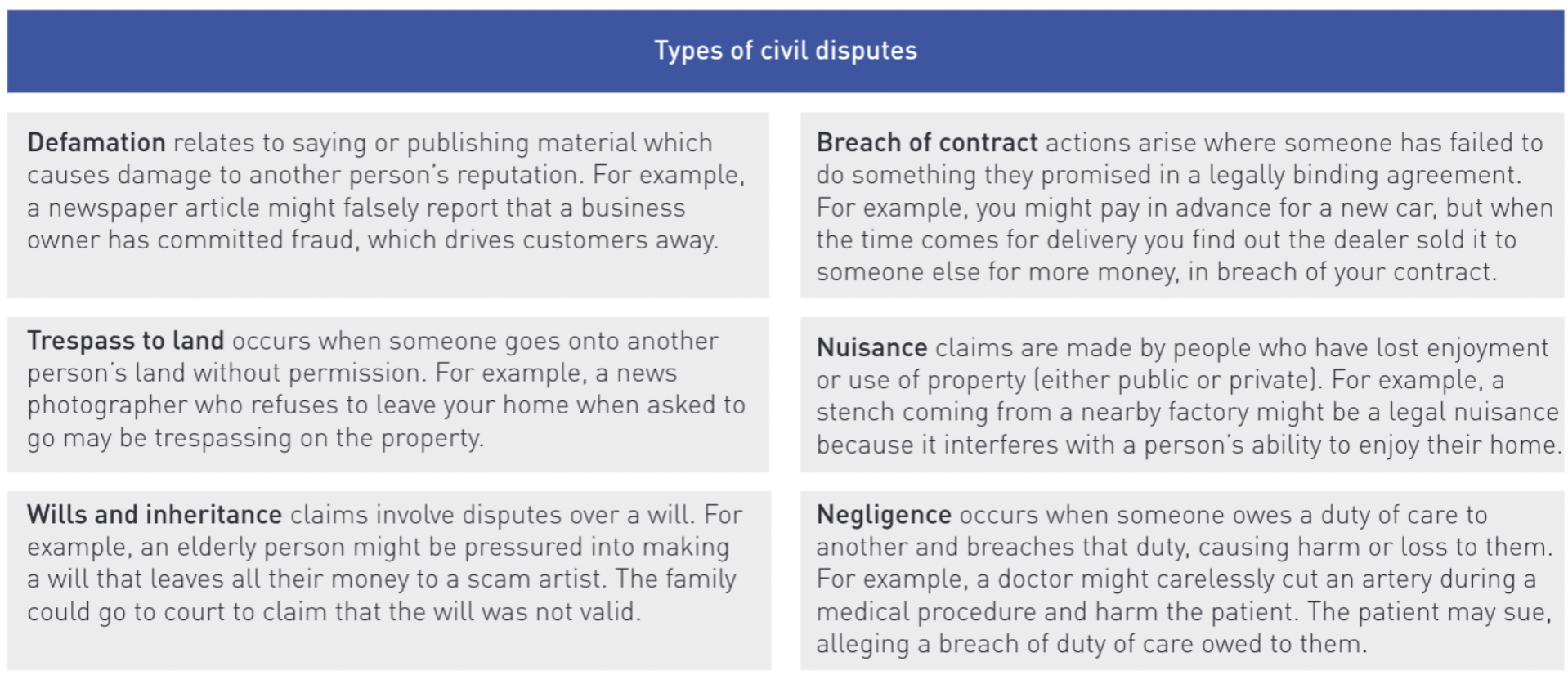
Defamation
Relates to saying or publishing material which causes damage to another person's reputation.
eg. a newspaper article might falsely report that a business owner has committed fraud, which drives customers away.
Limitation of actions: 1 year of publication of the statement
Breach
Of contract actions arise where someone has failed to do something they promised in a legally binding agreement.
Eg. you might pay in advance for a new car, but when the time comes for delivery you find out the dealer sold it to someone else for more money, in breach of your contract.
Trespass to land
Occurs when someone goes onto another person's land without permission.
Eg. a news photographer who refuses to leave your home when asked to go may be trespassing on the property.
Nuisance claims
Are made by people who have lost enjoyment or use of property (either public or private).
Eg. a stench coming from a nearby factory might be a legal nuisance because it interferes with a person's ability to enjoy their home.
Wills and inheritance
Claims involve disputes over a will.
Eg. an elderly person might be pressured into making a will that leaves all their money to a scam artist. The family could go to court to claim that the will was not valid.
Negligence
Occurs when someone owes a duty of care to another and breaches that duty, causing harm or loss to them.
Eg. a doctor might carelessly cut an artery during a medical procedure and harm the patient. The patient may sue, alleging a breach of duty of care owed to them.
Key principles of the Civil Justice System
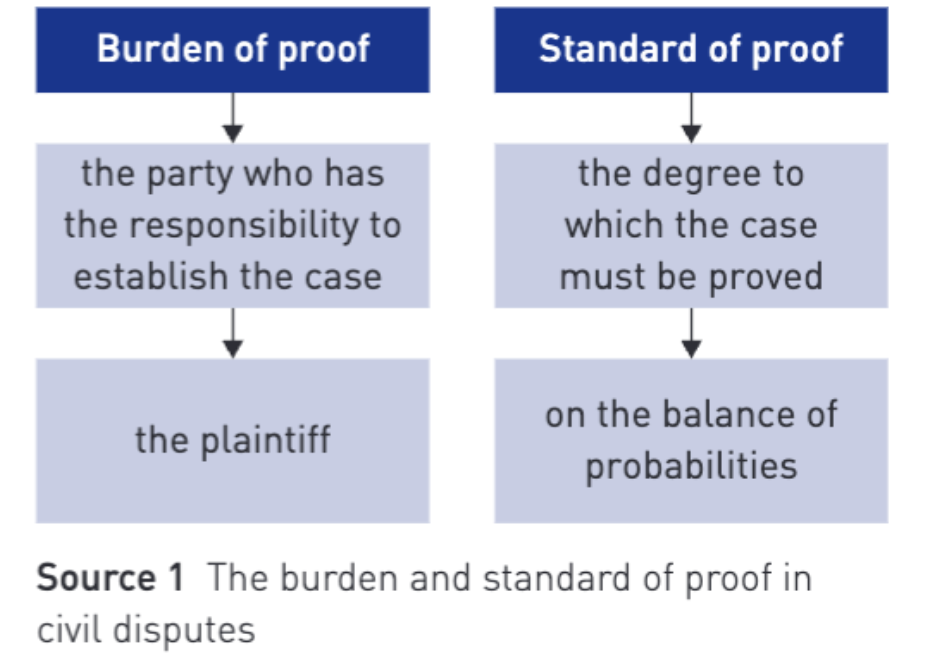
Burden of proof
The obligation (responsibility) of a party to prove a case.
The burden of proof usually rests with the party who initiates the case which is the prosecution in civil cases.
Standard of proof
The degree or extent to which a case must be proved in court.
Balance of probabilities
The standard of proof in civil disputes which requires the plaintiff to establish that it is more probable than not that their claim is true.
Civil law
An area of law that defines the rights and responsibilities of individuals, groups and organisations in society and regulates private disputes.
Class action
A legal proceeding in which a group of seven or more people who have a claim against the same person based on similar or related facts bring that claim to court in the name of one person, also called a representative proceeding or a group proceeding.
Damages
An amount of money that one party is ordered to pay to another party for loss or harm suffered. It is the most common remedy in a civil claim.
Liability
Legal responsibility for one's acts or omissions.
Limitation of actions
The restriction on bringing a civil law claim after the allowed time.
Remedy
Any order made by a court (or tribunal) or designed to address a civil wrong or breach.
A remedy should provide a legal solution for the plaintiff for a breach of the civil law by the defendant.
Statement of claim
A document filed by the plaintiff in a civil case to notify the defendant of the nature of the claim, the cause of the claim and the remedy.sought
Sue
To take cvil action against another person, claiming that they infringed some legal right of the plaintiff (or did some legal wrong that negatively affected the plaintiff
Tribunal
A dispute resolution body that resolves civil disputes and is intended to be less costly, more informal and a faster way to resolve disputes than courts.
Vicarious liability
The legal responsibility of a third party for the wrongful acts of another
eg. an employer's liability for what their employees do
Civil dispute
A disagreement between two or more individuals (or groups) makes a legal claim against the other.
Civil justice system
A set of processes, bodies and institutions used to resolve civil disputes.
3 Factors to consider before initiating a claim
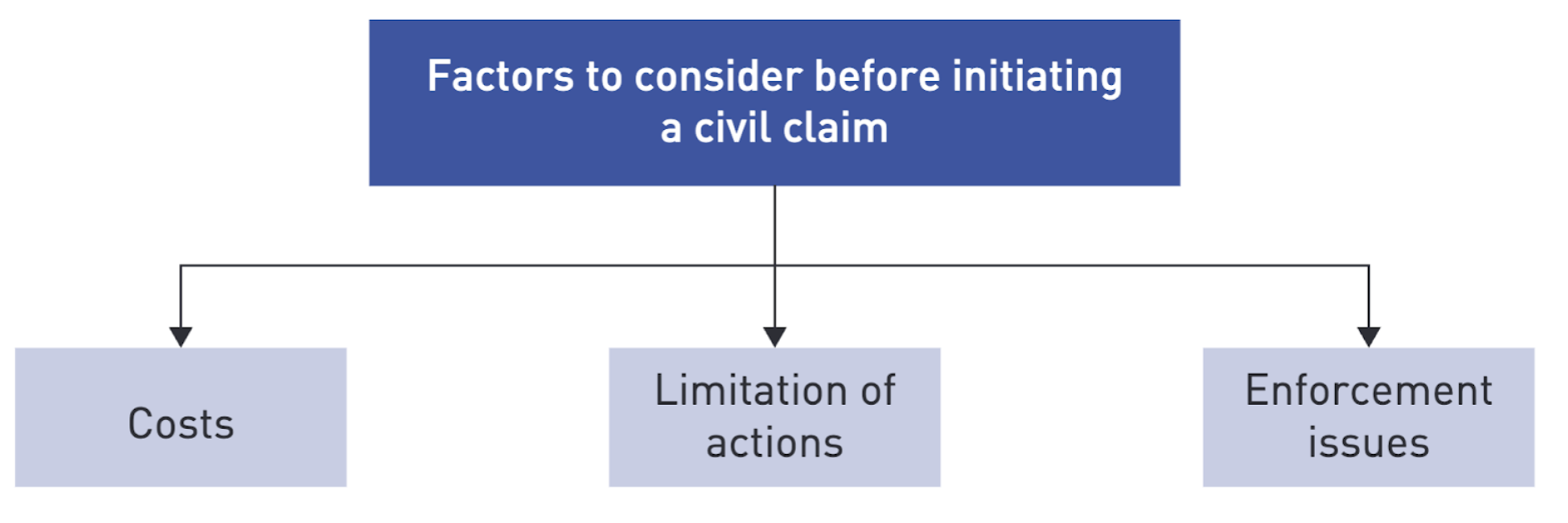
Purposes & downsides of initiating a civil claim
One of the main reasons to initiate a civil claim is that the party wants to be compensated for the loss they have suffered.
A party may also wish to demonstrate to the defendant and society in general that it is not acceptable to infringe peoples rights.
Downsides:
There is no guarantee that initiating a civil claim will be successful initiating call claim.
The legal fees are expensive
Time consuming
Stressful
May lead to negative publicity
Costs
Fees for legal representation:
Engaging a solicitor or barrister (sometimes both).
Fees vary based on the expertise of the practitioner, complexity of case, size of the case and which dispute resolution body it is heard in.
Will need to consider the cost of legal representation compared with how much they are claiming.
Disbursements:
Out of pocket expenses or fees (other than legal fees).
Court fees (filing, hearing, jury)
OR Tribunal fees (filing and hearing)
Mediation fees (cost of mediator and room)
Fees for expert witnesses
Costs involved using technology to manage documents relevant.
Adverse costs order:
A court order that a party (if unsuccessful) pay the other party's costs.
The fear of an adverse costs order can deter plaintiffs from initiating a case. They must consider:
- Cost to resolve
- Do the damages outweigh the cost of claim
- Eligibility for free legal aid
- Money to pay the adverse costs order
Limitation of actions
The restriction placed on the time within a civil claim can be commenced.
Limitations of actions ensures:
The defendant does not have to face action after a significant amount of time
Evidence is not lost and people can remember what happened
Disputes can be resolved as quickly as possible to promote social cohesion.
In some cases, the limitation period can be extended.
(Victoria is the first state to remove the limitation periods for a person who has suffered physical or sexual abuse as a minor, or psychological injury that arose from that abuse).
Limitation of actions for personal injury & contracts
3 years for personal injury
6 years for contract
Enforcement issues
2 ways that a plaintiff will obtain a settlement or remedy:
By settling with the defendant before the court or tribunal hands down a decision
By obtaining a remedy from a dispute resolution body such as a court.
The plaintiff will need to consider whether the defendant is able to pay, and if so whether the defendant will pay.
Some issues the plaintiff will need to consider:
The defendant may be bankrupt
Even if the defendant is not bankrupt, they may still be unable to pay
The defendant may be in jail, particularly if it arose out of a criminal case. It will be more difficult to enforce the remedy if the defendant.
If the defendant is a company, that company might not have any assets
The defendant may be overseas or uncontactable.
The plaintiff may not even know who the defendant is (may have been harassed in a public park, and the police have not been able to locate the defendant).
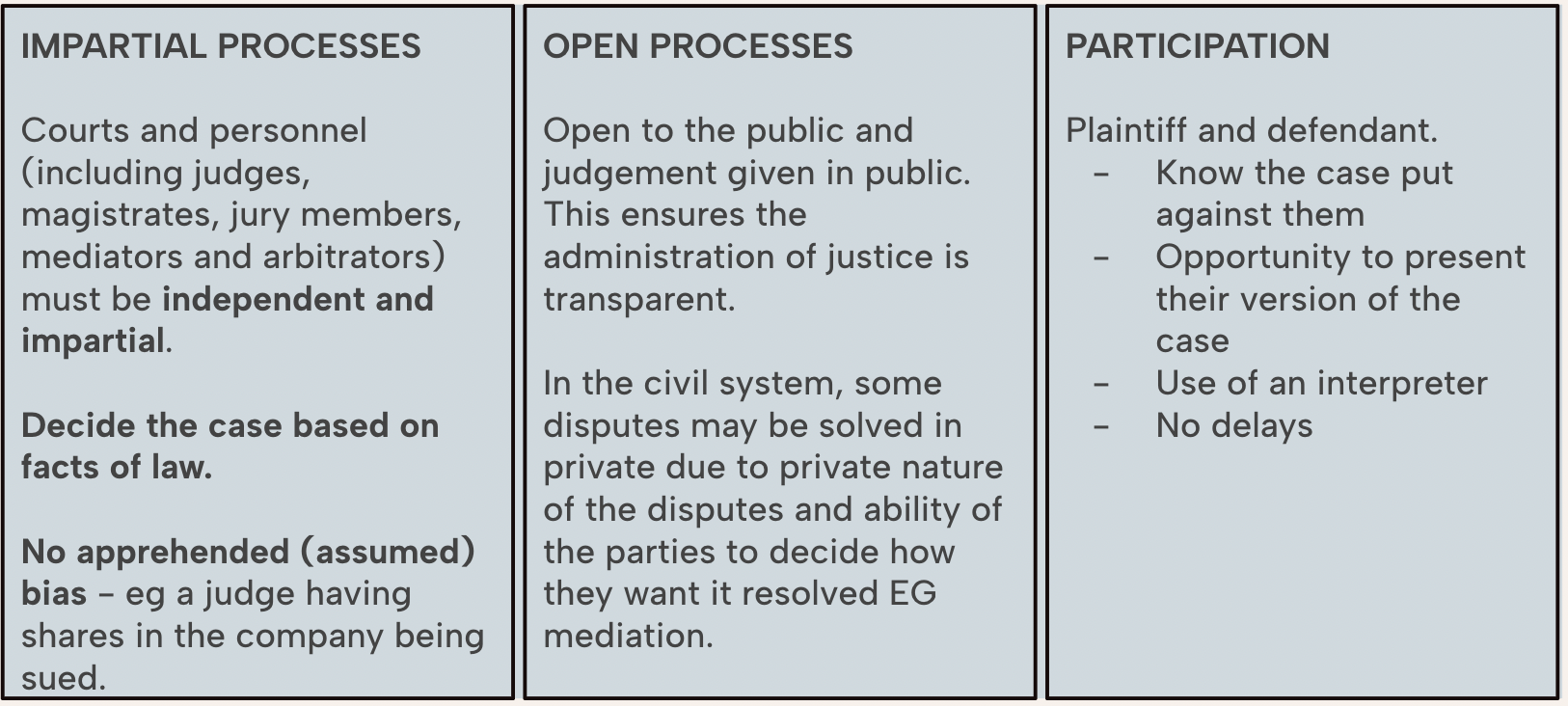
Fairness- Participation

Fairness
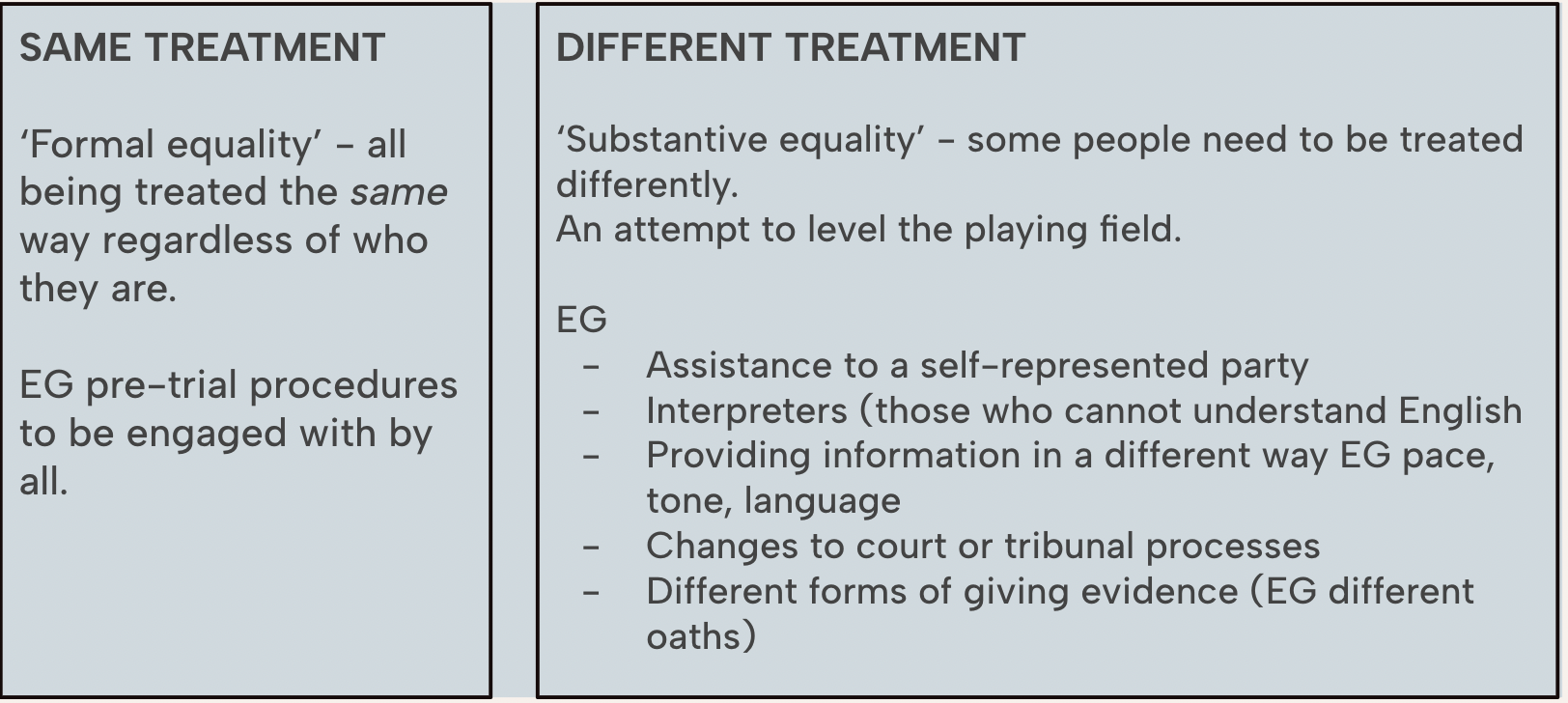
Equality- Treatment

Equality
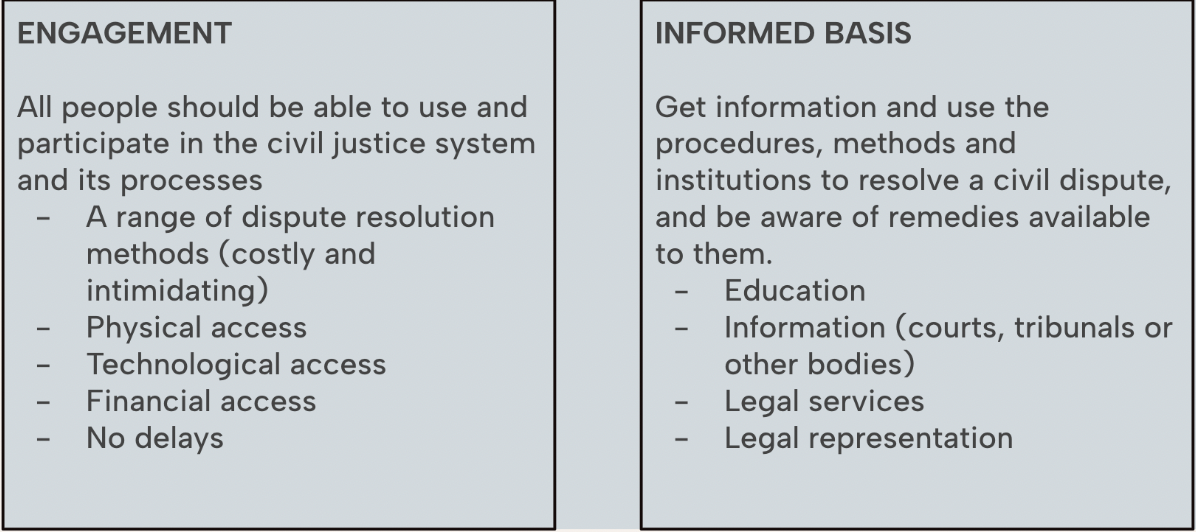
Access- Physical and Intellectual

Access
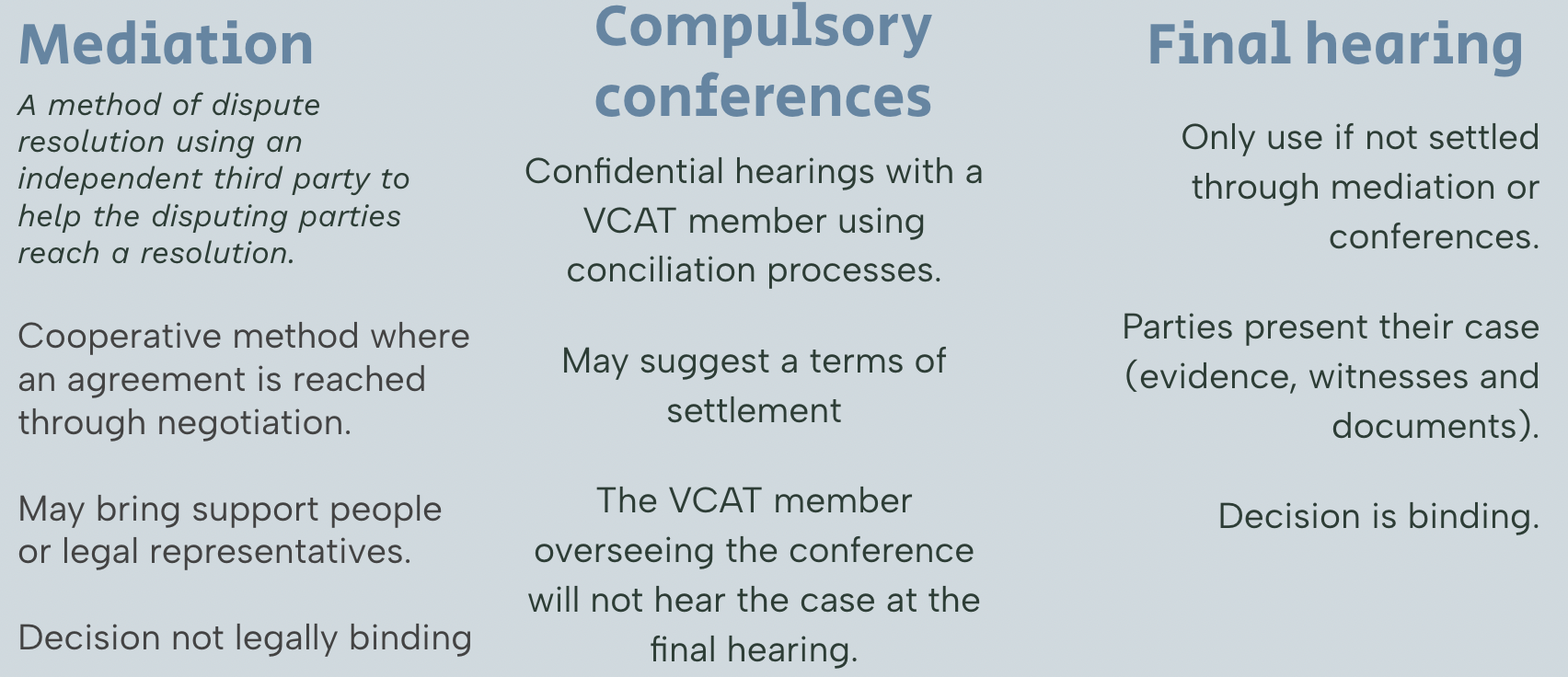
Mediation
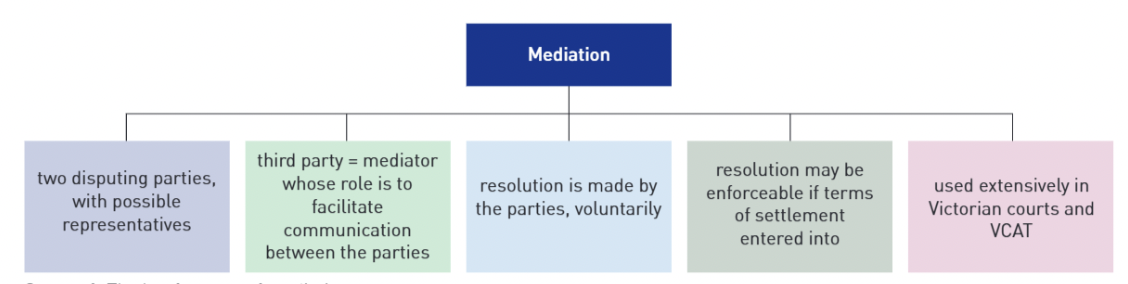
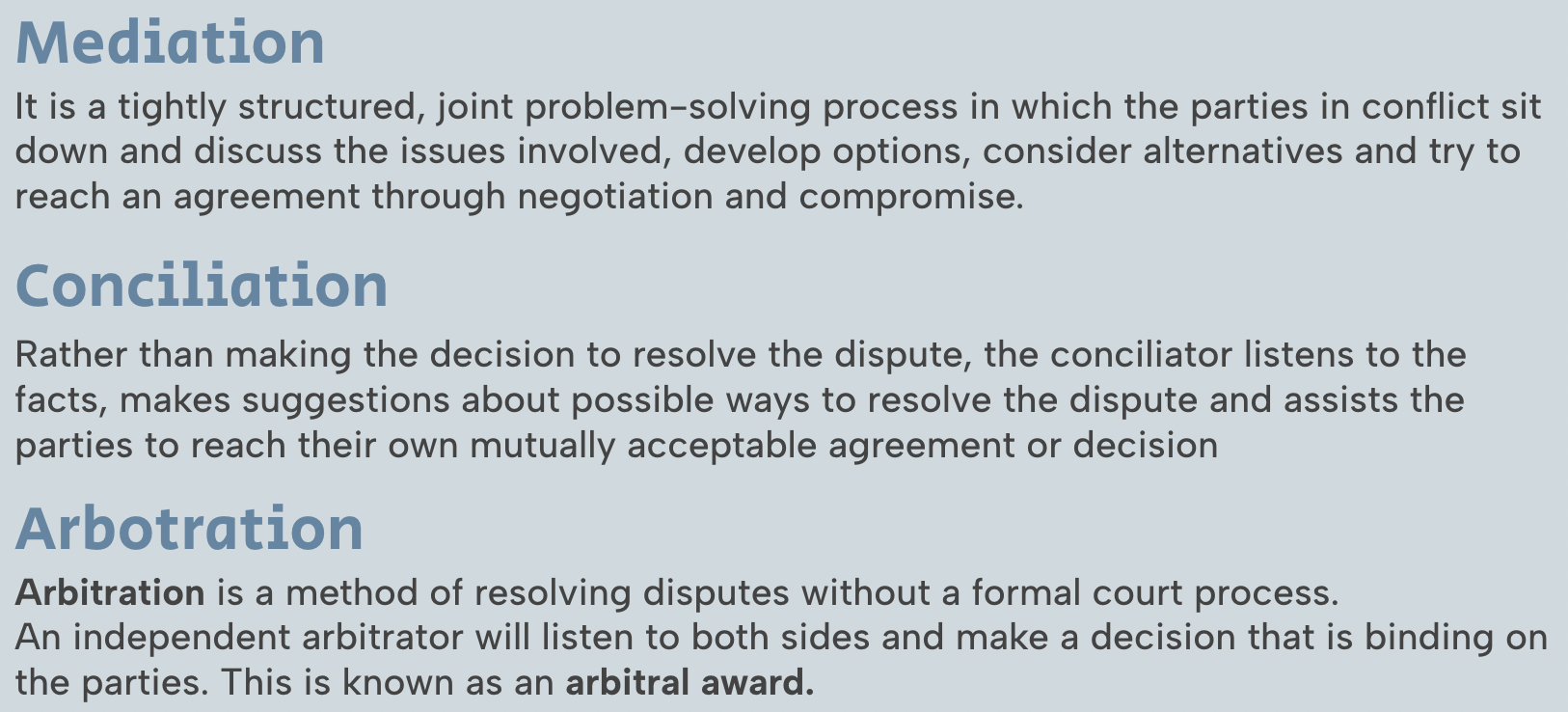
A method of dispute resolution that uses an independent third party. (i.e. a mediator) to help the disputing parties reach a resolution.
They do this with an independent mediator who, rather than advocating (or arguing) for either party, facilitates communication between the parties and encourage them to to reach their own agreement to resolve the dispute.
Used by courts, tribunals and other dispute bodies.
Any decision reached is voluntarily made by parties (not the mediator)
If the parties come to a decision, they may sign terms of settlement which reflects the agreement.
How mediation is used
If the plaintiff issues their claim in court, the court will generally order the parties to go to mediation before the final trial or hearing - with or without the consent of the parties.
The mediator can be appointed by the court or agreed on by the parties
The cost of mediation is usually split between the parties.
Mediator
An independent third party who does not interfere or persuade but helps the parties in a mediation as they try to reach a settlement of the matter.
Terms of settlement
A document that sets out the terms on which the parties agree to resolve their dispute.
Judicial mediation
Associate judges (judges who have certain powers to resolve disputes) in the Country Court and Supreme Court can also mediate disputes.
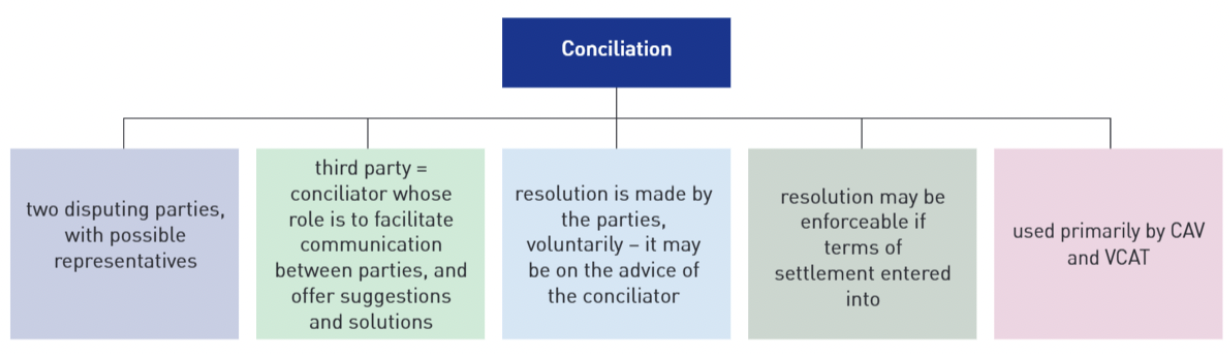
Conciliation
A method of dispute resolution that uses an independent third party lie. a conciliator) to help the disputing parties reach a resolution
Rather than making the decision to resolve the dispute, the conciliator listens to the facts, makes suggestions about possible ways to resolve the dispute and assists the parties to reach their own mutually acceptable agreement or decision
Conciliation can differ from mediation in the the conciliator has more influence over the outcome.
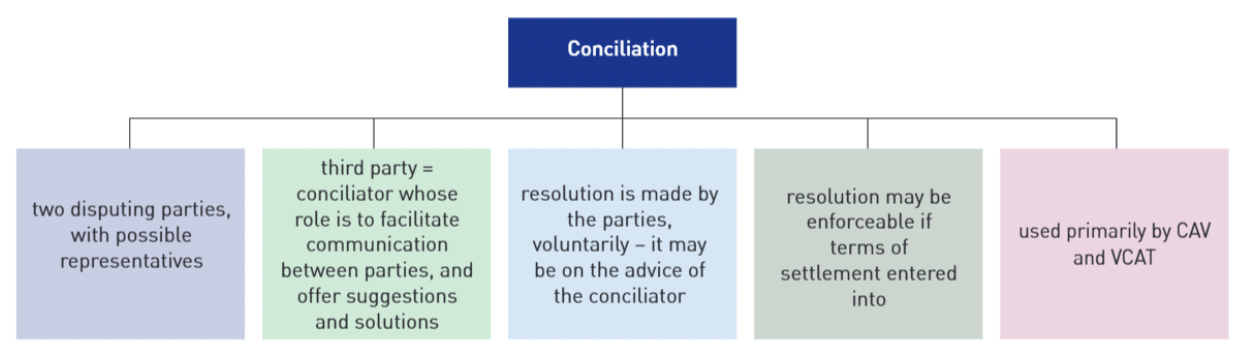
Conciliator
The independent third party in a conciliation, who helps the parties reach an agreement that ends the dispute between them.
The conciliator can make suggestions and offer advice to assist in finding a mutually acceptable resolution, but the parties reach the decision themselves
Key Differences Between Mediation and Conciliation
Role of the Third Party:
A mediator acts solely as a facilitator, remaining neutral on the substantive issues.
A conciliator plays a more directive role, identifying issues, evaluating the merits of the case, and proposing terms of settlement.
Expertise and Advice:
Conciliators often have specific professional expertise in the subject matter and can offer advice on the issues.
Mediators focus on the process, helping parties negotiate without advising on the legal or technical merits.
Process Structure:
Mediation is highly informal and adaptable, often focusing on repairing relationships.
Conciliation can be more formal, sometimes operating within statutory frameworks (like WorkCover or statutory tribunals).
Approach to Outcomes:
Mediation focuses on helping parties reach an agreement that they own.
Conciliation focuses on the conciliator facilitating a fair outcome, often providing guidance to get there.
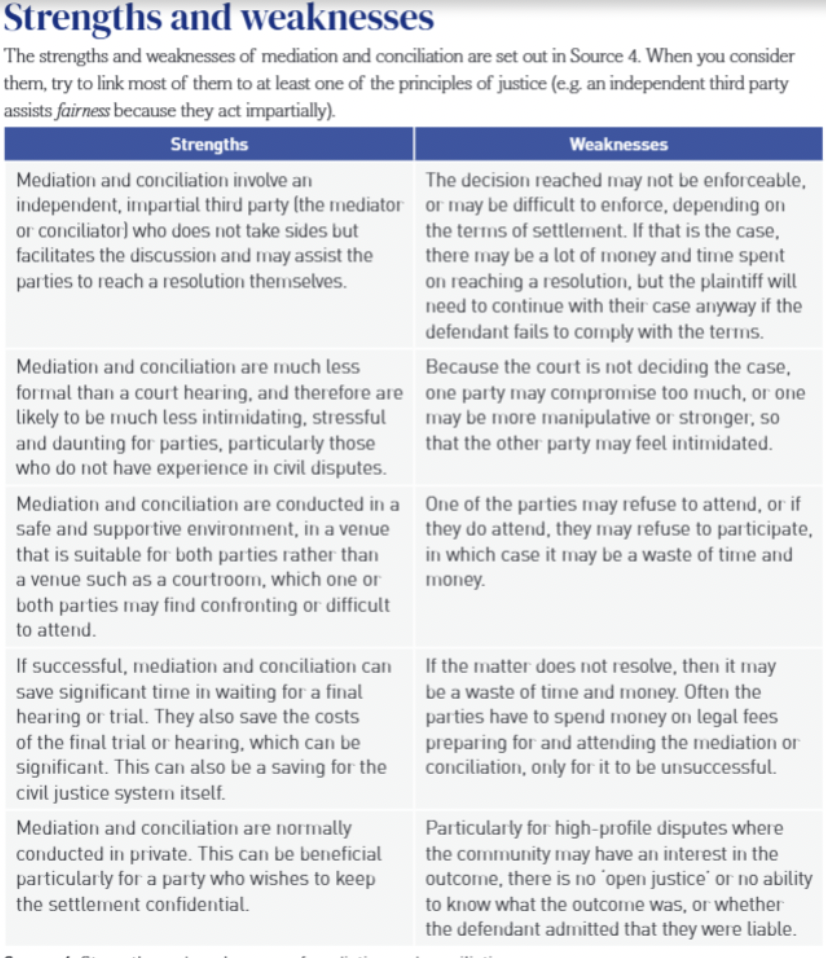
Pros and cons of mediation
Arbitration
A method of dispute resolution in which an independent person lan arbitrator) is appointed to listen to both sides of a dispute and make a decision that is legally binding on the parties.
The decision is known as an arbitral award
Generally, an arbitrator:
Not bound by rules of evidence but may inform themselves on any matter as they think fit
Must ensure that the parties are treated equally and each party is given a reasonable opportunity to present their case
Is not required to conduct the proceedings in a formal manner
In Victoria, arbitration is available when:
The parties have agreed to settle their dispute by arbitration
The court orders the parties to arbitration
The claim has been filed in the Magistrates' court and the plaintiff is seeking $10,000 or less
Arbitral award
A legally binding decision made in arbitration by an arbitrator.
Appropriateness of the methods used to solve civil disputes
Whether the parties have agreed or the claim in less than $10,000
Whether the parties want the benefit of a binding and enforceable decision
Whether the parties wish to have the dispute considered by a third party and want evidence to be presented
Whether both or one of the parties want the dispute to be resolved privately or confidently or whether they want a public record
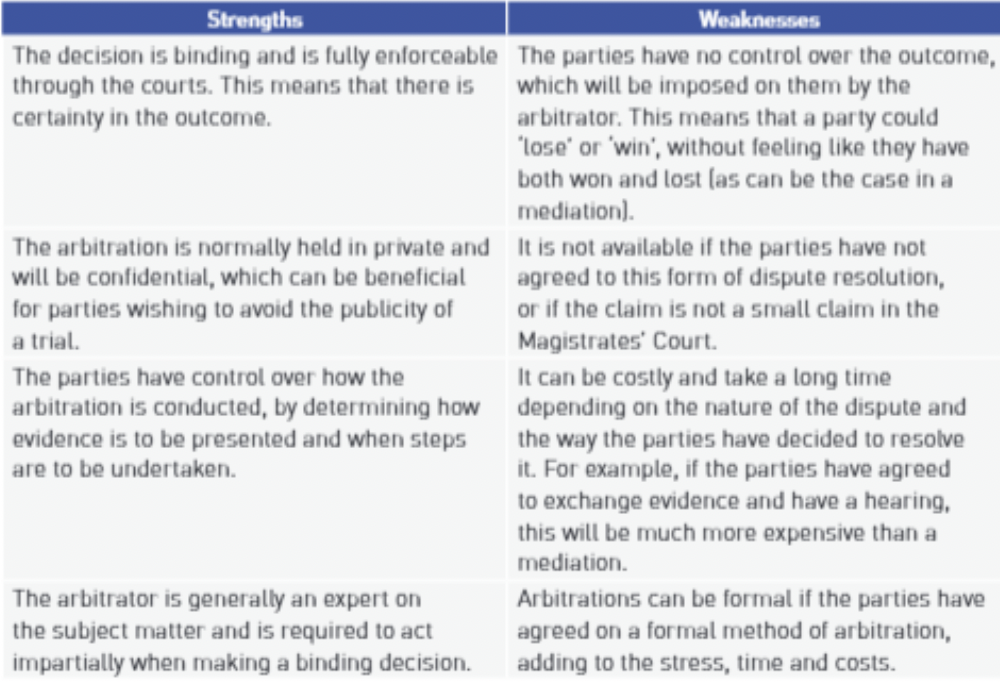
Strengths and weaknesses of arbitration
VICTORIAN HIERARCHY OF COURTS
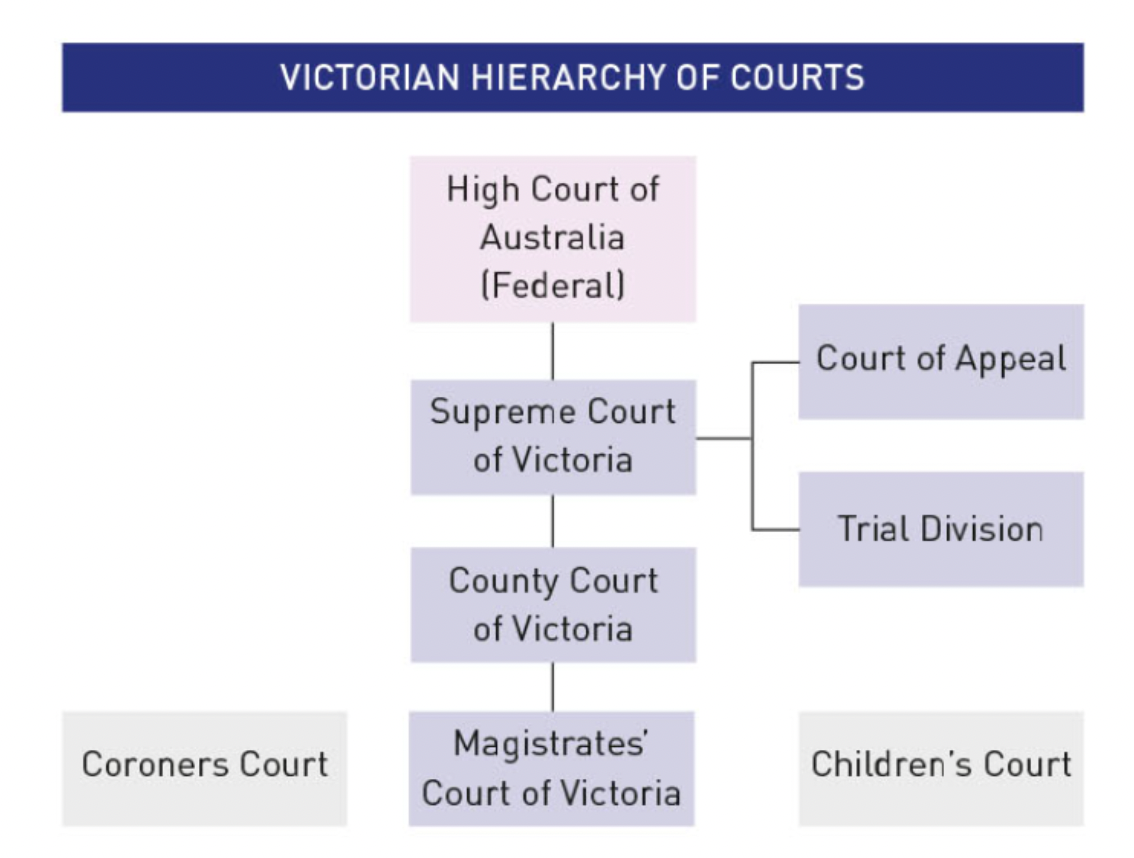
Administrative convenience
Cases can be distributed according to their severity and complexity
Minor civil disputes (where the plaintiff is seeking $100 000 or less) can be heard in the Magistrates Court. They are heard faster and are less expensive to resolve.
There are a greater number of Magistrates and Magistrates Courts due to the significant number of smaller disputes.
Enables them to allocate resources and create processes to ensure efficiency
More serious and more complex cases heard in the County or Supreme courts, which have unlimited jurisdiction. Technically plaintiffs can select either court but larger and more complex will tend to go to the Supreme.
Class actions are only heard in the Supreme Court.
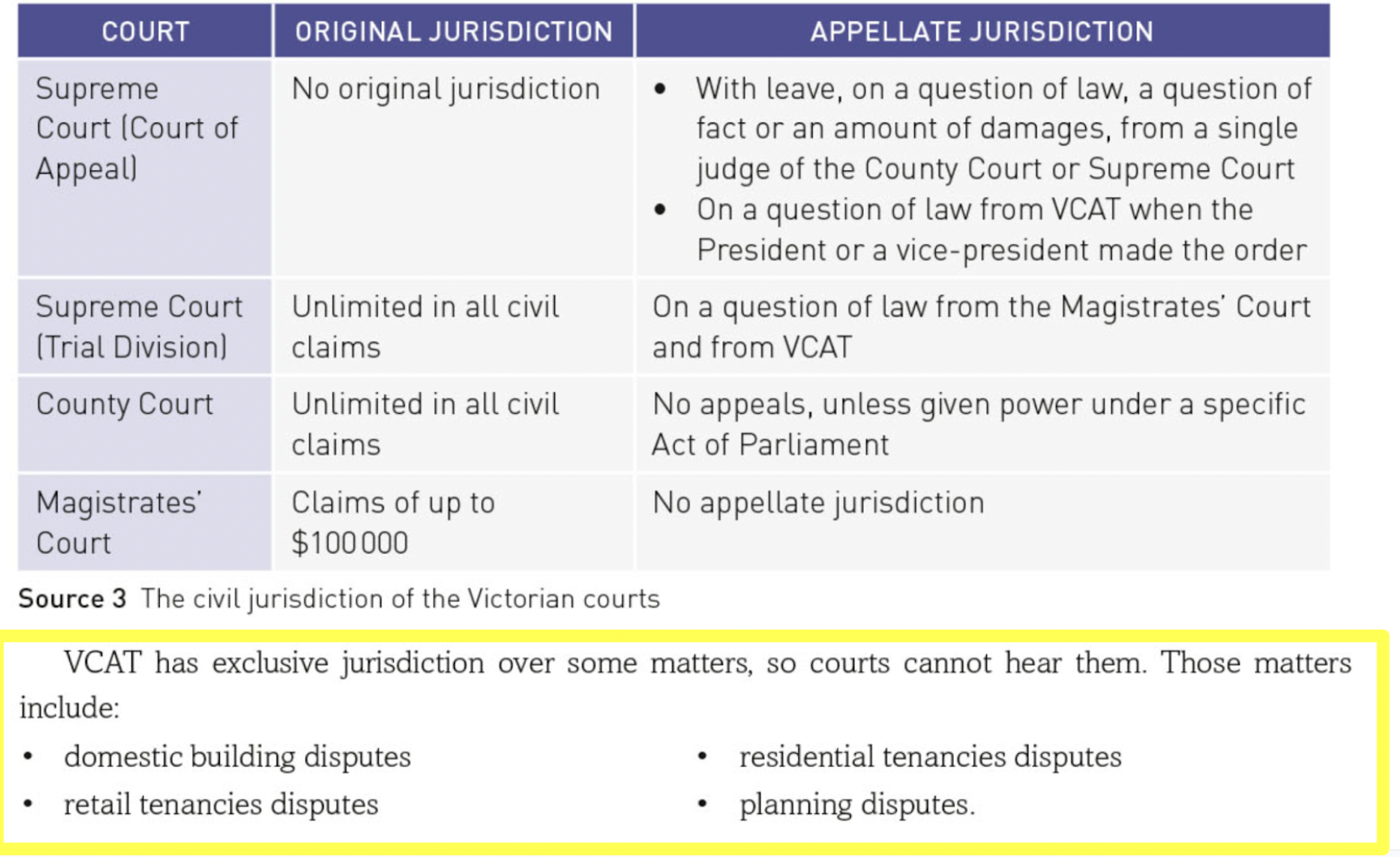
Appeals
If you are dissatisfied with a decision, and if there are grounds for appeal, you can take the matter to a higher court.
Grounds for appeal in a civil case include:
A point (or question) of law - the law has not been correctly applied
A question of fact - whether the facts of the case had been applied properly
The remedy awarded
Both the Court of Appeal and the High Court can determine special leave applications 'on the papers', which means that no formal hearing is required.
The aim is to streamline processes, and reduce costs, time and stress involved in a formal hearing.
Strengths and weaknesses of the court hierarchy
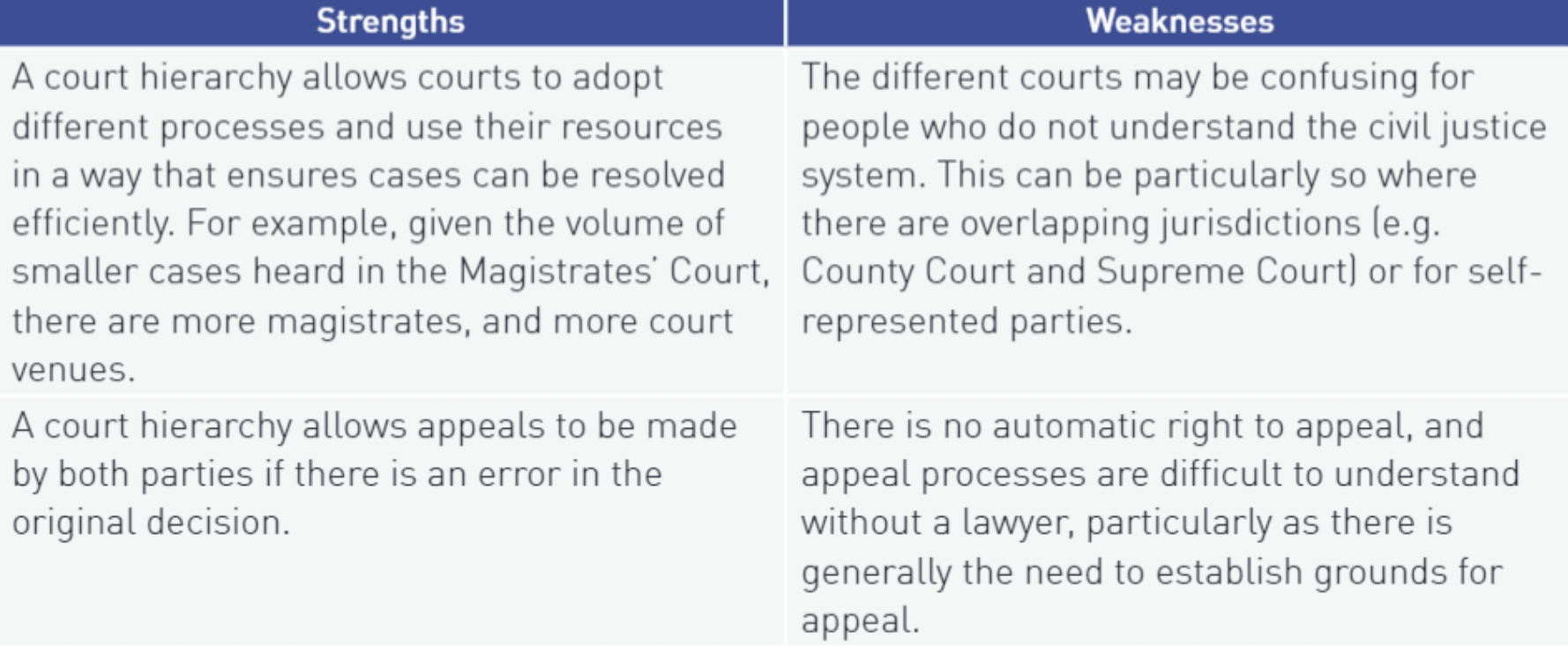
The role of the Judge and Magistrate in a Civil Case
If the plaintiff issues the claim in the County Court or Supreme Court, the judge will be the central figure with authority over the case. If the plaintiff issues the claim in the Magistrates' Court, the magistrate will have the primary role.
Their roles include:
Act impartially
Case management
Determine liability and the remedy
Decide on costs
Civil cases do not generally involve a court other than the court in which the plaintiff issues the claim.
Role - Act impartially
The judge or magistrate in a civil case must be impartial.
This means the judge or magistrate must ensure that they oversee the case and make a decision on liability without any bias toward or against either party.
Judges and magistrates are also independent of government and the parliament.
They do not make decisions in favour of political parties or in favour of a particular interpretation of the law.
The use of an independent and impartial judge or magistrate ensures that the rule of law is upheld.
Role - case management (before)
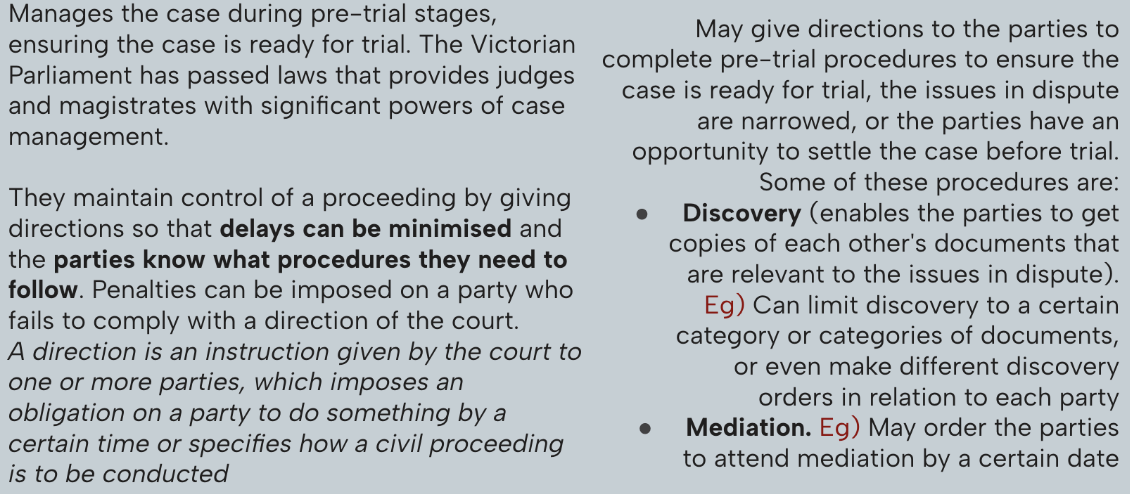
Role - case management (during)
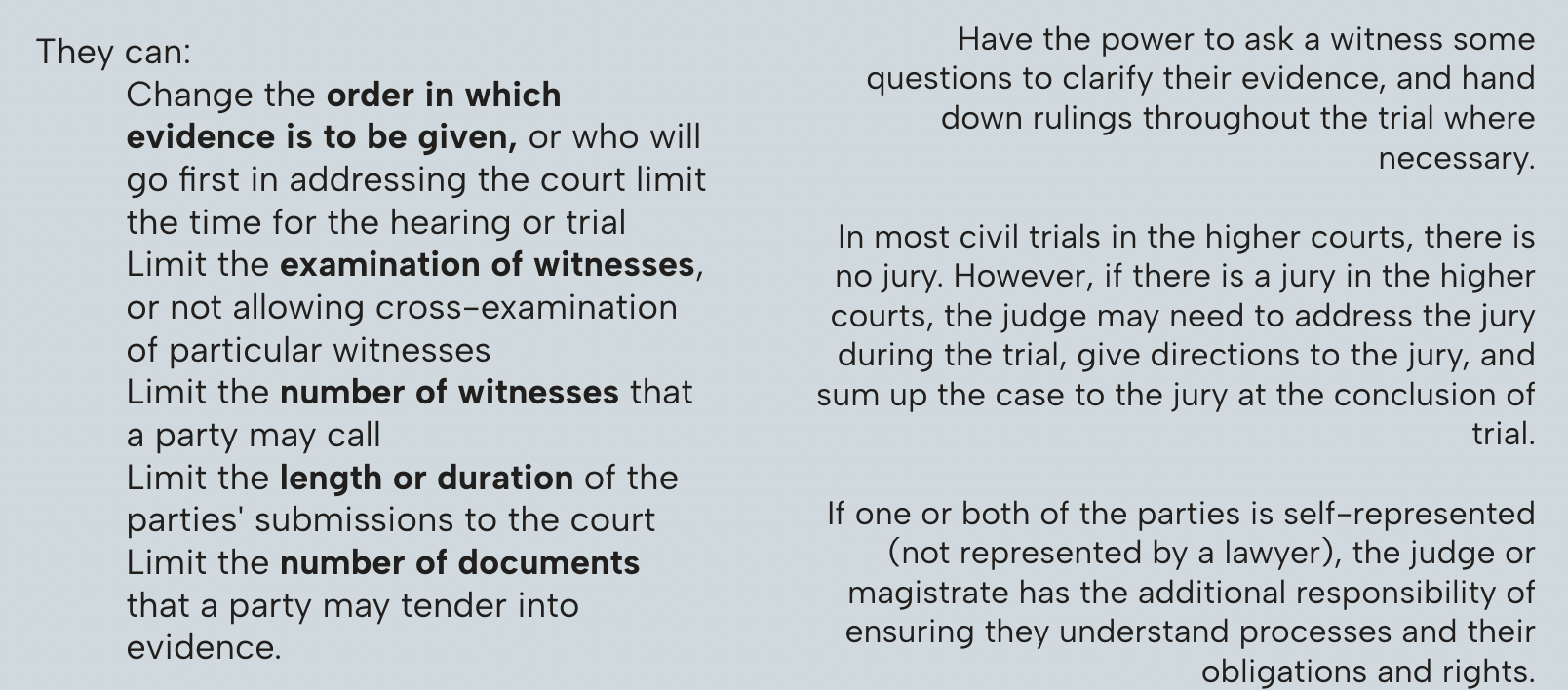
Role
Determine liability and the remedy:
The judge/magistrate is the decider of facts. They will normally reserve their decision and deliver it at a later time. In doing so, they normally provide their written reasons for their decision. Known as 'court judgements', they should be delivered in a timely, accessible and readable manner.
Decide on costs:
After each civil case the judge or magistrate will decide which party should bear the costs. The general rule is that working out the costs is left to the end, and the successful party is entitled to costs, but that is not always the case.
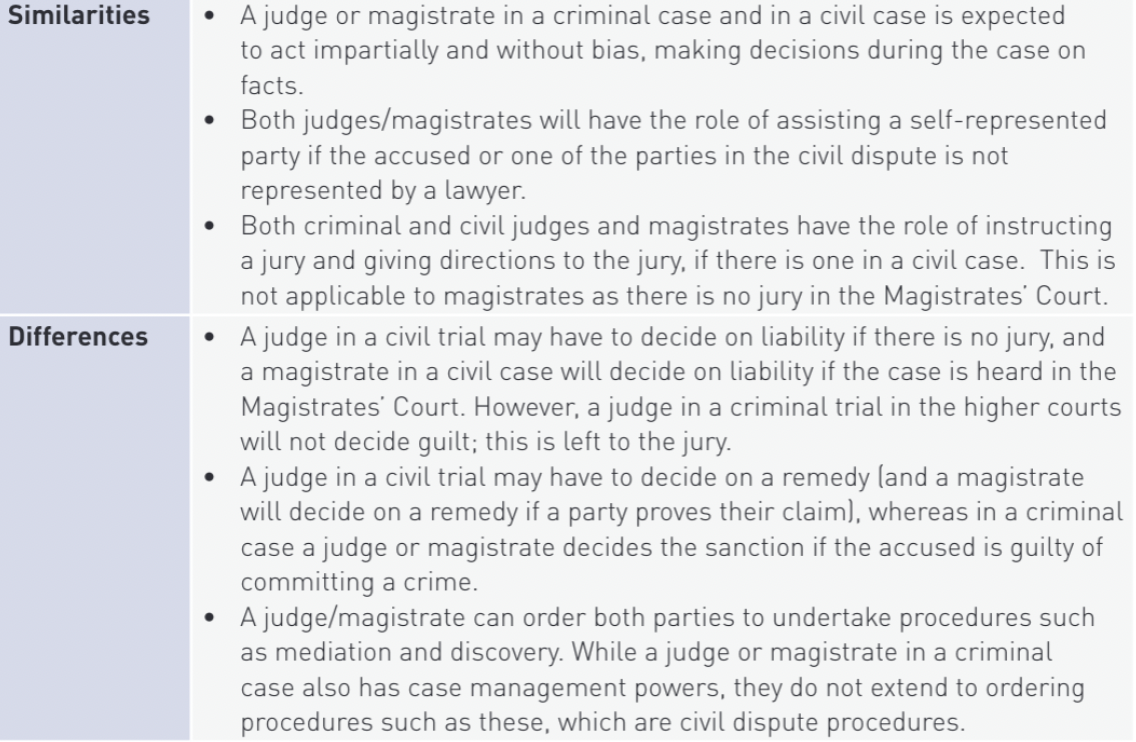
Similarities and differences of a criminal and civil trial
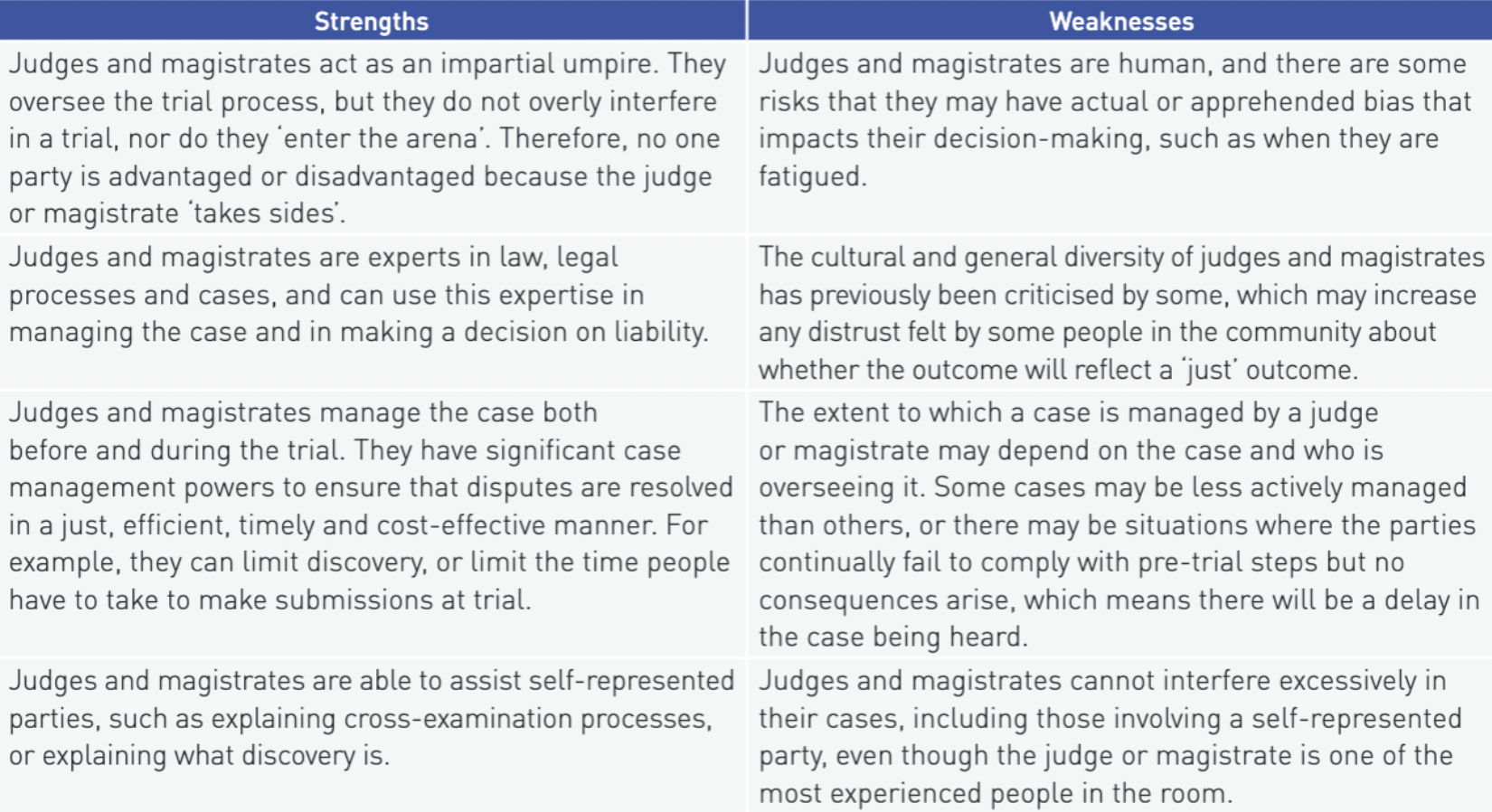
Strengths and weaknesses of the roles of the judge and magistrate
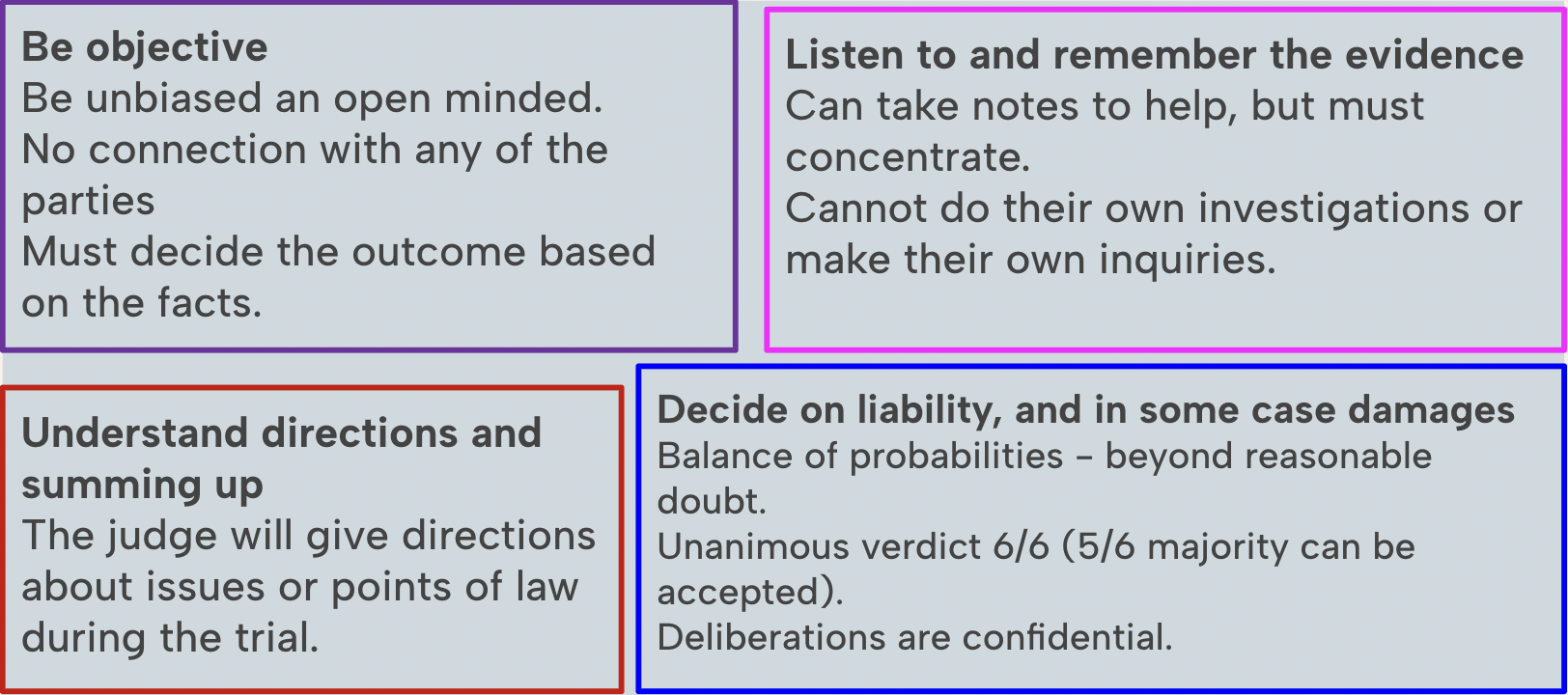
The jury in a civil case
Civil cases do not usually have a jury.
They can be used if:
The plaintiff or defendant specify during pleadings they want a trial by jury (the party requesting must pay the fee)
The court may order a proceedings is tried by jury (rare)
Decides which facts it believes to be true.
May be required to assess damages (in defamation the jury cannot decide on the amount of damages).
There are only 6 jurors in a civil trial (can empanel 8 but only 6 deliberate)
The role of the jury
Similarities and differences between the roles of the jury in criminal and civil law
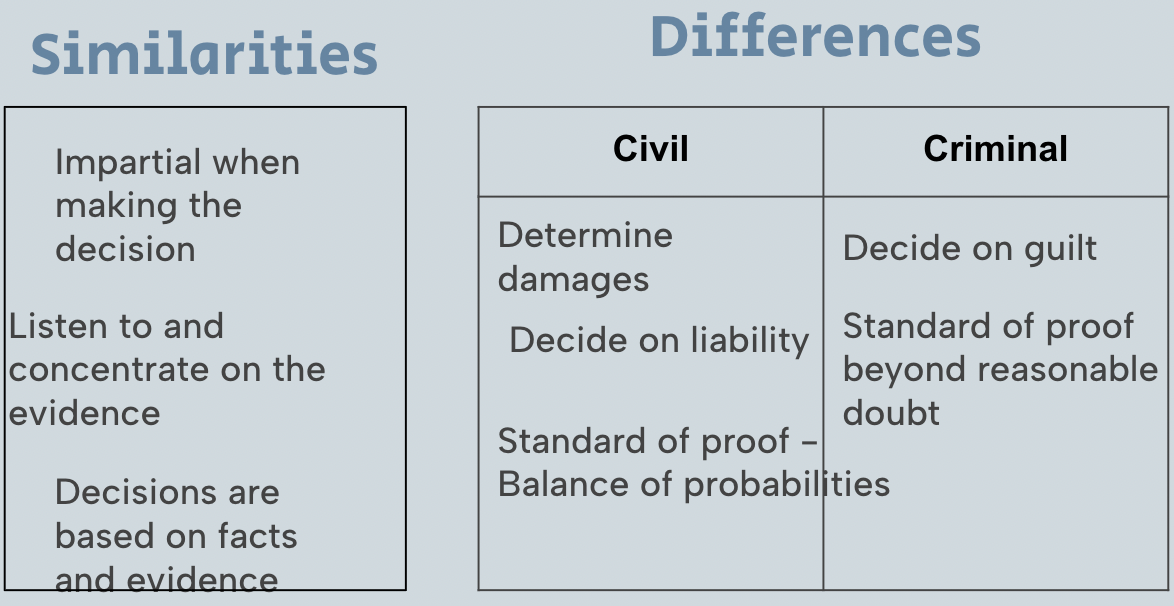
The role of the parties
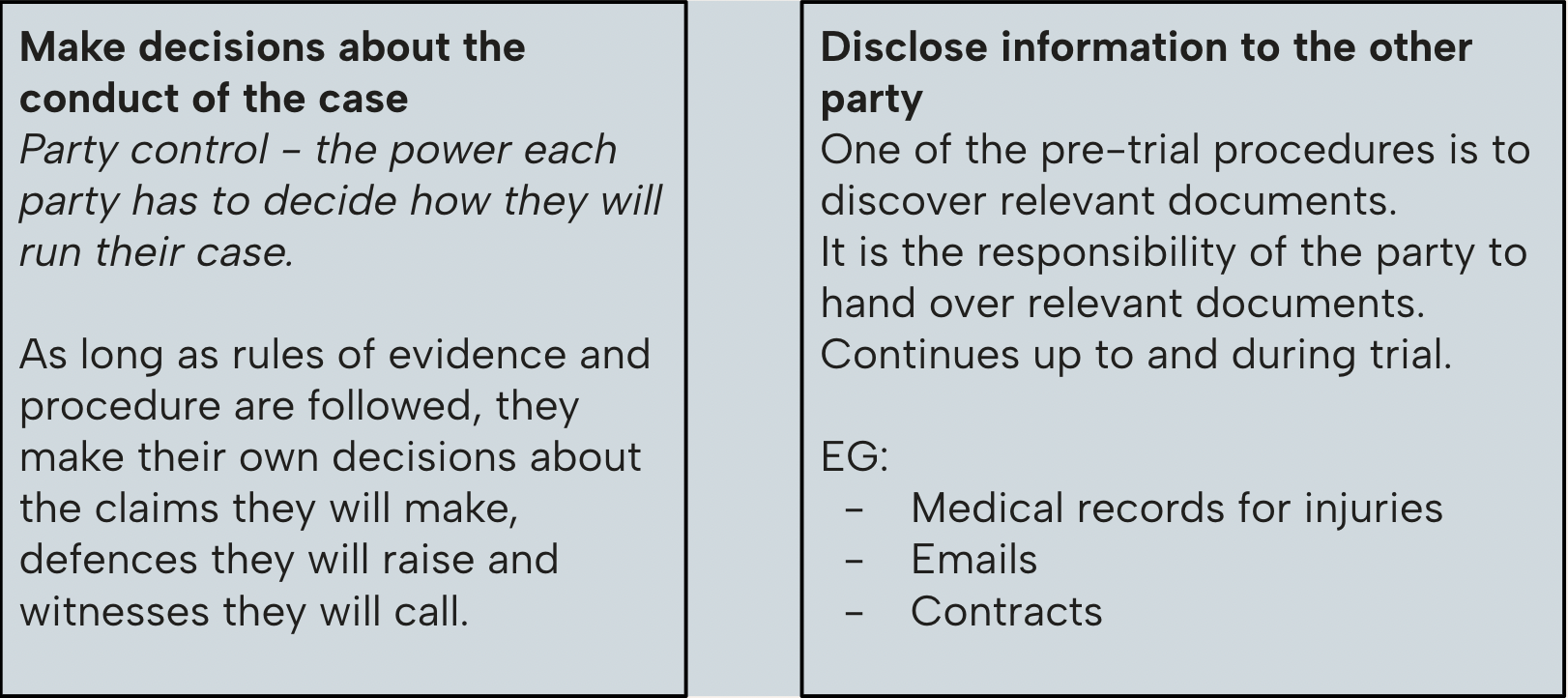
Party control
The power each party has to decide how they will run their case.
The role fo the parties
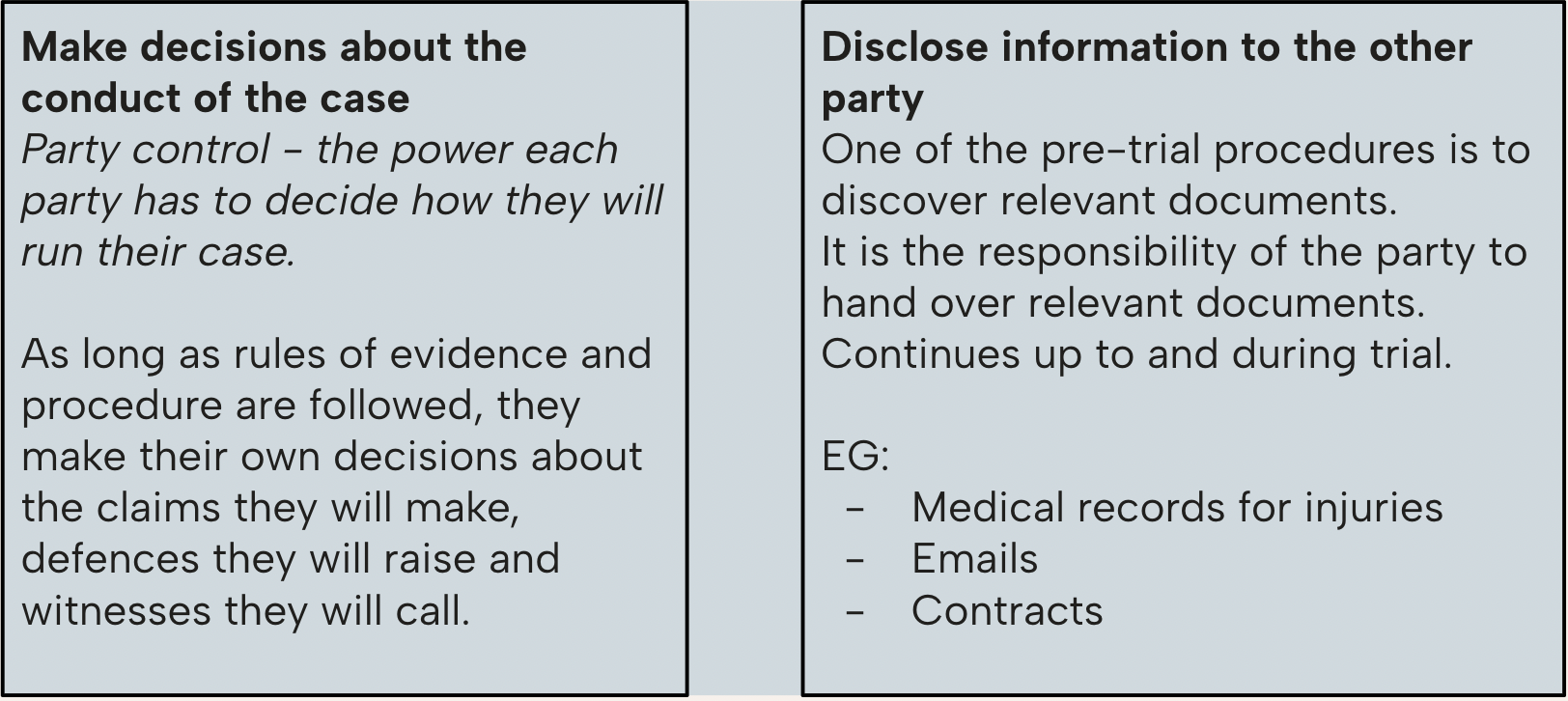
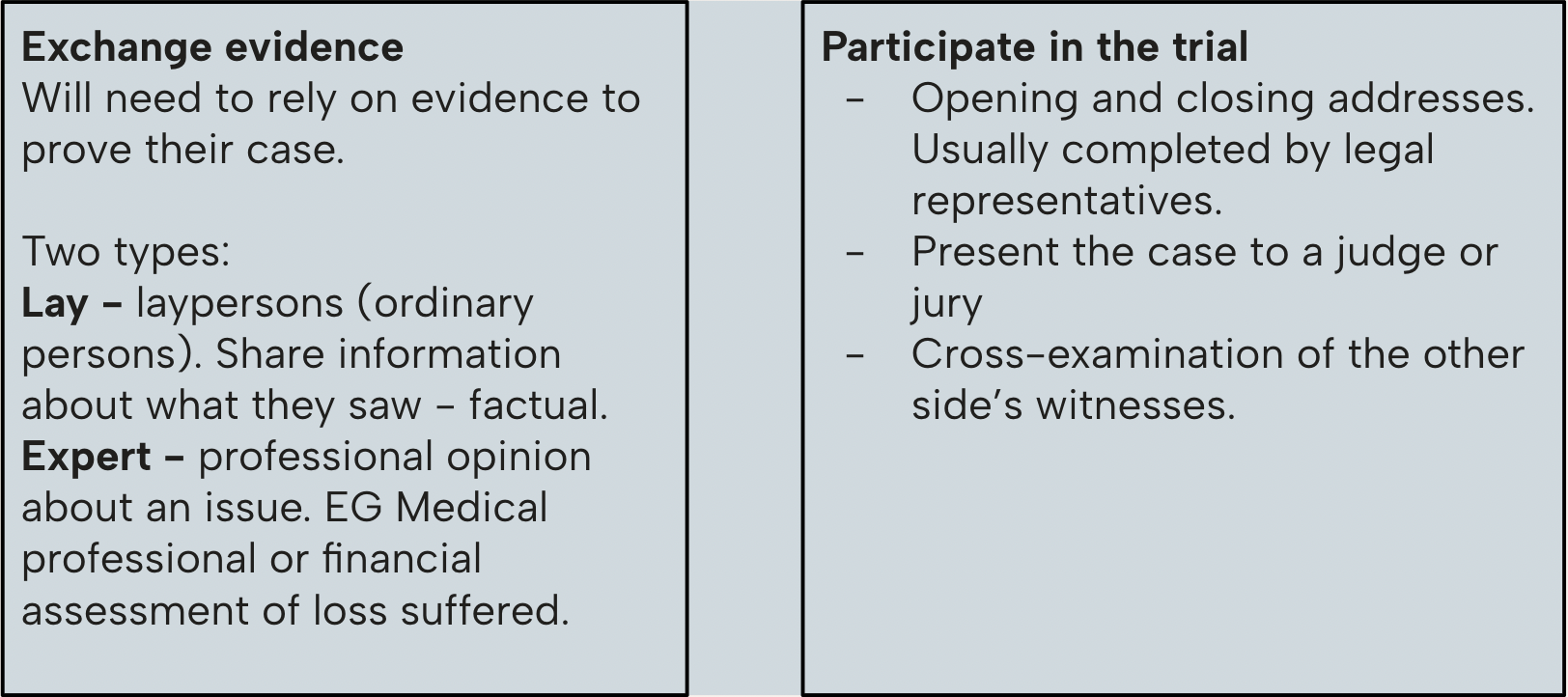
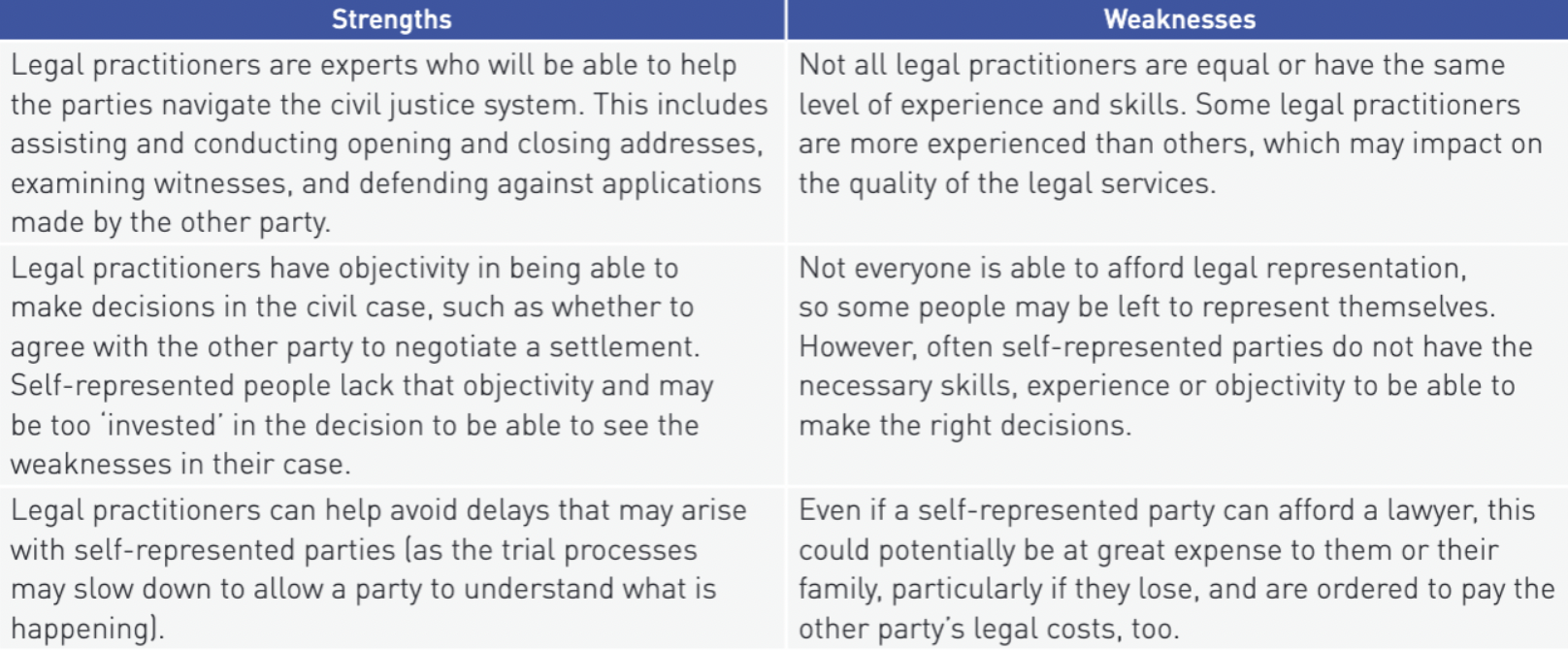
Similarities and differences between the roles of the parties in criminal and civil law
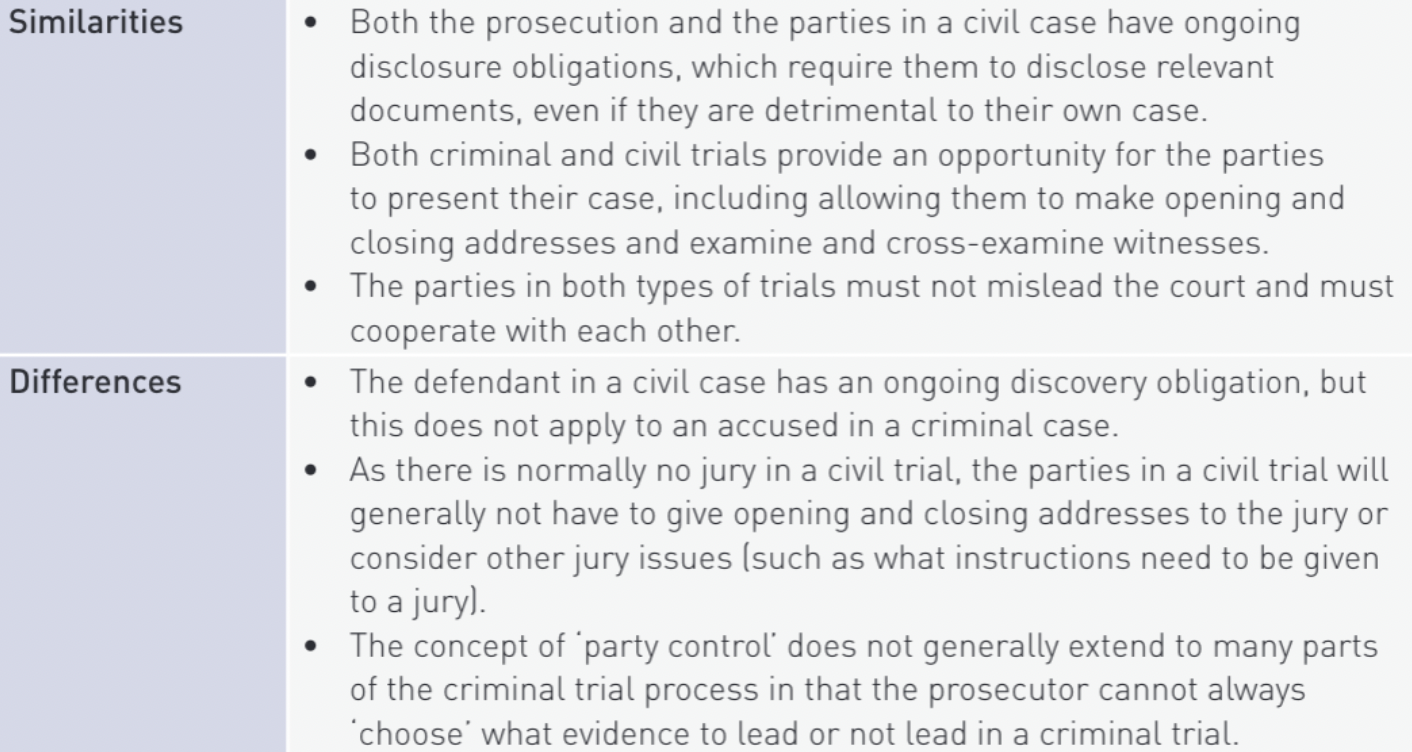
Strengths and weaknesses of the parties in the civil trial
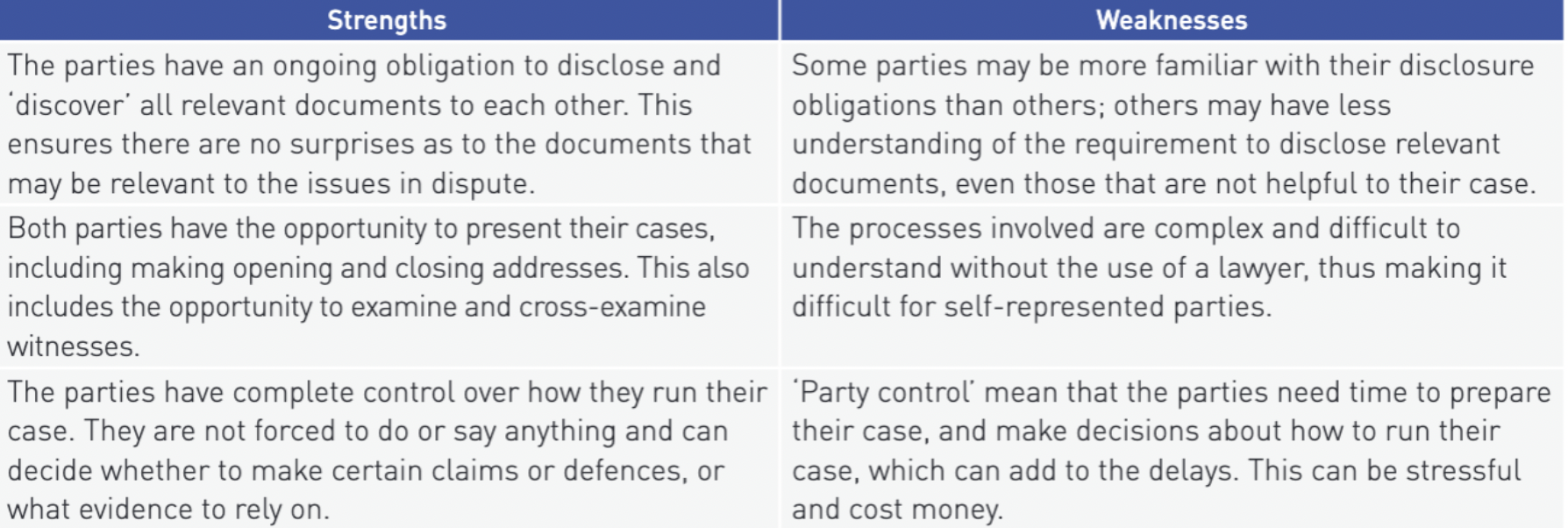
Why are legal practitioners needed?
Parties may not know how to present their evidence in the most effective way
May not know how to cross-examine a witness
May be emotionally invested and not able to make objective decisions.
The truth should emerge through each party presenting their own case to the best of their ability and the other side showing the flaws in the legal arguments and evidence being presented.
Provision of free legal aid
Victoria Legal Aid (VLA) is more challenging in the civil justice system most grants for for criminal or family law matters.
It does not assist in relation to:
Business matters
Pay disputes
Work injuries
Sometimes Community Legal Centres can help but it depends on the type of CLC.
VCAT is set up to generally not allow lawyers to represent people and some mediations may also not require the use of a lawyer.
Strengths and weaknesses of legal practitioners
Class action (also referred to as a group proceeding or a representative proceeding)
A type of proceeding where a group of people, who all have claims against the same party, join together in a proceeding.
The 'class action' or proceeding can be commenced if:
Seven or more people have claims against the same person
Those claims relate to the same, similar or related circumstances
The same issues need to be decided (such as whether the defendant owed a duty of care to those plaintiffs)
How class actions work
Class actions are normally commenced by a single person who 'represents' the group (or class). That person is known as the lead plaintiff (sometimes called the representative plaintiff)
The people who form part of the group are known as group members. Group members do not actively participate in the proceeding and are not named in the court documents. Group members may not even be known by the lead plaintiff or the law firm acting on behalf of the plaintiff, and the group members themselves may not even know a class action has been commenced or that they form part of a 'group'
The court actively manages and supervises class actions - they approve any settlement
Costs associated with class actions
Generally, if a class action fails, then the lead plaintiff alone is responsible for the costs of the proceeding and any potential adverse costs order. This means that not everyone may be prepared to be the lead plaintiff.
Although the lead plaintiff is responsible for the costs if the class action fails, this is not often the case, as normally the law firm will either act on a 'no win, no fee' basis, or a litigation funder is involved.
A litigation funder is a third party that agrees to pay the legal costs associated with the action in return for a percentage of any settlement or damages awarded.
Usually 20-40% of the total amount awarded, but varies from case to case. The litigation funder will also ordinarily agree that it will pay the costs of the class action if it fails. The use of litigation funders in Australia is now a regular feature of class actions.
Types of class actions
Shareholder class actions, where shareholders of a company may make a claim about being misrepresented about the state of the company's affairs
Product liability class actions, where consumers who have purchased a good or service have all suffered the same loss or damage. EG) a class action was launched in relation to alleged defective airbags in cars. Other products that have been the subject of class actions include soy milk, herbicides and medication
Class actions where employees group together to make claims in relation to underpayment or poor work conditions
Natural disaster class actions, where the group members have suffered loss or damage as a result of a natural disaster
Appropriateness of class actions
Depends on the facts of the case and the nature of the claim.
The following factors should be considered:
Whether there are seven or more people who have a claim against the defendant which arises out of the same or similar circumstances
Whether a plaintiff law firm or a litigation funder is prepared to fund the claim to avoid the lead plaintiff from having the burden of costs
Whether there is someone willing and able to be the lead plaintiff
The nature and size of the claims. Very small claims, for example, may not be economical (i.e. result in a outcome that is worth the effort and cost)
Whether one group member has suffered significantly more than other group members and may be prepared to conduct their own proceeding, and fund it, rather than having to 'share' any settlement with the other group members
(CAV) Consumer Affairs Victoria
A dispute resolution body which is part of the Victorian Government's Department of Justice and Community Safety.
It helps people settle their disputes effectively and constructively, without any costs.
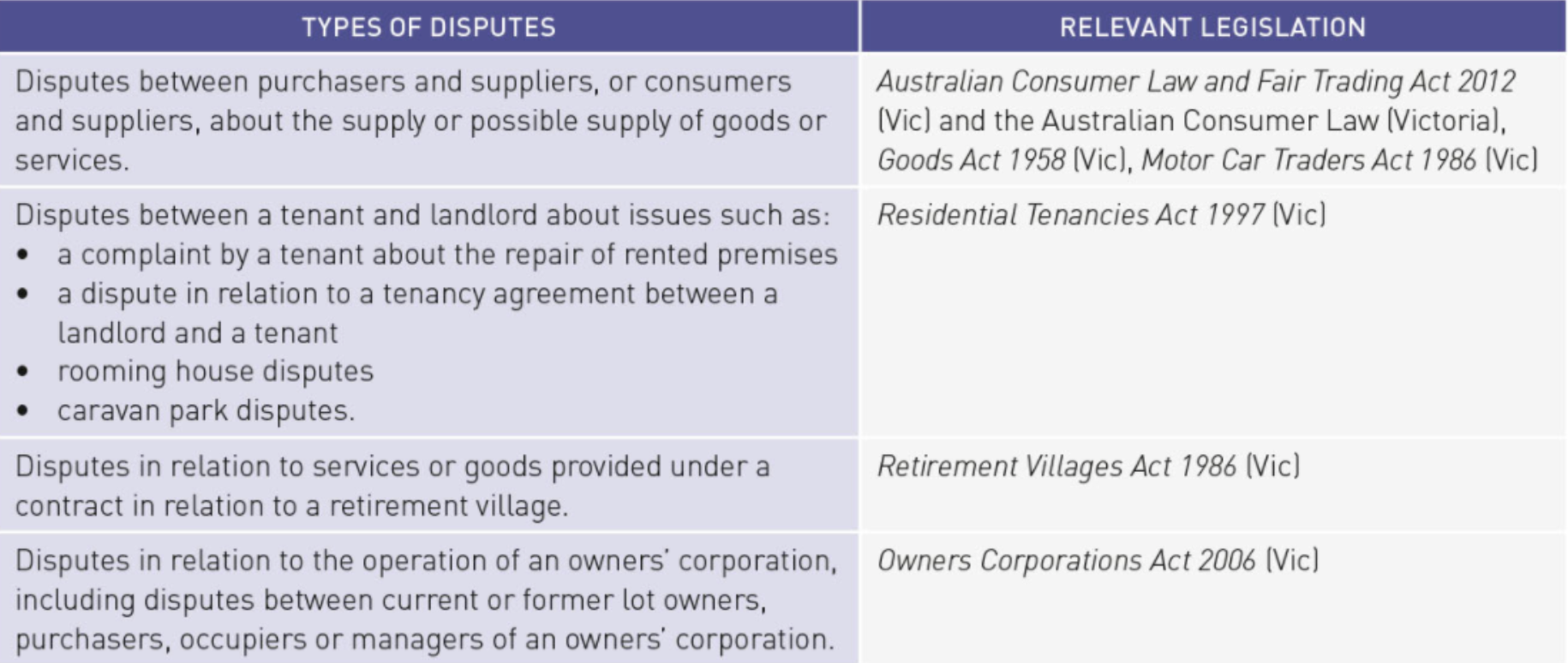
CAV only accepts complaints from consumers and tenants.
Advises the government on consumer legislation (laws about the sale and purchase of goods and services)
Provides information and guidance to educate people about consumer laws
Enforces consumer laws
It also provides consumers and traders, tenants and landlords with a dispute resolution process.
Complaints body
An organisation established by parliament to resolve formal grievances (complaints) made by an individual about the conduct of another party.
Rights and responsibilities
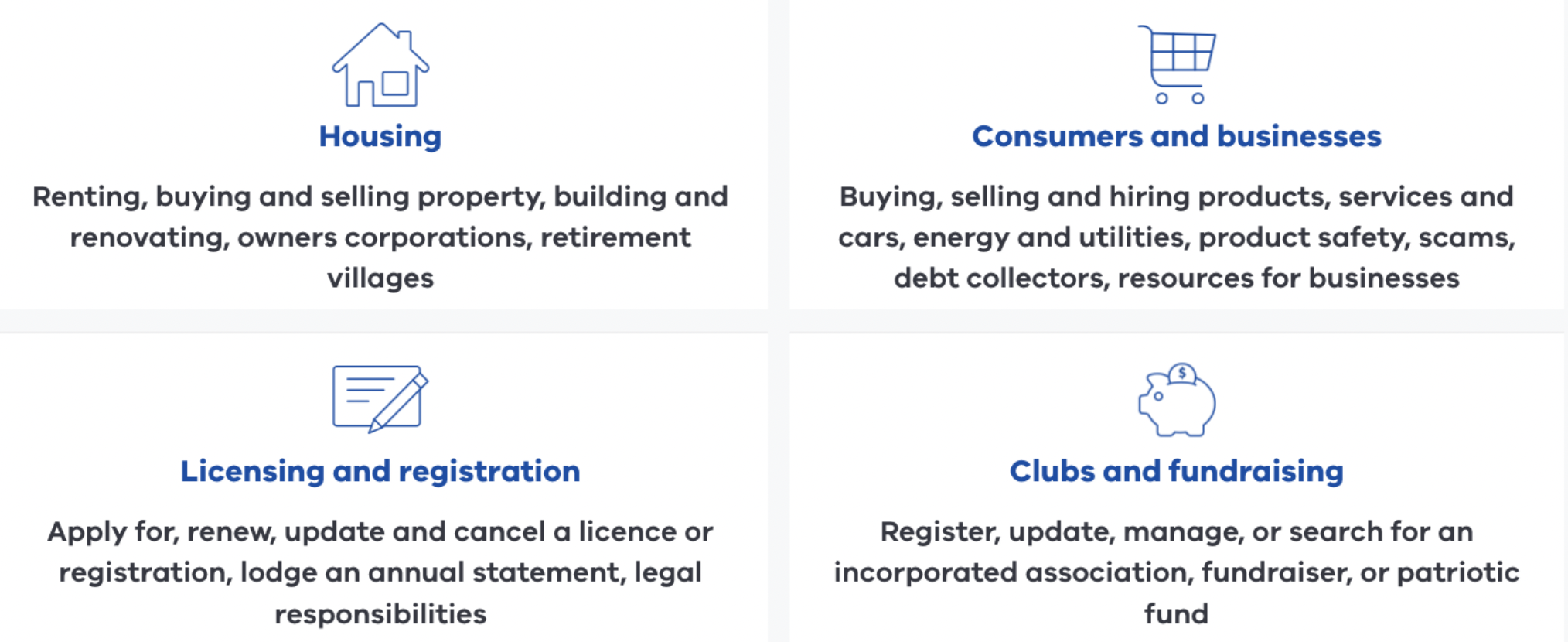
2 purposes of CAV are:
To help people come to an agreement about how to resolve their disputes efficiently without any cost to them. Allows people with smaller disputes about goods or services provided to them, or about their tenancy, to obtain a dispute resolution service that is not expensive, or will not take too long to resolve.
To try to help the parties reach a resolution that is consistent with the law. In helping parties resolve their disputes, CAV has a compliance focus to ensure that any person who has not complied with the law is aware of that and does not breach the law again.
The main method used by Consumer Affairs Victoria to resolve disputes:
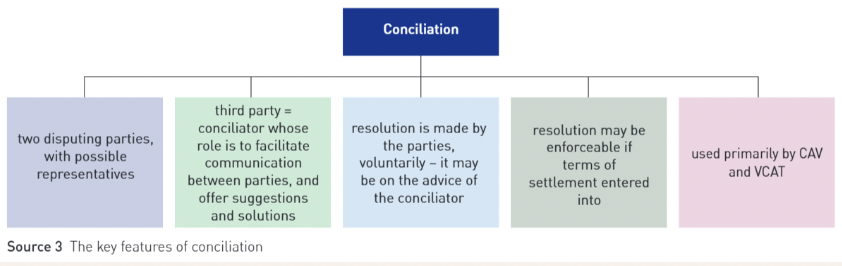
Conciliation
Parties use an independent third party (conciliator), who has specialist knowledge of the nature of the dispute, to help the parties reach a mutually acceptable decision between them. This is usually done over the phone.
If the parties come to an agreement, they may sign terms of settlement, a document that sets out the terms on which the parties agree to resolve their dispute. These terms are enforceable through the courts.
(Appropriateness of CAV) The factors considered by Consumer Affairs Victoria when deciding to offer a dispute resolution service:
1. Whether the dispute is within their jurisdiction
2. Whether the dispute is likely to be resolved (more likely to assist)
3. Whether there are alternative/better ways to resolve the dispute
It will also consider:
Whether it has already been dealt with by the Courts, CAV or VCAT
Whether the consumer has tried to resolve the dispute first
Whether the complaint warranted CAV involvement
If the consumer is vulnerable or disadvantaged.
Jurisdiction of CAV
The dispute may be likely to settle depending on whether:
There no delay in the person complaining to CAV
CAVs database show the other person has previously refused to participate.
The person complaining has not contributed through inappropriate behaviour
Not subjective (eg hairdressing services are subjective)
A reasonable offer has not already been refused.
Other matters the parties need to consider:
Whether they can solve through negotiation
Whether a binding order made by the courts is best
If the other party is unlikely to take it seriously.
Complexity of the matter
Whether the resolution is urgent (court)
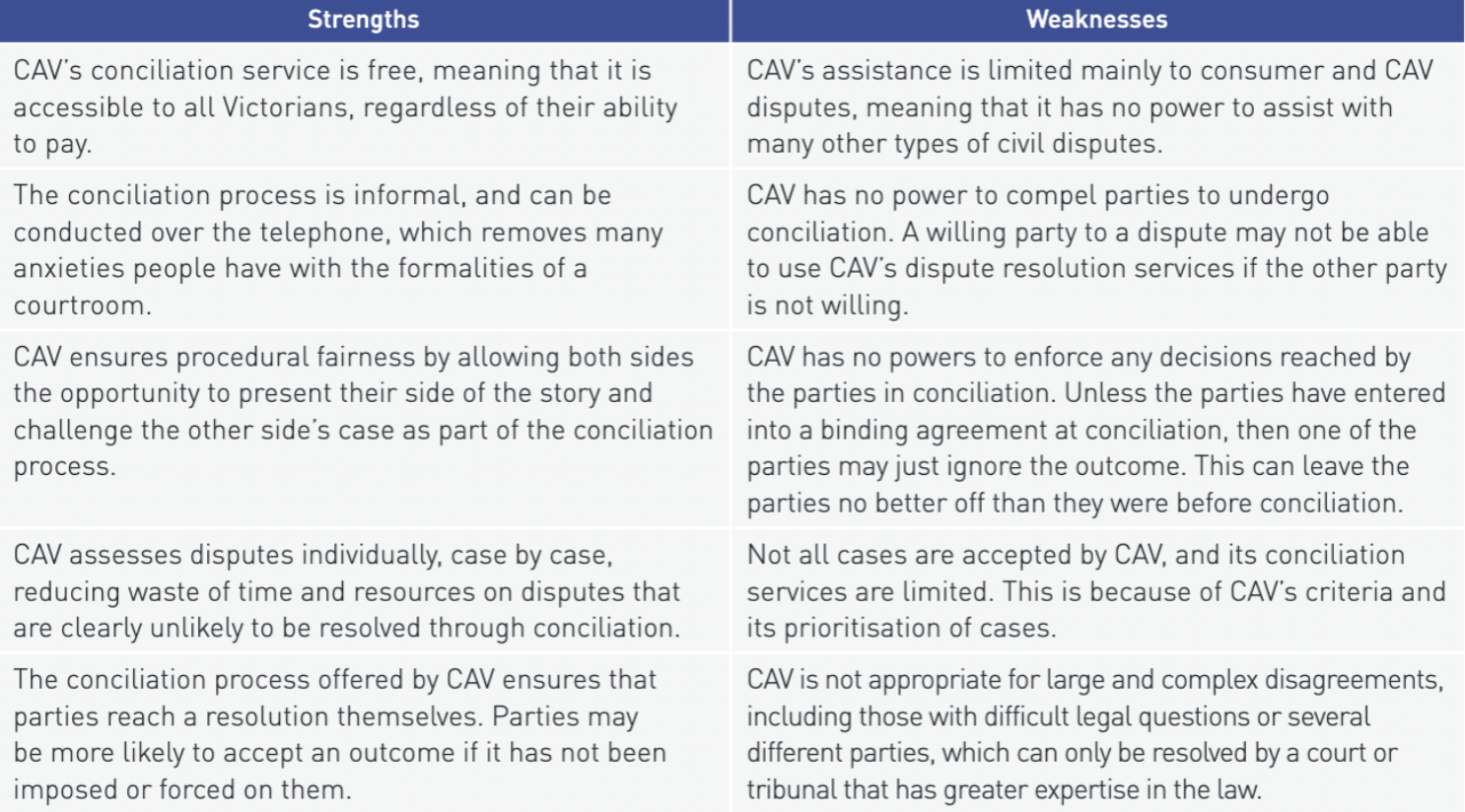
Strengths and weaknesses of CAV
Tribunals
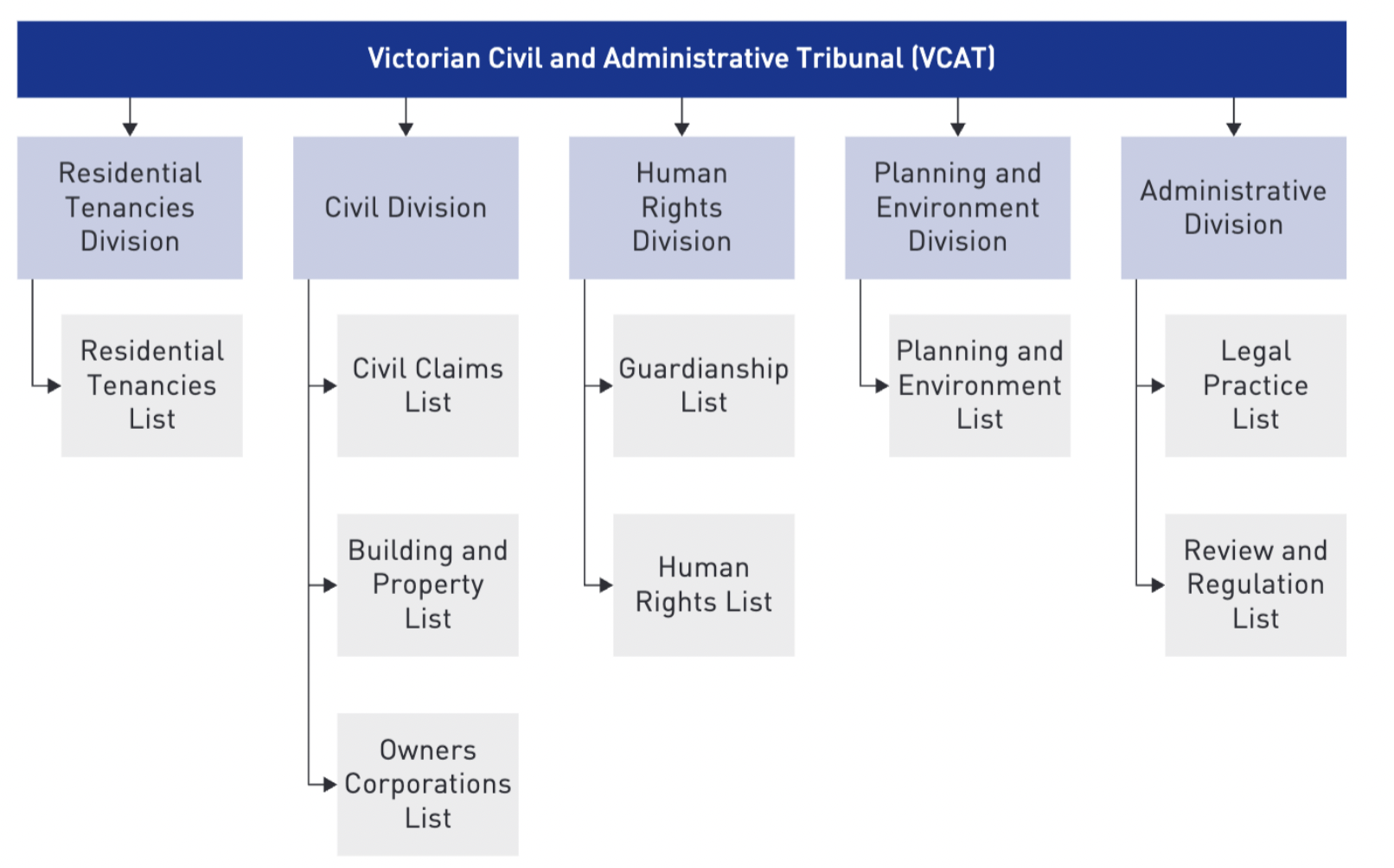
A dispute resolution body that resolves civil disputes and is intended to be a less costly, more informal and faster way to resolve disputes than the courts
Dispute resolution is less formal than the courts and is intended to be a cheaper and more efficient way of resolving disputes.
There are a number of tribunals in Australia:
Victims Of Crime Assistance Tribunal (VOCAT)
Mental Health Tribunal (MHT)
VCAT
Methods of dispute resolution
Dispute resolution methods used