Adaptations - 9
 Call Kai
 Learn
Learn Practice Test
 Spaced Repetition
 Match
Match Flashcards
 Knowt Play
1/12

There's no tags or description
Looks like no tags are added yet.
Name | Mastery | Learn | Test | Matching | Spaced | Call with Kai |
|---|
No analytics yet
Send a link to your students to track their progress
13 Terms
what are the different adaptations
1.Aerobic
2.Mixed
3.Anaerobic
4.Interval Training
5.Performance Profiles
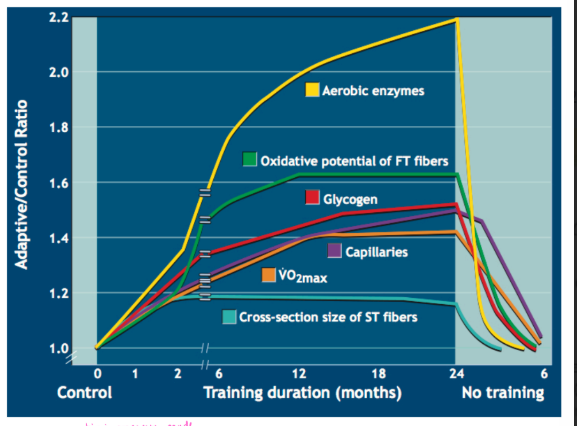
how does aerobic training improve enzyme and glycogen content
Aerobic training improves capacity for respiratory control in skeletal muscle
• Endurance-trained skeletal muscle fibers contain larger and more numerous mitochondria than less active fibers
• Mitochondrial enzyme activity increases ~50%
• Slow twitch (Type 1) fiber area is enhanced, more dense with mitochondria
big improvements made because they start untrained and wouldnt look the same if they tested athletes
how does aerobic training improve fat and cho management
@SUBMAX:
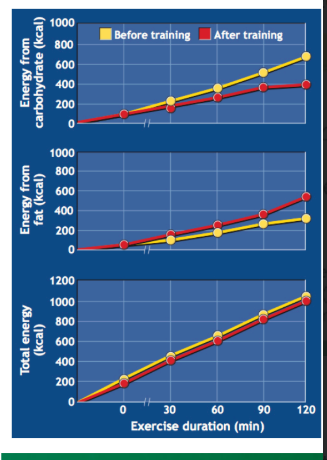
Reduced carbohydrate as fuel and increased fatty acid combustion in submaximal exercise, results from three combined effects:
1. Decreased muscle glycogen use
2. Reduced glucose production
3. Reduced use of plasma-borne glucose
@MAX:
Enhanced capacity to oxidize available carbohydrate during heavy to maximal exercise still important for competition!
how does aerobic training help fat handling
Increases intramuscular fatty acid oxidation via
there was a greater shift to intramuscular sources when your aerobic
- Greater blood flow within trained muscle
- More fat-mobilizing and fat-metabolizing enzymes
- Enhanced muscle mitochondrial respiratory capacity
- Decreased catecholamine release for the same absolute power output
what effect does endurance training have on blood lactate
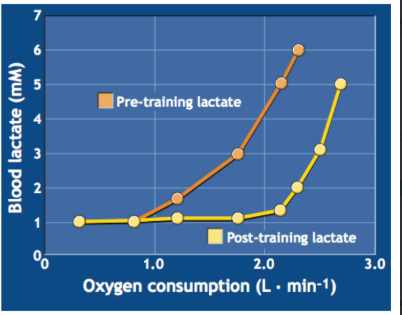
Endurance training lowers blood lactate levels and extends exercise before onset of blood lactate accumulation during a graded exercise test by :
1. Decreasing rate of lactate formation
2. Increasing rate of lactate clearance
3. Combined effects of decreasing lactate formation and increasing lactate removal at any given intensity
thresholds shift to the right when you focus training at threshold
how does anaerobic training effect substrates like creatine
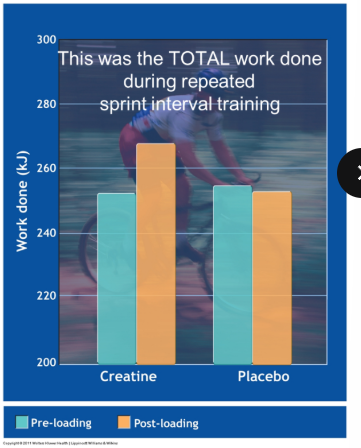
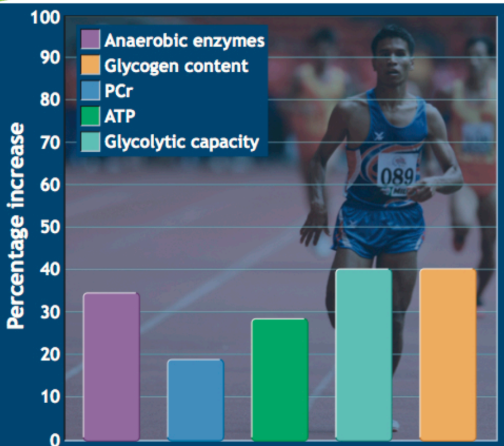
• High intensity training enhances short-term anaerobic power and the capacity to store creatine.
• Creatine supplementation may further increases intramuscular Cr and PCr
Creatine loading: Ingesting 20 g creatine monohydrate for 6 consecutive days and then reducing intake to 2 g/d maintains elevated intramuscular levels.
how does anaerobic training effect enzymes and glycogen content
• The most dramatic increases in anaerobic enzyme function and fiber size occur in Type II (fast twitch) muscle fibers
• Glycogen storage can increase two fold
• Glycolytic capacity also increases which drives both the anaerobic aerobic pathways.
what does anaerobic training do to capacity and pain tolerance
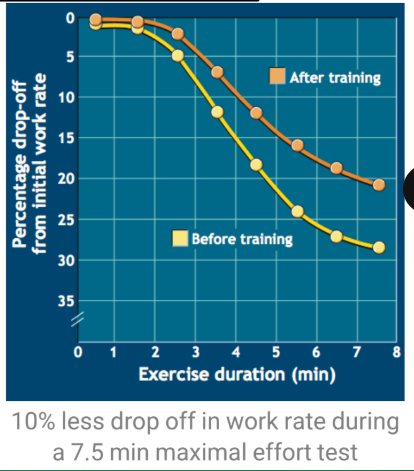
Improved motivation and tolerance to “pain”
Performance prior to and following 10 wk of training four d/wk for 40 to 60 min at 85% VO2max
less power output drop after training
what does interval training do to glycolytic and mitochondrial enzymes
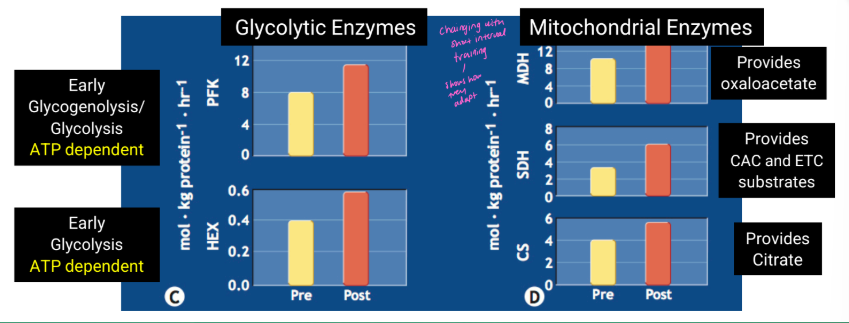
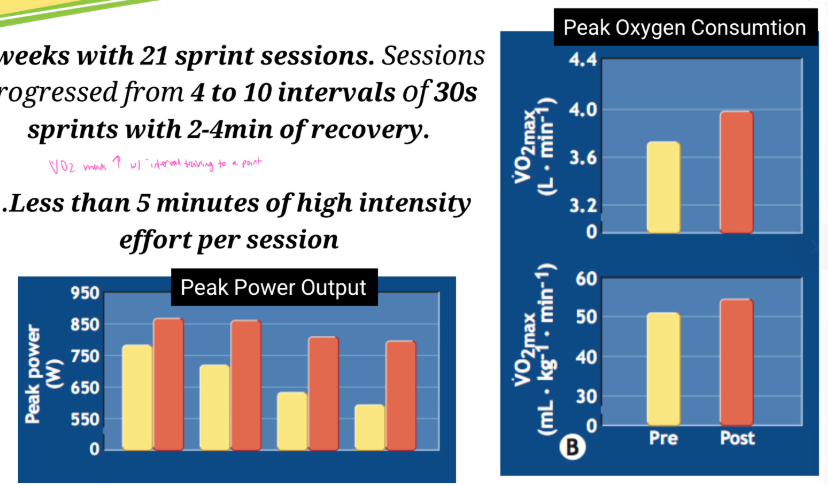
7 weeks with 21 sprint sessions. Sessions progressed from
4 to 10 intervals of 30s sprints with 2-4min of recovery.
...Less than 5 minutes of high intensity effort per session
what does ineterval training do to peak PO and peak oxygen consumption
VO2 max increases with interval training to a point
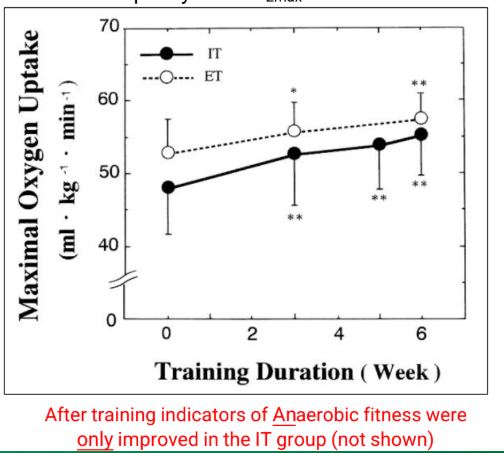
what are the Effects of moderate-intensity endurance and high-intensity intermittent training on anaerobic capacity and VO2max
The effect moderate-intensity endurance training (ET) - more change in mitochondria and type 1 fibers, interval group:
• 5 days per wk for 6wk
• @ 70% of VO2max ,
• 60 min per day,
• Cycle ergometry
After the ET training, Aerobic fitness i.e. VO2max increased by ~5 ml/kg/min The effect of high-intensity intermittent training (IT) - more change in pain tolerance, enzymes and glycogen, interval group:
• 5 days per wk for 6 wk.
• @ 170% of VO2max
• seven to eight sets of 20-s exercise with a 10-s rest
• Cycle ergometry
After the IT training, Aerobic fitness i.e. VO2max increased by ~7 ml/kg/min
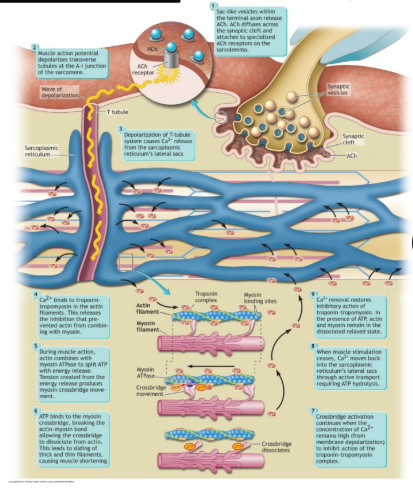
what is the excitation and contraction coupling
review more
review summary slides