AP Calculus BC Midterm Review
0.0(0)
Studied by 8 people0%Exam Mastery
Build your Mastery score
 AP Practice
Supplemental Materials Call Kai
Call KaiCard Sorting
1/27

Earn XP
Description and Tags
Last updated 6:26 PM on 12/13/22
Name | Mastery | Learn | Test | Matching | Spaced | Call with Kai |
|---|
No analytics yet
Send a link to your students to track their progress
28 Terms
1
New cards
1st derivative of a parametric
**y’=(dy/dt)/(dx/dt) “derivative of y(t) over derivative of x(t)”**

2
New cards
2nd derivative of a parametric
**y’’=[d/dt(dy/dx)]/(dx/dt) “derivative of dy/dx over derivative of x(t)”**
![**y’’=[d/dt(dy/dx)]/(dx/dt) “derivative of dy/dx over derivative of x(t)”**](https://knowt-user-attachments.s3.amazonaws.com/af62995e52794113b1c23c5f0b361671.jpeg)
3
New cards
Horizontal tangent line (parametrics)
dy/dt=0 “slope is 0, top is 0”
4
New cards
Vertical tangent line (parametrics)
dx/dt=0 “slope is undefined, bottom is 0”
5
New cards
Speed (aka “magnitude of the velocity vector”)
“the square root of dx/dt squared + dy/dt squared”

6
New cards
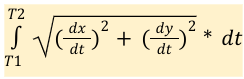
Arc length (aka “distance travelled”) parametrics
“the integral of the square root of dx/dt squared + dy/dt squared”
7
New cards
Arc length (aka “distance travelled”) cartesian/rectangular
“the integral of the square root of 1 + f’(x) squared”

8
New cards
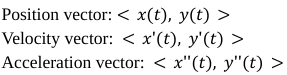
Vector-Valued functions (position, velocity, acceleration)
Given as <x(t), y(t)>, keep separate, 1st derivative is velocity 2nd derivative is acceleration
9
New cards
Taylor Polynomials

10
New cards
MacLaurin Polynomials
Taylor polynomial centered at x=0 (a=0 in equation)

11
New cards
Lagrange Error Bound
M is the max value of the (n+1)st derivative

12
New cards
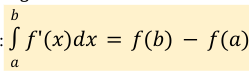
FTC 1
top minus bottom, remember indefinite integrals have a +C term
13
New cards
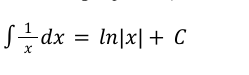
Integration- if the derivative of the bottom is on the top
General solution: “ln of the absolute value of x + C”
14
New cards
Other techniques of integration (there are 8)
is the derivative of the bottom on the top, is the derivative of the inside next to it, can you split it into fractions (single term in denominator), can you expand it, can you use synthetic/long division, can you use the rules of logs to simplify, can you use trig substitution, u-substitution
15
New cards
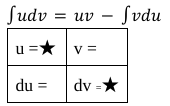
Integration by parts
“uv minus the integral of vdu (think voodoo)”, remember LIATE for assigning u values
16
New cards
LIATE
Logs
Inverse Trig
Algebraic
Trig functions
Exponential
Inverse Trig
Algebraic
Trig functions
Exponential
17
New cards
Integration of powers of sin and cos
Remember: sin^x + cos^x = 1
\- If the power of one is odd and positive, save one of those terms and convert the rest to the other term
\
Remember: sin^2(x) = \[1-cos(2x)\]/2,
cos^2(x) = \[1+cos(2x)\]/2
\-Use these identities if both terms exponents are even and positive
\- If the power of one is odd and positive, save one of those terms and convert the rest to the other term
\
Remember: sin^2(x) = \[1-cos(2x)\]/2,
cos^2(x) = \[1+cos(2x)\]/2
\-Use these identities if both terms exponents are even and positive
![Remember: sin^x + cos^x = 1
\- If the power of one is odd and positive, save one of those terms and convert the rest to the other term
\
Remember: sin^2(x) = \[1-cos(2x)\]/2,
cos^2(x) = \[1+cos(2x)\]/2
\-Use these identities if both terms exponents are even and positive](https://knowt-user-attachments.s3.amazonaws.com/0a4359f01914413ebca1d409298da97b.jpeg)
18
New cards
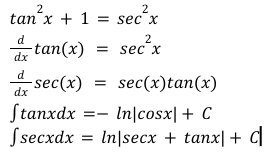
Integration of powers of tan and sec
Remember info in pic!
A lot of trial and error
A lot of trial and error
19
New cards
Method of partial fractions
factor denominator, split fraction into two parts, cross multiply, solve for A and B, then plug back into the fractions and integrate
20
New cards
Exponential Growth and Decay (differential equations)
“the rate of change of Y is proportional to Y”, dy/dt=ky, y=Ce^(kt) where C is the starting value

21
New cards
“Other” Exponential Growth and Decay (differential equations)
“the rate of change of Y is proportional to BLANK”, dy/dt = (get from word problem) y = use separation of variables
22
New cards
Newton’s Law of Cooling (differential equations)
“the rate of cooling of an object is proportional to the difference between the object’s temp and room temp”, dT/dt = k(T0 - Ts) where Ts is a constant representing room temp and T0 is initial temp, T = (T0-Ts)e^kt + Ts

23
New cards
Logistics Growth (differential equations)
“rate of change of y is proportional to y and the difference between the upper limit, L, and y”, dy/dt=ky(L-y), y=L/\[1+Ce^(-kLt)\]
![“rate of change of y is proportional to y and the difference between the upper limit, L, and y”, dy/dt=ky(L-y), y=L/\[1+Ce^(-kLt)\]](https://knowt-user-attachments.s3.amazonaws.com/0db8ca6dcf9f431e8f07beb14bbce54b.jpeg)
24
New cards
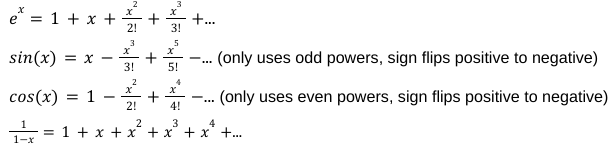
Taylor series to memorize
sin: starts pos to neg, uses odd powers
cos: starts pos to neg, uses even powers
cos: starts pos to neg, uses even powers
25
New cards
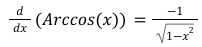
d/dx(Arccos(x)) =
\-1/sqrt(1-x^2)
26
New cards
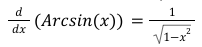
d/dx(Arcsin(x)) =
1/sqrt(1-x^2)
27
New cards
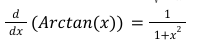
d/dx(Arctan(x)) =
1/(1+x^2)
28
New cards
sin(2x) =
2sin(x)cos(x)