Biology H - Mendelian Genetics Unit
 Call Kai
 Learn
Learn Practice Test
 Spaced Repetition
 Match
Match Flashcards
 Knowt Play
1/31

There's no tags or description
Looks like no tags are added yet.
Name | Mastery | Learn | Test | Matching | Spaced | Call with Kai |
|---|
No analytics yet
Send a link to your students to track their progress
32 Terms
Homozygotes (homozygous)
- Organism whose alleles for a specific character are identical
- Often referred to as “true” or “pure[ly]-mated”
- EX: PP/pp
Heterozygotes (heterozygous)
- Organisms whose alleles for a gene are different
- Often referred to as “hybrids”
- EX: Pp
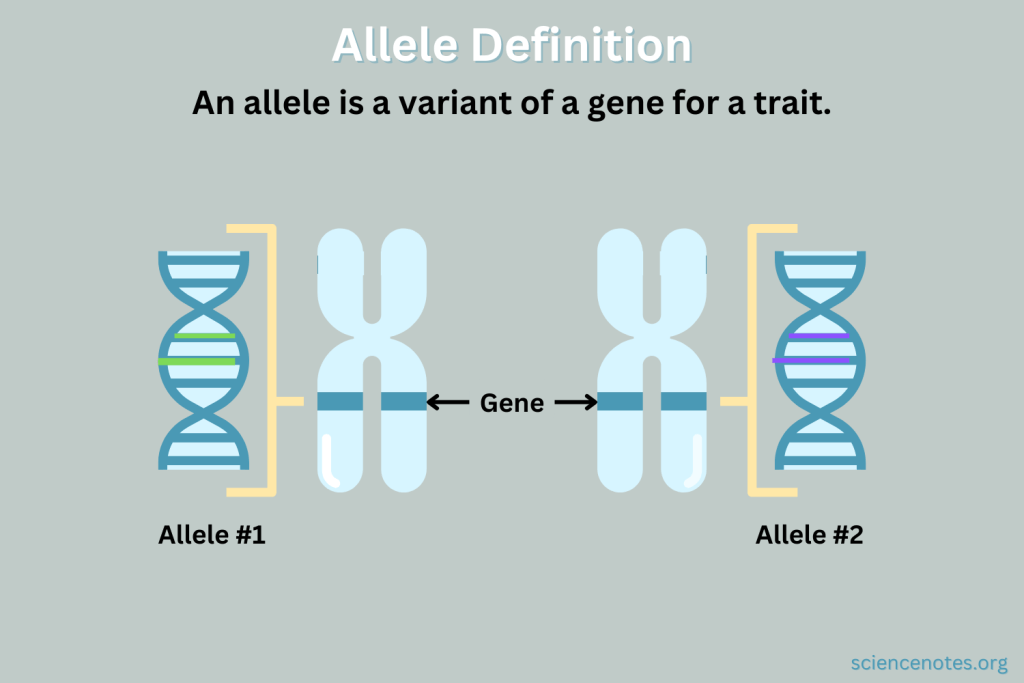
Alleles
- Alternate forms of genes, accounting for variations in characteristics
- Found at the same place (locus) on a chromosome
- Diploid organisms inherit two; one from each parent
Describe one instance where phenotype and genotype differ:
In the case of flower color in pea plants, PP and Pp organisms have the same phenotype (purple color) but different genotypes
Punnet squares act as…
predictors for the results of genetic crosses between individuals of (known) genotypes, revealing possible combinations of genes (and their corresponding probabilities)
Punnet squares illustrate Meiosis/Fertilization by…
- Separating parental alleles into gametes (Meiosis)
- Combining those gametes to form zygote genotypes (Fertilization)
Mendel used pea plants in his findings because…
- They have several contrasting traits that can easily be identified as dominant or recessivw
- Cross-pollination (fertilization between different plants) can be achieved by dusting one pea plant with pollen (sperm) from another
True-breeding
Producing offspring of the same variety by having a homozygous plant self-pollinate (or cross with one of the same genotype)
Equation for true-breeding:
P x P = F1 - Parent generation cross (where parents are AA and aa, and the offspring is Aa)
F1 x F1 = F2 - Filial cross (where parents are Aa, and the offspring can be either AA, Aa or aa)
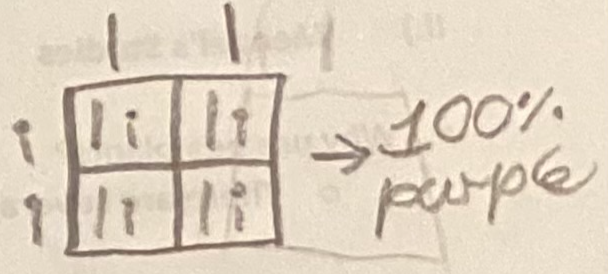
Principle of dominance
- States that if two alleles at a locus differ, then one (the dominant allele) determines the organism’s phenotype, and the other (the recessive allele) has no noticeable effect on appearance
- Incomplete dominance and co-dominance are exceptions to the principle
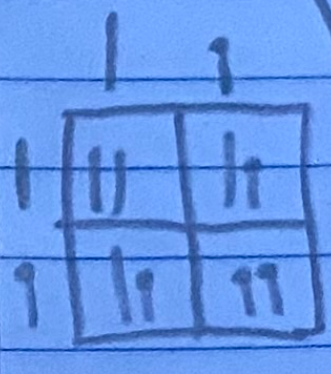
Principle of segregation
- States that the two alleles for a heritable character segregate during gamete formation (Meiosis), ending up in different gametes
- Thus, an egg/sperm can only get one out of two alleles present in the somatic cells of an organism
- Corresponds to the distribution of homologous chromosomes to different gametes in meiosis
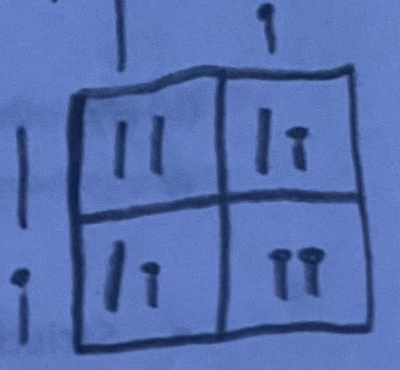
Monohybrid cross
- A cross between heterozygotes
Principle of independent assortment
- States that each pair of alleles segregate independently of other pairs of alleles during gamete formation (Meiosis)
- Mendel identified this principle by following two characters at the same time (dihybrid cross)
- Applies only to genes on non-homologous chromosomes
- PpTt x PpTt cross depicts this principle
Dihybrid cross
- A cross between F1 dihybrids (offspring resulting from a cross between two monohybrid-offspring parents) to make an F2 generation
- Can determine whether two characters are transmitted to offspring as a package or independently by analyzing the phenotype ratios of F2
- If the traits from the cross follow Mendel's Law of Independent Assortment, a 9:3:3:1 ratio appears
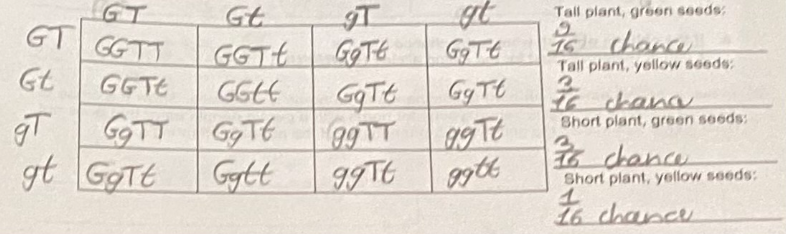
Genes located near eachother in a chromosome are…
(usually) inherited together
Principle of probability
- When tossing a coin, the outcome of one toss has no impact on another toss (statistically)
- In the same way, the alleles of one gene segregate into gametes independently of another gene’s alleles
- Example: The second offspring from two parents has the exact same chances of inheriting the genes that the first offspring did
Codominance
- One of two exceptions for Mendel’s principle of dominance
- Two dominant alleles affect the genotype in separate, distinguishable ways
- EX: Blood type (IAIB blood gene) + Roan cattle (even mixture of white and red hair; 50% chance of being roan and 50% chance of being white)
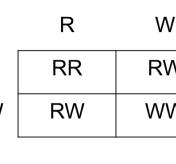
Incomplete dominance
- One of two exceptions for Mendel’s principle of dominance
- Creates a 3rd possible phenotype (for heterozygous offspring) as the two dominant traits mix unevenly
- EX: 4 O’clock flowers (can be multiple colors; let’s use a red-colored gene example)
Genotype ratio = 1:2:1 (RR to Rr to rr)
Phenotype ratio = 3:1 (red [even partially] to not red)
![<p>- One of two exceptions for Mendel’s principle of dominance</p><p>- Creates a 3rd possible phenotype (for heterozygous offspring) as the two dominant traits mix unevenly</p><p>- EX: 4 O’clock flowers (can be multiple colors; let’s use a red-colored gene example)</p><ul><li><p>Genotype ratio = 1:2:1 (RR to Rr to rr)</p></li><li><p>Phenotype ratio = 3:1 (red [even partially] to not red)</p></li></ul><p></p>](https://assets.knowt.com/user-attachments/18a84dc0-c31a-4379-ba60-0ebb5465293f.png)
Give an example of how some genes can exist in more than two alleles:
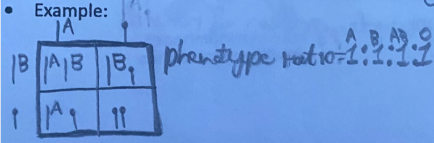
- In humans, the A, B and O blood types are determined by three alleles (where I = immunoglobulin antigens):
IA (A-type)
IB (B-type)
i (O-type)
(AB-type is a co-dominance between IA and IB)
- People with A-type blood have A antigens in their blood, B-type blood has B antigens, O-type blood has neither, and AB-type has both
- Also an example of codominance
Co-dominance example (human blood types):
(Refer to image)
Polygenic inheritance
- Term for a single trait being influenced by the combined, additive effects of multiple genes (most human traits are like this)
- EX: Hair, eye color, skin color, height, etc
Epigenetics
- The environmental influence on the expression of traits (recognizing that the environment affects gene expression)
- Another departure from Mendelian genetics, where Mendel forgot to account for the fact that the genotype (and resulting phenotype) for a character can depend on environment
- EX: Hydrangea flowers (flower species that become different colors based on soil acidity)
Name and describe 2 recessively-inherited disorders:
Cystic fibrosis
- The recessive allele results in defective or absent chloride transport channels in the plasma membrane
- Symptoms include:
Uncontrollable mucus buildup in internal organs (mostly lungs)
Abnormal break down absorption of nutrients (fats, proteins, vitamins, etc) in the small intestine
Sickle-cell anemia
- The substitution of a single amino acid in the hemoglobin protein affects the shape of red blood cells (where hemoglobin molecules are present), leading to crooked and rigid blood cells
- Symptoms include:
Physical weakness (from poor blood circulation)
Extreme pain (from clotting)
Organ damage
Paralysis (in severe cases)
Name and describe 2 dominantly-inherited disorders:
Anchondroplasia
- Lethal form of dwarfism that happens when the alleles in offspring are homozygous dominant
- No symptoms, as the offspring dies immediately
Huntington’s
- Degenerative disease of the nervous system where patients begin to lose control of muscle (and eventually become completely paralyzed)
- Symptoms do not appear until about 35-40 years of age
Linked genes (gene linkage)
- Genes located on the same chromosome that tend to be inherited together, showing that genes are not always independently assorted, but can be linked if in the same chromosome
- However, some process must break the physical connection between genes on the same chromosome, as these traits aren’t always linked. That process is the crossing over of homologous chromosomes
Sex-linked genes (sex linkage)
- Genes located on either chromosome that follow specific, non-Mendelian patterns of inheritance
- Examples of diseases caused by recessive alleles on the X-chromosome:
Color blindness (affects more males than females)
Duchene muscular dystrophy (continuous muscle degeneration)
Hemophilia (blood clotting)
Describe why it is important to differ autosomes from sex chromosomes
- Autosomal genes follow standard Mendelian inheritance (dominant/recessive patterns apply equally to both sexes).
- Sex-linked genes (on X or Y) show sex-specific inheritance patterns because males and females have different sex chromosome combinations.
This is because Mendel’s laws assume that every individual has two copies of each gene, both sexes produce the same kinds of gametes for them, and alleles segregate symmetrically into gametes, and sex chromosomes break these assumptions:
Males are XY, so they have only one copy of X‑linked genes.
Females are XX, so they have two copies.
- Which means that the Y-chromosome carries few genes, so many traits are inherited unequally between sexes (fathers pass their X chromosome only to daughters, never to sons. Mothers pass X chromosomes to both sons and daughters)
(Gene) Linkage mapping
The farther apart two genes are in a chromosome, the higher the probability that a crossover will occur between them, and therefore the higher the recombination frequency
X-inactivation
- In mammalian females, one of the two X chromosomes in each cell is randomly inactivated during embryo development
- If a female is heterozygous for a specific gene on the X-chromosome, she will be a mosaic for that character (her body will composed of two distinct cell populations: some express the gene from her mother, while others express the gene from her father)
- EX: Calico cats (where only females can be calico and present with different fur color at different parts of the body)
Nondisjunction (gene linkage)
- Homologous chromosomes don’t separate properly during mitosis, causing extra (24) or less (22) chromosomes pairs than normal
- As a result, one gamete receives two of the same type of chromosome, and another gamete receives no copy
- This disability (in offspring) can even cause spontaneous abortions—miscarriages (in mothers)—or lead to a variety of developmental disorders
Aneuploidy
Results from the fertilization of gametes in which nondisjunction (during Meiosis) leads to an abnormal number of chromosomes (n+1 or n-1)
Name and genetically annotate 3 aneuploid conditions:
Down syndrome (3 copies of chromosome #21)
- 47, + 21
Klinefelter syndrome (extra X-chromosome in male)
- 47, XXY
Turner’s syndrome (produces sterile female; only known viable monosomy in humans)
- 45, X0