Carbon Cycle
 Studied by 0 people
 Call with Kai
 Learn
Learn Practice Test
 Spaced Repetition
 Match
Match Flashcards
 Knowt Play
1/62

There's no tags or description
Looks like no tags are added yet.
Name | Mastery | Learn | Test | Matching | Spaced | Call with Kai |
|---|
No analytics yet
Send a link to your students to track their progress
63 Terms
Transfers in carbon cycle- photosynthesis
Living organisms convert Carbon Dioxide from the atmosphere and Water from the soil, into Oxygen and Glucose using Light Energy. By removing CO ₂ from the atmosphere, plants are sequestering carbon (see below) and reducing the potential impacts of climate change. The process of photosynthesis occurs when chlorophyll in the leaves of the plant react with CO ₂, to create the carbohydrate glucose. Photosynthesis helps to maintain the balance between oxygen and CO₂ in the atmosphere. The formula is shown below:
Carbon Dioxide + Water → Light Energy → Oxygen + Glucose
Respiration
Respiration - Respiration occurs when plants and animals convert oxygen and glucose into energy which then produces the waste products of water and CO ₂. It is therefore chemically the opposite of photosynthesis:
Oxygen + Glucose → Carbon Dioxide + Water
Photosynthesis- day and night
During the day, plants photosynthesise, absorbing significantly more CO ₂ than they emit from respiration. During the night they do not photosynthesise but they do respire, releasing more CO₂ than they absorb. Overall, plants absorb more CO₂ than they emit, so are net carbon dioxide absorbers (from the atmosphere) and net oxygen producers (to the atmosphere).
Combustion
When fossil fuels and organic matter such as trees are burnt, they emit CO ₂ into the atmosphere, that was previously locked inside of them. This may occur when fossil fuels are burnt to produce energy, or if wildfires occur.
Decomposition
When living organisms die, they are broken down by decomposers (such as bacteria and detritivores ) which respire, returning CO₂ into the atmosphere. Some organic matter is also returned to the soil where it is stored adding carbon matter to the soil.
Diffusion
The oceans can absorb CO ₂ from the atmosphere, which has increased ocean acidity by 30% since pre-industrial times . The ocean is the biggest carbon store, but with carbon levels increasing seawater becomes more acidic which is harming aquatic life by causing coral bleaching. Many of the world’s coral reefs now under threat.
Weathering & erosion
Rocks are eroded on land or broken down by carbonation
weathering. Carbonation weathering occurs when CO ₂ in the air mixes with rainwater to create carbonic acid which aids erosion of rocks such as limestone . The carbon is moved through the water cycle and enters the oceans. Marine organisms use the carbon in the water to build their shells. Increasing carbon dioxide levels in the atmosphere, may increase weathering and erosion as a result, potentially affecting other parts of the carbon cycle.
Burial & compaction
When shelled marine organisms die, their shell fragments fall to the ocean floor and become compacted over time to form limestone. Organic matter from vegetation and decaying marine organisms is compacted over time, whether on land or in the sea, to form fossil fuel deposits.
Carbon sequestration
Transfer of carbon from the atmosphere to other stores and can be both natural and artificial. A plant sequesters carbon when it photosynthesises and stores the carbon in its mass. Factories are also starting to use carbon sequestration in the form of Carbon Capture and Storage (CCS) . CO ₂ is captured and transported via pipeline to depleted gas fields and saline aquifers.
CCS advantages
Can be fitted to existing coal power stations.
● Captures 90% of CO₂ produced.
● There is a demand for CO ₂ (Coca-Cola, Plant Growth, Beer etc.), so transport systems via pipeline in liquid form already exist.
● Potential to capture half the world’s CO₂ emissions.
CCS disadvantages
High cost is the main restriction to the growth of CCS.
● Increases energy demand of power stations.
● May not be space to fit it to existing power stations.
● Economically viable in some cases as it is used to push oil out the ground, thus further increasing fossil fuel usage.
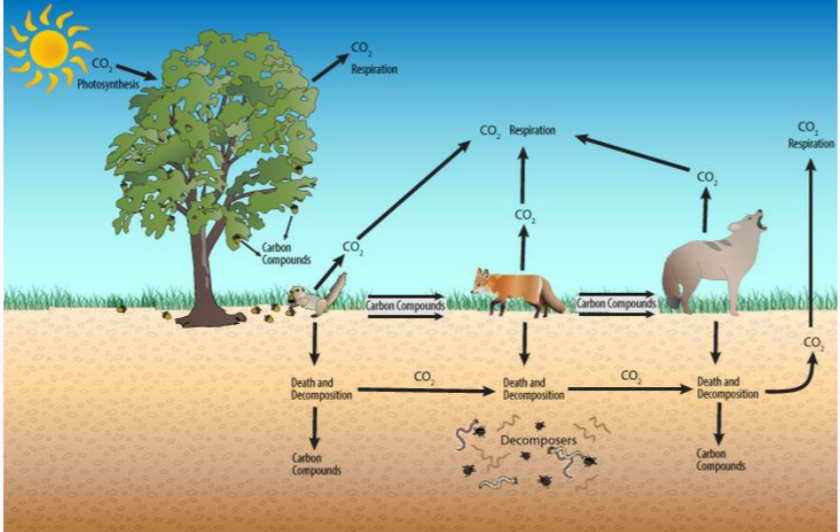
Carbon cycle- diagram animals and plants
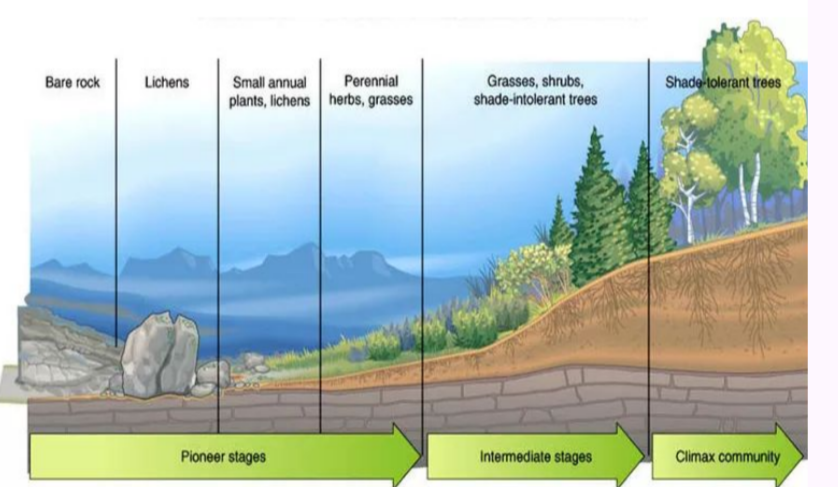
Lithosere succession
Carbon sink
any store which takes in more carbon than it emits , so an intact tropical rainforest is an example.
Carbon source
any store that emits more carbon than it stores so a damaged tropical rainforest is an example.
Main carbon stores in order of magnitude
Marine sediments&sedimentary rocks
Oceans
Fossil fuel deposits
Soil organic matter
Atmopshere
Terrestrial plants
Marine Sediments and Sedimentary Rocks - Lithosphere - Long-term
Easily the biggest store. 66,000 - 100,000 million billion metric tons of carbon . The rock cycle and continental drift recycle the rock over time, but this may take thousands, if not millions of years.
Oceans - Hydrosphere - Dynamic
The second biggest store contains a tiny fraction of the carbon of the largest store. 38,000 billion metric tons of carbon . The carbon is constantly being utilised by marine organisms, lost as an output to the lithosphere, or gains as an input from rivers and erosion.
Fossil Fuel Deposits - Lithosphere - Long-term but currently dynamic
Fossil fuel deposits used to be rarely changing over short periods of time, but humans have developed technology to exploit them rapidly, though 4000 billion metric tons of carbon remain as fossil fuels.
Soil Organic Matter - Lithosphere - Mid-term
The soil can store carbon for over a hundred years, but deforestation, agriculture and land use change are affecting this store. 1500 billion metric tons of carbon stored.
Atmosphere - Dynamic
Human activity has caused CO ₂ levels in the atmosphere to increase by around 40% since the industrial revolution , causing unprecedented change to the global climate. 750 billion metric tons of carbon stored.
Terrestrial Plants - Biosphere - Mid-term but very dynamic
Vulnerable to climate change and deforestation and as a result carbon storage in forests is declining annually in some areas of the world. 560 billion metric tons of carbon.
Lithosphere- storage of carbon
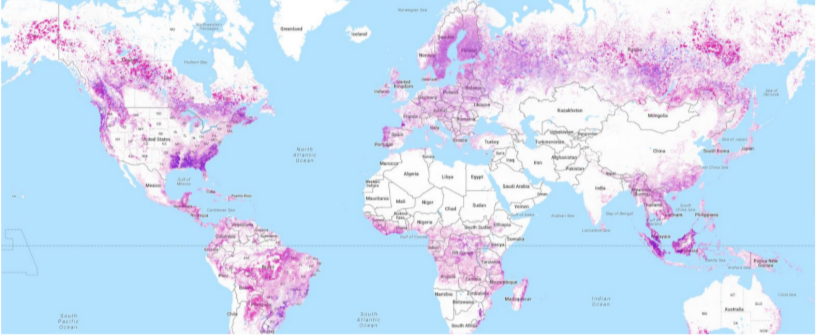
The lithosphere is the main store of carbon , with global stores unevenly distributed. For example, the oceans are larger in the southern hemisphere, and storage in the biosphere mostly occurs on land. Terrestrial plant storage is focussed in the tropics and the northern hemisphere. Different amounts of carbon are stored worldwide and one of the stores that is currently changing is trees:
Key: Pink is forest area lost. Purple is forest area gained.
Map evidence shows
The map shows how forests are declining in the tropical areas in the southern hemisphere and growing in the northern hemisphere . This is supported by data which shows that tropical areas such as Brazil and Indonesia have seen a decrease in carbon stocks of around 5 Gigatons of Carbon (GtC) in the last 25 years , but Russia, USA and China have seen increases of around 0.3, 2.9 and 2.3 GtC respectively.
Detailed info on forests and climate change shows
● Non-tropical forests have seen an increase in carbon sequestration in recent years , especially in Europe and Eastern Asia, due to conversion of agricultural land and plantations to new forests.
● Forests in industrialised regions are expected to increase by 2050 but in the global south, forested areas will decrease.
● Rate of forest loss has decreased from 9.5 million hectares per year in the 1990's to 5.5 million hectares per year in 2010-15.
● The eight countries with the largest forested areas are: Russia, Brazil, China, Canada, USA, DRC, Australia and Indonesia.
● Brazil has the most carbon stored on land and the most extensive deforested area.
● China has the largest amount of afforested area.
● Net Primary Productivity (NPP) refers to the amount of carbon absorbed by forests. For tropical forests it is positive all year round, but deciduous forests, have a negative NPP in winter, but across the whole year their NPP is positive.
Carbon cycle- changes over time- natural processes
Wildfires
Volcanic activity
Wildfires
Transfer carbon from biosphere to atmosphere as CO₂ is released through burning. This burning can encourage the growth of plants in the long term. There is much debate about whether preventing wildfires is beneficial. They have an important role in the carbon cycle, but may threaten homes. Is it right to extinguish the ones caused by human activity, or should we extinguish them because global warming is providing better conditions for wildfires to occur?
Volcanic activity
Carbon stored within the earth is released during volcanic eruptions, mainly as CO₂ gas. They contribute a relatively low proportion of CO₂ to the overall carbon cycle. The 1815 Mt Tambora eruption in Indonesia produced sulphur dioxide gas, which then entered the atmosphere, blocking radiation from the sun and lowering global temperatures by 0.4 - 0.7°C in 1816. In this way volcanoes can influence the carbon cycle by reducing photosynthesis rates, which will then also affect the water cycle.
Human impacts
Fossil fuel use
Deforestation
Farming practices
Fossil fuel use
Combustion transfers CO₂ to the atmosphere from a long-term carbon sink. Many of the other human impacts have already been discussed in this document. Nearly everything that we do impacts the carbon cycle in one way or another, from buying a new pair of jeans, to switching the light on or getting a drink of water.
Deforestation
Often used to clear land for farming/housing, rapidly releases carbon stored in plants using slash and burn techniques and interrupting the forest carbon cycle.
Farming practices
Pastoral farming releases CO₂ as animals respire, affecting the carbon cycle. Ploughing can release CO₂ stored in the soil. Farm machinery such as tractors may release CO₂.
Fluxes
Changes to the magnitude of carbon stores over time are called fluxes and may happen very rapidly or over thousands of years. Human activity is causing an unprecedented flux in the levels of CO₂ in the atmosphere as a direct result of fossil fuel combustion.
Carbon budget
the balance between carbon inputs and outputs to a store at any scale or the balance of exchanges between the four major stores of carbon
Enhanced greenhouse effect
The Enhanced Greenhouse Effect is the process that is currently causing global warming as abnormally high levels of greenhouse gases are being produced by humans, trapping radiation from the sun, causing global warming and leading to climate change. It is important that you discuss the Enhanced Greenhouse Effect when assessing human impacts on the global climate, not the Greenhouse Effect, which is a natural process. Radiative forcing refers to the difference between incoming solar radiation absorbed by the Earth and the energy radiated back out into space. This has increased in the recent years, leading to more heat being trapped. CO₂ is the single most important anthropogenic greenhouse gas in the atmosphere, contributing around 65% to radiative forcing by greenhouse gases.
Water carbon- increased temp
Increases in global temperature due to alteration of the carbon cycle will have significant impacts on the water cycle, leading to greater levels of evapotranspiration. The increase in global temperatures may make summer storms more likely but decrease the amount of rainfall in summer on average, yet increase the average winter rainfall.
Causes of enhanced greenhouse effect
Land use change
Fertilisers
Deforestation
Urbanisation
Rewilding emergence
Land use change
Accounts for a tenth of carbon release annually and impacts on short-term stores in the carbon cycle, such as the soil and atmosphere. For example:
○ Farming Practices: In the Amazon, around 70% of deforestation is for cattle ranching. Cattle produce significant amounts of methane, further contributing to global warming. Scientists are considering whether feeding cows different foods would help to reduce their methane emissions.
Fertilisers
significant source of greenhouse gases as well as rice padi fields, from which methane emissions have increased as a result of increased productivity due to higher CO₂ levels. More sustainable grains and seeds like quinoa are being considered as substitutes, which require less water to grow.
Deforestation
In total, deforestation accounts for about 20% of all global greenhouse emissions. The main impact is when the cycle is interrupted and the land is used for other purposes, which then reduces carbon sequestration and land becomes a carbon source rather than a carbon sink.
Urbanisation
the process of replacing countryside with buildings and other similar infrastructure. It affects the local and global carbon cycles, by replacing vegetation and covering soils. Urban areas occupy 2% of the world’s land mass, but these areas account for 97% of all human caused global CO₂ emissions. Cement is an important building material, but releases carbon dioxide during production, contributing 7% to global carbon dioxide emissions each year, so sustainable options for recycling concrete are being developed.
Rewilding
There is also the emergence of rewilding, where populated or managed human areas are being reduced or replaced by wildlife. This will hopefully restore environments in years to come and the trees that are planted will help mitigate global warming.
Milankovitch cycles ∆
Vostok ice core data from Antarctica suggests that in the past temperature change has occurred before carbon dioxide levels have risen, offering a slightly different explanation for historical global warming. It is possible that variations in the Earth’s orbit cause periods of time where we experience a greater heating effect from the sun, increasing the global temperatures. This increase in temperatures causes glaciers to melt and therefore increases flows in the carbon cycle; allowing more CO₂ to enter the atmosphere and for global temperatures to rise further. This is an example of positive feedback. The quantity of freshwater flowing into the oceans increases, causing temperature fluctuations between Earth’s two hemispheres. As the oceans became warmer, they release more CO₂ into the atmosphere (colder water can store more CO₂), causing further global temperature rises. So whilst orbital variations initiated the warming effect, over 90% of warming was likely as a result of the rise in atmospheric CO₂.
Milankovitch- disagree ∆
The results of this study are not widely agreed on, as any slight systematic errors (technical or equipment errors that vary by a consistent amount) in the data collection would affect the overall conclusions of the study. It is thought that it is natural that CO₂ levels and temperature increase during interglacial periods. Many forests colonised areas which became ice free as a result of temperature increases. The causes of present day global warming are more widely agreed upon with 97% of active climate scientists believing that global warming over the last 100 years is very likely to be due to human activity. The International Panel on Climate Change (IPCC) say it is 'virtually certain' that humans are to blame for 'unequivocal' global warming.
Impact of carbon cycle on regional climates- tropical rainforests
High rates of photosynthesis and respiration in forests lead to greater humidity, cloud cover and precipitation
● Deforestation reduces photosynthesis and respiration, further reducing humidity and cloud cover and decreasing precipitation
Oceans
Warmer oceans cause more plankton growth and through plankton chemical production, cause clouds to potentially form.
● Warm oceans also store less CO₂, as carbon sequestration is dependent on a cooler ocean. This means higher temperatures could lessen the effects of oceans as carbon sinks. Note how warmer, equatorial oceans are classed as CO₂ sources. This sets up a positive feedback loop where the greenhouse effect is heightened further.
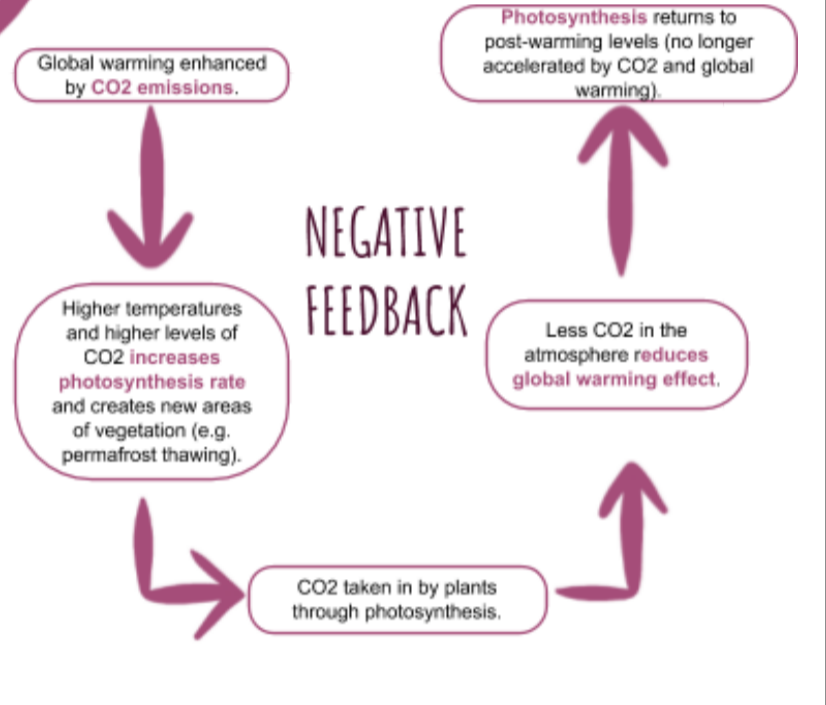
Feedback loop
A feedback loop is a type of chain reaction, where one process leads to another process, leading to another process, and so on. There are two types of feedback loops: positive and negative.
Negative + positive feedback definition
In negative feedback, the process that occurs is counteracted by an opposing process, causing the effects to cancel each other out and nothing to change.
In positive feedback, a process occurs, which causes another process to occur, which starts a chain reaction that heightens the first process.
Carbon positive feedback
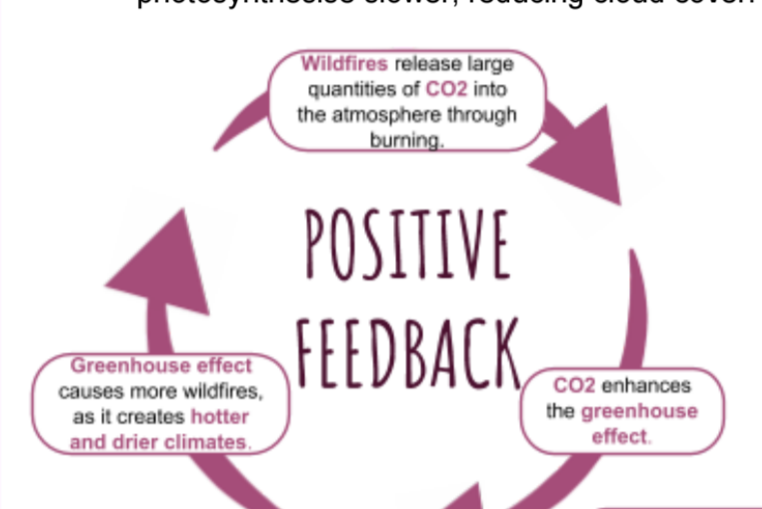
Wildfires are more likely in hotter and drier climates created by global warming, which release large quantities of CO₂ into atmosphere, which in turn then increases the warming effect.
● Ice reflects radiation from the sun, reducing surface warming. As sea temperatures rise and ice melts, the warming effect is amplified as there is less ice to reflect the radiation. Further melting occurs and the process continues.
● Higher temperatures are thawing the permafrost releasing CO₂ and methane (which has 20 times the warming effect of CO₂), causing warming on a local and global scale. Permafrost is frozen ground that remains at a temperature of 0°C or lower for at least 2 consecutive years. The higher temperatures cause more permafrost to melt, causing further gas releases and further warming.
Negative feedback carbon
Increased photosynthesis by plants and rising global temperatures allows vegetation to grow in new areas, e.g. where permafrost has melted. New vegetation absorbs CO₂ from the atmosphere, decreasing the warming effect
● Higher temperatures and more CO₂ cause a greater carbon fertilisation in plants, so they absorb more CO₂. This reduces the levels of CO₂ in the atmosphere and the rates of warming and carbon fertilisation will decrease. The process repeats. Scientists are now investigating whether carbon fertilisation is affected by other factors and peaks at a certain atmospheric CO₂ level. If this is the case, then there will be a limit to how much CO₂ plants can continue to sequester. It is suggested that carbon fertilisation is limited by water and nitrogen levels. If rainfall decreases as a result of climate change, then carbon fertilisation may decrease as a result, as water is required for photosynthesis.
● Higher CO₂ levels causes phytoplankton to grow (as they feed off CO₂). CO₂ is taken in through photosynthesis and levels decrease as a result, causing phytoplankton to decrease.
● Higher temperatures causes phytoplankton to grow and photosynthesise quicker. Phytoplankton release substances that lead to the formation of clouds, meaning cloud cover increases. Radiation from the sun is therefore less able to reach the oceans, reducing temperatures. This therefore causes phytoplankton to grow less quickly and photosynthesise slower, reducing cloud cover.
Mitigating climate chnage
Setting targets to reduce greenhouse gas emissions.
● Switching to renewable sources of energy.
● 'Capturing' carbon emissions and/or storing or burying them (sequestration).
Paris climate deal
Global Intervention - Paris Climate Deal (COP21):
● Aim to limit the increase of global temperatures to 2°C above pre-industrial levels.
● Support for developing countries.
● Public interaction and awareness schemes.
● Meet every 5 years to review and improve goals.
Regional intervention
20% reduction in GHG emissions and commitment to 20% of energy coming from renewable sources and 20% increase in energy efficiency by 2020.
● EU has suggested it will increase its emissions reduction to 30% if major GHG producing countries also improve their targets.
National intervention
Legally binding target for the UK to reduce GHG emissions by 80% of 1990 levels by 2050 with a target of 26% by 2020 which has recently increased to 34%.
● Created national carbon budgets and the Independent Committee on Climate Change to help the government and report on progress that is being made.
Local scale
● Improving home insulation.
● Recycling.
● Using energy more wisely and use of smart meters and using public transport or car sharing schemes and calculating personal carbon footprints.
Peatland
an expanse of waterlogged, acidic soil and peat (partially decayed organic matter). Waterlogged grounds stops oxygen from permeating, which reduces plant growth. Moorlands are major stores of carbon dioxide; in fact they are the largest terrestrial carbon store.
Carbon cycle impact and peatland info
Many areas of moor/peatland have been drained by large channels, which means they are no longer submerged. They have often been converted into highly productive farmland or plantations in tropical areas due to their fertile soils. This has caused an increased flood risk in local areas as surface storage is reduced by draining the moorland and streamflow is increased by digging the drainage ditches. This has impacts on the carbon cycle:
● Moor/peatland is drained.
● Water table is lowered affecting flows in the water cycle.
● The dry peat (decayed organic matter and vegetation that is preserved in wetland environments and has high carbon content) degrades easily.
● As the water table lowers, air is able to aid decomposition of the peat, releasing carbon dioxide.
Tropical rainforests: interrelationships between the cycles: natural rainforest water cycle
75% intercepted by trees and through stem flow
35% reaches the ground and infiltrates the soil and another 35% is used by plants and through transpiration returns to the atmosphere.
● 25% evaporates almost immediately and returns to the atmosphere.
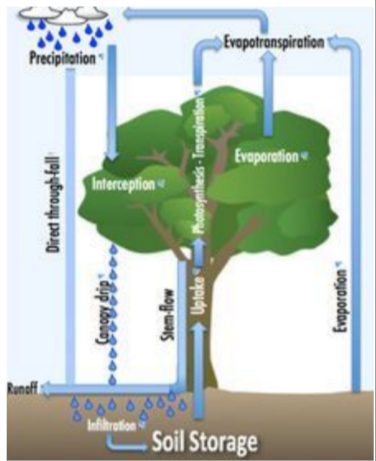
Deforested rainforest water cycle
Precipitation falls.
● Most reaches the ground immediately with little vegetation to intercept the rainfall, leading to high surface runoff increasing flooding risk.
● Less evapotranspiration, so the atmosphere is less humid and rainfall decreases.
Natural rainforest carbon cycle
Trees suited to humid and warm conditions, which promotes photosynthesis.
● They absorb large amounts of oxygen from the atmosphere acting as an important carbon sink.
● Decomposition and respiration releases CO₂ back to the atmosphere and soil, where carbon is stored.
Deforested rainforest carbon cycle
Lack of trees so photosynthesis is reduced.
● Fires to clear land leads to CO₂ being released into the atmosphere. Forests become a carbon source instead of a carbon sink.
● Lack of life until new plants grow.
● Low rates of decomposition occurs in this environment.
Relationships between the two cycle- part 1
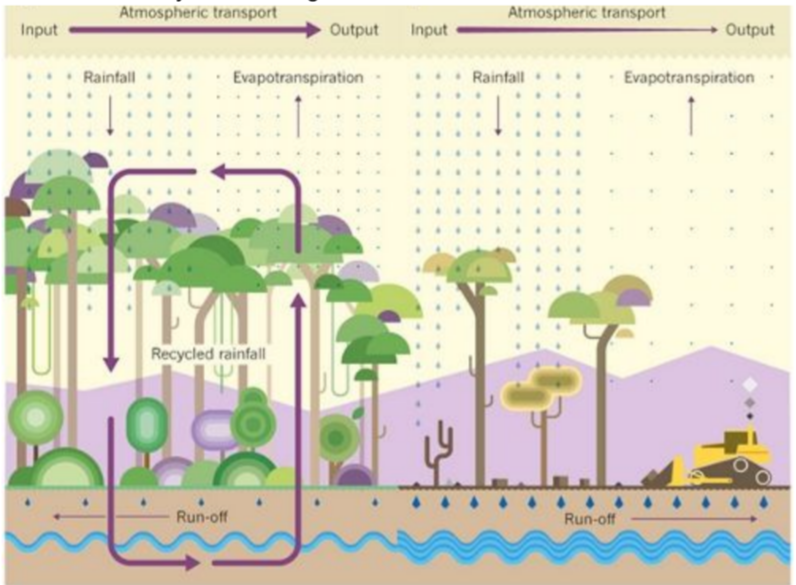
Rain that forms over intact tropical rainforest may fall over deforested land, causing soil erosion. If soil and ash flows into rivers it increases the carbon content of rivers. The water leaves the rainforest cycle as an output through streamflow due to reduced interception and increased surface runoff. This could cause desertification, potentially reducing overall evapotranspiration and precipitation in these areas. High temperatures could lead to forest migration as some habitats become unsuitable for trees as the climate changes, causing desertification in these areas. This desertification further reduces evapotranspiration and the likelihood of rainfall.
● Alternatively there is reduced rainfall in the intact forest as there is less evapotranspiration in the deforested area. This causes drought periods and the intact rainforest to deteriorate.
● The image below shows an intact rainforest water cycle on the left and a degraded tropical rainforest water cycle on the right.
Relationships between- part 2
Deforestation on peatlands and the digging of drainage channels reduces water storage. The organic peat matter is no longer preserved underwater and decomposes quickly, releasing CO₂ into the atmosphere. Weathering and erosion increase speeding up decomposition. There is a greater wildfire risk from the hotter temperatures.
● Blocking drainage ditches in peatland rainforests, helps restore the natural environment by increasing soil water storage and decreasing runoff. This can raise the water table and decrease the flood risk. More water is stored year round, ensuring a steady and even water supply, which is of better quality as it filtered by the wetlands. The area is more attractive to wildlife and becomes an important habitat. Carbon storage is also increased as peat is made up of carbon and water. Wildlife benefit from fewer drier conditions and better availability of food sources
 Note
Note  Flashcards (39)