Chapter 10 - The Development of Language
 Call Kai
 Learn
Learn Practice Test
 Spaced Repetition
 Match
Match Flashcards
 Knowt Play
1/6

Earn XP
Description and Tags
+ Lecture 8
Name | Mastery | Learn | Test | Matching | Spaced | Call with Kai |
|---|
No analytics yet
Send a link to your students to track their progress
7 Terms
Steven Pinker
Language is an adaptation:
Language is universal
Languages conform to a universal design
Children pass through a universal series of stages in acquiring a language
If children are put together without a pre-existing language, they will develop one of their own
Language and intelligence are doubly dissociable in disorders
nativist perspective: Noah Chomsky
universal grammar
S-structure: surface structure – the actual spoken sentence (different in different languages)
D-structure: deep structure – abstract representation of a sentence (universal grammar; the same in different languages)
Chomsky’s “poverty of stimulus” argument
Language requires the ability to connect d-structures to s-structures.
Children only hear the s-structure. The d-structure must be innate.
overregularisation:
Typically shown in irregular forms: (I goed, I eated, I seed).
Up until the age of 7 children overregularize.
Children apply syntactic rules (d-structure)
Explicit indication that language learning is not based on conditioning
overgeneralisation:
Creating a new verb by adding the suffix–ing: (I’m ballerining, It’s weathering).
Language input is complex.
Children receive little feedback about grammar.
Parents repeat ungrammatical sentences. Parents even reinforce ungrammatical sentences (“No dinosaur no go here.”, “That’s right.”)
Children acquire language quickly and easily.
universal design of language
A lot of criticism:
The myth of language universals – languages are too diverse and do not show universal design
Parental role in providing language models – sophisticated vocabulary use with toddlers explains additional variation in children’s later vocabulary
Innate knowledge or a predisposition to learn a language? – constructivist approach to language development.
Conclusion:
Language development needs:
Universal Grammar
Experience
General learning mechanisms (non-specific to language)
Language systems:
Pragmatic system: e.g., turn-taking
Phonological system: speech perception and production
Syntactic system: understanding and producing grammar
Semantic system: understanding the meaning of words
development of the pragmatic system
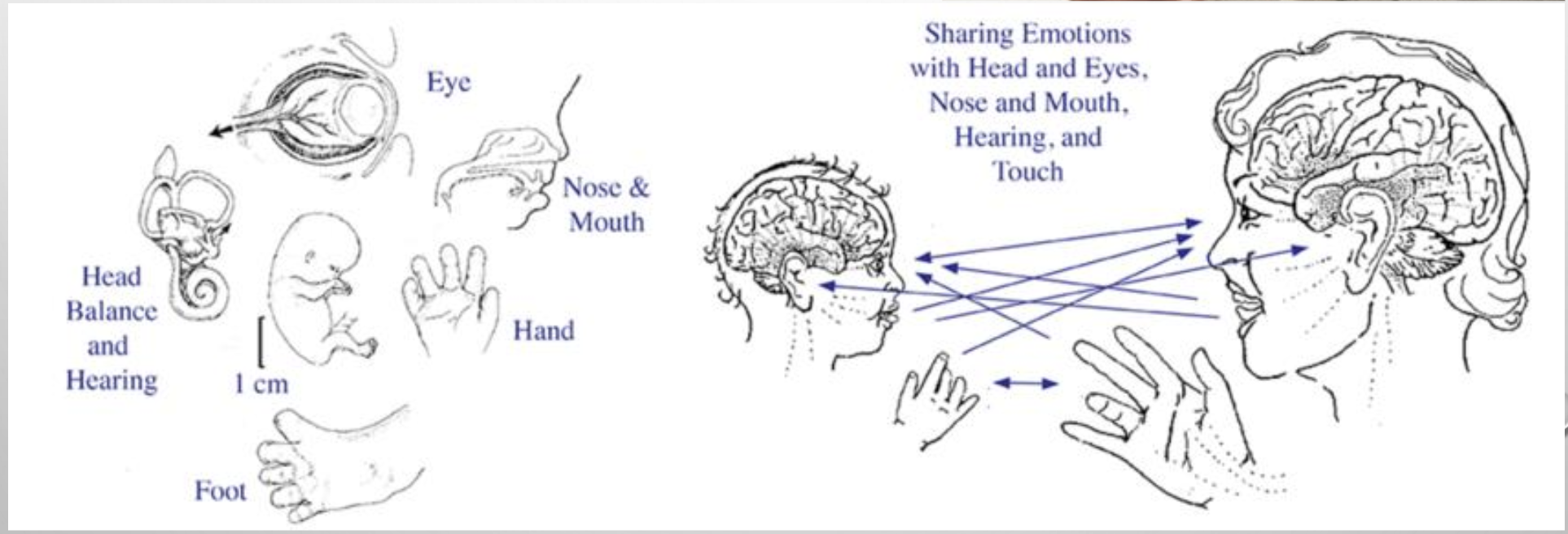
Proto-conversations: Involve many social, cognitive and motor skills
Imitation
Initiating interactions
Maintaining conversations
Repairing faulty conversations
All part of “shared intentionality” - the ability and motivation to engage with others in collaborative, cooperative activities with joint goals and intentions.
development of the phonological system
Speech segmentation
How does an infant learn this?
Infant-directed speech / motherese / baby talk:
Higher pitch
More exaggerated pitch contours
Larger pitch range
More rhythmic
Slower
Universal, even in sign language
Infants prefer motherese! (prefer singing even more).
Infants remember motherese better
Emotional component (“happy talk”)
Interactive component