A3.1 diversity of organisms
 Call Kai
 Learn
Learn Practice Test
 Spaced Repetition
 Match
Match Flashcards
 Knowt Play
1/19

There's no tags or description
Looks like no tags are added yet.
Name | Mastery | Learn | Test | Matching | Spaced | Call with Kai |
|---|
No analytics yet
Send a link to your students to track their progress
20 Terms
how is variation between organisms a defining feature of life?
no two individuals are identical in traits, including identical twins. the diversity of organisms adds to the richness of the natural world, and variation allows evolution by natural selection to occur.
what is the morphological species concept?
Carl Linnaeus defined a species as “a group of organisms with shared morphological traits”, claiming it was evidence of a “creator”.
what is the binomial system for naming organisms?
Genus species (underlined when handwritten but italicized when typed)
G uppercase, S lowercase
G. species when shortened
species with same genus have similar traits
what is the biological species concept? (disproved the morphological concept)
“a species is a group of organisms that can successfully interbreed and produce futile offspring”
a group of individuals can exist in a coherent unit and share genes in a gene pool, but similar characteristics ≠ same species
exceptions include offspring produced by hybridization that are fertile but are not a species (lion x tiger)
why is it difficult to distinguish between populations and species?
two geographically isolated populations can still be the same species if they share the same DNA & physical traits
what is the diversity in chromosomes numbers of plants and animal species?
each organization has a specific number of chromosomes
each species has a constant number of chromosomes
chromosome numbers of species are always diploid (humans 46, chimps 48)
what is the process of karyotyping?
stain
place on slide
burst open to spread chromosomes during metaphase
photographed
digitally arranged to make karyogram
what is a karyogram?
a visual representation of an individual's complete set of chromosomes, arranged in homologous pairs by size, centromere positions, and banding patterns
case study: chromosome 2 in humans & chromosome 12&13 in primates
the hypothesis that pair 2 in humans is a fusion of 12&13 in primates
humans have 23 pairs, while other great apes have 24 pairs
chromo 2 has a region in the middle with telomere sequences which are supposed to be at the END of chromos
this suggests that 12&13 fused end-to-end at some point in time
how is there unity of genomes within species?
every species has the same genes arranged in the same locations, ensuring compatibility during reproduction
bcs of this, during meiosis the chromosomes can align perfectly
how is there diversity of genomes within species?
An SNP is a change in a single DNA base that an become a polymorphism if its in at least 1% of the population.
Each human being contains 4000-5000 SNPs, which means each persons DNA differs at thousands of points, contributing to traits like how we look, susceptibility to diseases, etc.
versions of genes can change slightly, which causes individual variation like eye, hair color, skin color, etc.
how is there diversity in eukaryotic genomes?
variation in genome size (DNA content): large genomes contain more non-coding DNA, which contribute to genome size but not number
variation in base sequence composition: differences in nucleotide order accumulate through mutation, gene duplication, and deletion over evolutionary time (ex: SNPs) which explains diversity within & between species
what are current and potential future uses of whole genome sequencing?
whole genome sequencing (determining the entire base sequence of an organism ’ s DNA) is now much faster and cheaper
currently, it can be used to determine evolutionary relationships
in the future, it can be used to develop personalized medicine
why is it difficult to apply the biological species concept to asexually reproducing species?
asexually reproducing species produce offspring identical to the parent - they do not interbreed. technically, each offspring is a new species
why is it difficult to apply the biological species concept to bacteria that have horizontal gene transfer?
in horizontal gene transfer, genes move between different species (even distantly related ones). species are not isolated gene pools
how are chromosome numbers a shared trait within species?
gametes need matching sets of chromosomes to pair up during meiosis
if the sets don’t match (different chromosome numbers),
→ chromosomes can’t line up properly, meiosis fails, and the organism becomes infertile or sterilethis is why cross breeding between related species is unlikely to produce fertile offspring (eg. horse x donkey)
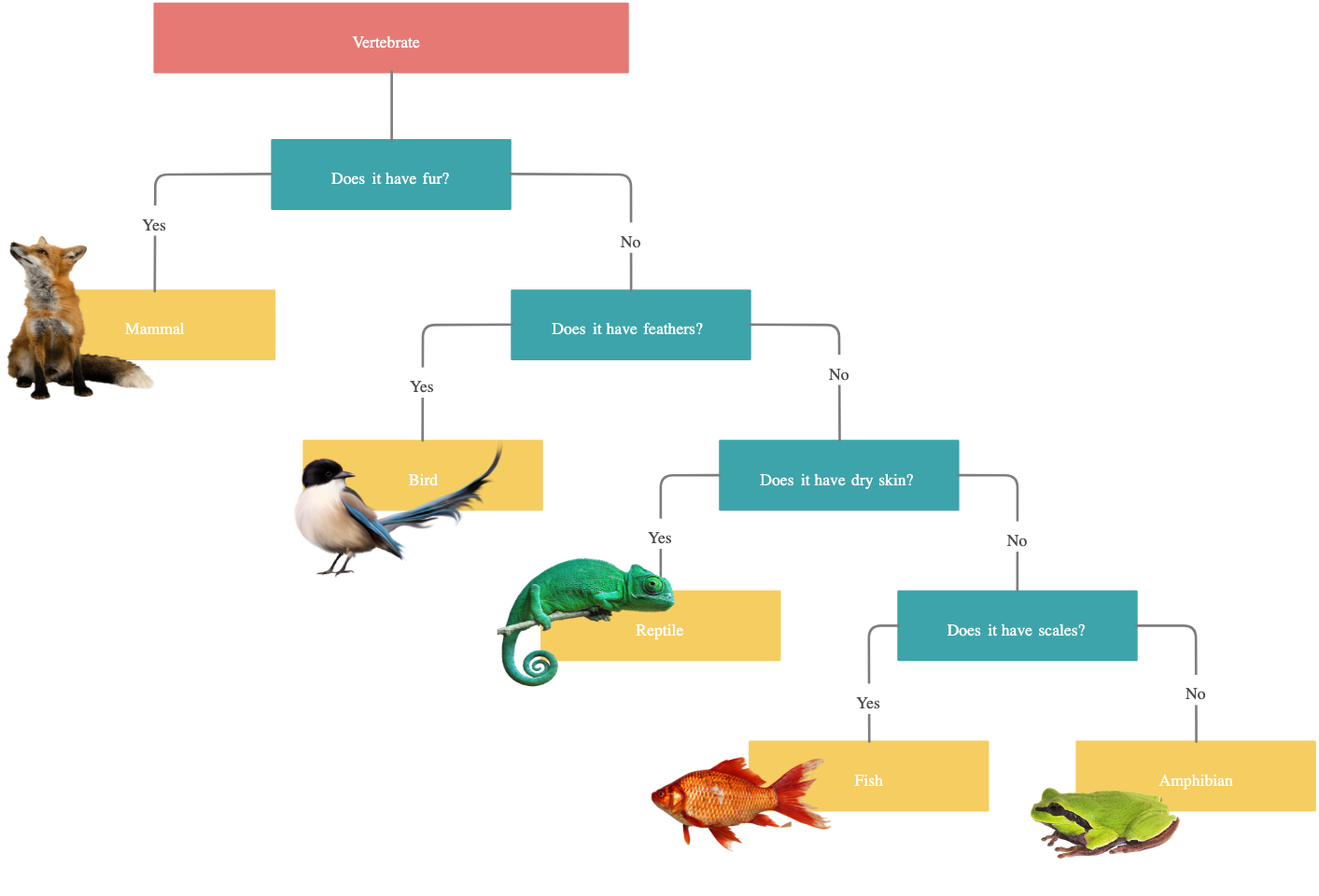
what is a dichotomous key? (know how to make one)
like a tree diagram but with physical traits of the organisms to separate them into categories
dichotomous key example
how can species be identified through barcodes?
DNA barcode: short section of DNA from specific gene and varies between species
Reference libraries are known barcodes from species, so when identifying unknown DNA samples you can compare its barcode to the library.
how can species be identified through environmental DNA?
environmental DNA is DNA that can be extracted from what is shed (e.g. soil, water, air, saliva, excretion), so they can extract the DNA and use the same barcode method to find the species