Topic 1 - Business in the Real World
 Call Kai
 Learn
Learn Practice Test
 Spaced Repetition
 Match
Match Flashcards
 Knowt Play
1/94

There's no tags or description
Looks like no tags are added yet.
Name | Mastery | Learn | Test | Matching | Spaced | Call with Kai |
|---|
No analytics yet
Send a link to your students to track their progress
95 Terms
1.1 - What is a business?
An organisation that produces a good or supplies a service
e.g. Amazon
1.1 - What is a good?
A good is a physical object
e.g. a car
1.1 - What is a service?
An intangible product (can’t touch it)
e.g. financial advice
1.1 - What is a customer?
Someone who buys a product from a business
1.1 - What is a consumer?
Someone who uses products from a business
1.1 - What is a need?
A basic necessity
e.g. food and water
1.1 - What is a want?
The desire for a particular product
e.g. chocolate and coffee
1.1 - What is an entrepreneur?
Someone who is willing to take the risks involved in starting a new business
1.1 - What is entrepreneurship?
The ability to be an entrepreneur
1.1 - Why might people want to become an entrepreneur?
Be their own boss
Keep profits
Need a job
An interest or hobby
Prove something to themselves/others
Unhappy with previous job
Flexible working hours
Gap in the market
To provide services as a social enterprise
1.1 - What is a social enterprise?
A non-profit business
1.1 - What is Factors of Production and what does it include?
Factors of Production is the resources that businesses use to provide goods/services. These include:
capital = equipment used
enterprise = skills of people involved in identifying business opportunities
land = physical land of where the business is and where resources are produced
labour = skills and number of employees employed
1.1 - What are resources?
The inputs that businesses use to provide goods/services
1.1 - What is enterprise?
Another word for business
OR
The skills of the people employed
1.1 - What is opportunity cost?
The sacrifice made when decisions are made/the trade-off
1.1 - What are some characteristics of an entrepreneur?
Most entrepreneurs are:
innovative
risk takers
hard working
determined
organised
1.1 - What are the different sectors of business?
Primary sector = businesses that produce and use raw materials
e.g. farmers
Secondary sector = businesses that convert raw materials into products
e.g. manufacturers
Tertiary sector = businesses that sell products/services
e.g. fast food stores
1.1 - What are the four functions of a business?
Marketing = promoting, pricing and placement
Operations = the activities involved in the production of a product
Human resources = Managing people/staff
Finance = raising, managing and monitoring money
1.1 - What are the changes in the business environment?
Technological change = this creates new markets and products
Economic change = this involves a range of factors
e.g. interest rate, inflation, and GDP
Legal change = new laws and regulations which may affect costs or demand
Environmental expectations = Customers and consumers are growing increasingly concerned about whether a business is eco- friendly or not. This could affect stuff like demand and sales.
1.2 - What is a sole trader?
Someone who sets up a business on their own
1.2 - What are some advantages of being a sole trader?
Quick and easy to set up
In control of all decisions
Keep profit
Own boss
Quick decisions
1.2 - What are some disadvantages of being a sole trader?
May not have all the skills required
Unlimited liability
Heavy workload
Finance
Difficult for time off
1.2 - What does profit mean and how is it calculated?
Difference between revenue and total costs
Revenue - total costs
1.2 - What does unlimited liability mean?
If the business goes bankrupt, the owner has to pay using personal finance and/or possessions
1.2 - What is a partnership?
When two or more people start a business
1.2 - What is a Deed of Partnership?
An agreement that sets out rules for a partnership like:
profit division
decision making
etc
1.2 - What are some advantages of a partnership?
Workload is shared
More finance sources
Skill sharing
Easier for time off
1.2 - What are some disadvantages of a partnership?
Disagreements
Unlimited liability
Liable for what partners do
Profit is divided
1.2 - What is a company?
A business which has its own legal identity which allows suing and ownership of products. It is owned by its stakeholders
1.2 - What is a stakeholder?
A person or organisation which owns part of a business (a share)
1.2 - What are some advantages of a company?
Limited liability
Better status in the eyes of some customers
Continues after the death of the founders
Can have shareholders
1.2 - What are some disadvantages of a company?
Have to register
Have to disclose sale information
Have to have accounts independently checked
Not in full control if there is other investors
1.2 - What are the types of companies?
Private limited company (ltd) - members of public cannot buy shares
Public limited company (plc) - members of public can buy shares off the Stock Exchange
1.2 - What is the Stock Exchange?
A market for the buying and selling of shares
1.2 - What is a flotation?
When a private limited company becomes a public limited company
1.2 - What are some advantages of being a private limited company?
Limited liability
Higher status
Company still exists after its founders
Can employ managers to run it day-to-day
1.2 - What are some disadvantages of being a private limited company?
Various legal procedures
Summaries of finance but be produced to be available to the public
Accounts must be checked by an independent accountant (auditor)
Must pay corporation tax
1.2 - What are some advantages of a public limited company?
Advertisement of shares
Attract more media coverage as they have more stakeholders
Higher status
1.2 - What are some disadvantages of a public limited company?
Media coverage could be bad if a mistake is made
Buyers of shares cant be controlled
Take overs are more likely
Legal procedures
1.2 - What is a not for profit organisation?
A business set up to achieve objectives other than profit
e.g. a charity
1.3 - What is an aim?
A general goal of a business
1.3 - What is an objective?
A specific target set for the business to hit
1.3 - What is the purpose of setting objectives?
Helps with decision making
Helps understand the businesses direction
Provides a target
Motivates people involved
1.3 - What are the roles of objectives?
Survival
Profit
Shareholder value
Customer satisfaction
Market share
Growth
Being ethical
Environmental and sustainability targets
1.3 - What is the equation for market share?
Market share = total..salessales..from..a..pro.duct x 100
1.3 - What should an effective objective state?
What the target is
When it must be achieved by
Who needs to achieve it
How to achieve it
1.3 - What resources can businesses use to achieve objectives?
Time
People
Money
Equipment
1.3 - What is a private sector organisation?
An organisation owned by individuals
1.3 - What is a public sector organisation?
An organization owned by the government
1.3 - Is profit an objective for private sector organisations?
Yes, most of the time
1.3 - Is profit an objective for public sector organisations?
No, not usually
1.3 - Can a business change objectives?
Yes, business usually have the objective of surviving for the first few months/years then its changes to fit the businesses success so far
1.4 - What are the main stakeholders of a business?
Employees
Government
Suppliers
Community
Customers
Shareholders
1.4 - What are the objectives of different stakeholders?
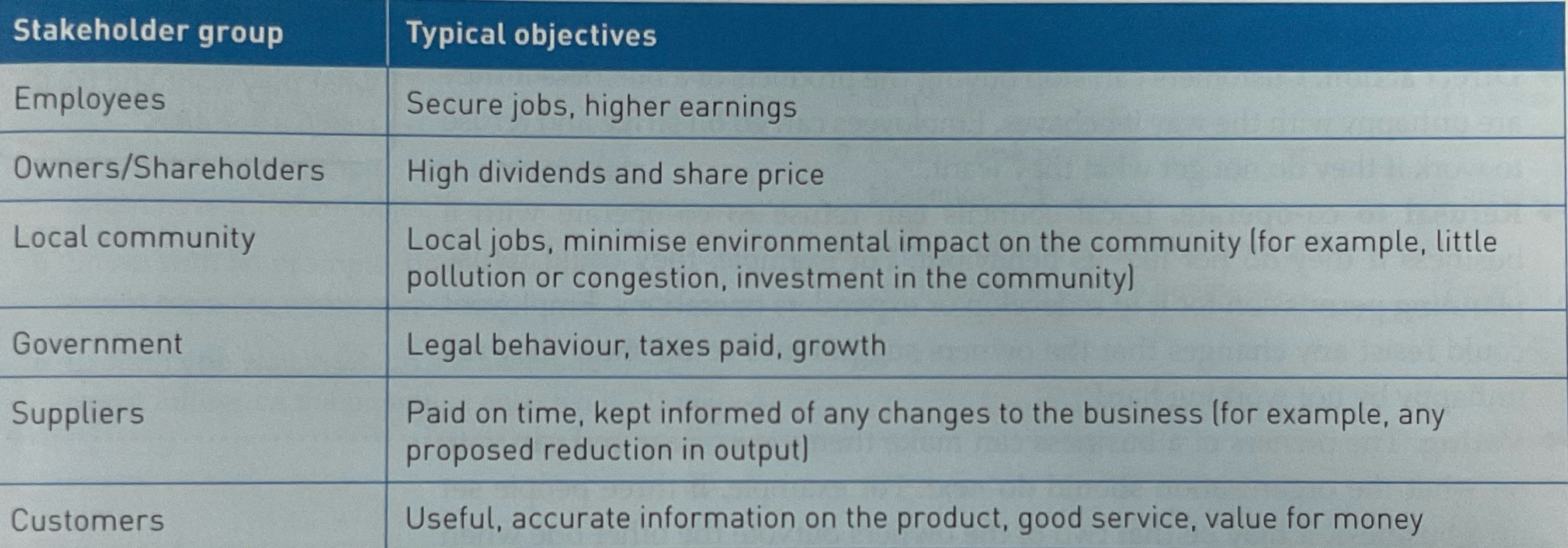
1.4 - How does a business have an impact on stakeholders?
Success affects number employed/salary
Values of owners/managers affects staff treatment
Local community
Treatment of suppliers
Success affects share price/dividends
Reducing tax affects governments revenue
1.4 - How can stakeholders influence a business?
Negotiation
Direct action
Refusal to co-operate
Voting
1.5 - Why is business location important?
Costs
Sales
Image
1.5 - What factors influence location?
Type of business
Proximity to the market
Competitors
Availability of raw materials
Availability and cost of labour
Transport links
Technology
Costs
1.5 - What are some advantages of locating overseas?
Cheaper labour
Access to a wider range of resources
Financial incentives from foreign governments
Avoids protectionist measures by foreign governments
Overseas market may be fast growing
1.5 - What are some disadvantages of locating overseas?
Different rules/regulations
Different demands
1.6 - What is a business plan?
A document setting out what a business does and what it hopes to achieve in the future
1.6 - What is the purpose of business planning?
Help set up a business successfully
Raise finance
Set objectives
Co-ordinate actions
1.6 - What are some disadvantages of business planning?
Uncertainty
Lack of experience
Change
1.6 - How can a business reduce the risk of business planning?
Research the market
Talk to experts and consultants
Plan for a variety of outcomes
Regularly review and update the plan
1.6 - What are the main sections of a business plan?
Background information on founders and investors with experience
Analysis of the market and the firm's expected position within it
Objectives
Prices set and expected sales
How the business will compete with rivals
Analysis of financial position
1.6 - How is revenue calculated?
Revenue = units sold x price
1.6 - How is profit calculated?
Profit = revenue - total costs
1.6 - How is total cost calculated?
Total cost = fixed cost + variable cost
1.6 - What is fixed cost?
Costs that don't differ when output changes
e.g. rent
1.6 - What is variable cost ?
Costs that are affected when output changes
e.g. packaging
1.7 - What are the methods of expansion?
Internal growth (organic growth) = selling more of its own products
External growth (integration) =joining another business
1.7 - How can size of a business be measured?
Value of sales
Value of the business
Number of employees
1.7 - What different ways can internal growth occur?
Franchising
Opening new stores
E-commerce
Outsourcing
1.7 - What is franchising?
When a franchiser sells the right for another business to use its name/sell its products
1.7 - What are the advantages of selling a franchise?
Can grow quickly
Franchisee provides some finance
Franchisees motivated
1.7 - What are the disadvantages of selling a franchise?
Lose some control
Franchisee problems could affect
Share profits
1.7 - What are the advantages of buying a franchise?
Established brand
Access to training and supplies
Share marketing costs
Learn from other franchises
1.7 - What are the disadvantages of buying a franchise?
Sharing profits
Work within franchiser's guidelines
Contribute to group marketing
Bad reputations can be carried
1.7 - What is e-commerce?
The act of buying or selling a product using an electronic system
1.7 - What is outsourcing?
When a business uses another business to produce for it
1.7 - What different ways can external growth occur?
Merger
Takeover
1.7 - What is another name for external growth?
Integration
1.7 - What is a merger?
When two or more firms join together and create another joint business
1.7 - What is a takeover/acquisition?
When one firm buys control of another
1.7 - What are the different types of business integration?
Horizontal
Vertical
Conglomerate
1.7 - What is horizontal integration?
When one firm joins another at the same stage of the same production process
1.7 - What is vertical integration?
When one firm joins another at a different stage of the same production process
What is backward vertical integration?
When a firm joins with its suppliers
1.7 - What is forward vertical integration?
When a firm joins with its distributors
1.7 - What is conglomerate integration?
When a firm joins another firm in a different type of production process
1.7 - What are some advantages of business expansion?
Can lead to economies of scale
More power market-wise
Higher status/importance
Greater rewards for staff
1.7 - What are some disadvantages of business expansion?
Slower decision making
Demotivated employees
Not as efficient to control/coordinate
1.7 - What is economies of scale?
When unit costs fall and sales increase as a business expands
1.7 - What is diseconomies of scale?
When unit costs increase as a business expands
1.7 - What are some disadvantages of expanding abroad?
Laws and regulations may differ
Existing businesses may resist new entrants
Customers buying habits/expectations may differ