psychology unit 1
 Call Kai
 Learn
Learn Practice Test
 Spaced Repetition
 Match
Match Flashcards
 Knowt Play
1/70

There's no tags or description
Looks like no tags are added yet.
Name | Mastery | Learn | Test | Matching | Spaced | Call with Kai |
|---|
No analytics yet
Send a link to your students to track their progress
71 Terms
Heredity
predisposed characteristics that influence an individual’s physical, behavioral, and mental traits and processes
Environment
external factors that an individual experiences, such as a person’s family, friend, groups, school, society cares about
Evolution
focuses on natural selection, the passing down of genes, and how many of our behaviors and mental processes actually come from our ancestors
Eugenics
improving the genetic quality of humans by promoting reproduction of individuals with desirable traits and discoursing reproduction between those with undesirable traits.
Henry Geddard
American eugenicist, pushed to use intelligence tests to rank people into different mental categories → society should prevent feeble minded people from having children
Heritability
Mathematical measure to estimate the variation there is in a population related to its genes, nature & nurture!
EX: 0.7 = 70% genetics and 30% environment
Epigenetics
examines how the environment and a person’s behaviors affect someone’s genes and how they work →how body reads DNA sequence, happens slowly, genes are being turned on or off
Plasticity
When the brain changes and builds new neural pathways in response to a person’s experiences
Central Nervous System (CNS)
brain and spinal cord
brain: processing sensory information → controlling motor functions, thinking, emotions, regulating bodily functions
spine: connects brain to the rest of the body
Peripheral Nervous system (PNS)
different nerves that branch off from the brain and spine, a communication network that connects the CNS to the rest of the body, sending information to the brain and carrying commands back, controls movements
Afferent Neurons (sensory neurons) PNS
send signals from sensory receptors (nerve endings) to the central nervous system, TO BRAIN AND SPINAL CORD, approaches brain to stimulate you (feelings, pain, etc)
Efferent Neurons (motor neurons) PNS
send signals from the central nervous system to the peripheral nervous system, FROM BRAIN AND SPINAL CORD, exits brain so you can initiate action
PNS: Somatic Nervous System (skeletal)
includes skeletal muscle movements and 5 senses, conscious and voluntary movements, brain sending signals to muscle to move
PNS: Autonomic Nervous System
controls involuntary activities, makes sure you breathe, heart is beating, stomach is digesting, bodily functions you need to survive → homeostasis, provding stability
ANS: Sympathetic Division
fight or flight response
what gets your body mobilized and ready for action, making your heart beat, faster, eyes dilate, and increases your breathing
slows down digestion so energy can go where it’s needed
ANS: Parasympathetic Division
rest and digest
Slows your heart rate, increases digestion, and helps you focus on saving and storing energy
Neurons
basic functional unit of the nervous system
communicates by using electrical impulses and chemical signals to send information throughout the body
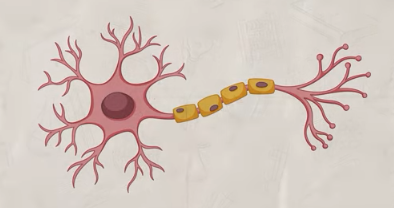
Cell
Soma: where the nucleus is! → contains genetic material that allows neurons to function
Dendrites: receive chemical information from adjacent neurons through its receptor sites to another neuron down the axon fiber
Axon Fiber: carries a signal away from the soma and out through the neurons terminal branches → transmits signals (protected by glial cell/schwann cell)
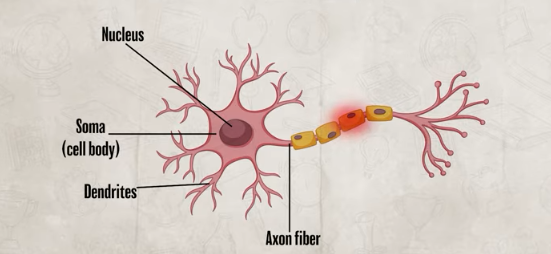
Schwann Cell
around axon fiber
produces myelin sheath that covers axon and protects it from being damaged
increases how fast action potential can travel down the axon
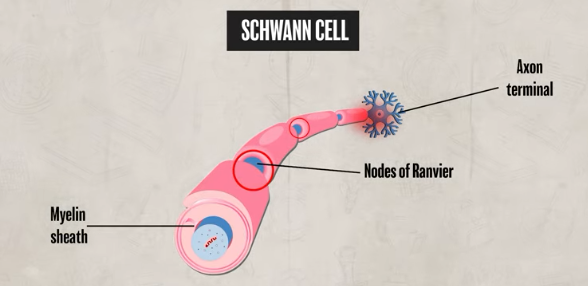
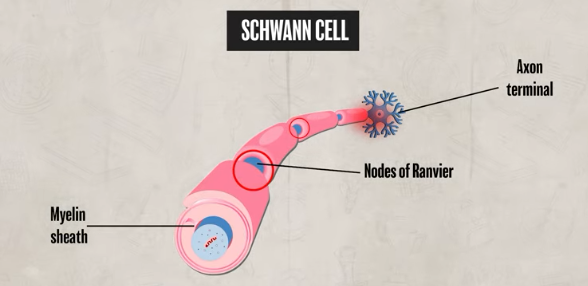
Myelin Sheath
protects axon
there are gaps in it that are known as NODES OF RANVIER → continuing action potential into AXON TERMINAL (endpoint)
where neurotransmitters are released into synaptic gap and cent to receiving neuron
nociceptors
pain receptors in skin
Afferent neurons send pain signals to the spinal cord into interneurons connecting sensory neurons to motor neurons (afferent and efferent), which causes muscles to move due to pain → reflex arc
Interneurons
neurons within brain and spinal cord
communicate internally and connect the sensory neurons to motor neurons, also known as efferent neurons
Glial Cells
all over the brain!
insulate neurons to speed up transmission and facilitate communication
neural transmission
all or nothing principle!!!
a neuron will only fire if the threshold is met
minimum amount of stimulation required for a neuron to fire and send an action potential → starts with DEPOLARIZATION
Depolarization
positive sodium ions flow into the neuron making the inside of the cell more positive allowing electrical charge to move along the axon into next neuron
Refractory Period
after neuron fires signal
brief period where neuron can’t fire again because it has to recharge and return to its resting state where it has a stable negative internal charge
Axon Terminal
where the signal is converted and sent to another neuron through a small pocket of space between the axon terminal of one neuron and the dendrite of another
tiny space: synapse
Chemical Synapses
uses neurotransmitters, chemical messengers that sends messages through the nervous system
Electrical Synapses
messages that need to be sent quickly and immediately
Synaptic Space
neurotransmitters diffuse through synaptic gap to deliver their messages
narrow space between two neurons
presynaptic terminal of one neuron and the postsynaptic terminal of another
Presynaptic Terminal (axon terminal of the neuron)
converts electrical signal to a chemical one and then sends neurotransmitters into synaptic gap
Postsynaptic Terminal
when neurotransmitters are accepted in the dendrite of the receiving neuron
through this process, they unbind with the receptors, some destroyed some reabsorbed
Reuptake
the transmitters are left in the synaptic gap are taken back and REABSORBED
Excitatory Neurotransmitters
when neurotransmitters bind to receptors it gets excited sometimes
increase likelihood that a neuron will fire an action potential
Inhibitory Neurotransmitter
Will decrease likelihood that a neuron will fire action potential
Hyperpolarization
when inside of neuron becomes more negative. moving neuron farther away from its threshold or intensity level needed for action potential
Multiple Sclerosis
when myelin sheath (protection) is damaged, resulting in the disruption of the transmission of electrical signals
- muscle weakness
- coordination problems
- fatigue
Myasthenia Gravis
autoimmune disorder that affects the communication between nerves and muscle
antibodies block or destroy acetylcholine receptors (enables bodily function things) preventing muscle contraction and causing muscle weakness and fatigue
Endocrine System
slower moving compared to nervous system
helps regulate different biological processes in body
Adrenaline
Epinephrine helps with the body’s response to high emotional situations and helps form memories
expands our air passages in the lungs and redistributes blood flow
fight or flight response
Leptin
balance our energy by supressing hunger
signals that the brain has stored enough fat, reducing someone’s appetite
Ghrelin
hunger hormone
signals to brain that we are hungry
helps promotes growth hormones
Melatonin
produced by the pineal gland in the brain and helps regulate sleep-wake cycles, circadian rhythm
Helps promote sleep and is typically more prevalent in the evening
Oxytocin
produced in the hypothalamus and released by the pituitary gland
love hormone → promotes feelings of affection and emotional bonding
Psychoactive Drugs
substances that purposefully alter an individuals perception, consciousness, or mood, these drugs can broken down into different categories!
Stimulants
excite and promote neural activity
give individuals energy, reduce a person’s appetite, and cause them to become irritable
Depressants
drugs that reduce neutral activity in an individual, these drugs case drowsiness, muscle relaxation, lowered breathing, and death if overdose
Hallucinogens
marihuana, peyote, and LSD
cause individuals to sense things that aren’t actually there
reduce individuals motivation and lead them to panic
Opioids
depressant! but have their own category due to addictive nature
give an individual pain relief
DRUGS INFLUENCE TRANSMITTERS INSIDE BODY
Agonist Drug
increases effectiveness of neurotransmitters by mimicking it and enhancing their effects or boosts production of transmitter itself
Can block the reuptake process, leading to an increase in neurotransmitter levels in the synapse since the excess isn’t reabsorbed
Ex: anti-anxiety medication
Antagonist Drug
decreases the effectiveness of a neurotransmitter
block them from being released from the presynaptic axon terminal or block the intended neurotransmitter from binding
Ex: medication for schizophrenia that blocks dopamine receptors
alcohol: blocks the release of glutamate, which acts as a depressent
Brain Plasticity
ability to change and adapt even after its injured, rewires itself and forms new neural connection or strengthen existing ones
helps learn new skills, recover from damage, or adjust to new experiences,
brain stem
medulla oblongata, pawns, midbrain
connects the brain to spinal cord which transmits messages between brain and body
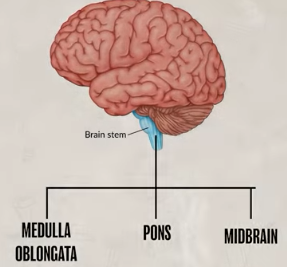
medulla
located just above the spinal cord and below the pond
controls autonomic functions such as heart rate, blood pressure, breathing, and digestion, things we don’t think about!
the pons
on top of the brain stem
connects different parts of nervous system: cerebrum and cerebellum
important role in sleep and dreaming, regulating REM
Cerebellum (little brain)
located at the base of the brain in the back, controls muscle movement, balance, and some forms of procedural learning
Damage can lead to uncoordinated or clumsy movement
procedural learning
long-term memory that involves learning how to perform tasks or actions through repetition and practice often without conscious awareness
Reticular Activating System
bundle of nerves that run through the brainstem, neurons that extend from brain stem up to the hypothalamus and other areas of the brain, filters incoming sensory information and alerts to important signals
regulates arousal and consciousness
controls sleep-wake cycle and general alertness
Brain’s Reward Center
neurotransmitters, dopamine to create that feeling, reinforces behaviors and mental processes
makes an individual feel satisfaction and pleasure
limbic system
between brain stem and cerebral cortex
includes thalamus, hypothalamus, hippocampus, and amygdala
emotion, memory, learning, and motivation
thalamus: limbic system
what receives sensory information, except for smell, and sends that information to the right areas of the brain
Ex: if you hear a sound, information → auditory cortex to be interpreted
Hypothalamus: limbic system
helps maintain homeostasis
controls hunger, thirst, body’s temperature, sexual behavior
regulates endocrine system by signaling the pituitary gland
Pituitary Gland
releases hormones that affect growth, our metabolism, and other glands throughout the body
Hippocampus: limbic system
key role in forming long-term memories, not storing
Amygdala: limbic system
involved in emotion, especially fear and aggression
helps you respond in emotional situations and form emotional memories
Cerebral Cortex
outer layer of the brain
left and right hemispheres → connected by the corpus callosum, thick band of neural fibers that allows communication
frontal, parietal, temporal, occipital lobes → higher order thinking, sensory processing, decision making, voluntary movement
Occipital Lobes
back of the brain
process visual information; everything you see is interpreted here
Temporal Lobe
forward in brain, just above ears
process sounds and help with language comprehension, understand words
TEMPORAL LOBE: Wernicke’s area
responsible for language and comprehension
if damaged, not able to produce meaningful speech
Parietal Lobes
regions that help your brain organize and make sense of information
information from different senses is brought together which allows you to make sense of the world in a more complete way
Parietal Lobes: Somatosensory Cortex
processes touch, pressure, pain, and temperature from the body
better understanding of where your body is in space
interprets what you’re touching