(10) Biological approach to treating OCD
 Call Kai
 Learn
Learn Practice Test
 Spaced Repetition
 Match
Match Flashcards
 Knowt Play
1/6

There's no tags or description
Looks like no tags are added yet.
Name | Mastery | Learn | Test | Matching | Spaced | Call with Kai |
|---|
No analytics yet
Send a link to your students to track their progress
7 Terms
Purpose of drug therapy
Serotonin is a neurotransmitter associated with mood
Low or irregular levels of serotonin may lead to an imbalance in mood e.g. feeling down, feeling manic, feeling anxious
An imbalance in mood may interfere with rational thinking and could lead to obsessive thoughts - a key characteristic of OCD
Most drug therapies aim to increase the level of serotonin available at the synapse
Antidepressant drugs: SSRI
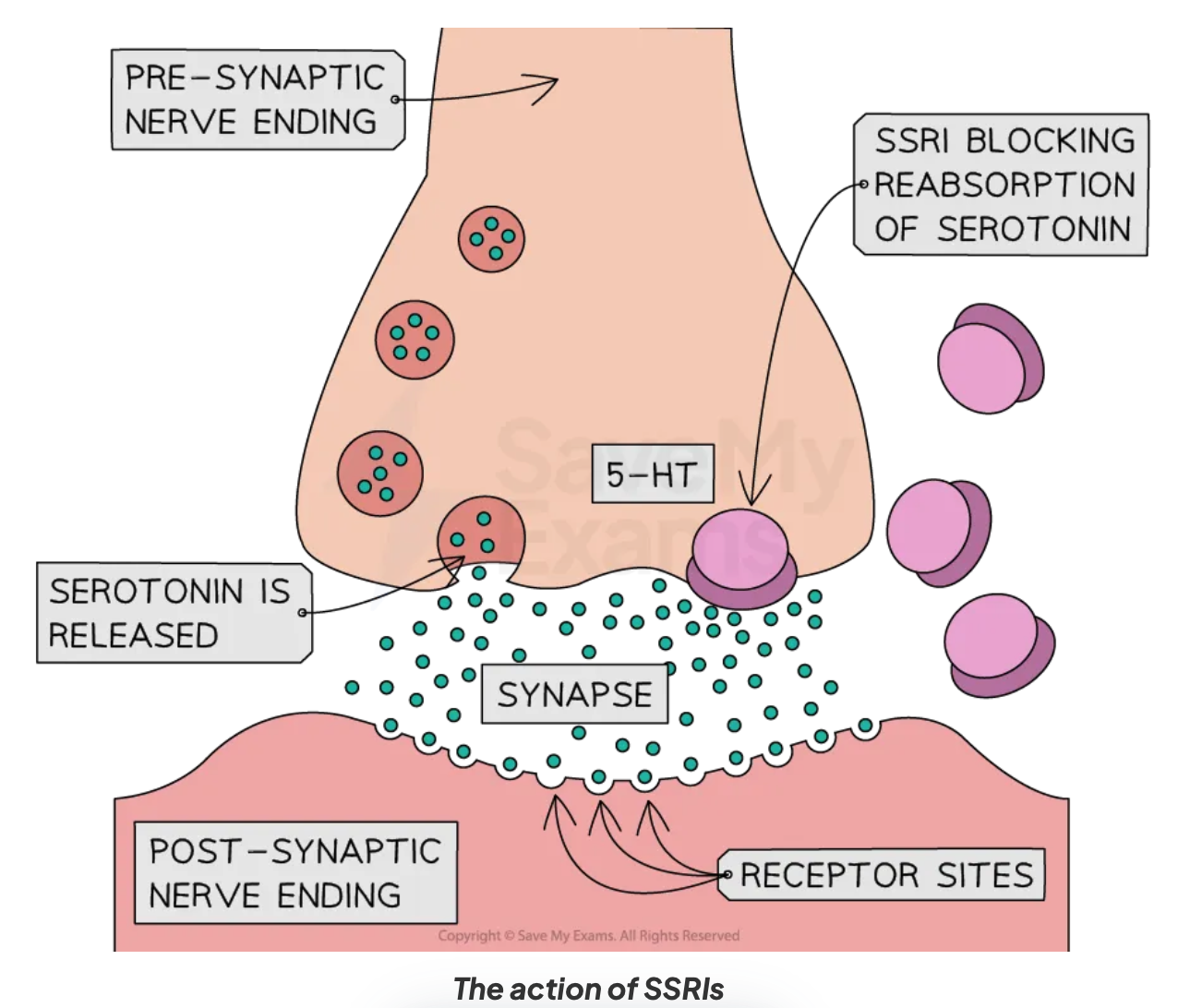
Antidepressant drugs used to tackle low levels of serotonin are known as Selective Serotonin Reuptake Inhibitors (SSRIs)
Reuptake occurs when molecules of serotonin do not cross the synaptic cleft i.e. they have not been transmitted to the postsynaptic neuron
The ‘spare’ molecules of serotonin are then taken back up into the presynaptic neuron
SSRIs work by preventing (or inhibiting) the reuptake of serotonin in the synaptic cleft back into the presynaptic neuron
Prevention of reuptake makes serotonin more accessible in the brain
More serotonin is then available to improve the transmission of messages between neurons
SSRIs are called selective because they mainly affect serotonin, not other neurotransmitters such as dopamine
SSRIs are commonly used to treat depression but they have also been found to be effective in the treatment of OCD
Alternative drugs to SSRIs: Tricyclics
Tricyclics and SNRIs (Serotonin Noradrenaline Reuptake Inhibitors) block the reuptake mechanism that re-absorbs both serotonin and noradrenaline into the pre-synaptic neuron after it has fired
As a result, more of these neurotransmitters are left in the synapse, prolonging their activity, and easing transmission of the next impulse.
E.g. Clomipramine (Anafranil) – Primarily used to treat OCD (rather than depression).
Alternative drugs to SSRIs: Benzodiazepines
- Slows down the activity of the whole central nervous system by enhancing the activity of the neurotransmitter GABA (which has a calming effect)
It does this by reacting with the GABA receptors on the outside of post-synaptic neurons. When GABA locks into the receptors, they open up a channel that increases the flow of chloride ions into the neuron
This makes it harder for the neurons to be stimulated by other neurotransmitters (summation stays negative), thus slowing down its activity, and making the person feel more relaxed
AO3: In support of the use of SSRI drugs to treat OCD
Soomro (2009) reviewed 17 studies (metanalysis), comparing the use of SSRIs with placebos in patients with OCD. All 17 studies found SSRIs to be more effective than placebos in reducing symptoms. (However the most effective treatments were those combining SSRIs with CBT).
This adds validity to the treatment method.
AO3: Side Effects
Side effects of SSRIs include headaches, insomnia, & nausea. SNRIs side effects include hallucinations, irregular heart beat, erection problems and weight gain. And BZ side effects include aggressiveness and LTM impairment. – All drugs involve issues with addiction and dependence. And drugs are only a cover of symptoms; not a long lasting cure.
However, Strengths of drug therapy; requires little effort and is quickly effective, so is a popular option for treatment. They are also cost-effective and non-disruptive to the lives of patients.
A03: biological reductionist
Need to further look at external factors, not just the biological influence (more holistic, interactionist approach)