(4B) Physiologic-based Pharmacokinetic Models (PBPK)
 Call Kai
 Learn
Learn Practice Test
 Spaced Repetition
 Match
Match Flashcards
 Knowt Play
1/10

There's no tags or description
Looks like no tags are added yet.
Name | Mastery | Learn | Test | Matching | Spaced | Call with Kai |
|---|
No analytics yet
Send a link to your students to track their progress
11 Terms
Partition Coefficient (p-value)
Ratio of drug concentration in tissue vs blood
Different from log P
log P = oil vs water (lab)
p-value = real body tissues
JUST LOOK!! ON FORMULA SHEET!
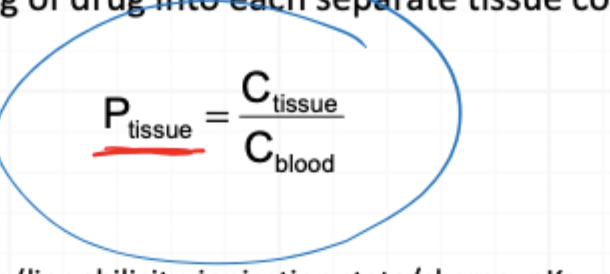
Partition Coefficient (p-value)
Key Concept
Each tissue has different p-value
Brain ≠ Liver ≠ Lung
JUST READ:
How to Use (EXAM)
👉 MATH
Formula:
Tissue concentration = Blood concentration × p-value
➡ Professor explicitly said:
You may get ANY previous PK math + p-value added
Partition Coefficient (p-value)
Why this matters
Used when targeting:
Brain (anxiety, epilepsy)
Specific infection sites (antibiotics)
PBPK MODEL STRUCTURE
Organs classified into:
Eliminating organs
Drug leaves system (kidney, liver, etc.)
Non-eliminating organs
PBPK MODEL STRUCTURE
Blood Flow
Arterial → Tissue → Venous
Exception: lungs (reverse flow)
PBPK MODEL STRUCTURE
Model Building
Each organ → own equation
All equations combined → full PK model
PBPK MODEL STRUCTURE
Dose Entry
Must specify where drug enters
Example: oral dose → GI tract
WHY PBPK MODELS ARE USED
Want tissue concentrations
Link drug concentration → effect
Study toxicity (toxicokinetics)
Predict across species (mouse → human)
Validation Concept
Deconvolution:
Convolution:
Deconvolution: blood → predict tissues
Convolution: tissues → predict blood