PILOT TRAING Vol 1 -First few hours
 Call Kai
 Learn
Learn Practice Test
 Spaced Repetition
 Match
Match Flashcards
 Knowt Play
1/77

There's no tags or description
Looks like no tags are added yet.
Name | Mastery | Learn | Test | Matching | Spaced | Call with Kai |
|---|
No analytics yet
Send a link to your students to track their progress
78 Terms
When is aircraft performance at its peak?
The cold, crisp air of winter.
During the summer months, what situation might cause you to delay a lesson?
The presence of local thunderstorms.
How would you define a “ceiling”?
The lowest broken or overcast cloud layer that covers the sky.
As a student pilot you will be flying
VFR (Visual Flight Rules).
What are the most important weather variables to consider before you make your go-no-go decision?
Visibility, winds, and cloud cover
to climb or descend in an airplane the pilot
Moves the yoke back and forward which moves the elevator up and down.
What is the purpose of the airplane’s rudder?
Its only function is to counteract the adverse yaw when rolling into or out of a turn.
How does a wing create lift?
The curved top surface of the wing increases air velocity and is the major source of lift.
What are the four forces acting on an airplane in flight?
Lift, weight, thrust, and drag.
On landing, what is the advantage to using flaps?
Extending the flaps permit a steeper and slower approach.
What is the purpose of the airplane engine’s mixture control?
To regulate the ratio of fuel to air entering the fuel distribution system.
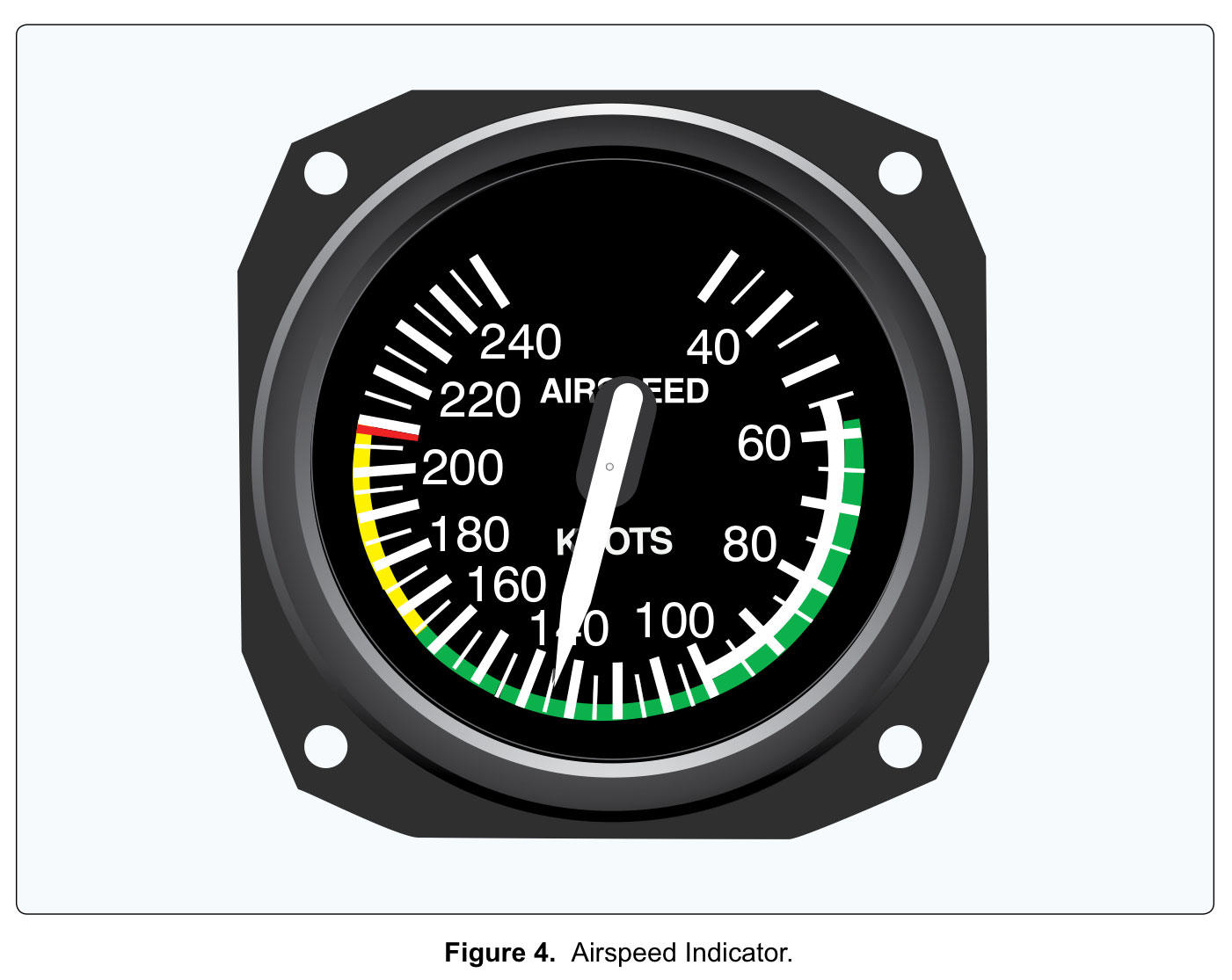
Refer to figure 4) Which color identifies the normal airspeed operating range?
The green arc.
The elevator trim control wheel:
Is rotated forward for nose down trim.
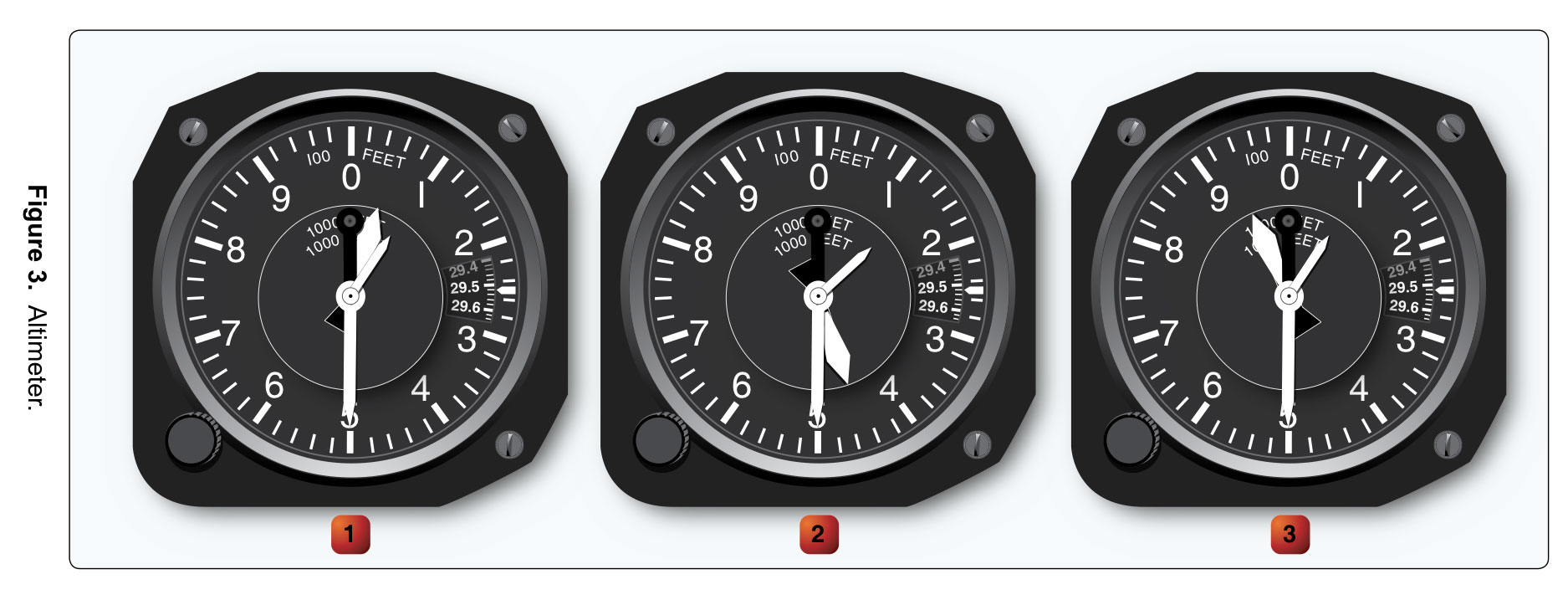
(Refer to figure 3) Altimeter 2 indicates
14,500 feet.
which of the following are considered aircraft flight instruments?
Turn coordinator, heading indicator and vertical speed indicator.
Straight mineral oil is typically used
during the engine or cylinder break-in period.
The dual magneto system allows the engine to run independently of the airplane's
electrical system.
Most of the heat caused by internal combustion is eliminated via
The exhaust system.
You'll move the ignition switch to the left or right position
during engine run-up to check both magnetos and be sure they're operating correctly.
The order of operation regarding the strokes of a typical four-stroke per cycle airplane engine is:
Intake, compression, power, and exhaust.
An aircraft engine features extra reliability because it has:
Dual magneto ignition system.
Engine lubrication oil performs three functions:
Coats moving parts, dissipates heat, and filters foreign materials.
Aviation fuel used in the Cessna training airplanes is colored:
Blue and rated at 100 octane.
The electrical system on the Cessna 172 uses:
An alternator to provide direct current to the system.
The Fuel pump system on a Cessna 172 uses:
An electric auxiliary fuel pump and an engine-driven fuel pump.
In order for the propeller to pull the airplane along, the blades are:
Twisted.
The left wing on a Cessna 172 is a mirror image of the right wing with the exception of:
The fuel vent, Pitot tube and stall warning sensor.
The required documents necessary to be onboard the airplane include:
Airworthiness Certificate, Registration, and Operating Handbook.
The preflight inspection begins:
As you walk toward the airplane.
When should you turn on the beacon light?
Before you start the engine.
Before you begin the engine starting checklist be sure to:
Set the parking brake and hold the foot pedal brakes.
Prior to starting the engine, set the fuel selector switch to:
Both.
To use the throttle properly before starting the fuel-injected engine in a Cessna 172:
Open the throttle about one quarter of an inch.
On starting the engine, first check for:
Oil pressure in the green after a few seconds.
Where can you find more information on good radio communication procedures?
The Aeronautical Information Manual.
The proper way to say the altitude 6,500 feet on the radio is:
Six thousand fife hundred
The generic term for the radio channel to use at airports without an operating control tower is:
CTAF
How should you pronounce letters of the alphabet and numerals on the radio?
By using the phonetic alphabet constructed by the International Civil Aviation Organization.
How is time expressed in the aviation system?
Either as coordinated universal time, or local time zone.
ll U.S. registered aircraft numbers begin with an 'N':
For brevity, you do not need to include the 'N' in your transmission in the U.S.
What are the four "Ws" of good radio communication?
Who you are calling, who you are, where you are, and what you want to do.
A UNICOM (Unified Communications) facility is:
Available at most nontowered airports.
The proper way to initiate communication with ATC is to:
Give your location, aircraft type, altitude, what you want to do, and if you have ATIS.
The 4Ws of radio communication are, in the proper sequence:
Who you are calling, Who you are, Where you are, and What you want.
Taxiing with a left quartering tailwind:
Move the aileron fully right and push the control wheel forward.
Airplane brakes are located:
On the top of the rudder pedals.
What is the correct control placement while taxiing in a left quartering headwind?
Aileron full left and the elevator neutral.
What is the most common method to enter the traffic pattern when returning to the airport?
Enter on a 45 degree angle to the midpoint of the downwind leg.
A good rule of thumb regarding your taxi speed is:
No faster than a brisk walk.
Runway numbers are determined from:
The approach direction and its number is the magnetic direction of the runway.
What is the traffic pattern leg that parallels the runway but in the direction opposite to landing?
Downwind
When it comes time to depart the traffic pattern, climb to pattern altitude and...
depart the pattern straight out or make a 45 degree turn in the direction of the pattern.
To turn the airplane to the right on the ground when taxiing:
Use a combination of the right rudder pedal and brake on the top of the right rudder pedal.
What is the correct control input while taxiing with a left quartering tailwind?
Aileron full right and the elevator forward.
Unless otherwise specified, what is the standard direction of the airport traffic pattern?
Left hand
After takeoff, what is the minimum altitude you should reach before making a turn?
After you are at least 500 feet above the ground.
During the takeoff, the airplane has a tendency to:
Turn to the left.
What is the proper way to depart the traffic pattern after takeoff
Either straight out or on a 45° leg in the direction of pattern.
The rudder has enough force to maintain directional control without the use of nosewheel steering:
When the airplane reaches a liftoff speed.
the left turning tendency of an airplane in a climb is overcome by:
The use of right rudder.
What are the four fundamentals of flight?
Turns, climbs, straight-and-level, and descents.
What is the primary reference for attitude when looking inside the airplane?
The position of the miniature airplane of the attitude indicator in relation to the horizon bar.
You know when your turn is properly balanced—horizontal lift is equaled by centrifugal force:
The ball in the inclinometer stays in the center.
What is the position of the airplane relative to the horizon called?
The attitude.
In a medium banked turn, once the desired bank is achieved:
Neutralize the controls.
Which instrument(s) are used to verify and crosscheck the attitude of the airplane?
Altimeter, heading indicator, airspeed indicator, and the turn coordinator.
Turns are divided into three categories:
Shallow, medium, and steep.
in a turn, you must:
Apply back pressure on the elevator control.
What is the primary reference for attitude when looking outside the airplane?
The relationship between a point (s) on the airplane and the horizon.
One way to determine if you are maintaining a constant attitude is to occasionally check:
The altimeter.
During a prolonged glide, clear the engine by:
Increasing the power to about 1500 RPM.
Flying the airplane on a constant heading and at a constant altitude is termed:
Straight-and-level.
The reference instruments for straight flight are:
The attitude indicator, heading indicator, and turn coordinator.
Climbing turns should be made using:
A shallow bank.
The airplane will gain altitude at a steady rate by applying:
Pitch and power.
The recommended glide speed is:
The speed that gives the greatest forward travel for the altitude lost.
When you decide to level-off from a climb:
Start the level-off 50 feet before your desired altitude.
To ensure that the airplane is laterally level:
Visually check the relationship of the wings to the horizon.