kines 350 exam 1 daily assignments
 Call Kai
 Learn
Learn Practice Test
 Spaced Repetition
 Match
Match Flashcards
 Knowt Play
1/63

There's no tags or description
Looks like no tags are added yet.
Name | Mastery | Learn | Test | Matching | Spaced | Call with Kai |
|---|
No analytics yet
Send a link to your students to track their progress
64 Terms
the pancreas functions as an ____ organ when it synthesizes pancreatic amylase, maltase, sucrase, and lactase and releases these enzymes through the pancreatic duct to the duodenum of the small intestine
Exocrine
a normal fasting blood glucose is _______ in a healthy individual free of disease
70 - 99.9 mg/dL
That transport protein that moves to the cell membrane following an insulin signaling cascade and allows for glucose to enter into the cell is _____
GLUT-4
What is glycogen? Where and how much glycogen is stored in humans? What enzyme facilitates glycogen storage?
Glycogen: a polysaccharide of highly branched chains of glucose which is the storage form of glucose in humans
400 grams of glycogen is stored in skeletal muscle
100 grams of glycogen is stored in the liver
Enzyme: glycogen synthase
What hormone primarily regulates blood glucose in the post prandial state? What tissues/organs does this hormone primarily impact to return to post-prandial blood glucose to fasting levels and how specifically?
Insulin regulates blood glucose in the post-prandial state.
In the liver, insulin decreases blood glucose by supporting glycogen synthesis.
In the skeletal muscle, insulin decreases blood glucose by supporting glucose use and storage as glycogen
In adipose tissue, insulin decreases blood glucose by stopping the breakdown of fat for energy and supporting glucose uptake/storage as triglycerides (lipogenesis)
The lipid that is the major energy source for energy metabolism in humans is ___?
triglycerides
To reduce your risk for heart disease you would want to have a higher level of the lipoprotein _____________.
high-density lipoprotein
True or False. Humans have a much greater capacity to store carbohydrates in the body than triglycerides.
false
in the fasted state, how are stored lipids (in adipose tissue) mobilized so that free fatty acids are available for energy metabolism?
If you are in a fasted state and you need more energy, we can break down fat in different parts of our body. The body will cause an increase in epinephrine and norepinephrine which activates sensitive lipase, found in the cells of adipose tissue. Once the fatty acids are liberated, they will enter into our bloodstream and go to any tissue that needs an energy source.
Chylomicrons
Enter into the bloodstream at the left subclavian vein and then circulate through general circulation. Their goal is to liberate triglycerides and free up energy for our cells to use. Lipoprotein lipase breaks down the triglycerides in the chylomicrons to fatty acids and glycerol. These fatty acids can then be stored or used as energy in the skeletal muscle, heart, mammary tissue and adipose tissue. The remnants, which are cholestrol and protein, travel to the liver.
VLDL
Synthesized in the liver and has a high portion of triglycerides. It is pushed out of the liver and back into the blood. It is going to be broken down by lipoprotein lipase. The particles get smaller. 2/3 of those particles go back to the liver to add more triglycerides and resynthesizes. 1/3 becomes LDL.
LDL
bad cholesterol. delivers cholestrol to different cells in the body that are in need of it. It delivers cholestrol by binding to a receptor on a cell.
HDL
good cholestrol. highest amount of protein. it picks up cholestrol around the body that is not needed or places in the body that has too much of it and takes it back to the liver to resynthesize it to a VLDL particle. The more you have, the better for your health it is.
You have a client who runs 8-10 miles everyday that continues to lose skeletal muscle mass. Your client is likely in _____
Negative Nitrogen Balance
You are a coach working with a bodybuilder. The bodybuilder continues to increase their skeletal muscle mass. The bodybuilder is likely in _________.
Positive Nitrogen Balance
__________ is the process by which an amine group is removed from an amino acid in the liver and urea is formed
deamination
True or False. Proteins are synthesized in the body by the process of transcription and translation.
True
Proteins are different from carbohydrates and lipids because they contain the chemical element _____
Nitrogen
Why could it be a protein problem that an athlete consumes a protein drink that is made up of amino acids that share the same transport protein for absorption?
amino acids enter the mucosal cell through active transport which requires ATP. Our amino acids will share some of the same transport proteins. If you are a drinking a protein drink made of certain amino acids that use the same transport, you can minimize the amount of absorption of those amino acids. These amino acids are competing against each other to enter into the mucosal cell. There should be a good representation of all amino acids.
Fate of Amino Acids once absorbed into the body
-energy source
-synthesis of glucose or fatty-acids
-non-protein molecules containing nitrogen
-protein synthesis
Energy Source
Deamination is happening. Amino acids form intermediates of citric acid cycle/Krebs cycle. This cycle pushes through a molecule to yield ATP. Certain amino acids can be deaminated and used in the Krebs cycle. Without those amino acids, we wouldn't have intermediates and wouldn't have the Krebs cycle. All amino acids yield Acetyl-CoA and all amino acids can be deaminated and become Acetyl-CoA. Protein increases its contribution to becoming an energy source
Synthesis of Glucose or Fatty Acids
Amino acids can be used to synthesize glucose or fatty acids. Gluconeogenesis can happen in 18 of the 20 amino acids. These 18 amino acids are deaminated and they are going to yield pyruvate, malate and oxaloacetate. They can go through glujconeogeneis. All amino acids are a potential source to become fatty acids. First, amino acids are going to be formed in Acetyl-CoA, it will be converted to a fatty acid. The fatty acid, if not used as energy, is stored in the body with 2 other fatty acids and a glycerol backbone as a triglyceride.
Non-Protein Molcules Containing Nitrogen
the primary nonprotein molecules - coenzymes. amino acids can synthesize the heme components of hemoglobin and myoglobin. They are synthesized into catecholamines. Tyrosine can be formed into dopamine, norepinephrine, and epinephrine. Amino acids are also used to synthesize serotonin. All of these things need to contain nitrogen.
Protein Synthesis
Regulated by gene expression and occurs via transcription and translation. No reservoir of protein in the body. The structure of each protein is critically important to its function. The major sources of protein in our body are found in skeletal muscle, visceral tissue, and plasma in our blood. Amino acids have to be synthesized into protein.
GLUT-4 can translocate to the skeletal muscle cell membrane by what two mechanisms - be specific? Why might this cause exercise-induced hyperglycemia if someone consumes a high glycemic index carbohydrate drink/meal in large quantities within 5 minutes of starting endurance exercise? When is it beneficial that these two GLUT-4 translocation mechanisms work together?
GLUT-4 can translocate to skeletal muscle membrane by insulin binding to a receptor on the skeletal muscle membrane and causing intracellular signaling or by skeletal muscle contractions causing translocation b. This might cause exercise-induced hypoglycemia if someone consumes a high glycemic index CHO meal in large quantities because both mechanisms will cause GLUT-4 translocation at the same time. There can be large amounts of glucose uptake into the skeletal muscle causing hypoglycemia. c. This could be beneficial post-exercise to maximize glycogen re-synthesis because there will be maximal glucose uptake into skeletal muscle.
When does the glucose-alanine cycle make the greatest contribution to exercise energy availability? List 2 types of activities/sports that would likely rely on the glucose-alanine cycle. Discuss the glucose-alanine cycle and be sure to include where/when deamination and transamination occurs.
The glucose-alanine cycle makes its greatest contribution to exercise energy availability with long-duration exercise that is >4 hours. ● Activity examples include running a marathon, ultra-endurance events, ironman events, hiking for a day (any activity that could be over 4 hours would be acceptable). ● Alanine is synthesized in the skeletal muscle when the amino acid leucine transaminates its amine group (nitrogen) with the glucose intermediate pyruvate. The newly formed alanine leaves the muscle and enters the liver. Alanine is deaminated in the liver to form pyruvate and is converted to glucose via gluconeogenesis and enters the blood for delivery to active muscle
What would be your recommendations to an endurance athlete for them to prevent hitting the wall during competition? Give specific recommendations with amounts in your answer. What is the physiological rationale supporting these methods in endurance athletes?
First recommendation: i. depletion/repletion technique: exhaustive exercise bout, a few days of low CHO diet, an exhaustive exercise bout, a high CHO diet ii. Modified approach: taper training a week before event while increasing % CHO in diet iii. Glycogen supercompensation by: glycogen supercompensation increases muscle glycogen stores, increases time to exhaustion, reduces time to complete a task, and may improve performance in team sports that involve fine and gross motor skills. b. Second recommendation i. Carbohydrate intake during exercise that includes glucose and fructose of 30-60 grams an hour ii. It improves exercise trial time and maintains exercise for longer at a given intensity as it is liver and muscle and glycogen sparing
You are the coach of a highly competitive, female, collegiate cross-country runner. This athlete is extremely lean and has a body mass index that classifies her as "underweight", and she always turns down pre- and post- game meals. The athletic trainer informs you that this athlete has suffered a stress fracture and will be out of competition for approximately 8 weeks. 21.
---What syndrome is your female athlete at risk for having?
the female athlete triad
You are the coach of a highly competitive, female, collegiate cross-country runner. This athlete is extremely lean and has a body mass index that classifies her as "underweight", and she always turns down pre- and post- game meals. The athletic trainer informs you that this athlete has suffered a stress fracture and will be out of competition for approximately 8 weeks.
---What three disorders must be present to be diagnosed with this syndrome?
Disordered eating, amenorrhea, osteoporosis
You are the coach of a highly competitive, female, collegiate cross-country runner. This athlete is extremely lean and has a body mass index that classifies her as "underweight", and she always turns down pre- and post- game meals. The athletic trainer informs you that this athlete has suffered a stress fracture and will be out of competition for approximately 8 weeks.
---Name on personality behavior that is linked to this syndrome.
-compulsive behavior
-compulsive
-highly competitive
-low self-esteem
-perfectionist
-self-critical
-depression
You are the coach of a highly competitive, female, collegiate cross-country runner. This athlete is extremely lean and has a body mass index that classifies her as "underweight", and she always turns down pre- and post- game meals. The athletic trainer informs you that this athlete has suffered a stress fracture and will be out of competition for approximately 8 weeks.
---Provide two treatment options for this syndrome.
Reduce training level by 10-20% because you want to have the athlete training at a constant rate that equals their total energy expenditure. Increases body weight by 2-3%
Would a high carb diet or a ketogenic diet be better for an endurance athlete - provide specific rationale for why
High carbohydrate diet. Athletes who ate a 65% carb; 15% lipid, and 20% protein diet had a longer amount of time until exhaustion when on the bicycle ergometer compared to the athletes who ate a 62% lipid; 21% carb; 17% protein diet. There is a better relationship between exhaustion and high carbs than there is between exhaustion and high fats. There is the best benefit from following a higher carb diet because their initial amount of muscle glycogen was higher at the start of exercise. Carb intake is important for endurance performance. Eating keto is effective for weight loss but your fatigue perception is higher, and your glycogen content is lowered if you're an endurance athlete.
what are the protein recommendations for a vegan?
1.3-1.8 g per kg of body mass
the most variable component of total daily energy expenditure is _____
Activity
Bioenergetic system with substrate.
Immediate Phosphagen:
Phosphocreatine (PCr)
Bioenergetic system with substrate.
Anaerobic Glycolytic
Glucose/Glycogen
Bioenergetic system with substrate. Aerobic Metabolism
Glycogen/Glucose, Fat, or Amino Acids
Bioenergetic system with the direction the system lasts.
Immediate Phosphagen:
0-30 seconds
Bioenergetic system with the direction the system lasts.
Anaerobic Glycolytic
20-180 seconds
Bioenergetic system with the direction the system lasts.
Aerobic Metabolism
>3 minutes
Bioenergetic system with the limiting factor
Immediate Phosphagen:
phosphocreatine depletion
Bioenergetic system with the limiting factor
Anaerobic Glycolytic
lactate accumulation
Bioenergetic system with the limiting factor
Aerobic Metabolism
glycogen depletion
Bioenergetic system with the activity that is primarily reliant on that system
Immediate Phosphagen
throwing shot put
Bioenergetic system with the activity that is primarily reliant on that system
Anaerobic Glycoltic
400 meter sprint
Bioenergetic system with the activity that is primarily reliant on that system
Aerobic Metabolism
running a half marathon
ATP synthesis occurs in the ______ with the immediate phosphates system, _______ with the anaerobic glycolytic system, and _________ with aerobic metabolism
Cytosol (cytoplasm)
Cytosol (cytoplasm)
Mitochondria
How is lactate that is produced during anaerobic metabolism removed from the body? What causes lactate accumulation in the blood - not the typical exercise intensity that this occurs in individuals.
a. Lactate is removed from the body by: i. Being oxidized for energy in the heart, liver, kidney or ventilatory muscles ii. Intramuscular lactate shuffle - shuffled to neighboring muscle fibers with high oxidative capacity iii. Cori cycle - gluconeogenesis b. Lactate accumulates in the blood during strenuous exercise (which is around 50- 60% VO2max in untrained, healthy individuals) because lactate appearance is greater than lactate clearance. This is because at this intensity, pyruvate is converted to lactate since the intensity is too high for pyruvate to enter aerobic metabolism (aerobic metabolism is too slow as energy demands exceed oxygen supply).
Olivia and Anne have the same VO2 max (50mL/kg/min) and they are asked to run a 30 minute trial at 8mph. Olivia's oxygen consumption during the trial is 38 mL/kg/min and Anne's oxygen consumption during the trial is 41 mL/kg/min. Who is more economical?
Olivia
Which extrinsic factor could give an athlete an economical advantage to the other athletes during a marathon in which all runners complete the same course?
footwear
True or False. Swimming in cold water (water below 77 degreesF or 25 degrees C) improves movement economy for swimmers.
False
True or False. Females have a greater swimming movement economy than males because they have more fat and are therefore more buoyant.
True
Which form of aerobic activity will have a higher energy cost for an individual?
weight bearing exercise (ex. Treadmill walking)
Fast component of exercise oxygen consumption
the exponential rise in oxygen consumption during the first minutes of exercise
Oxygen Deficit
the quantity of oxygen that would have been consumed had oxygen consumption reached steady state immediately
Excess Post-Exercise Oxygen Consumption
the total oxygen consumed in recovery minus the total oxygen theoretically consumed at rest
Movement economy
the energy required to maintain a constant velocity of movement
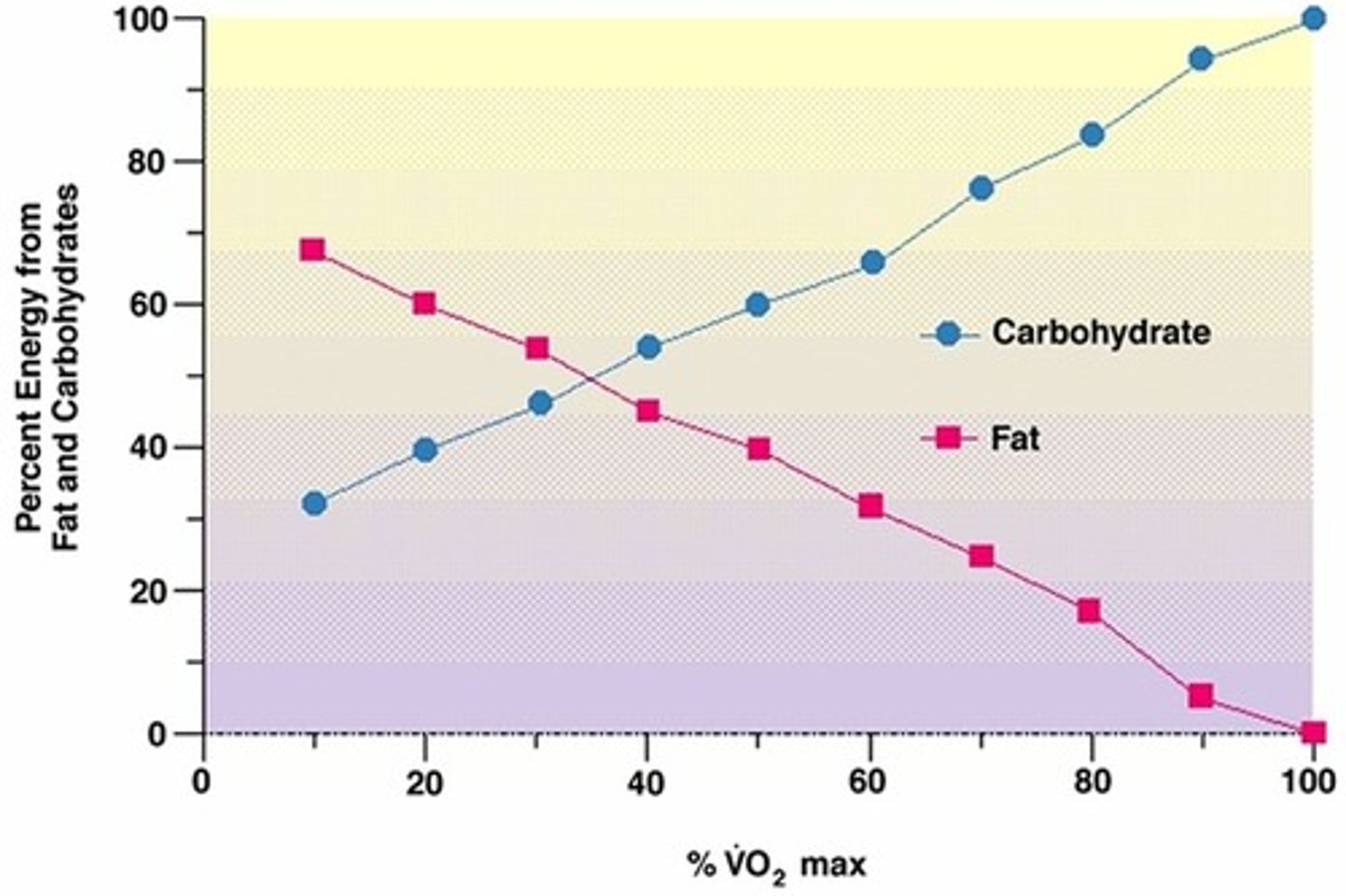
What is the crossover concept? How does endurance training impact the curve - specifically at a given exercise intensity how does endurance training impact fat oxidation?
a. The Crossover Concept is a theoretical means to understand the effects of exercise intensity on the balance of carbohydrate and lipid metabolism during sustained exercise. b. Endurance training shifts the curve so that at higher exercise intensities fat is the primary fuel source for ATP production by aerobic metabolism. c. Physiological adaptations: ↑ fatty acid mobilization from adipose tissue, ↑ number and density of capillaries in trained muscles that increases energy substrate delivery, ↑ transport of FFAs through the muscle fibers plasma membrane, ↑ fatty acid transport inside muscle cell, ↑ size and number of mitochondria, ↑ quantity of enzymes involved in β-oxidation, citric acid cycle metabolism, and electron transport chain, ↑ IMTG's
How does endurance exercise training impact the rate of lactate appearance in the blood and what is a physiological adaptation that contributes to this?
Exercise training decreases the rate of lactate appearance during exercise due to increased size and number of mitochondria as well as increased activity and number of aerobic enzymes which facilitates formed pyruvate entering aerobic metabolism instead of being converted to lactate.
Which is NOT an adaptation to anaerobic exercise training?
Increased quantity and activity of key enzymes that control aerobic metabolism
True or False. An endurance trained athlete takes longer to achieve steady state oxygen consumption trained athlete takes longer to achieve steady state oxygen consumption than an untrained individual.
False
Higher plasma epinephrine/norepinephrine levels during exercise with training contributes to a greater reduction in circulating glucagon levels during exercise which helps maintain blood glucose levels.
Insulin
Epinephrine/Norepinephrine
Which scenario would result in an individual beginning exercise with the highest amount of skeletal muscle glycogen levels?
Endurance trained individual following a high CHO diet
True or False. Endurance Training will cause an increase in an athlete's intramuscular triglyceride stores.
True