PSYC 351 Final Exam Study Guide
 Call Kai
 Learn
Learn Practice Test
 Spaced Repetition
 Match
Match Flashcards
 Knowt Play
1/105

There's no tags or description
Looks like no tags are added yet.
Name | Mastery | Learn | Test | Matching | Spaced | Call with Kai |
|---|
No analytics yet
Send a link to your students to track their progress
106 Terms
One way the method of limits is different from the method of constant stimuli is that only the method of limits:
limits VS constant stimuli: constant stimuli is randomized
One way the method of limits is different from the method of adjustments is that only the method of limits:
limits VS adjustments: who controls it
According to Signal Detection Theory, which of the following would result in an INCREASE in FALSE ALARMS?
adopting a liberal response criterion (shifting the threshold to the left)
According to Signal Detection Theory, which of the following would result in an DECREASE in FALSE ALARMS?
an observer adopts a more conservative decision criterion (shifting the threshold to the right)
What is a key difference between an absolute threshold and a Just Noticeable Difference (JND)?
absolute: minimum intensity to detect PRESENCE of stimulus 50% of time
JND: minimum intensity to detect difference between 2 existing stimuli 50% of the time
Which of the following is considered a DIRECT measure of brain activity?
EEG is a direct measure of brain activity
Person A has a more conservative criterion than Person B, but they have the same sensitivity. Which of the following figures below correctly represents Person A vs. Person B with regards to Signal Detection Theory?
Curves should the same distance apart, but line for Person A should be more towards the right
Which of the following statements about the wavelengths of visible light is TRUE? [Note: you don’t have to know the exact #’s, but you should know the relative directions of which colors are longer vs. shorter wavelengths, including outside of the visible spectrum].
purple has shortest wavelength, red has longest
X-rays | UV | visible purple → visible red | IR | microwave | radio
Your dog Rufus has a bright green toy ball that is perfectly round. However, he has dropped it to the bottom of the pool, and now it looks more like an oval to you through the water. Which of the following statements most accurately describes why your eye is seeing an oval green ball underwater?
light refraction
When light strikes a photoreceptor, what happens to its electrochemical process?
cells become hyperpolarized
Which stimulus would optimally activate an OFF-center ganglion cell?
lights being turned off/darkness
What best describes the relationship between Convergence and Receptive Field size?
direct relationship
A bipolar cell begins releasing more neurotransmitters to a ganglion cell. Which of the following statements CANNOT be true about why this is happening?
bipolar cell was depolarized by an increase in glutamate release from the photoreceptors
(also, bipolar cells cannot fire action potentials)
Relative to photoreceptors, ON bipolar cells have a _________ pattern of depolarization because they have __________ glutamate receptors.
reverse, metabotropic
The left visual field projects to the _______ half of each eye and then is processed by the LGN in the _______ hemisphere.
right; right
Which of the following statements about cortical magnification is TRUE?
cortical magnification: dramatic scaling of information from different parts of visual field
→ proportionally much more cortex devoted to processing fovea than the periphery
→ periphery sees multiple levels of acuity loss due to converging steps
Which factor for a bar of light DOES NOT alter V1 simple cells firing rates
simple cells respond to both orientation and location
(DO effect: orientation, spatial frequency, edges, gratings → orientation, position, length, duration)
Lupo is an eye doctor. A patient comes in and complains about losing sight in their left or right eye completely. Which region might Lupo suspect is damaged in this patient?
one eye or one optic nerve is damaged (contralateral optic nerve to eye)
Lupo is an eye doctor. A patient comes in and complains about losing sight in the outer parts of their visual field. Which region might Lupo suspect is damaged in this patient?
optic chiasm
Lupo is an eye doctor. A patient comes in and complains about losing sight in one side of the visual field in both eyes. Which region might Lupo suspect is damaged in this patient?
visual pathways from the optic chiasm to the visual cortex in the back of the head
→ disorder is known as homonymous hemianopia and can result from a stroke or tumor that damages one side of the brain
Which of the following is unique about V1 compared to LGN?
transformation of receptive fields from a circular center-surround organization into orientation selectivity
→ while LGN neurons (like retinal ganglion cells) respond best to circular spots of light, V1 neurons are finely tuned to detect edges, bars, or lines at specific orientations.
Which area(s) is not part of extrastriate cortex?
V1 (striate cortex)
→ V2-5 are all part of the extrastriate
Which of the following behaviors would NOT be a sign of agnosia?
general memory loss, motor dysfunction, etc.
Which of the following deficits would most likely indicate a lesion specifically to V2?
intact acuity, but impairments in grouping principles, perception of emergent objects
The principle of relatability helps us to understand:
when edges are and are not amodally completed behind occluders
relatability → assuming two line segments that share the same slope/contour are part of a continuous whole
Which scenario is best understood via a Reverse Hierarchy Model, rather than just via Feed Forward model?
anything that requires a top-down, general, categorical impression
Keith likes fishing. Whenever he has his fishing line in the water, if he feels even the slightest tug, he immediately starts trying to reel in his fishing line to see if he caught anything. How would signal detection theory describe Keith’s behavior?
his criterion is really liberal and shifted more left
What statement best explains the relationship between receptive field size and complexity as you move from V1→V2→V4→Inferotemporal cortex?
receptive field (RF) sizes increase while the complexity of encoded visual features—such as shapes, objects, or faces—increases in parallel
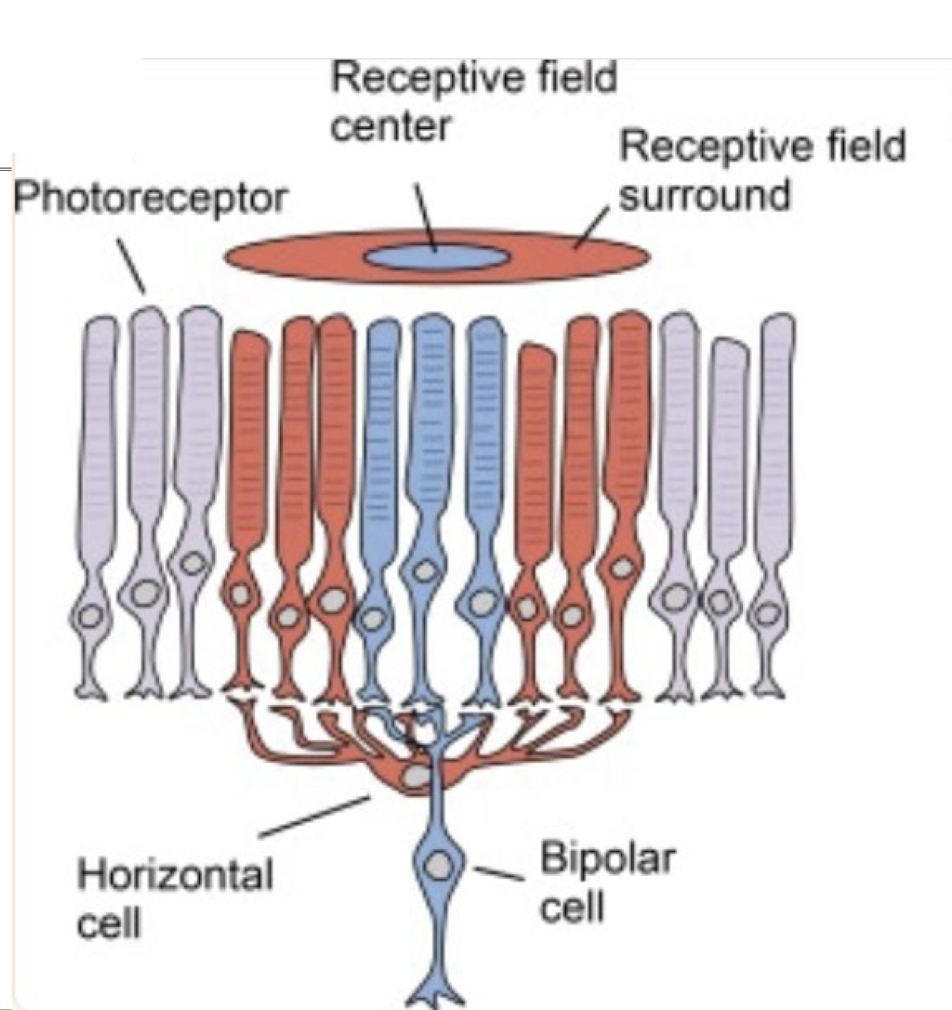
How is the center-surround system of vision accomplished? [know the different cells in the earlier layers]
1. horizontal cells connect additional photoreceptors to bipolar cells
→ the cells that are indirectly connected leads to a reversed connection (creating the “surround”) (opposite of a direct effect)
lateral inhibition: process of adjacent cells at the same level blocking, or inhibiting, each other’s effects
What type of color-blindness results in a univariance problem?
Monochromacy
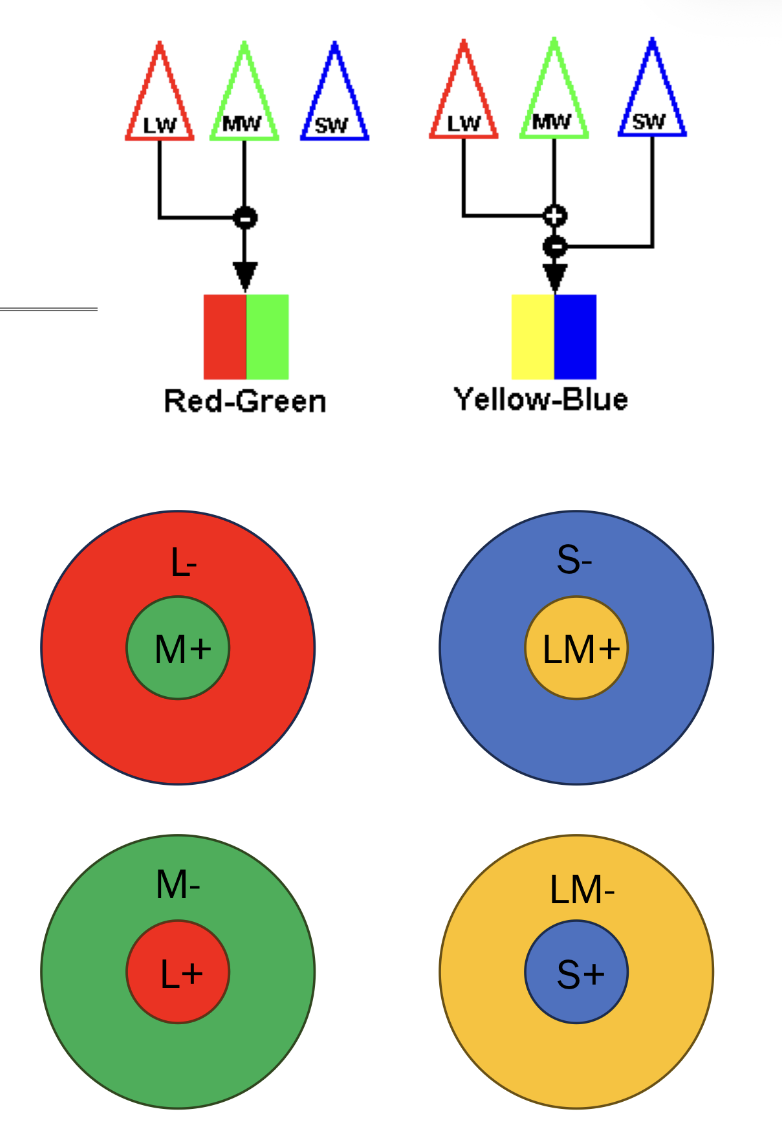
A single opponent cell in the LGN is shown to have a [COLOR] center. What must its surround be coded as? [I will give you the center color on the exam, you’ll need to pick the appropriate surround wavelength and +/-].
red + green | blue + yellow
L + M (+/-) | S + LM (+/-)
→ a + center is ON center, a - center is OFF center
What is one potential explanation for why some people on the internet perceived “The Dress” as blue and black, while others perceived it as white and gold?
color constancy & heuristics
When your brain is processing color, it often discounts what factor?
illuminant
Which of the following statements about white light is true?
not all white light is equal
white light is composed of all the colors of the visible spectrum
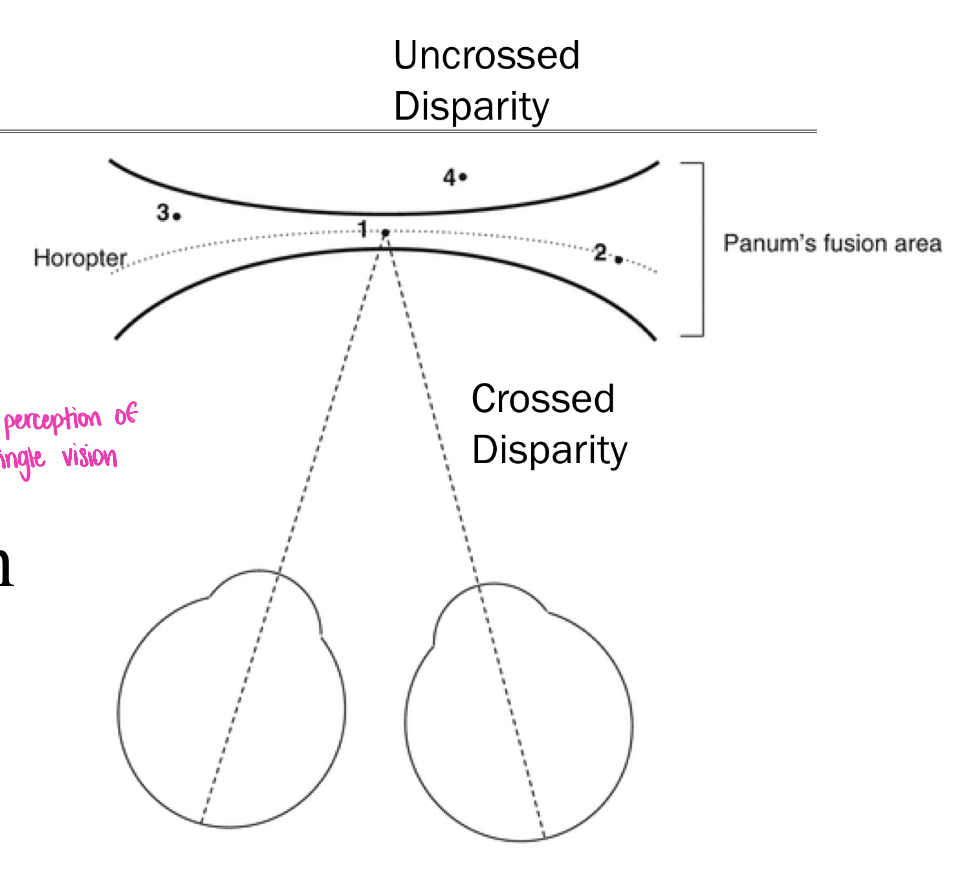
Which of the following statements about Panum’s Fusion Area is true?
everywhere outside of the horopter has retinal disparity
in panum’s area, the disparity is small enough that you can percieve single vision (brain can solve correspondence problem)
disparity past that area creates diplopia (double vision)
In the image below [provided on the exam] A and B are triangles that are partially obstructed by a square. However, A and B are at different distances from you. What depth cue would suggest that A is most likely closer to you than B?
A is larger than B
A is closer to the ground than B
A has larger texture and less spatial frequency than B
A is more clear and distinct than B
In the image below [provided on the exam] A and B are triangles that are partially obstructed by a square. However, A and B are at different distances from you. What depth cue would suggest that A is most likely further to you than B?
A is smaller than B
A is higher from the ground than B
A has smaller, tighter textures and increased spatial frequency compared to B
A is hazier and less distinct than B
Which region of the brain cannot have cells that are sensitive to retinal disparity?
the LGN
Which depth cue likely requires brain area MT to be effective?
motion parallax
Which of the following is an example of the binding problem in visual attention?
Illusory Conjunction?
binding problem: need to bind/unbind features to complete target search
You are conducting a perception experiment with 2 conditions. In condition 1, the task is to find straight lines of ANY orientation. In condition 2, the task is to find lines of exactly 45 degree orientation. You are recording from a V1 cell with orientation selectivity for 45 degree lines. You predict that in Condition 1, attention will cause ___________, while in condition 2 attention will cause __________ to the cell. [Each blank is 1 of the 4 ways attention can impact cell firing]
no firing; firing
Ingrid is running a cuing paradigm where participants are attending to 4 possible locations, labeled A, B, C, and D. A and B are close to each other, C and D are close to each other, but A and B are relatively far from C and D. When Ingrid provides an invalid cue for Point A [meaning the cue is at point A but the target does not appear there], she finds that the response time cost is less when the target appears at Point C than at Point B [despite B being closer]. What is one possible reason for this finding?
A and C are within the same object despite being farther away
If you are searching for your car keys and you restrict your attention to horizontal surfaces near the front door, you are using:
scene-based guidance
Hemineglect has been shown to be a deficit of conscious attention, not of overall visual perception. What data make it clear that participants are indeed perceiving the neglected side of space, even if they cannot attend to it?
stuff they are perceiving can still influence their decisions
The marquee outside of a theater has lights in a loop that blink on and off in rapid succession, leading to the impression that the lights are moving around the marquee. This is an example of which type of motion?
apparent motion
Nirav is watching a soccer game. For a while, he is fixated on the goalie who is just standing in front of the goal. Nirav then quickly moves his eyes to midfield to watch the action, but realizes he didn’t notice the ball move while he shifted his eyes. This is due to _______________.
saccade
A person detects an object moving. It passes from the receptive field of Cell A to the receptive field of Cell B. For a motion sensitive cell in V1 to respond appropriately to this motion, what is the correct wiring of cells between A & B to V1? D = Delay Cell, and X = Multiplication Cell.
Cell A → Delay Cell (D) → Multiplication Cell (X)
Cell B → Multiplication Cell (X)
Multiplication Cell (X) → V1 Motion Sensitive Cell
- Multiplication Cell (X) fires only when both signals arrive simultaneous
The Superior Colliculus may receive input from all of the following brain regions EXCEPT:
YES to:
LGN
parietal cortex
Frontal eye field
Which statement comparing the tympanic membrane and the oval window is FALSE?
“The oval window is larger than the tympanic membrane.”
→ The tympanic membrane (eardrum) is significantly larger (\(14-20\) times) than the oval window.
"The oval window is used to amplify sound vibrations from a smaller area to a larger area.”
→ The sound is transferred from the larger tympanic membrane to the smaller oval window, which concentrates the force to amplify pressure.
"The tympanic membrane has a higher acoustic impedance than the oval window."
→ The oval window leads to the fluid-filled inner ear, which has a much higher impedance than the air-filled outer ear, requiring the middle ear to act as an impedance matcher.
What wavelength of sound is coded in the APEX of the cochlea and why?
low-frequency; apex is wide & flexible
tip/helicotrema
What wavelength of sound is coded in the BASE of the cochlea and why?
high-frequency
base
Which of the following is an example of Rate Saturation?
when an auditory nerve fiber reaches its maximum firing rate (spikes per second) in response to a sound, and further increases in sound intensity (volume) do not produce a higher firing rate
Experimenters were recording from two Auditory Nerves (1 and & 2). They first played Sound 1 and recorded the spiking from each Auditory Nerve, and then played Sound 2 and recorded from each auditory nerve. The results are graphed below [Will be provided on test]. What can you conclude about Auditory Nerves 1 and 2 from this data?
high-spontaneous fibers start firing at lower dB, and low-spontaneous fibers require higher-intensity sounds before they fire
neurons also carry temporal coding (phase locking: where a single neuron fires at a distinct point along a cycle of a given frequency sound wave)
Which of the following data from a Posner’s Cuing Paradigm would be most likely to be evidence for inhibition of return?
the cues slows the participant’s response relative to no cue at all
inhibition of return: if attention is cued to a location but then leaves that location, often even slower to return to it than if there had never been a cue
How is proprioception and/or kinesthesia important for [type of vision] perception? [I will pick one of the key types of visual perception: motion, depth, attention, and you’ll need to tell me how proprioception/kinesthesia might be involved]
![<p>NEW What part of the Cochlear partition is labeled _______. [I will pick one of</p><p>the unlabeled locations in the below figure and you’ll have to name it]</p>](https://assets.knowt.com/user-attachments/d512053c-de50-4dab-8f9e-1b3433a5051b.png)
NEW What part of the Cochlear partition is labeled _______. [I will pick one of
the unlabeled locations in the below figure and you’ll have to name it]