4.2 Poverty + inequality
 Call Kai
 Learn
Learn Practice Test
 Spaced Repetition
 Match
Match Flashcards
 Knowt Play
1/16

There's no tags or description
Looks like no tags are added yet.
Name | Mastery | Learn | Test | Matching | Spaced | Call with Kai |
|---|
No analytics yet
Send a link to your students to track their progress
17 Terms
Absolute poverty
When income is below the threshold of $2 per day(measured by PPP) to access the most basic, life sustaining goods + services. food, water, shelter
Relative poverty
Earning less than a particular percentage of a country’s average income.
In the UK, this percentage is 60%, in Australia, it’s 50%.
Equity vs inequality
Equity: Fair distribution of income
-horizontal equity: Those with the same incomes are taxed the same.
-vertical equity: higher income earners pay higher taxes.
Equality: equal distribution of income
Causes of poverty
ABSOLUTE
Unemployment: Cyclical- lack of AD in economy, workers lose jobs+income. Structural- lack skill for higher paying jobs, lose jobs+income.
Increased pop + density: strain on resources, higher prices and lower supply, less disposable income to spend on basic needs
RELATIVE
Poor health/ healthcare + access: limits productivity, increased spending on health so less to spend on basic needs, less earning potential,
Poor education/ skills + access: limits productivity, limits earning potential, limits the kind of jobs people can take
Tax cuts for high income earners: more disposable income, increased divide between rich + poor
Income
The flow of money received each year.
Salary, interest earned on cash in the bank, benefit payments
Income inequality
The uneven distribution of income among individuals or households.
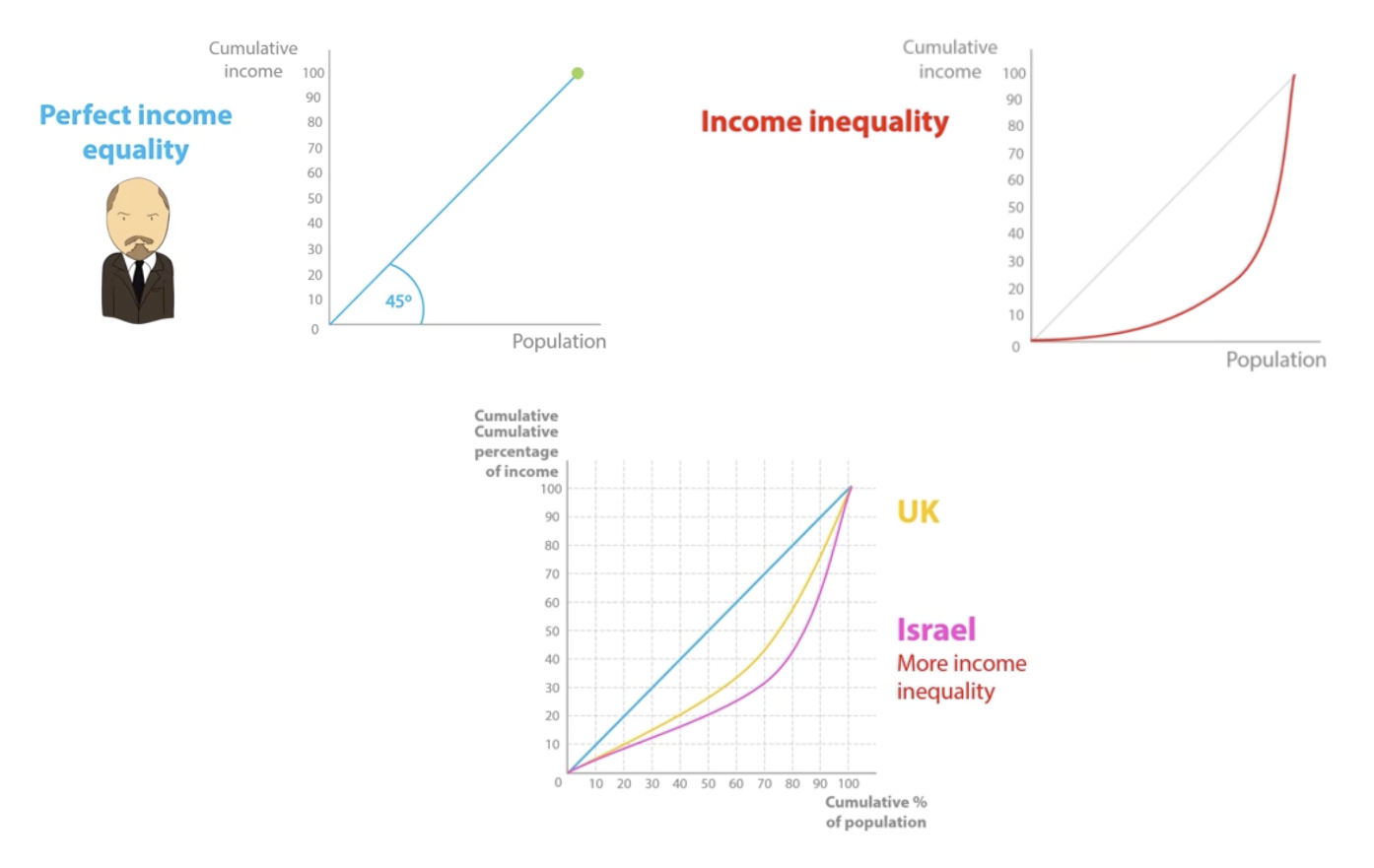
Lorenze curve
Measures income inequality across countries.
-the closer a country’s Lorenz curve is to the 45° line of perfect equality, the more equal its incomes are.
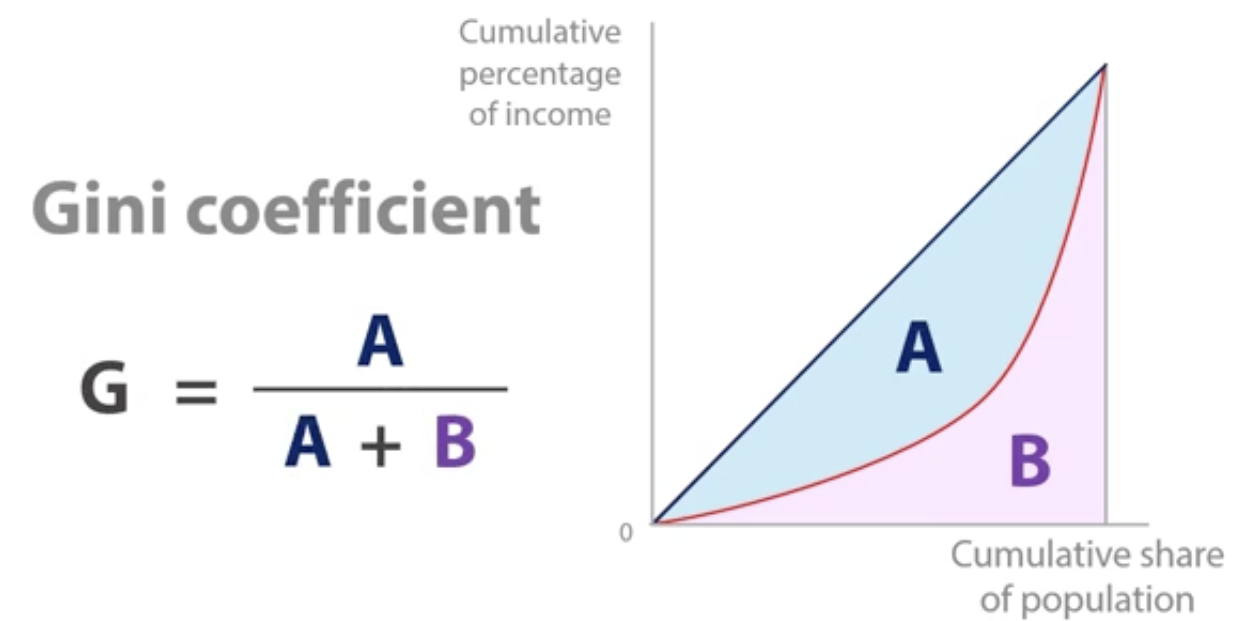
Gini coefficient
As Gini coefficient increases, income inequality increases.
-always between 0 and 1 where 0=perfect income equality and 1=total income inequality
Wealth
Stock of all your assets added up.
-house, car, shares, stocks, etc.
Wealth inequality
When wealth is distributed unequally between a population.
Causes of income+wealth inequality
within a country vs between countries
Experience: more skills gained over time→more experience→demand higher wages→earn higher income→accumulate more wealth over time
Differences in education: the more qualifications someone has, the greater the earning potential→higher income
Taxation policy: low income earners taxed a higher % of income + vice versa for high income→ increase + wealth gap between diff groups.
Between countries:
Globalisation: offshored + outsourced countries earn less and profits go back to AC’s, CA in one country.
Geopolitical factors: war, conflict, political instability, hinder development.
Policies to reduce income+wealth inequality
Taxation: ↑ progressive tax and ↓ regressive tax→ taxing rich more and poor less→poorer get more disposable income.
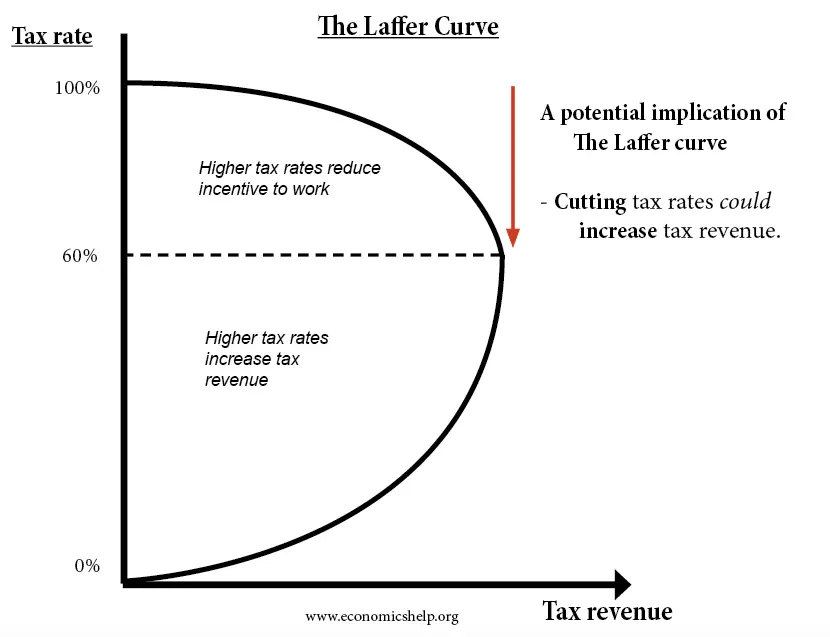
Laffer curve- Incentive to earn higher incomes decrease→less tax revenue by gov.
Reduced regressive taxes means large reduction in tax. revenue by gov.
Increase benefits: benefits (e.g. unemployment, child support)given to those on lower incomes to increase their incomes.
More incentive to stay on benefits + not find work- strain on public finances.
Higher gov. spending→budget deficit
Gov. spending on education/ training + healthcare: more skills/ better health→increase productivity→higher wages+incomes
High gov. spending→budget deficit. Long time to take an effect.
Capitalist
People who own and use the factors of production in the hope of making money or profit.
Capitalism
An economy with capitalists in it.
-thrives best in free economies as all factors of production are allocated by the price mechanism, not the state.
How does capitalism limit economic growth
When workers have low wages, they will not have enough money to invest in the economy. This will therefore hold back AD and limit growth.
If capitalists save their wealth, then there is a leakage from the circular flow of income. It will also mean less investment or consumption, so AD will not shift out as far as it could. So workers don’t see the increase in living standards(due to leakage from circular flow of income).
How does capitalism improve inequality
Income inequality can incentivise people to take risks- improves economy by ↑ investment which leads to an outward shift in AD. This will ↑ derived demand for labour, ↑ employment for low income ppl. This will lead to greater output + improved living standards for everyone.
-more competition can decrease prices
How can capitalism create inequality
Business owners can decide their own income/ wages. So they can decide to pay themselves higher wages. And they can pay their workers smaller wages. This leads to income inequality.
Creates winners + losers: some people can invest their money and make big profit. Some people can invest their money and lose all of it(if it fails, e.g. due to failed investment). Mixed economies can close the gaps between winners and losers, by providing public goods like school for the losers, and taxing the rich for the winners.