lecture 9- alpha error accumulation
 Call Kai
 Learn
Learn Practice Test
 Spaced Repetition
 Match
Match Flashcards
 Knowt Play
1/10

There's no tags or description
Looks like no tags are added yet.
Name | Mastery | Learn | Test | Matching | Spaced | Call with Kai |
|---|
No analytics yet
Send a link to your students to track their progress
11 Terms
What are decision errors?
there is a test decision at end of hypothesis test
P<.05 - significant, test decision for H1, non-zero effect
P>.05 - non-significant, test decision for H0, effect may be zero
This decision may be wrong
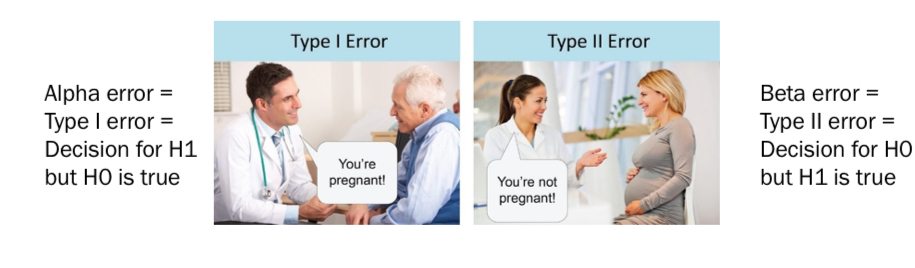
type I / alpha errors are controlled in the hypothesis test
Comparing p to 0.05. 5% probability that a test decision for H1 even though H0 is true.
Type II / beta errors are reduced by high statistical power (sample size)
Stat power= probability of detecting an existing effect
Type II - 1-power (prob of not detecting an effect if it exists)
What is the problem of multiple testing?
researchers often conduct more than one hypothesis test
Can be legit or because they are fishing
What is the probability they make an alpha error across multiple tests?
What is a composite hypotheses?
an OR hypothesis
E.g. H1: E ≠ S OR E ≠ W OR E ≠ NI OR S ≠ W OR S ≠ NI OR W ≠ NI
if at least one of the statements is true, then H1 is true
Each statement is tested with one t-test
What is the probability of making a correct decision for H0 in multiple testing?
E.g. If there is truly no difference in knowledge between countries:
probability of NOT making an alpha error in a single test: 1-a
Probability of NOT making alpha error in any test: 1 - ɑ) ・(1 - ɑ) ・(1 - ɑ) ・(1 - ɑ) ・(1 - ɑ) ・(1 - ɑ)
= (1 - ɑ)6
for a = 0.05, this is 73.5%
So 26.5% chance of making at least one error
This is alpha error accumulation.
What is alpha error accumulation?
increase in probability of making a type 1 error when conducting multiple statistical tests
What is family-wise error rate?
probability of making at least one type I error across multiple tests
What is comparison-wise error rate?
probability of making a type I error in a single test
What is the Sidak correction method?
an alpha error correction method- lowering the alpha level in each test to keep family-wise error rate small
Probability of making at least one type I error: 1 - (1 - ɑ)N
Simply invert the function to calculate the FWER. α= 1-√(N&1-FWER)
What is the Bonferroni correction method?
α= FWER/N
Bonferroni always corrects a bit too much but is much easier and used more often.
When should you correct?
the goal of a hypothesis test is to provide a way of deciding about a research hypothesis
This decision is necessarily temporary / intermediate and part of a bigger research program where theories can change over time
Only correcting at the level of an individual study is enough - usually test one research hypotheses
If they are composite hypotheses that require multiple tests, these are a family of tests.
Correct for families, not all tests.
Use alpha error correction methods for OR hypothesis but not for AND hypothesis
Are all families equal?
correction methods need to be applied for OR hypotheses where discovery is claimed if at least 1 is significant
But not all composites are OR hypotheses e.g. reading a book before bed is better for sleep quality than a podcast, which is better than scrolling on your phone.
OR hypotheses: single type I error in any test- wrong decision for H1- grows more likely with many tests.
AND hypotheses: all hypothesis tests need to make type 1 errors for a wrong decision for H1- grows less likely with many tests.