microbio exam 1 short answer
 Call Kai
 Learn
Learn Practice Test
 Spaced Repetition
 Match
Match Flashcards
 Knowt Play
1/44

There's no tags or description
Looks like no tags are added yet.
Name | Mastery | Learn | Test | Matching | Spaced | Call with Kai |
|---|
No analytics yet
Send a link to your students to track their progress
45 Terms
Why study microbiology?
To understand microorganisms, how they affect health, and how they can be used to benefit people.
What are the 7 classes of microbes? How are they similar? Different?
Bacteria – Single-celled prokaryotes.
Archaea – Single-celled prokaryotes that are different from bacteria.
Fungi – Eukaryotes such as molds and yeast that absorb nutrients.
Protozoa – Single-celled eukaryotes that eat other organisms.
Algae – Eukaryotes that make their own food through photosynthesis.
Helminths (worms) – Multicellular eukaryotic parasites.
Viruses – Non-living infectious agents that need a host cell to reproduce.
Similar:
-They are all microscopic or studied in microbiology.
-Many can affect human health, either positively or negatively.
-Most reproduce and live in many different environments (except viruses, which need a host).
Differences:
-Cell type: Bacteria and archaea are prokaryotes; fungi, protozoa, algae, and helminths are eukaryotes; viruses are not cells.
-Number of cells: Some are single-celled (bacteria, archaea, protozoa), while others are multicellular (helminths; many fungi and algae).
-Nutrition: Some make their own food (algae), while others consume or absorb nutrients (fungi, protozoa, helminths).
-Viruses are unique because they cannot reproduce on their own and must infect a living cell.
What are some of the benefits of microbe? Some of the problems they cause?
benefits :
-Help digest food and support human health.
-Produce oxygen (some algae).
-Make antibiotics, vaccines, and medicines.
-Help make foods like yogurt, cheese, and bread.
-Break down dead organisms and waste, recycling nutrients.
-Help clean up pollution through bioremediation.
Problems:
-Cause infectious diseases (such as strep throat, tuberculosis, and COVID-19).
-Spoil food.
-Cause food poisoning.
-Damage crops and plants, reducing food production.
-Cause infections in humans and animals.
-Some produce toxins that can make people sick.
What is life? Are all microbes “alive?”
Life is usually defined by a set of characteristics that living things share, such as:
-Being made of cells
-Using energy (metabolism)
-Growing and developing
-Responding to the environment
-Reproducing
-Having genetic material (DNA or RNA)
-Maintaining internal balance (homeostasis)
No not all alive :
-Most microbes like bacteria, fungi, protozoa, algae, and helminths are alive because they are made of cells and carry out all life processes.
-Viruses are not considered living because they:
-Are not made of cells
-Do not use energy on their own
-Cannot reproduce without a host cell
What is the binomial nomenclature system? How do you correctly write the name of a microorganism? How and when do you abbreviate it?
A 2-part naming system for living things (genus - capitalized+ species-lowercased)
Compare and contrast the 5 Kingdom vs. the 3 Domain systems of classification. What criteria does each use for classification?
5-kingdom (Whittaker) : mainly how they look & how they get food
Groups organisms into 5 kingdoms:
-Monera (bacteria)
-Protista
-Fungi
-Plantae
-Animalia
Criteria:
-Cell type (prokaryote vs eukaryote)
-Number of cells (unicellular vs multicellular)
-Mode of nutrition (autotroph vs heterotroph)
-Cell structure (complexity, cell wall type)
3 domain system (Woese): mainly based on genetic & evolutionary relationships not just appearance
Groups all life into 3 domains:
-Bacteria
-Archaea
-Eukarya
criteria :
-Genetic relationships (DNA/RNA differences)
-Ribosomal RNA (rRNA) sequences
-Evolutionary ancestry
What is Spontaneous Generation? What is Biogenesis? How was spontaneous generation finally rejected?
-the old idea that living things can arise from non-living matter.
-the idea that all living things come from other living things.
-Louis Pasteur experiments: He boiled broth to kill all microbes. The flask allowed air in but blocked microorganisms. No life grew in the broth unless microbes were allowed in.
What is a spore former/bacterial endospore? How did it complicate the quest to disprove spontaneous generation?
-A spore former is a type of bacterium that can produce an endospore.
-Bacterial endospore: a tough, dormant (inactive) survival structure made inside some bacteria.
When conditions improve, the endospore can germinate and become a normal, active bacterium again.
-Endospores made it harder to prove that life only comes from life because:
-Endospores are very resistant to heat and sterilization
-Early scientists would boil broth or food to kill -microbes
-But endospores could survive boiling
-Later, these spores would grow back into bacteria
Robert Hooke
-First used a microscope to study cork
-Named the term “cells”
-Contribution: Started cell biology and early microscopy
Antoni van Leeuwenhoek
-Built powerful microscopes
-First to observe living microorganisms
- Contribution: Discovered bacteria and “animalcules” (protozoa)
Girolamo Fracastoro
-Suggested diseases are spread by invisible particles (“germs”)
-Contribution: Early idea of germ theory
Joseph Lister
-Introduced antiseptic surgery using disinfectants
- Contribution: Reduced surgical infections
Louis Pasteur
-Disproved spontaneous generation
-Developed germ theory, pasteurization, vaccines
Contribution: Founder of modern microbiology
Robert Koch
-Linked specific microbes to specific diseases
-Created Koch’s postulates
- Contribution: Proved bacteria cause disease
Angelina & Walther Hesse
-Introduced agar as a solid growth medium
-Contribution: Made bacterial culturing possible
Alexander Fleming
-Discovered penicillin
-Contribution: First antibiotic, revolutionized medicine
How does an immunization work?
Immunization trains your immune system to recognize and fight a disease before you actually get infected by giving your body a safe germ, like a vaccine, to create antibodies to fight it so your body recognizes the germ
Why were antibiotics considered the “wonder drugs?” Are they still “wonder drugs,” today?
Bc they could quickly cure bacterial infections that were once deadly or untreatable.
-They killed bacteria causing diseases like pneumonia, strep throat, and infections after surgery
-They greatly reduced death rates from infections
-They made surgery and childbirth much safer
-They worked fast and effectively compared to earlier treatments
Antibiotics were “wonder drugs” because they revolutionized medicine by curing deadly infections. They are still very important today, but antibiotic resistance means they are not as powerful as they once were.
how do you calculate total magnification?
Objective power x ocular power
How does resolving oil help you visualize a sample when using the 100X objective?
Resolving oil is placed between the slide and the 100X lens to improve image clarity and detail.
How it helps:
-Light normally bends (refracts) when it passes from glass → air → lens
-This bending can cause blurry images and loss of detail
-Immersion oil has the same refractive index as glass
-This means light passes straight through instead of bending
Result:
-More light enters the lens
-Less distortion happens
-You get a sharper, clearer image with higher resolution
When would you need to use an electron microscope?
when you need to see things that are too small for a light microscope to resolve clearly.
How can you prepare a sample for viewing under the microscope?
1.) Place a drop of the sample on a clean glass slide
2.) Spread it thinly so light can pass through
3.) Add a stain (if needed) to make cells easier to see
4.) Place a coverslip on top to flatten and protect the sample
5.) Remove air bubbles so the image is clear
What can a simple stain tell you? A differential stain? A structural stain?
Simple: Shows what the cells look like using one color.
Differential: Uses multiple colors to tell bacteria apart.
Example: Gram stain
Gram-positive = purple
Gram-negative = pink
When would you use enriched agar?
You use enriched agar when bacteria won’t grow on regular media because they need special nutrients to survive and multiply.
What can selective and differential agar tell you?
Selective: Shows what can survive and grow in that medium.
Differential: Shows how bacteria are different from each other while growing.
What would be the benefit of using a streak plate over a pour or a spread plate?
A streak plate is better because it is the quickest and easiest way to isolate pure bacterial colonies for study.
What are the characteristics of life?
Life is defined by being cellular, using energy, growing, responding, reproducing, having DNA, maintaining balance, and evolving.
Compare and contrast prokaryotic and eukaryotic cells. In which ways are they similar? In which ways are they different?
Similarities
-Have a cell membrane
-Contain cytoplasm
-Have DNA (genetic material)
-Contain ribosomes (make proteins)
-Carry out basic life processes like metabolism and growth
differences
Prokaryotic cells
-No nucleus (DNA is in the nucleoid/nuclear region)
-No membrane-bound organelles
-Usually smaller and simpler
-Single-celled organisms
-Examples: bacteria, archaea
Eukaryotic cells
-Have a true nucleus (DNA enclosed in membrane)
-Have membrane-bound organelles (mitochondria, ER, Golgi, etc.)
-Usually larger and more complex
-Can be single-celled or multicellular
-Examples: animals, plants, fungi, protists
Will prokaryotes ever evolve to be the size of an elephant? Why or why not?
Prokaryotes can’t grow to elephant size because their simple cell structure and nutrient limits prevent them from supporting large bodies.
They stay microscopic, while large organisms are made of many specialized eukaryotic cells.
Prokaryotes do not have compartments like eukaryotic cells do in which to carry out chemical reactions. How do they accomplish tasks like respiration and photosynthesis?
prokaryotes don’t have membrane-bound organelles, they still carry out essential processes by using their cell membrane and internal enzymes spread throughout the cytoplasm
-Prokaryotes perform respiration on the cell (plasma) membrane
-The membrane contains electron transport chain proteins
-ATP is made when enzymes embedded in the membrane create a proton gradient
How does a prokaryotic flagella move the cell?
-The flagellum is attached to a motor protein embedded in the cell membrane
-This motor uses energy (usually from proton movement/gradient) to spin the flagellum
-The flagellum rotates like a propeller in water
-This pushes the cell forward (or backward depending on direction
counterclockwise rotation → “run” (straight movement)
Clockwise rotation → “tumble” (random reorientation)
This is how bacteria perform chemotaxis (moving toward food or away from toxins).
What is a biofilm and how does it make a bacterial cell more virulent?
A biofilm is a community of microorganisms that stick together on a surface and are surrounded by a self-produced slimy protective layer (glycocalyx).
Ex. dental plaque, Slime on pipes & rocks
Biofilms make bacteria more dangerous because they:
Protect bacteria from antibiotics
Drugs have a hard time penetrating the slime layer
Hide from the immune system
White blood cells can’t easily reach or destroy them
Allow long-term survival
Bacteria can stay in the body and cause chronic infections
Share genes easily
Bacteria in biofilms can exchange DNA (including antibiotic resistance genes)
What reagents are used in the Gram Stain? How do they work and what do they tell you about the bacterial cell wall?
1. Crystal Violet (Primary stain)
What it does: Stains all bacteria purple
Function: Initial dye that enters all cells
Result: All cells start purple
2. Iodine (Mordant)
What it does: Forms a crystal violet–iodine complex
Function: “Locks” the purple dye inside the cell wall
Result: Makes the stain harder to remove
3. Alcohol or Acetone (Decolorizer)
What it does: Removes stain from some bacteria
Function: Key step that separates bacteria types
Important difference:
Gram-positive: thick peptidoglycan → retains purple dye
Gram-negative: thin wall + outer membrane → loses purple dye
4. Safranin (Counterstain)
What it does: Stains decolorized bacteria pink/red
Function: Makes Gram-negative bacteria visible
Final colors:
Gram-positive = purple
Gram-negative = pink/red
What it tells you about the cell wall
Gram-positive bacteria:
✔ Thick peptidoglycan layer traps purple dyeGram-negative bacteria:
✔ Thin peptidoglycan + outer membrane (LPS)
✔ Lose purple dye, take up pink stain
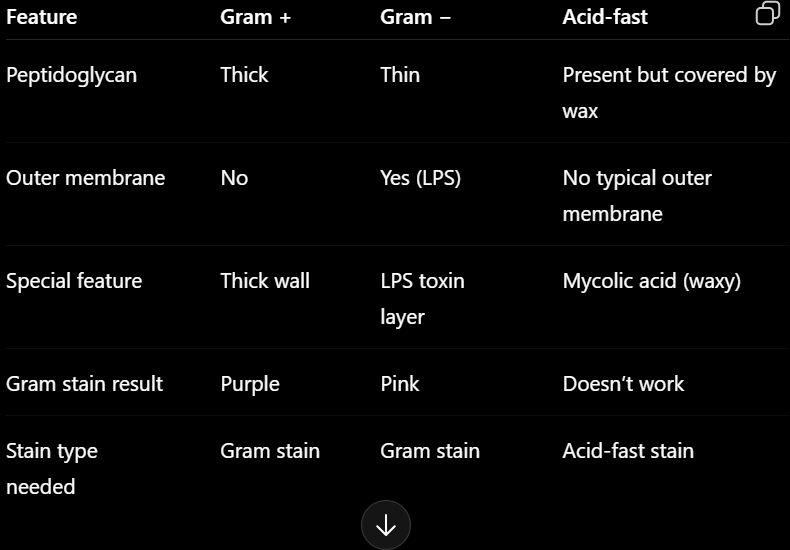
Compare and contrast the three cell wall types. Why is a special stain needed for the Acid-fast bacteria? Why doesn’t the Gram Stain work?
Why Gram stain doesn’t work
Gram stain depends on dye binding to peptidoglycan
Acid-fast bacteria have a waxy barrier that blocks dye entry
Even after staining, they resist decolorization differently, so results are unreliable
How do the Mycoplasma bacteria resist osmotic shock?
Mycoplasma resist osmotic shock by strengthening their cell membrane with sterols, since they lack a rigid cell wall.
Vibrio cholerae
Gram-negative, comma-shaped (vibrio), motile with flagellum | Causes cholera → severe watery diarrhea | Can cause rapid dehydration and death without treatment |
Mycobacterium tuberculosis
Acid-fast bacteria with waxy mycolic acid cell wall | Causes tuberculosis (TB) | Airborne disease that spreads easily and affects lungs |
Clostridium tetani
Gram-positive, endospore-forming, anaerobic rod | Causes tetanus (muscle stiffness/spasms) | Spores in soil can enter wounds and be deadly |
Clostridium difficile
Gram-positive, spore-former, anaerobic | Causes severe antibiotic-associated diarrhea/colitis | Can spread in hospitals and is hard to treat |
Bordetella pertussis
Small Gram-negative coccobacillus | Causes whooping cough (pertussis) | Highly contagious, dangerous for infants |
Yersinia pestis
Gram-negative rod, facultative intracellular | Causes plague (bubonic/pneumonic) | Historically caused pandemics (Black Death ) |
Streptococcus pyogenes
Gram-positive cocci in chains (strepto-) | Causes strep throat, scarlet fever, necrotizing fasciitis | Common infections that can become severe if untreated |
Staphylococcus aureus
Gram-positive cocci in clusters (staphylo-) | Causes skin infections, MRSA, toxic shock syndrome | Antibiotic resistance makes it harder to treat |
Neisseria meningitidis
Gram-negative diplococci | Causes meningitis (brain/spinal cord infection) | Can progress very quickly and be life-threatenin |
Pseudomonas aeruginosa
Gram-negative rod, opportunistic, biofilm former | Causes hospital-acquired infections (lungs, wounds, burns) | Very antibiotic-resistant and dangerous in hospitals |