MARK 1115 - Ch 4
 Call Kai
 Learn
Learn Practice Test
 Spaced Repetition
 Match
Match Flashcards
 Knowt Play
1/19

There's no tags or description
Looks like no tags are added yet.
Name | Mastery | Learn | Test | Matching | Spaced | Call with Kai |
|---|
No analytics yet
Send a link to your students to track their progress
20 Terms
three functional roles that both marketing research and marketing analytics can play in an organization:
Descriptive role: Presenting factual statements. For example, what are the historic sales trends in the industry? What are consumers’ attitudes toward a product and its advertising?
Diagnostic role: Explaining relationships within data. For example, what is the impact on a product’s sales if the colour of the packaging is changed?
Predictive role: Predicting results of a marketing decision. For example, what is the impact of a new product introduction on market share?
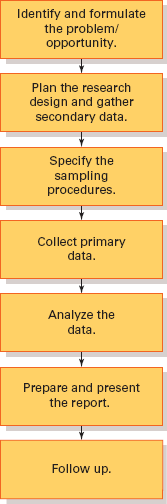
Figure 4.2 The Marketing Research Process
5 - interpret and draw conclusions from data
6 - statement of research, summary of major findings, conclusion
7 - internal/external → ask furthur questions and support decisions
vocab: research design
specifies which research questions must be answered, how and when data will be gathered, and how the data will be analyzed.
→ exploratory research - gathers information to help define the problem
→ descriptive research - describe marketing situations or markets
→ causal research - test hypothesis of cause-and-effect
probability sampling
SRS
systematic sampling - K=N/n
stratified sampling - grouped, then randomly choose n from each group
cluster sampling - grouped, then randomly choose group to survey
non-probability sampling
convenience sampling - proximity and idea
judgemental sampling - choose people based on what you think about them
quota sampling - need to have a specific amount, then use convenience/judgemental
snowball sampling - ask one person then ask if they know other people
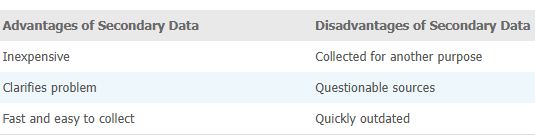
advantages and disadvantages of secondary data
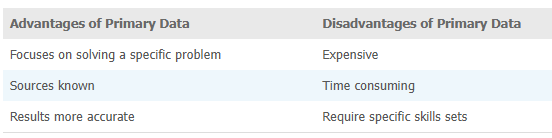
advantages and disadvantages of primary data
vocab: measurement error
occurs when the information requested by the researcher differs from the information provided by the measurement process.
→ e.g. say they bought crest toothpase when they do not
qualitative data collection method:
depth interview: involves a discussion between a well-trained researcher and a respondent who is asked about attitudes and perspectives on a topic.
→ 1-on-1
focus group: is a small group of recruited participants engaged in a nonstructured discussion in a casual environment
quantitative data collection method:
survey research
online/telephone/mall intercept interview
questionnaire
observation research/mystery shopper
experiments (laboratory/field)
observational research and mystery shopper
obs: researchers watching what other people do (behavioural pattern)
mystery: reseachers pose as customers, observational data about the store (ie. are the shelves are stocked & customer-employee interactions)
vocab: ethographic research
the study of human behaviour in its natural context, involves observation of behaviour and physical setting.
vocab: experiment
causal method - cause and effect
laboratory: researcher can create and control set of variables
field - more realistic experiment → respondant will display relevant behaviour and attitudes
vocab: big data
exponential growth in the volume, variety, and velocity of information and the development of complex new tools to analyze and create meaning from such data.
CRM
customer relationship management
records all interactions between a company and its customers
vocab: data mining
the process of sorting through large sets of data to find patterns and relationships
vocab: structured data
is data that is easily defined and organized
vocab: unstructured data
is data that is not easily defined and organized, including audio, video, photos, written messages, presentation slides, and anything else where the contents of the data don’t belong to a clear category
vocab: personally identifiable information
data that can be used to identify a particular person
vocab: anonymized data
data where personally identifiable information has been removed