RC10 - Individual differences and risk II (keyterms, mp + scenario questions)

0.0(0)
Studied by 0 people
call kaiCall Kai
learnLearn
examPractice Test
spaced repetitionSpaced Repetition
heart puzzleMatch
flashcardsFlashcards
GameKnowt Play
Card Sorting

1/28

encourage image

There's no tags or description

Looks like no tags are added yet.

Last updated 3:24 PM on 5/29/26
Name
Mastery
Learn
Test
Matching
Spaced
Call with Kai

No analytics yet

Send a link to your students to track their progress

29 Terms
1
New cards
What are the main theoretical explanations for individual differences in risk perception?
Evolutionary, biological, social/psychological, identity-based, personal experiences, personality, and historic events — and these factors often interact (intersectionality)
2
New cards
What is intersectionality in risk perception?
The idea that multiple factors (e.g., gender, race, income, culture, age, education) interact and jointly shape risk perception — no single factor operates in isolation
3
New cards
What are the three ways age differences in risk manifest (Nolte & Hanoch, 2024)?
1. Risk attitudes — older adults perceive higher risks and are less willing to take them 2. Self-reported risk taking — older adults report fewer risks 3. Behavioral measures — mixed results; older adults struggle more with learning-based risk tasks
4
New cards
In which domains do the biggest and smallest age differences in risk-taking occur?
Biggest differences: leisure and career contexts. Smallest differences: health contexts. Social contexts show unclear/mixed findings
5
New cards
What is Risk-Sensitivity Theory (applied to age)?
We take risks to satisfy needs and reach goals; because older adults have already met many goals (status, partner, wealth), the incentive for risk-taking declines
6
New cards
What is Socioemotional Selectivity Theory (Carstensen et al., 2000)?
Due to perceiving their time as limited, older adults prioritize emotionally meaningful, short-term, and social goals — leading them to avoid risks that could cause losses or negative feelings
7
New cards
Why is the age-related decline in risk-taking not universal?
Cultural and socioeconomic factors moderate it — in societies with more challenges (e.g., high inequality, low safety), risk-taking rates are higher and age-related declines are less pronounced or absent (Mata et al., 2016 across 77 countries)
8
New cards
What is the general finding on gender and risk perception (Byrnes et al., 1999; Croson & Gneezy, 2009)?
Women perceive more risks and take fewer risks than men — true across many domains; gender differences are largest for driving, intellectual/physical skill tasks and smallest for smoking, drug use, and sex
9
New cards
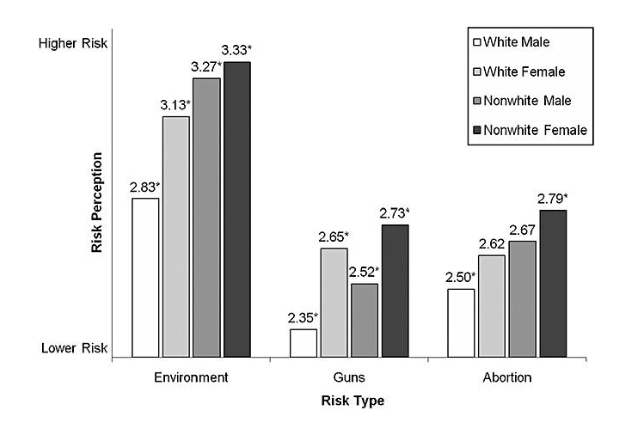
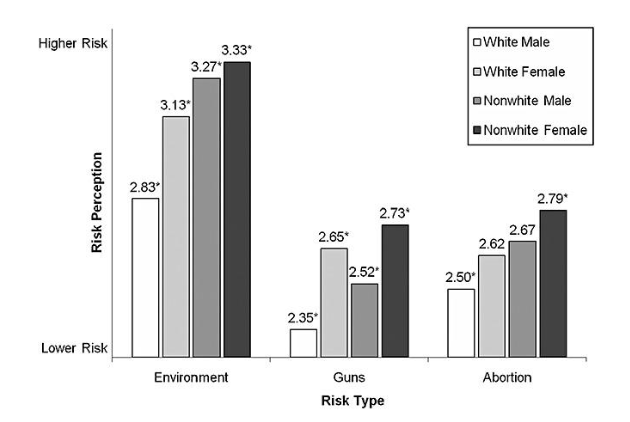
What is the white male effect?
White men consistently rate a wide range of risks as lower and less serious than women and non-white men — one of the most robust findings in risk perception research
10
New cards
What are the main explanations for the white male effect (Kahan et al., 2007)?
1. Women and less educated people have less power and feel less control 2. Social roles (economic salience vs. health/safety concern) 3. Sociopolitical factors (institutional trust) 4. Worldviews and risk skepticism (hierarchist, individualist worldviews)
11
New cards
What is the cultural cognition thesis?
People unconsciously filter and interpret risk information in a biased way to align with the values and worldviews of their cultural identity group
12
New cards

What is the cultural theory of risk (Dake, 1992 / Douglas & Wildavsky, 1982)?

A framework explaining risk perception differences through two dimensions: grid (extent of assigned social roles) and group (extent of in-group vs. out-group thinking) — producing four worldviews
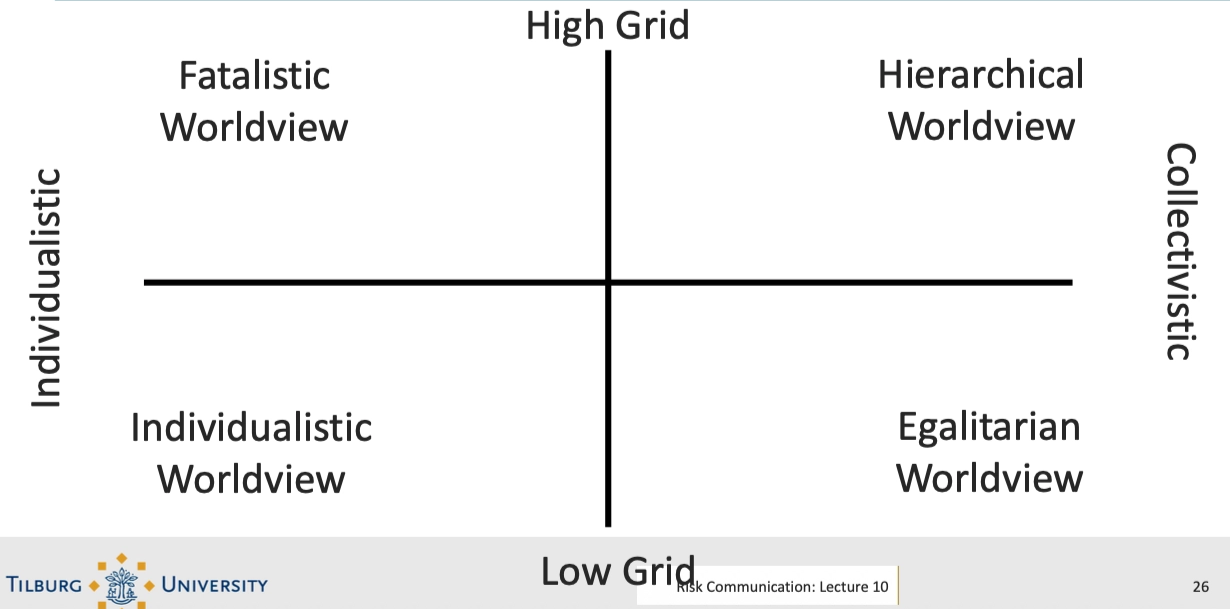
<p>A framework explaining risk perception differences through two dimensions: grid (extent of assigned social roles) and group (extent of in-group vs. out-group thinking) — producing four worldviews</p>
13
New cards

What are the four worldviews in cultural theory of risk and their view of nature?

Individualist (low grid, low group) — nature benign; Egalitarian (low grid, high group) — nature fragile; Hierarchist (high grid, high group) — nature tolerant but vulnerable if mismanaged; Fatalist (high grid, low group) — nature capricious, nothing can be done
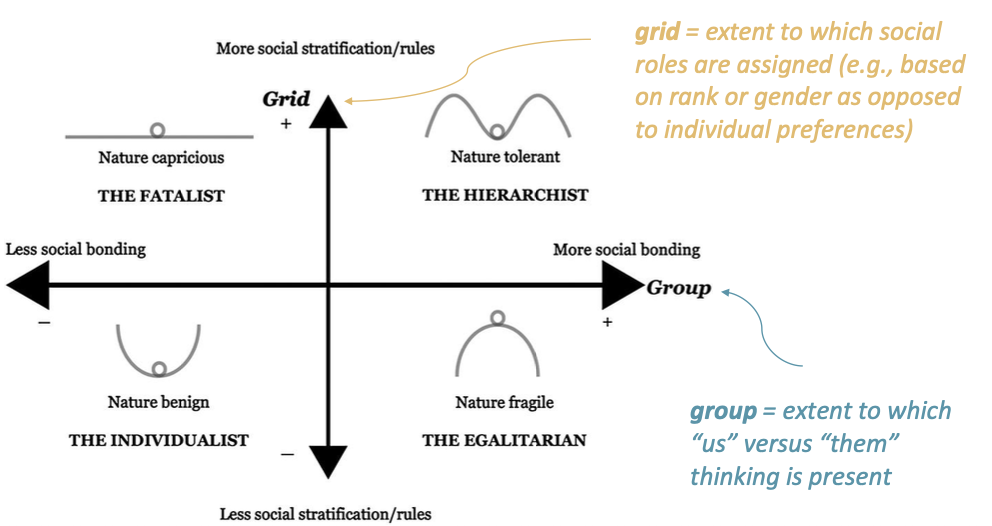
<p>Individualist (low grid, low group) — nature benign; Egalitarian (low grid, high group) — nature fragile; Hierarchist (high grid, high group) — nature tolerant but vulnerable if mismanaged; Fatalist (high grid, low group) — nature capricious, nothing can be done</p>
14
New cards
How does each worldview respond to environmental risk?
Individualist: dismisses government involvement; Egalitarian: highly concerned (e.g., climate change); Hierarchist: tolerant but cautious; Fatalist: resigned, no warning needed
15
New cards

What are three critical weaknesses of cultural theory of risk?

  1. Weak predictive power for actual risk perception 2. Oversimplified labels 3. People rarely fit neatly into one worldview — worldviews may be scales or combinations

16
New cards
What does McEvoy et al. (2017) illustrate about cultural theory of risk?
Rural Montana residents near oil/gas development held predominantly individualist views (nature resilient, economic benefits outweigh risks) but showed egalitarian and hierarchist deviations when dealing with authorities or collective action — risk skepticism is conditional on cultural orientation
17
New cards
What is the psychometric paradigm in risk perception?
The framework showing people judge risks not by mortality statistics but by qualitative dimensions such as voluntariness, controllability, and the degree of dread evoked
18
New cards
What is catastrophic potential?
A qualitative dimension of risk reflecting the degree to which a hazard could cause mass casualties or irreversible widespread destruction in a single event — strongly elevates lay risk perception
19
New cards
What distinguishes expert risk assessment from lay risk perception?
Experts equate risk with statistical probability and expected mortality; lay people use a broader qualitative concept including uncertainty, dread, fairness, and catastrophic potential
20
New cards
Why does expert-public conflict persist in risk communication?
Experts try to persuade with statistics, which fail to connect with the public's qualitative mental models — and experts themselves are not objective; their assessments also reflect values (e.g., academic vs. industry toxicologists disagree)
21
New cards
What are decisions from description vs. decisions from experience?
Description = probabilities are explicitly stated upfront; Experience = probabilities must be learned through trial and feedback. Older adults perform similarly to younger adults in description tasks but make worse decisions in experience tasks
22
New cards
What is the framing asymmetry in aging and risk-taking behavior?
When outcomes are framed as gains, older adults take fewer risks than younger adults; when framed as losses, age differences largely disappear
23
New cards
What cognitive mechanisms explain poorer experience-based risk decisions in older adults?
Declining cognitive capacities with age: slower processing speed, reduced executive control, and changes in brain anatomy and neural processing
24
New cards
What did the COVID-19 pandemic reveal about age and risk perception?
Older adults felt significantly higher health/fatality risks but perceived lower chances of infection or job loss compared to younger adults — selective heightened perception aligned with their most feared outcomes
25
New cards
What is the distinction between self-report and behavioral measures of risk?
Self-report: surveys asking about perceived risk and intentions — consistently show older adults as more risk-averse; behavioral: experimental choice tasks — show more nuanced, domain-specific results
26
New cards
What is the key practical implication of individual differences for risk communicators?
Neither the public nor experts should be treated as homogeneous groups — effective risk policy must integrate diverse sociodemographic backgrounds, worldviews, and levels of expertise into the decision-making process
27
New cards
What does the World Values Survey find about culture and risk-taking?
More risk-taking in countries with less safety, more challenges, and lower HDI scores — but within high-GDP countries, individual-level deprivation is an even stronger predictor of risk-taking than in poor countries
28
New cards
Explain why highly numerate individuals can sometimes be disadvantaged by their number sensitivity
High-numeracy individuals derive sharper affective meaning from numbers — this can cause them to "overuse" numbers, e.g., rating a bet with a tiny loss as more attractive than the same bet without the loss because the loss contrast amplified the gain's positive affect
29
New cards
What is the practical implication of the white male effect for risk communication?
Risk messages need to account for the fact that the same hazard is perceived very differently based on gender and ethnicity — particularly that white male audiences may systematically underestimate risks that other groups find serious