CHEM 122 Ch. 13.1.-4
 Call Kai
 Learn
Learn Practice Test
 Spaced Repetition
 Match
Match Flashcards
 Knowt Play
1/86

There's no tags or description
Looks like no tags are added yet.
Name | Mastery | Learn | Test | Matching | Spaced | Call with Kai |
|---|
No analytics yet
Send a link to your students to track their progress
87 Terms
Reaction quotient symbol
Q
Qc
uses molar concentrations
Qp
uses partial pressures
Q units
NONE
equilibrium constant symbol
K
K =
Q at equilibrium
Law of mass action
At a given temperature, the reaction quotient for a system at equilibrium is constant.
A reaction exhibiting a ______ K will reach equilibrium when most of the reactant has been converted to product, whereas a _____ K indicates the reaction achieves equilibrium after very little reactant has been converted.
large, small
If Q < K, the reaction proceeds in the ______ direction.
forward
If Q > K, the reaction proceeds in the ______ direction.
reverse
Relationship between Kp and Kc
Kp=Kc(RT)^Δn
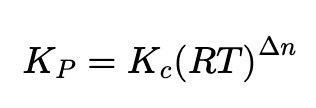
Δn =
moles of products - moles of reactants
Homogeneous equilibrium
All reactants and products are in the same phase (usually all gases or all aqueous). Include all gases and aqueous species in the equilibrium expression.
Hetergeneous equilibrium
Reactants and products are in different phases. Only include gases and aqueous species in the equilibrium expression; omit pure solids and liquids.
What gets included/removed in K expressions
keep gases (g) and aqueous species (aq), remove pure solids (s) and pure liquids (l) because their concentrations are constant.
How to write equilibrium expression
Products over reactants, with coefficients used as exponents.
If a reaction is reversed, what happens to K?
1/K (take the reciprocal)
If all coefficients are multiplied by a number x, what happens to K?
K^x (Raise K to the power of x)
If all coefficients are divided by a number, what happens to K?
Raise K to the reciprocal power (ex. if all divided by 2, raise K to ^1/2, OR take square root so 2√K)
If reactions are added together, what happens to K?
Multiply K’s (K1 x K2)
If reactions are subtracted, what happens to K?
Divide K’s (K1/K2)
Le Châtelier’s principle
if an equilibrium system is stressed, the system will experience a shift in response to the stress that re-establishes equilibrium
Changes in ________ and ________ are the two stresses that can shift an equilibrium.
concentration, temperature
Kc is the ratio of
the rate constant for the forward reaction, kf, to the rate constant for the reverse reaction, kr.
Kc > 1
products favored at equilibrium
Kc < 1
reactants favored at equilibrium
K_ uses [x] and K_ uses (x)
c, p
For questions asking when Kp = Kc, look for equations where
Δn = 0
When solving for Δn, ONLY COUNT
GASES (g)
For a chemical reaction at equilibrium,
the rates of the forward and reverse reactions are equal
T/F: All chemical reactions go to completion
false
Rate of rxn depends on ______ and k (________ dependent)
concentration, temperature
Equilibrium does NOT mean that individual __________ are equal.
concentrations
Equilibrium = ________ are constant
products
If Kc < 1, the reaction will be _____-favored and will proceed in the ________ direction.
reactant, reverse
If Kc > 1, the reaction will be _____-favored and will proceed in the ________ direction.
product, forward
If Kc = __, the reaction will favor neither products nor reactants strongly.
1
Kc is defined as the ratio of the rate of _____ reaction to the rate of _____ reaction.
forward, reverse
Reactants —> products means the reaction proceeds in the ______ direction.
forward
Products —> reactants means the reaction proceeds in the ______ direction.
reverse
ONLY _____ and ______ are included in k!
gases (g), aqueous solutions (aq)
P₀₂ =
partial pressure of oxygen
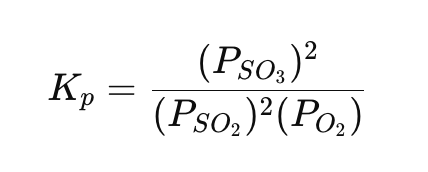
Kₚ is specifically for ___________ reactions.
gas phase

Write the expression for Kp for the following chemical reaction:
M units =
concentrations
atm units =
partial pressures
Shifts towards products = shifts _____.
right
Shifts towards reactants = shifts _____.
left
Consequently, changes in __________ and __________ are the two stresses that can shift an equilibrium.
concentration, temperature
Adding a reactant shifts equilibirum ______ (_______ direction).
right, forward
Removing a product shifts equilibrium ______ (_____ direction).
right, forward
Adding a product shifts equilibrium ______ (______ direction).
left, reverse
Removing a reactant shifts equilibrium _____ (______ direction).
left, reverse
Per the law of mass action, the value of the ____________ will be the same after the stress as it was before.
equilibrium constant (k)
If you add a reactant, Q ______.
decreases
If you remove a reactant, Q _______.
increases
If you add a product, Q _______.
increases
If you remove a product, Q ________.
decreases
When volume decreases/pressure increases, shift toward side w/ _____ moles of gas.
fewer
When volume increases/pressure decreases, shift toward side w/ ______ moles of gas.
more
If the reaction is exothermic, treat heat like a _______.
product
If the reaction is endothermic, treat heat like a _________.
reactant
In an exothermic reaction, if temperature increases, equilibrium will shift ____.
left
In an exothermic reaction, if temperature decreases, equilibrium will shift ____.
right
In an endothermic reaction, if temperature increases, equilibrium will shift ____.
right
In an endothermic reaction, if temperature decreases, equilibrium will shift ____.
left
Equilibrium shifts right/forward direction = ______ favored.
products
Equilibrium shifts left/reverse direction = _______ favored.
reactants
State Le Chatelier’s principle for predicting what happens to a system when something momentarily takes it away from equilibrium.
When a stress or disturbance is applied to a system at equilibrium, the system will respond by shifting in the direction that minimizes the effect of the stress.
T/F: Only gases and aqueous species affect equilibrium shifts, while pure solids and liquids do not shift equilibrium when added, removed, or changed in amount.
true
For pressure/volume problems with shifting, ONLY count moles of ___.
gas (g)
If ΔH < 0, the reaction is _________.
exothermic
f ΔH > 0, the reaction is _________.
endothermic
T/F: Temperature is the ONE stress that changes the value of K
TRUE
temperature and K change in the SAME direction
endothermic
temperature and K change in OPPOSITE directions
exothermic
T/F: Catalysts impact K
FALSE
Recognize that the use of a catalyst affects the rate at which a system reaches equilibrium but does not change the value of the equilibrium constant.
Catalyst increases the rate of reaction by decreasing the activation energy, but has no effect on the value of K. Catalysts allow reactions to achieve equilibrium faster.
For a given rxn, predict whether higher or lower temp + pressure conditions will favor the formation of desired substance
What conditions will shift equilibrium toward the side that makes more of the desired substance?
T/F: Adding an inert gas causes equilibrium to shift
FALSE
Leading zeros before a . (ex. 400.0) are
NEVER SIGNIFICANT
“What is the composition of the reaction mixture”
Find molar concentrations of reactants/products