Biological Treatment for OCD
 Call Kai
 Learn
Learn Practice Test
 Spaced Repetition
 Match
Match Flashcards
 Knowt Play
1/64

There's no tags or description
Looks like no tags are added yet.
Name | Mastery | Learn | Test | Matching | Spaced | Call with Kai |
|---|
No analytics yet
Send a link to your students to track their progress
65 Terms
What does the SERT gene do?
Lowers levels of serotonin in the brain
What have low levels of serotonin been linked to?
experiencing obsessive thoughts
What happens in the process of re-uptake: when does it occur?
after synaptic transmission
What happens in the process of re-uptake: what is it?
the process of neurotransmitters being taken back in to the presynaptic neuron (after synaptic transmission)
What happens in the process of re-uptake: What are then ready to be used again?
the neurotransmitters
SSRIs?
Selective Serotonin Reuptake Inhibitors
SSRIs: what are they?
the standard medical treatment used to tackle the symptoms of OCD are SSRIs
SSRIs: what do they do?
increase certain neurotransmitters in the brain
SSRIs: how do they increase certain neurotransmitters in the brain?
by preventing the re-absorption of serotonin
SSRIs: by preventing the re-absorption of serotonin, what do SSRIs effectively do?
effectively increase serotonin levels in the synapse
SSRIs: what do they continue to stimulate by effectively increasing serotonin levels in the synapse?
continue to stimulate the post-synaptic neuron
SSRIs: the process of re-uptake?
…
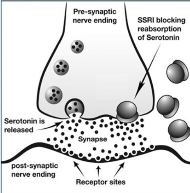
SSRIs: what is medication usually used alongside?
cognitive-behavioural therapy(CBT)
SSRIs: why is medication and CBT used alongside each other - what do the drugs reduce?
the sufferer’s symptoms - such as anxiety or depression
SSRIs: why is medication and CBT used alongside each other - what does this mean the patient can do?
can then engage more effectively with CBT
SSRIs: why is medication and CBT used alongside each other - what may some sufferers respond best to?
CBT alone without the need for medication
SSRIs: what size dose are they usually given in to begin with?
20mg doses
SSRIs: what can be done when the SSRIs are not effective after three to four months (2)?
dose can be increased or it can be combined with other drugs
SSRIs: What can the does for Fluoxetine be increased up to?
up to 60mg a day
What do patients respond differently to?
to different drugs - and sometimes alternatives work well for some people and not at all for others
Older type of medication?
Tricyclics
Tricyclics: what are they?
A type of anti-depressant (e.g. Clomipramine)
Tricyclics: their effect?
same effect as SSRIs, but more severe side effects
Tricyclics: when are they used?
Only used if SSRIs are not working
Newer type of medication?
SNRIs
SNRIs: what does it stand for?
Serotonin – Noradrenaline Reuptake Inhibitors
SNRIs: what does it increase levels of (2)?
levels of serotonin AND noradrenaline
SNRIs: who are they reserved for?
patients who do not respond to SSRIs
SNRIs: diagram?
…

Strength - P: what is there a lot of research to show?
the effectiveness of SSRIs
Strength - Ev1: what was Soomro et al?
a meta-analysis which reviewed 17studies comparing SSRIs to placebos in the treatment of OCD
Strength - Ev2: when did Soomro et al take place?
2009
Strength - Ev3: what did all 17 studies researched in Soomro et al (2009) show?
significantly better results for SSRIs than for the placebo conditions
Strength - Ex1: how many participants is Soomro et al (2009) based on in total?
3097
Strength - Ex2: what does this large number of participants mean the research is?
more applicable to a wider range of people than a single research study
Strength - L: therefore, what is good about the supportive research?
has a good population validity
Weakness - P: what may evidence for drug treatments be?
biased
Weakness - Ev1: What has Ben Goldacre suggested?
that the evidence favouring drug treatments is biased because much of the research into them is sponsored by drug companies who have a vested interest in not reporting all the evidence
Weakness - Ev2: when did Ben Goldacre suggest this?
2013
Weakness - Ex: what may these companies not publish?
research that argues against the effectiveness of their drug to maximise their own economic gain
Weakness - L: therefore, what may not be as effective as the research suggests?
SSRIs
Strength - P: what is medication much less disruptive than?
psychological treatments
Strength - Ev1: what does taking SSRIs require?
very little effort - patients can simply take them until their symptoms decline
Strength - Ev2: what don’t patients have to engage with?
the hard work of psychological therapy
Strength - Ex what has this led to most patients doing?
finishing their medication treatment - whereas with therapy there is a much higher dropout rate
Strength - L: therefore, regardless of effectiveness, what patients much more likely to do?
much more likely to finish a course of medication than a course of therapy
Weakness - P: what can medication have?
side effects
Weakness - Ev1: while SSRIs will help most people, who experience relatively serious side effects?
Weakness - Ev2: how many patients who take tricyclics will experience weight gain?
1 in 10
Weakness - Ev3: how many patients who take tricyclics will become aggressive and suffer blood pressure problems?
1 in 100
Weakness - Ex: what do these side effects often result in?
patients not wanting to continue their drug treatment
Weakness - L: therefore, what is there a chance people will not do?
that people will not finish their drug treatment, again meaning that how effective the medication is will not actually matter