3.1.3.5 AVERAGE REVENUE, TOTAL REVENUE AND PROFIT
 Call Kai
 Learn
Learn Practice Test
 Spaced Repetition
 Match
Match Flashcards
 Knowt Play
1/59

There's no tags or description
Looks like no tags are added yet.
Name | Mastery | Learn | Test | Matching | Spaced | Call with Kai |
|---|
No analytics yet
Send a link to your students to track their progress
60 Terms
Define total revenue
The total amount of money a firm receives from selling its goods or services
What is the total revenue calculation?
Total revenue = price x quantity sold
Define average revenue
The revenue a firm receives per unit of output sold
What is the average revenue calculation?
Average revenue = total revenue / quantity sold
What does marginal mean in simple terms?
The next one
Define marginal revenue
The additional revenue gained from selling one more unit of a good or service
What else is the demand curve?
The average revenue curve (which is the price)
What is the marginal revenue calculation?
Marginal revenue = change in total revenue / change in quantity
Define perfect competition
A market structure where many firms sell identical products, there is free entry and exit, firms are price takers
Define monopoly
A market structure where a single firm dominates the market, high barriers to enter and exit, firms are price makers
Define price taker
A firm that has no control over the market price
must accept the price determined by market supply and demand
Define price maker
A firm that has the power to set or influence the price of its products
Define quantity setter
A firm that chooses the level of output it will produce, while the market determines the price
What 2 things can a monopoly set?
Price and quantity set
If a monopoly wants to sell more, what do they do the price?
Lower the price
Which curve is more responsive? (MR or AR) And why?
The MR curve is more responsive as it is steeper
Why is the AR curve less responsive?
The AR curve takes into account every unit - so is less responsive to it
What is the main difference between perfect competition and monopolistically?
Branding (packaging, logo)
Give an example of a same product in a perfectly competitive market and monopolistically market?
Yoghurt and muller yoghurt
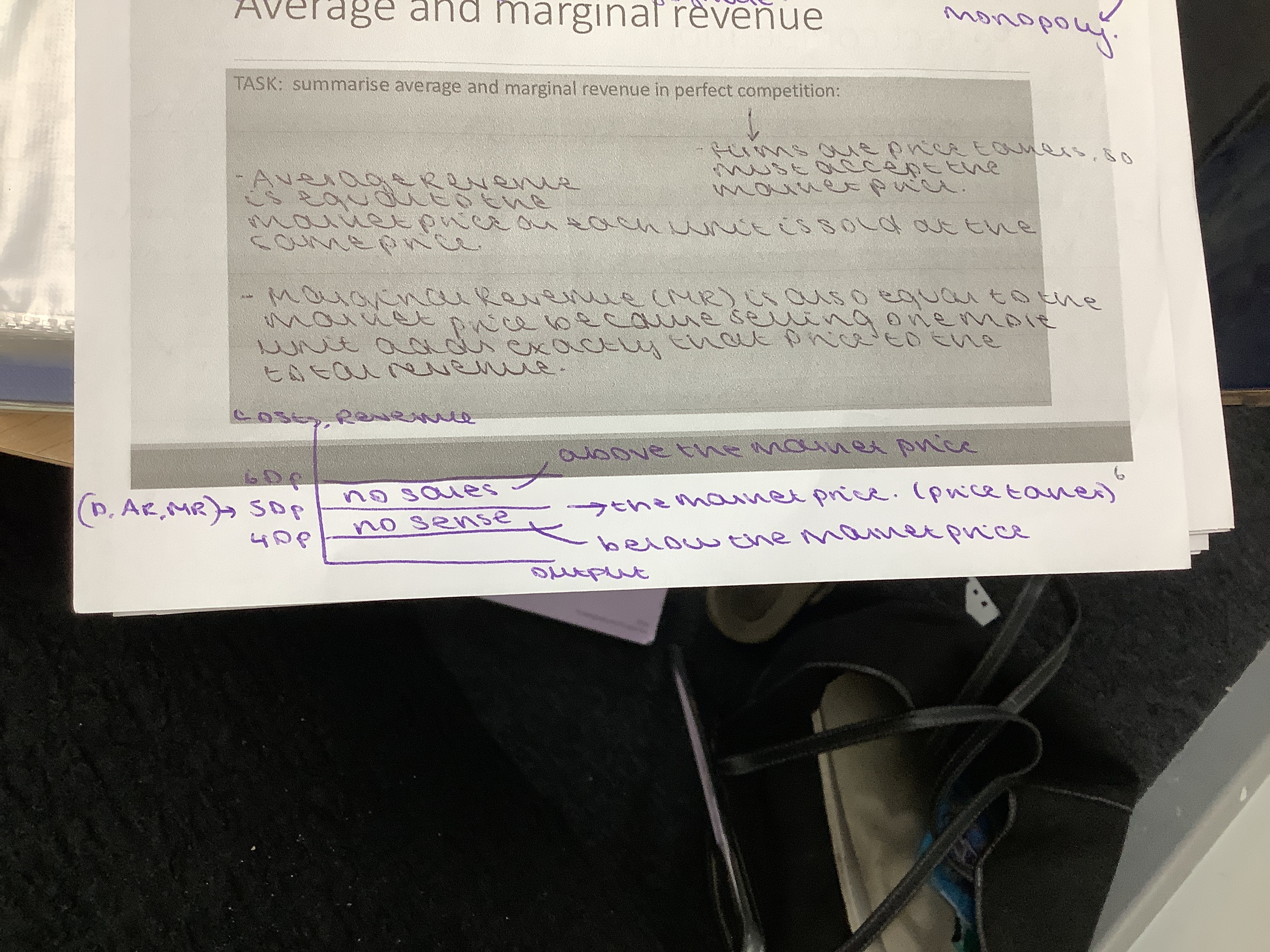
What is the relationship between AR and MR in perfect competition?
AR = MR = PRICE
both are constant and horizontal as firms are price takers
What is the relationship between AR and MR in imperfect competition?
MR lies below AR
when a firm lowers price to sell more units, AR falls and MR falls faster
What does the diagram look like with no sales and no sense?
Why does the MC curve slope upwards?
As producing additional units usually increases costs
Where on the graph does it show profit max?
When MC and AR/MR meet
When do firms make normal profit?
When AR = AC
When do firms make a loss?
AR < AC
When do firms make supernormal profits?
AR > AC
If a monopoly increases prices, what may consumer do?
Find a cheaper alternative
In a monopoly, why is the demand curve downwards sloping?
As the firm must lower the price to sell more units
So to increase sales (as it is the only firm in the market), it may have to reduced its price, this causes the demand curve to slope downwards
Explain why MR is twice as steep as AR?
MR is twice as steep as AR because price cuts to sell extra units reduces revenue from previous points
Why doe MR go through the output axis?
MR crosses the x axis as it is half the maximum quantity because that's the point of maximum total revenue
Define profit
The difference between total revenue and total costs
Profit calculation
Profit = Total revenue - total costs
Define profit maximization
The process by which a firm chooses the level of output where profit is the greatest
When does profit maximization occur?
When MR = MC
Does profit continue to max beyond the profit maximization point? Why?
No, at this point, producing more or fewer units would reduce profit
Define normal profit
The minimum profit necessary to keep a firm in business
Define abnormal profit
Profit above the normal profit
indicates the firm is earning more than needed to cover al costs (often possible in monopolies or market with barrier to enter)
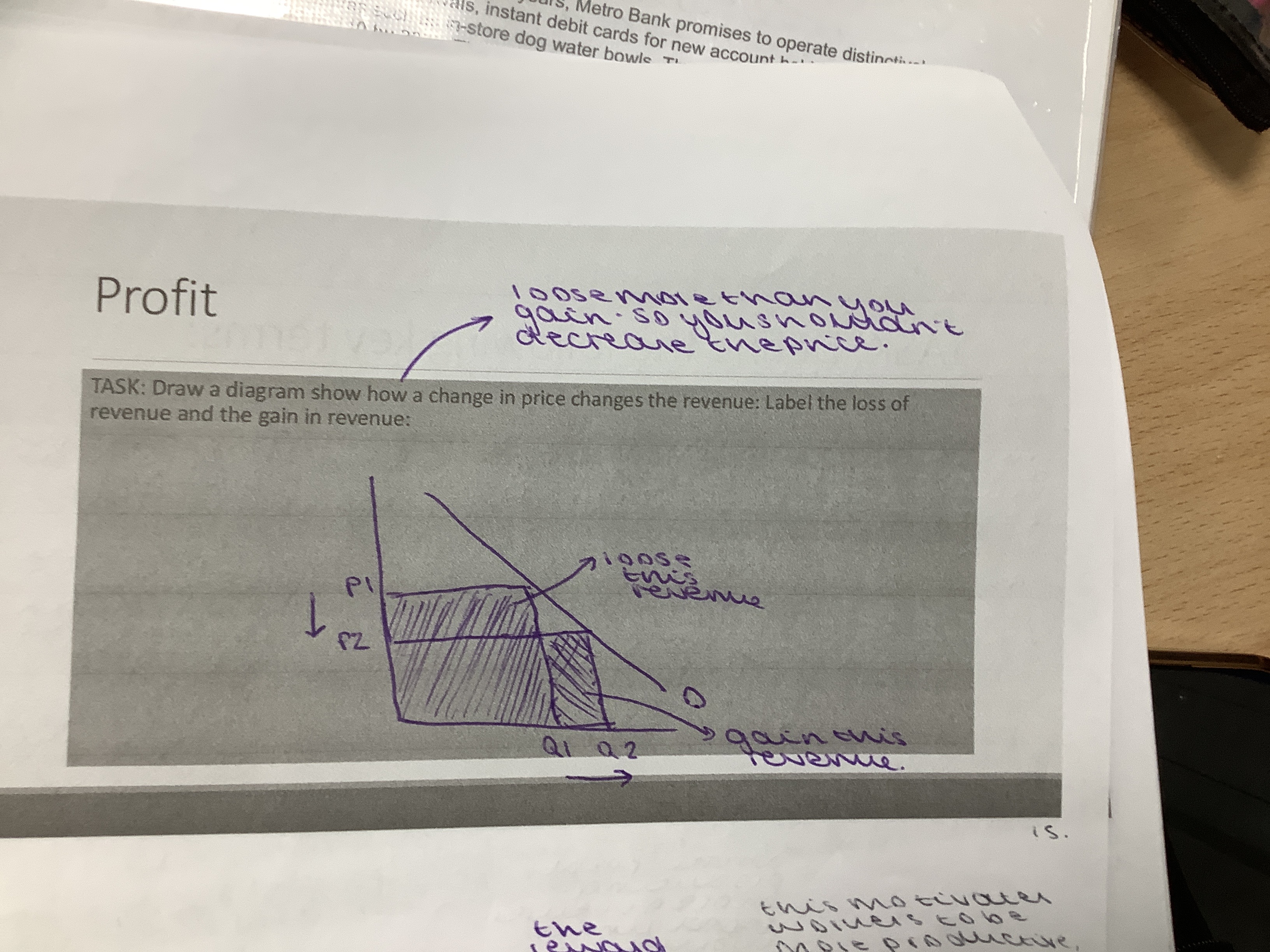
Draw a diagram showing how a change in price changes the revenue
What is the role of profit in "the creation of worker incentives"?
Profit allows firms to reward employees with bonuses, higher wages or promotions (this motivates workers, increases productivity and improves the firms performance)
What is the role of profit in "the creation of shareholder incentives"?
Profit generates returns for shareholders in the forms of dividends
What is the role of profit in "profits and resource allocation"?
Profits signals if resources need to flow into or exit an industry
What is the role of profit in "profit as a reward for innovation and risk saving"?
Profit rewards successful risk taking, this encourages further innovation
What is the roe of profit in "profit as a source of business finance"?
Profit can be reinvested to funds expansion, researcher or new tech/machinery
Define productive efficiency
Occurs when a firm produces goods or services at the lowest possible cost (achieved when resources are used efficiently and output is on the lowest point on the AC curve)
Where does productive efficiency occur?
MC = AC (lowest point on the AC curve)
What is an example of one of the most productively efficiency businesses?
Ryan Air (they operate at the lowest point of the AC curve)
Define dynamic efficiency
Occurs when a firm improves efficiency over time, through innovation, research and development (focuses on long term improvement rather than than just short term)
Which market structure are most likely to be dynamically efficient? Why?
Monopolies (as they have resources/profit to reinvest)
How does technical change affect "methods of production"?
Technical change often introduces machinery and automation, this allows firms to produce goods faster and more accurately, increasing output
How does technical change affect "productivity"?
Technical change increases labour productivity, producing more in the same time frame (contributes to economic growth and higher incomes)
How does technical change affect "efficiency"?
Technical change can reduce overall costs meaning goods are produced at lower costs per unit
How does technical change affect "costs of production"?
Initially technical change may increase costs due to investment and machinery BUT overtime, it reduces costs
Define monopolistically competition
A market structure with many firms selling simile but not identical products
some control over price
low barriers to enter to enter/exit
Define duopoly
A market dominated by only 2 firms
Define oligopoly
A market structure with a few large firms dominating the market
high barrier to enter and exit
firms are independent
Define creative destruction
A concept where innovation destroys old industries or products while creating new ones (they push out the less relevant businesses in the industry)
have dynamic efficiency
How does technological change influence the structure of markets?
entry of new firms (innovation can lower production costs - increases competitiveness)
market concentration (smaller firms may be pushed out)
product differentiation (firms can offer unique products)
higher barrier to enter and exit
How does the process of creative destruction link to technological change?
Technological change drives new products, processes or technologies
these innovations replaced outdated methods or products making old firms less competitive
What type of inefficiencies do monopolies experience?
X-inefficiency (they feel less need to be efficient as there is less competiton)