POLS 207 Local Political Systems
 Call Kai
 Learn
Learn Practice Test
 Spaced Repetition
 Match
Match Flashcards
 Knowt Play
1/14

There's no tags or description
Looks like no tags are added yet.
Name | Mastery | Learn | Test | Matching | Spaced | Call with Kai |
|---|
No analytics yet
Send a link to your students to track their progress
15 Terms
Local governments in the US political system
the us constitution outlines the basic relationship between states and national government
it recognizes states as sovereign political entities
state authority does not derive from the national government
state authority comes from the people
but it contains no mention of local government!
not even for washington dc
what about the 90000+ local governments in the US
What exactly are local governments
local governments are subdivisions of state governments
no independent authority
no inherent powers
These political subdivisions exercise authority delegated by their state government
the relationship between state and local government is unitary
Dillon’s Rule
Municipal corporations owe their origin to, and derive their powers and rights wholly from, the legislature. It breathes into them the breath of life, without which they cannot exist. As it creates, so may it destroy. If it may destroy, it may abridge and control.
John Dillon, Clinton v. Cedar Rapids & the Missouri River Railroad (1868)
• Dillon’s Municipal Corporations (1872)
• Systematic study of local governments & their powers
• S.C.O.T.U.S. cites in landmark Hunter v. Pittsburg (1907)
The status of local governments
Dillons rule sets out a narrow interpretation of local authority
local governments have only those powers granted to them by state
powers must be expressly granted by constitution or by law
As a political matter, however, local governments may enjoy substantial autonomy
wariness of one-size-fits-all solutions
tradition of local governance
especially true in some regions
Advantage of some local control
But as a political matter, states can also greatly restrict
e.g. Death Star Bill
TX attempt to rein in its Blue cities via a broad local-control bill
Localities in the US
Great diversity in communities
in terms of their geographic size, population, and socioeconomic composition
Great diversity in their governing structures
form and organization
powers and responsibilities
method of selecting officials
Trends in US local governments and governance
Two Functions of Local Governments
Service Function
providing services not offered by private sector
i.e. market failure, natural monopolies, merit goods
Political function
questions of who gets what
managing conflict over public policy
Functions frequently overlap
who gets high-quality services vs. who gets low-quality services
Two general categories of local governments
General Purpose
governments that provide wide range of services
Special Purpose
governments that fulfill specific purpose
most provide a single service
General Purpose Governments
County Gov’ts (~3,000 in U.S; 254 in TX)
In Texas counties have a dual role:
Provide basic services, such as law enforcement, courts, roads, public health, public records
Serve as limited administrator for state functions, such as vehicle licensing, voter registration, elections
Municipal / City Gov’t (~19,500 in U.S; 1,225 in TX)
Responsible for police, fire, parks, streets, sanitation, welfare & (sometimes) education
Towns & townships (~16,000 in U.S.)
Differences w/ municipalities not easily defined
Rooted in history, population, region of U.S…
Special Purpose governments
Special Districts
• Usually serve single specific purpose, such as:
• e.g. fire-protection, mosquito- control, MUD, parks, library
• Most common type of gov’t, but least understood & often least transparent!
• Exception: School Districts
• U.S: ~12,500 ISDs + ~39,500 others
• TX: 1,070 ISDs & 2,984 others
Country Government in the US
• Oldest form of U.S. local government
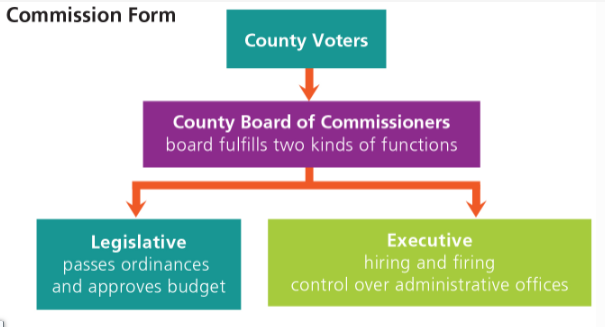
• Traditional form is body of commissioners w/ both legislative & executive power
• ~3-50 members, called a board, court, etc.
• Members usually share general responsibility of all county functions---NO chief executive!
• Other elected or appointed officials:
• Sheriff
• Constable
• County clerk
• County attorney
• Tax assessor
• Treasurer
• Auditor
• Health officer
• Coroner
• Library board
Commission Form
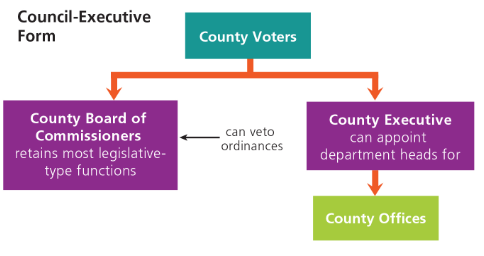
Council Executive Form
more centralized variation on county government
has a county executive or “county mayor” as chief executive
Board of commissioners act as legislature
Found in ~15% of US counties
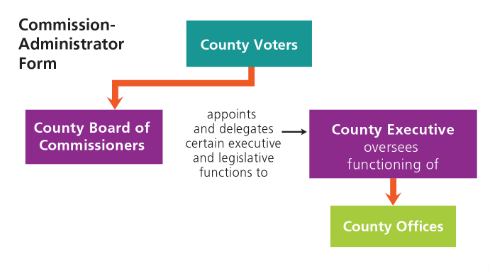
Commission-Administrator Form
• Professionalized variation on county gov’t
• Has county administrator who answers to elected commissioners
• Commissioners fulfill political function, administrator oversees efficient delivery of services
• Found in ~12% of U.S. counties
Other Institutional Variations
• Some states permit counties more autonomy from state
• County residents may adopt a charter that allows them a unique form of organization
• 37 states allow ”home rule” counties
• Only ~9% of U.S. counties are home rule counties
County Government in Texas
TX counties all use traditional county commission structure (regardless of size, population)
Structure & powers defined by TX Constitution
Commissioners’ Court w/ 4 elected commissioners
+ county judge (w/ some executive functions)
Controls land use for unincorporated land
Service-provider whose biggest expenses are:
• Law enforcement, including courts & jails (~50%)
• Roads & bridges (10-30%)
• Health & welfare (~10%)
Local administrator for the state