Carbohydrates
 Call Kai
 Learn
Learn Practice Test
 Spaced Repetition
 Match
Match Flashcards
 Knowt Play
1/103

There's no tags or description
Looks like no tags are added yet.
Name | Mastery | Learn | Test | Matching | Spaced | Call with Kai |
|---|
No analytics yet
Send a link to your students to track their progress
104 Terms
Uses in foods
sweeteners
influences body and mouth feel
fat replacers
manupulation of flow characteristics
ensure texture for ketchup
Crystallization agents in candy
used to lower Aw and elongate shelf life of products
fermentation of substrates in yogurt, wine etc
used in colour and flavouring
Monosaccharides
glucose and fructose
simple sugars that cannot be hydrolized further
can join together to form larger molecules through glycosidic linkages
Disaccharides
sucrose and lactose
2 monosaccharides
glycosidic linkages connect the monosaccharides to one another to create them
Oligosaccharides <20 sugar units
stachyose
only a few of them are natural and most come from polysaccharide hydrolysis
Polysaccharides >20 sugar units
cellulose
Maillard reaction
colour, taste and aroma of cooked foods
involves reducing sugars
Reducing sugars
sugars with C=O group of aldehyde joins with -OH group on C-5 to form a hemiacetal (OH and OR attached to the same C)
sugars with hemiacetal is in equilibriam wiht its acyclic form
contains CHO in acyclic form
Can be an open or closed circle
all monosaccharides and some disaccharides, oligosaccharides and polysaccharides
involved in the maillard reaction
Non reducing sugars
sugars with acetal have 2 OR groups attached to the same C
acetals lock the sugar in place so it does not open into acyclic form
no reducing
3 stages of the maillard reaction
early maillard:
carbonyl group of the reducing sugar condenses with an amino group on a free amino acid or free amino group on a protein
produces glycosylamine and water
Glucosamine undergoes Amadori rearrangement to yield a 1-amino-2-keto sugar
Advanced maillard reaction
Amadori compound is split apart
in acid reaction is slow, in basic it is fast
forms hydroxymethylfurfural (HMF)
Final Maillard reaction
melanoidin formation (brown nitrogen containing polymers
Amino compounds + sugar fragments
HMF + amino compounds
intermediates (reductones and aldehydes) + amino compounds
Early maillard reaction
carboxyl group of the reducing sugar condenses with an amino group on a free AA or free amino group on a protein
produces glycosylamine and water
glucosamine undergoes Amadori rearrangement to yield a 1-amino-2-keto sugar
amadori compound is colourless
Glycosylamine and water
produced in the early maillard reaction
advanced maillard reaction in acid
amadori compound is split apart → amino group removed
produces deoxyketose
deoxyketose undergoes dehydration and produces hudromethylfurfural (HMF)
Reaction is slow
Advanced maillard reaction (basic conditions)
amadori compound breaks apart → amino group removed
produces deoxyosone
goes through dehydration producing
maltol and isomaltol
these are the flavour and aroma compounds
HMF
yellow product of acidic advanced maillard step
Maltol and isomaltol
flavour and aroma compounds produced from neutral an basic pH advanced maillard reaction
final maillard reaction
melanoidin formation
the brown nitrogen containing polymers
amino compounds + sugar fragments
HMF + amino compounds
intermediates (reductones and aldehydes) + amino compounds
Pros of maillard reaction
contributes to flavour, aroma and colour compounds
Cons of maillard reaction
reduced nutritional value,
decreased protein quality
AA + reducing sugar ruins the AA
this is especially relevant for essential amino acids like lysine
heterocyclic amine production
these are mutogenic
factors that influence the maillard reaction
temperature
pH
Aw
metal ions
sugar structures
Temperature effect on maillard
reaction occurs in the presence of heat and during storage
the higher temperature, creates a more brown pigment
shown through spray drying palm sap
the sap was more brown when it was dried at a higher temperature
pH effects on maillard reaction
Amadori products undergo dehydration fo form HMF at 4-7pH but prefer <5
pH >7 the amadori products form deoxysones whch react and polymerize to form melanoidins
in real food there is a variety of intermediates
production of melanoidins will be faster at more alkaline pH
very little browning occurs at <6pH
water activity impact on maillard
high rates of maillard at 0.6-0.7 Aw
intermediate Aw
at high Aw amino groups and reducing sugars are diluted by too much free water
at lower Aw less free water so reagents are more concentrated and have limited movement
at interemediate Aw, the reactant mobility is highest and reaction occurs quickly
Metal ions and maillard reaction
Copper 2 & 3 and iron 2 &3 ions form unstable complexes with amadori products
Copper 2 ions oxidize glucosamine in early maillard reaction
regenerate free primary amino groups speeds up breakdown of protein complexes that can form melanoidins
Copper 2 ions
oxidize glucosamine in the early maillard reaction
acts to regenerate free primary amino groups
speeds up breakdown of protein complexes that can form melanoidins
sugar stuctures influence on maillard
maillard requires reducing sugars in the open chain form
sugars carbonyl in the aldehyde group reacts with amino groups of amino acids
some sugars spend more time in the open chain form
sugars in open chain form undergo maillard reaction more rapidly
sulphites
act to inhibit maillard reaction by blocking hydroxymethylfurfural and therefore preventing the melanoidins
order of sugars in open chain going through maillard fastest to slowest
D-xylose → L-arabinose → hexoses → disaccharides
Caramelization
carbohydrates (sucrose, reducing sugars) are heated without nitrogen containing compounds
facilitated by using small amounts of acids or alkali and certain salts
thermolysis causes dehydration of the sugar
introduction of double bonds or formation of anhydro rings
furans like HMF are formed (unsaturated rings)
conjugated double bonds absorb light and produce colour
unsaturated rings condense and polymerize → colours, aroma, taste
catalysts are added to increase reaction rate and to direct the reaction
What facilitates the formation of caramelization
small amounts of acids or alkali and certain salts
Thermolysis in caramelization
introduces of double bonds or formation of anhydro rings
causes dehydration of the sugar
how are caramel flavours and colours industrially produced
heating a sucrose solution with ammonium salts or ammonium bisulphite
rate of caramel colour formation increases with increasing temperature and pH
reaction is optimal at pH 8
heat decomposes sugar to unsaturated rings to produce flavours
maltol and isomaltol imitate odor and flavour of freshly baked bread
used in ice cream, cookies and other baked goods
maltol and isomaltol flavours
imitate the odor and flavour of freshly baked bread
Cellulose
primary cell wall components of plants
D-glucose bound by B-(1,4)-glycosidic bonds
has crystaline and amorphous regions with higher degree of crystalinity
crystaline regions are ordered, and parallel
OH on the glucose from one polysaccharide chain H-bonds with O on the neighbouring chain to give it high strength and insolubility
dietary fibre
can be modified to bind water and increase viscosity
Starch
main polysaccharide in plants made of amylose and amylopectin in granules
20-30% amylose and 70-80% amylopectin
the composition depends on the source and type of starch
granuoles have an organized layered structure
crystaline and amorphous regions
water soluble and digestible with the addition of heat
without temperature it is insoluble
crystaline layers in starch
less dense and ordered with amylopectin in a double helixal pattern
amorphous layers in starch
less dense and unordered with both amylose and amylopectin
maltese cross pattern in starch
birefringence in raw starch under polarized light
caused by the organized structure of amylopectin
water solubility of starch
water insoluble and digestible with the addition of heat
amylose structure
low molecular weight
linear chains of a-D-glucose
units joined by a-1,4 glycosidic linkages
amylopectin
high molecular weight
high branded chains (long or short)
a-D-glucose linked by a-1,4 and a-1,6 glycosidic bonds
creates the branched pattern
Gelatinization
starch granuoles are heated in water
causes the molecule to vibrate and breaks the intermolecular H-bonds
water enters the granuole in the amorphous regions first (less ordered)
linkages in the crystaline region are broken in crystalline region
water enters and H-bonds with amylopectin
granuoles swell and birefringence is lost
gelatinization in starch with hgih amylopectin
higher granule swelling power and higher viscocity at low temperature
amylopectin H-bonds with water, swells and reaches a large granule size causing highest viscocity in short time
starches with higher amylose (and lower amylopectin)
low swelling power and low viscosity even at a hgih temperature
Granule size increase causes…
amylose leaches out and amylopectin stays in the swollen granule
when heat is removed the starch solution cools and viscosity increases
birefringence over temperature in native and high amylose
decrease birefringence at increasing temperature
native maize lost birefringence at lower temperature compared to high amylose maize
stirring gelatinization
breaks the granules
peak viscosity
point where the paste swells to a max size
should remove the semi-solid gel at this time
further cooking and or continuous agitation results in ruptured granules and lower viscosity
what happens to paste upon cooling
retrogradation
syneresis
retrogradation
starch molecules H-bond with neighbouring molecules to form junction zones to achieve a more ordered state
junction zones form when 2 or more polymer chains interact and bind eachother along part of its chain length to form a 3D gel network
increase in viscosity and gel-like ocnsistency
amylose is primarily involved but over time, amylopectin is also involved but at a slower rate
Junction zones
determine gel firmness
if they grow after the gel forms the network becomes more compact
example of retrogradation
film on top of gravy
syneresis
junction zones growing after gel formation causing the network to become more compact
the structure contracts and water is pushed out from between the starch molecule
sugar effect on paste viscocity
sugar binds water leaving less available to hydrate the starch
causes a delay in gelatinization until a higher temperature
less water enters the granule and causes more thermal energy to be needed before the start can swell and gelatinize
lower peak viscosity and weaker gel strength
fat effect on viscosity
fat coated granules can prevent water from reachign the granule and prevents absorption
lipids form complexes with amylose where the hydrophobic part of the lipid is inside the helixal starch structure and lipid head is outside the helix
delays gelatinization and requires a higher temperature
salt effect on viscosity
salt competes with the starch granules for water
reduction in granule swelling
delays gelatinization
starts at higher temperature
decreased viscosity
pH effect on viscosity
acids hydrolyze glycosidic bonds leading to shorter starch polymers
pH <4
cookign and water entry to granule can prematurely rupture the granule and cecrease viscosity
pH >10
improves solubility of the starch so there is more interaction with water
more swelling
increased viscosity
protein effect on viscosity
gelatinization of starch and the denaturation of gluten in doughs and batters increase structure, body and viscosity
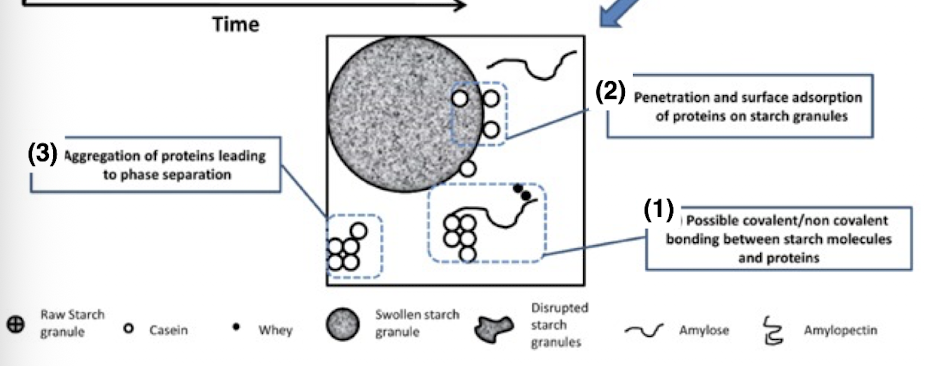
3 types of protein interactions
swollen granules break open and amylose and amylopectin leach out and starch binds the protein
proteins with hydrophillic groups, amide, hydroxyl, carboxyl form bonds wiht hydroxyl groups
adsorption of proteins at the surface of the starch granule
proteins aggregate around the surface of the starch granule
gelatinizaition of starch and denaturation of gluten in dough structure
retrogradation on bread
causes hardening upon cooling
staling depends on ingredients, how it was baked and how its stored
amorphous state of starch in the bread starts to be more ordered and crystalline state
amount of water is just enough to gelatinize the starch
amylose is leached out and may finish intermolecular h-bonding to achieve a more ordered state by the time the bread cools to room temperature
firm and slicable
amylopectin takes a longer time to retrograde and continues even after its fully cooled
involves interactions between its outer branches
outer branches come together, align and form intra-molecular bonds
structure is rigid
crumb firmness
control of bread staling
heat can temporarily shift the amylose and amylopectin from semi-crystalline state to amorphous state
reheating bread with small amounts of water can temporarily reverse the retrogradation
emulsifiers like mono and di-glycerides can reduce staling by interacting with starch
emulsifiers form complexes with amylose and linear branch chains of amylopectin
slows down the recrystalization of amylopectin and retrogradation to give softer crumb
emulsifiers effect on retrogradation
mono and diglycerides may reduce staling by interacting with starch
form complexes with amylose and linear branch chains of amylopectin
slows recrystalization of amylopectin and retrogradation to give softer crumb