Liberation Theology - Marx
 Call Kai
 Learn
Learn Practice Test
 Spaced Repetition
 Match
Match Flashcards
 Knowt Play
1/137

There's no tags or description
Looks like no tags are added yet.
Name | Mastery | Learn | Test | Matching | Spaced | Call with Kai |
|---|
No analytics yet
Send a link to your students to track their progress
138 Terms
Alienation
The state or experience of being isolated
Exploitation
The action or fact of treating someone unfairly in order to benefit from their work
Bourgeois
Belonging to or characteristic of the middle class, typically with reference to its perceived materialistic values or conventional attitudes.
Proletariat
Working-class people regarded collectively (often used with reference to Marxism).
Communism
A theory or system of social organization in which all property is owned by the community and each person contributes and receives according to their ability and needs.
Dehumanise
Deprive of positive human qualities.
Liberation Theology
A movement in Christian theology, developed mainly by Latin American Roman Catholics, which attempts to address the problems of poverty and social injustice as well as spiritual matters.
Capitalism
An economic and political system in which a country's trade and industry are controlled by private owners for profit, rather than by the state.
Jesus the Liberator
The belief that Jesus was a person who liberates people from imprisonment or oppression
Praxis
Practice rather than theory. Referred to as 'action'
Orthodoxy
Authorized or generally accepted theory, doctrine, or practice.
Orthopraxy
In the study of religion, orthopraxy is correct conduct. How a person conducts themselves and acts upon their faith and belief
Contextual Theology
A type of theology by which theologians reflect on a specific situation in light of experience e.g. Liberation theologians focus on the situation of the poor and their experience
Karl Marx
Karl Heinrich Marx was born on 5 May 1818 in Trier in western German, the son of a successful Jewish lawyer. In 1843, after a short spell as editor of a liberal newspaper in Cologne, Marx and his wife Jenny moved to Paris, a hotbed of radical thought. There he became a revolutionary communist and befriended his lifelong collaborator, Friedrich Engels. Expelled from France, Marx spent two years in Brussels, where his partnership with Engels intensified. They co-authored the pamphlet 'The Communist Manifesto' which was published in 1848 and asserted that all human history had been based on class struggles, but that these would ultimately disappear with the victory of the proletariat (working class).
In 1849, Marx moved to London, where he was to spend the remainder of his life. For a number of years, his family lived in poverty but the wealthier Engels was able to support them to an increasing extent. Gradually, Marx emerged from his political and spiritual isolation and produced his most important body of work, 'Das Kapital'. The first volume of this 'bible of the working class' was published in his lifetime, while the remaining volumes were edited by Engels after his friend's death. Marx did not live to see his ideas carried out in his own lifetime, but his writings formed the theoretical base for modern international communism.
What is Alienation?
The separation or estrangement of human beings from some essential aspect of their nature or from society, often resulting in feelings of powerlessness or helplessness. Today, the concept of alienation has become part of ordinary language, much used in the media. We may be told, for example, that who groups are becoming alienated from society, or that young people are alienated from mainstream values.
Marx’s Theory of Alienation
Marx's ‘Theory of Alienation’ was that in modern industrial production under capitalist conditions workers will inevitably lose control of their lives by losing control over their work. Workers thus cease to be autonomous beings in any significant sense. Under pre-capitalist conditions a blacksmith or a shoemaker would own his own shop, set his own hours, determine his own working conditions, shape his own product, and have some say in how his product is sold. His relationships with the people with whom he worked and dealt had a more or less personal character.
Marx - the average worker is not much more than a replaceable cog
Under the conditions of modern factory production, by contrast, the average worker is not much more than a replaceable cog in a gigantic and impersonal production apparatus. Where armies of hired operatives perform monotonous and closely supervised tasks, workers have essentially lost control over the process of production, over the products which they produce, and over the relationships they have with each other. As a consequence they have become estranged from their very human nature, which Marx understood to be free and productive activity.
Marx - Human beings cannot be human under these conditions
Human beings cannot be human under these conditions, and for this reason the implication was obvious for Marx: Capitalism has to be abolished as much as any political oppression if a society is to be set free from the social restrictions.
Marx - his Economic and Philosophical Manuscripts of 1844:
“In what, then, consists the alienation of labour? First, in the fact that labour is external to the worker, i.e., that it does not belong to his nature, that therefore he does not realize himself in his work, that he denies himself in it, that he does not feel at ease in it, but rather unhappy, that he does not develop any free physical or mental energy, but rather mortifies his flesh and ruins his spirit. The worker, therefore, is only himself when he does not work, and in his work he feels outside himself. He feels at home when he is not working, and when he is working he does not feel at home. His labour, therefore, is not voluntary, but forced--forced labour. It is not the gratification of a need, but only a means to gratify needs outside itself. Its alien nature shows itself clearly by the fact that work is shunned like the plague as soon as no physical or other kind of coercion exists.”
Marx's theory suggests capitalist production creates alienation in four main areas
Workers are alienated from their own labour power – they have to work as and when required and to perform the tasks set by their employers.
They are alienated from the products of their labour – which are successfully claimed by capitalists to be sold as products on the marketplace for profit, while workers only receive a fraction of this profit as wages.
Workers are alienated from each other – they are encouraged to compete with each other for jobs.
They are alienated from their own species being – according to Marx, satisfying work is an essential part of being human, and capitalism makes work a misery, so work under capitalism thus alienates man from himself. It is no longer a joy, it is simply a means to earn wages to survive.
Marx on God and Religion
Marx's opinion is that religion is an illusion that provides reasons and excuses to keep society functioning in a certain way. He suggests that religion, in the face of real oppression on earth, offered spiritual blessings in heaven. People would therefore put up with their present suffering in the hope of a spiritual reward - using it like a drug to ease the pain of their situation. Marx is saying that religion creates illusory fantasies for the poor. Economic realities prevent them from finding true happiness in this life, so religion tells them this is acceptable because they will find true happiness in the next life.
Marx - Religion does not fix the underlying causes of people's pain and suffering
Instead, it helps them forget why they are suffering and causes them to look forward to an imaginary future when the pain will cease instead of working to change circumstances now. Even worse, this "drug" is being administered by the oppressors who are responsible for the pain and suffering.
Karl Marx – Alienation and Exploitation
In a capitalist society there are two basic classes of people:
The Bourgeois (Property owning class) and The Proletariat (working-class people)
Karl Marx – Alienation and Exploitation
The relationship between these two classes is exploitative:
The amount of money the employer pays the worker is less than the total value of goods that worker produces. To Marx, Profit is basically the accumulated exploitation of workers in capitalist society.
Karl Marx – Alienation and Exploitation
Control of the Economic Base means control of the superstructure.
According to Marx those who have economic power control all other institutions. Religion was one such institution that Marx said had this power.
Karl Marx – Alienation and Exploitation
The Bourgeois use their control of institutions to keep the masses ignorant of their exploitation:
This is known as ideological control. According to Marx this was mainly done through the Mass Media and Religion and left people in state of illusion.
Karl Marx – Alienation and Exploitation
Capitalism causes alienation:
Under Capitalism the worker becomes alienated from the process of production, from the people he works with and from the products they produce. This is because he lacks control over his work and becomes a 'machine', and thus work appears as 'alien' to him.
Karl Marx – Alienation and Exploitation
Competition leads to increasing levels of exploitation:
Marx argued that the Capitalism had within it the seeds of its own destruction - it would eventually create the social conditions that would lead to its downfall. In order to stay competitive, Capitalists would have to sell goods at lower prices, which would mean reduced profit. This would then encourage Capitalists to seek to reduce wages and increase efficiency- making the working conditions of the proletariat ever worse. Marx theorised that increasing numbers of increasingly exploited proletarians crammed into ever expanding cities (where factories were based) would eventually lead to a violent revolution - in which the proletariat would throw off their oppressors.
Karl Marx – Alienation and Exploitation
Revolution and Communism:
Marx argued that following the overthrow of the Bourgeois – society would eventually organise itself along Communist lines – where the means of production are collectively owned (no private property) and everyone has equal wealth. Marx was vague about exactly what the Communist society would look like but argued that in this society ‘each would give according to their ability and take according to their needs’ and that there would be a lot more free time for all.
What is Liberation Theology?
A movement in Christian theology, developed mainly by Latin American Roman Catholics, which attempts to address the problems of poverty and social injustice rather than just focusing on spiritual matters. It grew out of the political and social situation in Latin America during the 1960's and 1970's. At that time the contrast between the rich landowners and the poor was even greater than it is today. Then, as today, the poor lived in favelas or shanty towns of houses made of corrugated iron and other scraps of materials overlooked by luxury apartments of the rich.
Lib T and El Salvador
El Salvador, where the liberation theology movement gained its momentum, is still one of the most violent countries in the world with an average of one murder per hour. It was the condition of the poor and oppressed in Latin America that led Roman Catholic priest and theologians to review how they should act and to consider the views of Karl Marx.
Contextual Theology
Liberation theology is a type of theology by which theologians reflect on a specific situation in light of experience. In responding particularly to the plight of the poor both politically and spiritually, liberation theology is a contextual theology. For example, in liberation theology, the 'first step' is to deal with the situation of oppression and injustice and the 'second step' is to reflect theologically. However, by placing the needs of the poor and oppressed before the official teachings of the Roman Catholic Church, liberation theology has often been regarded as radical and dangerous by church and state authorities.
Gustavo Guttierrez
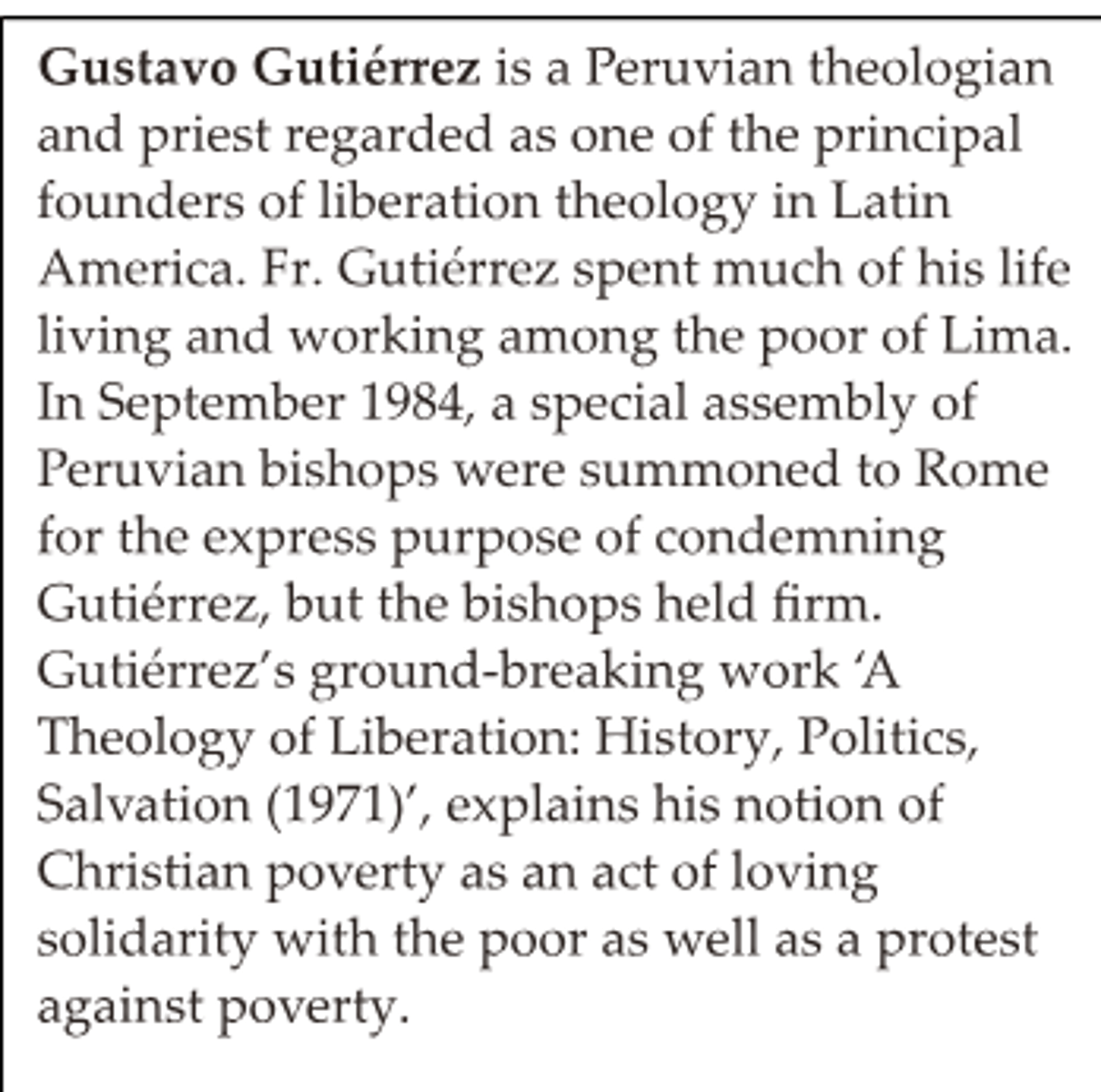
Liberation Theology and Karl Marx
Marxist ideas were used both explicitly and implicitly by liberation theologians. Gustavo Gutierrez used Marx implicitly whilst Leonardo Boff and Jose Miranda (author of Marx and the Bible) explicitly discussed the relationship between Marxism and Christianity.
In general, liberation theologians use Marx as a tool for understanding poverty. They do not adopt his ideas wholesale, but borrow concepts and terminology which they find helpful.
Boff set out very clearly how liberation theology used Marx.
'In liberation theology, Marxism is never treated as a subject on its own but always from and in relation to the poor. Placing themselves firmly on the side of the poor, liberation theologians ask Marx:' what can you tell us about the situation of poverty and ways of overcoming it?' Here Marxists are submitted to the judgement of the poor and their cause, and not the other way around. Therefore, liberation theology used Marxism purely as an instrument. It does not venerate it as it venerates the gospel.’ (Leonardo Boff)
Leonardo Boff took pains to stress that liberation theology is not the same as Marxism.
Marx's ideas were used because they were perceived to be useful in the Latin American context. Marx is a useful tool or instrument for doing theology but “Marx is a useful ‘companion on the way’, there is only one teacher, Jesus Christ.”
Liberation Theology and the different views of Poverty
It could just be seen as a fact of life. Some people are poor. There is no underlying cause to be addressed. One can help the poor by giving them charity. This is the empirical view of poverty.
Alternatively, one could attribute poverty to the backwardness of a country. They are poor because they are less developed. The solution is to help them develop. This is the functional view of poverty.
Finally, liberation theologians follow Marx in arguing that the poor are poor because they are oppressed. This is the dialectical view of poverty. The way to help them is to end oppression.
Liberation theologians have a dialectical view of poverty.
In their eyes, poverty and oppression alienated people from their God-given human nature. Capitalist society had been guilty of seeing people as a raw material for making money rather than as fellow human beings created in the image of God. Liberation theologians aimed to restore the dignity of the poor by giving them autonomy and some control over their own destiny.
The Meeting of Latin American Catholic Bishops at Medellin and Puebla
In 1968 in Medellin, Columbia the Latin American Catholic Bishops met to discuss this ‘bottom up’ theology with reference to the teachings of Karl Marx. At Medellin the bishops voiced the need for 'political change' as being necessary for social improvement. Potentially this could be seen as an endorsement of revolution. The bishops also stated 'we, as bishops, wish to come closer to the poor in sincerity and brotherhood'. As part of this the bishops recognised that the Church should not itself be wealthy. 'The poverty of the church and of its members in Latin America ought to be a sign and a commitment - a sign of the inestimable value of the poor in the eyes of God.'
Medellin - Gustavo Gutierrez encouraged Christians to 'build a new society'
Gustavo Gutierrez encouraged Christians to 'build a new society' and to support the 'exploited classes' in their struggle against their oppressors which could be understood in the Marxist sense of entering into the class struggle on behalf of the poor. Gutierrez advocated a 'preferential option for the poor' which suggests reversal in action.
This phrase was not used at Medellin (although the idea of having a particular concern for the poor is present). At the Latin American Bishops' third conference at Puebla in 1979 the bishops agreed that 'the poor merit preferential attention' 'we affirm the need for conversion on the part of the whole Church to a preferential option for the poor.'
Liberation theologians would argue that the ideas of revolution and reversal is found in the Bible as well as in Marx.
Jesus preached that 'the first shall be last and the last shall be first' (Matthew 20:16) and appeared to align himself with the poor and the outcasts rather than the rich and the powerful. He said that he had come to 'bring good news to the poor' and to 'set the captives free' (Luke 4:18). Consequently, it is not simply that liberation theologians borrowed the idea of reversal from Marx, they felt that it echoed what the Bible said.
What is Praxis?
Marx famously said 'the philosophers have only interpreted the world, the point is to change it'. He believed that one should not stand back and describe the processes by which history changed. Instead one should get involved. The term 'praxis' can be translated as 'action' but it is action directed towards a certain end.
For Marx, this end was the socialist revolution and eventual communist state. For Marx, progress happened through class struggle in history. Praxis is the entering into this class struggle to bring about change.
Gustavo Gutierrez said 'to know God is to do justice'.
He argued that theology should 'be part of the process through which the world is transformed'. He also advocated 'active effective participation in the struggle which the exploited classes have undertaken against their oppressors'. The Marxist undertones are clear.
Liberation theology advocates orthopraxis (right action) over orthodoxy (right belief).
Whilst the terminology reflects Marx, the ideas that should underpin orthopraxis were more specifically Christian. For Marx, orthopraxis was about working for a socialist revolution to bring about a communist state. For liberation theologians, orthopraxis meant putting Christian’s beliefs into practise and working to bring about the Kingdom of God on earth by living according to God's rules.
Christianity has always taught that beliefs should be put into practice
Of course Christianity has always taught that beliefs should be put into practice, what is distinctive about liberation theology is that it advocated active engagement in areas like politics and in economics - areas which have traditionally been regarded as secular (secular = non-religious). Liberation theologians emphasised that religion should affect the whole of life, not just certain areas of it. Thus nothing can be regarded as 'off-limits' from the point of view of religion.
The Preferential option for the Poor’
Leonardo Boff and his brother Clodovis Boff wrote a book in 1987 entitled ‘Introducing Liberation Theology’.
Boff Brothers - 'Introducing Liberation Theology'.
Theological Motivation:
The God of the Bible is an immanent and involved in human history. This God seeks justice and sides with those that are oppressed (Exodus and the liberation of the Jewish people from slavery)
Christological Motivation:
Jesus sided with the poor and acted in solidarity with those who were marginalised by society.
Eschatological Motivation:
God will judge the world based on whether a person has sided with the poor according to Jesus’ parable of the ‘Sheep and Goats’. (Matthew 25)
Apostolic Motivation:
After Jesus’ death the first apostles organised a general levy on all Christian groups to raise money for the poor. They did not distinguish between Christina and non-Christian poor.
Ecclesiological Motivation:
All Christian members of the Church, should as a matter of faith, seek the liberation of the poor.
Pope Francis' apostolic exhortation: Evangelii Gaudium (The Joy of the Gospel)
In 2013 Pope Francis published an apostolic exhortation named 'Evangelii Gaudium. An exhortation is a papal document that, as the name suggests, exhorts (strongly encourages) people to implement a particular aspect of the Church's life and teaching. Its purpose is not to teach new doctrine, but to suggest how Church teachings and practices can be applied today.
In the exhortation Pope Francis asks Catholics to respond to the Gospel
In the exhortation Pope Francis asks Catholics to respond to the Gospel, to live it more fully and more deeply, to reach out to the poor and broken, to end injustice and to build peace. Below you will see a number of arguments that can be used to show that Pope Francis supports the liberationist view that the poor should have a preferential option
Has liberation theology engaged too much with Marxism? - Yes - Pope St John Paul II
Pope John Paul II believed that to turn the church into a secular political institution and to see salvation solely as the achievement of social justice was to rob faith in Jesus of its power to transform every life. The image of Jesus as a political revolutionary was inconsistent with the Bible and the Church's teachings. Christian theology should not be political, or involved in revolutionary violence. The Church's business was bringing about the Kingdom of God, not about creating a Marxist utopia.
Has liberation theology engaged too much with Marxism? - Yes - Cardinal Ratzinger
In 1984, Cardinal Joseph Ratzinger (who later became Pope Benedict XIII) criticised the use of Marxism in the liberation theology movement. Liberation should be understood spiritually first and then practically or politically second. Ratzinger and other leaders of the Catholic Church were wary of the political nature of liberation theology and argued that secular ideologies should be avoided.
Has liberation theology engaged too much with Marxism? - Yes - Ratzinger
Ratzinger argued that many liberation theologians rely too heavily on the Marxist analysis of society, and others even more so for their support of Marxist revolutions or regimes. They argue that Marxist ideologies are incompatible with catholic beliefs. Christianity focused on the view that Salvation came through the death and resurrection of Jesus. There is too much focus on materialism and not enough focus on the message of Jesus. Ratzinger argued that liberation should be about the person and not the economic situation of the poor.
Has liberation theology engaged too much with Marxism? - Yes - New Testament
The New Testament seems to suggest that Jesus would not have supported the ideology of Marx and Christians should not enegage with it. When Jesus was asked to take sides in the political controversies of his time (the domination of the Roman Empire), he answered, “My kingdom is not of this world. Give to Caesar what is Caesar’s and to God, what belongs to God”. Liberation theology violates this basic Christian doctrine, by making Christianity explicitly political, a revolutionary movement devoted to overthrowing ‘Caesar’.
Has liberation theology engaged too much with Marxism? - Yes - Guttierez
Gustavo Gutierrez used the teachings of Karl Marx implicitly rather than explicitly. He made it clear in his teaching that Marx and Christianity could not be combined, even if they share common ground. The fundamental issue was the Marx believed that religion/Christianity was part of the problem whereas Gutierrez saw it as the solution. Marx said religion kept the poor oppressed whereas Gutierrez saw the message of Jesus as one of hope and change.
Has liberation theology engaged too much with Marxism? - No - Boff
Leonardo Boff argues that Christianity like Marxism does not teach that we meekly accept suffering and wait for heaven, but that we try to confront the political authorities and try to change society so it becomes more fair and just. Boff says, A Christology [understanding of Christ] that proclaims Jesus Christ as the Liberator (Jesus Christ Liberator 1972). Boff is arguing that Christianity should engage with Marxism as it is a god tool or instrument for theology.
Has liberation theology engaged too much with Marxism? - No - Marx is a useful companion on the way
Leonardo Boff took pains to stress that liberation theology is not the same as Marxism. Marx's ideas were used because they were perceived to be useful in the Latin American context. Marx is a useful tool or instrument for doing theology but “Marx is a useful ‘companion on the way’, there is only one teacher, Jesus Christ.” As long as the Christian message of Jesus remains the main priority then Marxism should be engaged with.
Has liberation theology engaged too much with Marxism? - No - Alistair Kee
Professor of Religious Studies, Alistair Kee argues that liberation theology has not used Marx enough. He argues that liberation theologians can’t just accept bits of Marx they find helpful and avoid the basic ideas on which they are built. For instance, Marx favoured a radical approach to change. This radical approach might lead to revolution and change of regime. He argues that liberation theology is too conservative and has failed in its opportunity to change the social and political issues caused by capitalism.
Has liberation theology engaged too much with Marxism? - No - Restrepo
Camilo Torres Restrepo was a Columbian Catholic priest who tried to reconcile Marxism with Christianity. He argued that liberation theologians needed to engage with Marxism more and said that words without action are empty and if this meant revolution, even violence, then it was a sign of faith to be involved. He joined a guerrilla (revolutionary) movement and is quoted as saying:
“…the mental process of Marxists appears to be so useful for revolutionary methods”
Should Christian theology engage with atheist secular ideologies (Marxism)? - Yes - Kingdom of God
Liberation theology advocates right action over right belief. For Marx, right action was about working for a socialist revolution to bring about a communist state. For liberation theologians, right action meant putting Christian’s beliefs into practise and working to bring about the Kingdom of God on earth by living according to God's rules. Many liberation theologians, notable Leonardo Boff argued that Marx was a useful instrument or tool for doing theology but Jesus Christ was the main teacher.
Should Christian theology engage with atheist secular ideologies (Marxism)? - Yes - Medellin
At the Latin American Bishops’ conference in Medellin in 1968 Gustavo Gutierrez encouraged Christians to 'build a new society' and to support the 'exploited classes' in their struggle against their oppressors. This can be understood as engaging with atheist secular ideology as it followed the Marxist teaching of entering into the class struggle on behalf of the poor. Gutierrez advocated a 'preferential option for the poor' which challenges capitalist society.
Should Christian theology engage with atheist secular ideologies (Marxism)? - Yes - Puebla
At the Latin American Bishops' conference at Puebla in 1979 the bishops agreed that 'the poor merit preferential attention' They advocated active engagement in areas like politics and in economics - areas which have traditionally been regarded as secular (secular = non-religious). The bishops emphasised that religion should affect the whole of life, not just certain areas of it. Thus nothing can be regarded as 'off-limits' from the point of view of religion.
Should Christian theology engage with atheist secular ideologies (Marxism)? - Yes - Boff
Leonardo Boff argues that Christianity does not teach that we meekly accept suffering and wait for heaven, but that we try to confront the political authorities and try to change society so it becomes more fair and just. Boff says, A Christology [understanding of Christ] that proclaims Jesus Christ as the Liberator (Jesus Christ Liberator 1972). Boff is arguing that Christianity and secular ideologies like Marx can be used together.
Should Christian theology engage with atheist secular ideologies (Marxism)? - Yes - Jesus - Preferential option of the poor
One of the main principles of this kind of understanding of Jesus sees him as giving preference, not to the rich and powerful, but instead to the poor and oppressed. This can be seen in two stories from the New Testament - The parable of the Good Samaritan and the story of the Healing of the Woman with a haemorrhage. In both stories an oppressed group (Samaritans and women) are celebrated. Samaritans were regarded as being racially and religiously impure, but Jesus teaches of their kindness and humanity. Jesus involved himself in political and social issues.
Should Christian theology engage with atheist secular ideologies (Marxism)? - No - New Testament
The New Testament also seems to suggest that Jesus wanted to separate Christianity from secular ideology. When Jesus was asked to take sides in the political controversies of his time (the domination of the Roman Empire), he answered, “My kingdom is not of this world. Give to Caesar what is Caesar’s and to God, what belongs to God”. Liberation theology violates this basic Christian doctrine, by making Christianity explicitly political, a revolutionary movement devoted to overthrowing ‘Caesar’.
Should Christian theology engage with atheist secular ideologies (Marxism)? - No - Camel
Elsewhere in the New Testament Jesus stated that it was easier for a camel to pass through the eye of the needle, than a rich man to enter into the kingdom of God. This suggests, rather obviously, that wealth and power are obstacles to the Christian's path to the Kingdom of Heaven. Liberation theology, again in strong contrast to actual Christian doctrine, states that we should change the lives of the poor first (bottom up approach) but this was not the teaching of Jesus.
Should Christian theology engage with atheist secular ideologies (Marxism)? - No - Pope St John Paul II
Pope John Paul II believed that to turn the church into a secular political institution and to see salvation solely as the achievement of social justice was to rob faith in Jesus of its power to transform every life. The image of Jesus as a political revolutionary was inconsistent with the Bible and the Church's teachings. Christian theology should not be political, or involved in revolutionary violence. The Church's business was bringing about the Kingdom of God, not about creating a Marxist utopia.
Should Christian theology engage with atheist secular ideologies (Marxism)? - No - Cardinal Ratzinger
In 1984, Cardinal Joseph Ratzinger (who later became Pope Benedict XIII) criticised the use of Marxism in the liberation theology movement. Liberation should be understood spiritually first and then practically or politically second. Ratzinger and other leaders of the Catholic Church were wary of the political nature of liberation theology and argued that secular ideologies should be avoided.
Should Christian theology engage with atheist secular ideologies (Marxism)? - No - Ratzinger
Ratzinger argued that many liberation theologians rely too heavily on the Marxist analysis of society, and others even more so for their support of Marxist revolutions or regimes. They argue that Marxist ideologies are incompatible with catholic beliefs. Christianity focused on the view that Salvation came through the death and resurrection of Jesus. There is too much focus on materialism and not enough focus on the message of Jesus. Ratzinger argued that liberation should be about the person and not the economic situation of the poor.
Should Christians prioritise one group (the poor) over another? - Yes - Boff
Leonardo Boff argued that the Bible clearly shows a 'preferential option for the poor'. He and his brother, Colvodis, outlined five motivations for why Christians should prioritise the poor over other groups. They argued that the Bible clearly showed the actions of a God that cared for the oppressed and that Jesus (His Son) sided with the poor. Likewise, they argue that the Christian belief in judgement after death as expressed in the parable of the 'Sheep and Goats' shows that reward will be for those that side with the poor. The Boff brothers were clear that the poor were the priority.
Should Christians prioritise one group (the poor) over another? - Yes - Medellin
At the Latin American Bishops’ conference in Medellin in 1968 Gustavo Gutierrez encouraged Christians to 'build a new society' and to support the 'exploited classes' in their struggle against their oppressors. Gutierrez advocated a 'preferential option for the poor' which challenges capitalist society.
Should Christians prioritise one group (the poor) over another? - Yes - Puebla
At the Latin American Bishops' conference at Puebla in 1979 the bishops agreed that 'the poor merit preferential attention' They advocated active engagement in areas like politics and in economics - areas which have traditionally been regarded as secular (secular = non-religious). The bishops emphasised that religion should affect the whole of life, not just certain areas of it. Thus nothing can be regarded as 'off-limits' from the point of view of religion and we should change the reality of life for the poor.
Should Christians prioritise one group (the poor) over another? - Yes - Jesus as liberator
Leonardo Boff argues that Christianity does not teach that we meekly accept suffering and wait for heaven, but that we try to confront the political authorities and try to change society so it becomes more fair and just. Boff says, A Christology [understanding of Christ] that proclaims Jesus Christ as the Liberator (Jesus Christ Liberator 1972). Boff is arguing that Jesus prioritised the poor and we should follow that example.
Should Christians prioritise one group (the poor) over another? - No - Roman Catholic Church
The Roman Catholic Church advocates Orthodoxy over orthopraxy. This means that the official doctrines (teachings) of the Church are of primary importance. Care for the poor is an important part of Catholic theology but other Church teachings such as the nature of God, sin & salvation and Catholic social teaching have equal standing in the Church. Pope John Paul II was concerned that liberationists put too much emphasis on the Marxist analysis of alienation, oppression and exploitation.
Should Christians prioritise one group (the poor) over another? - No - Ratzinger
In 1984, Cardinal Joseph Ratzinger (who later became Pope Benedict XIII) criticised the use of Marxism in the liberation theology movement. Liberation should be understood spiritually first and then practically or politically second. Ratzinger and other leaders of the Catholic Church were wary of the political nature of liberation theology and argued that secular ideologies should be avoided.
Should Christians prioritise one group (the poor) over another? - No - Pope St John Paul II
Pope St John Paul II believed that to turn the church into a secular political institution and to see salvation solely as the achievement of social justice was to rob faith in Jesus of its power to transform every life. The image of Jesus as a political revolutionary was inconsistent with the Bible and the Church's teachings.
Matthew 5:3
Blessed are the Poor in spirit, for theirs is the kingdom of Heaven
Poor in Spirit Meaning
To be poor in spirit means recognising that everything good in our nature comes from God. Anything worthy or praise in us comes from God and God alone. Being poor in spirit is a type of spiritual posture, acting as a "beggar" before the Lord.
Gustavo Gutierrez - Poor Quote
If there is no friendship with them [the poor] and no sharing of the life of the poor, then there is no authentic commitment to liberation, because love exists only among equals
Jon Sobrino: A Preferential Option for the Poor
Gustavo Gutierrez - “Theology must be a critical reflection on humankind, on basic human principles.
- Theology is the second step.
- Speaks about God who identifies with the poor and the most abandoned.
Jon Sobrino - Gutierrez and Historical Jesus
Takes the historical Jesus as the starting point for its reflection on Christology - attends to classic theological themes while at the same time stresses the importance of life experiences.
- Christology is not merely the Christology of Christ, but also it is the Christology of the body of Christ.
Jon Sobrino - The meaning behind each title reveals the personality, characteristics and nature of God that God’s people would like to recognise
The faithful God, the righteous God, the Jealous God, the Mighty God, God of truth, compassionate God - many place their emphasis on God's great love for the poor.
God = the defender of the orphan, the widow, the stranger, the meek and the oppressed.
- 'The Lord hears the cry of the poor (Ps 34).
- Protector of the poor (Ps 12, 5).
- Provider of the poor (Ps 68).
Isaiah
God = promised to send among the oppressed a saviour to defend and deliver them.
God always stands by the oppressed and defends the poor.
Reading works of liberation theology, we can easily view a dialectic class struggle between the rich and the poor, the oppressed and the oppressors.
Medellin and Puebla
There are rich people because there are poor people, and there are poor people because there are rich people.
Ernesto Valiente
"In a reality driven by oppression, God's disclosure is at once revelatory and liberating... God's justice liberates the victims from oppression, and God's forgiveness liberates oppressors from their guilt.
Gustavo Gutierrez. - Poor Person quote
A poor person… is someone who has to wait a week at the door of the hospital to see a doctor. A poor person is someone without social or economic weight, who is robbed by unjust laws; someone who has no way of speaking up or acting to change the situation. Someone who belongs to a despised race and feels culturally marginalised is in-significant. In sum, the poor are found in the statistics, but they do not appear there with their own names
Exploitation and Alienation:
MARX
wage labour (paying people to do a job) = always exploiting them.
Exploitation = intrinsic to capitalist system.
Exploitation and Alienation - Boff
Used Marx’s ideas as a tool for socio-analytical mediation.
Marx - provided way of understanding poverty in terms of exploitation.
Poverty - viewed in different ways:
Empirical view: Fact of life - Some people are poor, no underlying cause.
Functional view: Poor because they are less developed.
Dialectical view: Poor because they are oppressed.
Exploitation and Alienation - Liberation Theologians
Understand the cause of poverty is important, because you can’t solve the problem until you know what caused it (no shit).
Liberation theologists - do not go so far as to wholly reject capitalism, but they do think that Marx provides a very useful critique of its excesses.
Latin America - tradition of latifundia and hacienda = most land in the hands of wealthy land owners who can then exploit the workforce.
Owning the means of production
Marx: The only reason a person would sell themselves as labor for hire was that they were not in a position to work for themselves - the bourgeoisie owned the things necessary to produce food and goods.
Marx: Workers should own the means of production, in order to avoid exploitation, as they would not be paid less for their work than the value of their work.
Liberation Theologians: Supported the land reforms which sought to end the uneven distribution of land in Latin America. They became vocal critics of exploitative labour practices.
Bishops: ‘To create a just social order is an eminently Christian task’. ‘If they jealously retain their priviledges… they are responsible to history for provoking ‘explosive revolutions of despair’.
False and Consciousness - Marx
Believed that it was first necessary to alert the oppressed masses to the possibility of change - thought that, in many instances, the proletariat were in a state of false consciousness, because they did not realise that they were exploited and they did not realise that thing could be different.
False Consciousnesses - Latin American Bishops
Priests should use their pulpits for consciousness-raising - should aim to ‘awaken in individuals and communities… a living awareness of justice… [and] a sense of responsibility and solidarity’.
False Consciousnesses - Guttierez
As well as liberating people from the physical things that oppress them, people also need to be liberated from oppressive ideas that restrict their ability to flourish as human beings.
False Consciousness - Liberative hermeneutics
Play an important role in consciousness-raising. Stories like the Exodus and Jesus’ message to the poor could be used to make it clear that poverty is not part of God’s plan, but occurs as a result of sin.
Reversal and Revolution + Praxis:
Marx’s ultimate aim was for a classless society
People who have power are unlikely to give it up for the sake of greater fairness
Violent revolution would be justified given the greater good that would come from it
At Medellin, Bishops knew “political change was a prerequisite for social improvement
endorsement of revolution?
Bishops and Praxis
“We, as bishops, wish to come closer to the poor in sincerity and brotherhood”
Bishops recognised church shouldn’t be wealthy:
“The poverty of the church and of its members in Latin America ought to be a sign and a commitment - a sign of the inestimable value of the poor in the eyes of God.”
Guttierez and Praxis
Encouraged christians to ‘build a new society’ and support ‘exploited classes’ against oppressors
Marxist sense of entering struggle on behalf of the poor
Advocated a ‘preferential option for the poor’ suggesting reversal in action
Phrase not used at Medellin - idea of having a particular concern for the poor is present
At latin american bishops 3rd conference at puebla in 1979
'the poor merit preferential attention' 'we affirm the need for conversion on the part of the whole Church to a preferential option for the poor.'
Liberation theologians argue ideas of revolution and reversal is found in the Bible
Jesus preached ‘the first shall be last and the last shall be first’ (Matthew 20:16)
Appeared to align himself with poor and outcasts rather than rich and powerful
Jesus said he’d come to “bring good news to the poor” + to ‘set the captives free (Luke 4:18)
Praxis?
Marx believed we cannot simply stand back - 'the philosophers have only interpreted the world, the point is to change it'
Terminology reflects Marx, but ideas that should underpin orthopraxis were more specifically about Christianity.
Marx = orthopraxis was about bringing a socialist revolution and a communist state
LT = orthopraxis meant putting Christian beliefs into praxis to bring about the Kingdom of God
LT advocated active engagement in areas like politics and economics - areas which have been regarded secular
LT emphasised religion should affect the whole of life
Nothing can be regarded as ‘off-limits’ from the pov of religion
Does Christianity tackle social issues more effectively than Marxism? - Pope St John Paul II
Thought that the preferential option of the poor was an important part of 'Christian charity'. However, he added that dealing with spiritual poverty was an important focus not just economic poverty. St Paul II takes about charity, implying the solution is charity not political action. Spiritual poverty St Paul II defined as anything which results from over attachment to superficial material things such as drugs, pornography and 'other forms of consumerism which exploits the frailty of the weak, tend to fill their resulting spiritual void'. He claimed that the cry for justice and preferential solidarity with the poor was indispensable, but that it need not be "mortgaged to ideologies foreign to the faith".