LECTURE 11 + 12: NEURONAL SIGNALING
 Call Kai
 Learn
Learn Practice Test
 Spaced Repetition
 Match
Match Flashcards
 Knowt Play
1/39

There's no tags or description
Looks like no tags are added yet.
Name | Mastery | Learn | Test | Matching | Spaced | Call with Kai |
|---|
No analytics yet
Send a link to your students to track their progress
40 Terms
how is the resting membrane potential defined? what does it tell you about the cell/neuron?
-the membrane potential when the cell is at rest, it’s not passing on the signal at that specific time, nothing is happening, resting state for our cell
-potential difference across the plasma membrane
*Vin - Vout
what are the two main components of an electrochemical gradient?
concentration gradient —→ established by concentration on molecules on each side of the membrane
electrical field gradient —→ established by the different charges on each side of the membrane
*note: opposing charges attract
what is equilibrium potential?
membrane potential required to produce an equal (but opposite) flux to counteract the flux established by the concentration gradient.
ion specific
can be calculated using the Nernst equation
how does the Na+/K+ ATPase pump help establish the membrane potential? what other channel type helps establish the resting membrane potential?
know which direction all ions are moving
-Na+/K+ ATPase pumps establish an initial concentration gradient
3 Na+ out
2K+ in
electrogenic pump: pumps that contribute to/establish the membrane potential
-K+ leak channels allow K+ to flow out of the cell (down its concentration gradient)
establishes a negative charge within the cell
leak channels: channels that slowly “leak” ions and constantly remain open
normal resting membrane potential = -70mV
what are excitable cells?
the ability to produce electrical signals and transmit information between different regions of the membrane
all neurons and muscle fiber types are excitable
excitable cells contain excitable membranes
REVIEW QUESTION 1: WHAT 2 PROTEINS/CHANNELS ARE RESPONSIBLE FOR ESTABLISHING THE (resting?) MEMBRANE POTENTIAL?
REVIEW QUESTION 2: WHERE IS THE NA+ CONCENTRATION THE HIGHEST?
potassium leak channels and sodium potassium ATPases
outside
what is depolarization? what happens to the membrane potential? how does this differ from repolarization?
depolarization: membrane potential becomes less negative (increases) (ex. -70 mV to +50mV)
can produces an overshoot —→ inside of cell becomes positive with respect to the outside of the cell
repolarization: return to resting membrane potential (ex. +50mV to -70mV)
what is hyper polarization? what happens to the membrane potential? what is afterhyperpolarization?
hyperpolarization: membrane potential becomes more negative than the normal resting potential (ex. -70mV to -90mV)
afterhyperpolarization: period following hyperpolarization where the membrane returns to its normal resting potential (ex. -90mV to -70mV)
what are the 2 types of electrical signaling?
graded potential: signal occurs over a short distance of the plasma membrane
action potentials: signal occurs over longer distances of plasma membrane
how do graded potentials work?
what effect do they have on the cell?
how are they different from action potentials?
graded potentials: localized changes in membrane potential that die out within 1-2mm of their origin (are decremental and may produce summation)
ions flow into the cell depolarizing or hyperpolarizing the membrane —→
ions diffuse through the intracellular fluid away from the depolarized region —→
depolarization/hyperpolarization spreads to adjacent areas along the membrane —→
leak channels allow ions to pass through the membrane —→
loss of charge
action potentials: produce a much larger alteration in the membrane potential than graded potentials
(but the actual signal is going to be passed on down the neuron, so down the axon, towards our destination)
are very brief
1 neuron can experience over 100 action potentials in 1 second
what are voltage gated ion channels? how do Na+ and K+ voltage gated ion channels differ?
-open/close with changes to the membrane potential
-2 types involved in action potentials:
Voltage gated Na+ channels
quicker to respond than voltage gated K+ channels
contain an inactivation gate —→ blocks the channel limiting the flux of Na+
Voltage gated K+ channels
know the following regarding action potentials:
channels that are open (and closed) during depolarization, repolarization, hyperpolarization, and afterhyperpolarization
when voltage gated Na+ channels inactivate
when voltage gated Na+ and K+ channels open and close
effect of channels opening/closing on membrane potential
how resting membrane potential is restored
STAGE 1
resting membrane potential
depolarizing stimulus
ligand gated sodium channel is responsible for depolarizing the membrane enough to (open Na+ channels) —→
voltage gated Na+ channels are open
STAGE 2
membrane reaches the threshold potential
voltage gated Na+ channels rapidly open in large numbers
further local depolarization
STAGE 3
voltage gated Na+ channel are open
further depolarization of the membrane
STAGE 4
membrane potential becomes positive
voltage gated Na+ channels inactivate
voltage gated K+ channels open
STAGE 5
repolarizes membrane
voltage gated Na+ channels inactivate
voltage gated K+ channels open
STAGE 6
hyperpolarizes membrane
voltage gated K+ channels remain open
voltage gated Na+ channels close
STAGE 7
voltage gated K+ channels close
the return of the membrane to resting potential
afterhyperpolarization
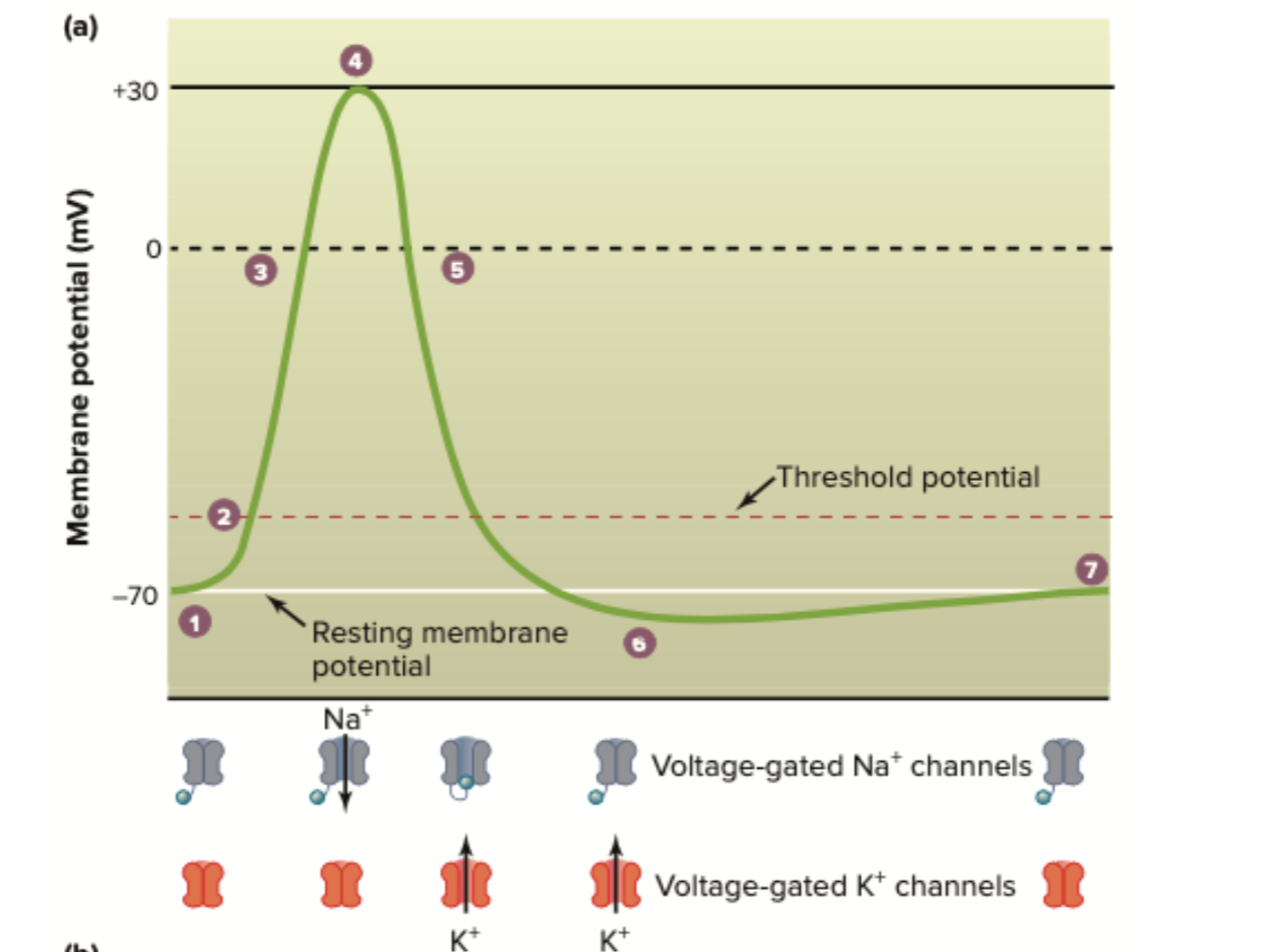
what is the “threshold potential”? what happens if the threshold potential isn’t reached?
step B:
membrane reaches the threshold potential
potential required for the depolarizing phase of an action potential
threshold stimuli: stimuli that are strong enough to depolarize the membrane to the threshold potential
threshold potential —→ typically a change of 15mV (so -55mV since resting is -70mV)
-if the threshold potential is not reached, nothing occurs.
why are action potentials all or none?
action potentials occur maximally or not at all
threshold potential reached —→ events that follow are no longer dependent on stimulus strength
REVIEW QUESTION 3: NAME THE ACTION POTENTIAL PHASE OCCURING AT 3, 5, AND 6
REVIEW QUESTION 4: WHICH CHANNELS ARE OPEN DURING PHASE 3, 5, AND 6
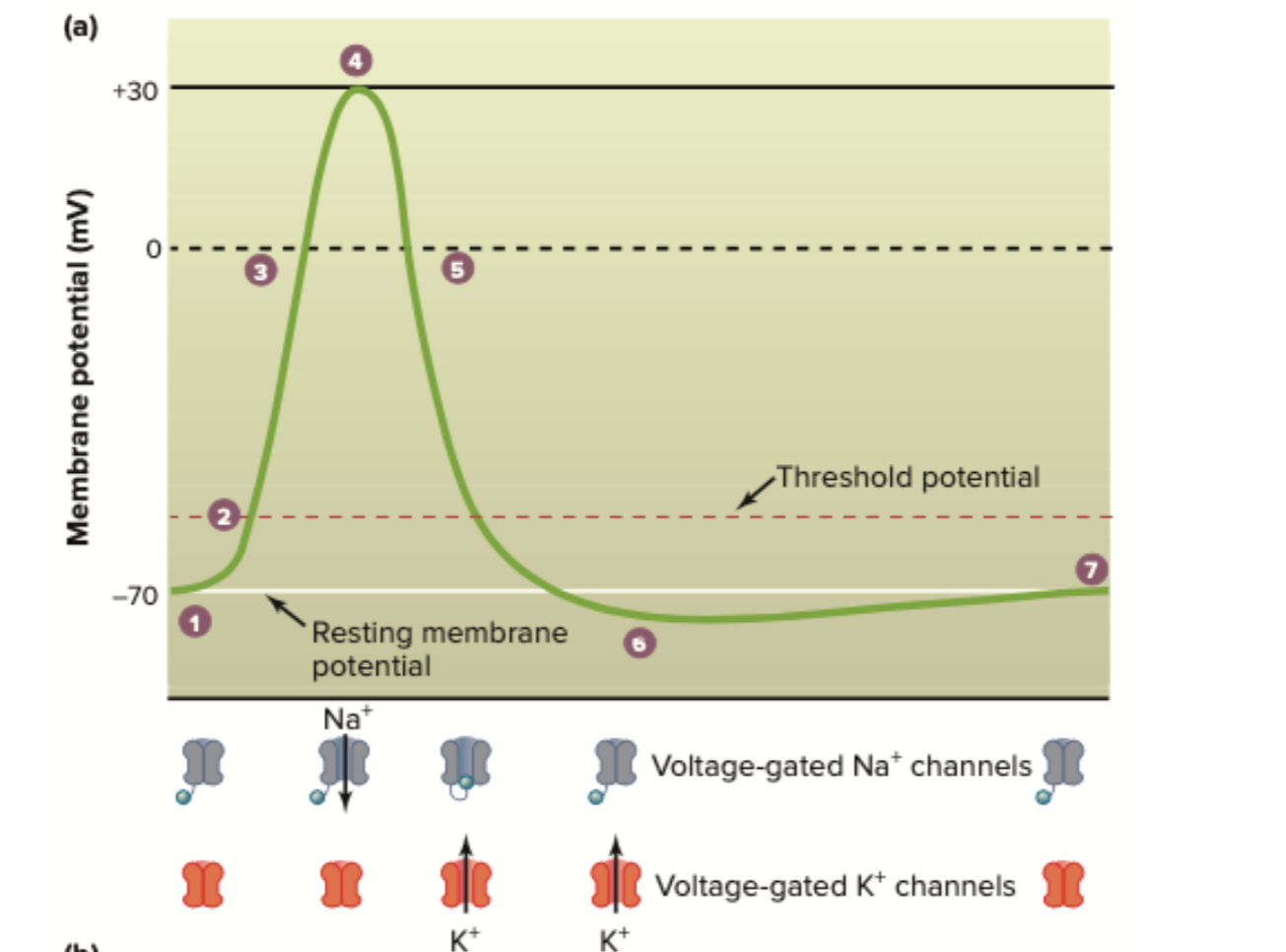
phase 3 is called depolarization, voltage gated sodium channels are open
phase 5 is called repolarization, voltage gated potassium channels are open voltage gated sodium channels are inactive
phase 6 is called hyperpolatizaion, some voltage potassium channels are still open as they are in the process of closing and voltage gated sodium channels are now closed
what is the absolute refractory period? how does it differ from the relative refractory period?
what channels are open during each phase?
absolute refractory period: period where additional stimuli cannot produce an additional action potential
occurs when voltage gated Na+ channels are open or inactivated
relative refractory period: period where a second action potential can be produced —→ requires a stronger stimulus than normal
occurs during afterhyperpolarization
some K+ channels are still open
some Na+ channels still remain inactive
what is action potential propagation? which direction can the action potential travel?
the process by which local currents produced by the action potential depolarize an adjacent site of the membrane —→ allows for the action potential to travel along the neuron
-action potential is only going to be able to travel from the direction of cell body to the axon terminal because of the flow of ions
what two factors determine the velocity of an action potential?
dependent on:
the diameter of the fiber
wider fiber = faster
increased ion flow
myelination
what is saltatory conduction? how does it increase the speed on the action potential?
saltatory conduction: regeneration of action potentials at the nodes of Ranvier.
myelin acts as an insulator —→ prevents leakage of “charge” in myelinated areas
myelinated areas contain lower amounts of voltage gated Na+ channels
action potentials can only occur at the nodes of ranvier
contain higher concentrations on voltage gated Na+ channels
-SO BASICALLY, Saltatory conduction is the rapid propagation of an action potential along a myelinated axon, where myelin prevents current loss and the signal “jumps” between nodes of Ranvier—sites rich in voltage-gated Na⁺ channels—thereby increasing conduction speed.
how do EPSP’s and IPSP’s differ? think about the membrane potential. how does each affect the likelihood of an action potential occurring?
EXCITATORY POSTSYNAPTIC POTENTIAL (EPSP)
membrane of the postsynaptic neuron is depolarized —→ brought closer to the threshold potential —→ increased likelihood of action potential
(depolarization of the postsynaptic membrane is called)
INHIBITORY POSTSYNAPTIC POTENTIAL (IPSP)
membrane of the postsynaptic neuron becomes hyperpolarized —→ further from the threshold potential —→ decreases likelihood of action potential being produced
(hyperpolarization of the postsynaptic membrane is called)
what is convergence? why does convergence occur?
-many presynaptic neurons + 1 postsynaptic neuron
-allows for many sources to influence the activity of one neuron
(many things coming together at a one common point)
what is divergence? why does divergence occur?
1 presynaptic neuron + many postsynaptic neurons
allows for one neuron to affect many pathways
(one signal coming from one presynaptic neuron that is going to affect many postsynaptic neurons)
what is temporal summation? how does temporal summation differ from spatial summation?
TEMPORAL SUMMATION
-summed potential created by more than one EPSP (or IPSP) arriving at a single synapse
EPSP’s (or IPSP’s) must occur in quick succession
SPATIAL SUMMATION
-summed potential created from EPSP’s and IPSP’s arriving via different synapses at the same time
what is an electrical synapse? what is one advantage of electrical synapses?
-plasma membrane of presynaptic and postsynaptic neurons are joined by gap junctions
-allows for the depolarization of the second membrane (postsynaptic membrane) to reach threshold potential
produces a rapid response
what is a chemical synapse?
-presynaptic neuron contains synaptic vesicles that contain neurotransmitters
-neurotransmitters are released into the synaptic cleft and bind to receptors on the postsynaptic membrane
know the basics steps in neurotransmitter release. this includes SNARE proteins.
NEUROTRANSMITTERS RELEASE AND CA2+
increased Ca2+ (calcium) in the axon terminal —→
more synaptic vesicles dock at membrane —→
increased amount of neurotransmitter released —→
increased amplitude of the postsynaptic IPSP or EPSP
SNARE PROTEINS
-found in membrane of the synaptic vesicle and plasma membrane of axon terminal
-Ca2+ bind to synaptotagmins —→ allows for formation of the SNARE complex —→ synaptic vesicle fuses with membrane releasing neurotransmitters
what are the 2 neurotransmitter receptor types discussed in class? how does each function?
ionotropic receptors: act as ion channels
metabotropic receptors: linked with second messenger systems —→ indirectly open/close ion channels
how are neurotransmitters removed from the synaptic left?
-reuptake: taken up by the presynaptic terminal for reuse
-can be degraded by glial cells
are transformed by enzymes into inactive substances
may be taken up by the presynaptic neuron
how does adjusting the Ca2+ concentration at the axon terminal increase the postsynaptic response?
increasing Ca²⁺ → increases neurotransmitter release → produces a stronger postsynaptic response.
what are axoaxonic synapses? how do they work?
know the difference between presynaptic facilitation and presynaptic inhibition.
-synapses where the axon terminal of one neuron ends on the terminal of a second neuron
Example:
neuron A secretes a neurotransmitter that binds to receptors embedded within the plasma membrane of neuron B —→
changes the amount of neurotransmitter released by neuron B —→
indirectly has an effect of the postsynaptic membrane of neuron C
PRESYNAPTIC FACILITATION
-stimulatory action produced by the axon terminal of one neuron directly on the terminal of another
results in an increase of neurotransmitter release
PRESYNAPTIC INHIBITION
-inhibitory action produced by the axon terminal of one neuron directly on the terminal of another
results in a decrease of neurotransmitter release
what are auto-receptors?
-receptors for a particular neurotransmitter that are found on the same axon terminal that secreted them.
acts as a form of negative feedback —→ decreases the further release of the neurotransmitter
know the two acetylcholine receptor types? where is each found in the body? what effect does each produce in the postsynaptic neuron following the binding of acetylcholine?
NICOTINIC ACETYLCHOLINE RECEPTORS
-acetylcholine receptors that respond to both acetylcholine and nicotine
ionotropic receptors that are permeable to both Na+ and K+ ions —→ depolarization of the membrane
locations:
neuromuscular junctions
(skeletal muscle)
brain: regions that are involved in attention, memory, and behavior
MUSCARINIC RECEPTORS
-acetylcholine receptors that respond to both acetylcholine and muscarine
metabotropic receptors that are coupled with G proteins —→ alter enzyme and ion channel activity
locations:
CNS - brain
PNS - glands, smooth muscle fibers, and the heart
know the different types of biogenic amines.
small charged molecules that are synthesized from amino acids and contain an amino acid group
types:
dopamine, norepinephrine, serotonin, and histamine
where would catecholamine secreting neurons be found in the body? what effect do catecholamine receptors have?
locations:
cell bodies originate within the brain stem or hypothalamus and axons branch to brain and spinal cord
involved in consciousness, mood motivation, attention, blood pressure, and hormone release
-receptors are metabotropic —→ utilize second messengers within the cytosol of the postsynaptic neuron
can be excitatory or inhibitory (regulating critical functions like vasoconstriction, heart rate, smooth muscle contraction)
what effects does the neurotransmitter serotonin have?
locations:
synapses throughout the CNS
effects:
muscles —→ excitatory
regions of the brain that mediate sensations —→ inhibitory
how do selective serotonin reuptake inhibitors work?
-used to treat depression
-inhibit the reuptake of serotonin by the presynaptic neuron at the synapse —→ increases the amount of serotonin available
what is long term potentiation? know the basic steps of long-term potentiation. what neurotransmitter is responsible for long term potentiation?
-process by which certain synapses undergo changes that enhance synaptic transmission
GLUTAMATE IS THE NEUROTRANSMITTER RESPONSIBLE FOR LONG TERM POTENTIATION
what effect do GABA receptors have on the postsynaptic neuron?
-inhibitory neurotransmitter
-can bind to:
ionotropic receptors —→ Cl- (chlorine) influx into the cell resulting in an IPSP
metabotropic receptors —→ inhibitory signal transduction pathway
-ethanol stimulates GABA synapses increasing their activity —→ sensory perception inhibition, loss of motor coordination, etc.
what effect do glycine receptors have on the postsynaptic neuron?
inhibitory neurotransmitter released by interneurons in the brainstem and spinal cord
binds to ionotropic receptors in the postsynaptic membrane —→ Cl- (chlorine) influx into the cell
know the basic structure of neurons found in the ANS.
what neurotransmitters are secreted by each the preganglionic neuron? what neurotransmitters are secreted by the postganglionic neurons in each division?
-the ANS contains two neurons between the CNS and the peripheral effector:
preganglionic neuron: cell body is found within the CNS
neurotransmitter secreted: acetylcholine
postganglionic neuron: cell body is found in the PNS
autonomic ganglion: cell body cluster in the PNS
sympathetic division: postganglionic neurons secrete the neurotransmitter norepinephrine
parasympathetic division: postganglionic neurons secrete the neurotransmitter acetylcholine