BIO3 - Chapter 14
 Call Kai
 Learn
Learn Practice Test
 Spaced Repetition
 Match
Match Flashcards
 Knowt Play
1/101

Earn XP
Description and Tags
Principles of Disease & Epidemiology
Name | Mastery | Learn | Test | Matching | Spaced | Call with Kai |
|---|
No analytics yet
Send a link to your students to track their progress
102 Terms
pathology
the study of disease
etiology
the study of the cause of a disease
pathogenesis
the development of disease
infection
colonization of the body by pathogens
disease
an abnormal state in which the body is not functioning normally
about the human microbiome
established in the utero, can be acquired from food, people, and pets, remaint throughout life
normal microbiota
permanently colonize the host & don’t cause disease under normal conditions
transiet microbiota
may be present for days, weeks, or months
factors that determine distribution & composition of normal microbiota
nutrients, physical & chemical factors, host defenses & mechanical factors
microbiome in vaginal birth
lactobacillus & bacteroides
microbiome in cesarean birth
resembles the human skin; S. aureus
microbial antagonism (aka competetive exclusion)
competition between microbes
how do normal microbiota protect the host
competing for nutrients, producing substances harmful to invading microbes, affecting pH & available O2
probiotics
live microbes applied to or ingested into the body, inteded to exert a beneficial effect
symbiosis
the relationship between normal microbiota & the host
types of symbiosis
commensalism, mutualism, parasitism
commensalism
one organism benefits, the other is unaffected
mutualism
both organisms beneft
parasitism
one organism benefits at the expense of the other
opportunistic pathogen
pathogen that doesn’t cause disease but takes advantage of a “weakened opportunity” to cause infection; E. coli
Koch’s postulates procedure
sample from diseased animal
mirobe grown in pure culture & identified
microbe innoculated into healthy animal
disease reproducted in animal
microbe from animal is isolated & grown in pure culture
koch’s postulates purpose
to prove the cause of an infectious disease
exceptions to Koch’s posstulates
some pathogens can cause several disease conditions
some pathogens cause disease only in humans
some microbes have never been cultured
symptoms
changes in the body function that are felt by a patients as a result of disease
signs
changes in a body that can be measured or observed as a result of disease
syndrome
a specific group of signs & symptoms that accompany a disease
communicable disease
a disease that is spread from one host to another
contagious diseases
diseases that are easily & rapidly spread from one host to another
noncommunicable disease
a disease that is not spread from one host to another
incidence
fraction of a pop. that contracts a disease during a specific time; indicates the spread of disease
prevalence
fraction of a pop. having a specific disease at a given time; include both old & new cases; indicate severity of the disease
sporadic disease
disease that occurs occasionally in a pop.
endemic disease
disease constantly present in a pop. - common cold
epidemis disease
disease acquired by many hosts in a given area in a short time - influenza
pandemic disease
worldwide epidemic - covid
herd immunity
immunity in most of a pop.
acute disease
symptoms develop rapidly
chronic disease
disease develops slowly
subacute disease
symptoms between acute & chronic
latent disease
disease with a period of no symptoms when the causative agent is inactive
local infection
pathogens are limited to a small area of the body
systemic (generalized) infection
an infection throughout the body
focal infection
systemic infection that began as a local infection
sepsis
toxic inflammatory conditions arising from the spread of microbes, especially bacteria or their toxins, from a focus of infection
septicemia
growth of bacteria in the blood
bacteremia
bacteria in the blood
toxemia
toxins in the blood
viremia
viruses in the blood
primary infection
acute infection that causes the initial illness
secondary infection
opportunistic infection after a primary (predisposing) infection
subclinical disease
no noticeable signs or symptoms (inapparent infection)
predisposing factors
factors that make the body more susceptible to disease
predisposing factors examples
gender, inherited traits, climate & weather, fatigue, age, lifestyle, chemotherapy, emotional distrubances
incubation period
interval between initial infection & first signs & symptoms
preodromal period
short period after incubation;early, mild symptoms
period of illness
disease is most severe
period of decline
signs & symptoms subside
period of convalescence
body returns to its prediseased state
causes of the spread of infection
reservoirs of infection & transmission of disease
reservoirs of infection ex
human (AIDS, gonorrhea)
animal (rabies, lyme disease)
nonliving (botulism, tetanus)
significance of human carriers
may have inapparent infections or latent diseases
methods of transmission of disease
contact, vehicle, vectors
methods of contact
direct, congenital transmission, indirect, droplet
direct contact
req close association between infected & susceptible host
congenital transmission contact
transmission from mother to fetus or newborn at birth
indirect contact
spread by fomites
fomite
any nonliving object involved in the spread of an infection, such as clothes, utensils, & furniture
droplet contact
transmission via airborne droplets
vehicle transmission
transmission of disease by a medium, such as water, air, or food
vectors
arthropods (fleas, ticks, mosquitoes, most common); transmission via mechanical or biological transmission
what are the 2 general methods vectors transmit disease by
mechanical transmission & biological transmission
mechanical transmission
arthropod carries pathogen on feet
biological transmission
pathogen reproduces in vector
healthcare-associated infections (HAIs)
aka nosocomial infections; acquired while recieveing treatment in a health care facility
factors that make it easy for HAI to occur
microorganisms in the hospital env
compromised host
chain of transmission in a hospital
compromised host
an individual whose resistnce to infection is impaired by disease, therapy, or burns
methods of controlling HAIs
universal precautions
reducing number of pathogens
infection control committees
what are the universal precautions
standard & transmission-based precautions
standard precautions
basic, minimum practices
transmission-based precautions
supplemental to standard precautions; designed for known or suspected infections
types of transmission-based precautions
contact, droplet, airborne precautions
ways to reduce # of pathogens
handwashing, disinfecting tubs used to bather patients, cleaning instruments scrupulously, using disposable bandages & intubation
emerging infectious diseases (EID)
diseases that are new, increasing in incidence, or showing potential to increase in the near future
contributing factors of EIDs
genetic recombination, evolution of new strains, inappropriate use of antibiotics & pesticides, changes in weather patterns, modern transportation, ecological disaster, war, & expanding human settlement, animal control measures, public health failure
epidemiolody
study of where & when diseases occur
role of epidemiologists
determine the etiology of a disease, ID other important factors concerning the spread of disease, develop methods for controlling a disease, assemble data & graphs to outline incidence of disease
descriptive epidemiology
collection & analysis of data
analytical epidemiology
comparison of a disease group & a healthy group
experimental epidemiology
controlled experiments
what is case reporting
health care workers report specified disease to local, state, & national offices
significance of nationaly notifiable diseases
physicians are required to report occurrence
morbidity
incidence of a specific notifiable disease
mortality
deaths from notifiable diseases
morbidity rate
number of people affected in relation to the total population in a given time period
mortality rate
number of deaths from a given disease in relation to the population in a given time
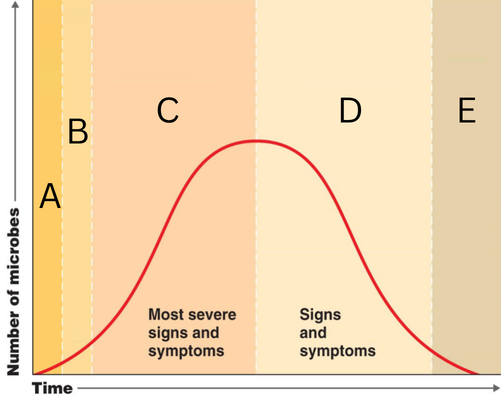
A
incubation period
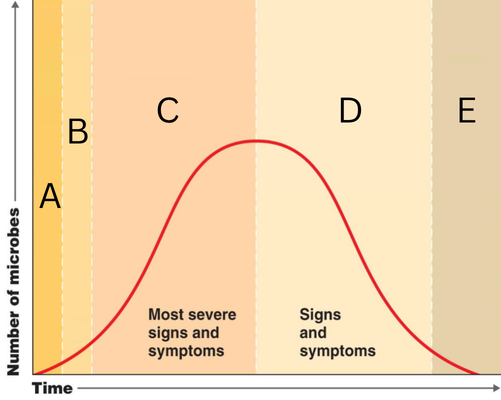
B
prodromal period
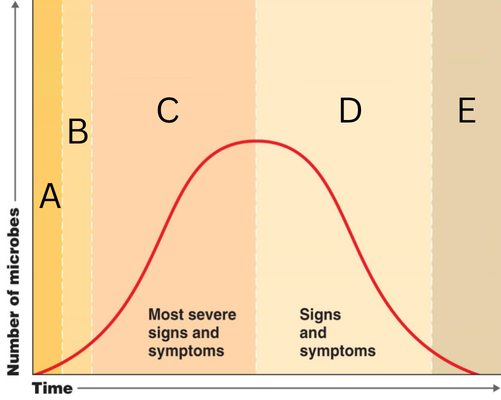
C
period of illness
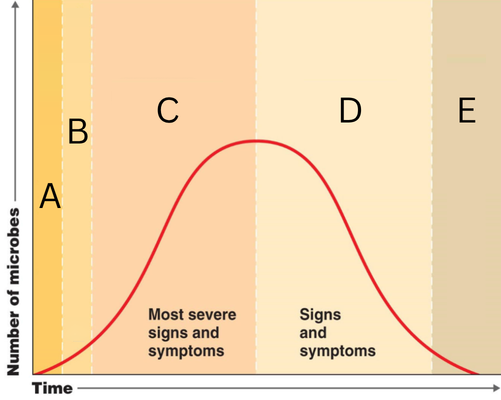
D
period of decline
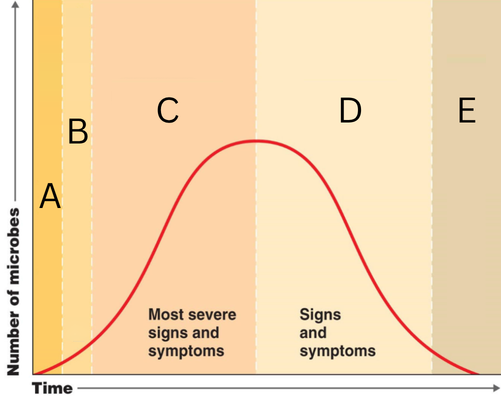
E
period of convalescence