EXSS NS regions
 Call Kai
 Learn
Learn Practice Test
 Spaced Repetition
 Match
Match Flashcards
 Knowt Play
1/29

There's no tags or description
Looks like no tags are added yet.
Name | Mastery | Learn | Test | Matching | Spaced | Call with Kai |
|---|
No analytics yet
Send a link to your students to track their progress
30 Terms
Central Nervous System (CNS)
Brain lies above foramen magnum
Spinal cord lies below foramen magnum
Peripheral Nervous System (PNS)
12 pairs cranial nerves
31 pairs spinal nerves
Peripheral nerves
3 main functions of nervous sytem
Sensory
- senses changes in the internal and external envionmentIntegrative
- analyzes data, stores data, decides which stimuli are importantMotor
- responds to simuli through muscular contractions or glandular secretion
Spinal cord tracts
Sensory/Ascending tracts = conduct nerve impulses to brain
Motor/Descending tracts = conduct impulses down cord
Somatic Nervous System
Sensory neurons and Motor Neurons to Skeletal Muscle
1 Neuron in pathway: Motor neurons innervate skeletal muscle to produce conscious, voluntary movements
Effect of a motor neuron = excitation
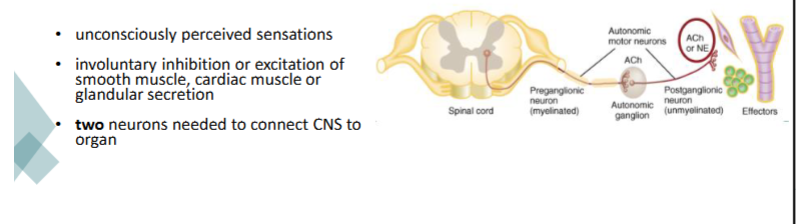
Autonomic Nervous System (ANS)
Operates via reflex arcs
2 Neurons in pathway (preganglionic + postganglionic)
continuous flow of sensory input and motor output
Not aware or autonomic responses, hypothalamus is control center
Autonomic Nervous System (ANS) DIVISONS
Sympathetic Division
Parasympathetic Division
Hypothalamus balances both
Autonomic Nervous System (ANS) NEUROTRANSITTERS
Neurons classified based on neuotransmitter released
Adrenergic = NE
Cholinergic = ACH
Autonomic Nervous System (ANS) RECEPTORS
Nicotinic = Preganglionic, receive ACh → excitation
Adrenergic = Postgalgnlionic, receive NE → excite or inhibit
Muscarinic = Postganglionic, receives ACh → excite or inhibit
Preganglionic neurons
Release ACH to nicotinic receptors = Excitation
Postganglionic neurons
Release norepinephrine (NE) to adrengic receptors (SNS) or ACH to muscarinic resecptors (PNS)



Sympathetic Responses
Fight or Flight
Physical or emotional stress
E situations
Sympathetic Responses Indicators
dilation of pupils, dilation of airways, respiratory rate
increases
• increase of heart rate, force of contraction & BP, blood flow to
skeletal & cardiac muscle, blood glucose levels
• increase blood pressure and mental activity
• decrease in blood flow to nonessential organs
• Some organs have only sympathetic innervation
• sweat glands, adrenal medulla, arrector pili mm & many blood
vessels
Parasympathetic responses
Rest and Digest activities
Conserve and restore energy during times of rest
Actions oppose those of sympathetic system
Decrease HR, diamter of airways and coronary vesssels
Normally dominate over sympathetic impulses
SLUDD RESPONSESSalivation, lacrimation, urination, digestion, and defactation
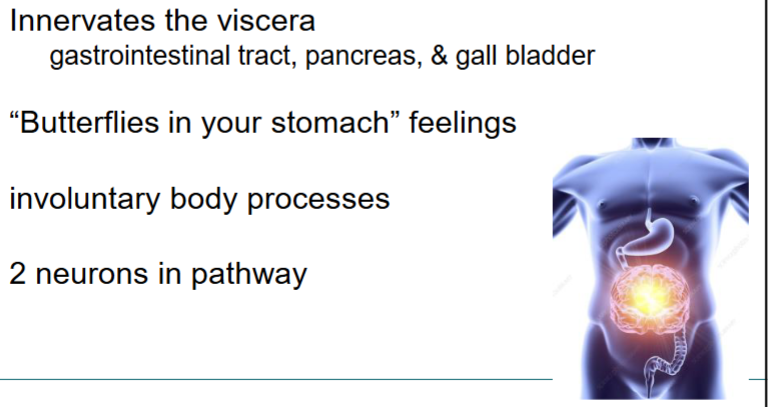
Enteric Nervous System
Neurons V Neuroglia
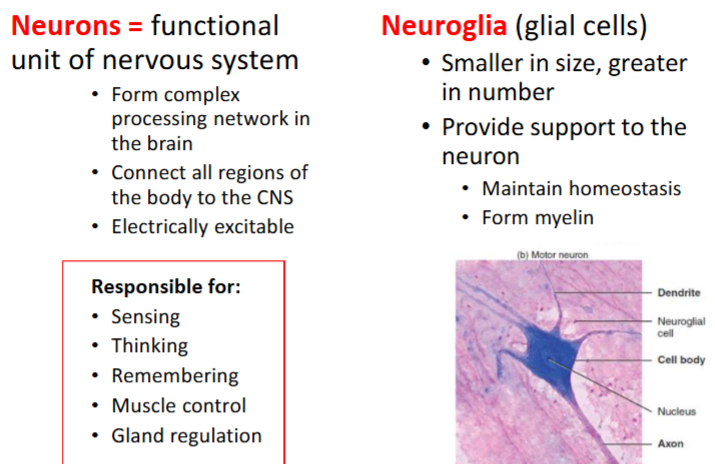
3 main components of neurons
Dendrites
Cell body/Soma
Axon
Many axon make up a nerve
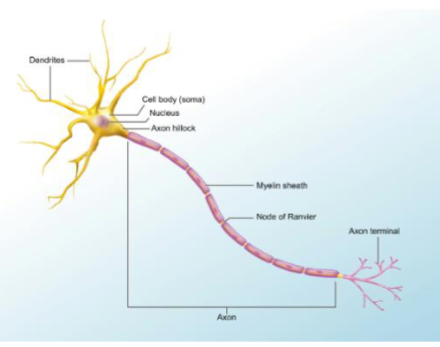
Function classification of neurons
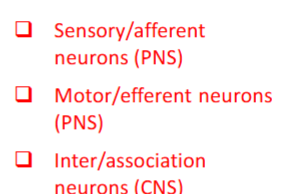
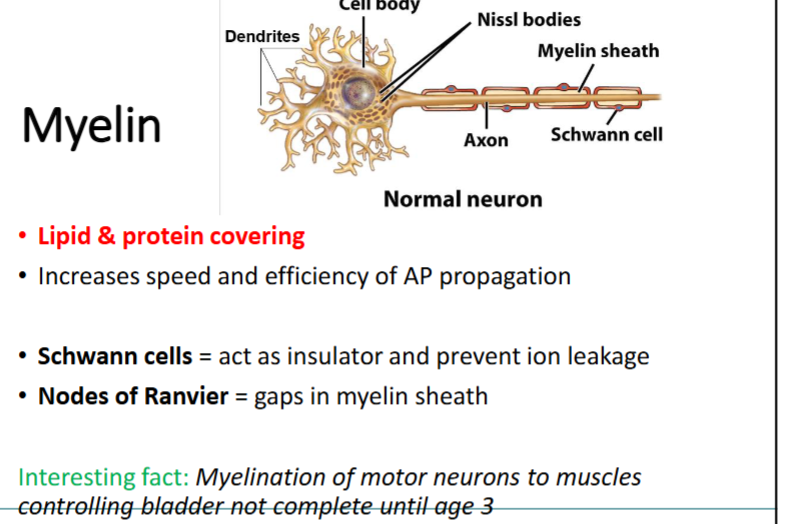
Myeline Sheath
Multilayered lipid
insulates axon
Increase nerve conduction velocity
Nucleus = Schwann cells
Gapes = Nodes of ranview
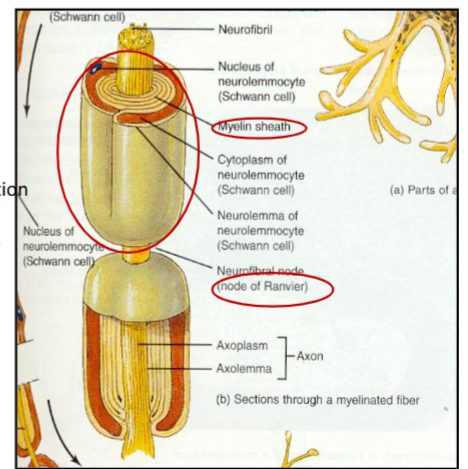
Myelin
Multiple Sclerosis (MS)
Deterioration of myelin sheath
Sensory of motor neurons
Neurons become ineffective
Muscle atrophy
Decreased coordination
Currently no cure
Synapses
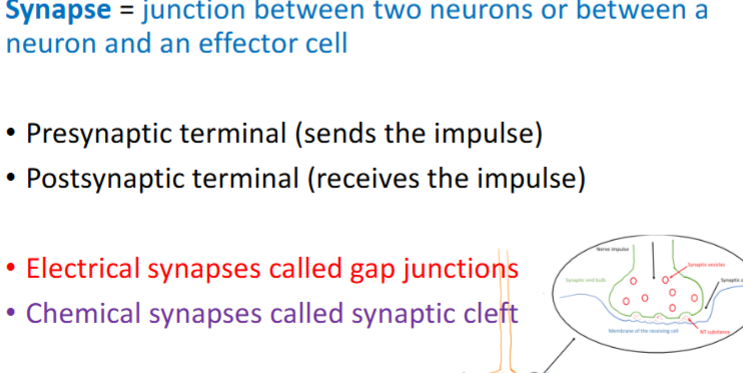
Eletrical synapse
Ionic current spreads to next cell through gap junctions
faster, two way transmission and capable of synchronizing neurons
Chemical synapse
one way informationt ransfer from presynaptic to postsynapic neuron
neurons/cells involved do not touch but are seperates by a synaptic cleft
Pharmacology of the NMJ
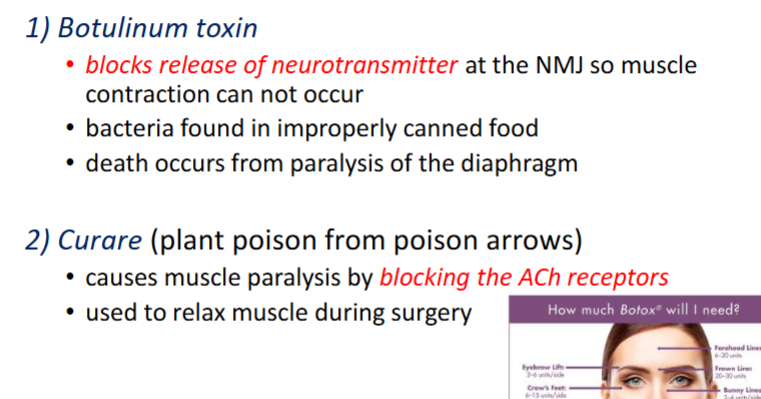
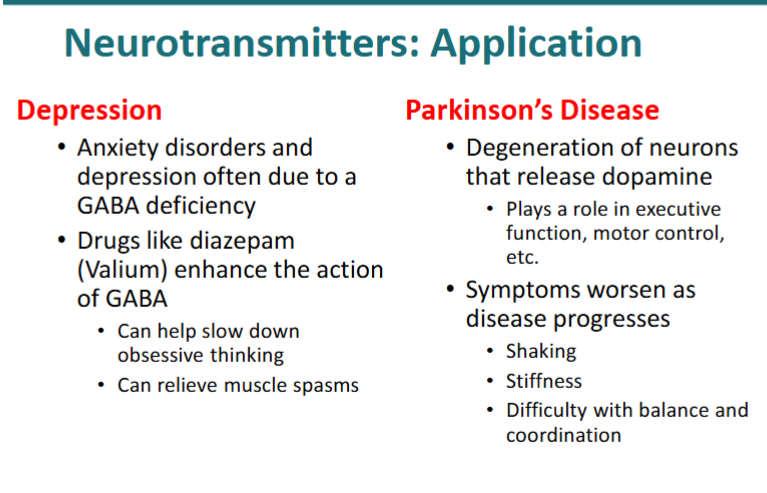
Neurotransmitters
Released form axon terminal into synaptic cleft into a response to a nerve impulse
Effects can be modified via synthesis, release, removal, receptor site
Agonist = enhance
Antagonist = Blocks
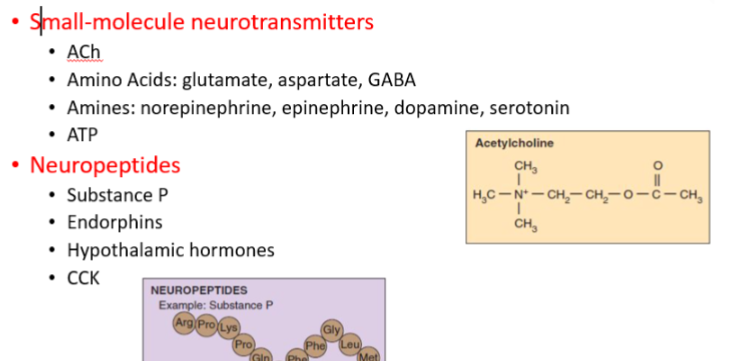
Common neurotransmitters