Physics June program electricity test
 Call Kai
 Learn
Learn Practice Test
 Spaced Repetition
 Match
Match Flashcards
 Knowt Play
1/83

There's no tags or description
Looks like no tags are added yet.
Name | Mastery | Learn | Test | Matching | Spaced | Call with Kai |
|---|
No analytics yet
Send a link to your students to track their progress
84 Terms
(Electrodynamics) What does the symbol “φ” refer to?
Magnetic flux
Scalar
Unit: weber (Wb)
(Electrodynamics) What does the symbol “θ” refer to in φ = BAcosθ?
The angle between the permanent magnetic field and the normal of the circuit
Scalar
Unit: Degrees
(Electrodynamics) What does the symbol “ε” refer to?
Induced EMF
Scalar
Unit: Volts (V)
(Electrodynamics) What does the symbol “B” refer to in φ = BAcosθ?
Magnetic field strength
Vector
Unit: Tesla (T)
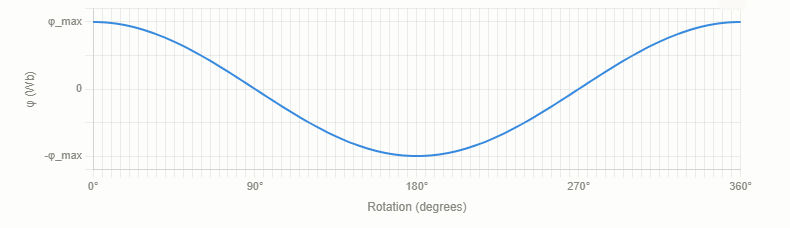
(Electrodynamics) How does a magnetic flux over (relative) degree of rotation graph look?
(Degree of rotation is always relative to starting point)
(Electrodynamics) How does an induced EMF over (relative) degree of rotation graph look?
(Degree of rotation is always relative to starting point)
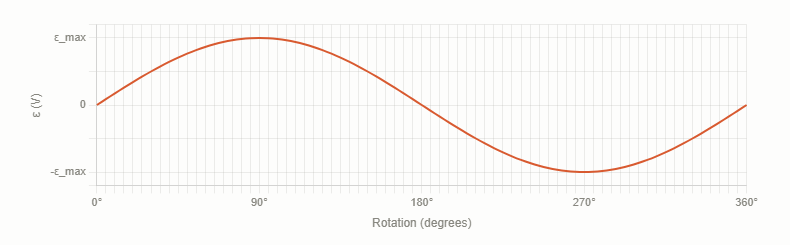
(Electrodynamics) When is induced EMF at a maximum?
When magnetic flux is at a minimum - circuit is parallel to magnetic field
(Electrodynamics) When is magnetic flux at a maximum?
When induced EMF is at a minimum - circuit is perpendicular to magnetic field
(Electrodynamics) Which hand do you use for motors and which do you use for generators
Left hand = Fleming’s Left Hand Motor Rule
Right hand = Fleming’s Right Hand (Generator) Rule
(Electrodynamics) Explain F = I L B sin θ
F — Force (N) The mechanical force exerted on the wire by the magnetic field. This is what makes electric motors work.
I — Current (A) The current flowing through the conductor. More current = more force.
l — Length (m) The length of the conductor that is actually inside the magnetic field. Only the section within the field experiences a force.
B — Magnetic field strength (T) The stronger the field, the greater the force.
sinθ — The angle between the current direction and the magnetic field direction.
θ = 90° → sinθ = 1 → maximum force (current perpendicular to field)
θ = 0° → sinθ = 0 → zero force (current parallel to field)
(Electrodynamics) What is the design difference between IEB Motors and Generators?
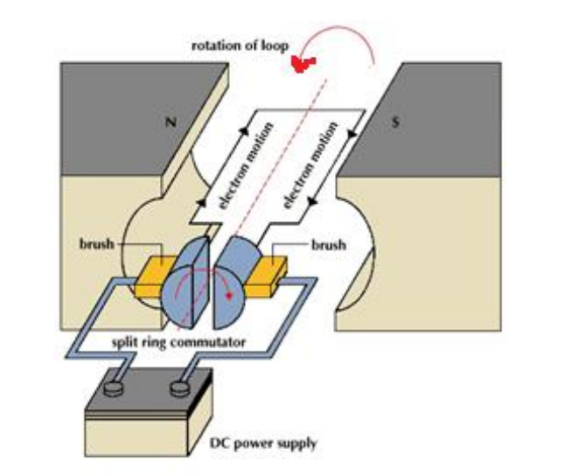
Motors - DC (Split rings)
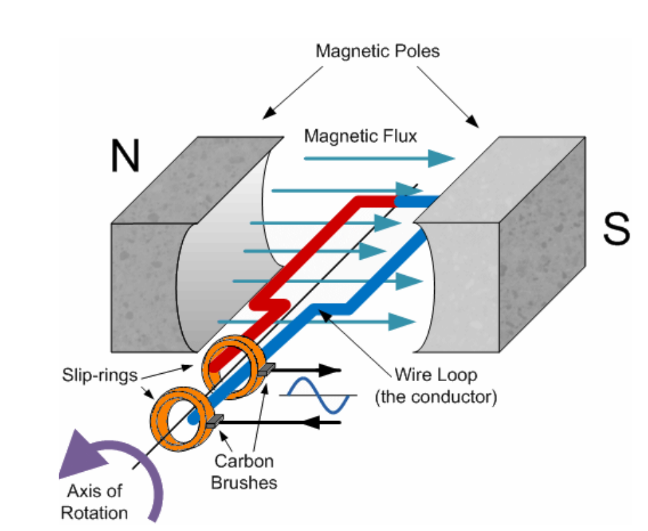
Generators - AC (Slip rings)
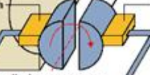
What do the 2 blue semi cylinders represent and what circuit do they form part of?
They are split ring commutators, part of the DC Motor.
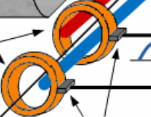
What do the 2 orange rings represent and what circuit do they form part of?
They are slip ring commutators, they form part of the AC generator.
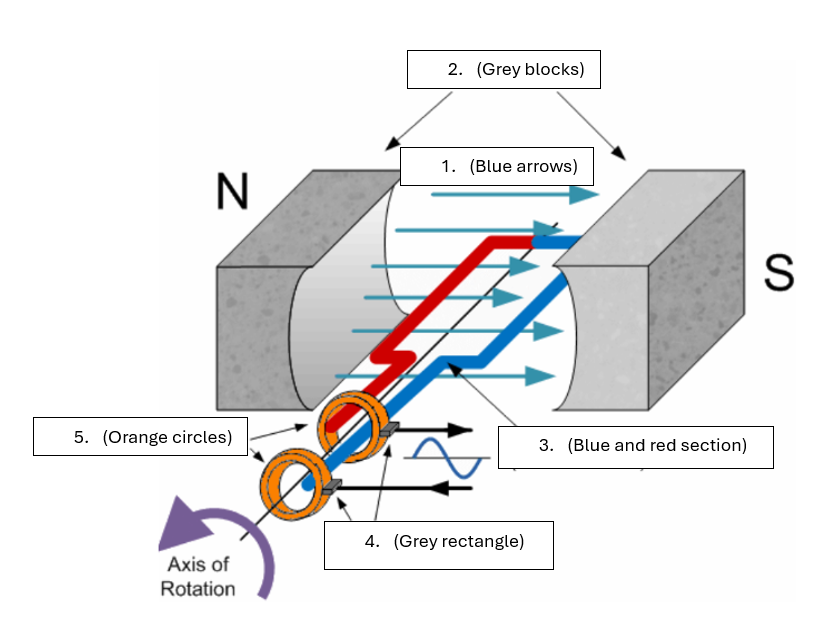
Label this diagram
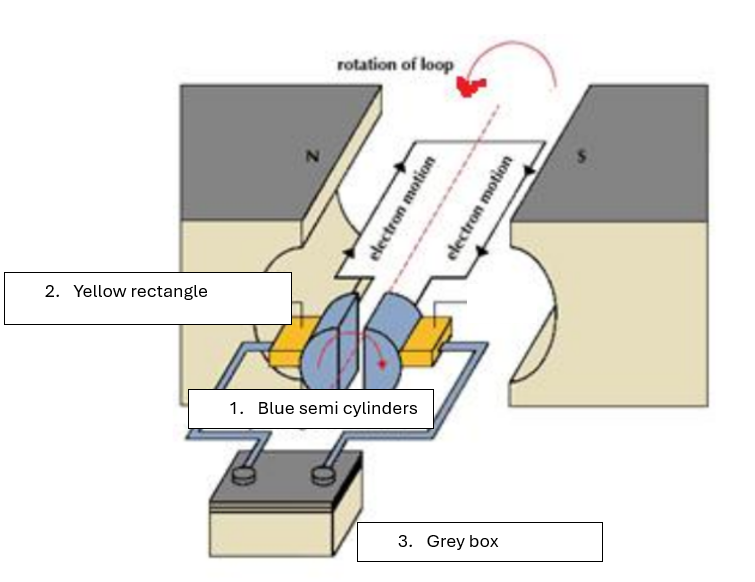
Label this diagram
(Electrodynamics) The factors affecting the magnitude of the induced emf:
- The rate at which the coil moves relative to the magnetic field (Increase in speed = increased EMF)
- The angle between the coil and the magnetic field (parallel = max, perpendicular = min)
- The number of turns on the coil (Increase in turns = increase in EMF)
- The magnitude of the magnetic field (Stronger magnitude = greater change in magnetic flux = increase in EMF)
- The area of the conducting coil (Larger area = increase in flux = greater change in magnetic flux = increase in EMF)
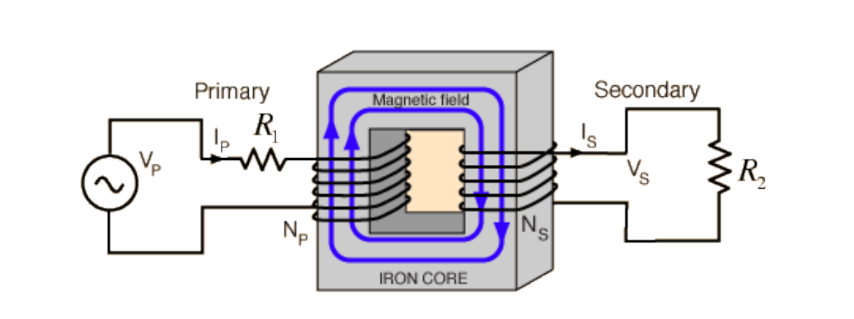
(Electrodynamics) - How does a transformer work?
Alternating current is sent to the primary coil
Current causes a change in magnetic field around the conductor (iron core)
Change in magnetic field causes a change in magnetic flux experienced by the secondary coil
Direction of induced current is explained by Lenz’s law
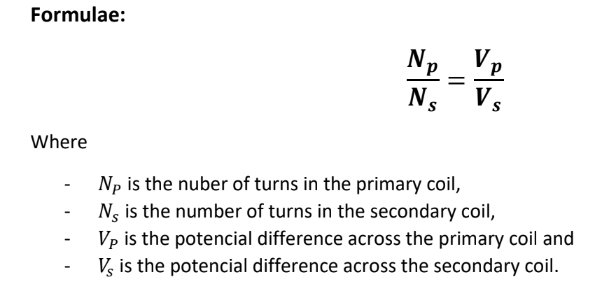
(Electrodynamics) - Transformer step formula (potential difference and turns)
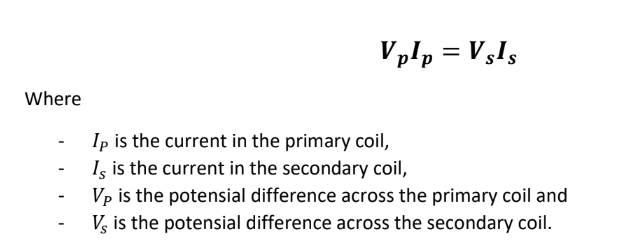
(Electrodynamics) - Transformer step formula (current and potential difference)
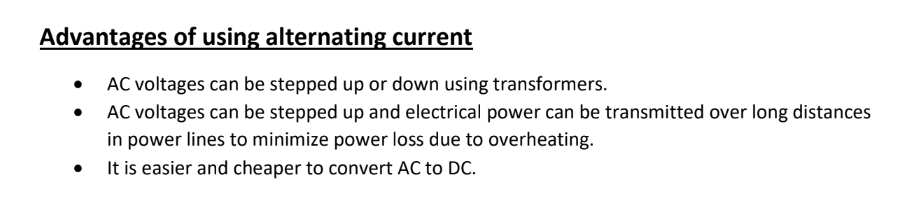
(Electrodynamics) - Advantages of using AC current
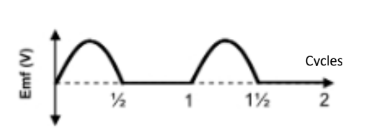
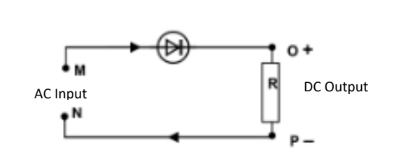
What circuit creates this graph? What is this process called?
Half wave rectification
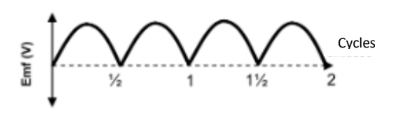
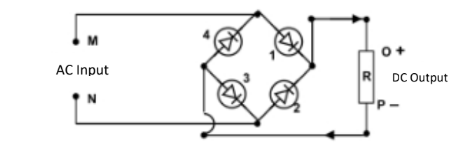
What circuit creates this graph? What is this process called?
Full wave rectification
(Electrodynamics) How does a diode look?
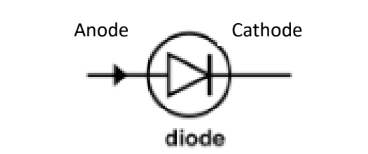
(Electrodynamics) How do you get a constant current/voltage graph?
Via a Battery (not a generator using any kind of rectification)
SAGS Definition of: Magnetic field
Produced by magnets or by moving electrical charges. Magnetic field lines are drawn to represent the direction of the magnetic field at a point. The symbol for magnetic field strength is B and the unit is the Tesla (T).
SAGS Definition of: Right hand rule
When you hold a current carrying conductor in your right hand so that your thumb points in the direction of conventional current, your fingers will curl in the direction of the magnetic field.
SAGS Definition of: Solenoid rule (Right hand thumb rule)
When you hold a solenoid in your right hand so that your fingers curl in the direction of conventional current, your thumb will point in the direction of the north pole.
SAGS Definition of: Magnetic Flux Density (B)
A representation of the magnitude and direction of the magnetic field.
SAGS Definition of: Magnetic flux (Φ)
For a loop of area (A) the magnetic flux (Φ) passing through the loop in the presence of a uniform magnetic flux density (B) is defined as Φ = BA cosθ, where θ is the angle between the magnetic flux density (B) and the normal to the loop of area (A). (No calculations required)
SAGS Definition of: Magnetic flux linkage
The product of the number of turns on the coil and the flux through the coil (NΦ).
SAGS Definition of: Faraday's law
The emf induced in a coil is directly proportional to the rate of change of magnetic flux (flux linkage).
SAGS Definition of: Lenz's law
The induced current flows in a direction so as to set up a magnetic field to oppose the change in magnetic flux.
SAGS Definition of: Electromagnetic induction
Occurs when a current is induced in a closed conducting loop when there is a change in the magnetic flux passing through the surface area of the conducting loop.
SAGS Definition of: AC
Alternating current. Current which reverses direction periodically.
SAGS Definition of: Commutator
A device that ensures that the direction of the current in a coil is reversed every half revolution.
SAGS Definition of: Conventional current
The rate of flow of positive charge from the positive terminal of the cell to the negative terminal.
SAGS Definition of: DC
Direct current. Current flowing in one direction only.
SAGS Definition of: Diode
A component that only allows current to flow in one direction.
SAGS Definition of: Bridge rectifier
A type of full-wave rectifier that uses four or more diodes in a bridge circuit configuration to efficiently convert alternating (AC) current to a direct (DC) current.
SAGS Definition of: Fleming’s Left Hand Motor Rule
Thumb = Force
Index / pointer finger = Magnetic field
Middle finger = Direction of current
SAGS Definition of: Fleming’s Right Hand Generator Rule
Thumb = Force
Index / pointer finger = Magnetic field
Middle finger = Direction of current
(Electric circuits) What does the symbol “V” refer to?
Potential difference
Scalar
Unit: Volts ( V )
(Electric circuits) What does the symbol “ε” refer to?
EMF (Electromotive force)
Scalar
Unit: Volts ( V )
(Electric circuits) What does the symbol “I” refer to?
Current
Scalar
Unit: Ampere ( A )
(Electric circuits) What does the symbol “R” refer to?
Resistance
Scalar
Unit: Ohm ( Ω )
(Electric circuits) What does the symbol “W” refer to?
Work
Scalar
Unit: Joules ( J )
(Electric circuits) What does the symbol “P” refer to?
Power
Scalar
Watts ( W )
(Electric circuits) How do you turn EMF = Vint + Vext into y = mx + c
Vext = -Ir + EMF
(Electrostatics) What is the relationship between a charged object and a neutral object?
Both objects experience a force of attraction.
(Electrostatics) What effect does the strength of the magnitude of charge have on electric field lines?
The larger the magnitude of the charge on an object the DENSER the electric field lines drawn (to show relative strength).
(Electrostatics) What is different about an electric field between 2 parallel charged plates as opposed to an electric field around a point?
E (Electric field strength) is constant in every position between the plates.
(Electrostatics) What does the symbol “Q” refer to?
The charge of the object creating the field which makes another charge experience a force
Scalar
Unit: Coulomb ( C )
(Electrostatics) What does the symbol “q” refer to?
The charge of the object in an electric field which is experiencing a force
Scalar
Unit: Coulomb ( C )
(Electrostatics) What does the symbol “E” refer to?
The electric field strength
Vector
Unit: N.C-1
(Electrostatics) What is Coulomb’s constant, what is it’s symbol and what unit does it have?

(Electrostatics) What is the formula for “E” that is NOT on the formula sheet?

(Electrostatics) What is the formula for determining the new charge on an object after it comes into contact with another object?

(Electrostatics) What is the formula for determining the change in charge after 2 charged objects come into contact?

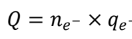
(Electrostatics) What is the formula for determining the number of electrons (most likely transferred)?
SI Prefix: T
Tera: 10^12
SI Prefix: G
Giga: 10^9
SI Prefix: M
Mega: 10^6
SI Prefix: k
Kilo: 10^3
SI Prefix: h
Hecto: 10^2
SI Prefix: da
Deca: 10^1
SI Prefix: d
Deci: 10^-1
SI Prefix: c
Centi: 10^-2
SI Prefix: m
Milli: 10^-3
SI Prefix: μ
Micro: 10^-6
SI Prefix: n
Nano: 10^-9
SI Prefix: p
Pico: 10^-12
SAGS Definition of: Potential difference
The work done per unit positive charge. V = W/Q
SAGS Definition of: Current
The rate of flow of charge. I = Q/t
SAGS Definition of: Ohm's Law
The current through a conductor is directly proportional to the potential difference across the conductor at constant temperature.
SAGS Definition of: Resistance
A material's opposition to the flow of electric current.
SAGS Definition of: EMF
The total energy supplied per coulomb of charge by the cell.
SAGS Definition of: Power
The rate at which work is done / The rate at which energy is transferred.
SAGS Definition of: Electrical power
The power dissipated in a device is equal to the product of the potential difference across the device and the current flowing through it.
SAGS Definition of: Kilowatt hour
A unit of energy. 1 kWh is the amount of energy used when 1 kilowatt of electricity is used for 1 hour.
SAGS Definition of: Internal resistance
The resistance inside a real battery.
SAGS Definition of: Coulomb's Law
Two point charges exert forces on each other. The force is directly proportional to the product of the charges and inversely proportional to the square of the distance between the charges.
SAGS Definition of: The magnitude of the electric field at a point
The force per unit positive charge.
SAGS Definition of: Electric field
A region of space in which an electric charge experiences a force. The direction of the electric field at a point is the direction that a positive test charge would move when placed at that point.
Which math formula is likely to come up in an electrostatics question?
Quadratic formula