Chapter 9 Muscle Tissue
 Call Kai
 Learn
Learn Practice Test
 Spaced Repetition
 Match
Match Flashcards
 Knowt Play
1/37

There's no tags or description
Looks like no tags are added yet.
Name | Mastery | Learn | Test | Matching | Spaced | Call with Kai |
|---|
No analytics yet
Send a link to your students to track their progress
38 Terms
What are the Characteristics of Muscles
Excitability - able to respond to stimuli
contractility - shorten forcibly
extensability - can be stretched
elasticity - able to recoil
Primary Functions
movement, maintianing postion/posture, support soft tissues, control orfices (openings in body), heat generation
Skeletal Muscle
attatched to bones, voluntary, multinucleated, striated
Cardiac Muscle
in wall of heart, involuntary, uninucleate, striated
Smooth Muscle
in walls hollow organs, involuntary, uninucleate, spindle-shaped, nonstriated
Origin of Muscle
stationary during contraction
Insertion of Muscle
mobile during contraction
Direct Attachments
attachment of muscle by fusion of muscle sheath to periosteum of bone
Indirect Attachments
connection through tendon of Aponeurosis (flat sheet)
Epimyseum
outermost layer of muscle
What makes up muscle tissue?
muscle facicles
Perimysium
peremeter around muscle fascicles
what makes up muscle facicles?
muscle fiber (long muscle cells)
endomyseum
surrounds muscle fibers
plasma membrane of muscle fibers
sarcolemma
cytoplasm of muscle fibers
sarcoplasma
what makes up muscle fibers
myofibrils
sarcomere
smallest contractile unit
thick filaments
each filament contains bundle of myosin with tail + 2 heads. During contraction heads bond to thin filaments (cross bridges)
Thin Filaments
twisted strands of actin subunits that bind to myosin head
tropomysin
strands around actin that block binding sites
troponin
complexes that bind to actin, tropomysin, and Ca2+ (can hold tropomysin in place or move when stimulated to cause flexion)
elastic filaments
composed of titin which is a spring like protein that cause muscles to recoil
myofilaments
thin, thick, elastic filaments
neuromuscular junction
where the nerve meets and sends e- signal
motor neuron
stimulates a group of muscle fibers (motor units)
First class lever
fulcrum in the middle [nodding movement with skull]
![<p>fulcrum in the middle [nodding movement with skull]</p>](https://assets.knowt.com/user-attachments/4ab92553-1bd1-48d3-9b68-f3ad81aae24d.png)
Second-Class Lever
load is in the middle [standing on tip toes]
![<p>load is in the middle [standing on tip toes]</p>](https://assets.knowt.com/user-attachments/76590c06-d43f-4b57-b767-c2722ed1d34c.png)
Third-Class Lever
applied force in the middle (most common)
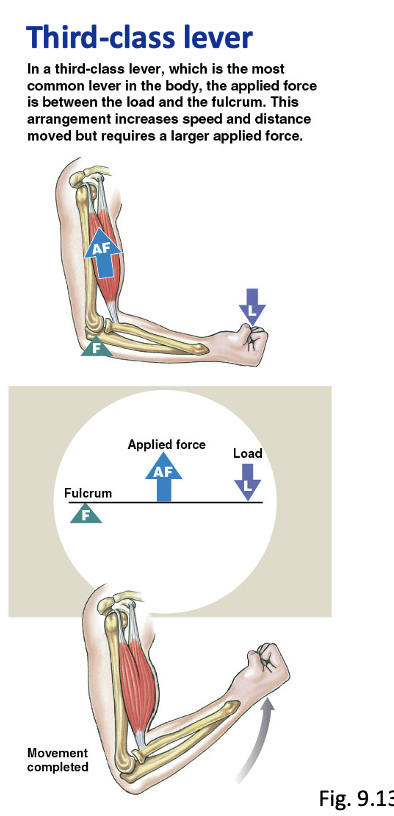
Examples of Muscles Named by Location
temporalis, intercostal
Examples of Muscles Named by shape
deltoid, rhomboideus
Examples of Muscles Named by size
gluteus maximus, (longus)
Examples of Muscles Named by direction of fibers
rectus ___, external, internal, transverse
Examples of Muscles Named by number of heads
biceps, triceps
Examples of Muscles Named by location of attachments
[sternocleidomastoid] (uses compound names)
Examples of Muscles Named by relative position
lateralis/medialis
Examples of Muscles Named by action
adductor, exgtensor