2. 744 Overview of Mobility Slides3
 Call Kai
 Learn
Learn Practice Test
 Spaced Repetition
 Match
Match Flashcards
 Knowt Play
1/55

Earn XP
Description and Tags
mobility other than gait
Name | Mastery | Learn | Test | Matching | Spaced | Call with Kai |
|---|
No analytics yet
Send a link to your students to track their progress
56 Terms
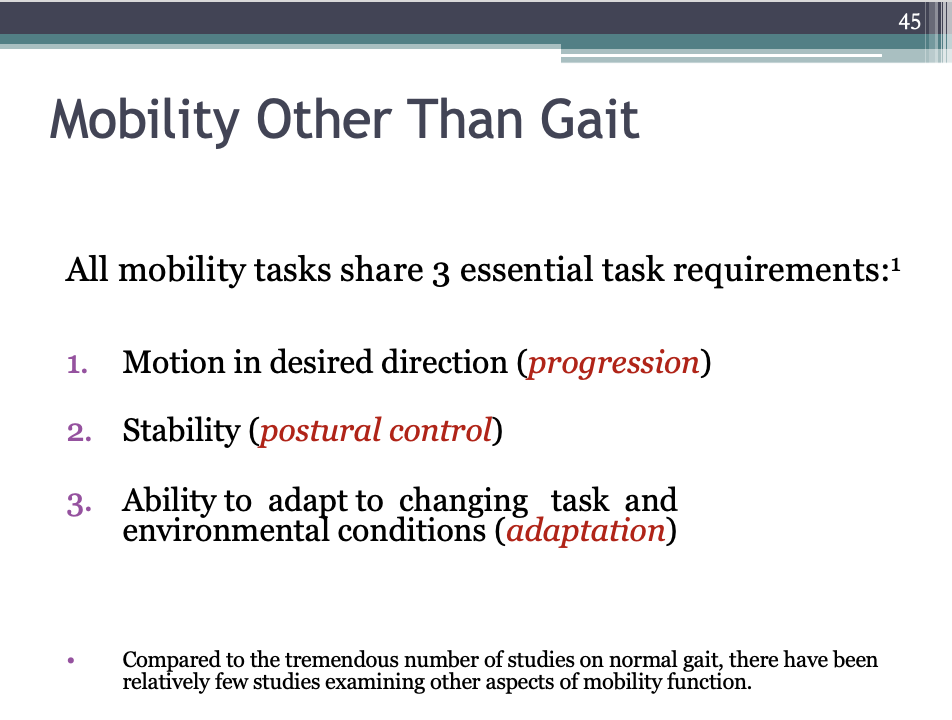
mobility other than gait: all mobility tasks share 3 essential task requirements
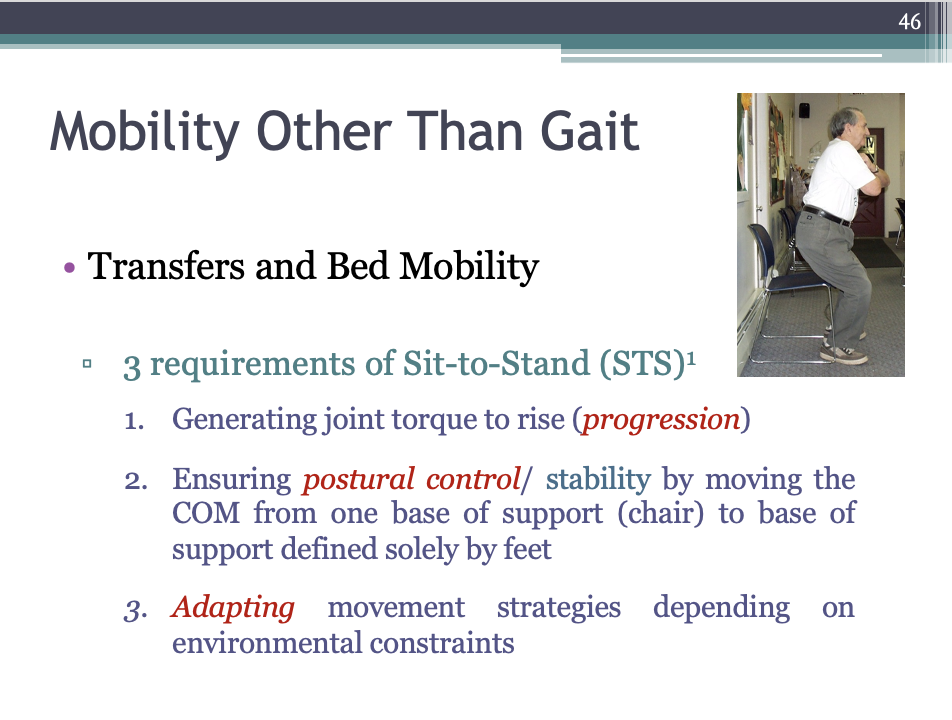
transfers and bed mobility: 3 requirements of STS
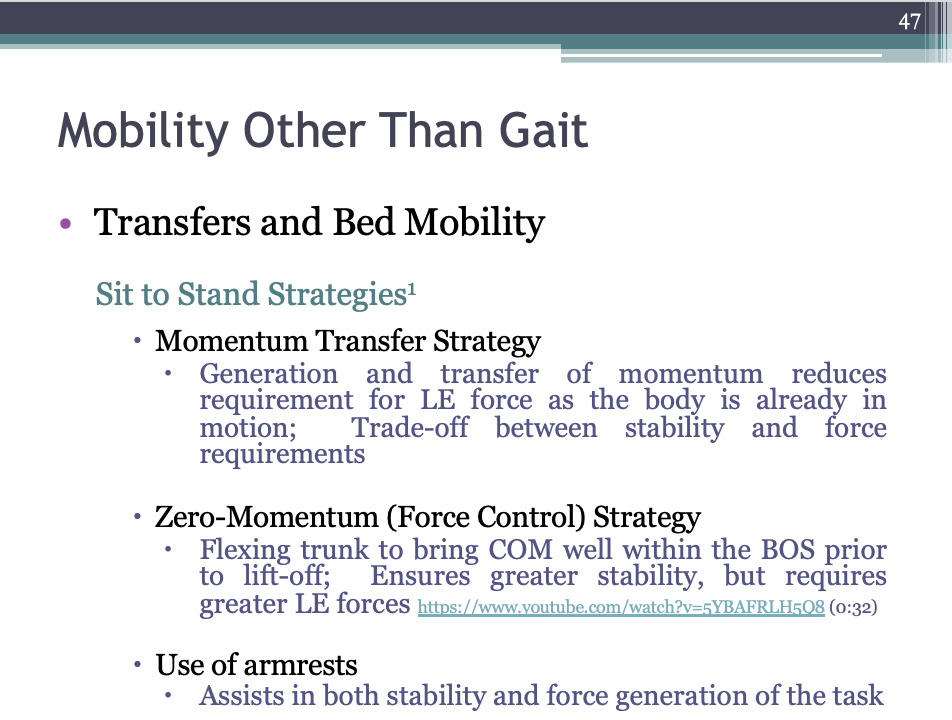
Transfers and bed mobility: STS strategies
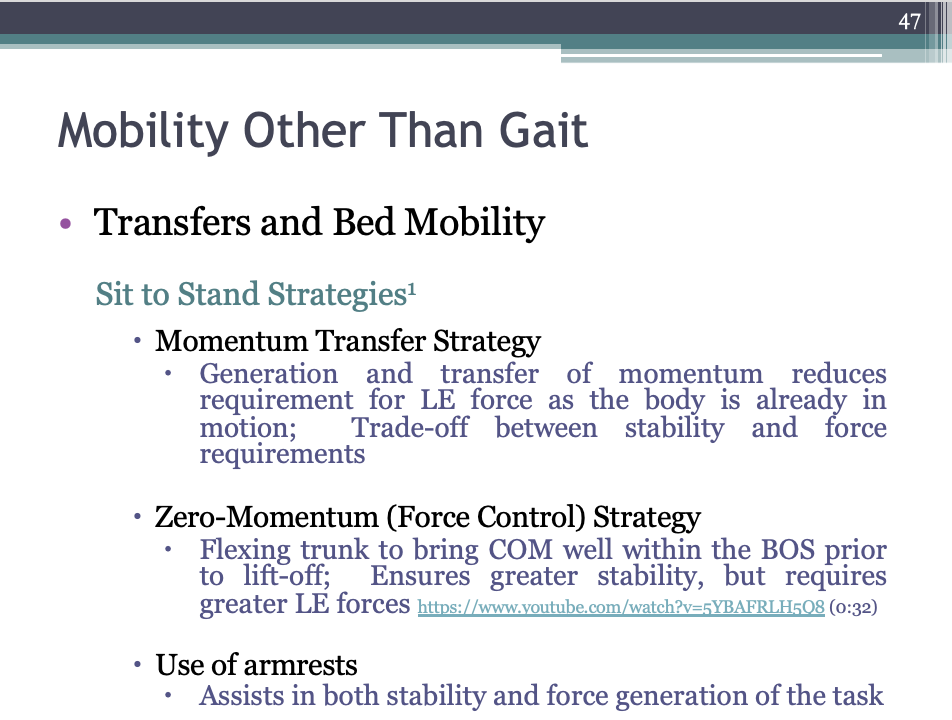
Transfers and bed mobility: STS strategies - momentum transfer strategy
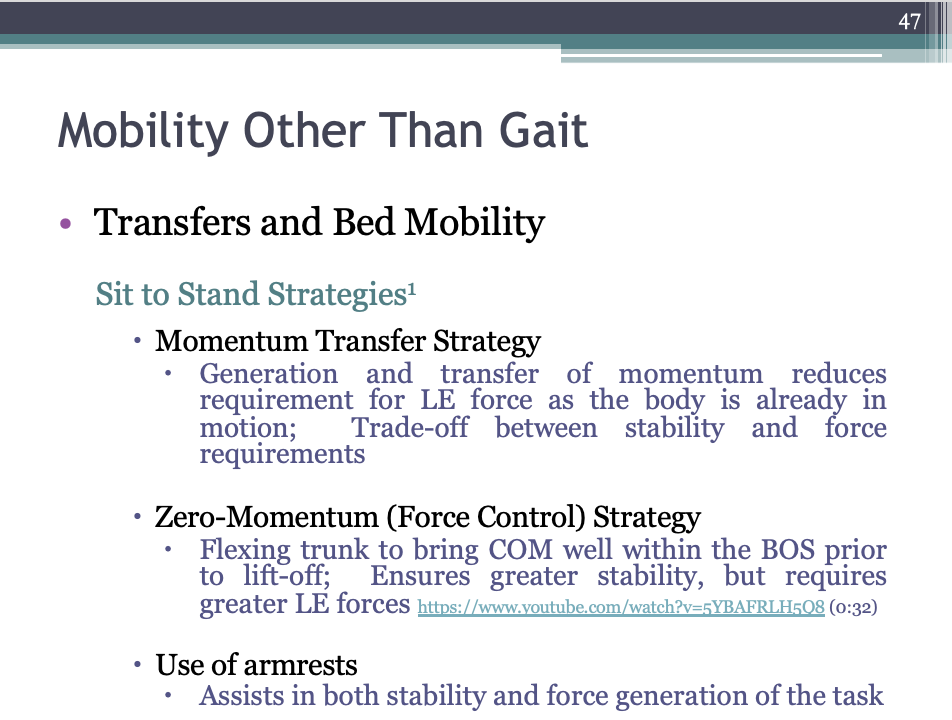
Transfers and bed mobility: STS strategies - zero-momentum (force control) strategy
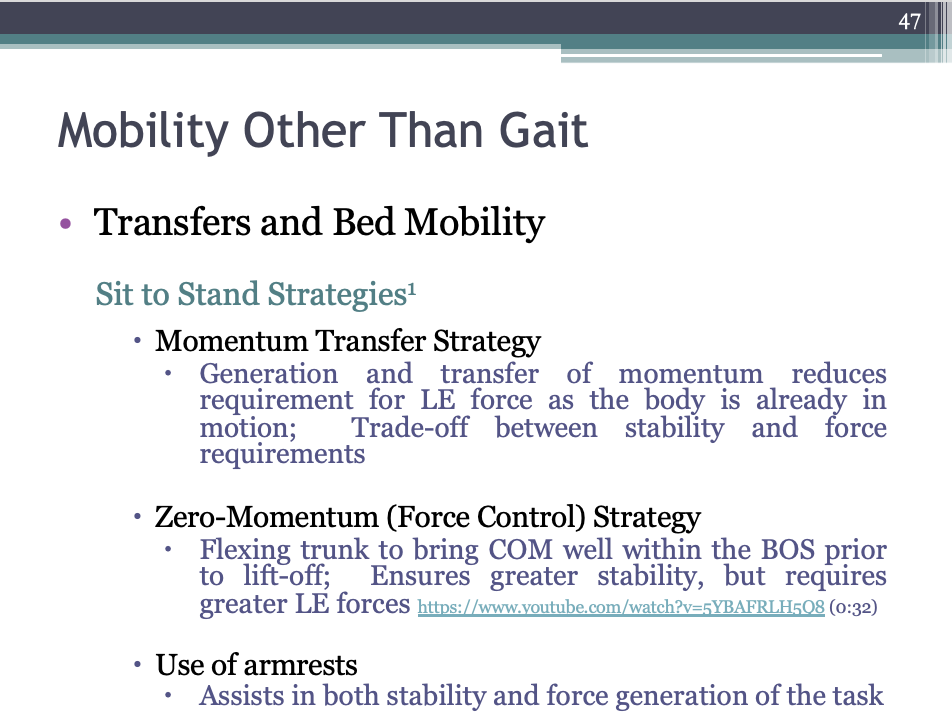
Transfers and bed mobility: STS strategies - use of armrests
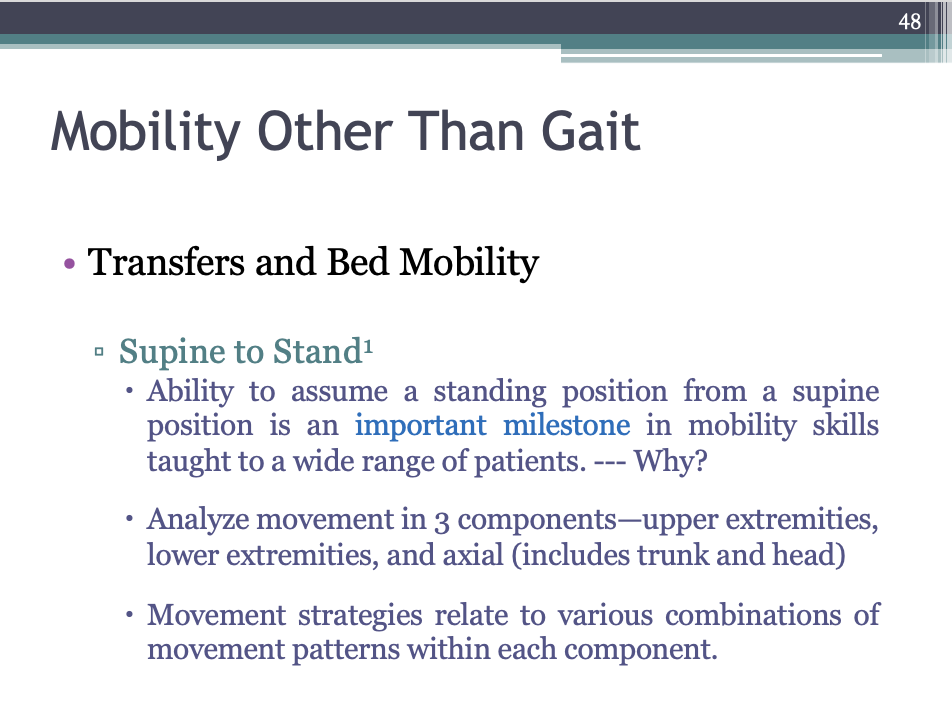
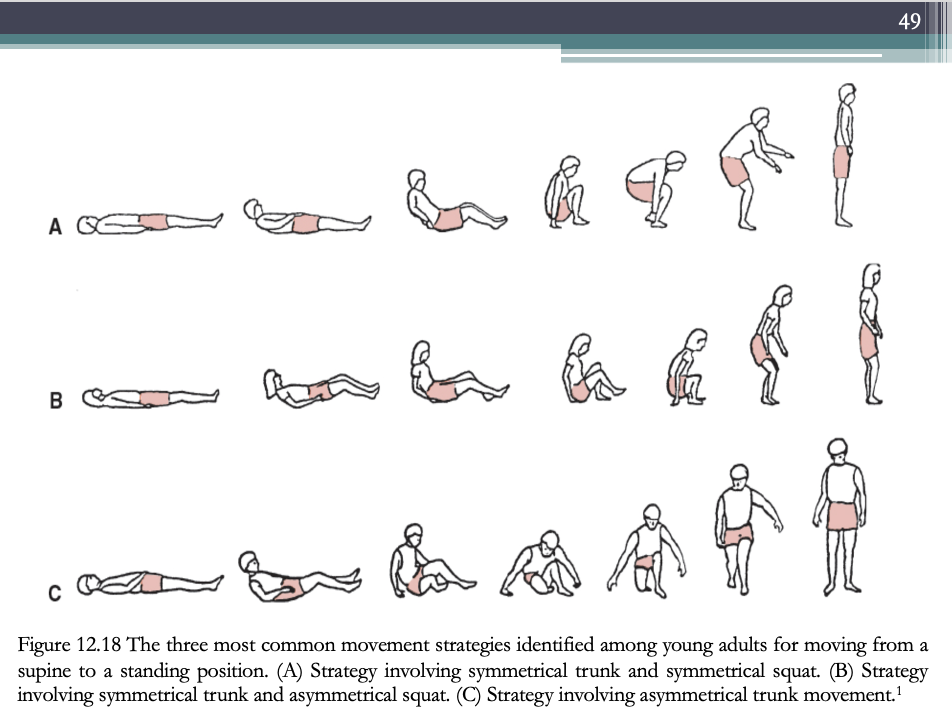
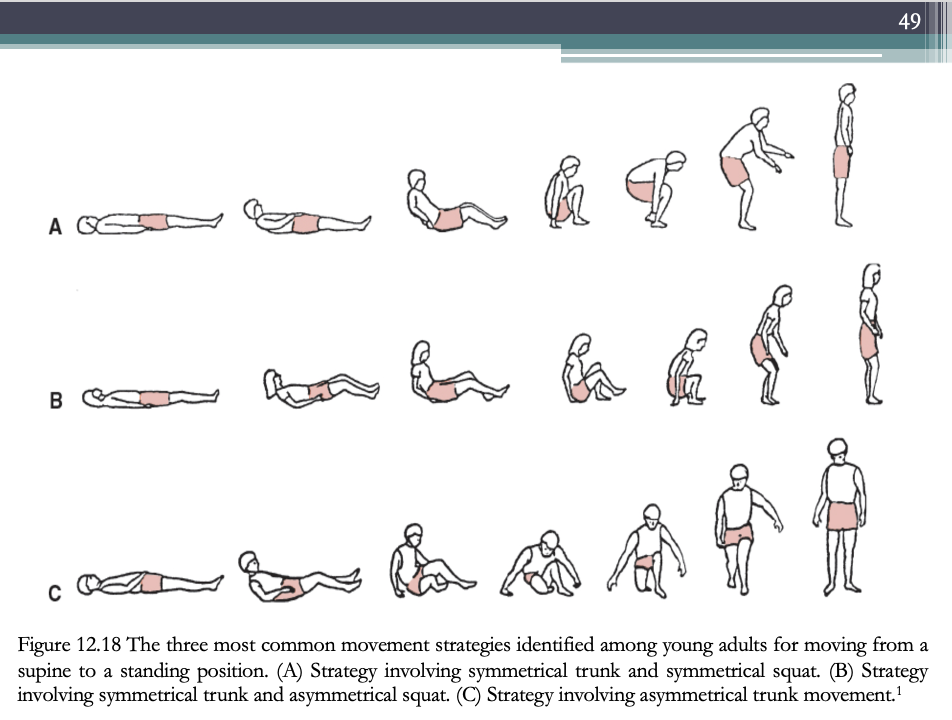
transfers and bed mobility: supine to stand
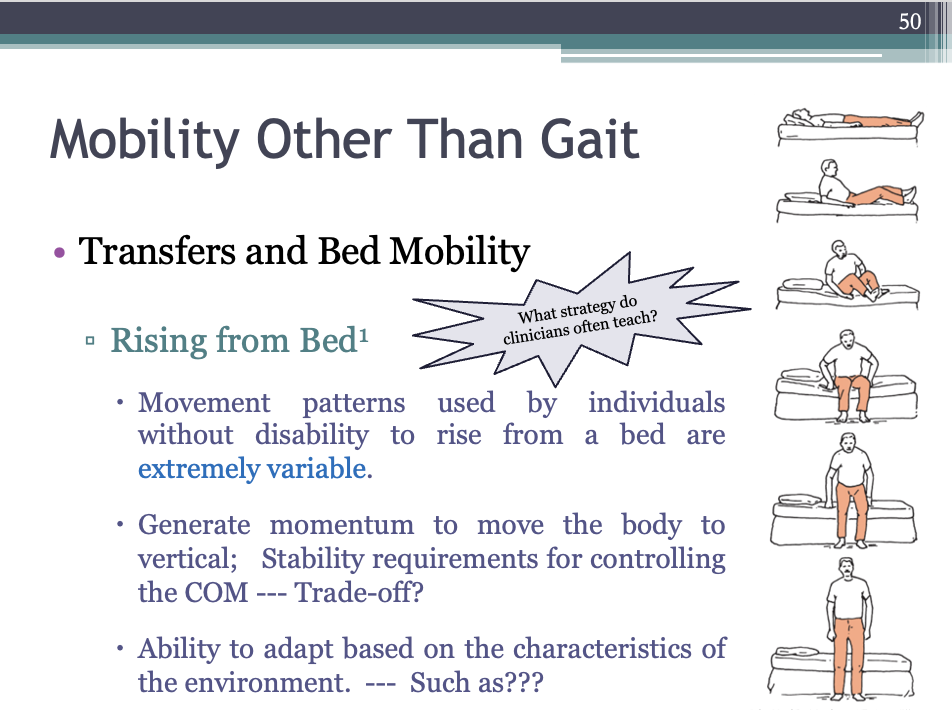
transfers and. bed mobility: rising from bed
Clinicians are often called on to help patients relearn the task of getting out of bed. In therapeutic textbooks on retraining motor control in patients with neurologic impairments, therapists are often instructed to teach patients to move from supine to side-lying, then to push up to a sitting position and from there, to stand up. These instructions are based on the assumption that this pattern represents that typically used to rise from a bed (Bobath1; Carr & Shepherd).
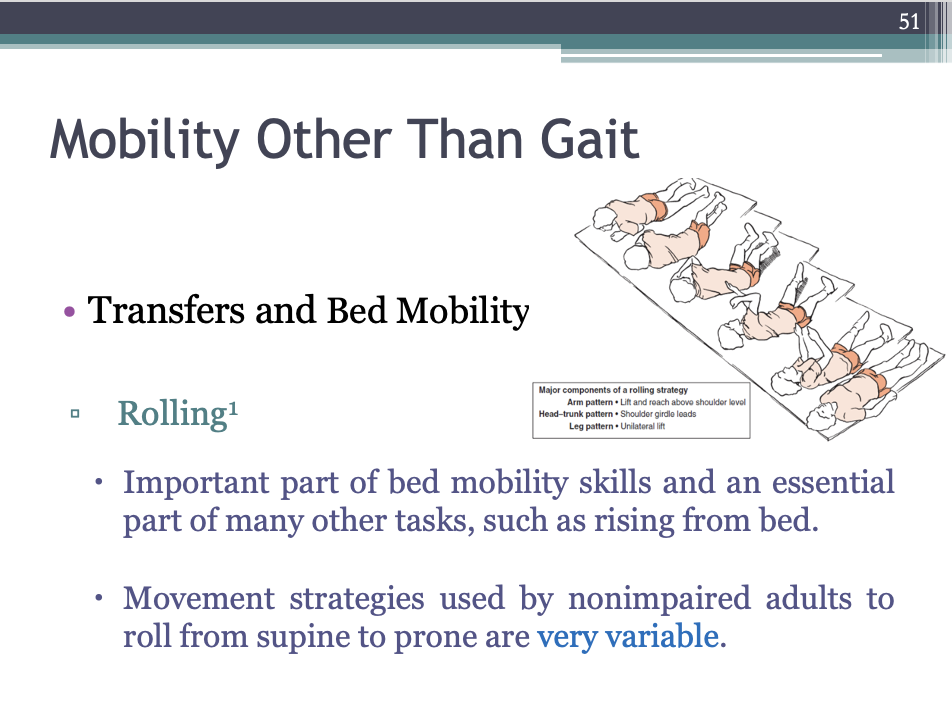
Movement strategies used by nonimpaired adults to roll from supine to prone are very ____
Movement strategies used by nonimpaired adults to roll from supine to prone are very variable.
transfers and bed mobility: rolling
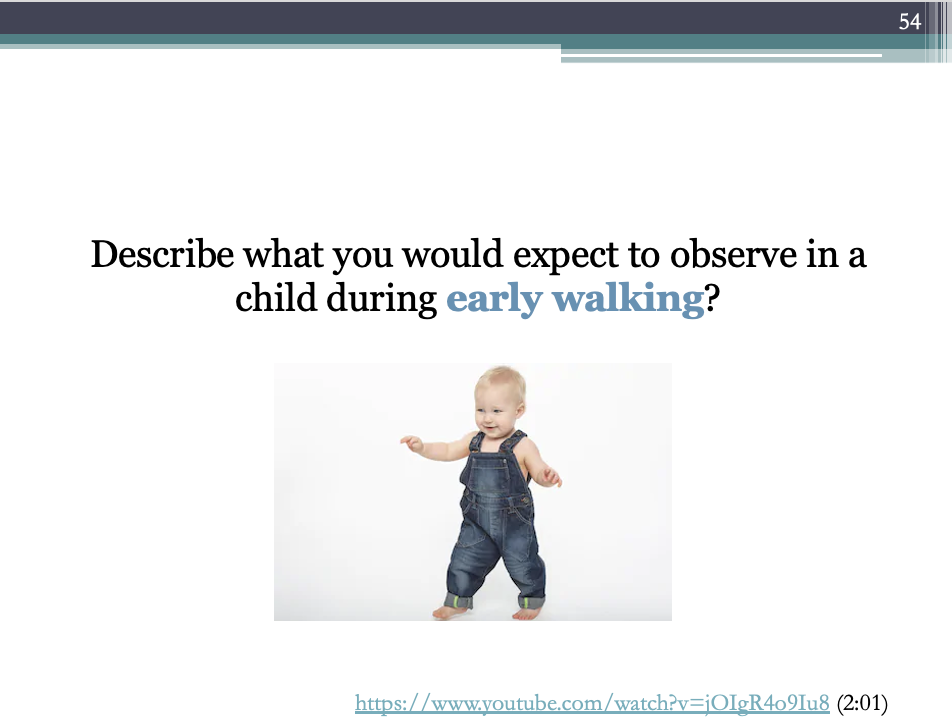
high guard
____ can be elicited in newborns under certain conditions.
stepping
Function of a locomotor CPG is present in a limited capacity at birth
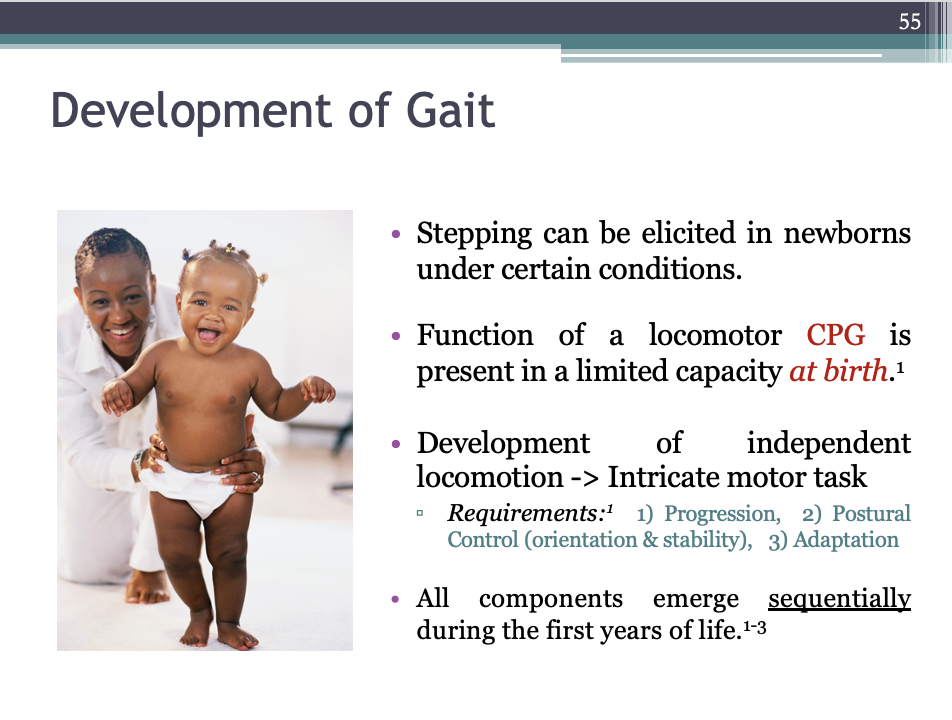
•All components emerge ____ during the first years of life
•All components emerge sequentially during the first years of life.1-3
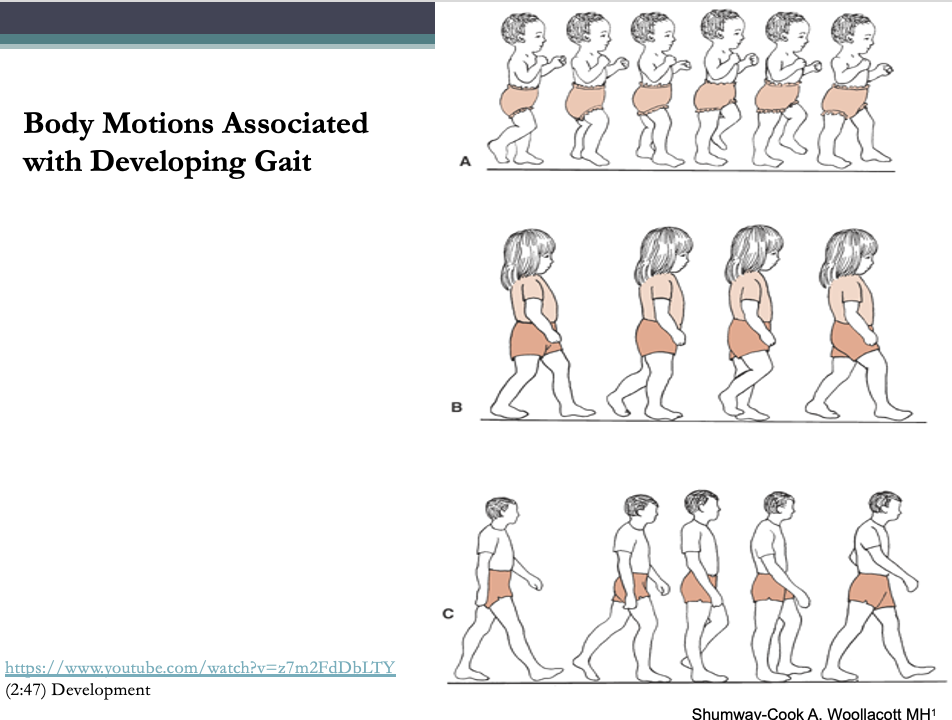
development of gait: development of independent locomotion →
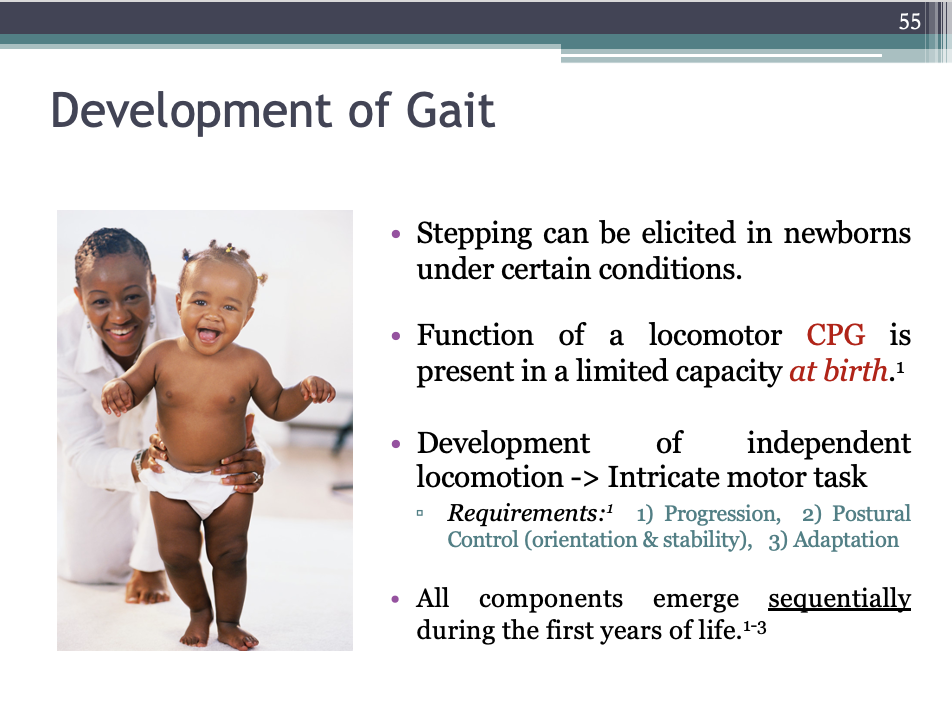
•Prenatal coordination noted in animal research suggests that a ___________ on emerging locomotion behavior is the immaturity of the postural system and thus the inability to achieve upright stability – not simply because of a lack of neural circuitry.1
Intralimb coordination develops before interlimb coordination.
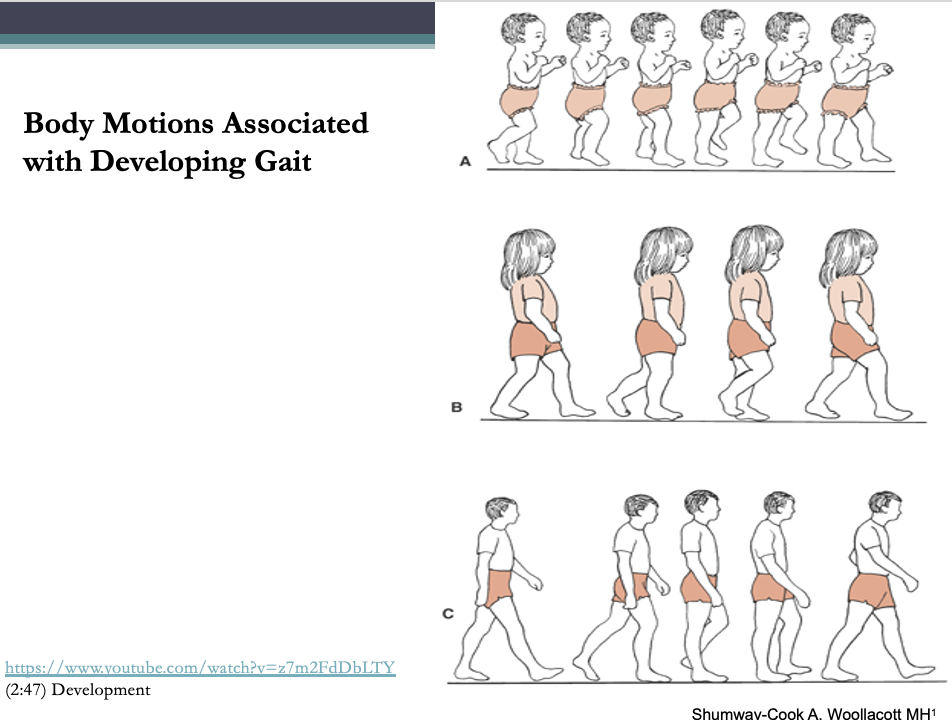
A.Initial gait
B.Elementary gait
C.Mature gait
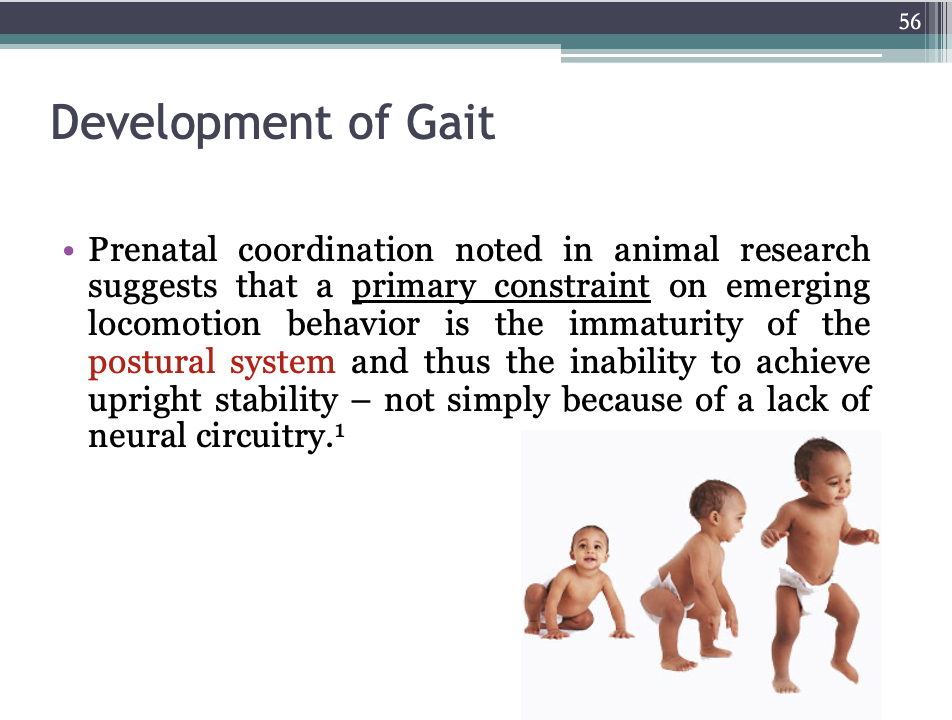
Common gait characteristics of the first year
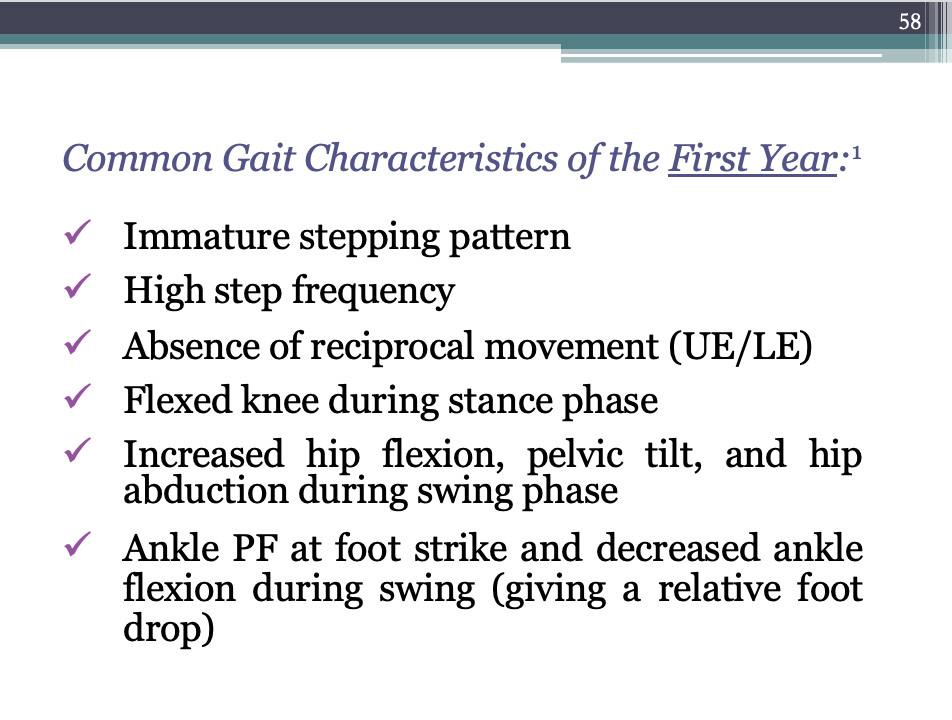
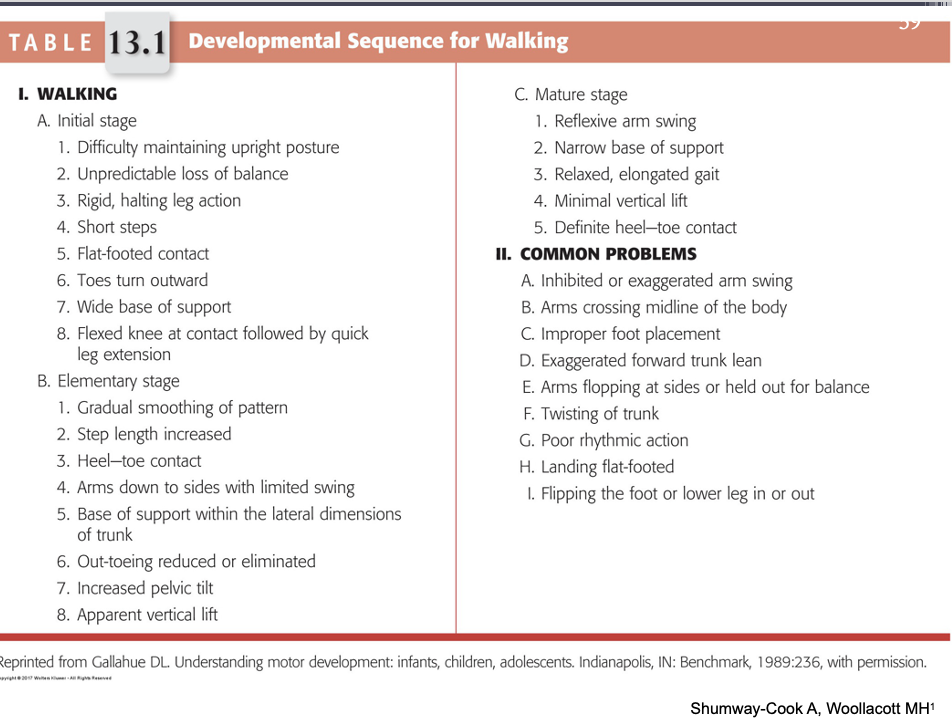
Chart indicates the developmental sequence of walking.
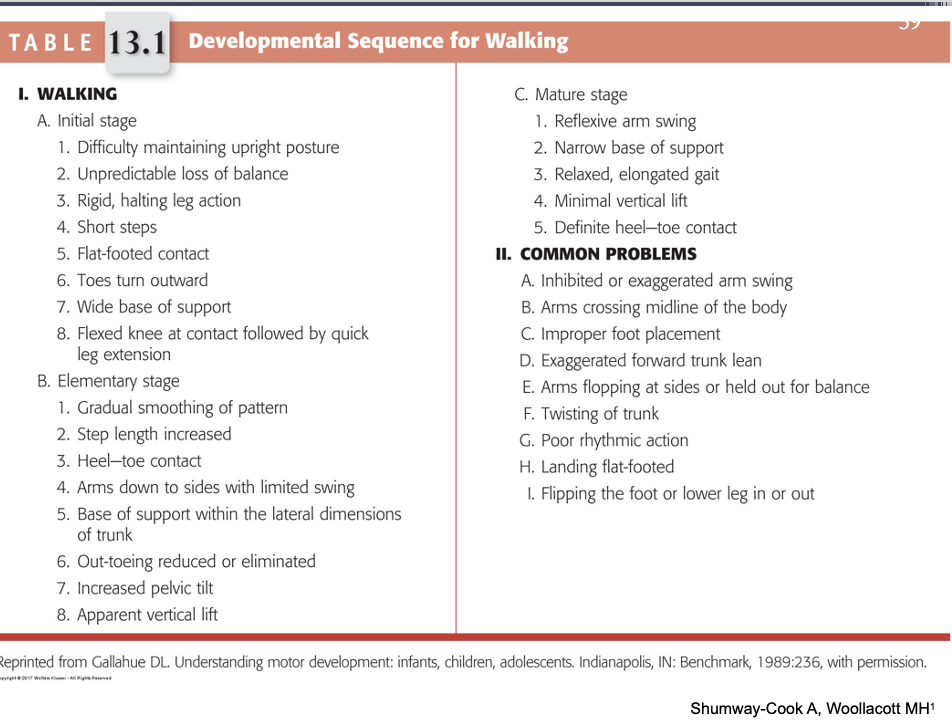
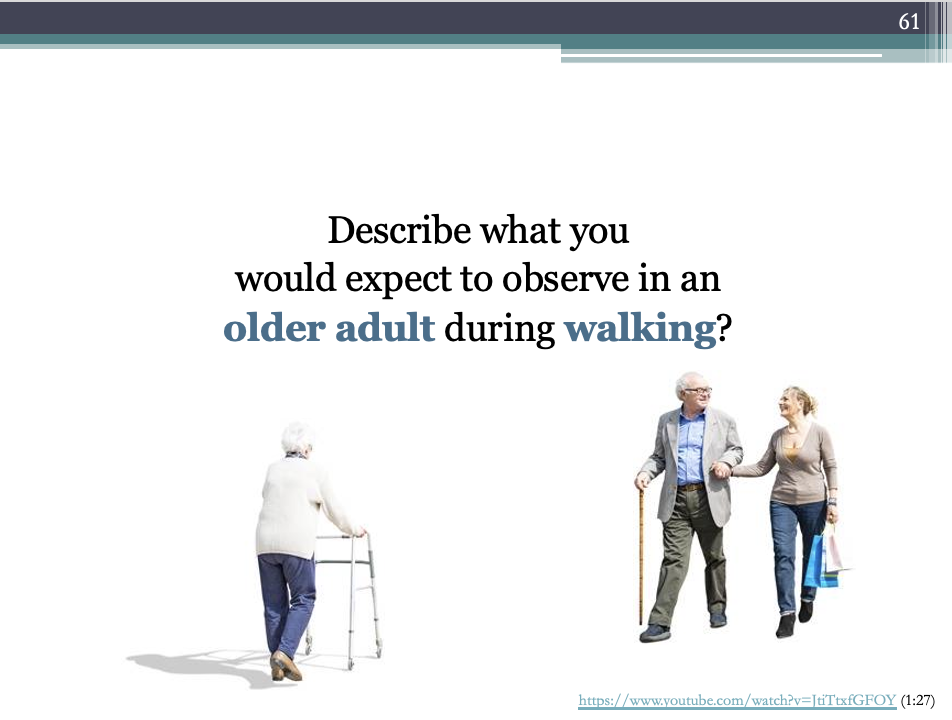
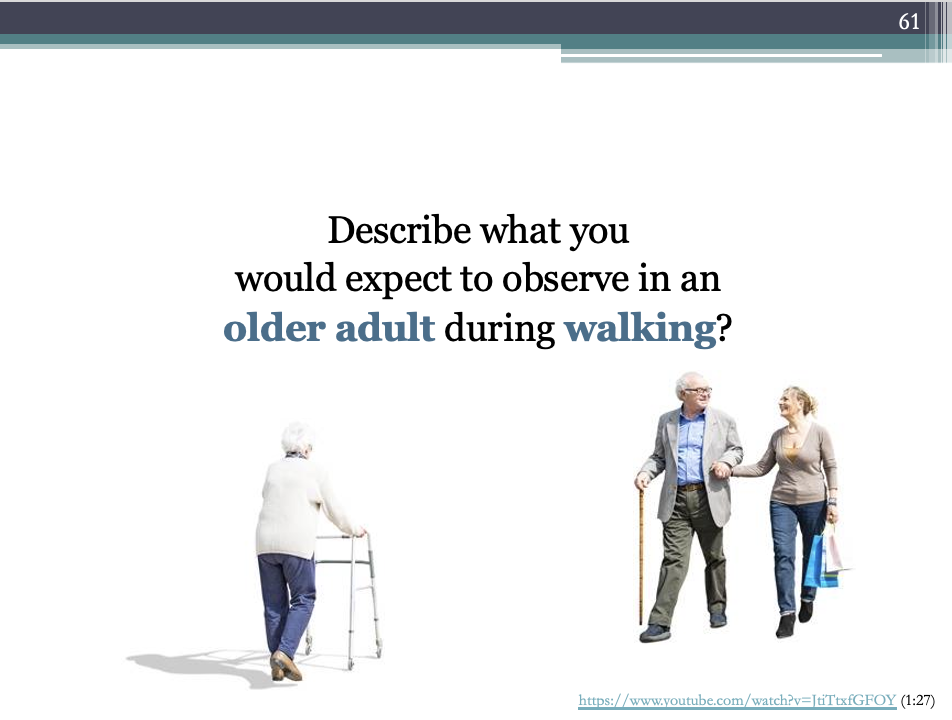
the pictures
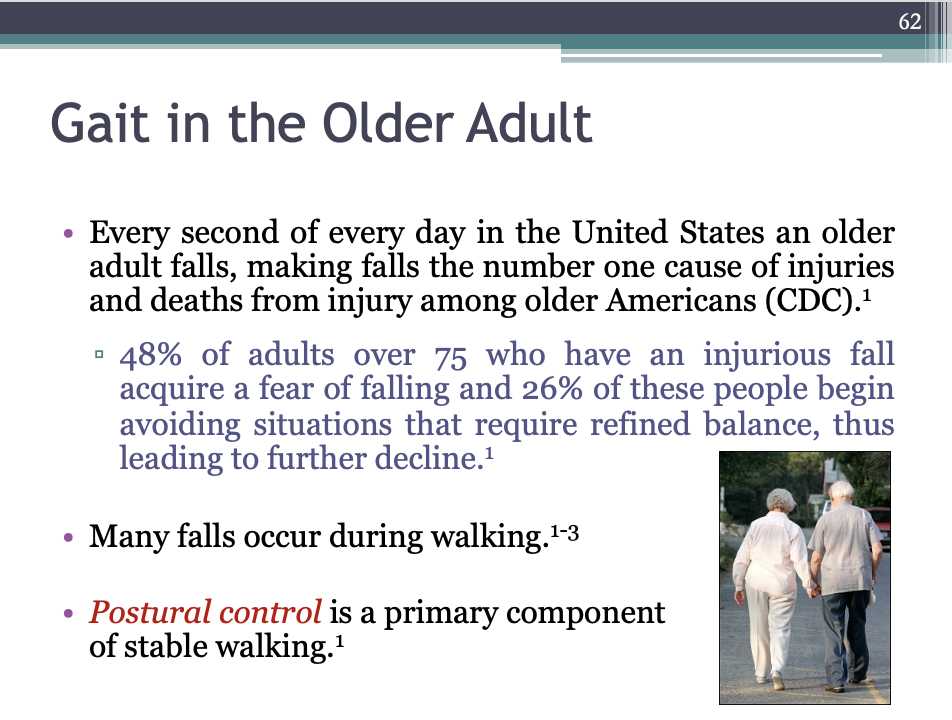
gait in the older adult: % of adults over 75 with injurious fall; when do falls occur; what is the primary component of stable walking
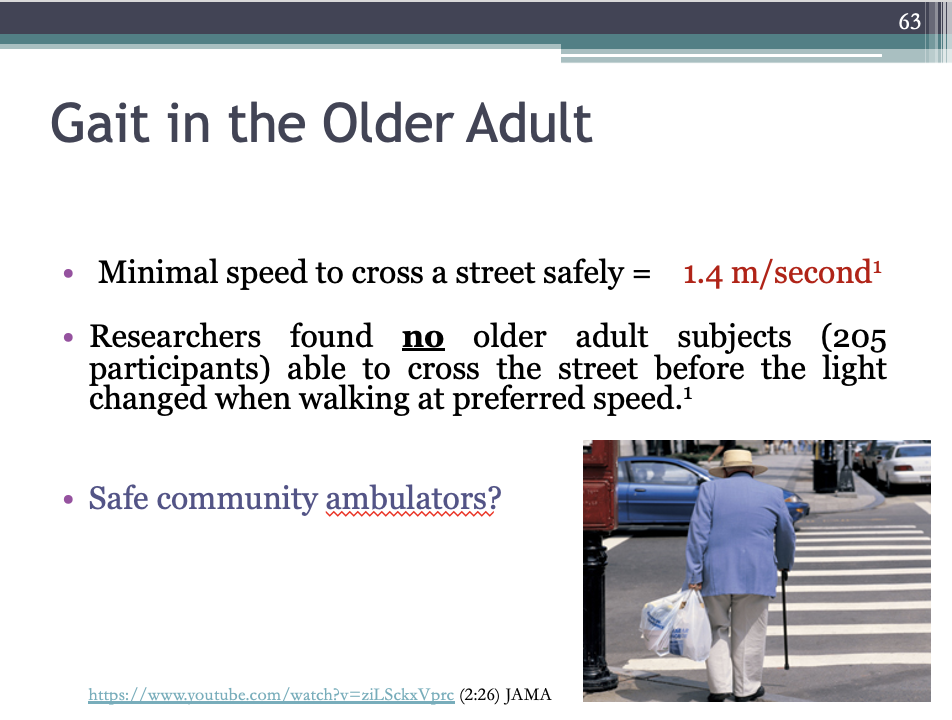
Minimal speed to cross a street safely
None of them were able to cross the street before light change at their preferred speed
If they cant increase their speed it makes them less safe
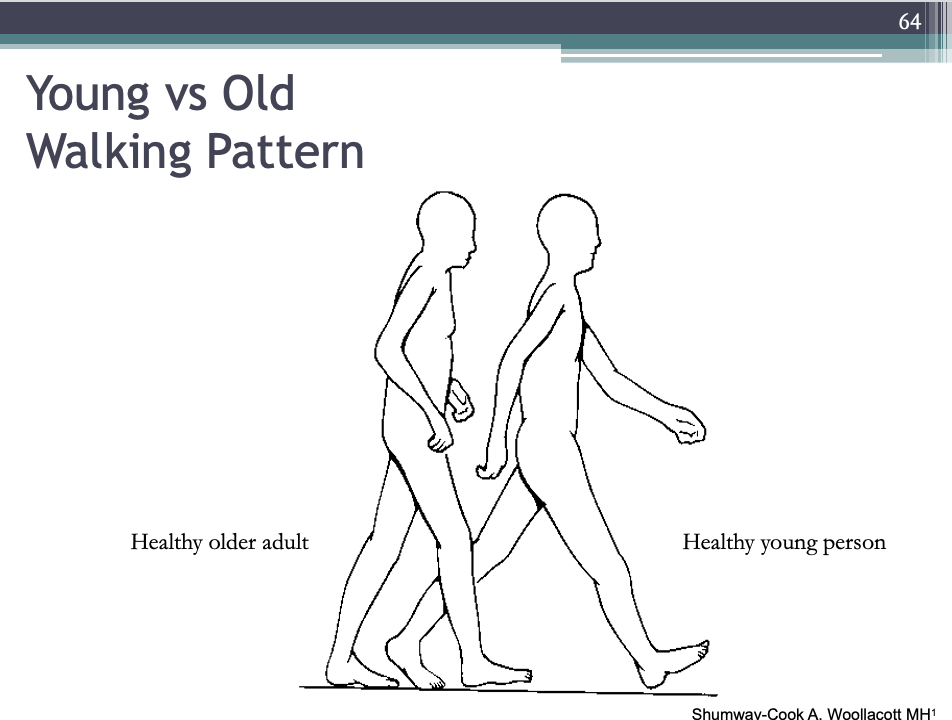
young vs old walking pattern picture
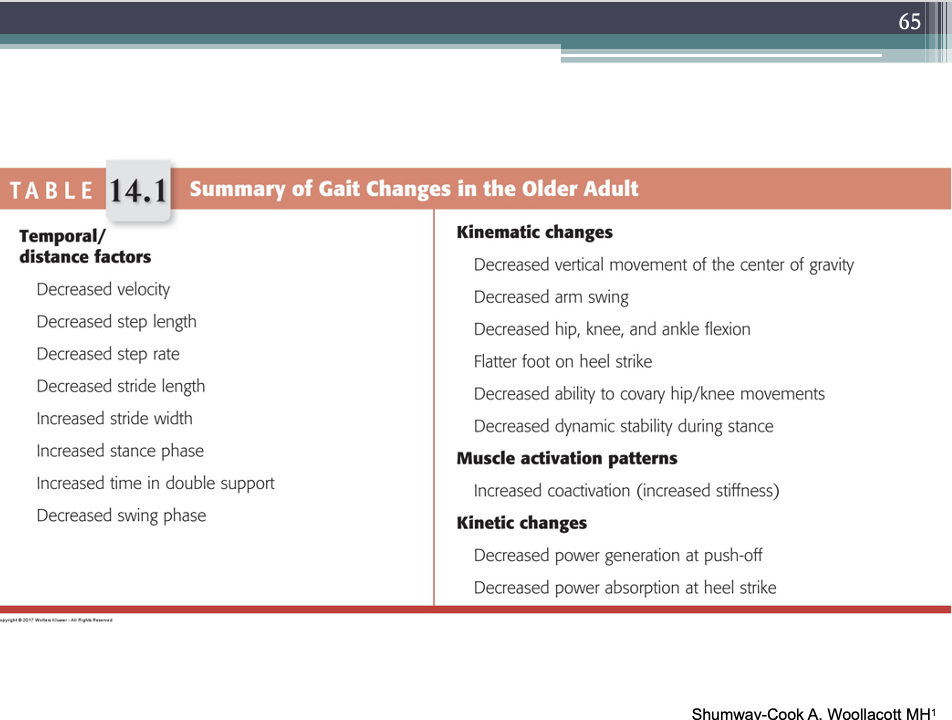
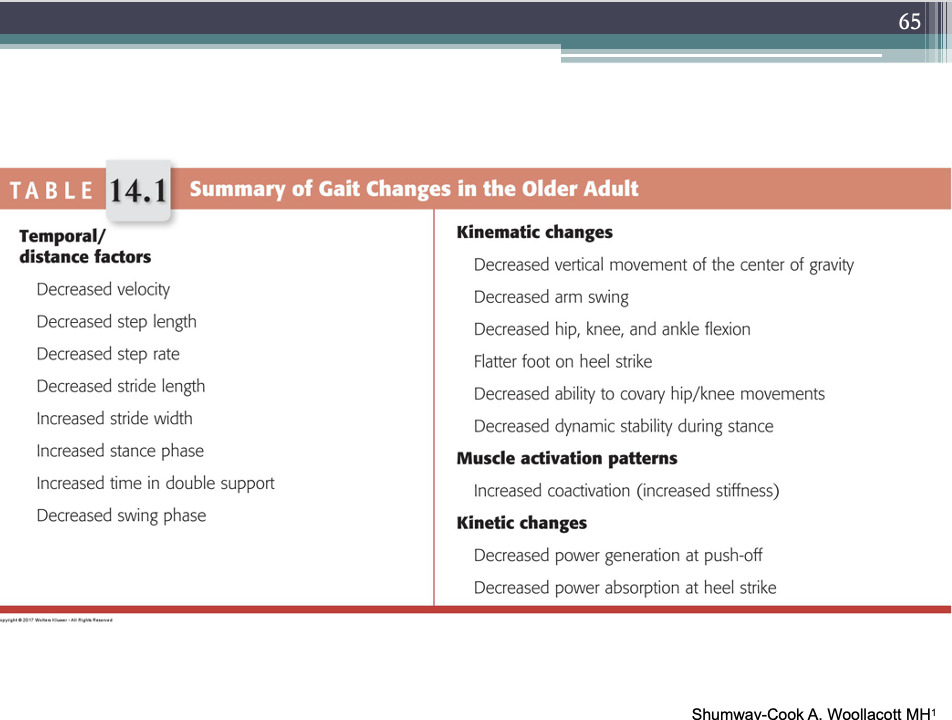
age related changes in mobility:
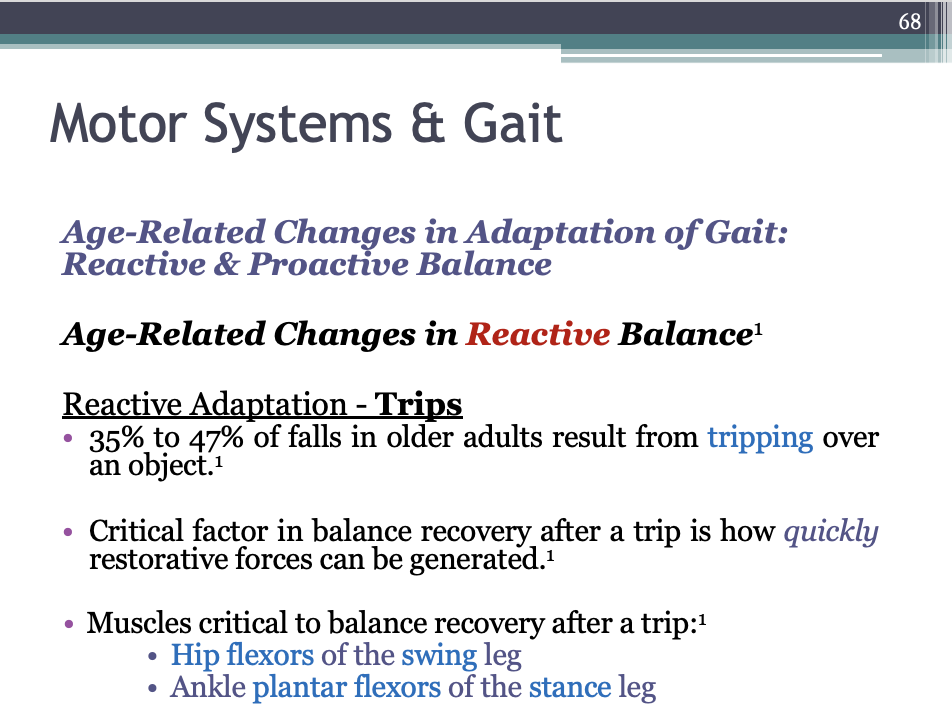
motor systems & gait: age-related changes in adaptation of gait: reactive balance - reactive adaptation (trips)
The speed and magnitude of the “trip” are more important than the strength required to recover.
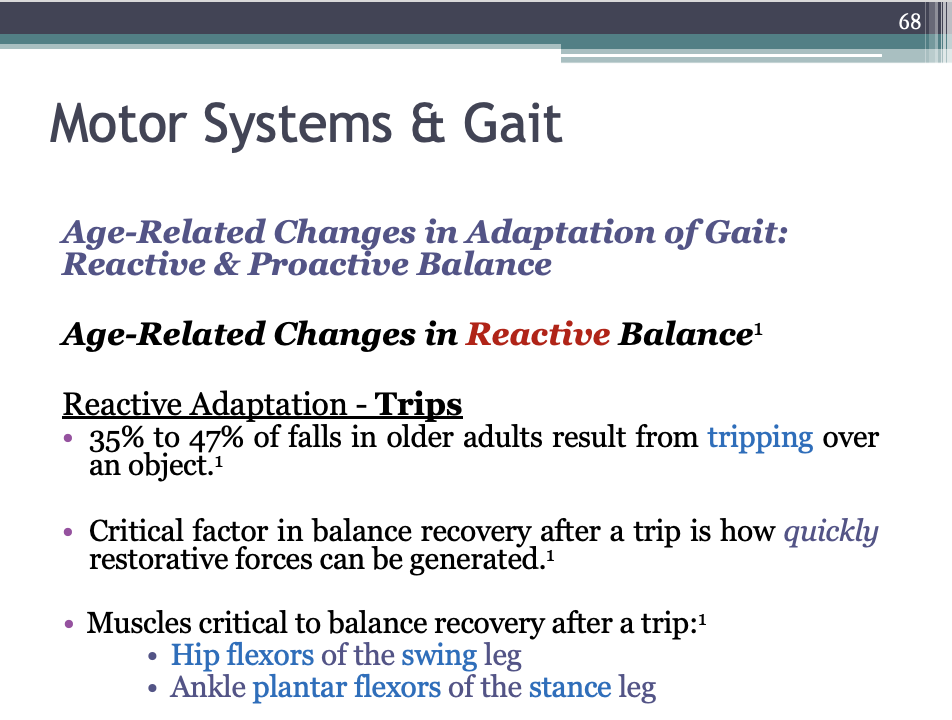
Muscles critical to balance recovery after a trip
The speed and magnitude of the “trip” are more important than the strength required to recover.
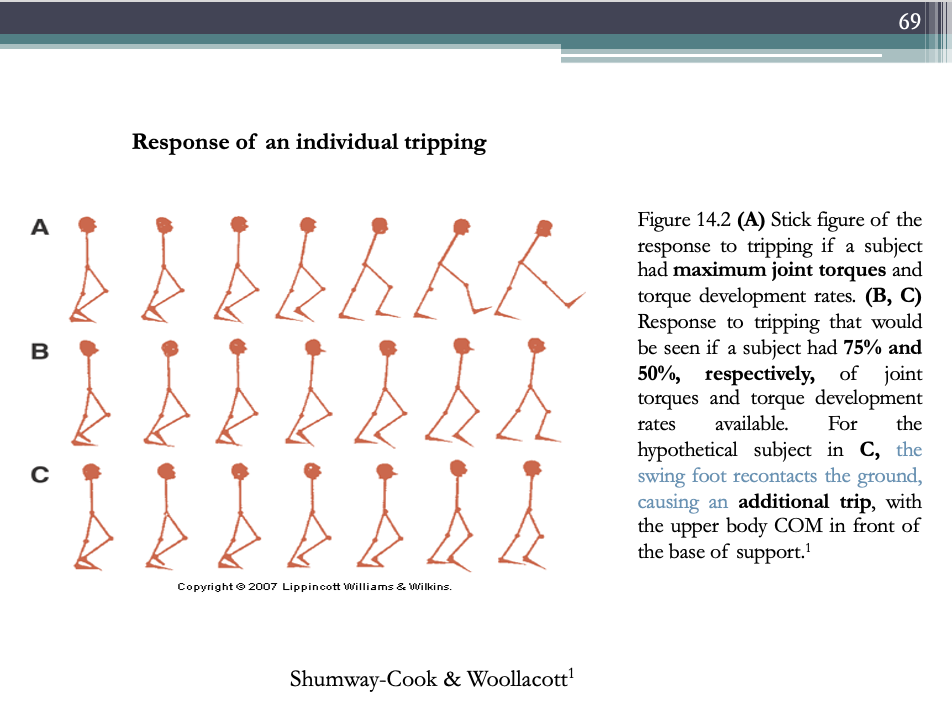
response of an individual tripping
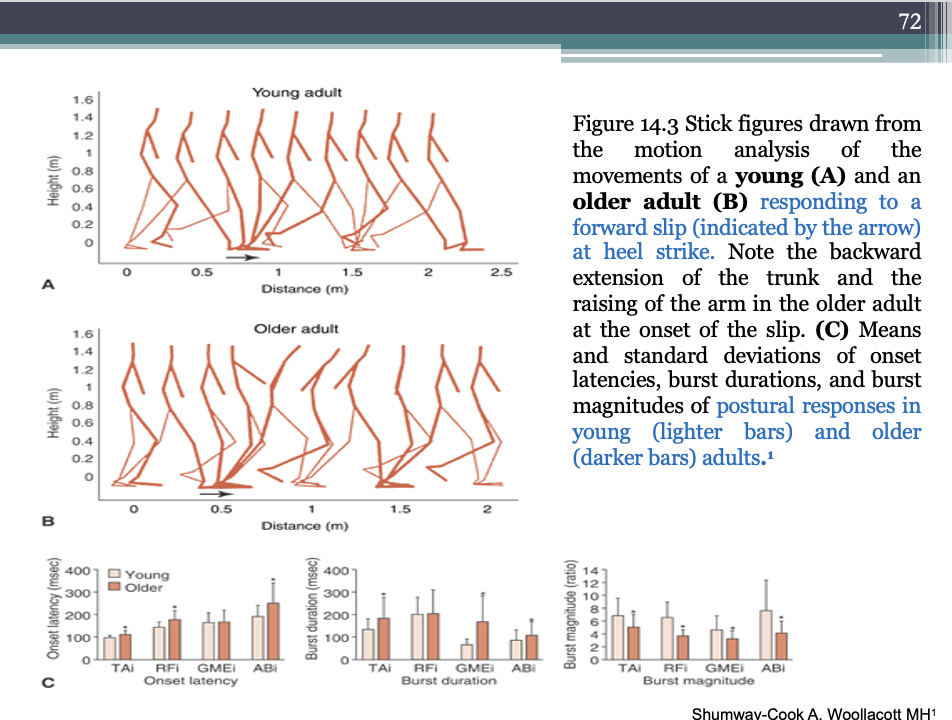
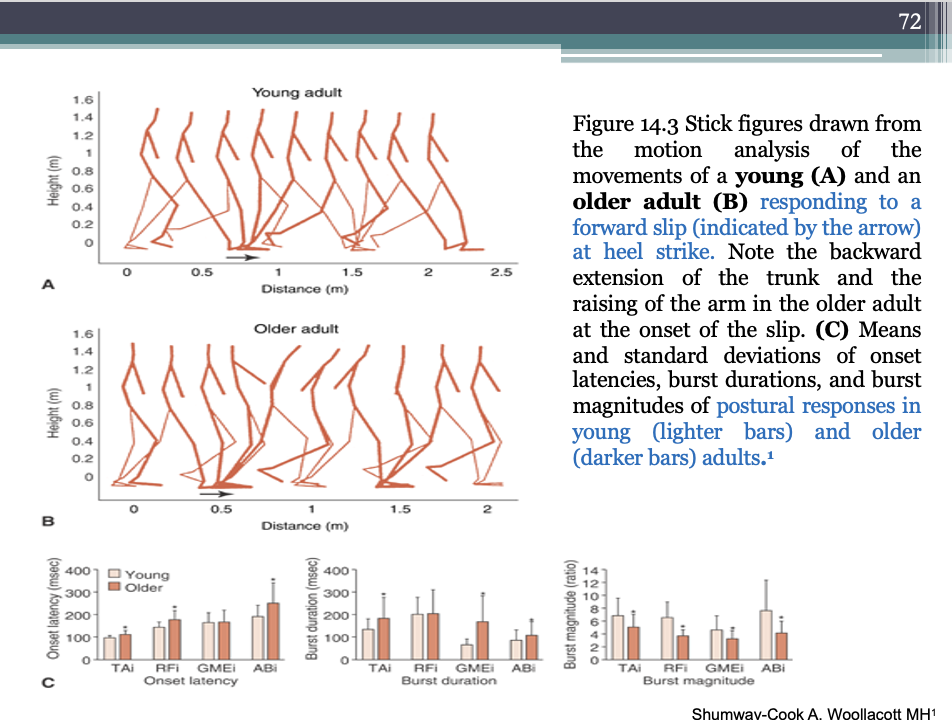
motor systems & gait: age-related changes in adaptation of gait: reactive balance - reactive adaptation (slips) older adults have difficulty generating EFFICIENT _____
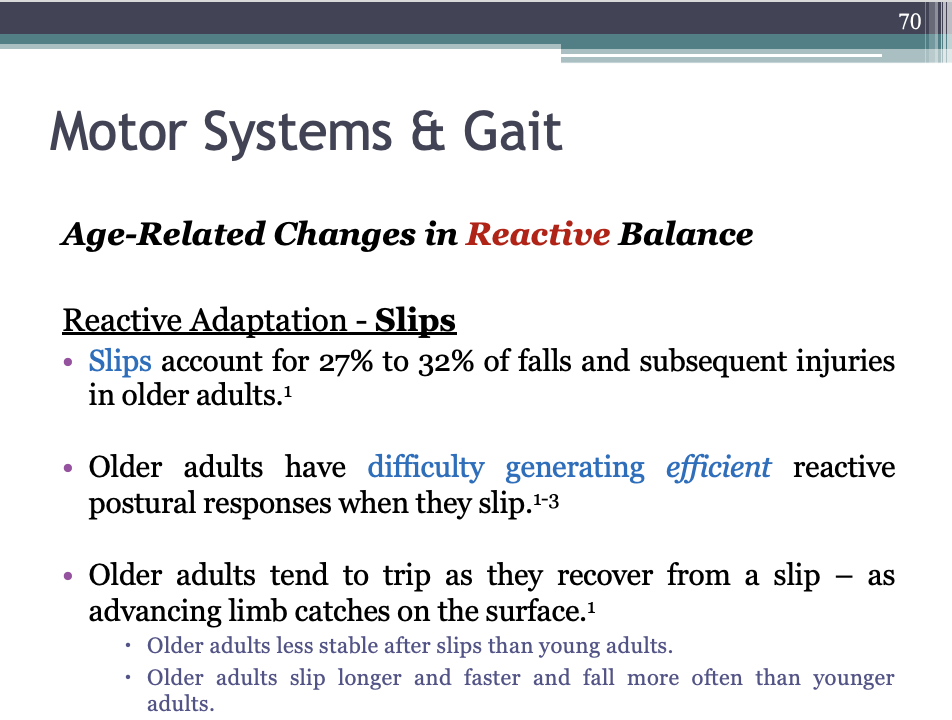
motor systems & gait: age-related changes in adaptation of gait: reactive balance - reactive adaptation (slips) Older adults have difficulty generating efficient
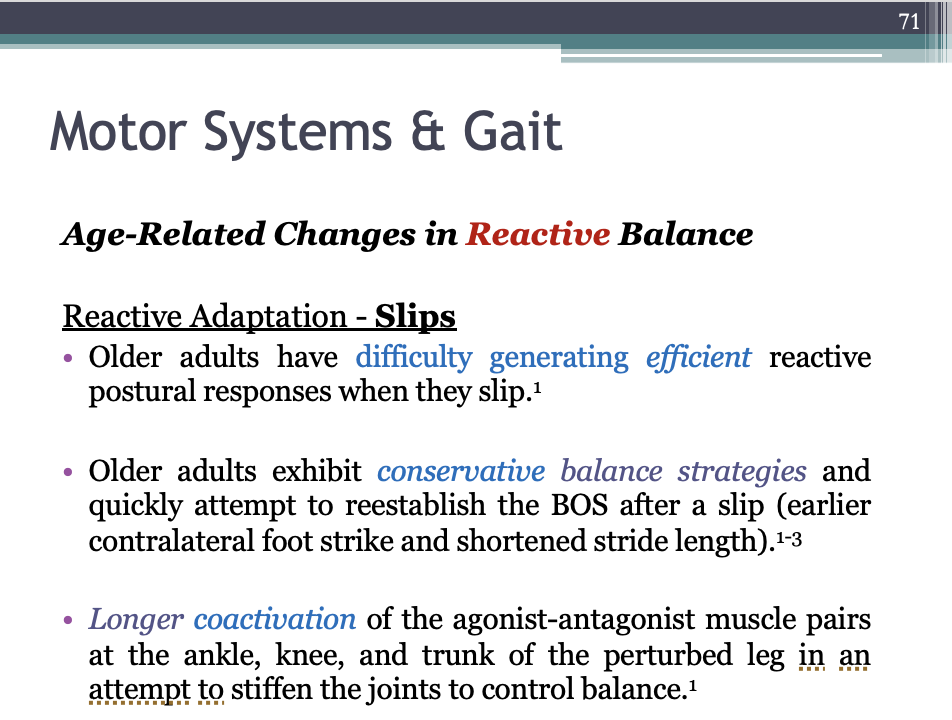
Older adults exhibit _____ balance strategies;
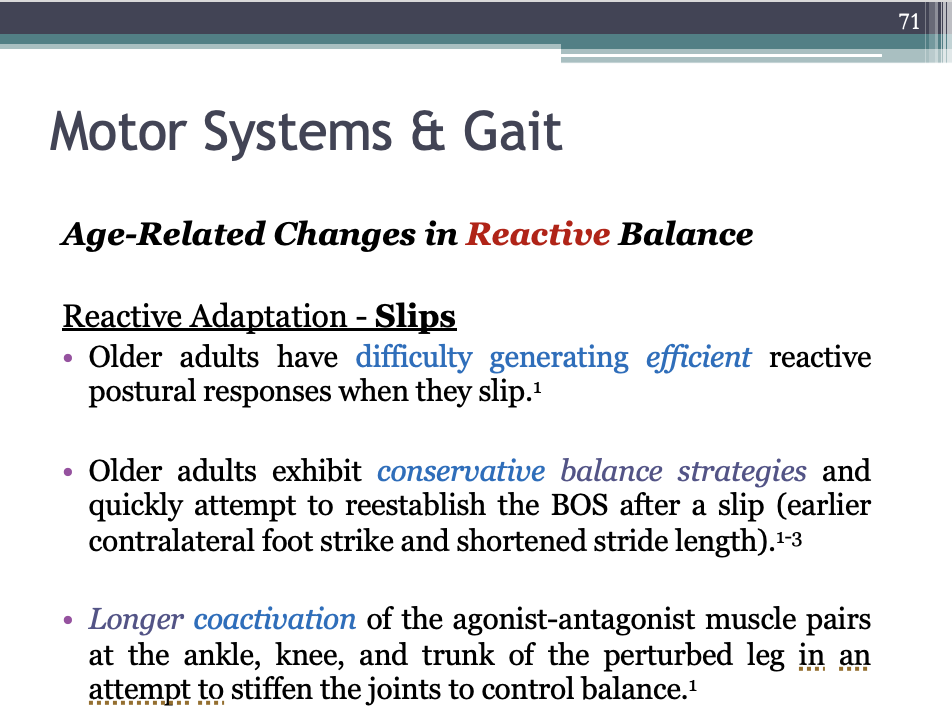
Longer ______ of the agonist-antagonist muscle pairs at the ankle, knee, and trunk of the perturbed leg in an attempt to stiffen the joints to control balance
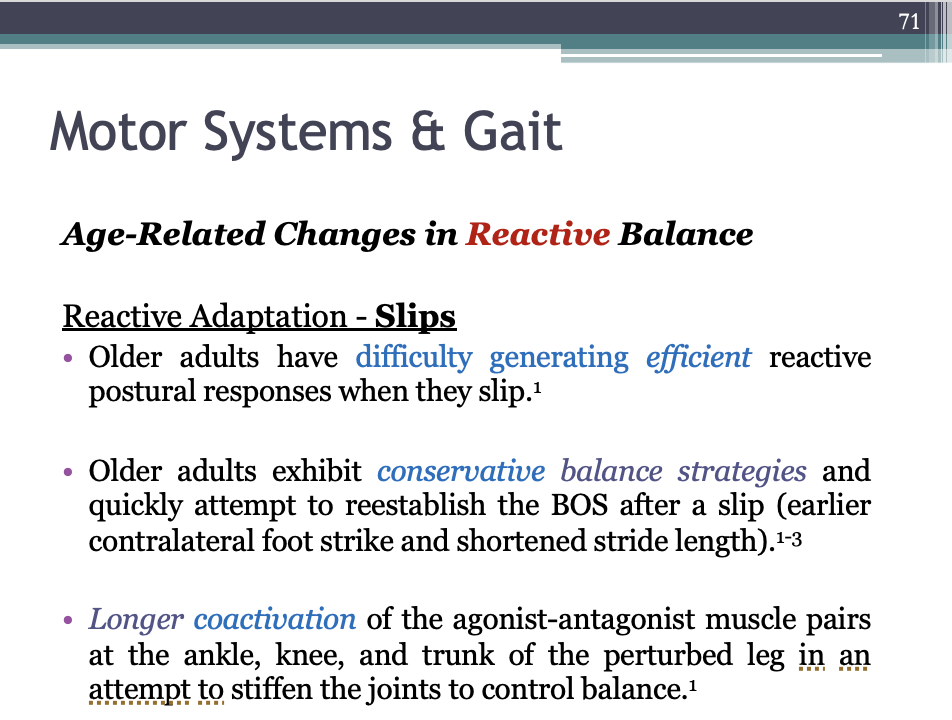
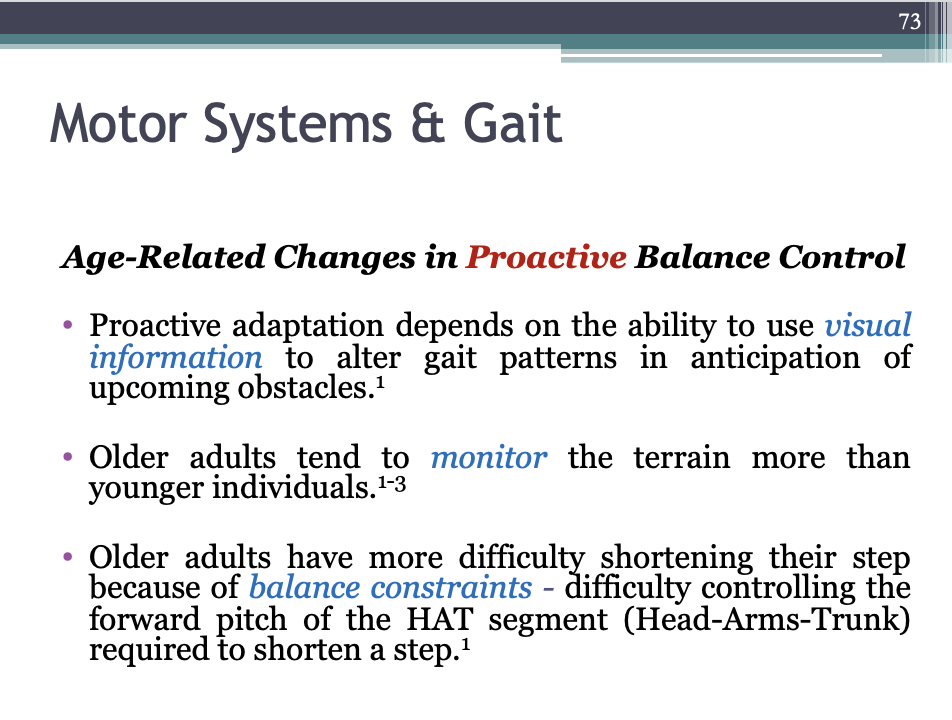
Age-Related Changes in Proactive Balance Control: Proactive adaptation depends on the ability to use
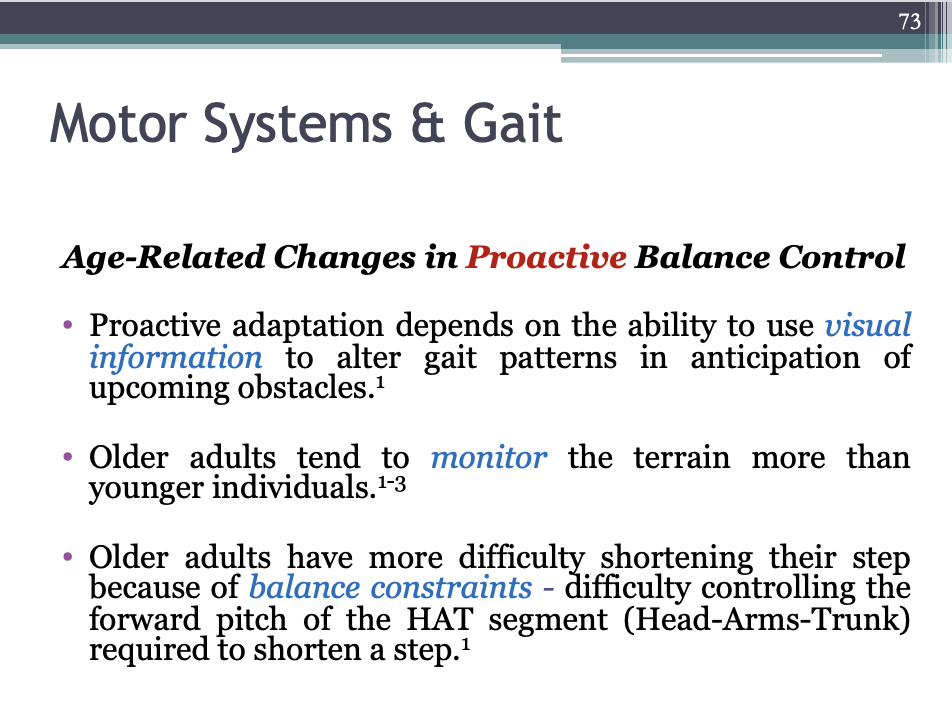
Age-Related Changes in Proactive Balance Control: Older adults tend to _______ the terrain more than younger individuals
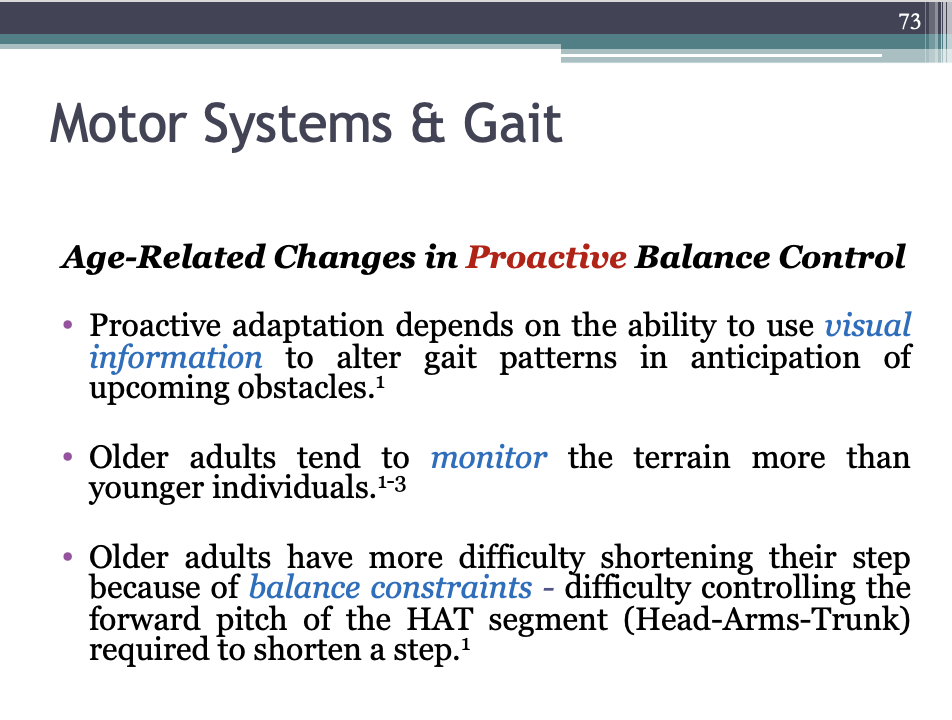
Older adults have more difficulty shortening their step because of ____________ - difficulty controlling the forward pitch of the HAT segment (Head-Arms-Trunk) required to shorten a step
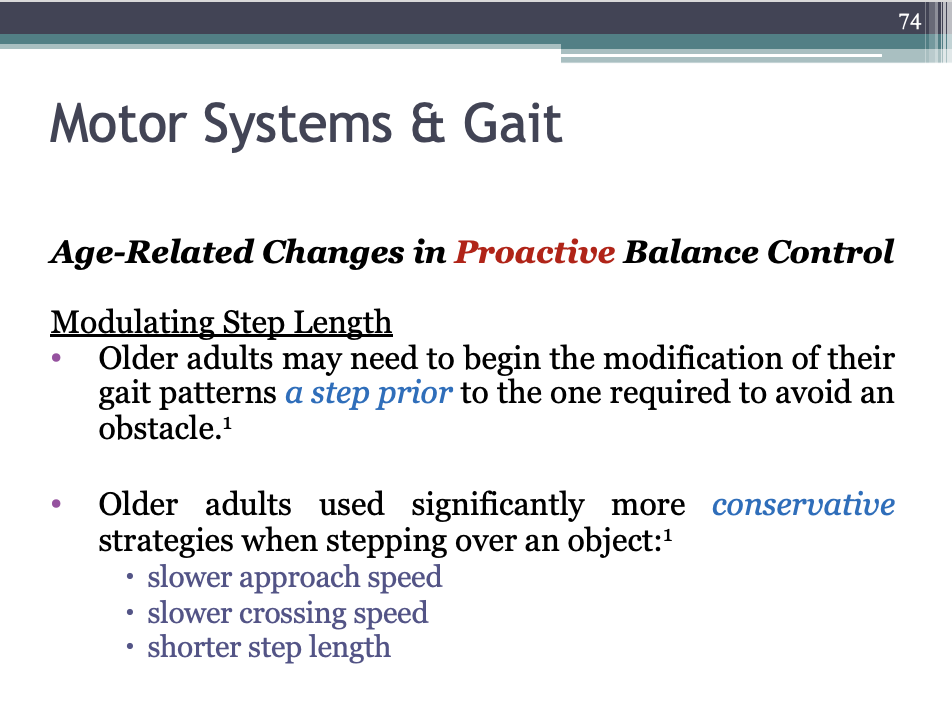
Age-Related Changes in Proactive Balance Control: modulating step length
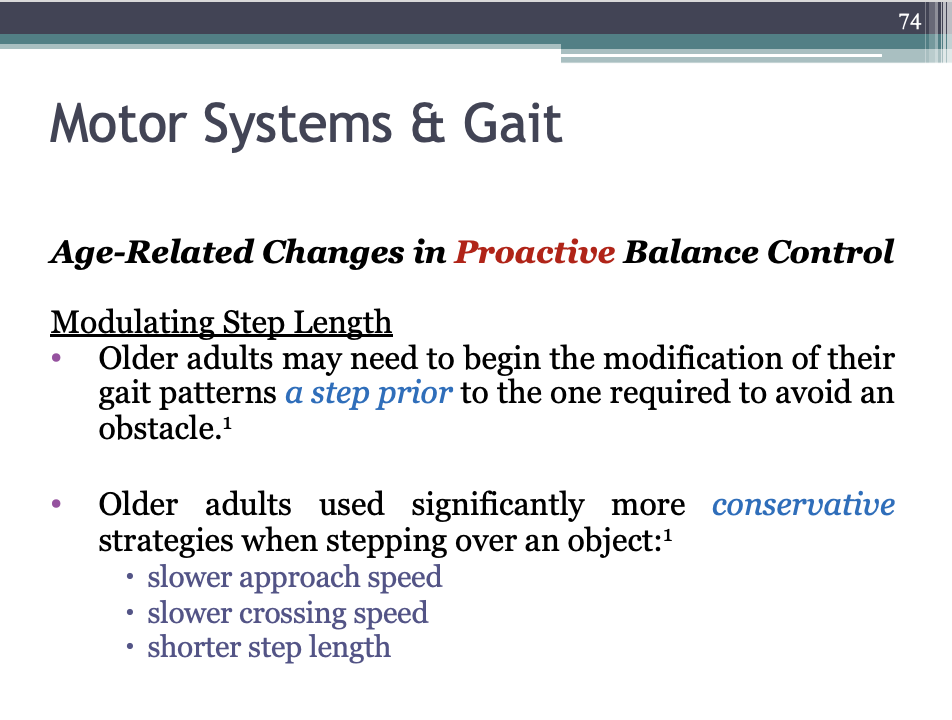
Older adults used significantly more ________ strategies when stepping over an object - such as
Age-Related Changes in Proactive Balance Control: obstacle crossing
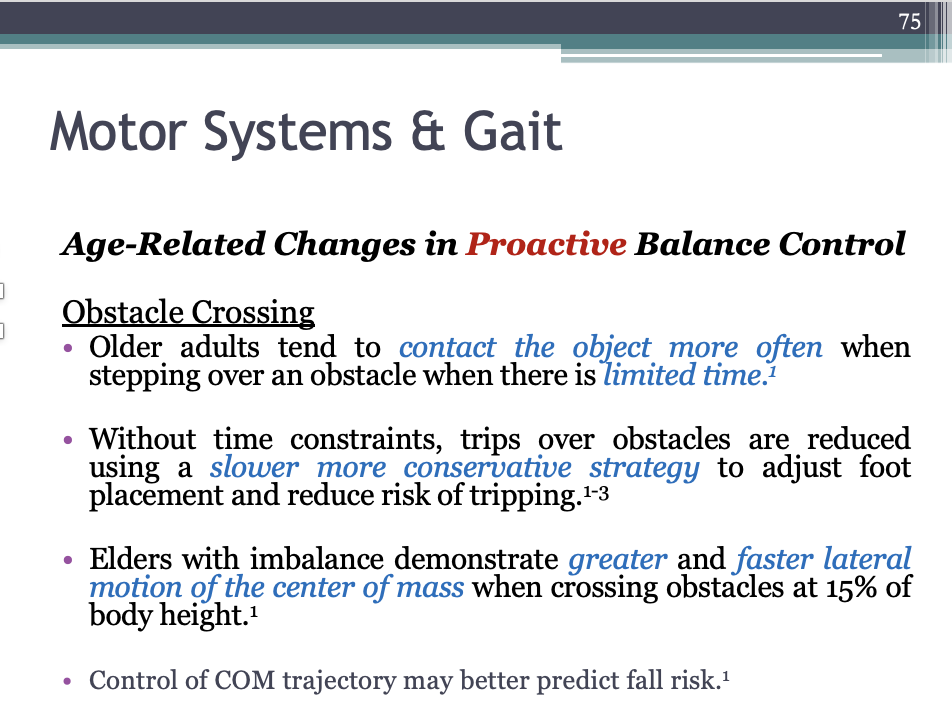
Older adults tend to __________when stepping over an obstacle when there is limited time
Age-Related Changes in Proactive Balance Control: obstacle crossing
Without time constraints, trips over obstacles are reduced using a ________ to adjust foot placement and reduce risk of tripping
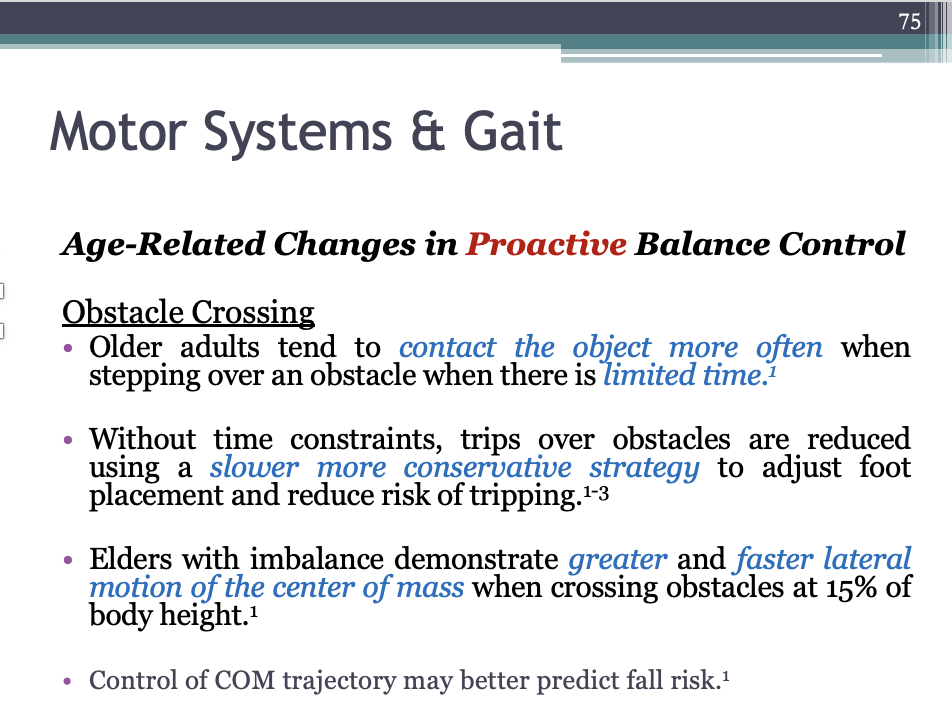
Age-Related Changes in Proactive Balance Control: obstacle crossing
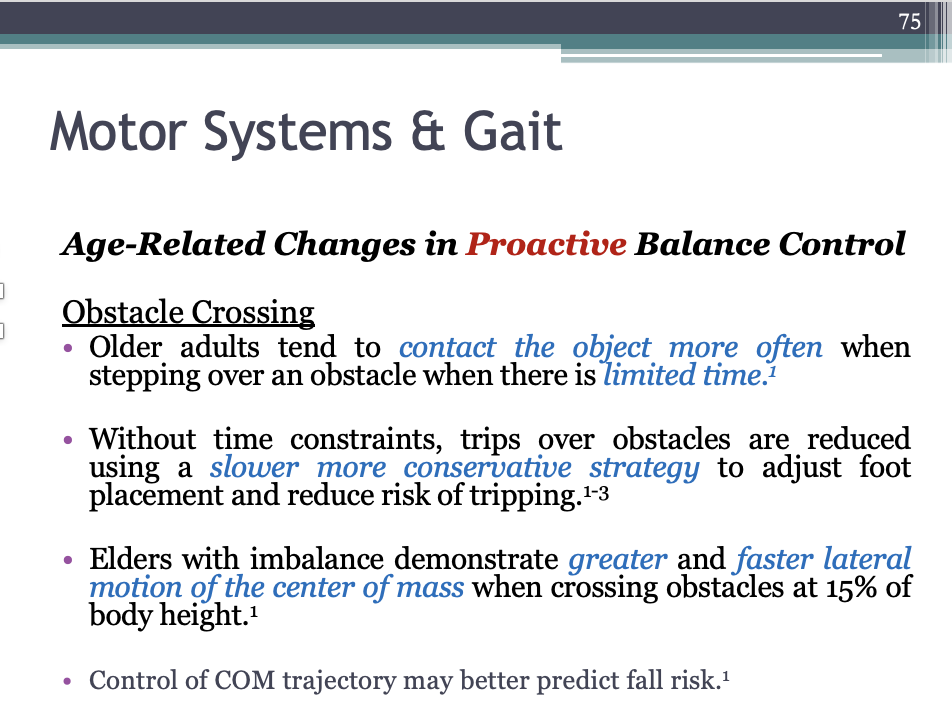
Elders with imbalance demonstrate greater and faster _______ motion of the center of mass when crossing obstacles at 15% of body height
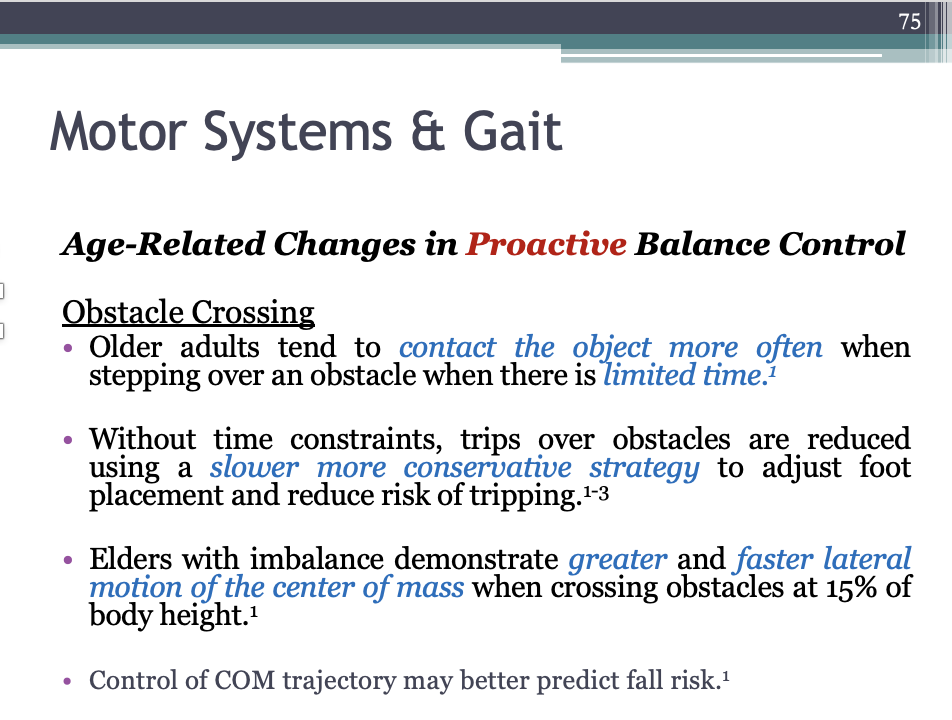
better predictor of fall risk
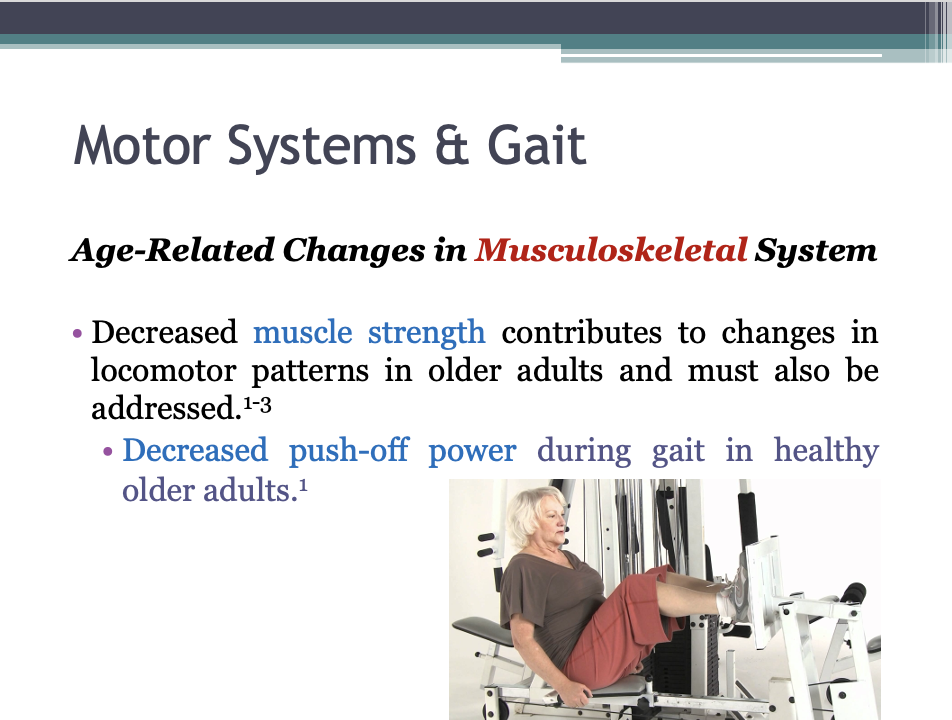
Age-Related Changes in Musculoskeletal System
Decreased _________ contributes to changes in locomotor patterns in older adults and must also be addressed - leads to ____
Age-related changes in sensory systems
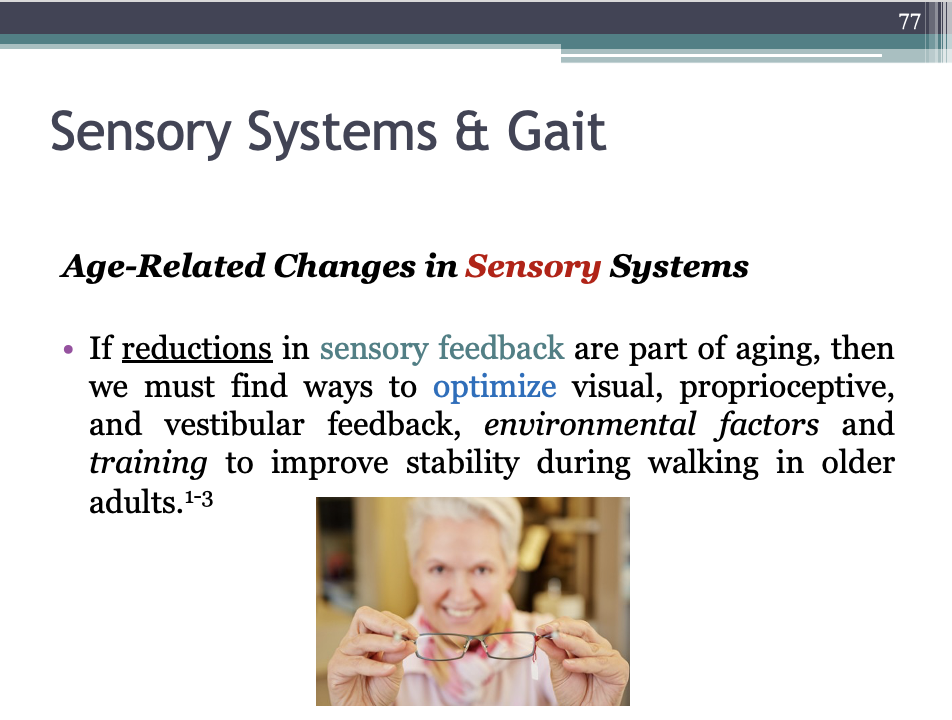
If reductions in sensory feedback are part of aging, then we must find ways to optimize _______
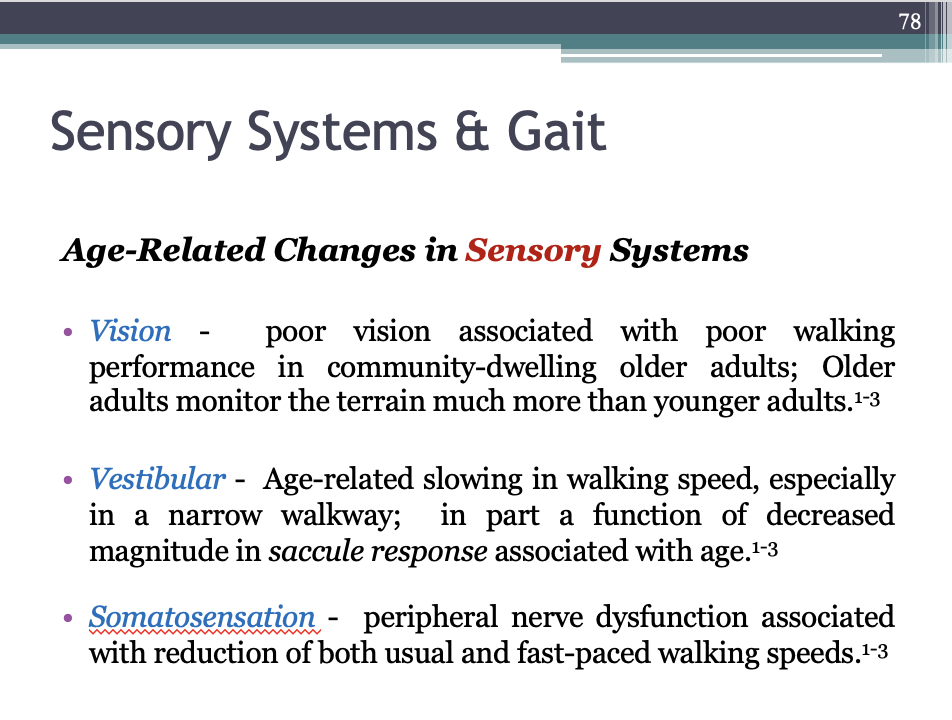
Age-Related Changes in Sensory Systems: vision
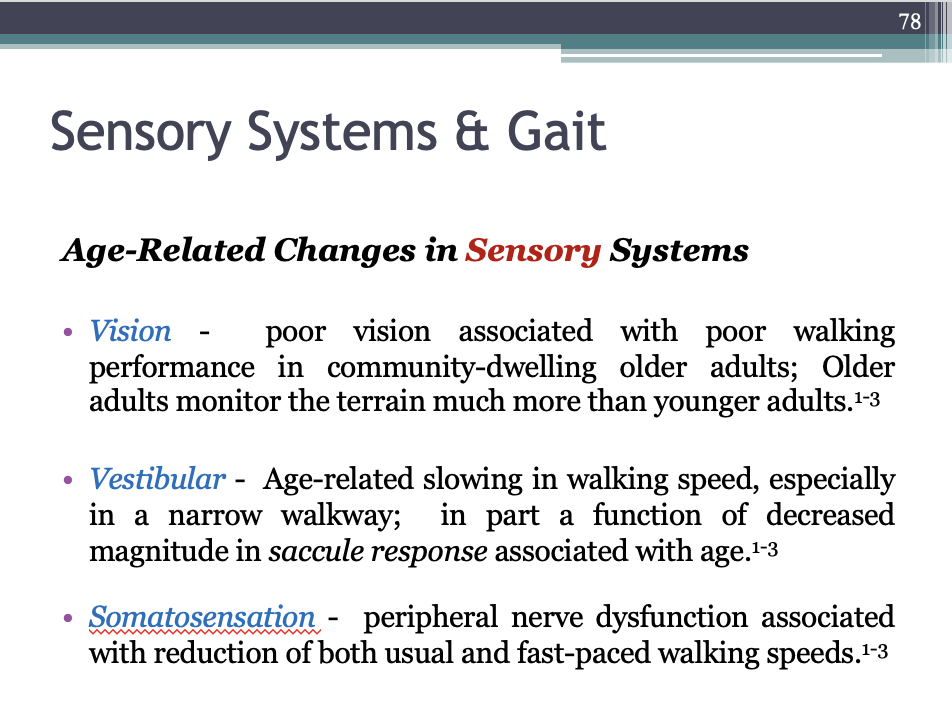
Age-Related Changes in Sensory Systems: vestibular
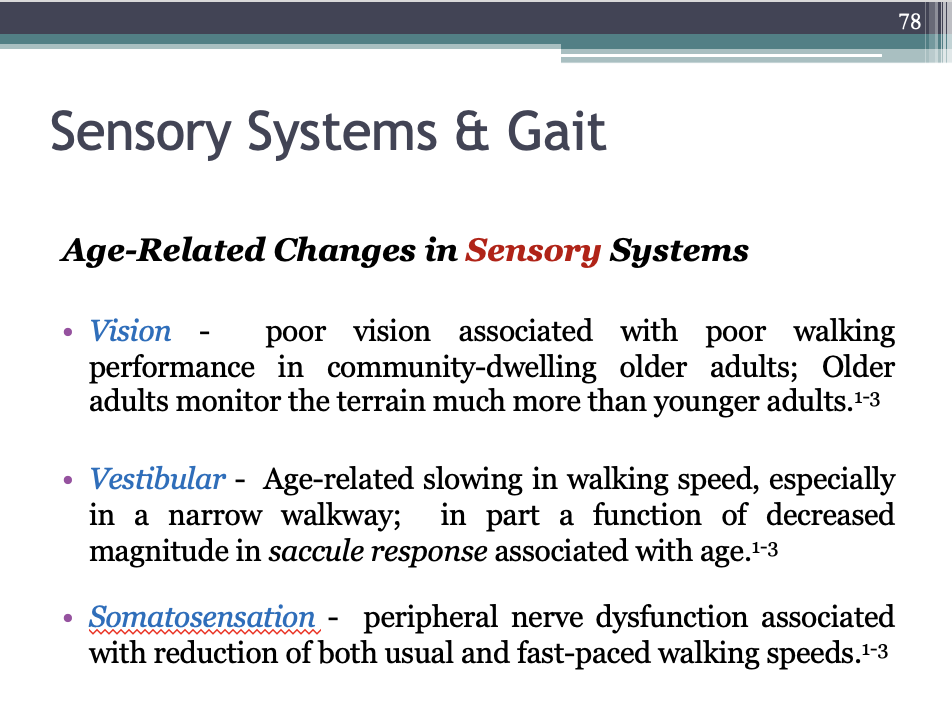
Age-Related Changes in Sensory Systems: somatosensation
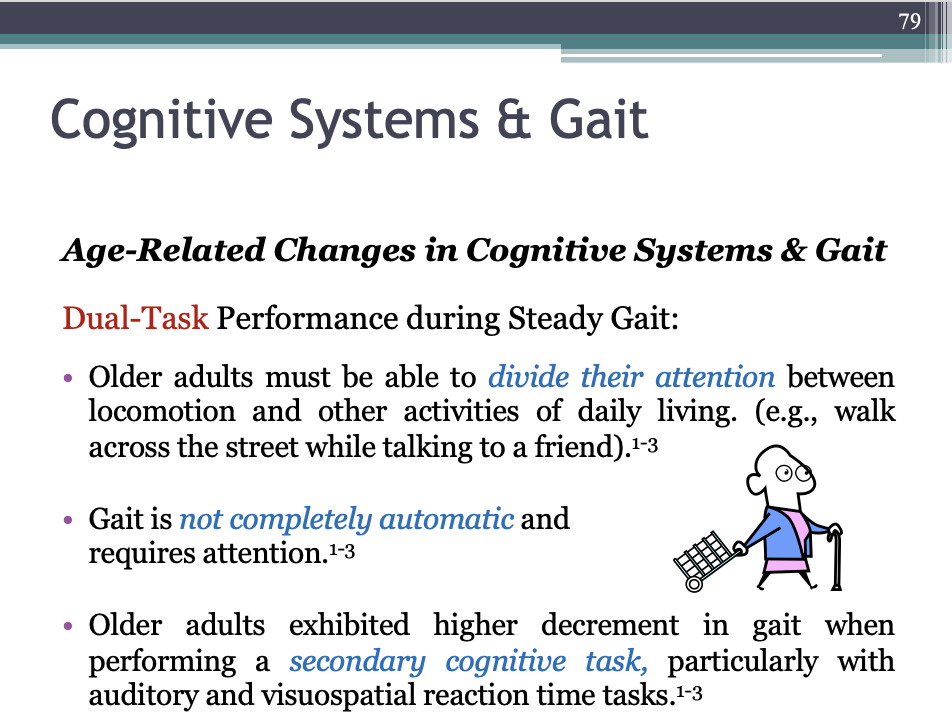
Age-related changes in cognitive systems and gait: Dual-task performance during steady gait: Older adults must be able to _______ between locomotion and other activities of daily living. (e.g., walk across the street while talking to a friend).
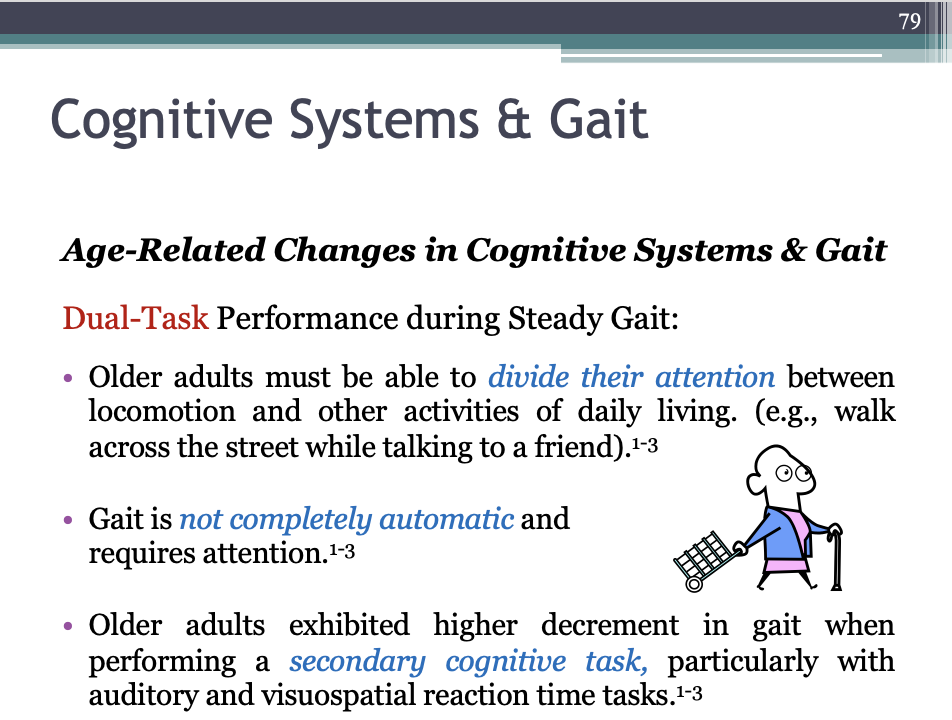
Gait is not completely _______ and requires attention
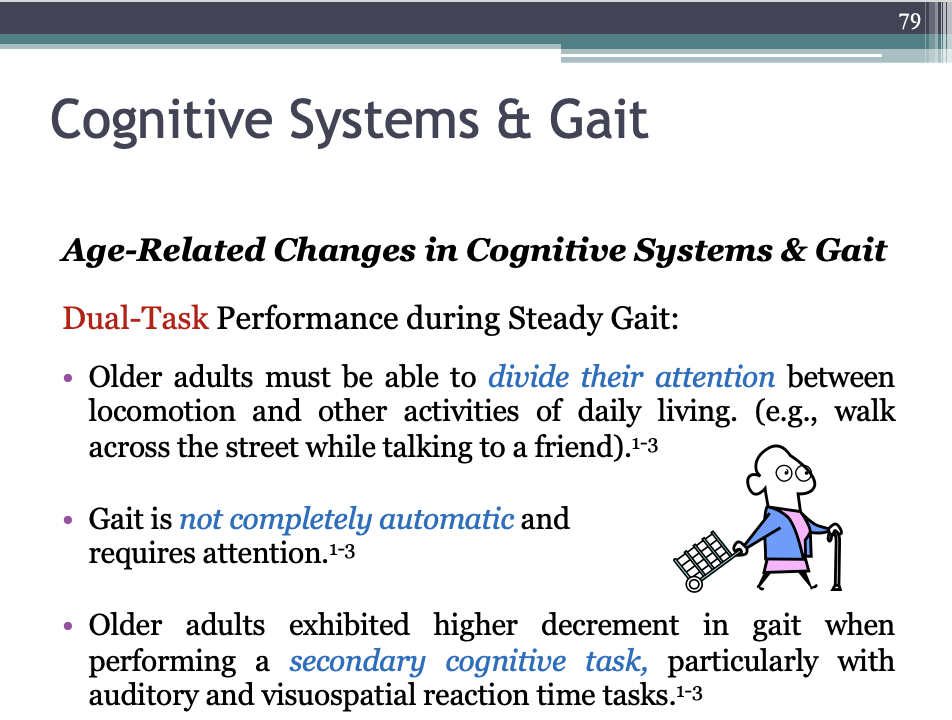
Older adults exhibited higher decrement in gait when performing a _________, particularly with auditory and visuospatial reaction time tasks
Age-Related Changes in Cognitive Systems & Gait
Dual-Task Performance during Obstacle Crossing:
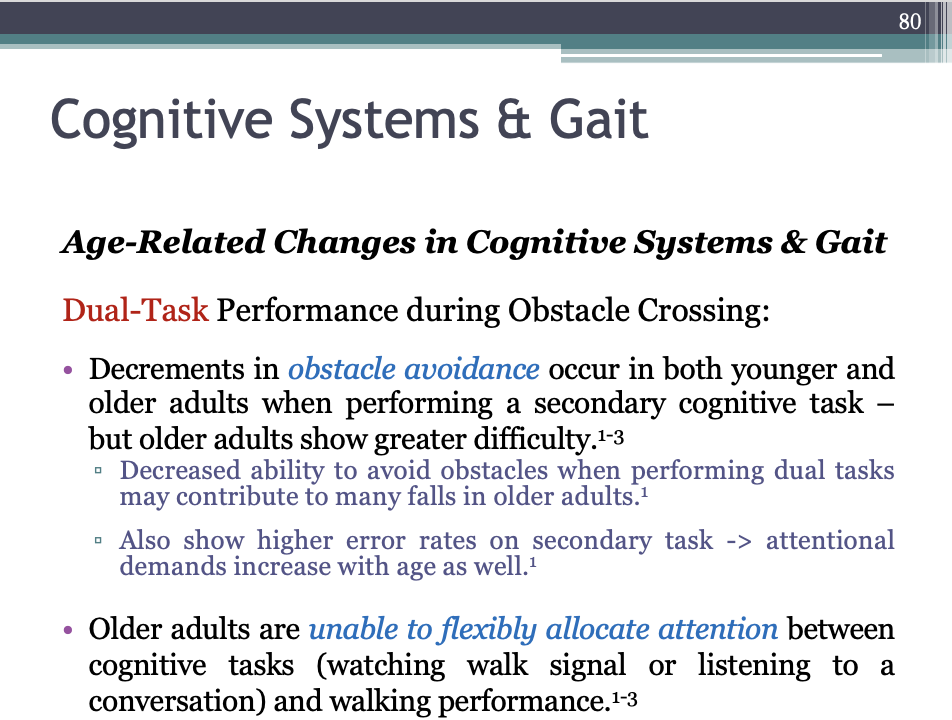
Age-Related Changes in Cognitive Systems & Gait
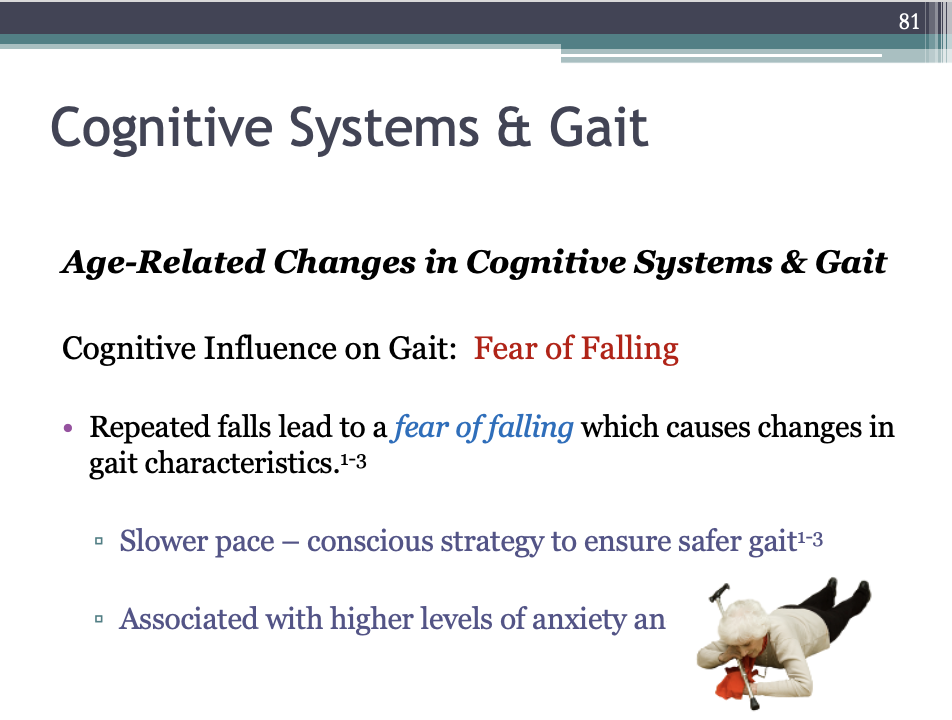
cognitive influence on gait: fear of falling
regression hypothesis
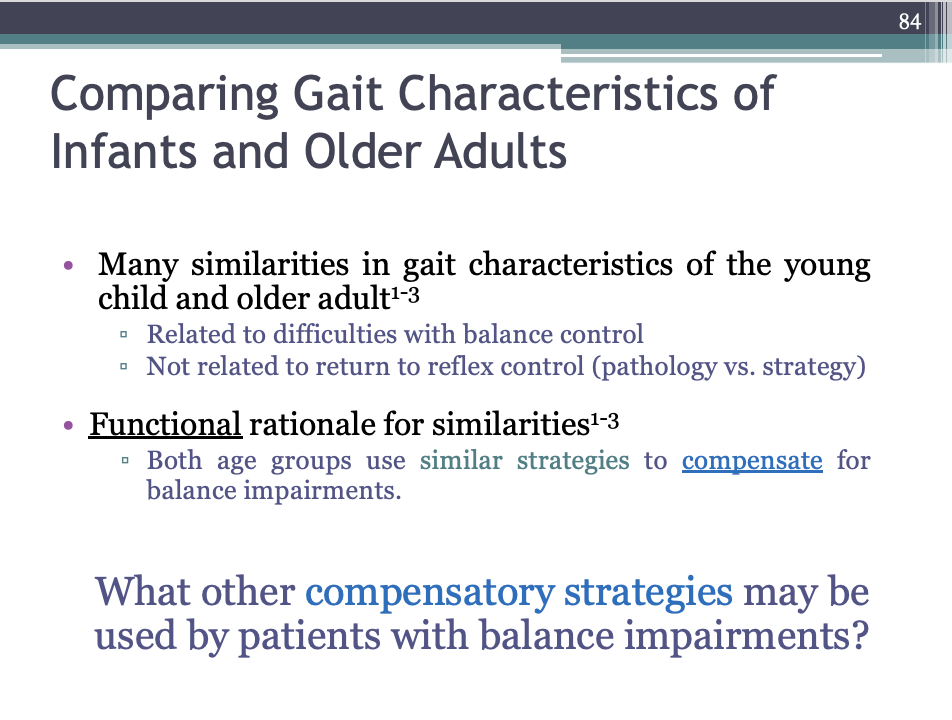
Compensation for different reasons – using similar strategies.
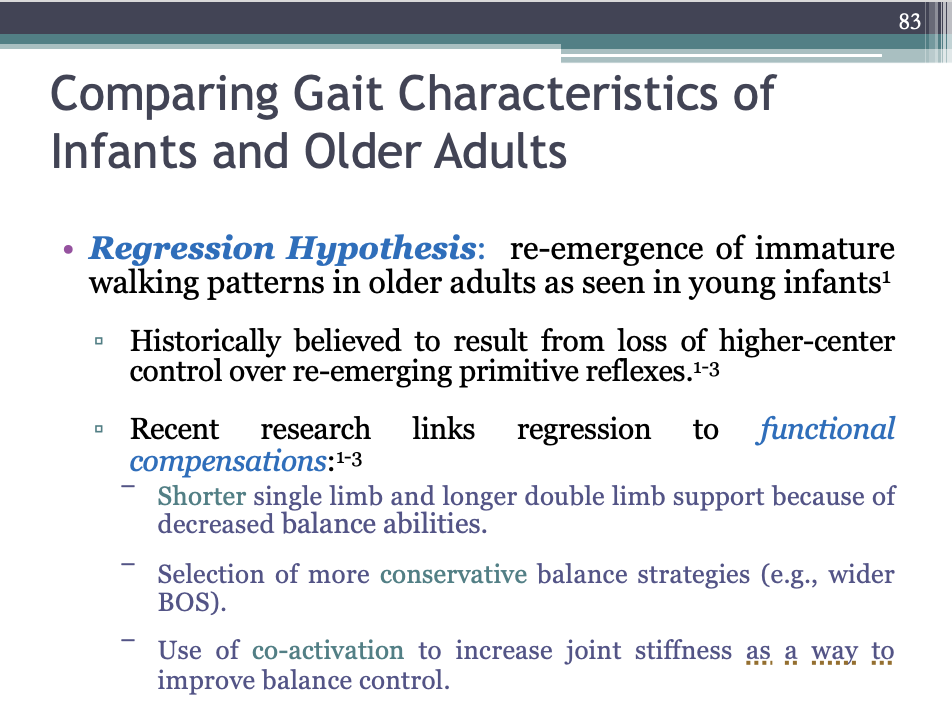
Comparing gait characteristics of infants and older adults