human structure and function

0.0(0)
Studied by 0 people
call kaiCall Kai
learnLearn
examPractice Test
spaced repetitionSpaced Repetition
heart puzzleMatch
flashcardsFlashcards
GameKnowt Play
Card Sorting

1/25

encourage image

There's no tags or description

Looks like no tags are added yet.

Last updated 4:10 AM on 5/21/26
Name
Mastery
Learn
Test
Matching
Spaced
Call with Kai

No analytics yet

Send a link to your students to track their progress

26 Terms
1
New cards
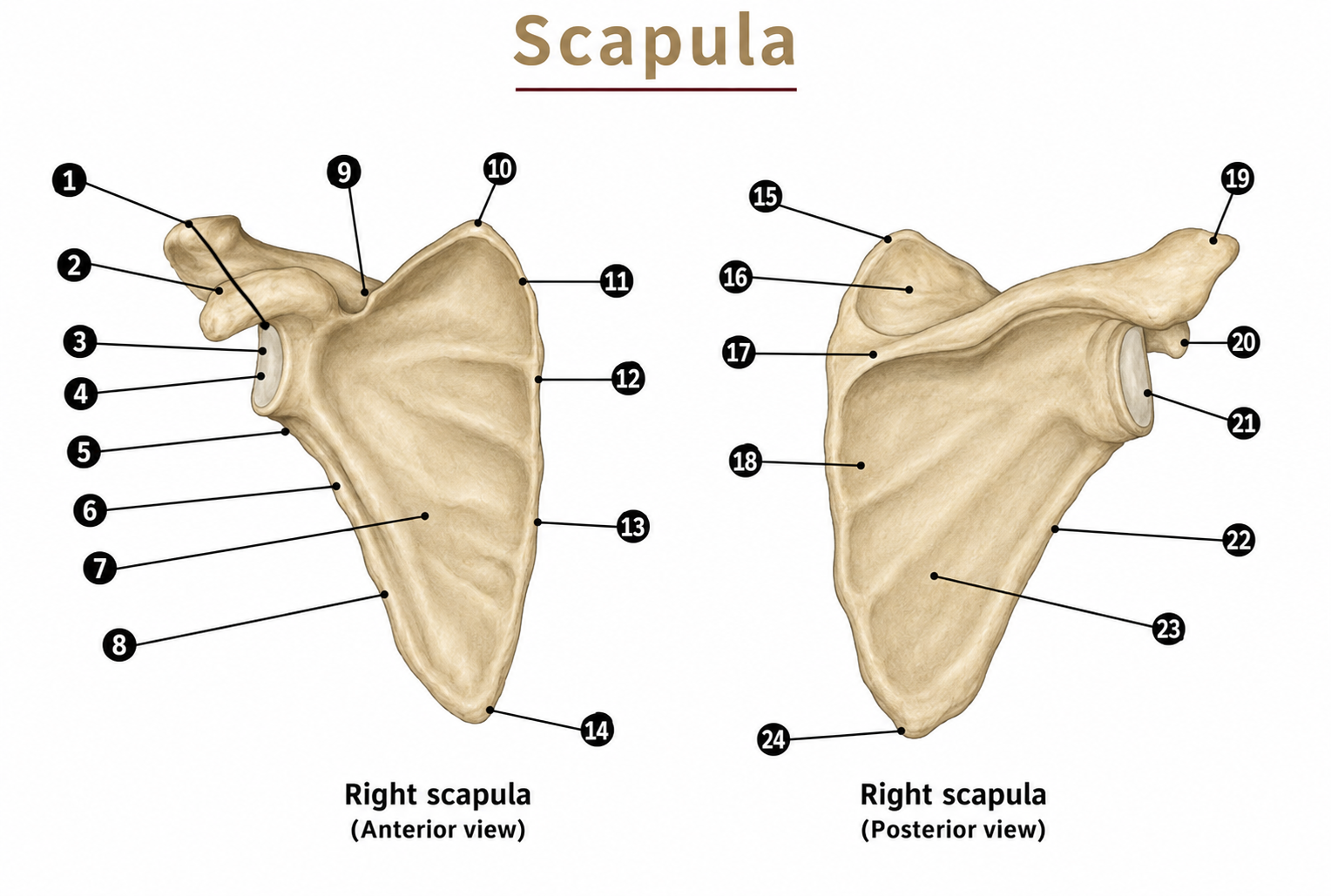
<p>label numbers 21, 20, 17, 13, 24/14, 19, 1, 6</p>

label numbers 21, 20, 17, 13, 24/14, 19, 1, 6

  1. glenoid cavity: joints the head of the humerus at the shoulder joint

  1. coracoid process

  1. scapular spine: insertion of trapezius and origin for posterior head of deltoid

  1. vertebral/medial border: insertion of rhomboids and levator scapulae

24/14. inferior angle: origin of teres major

  1. acromion process: origin of part of deltoid, insertion of part of trapezius, attachment of coracoacromial ligament

  1. supragenoid tubercle: origin of the long head of biceps brachii

  1. infraglenoid tubercle: origin of the long head of triceps brachii
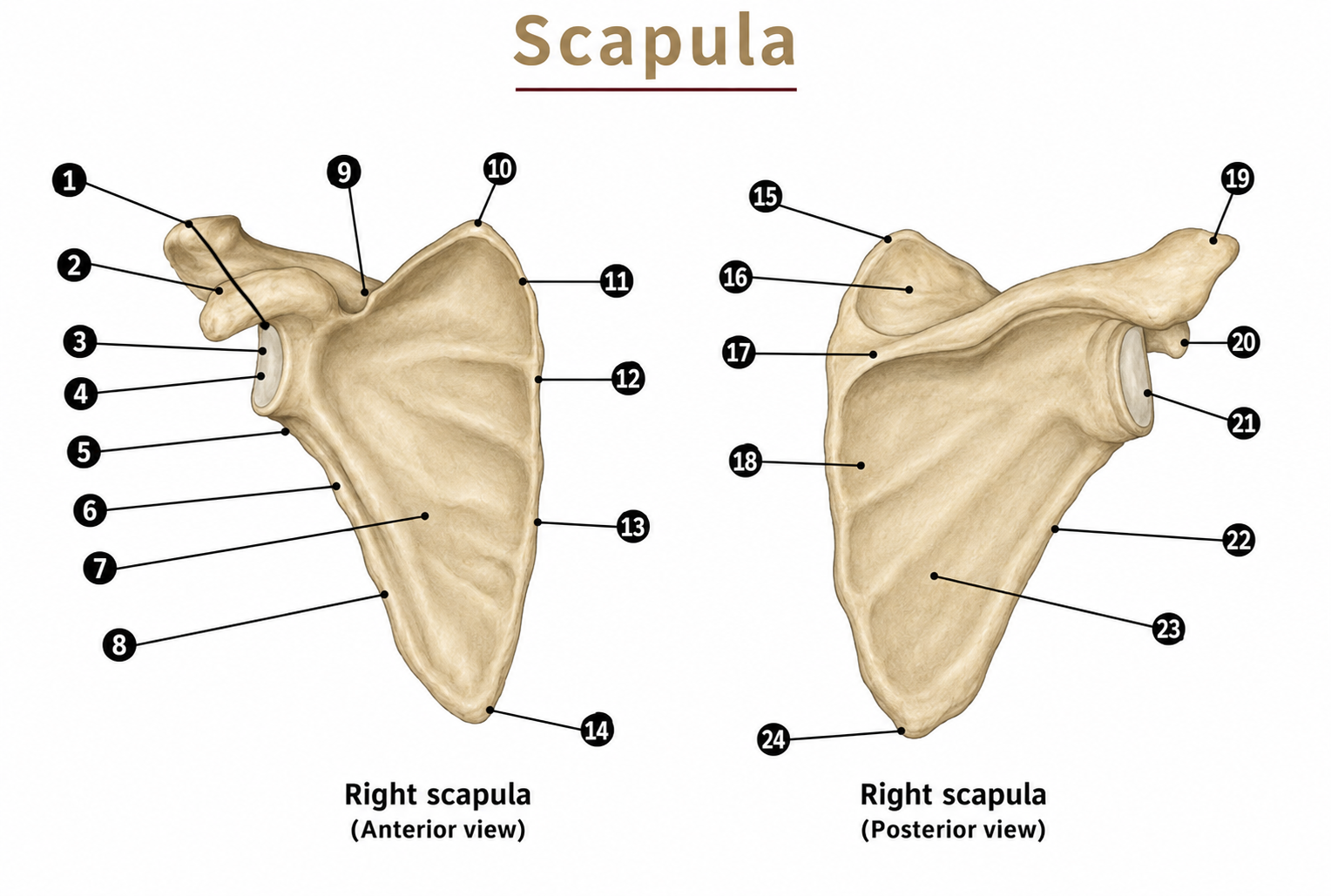
<ol start="21"><li><p>glenoid cavity: joints the head of the humerus at the shoulder joint</p></li></ol><ol start="20"><li><p>coracoid process</p></li></ol><ol start="17"><li><p>scapular spine: insertion of trapezius and origin for posterior head of deltoid</p></li></ol><ol start="13"><li><p>vertebral/medial border: insertion of rhomboids and levator scapulae</p></li></ol><p>24/14. inferior angle: origin of teres major</p><ol start="19"><li><p>acromion process: origin of part of deltoid, insertion of part of trapezius, attachment of coracoacromial ligament</p></li></ol><ol><li><p>supragenoid tubercle: origin of the long head of biceps brachii </p></li></ol><ol start="6"><li><p>infraglenoid tubercle: origin of the long head of triceps brachii</p></li></ol><p></p>
2
New cards
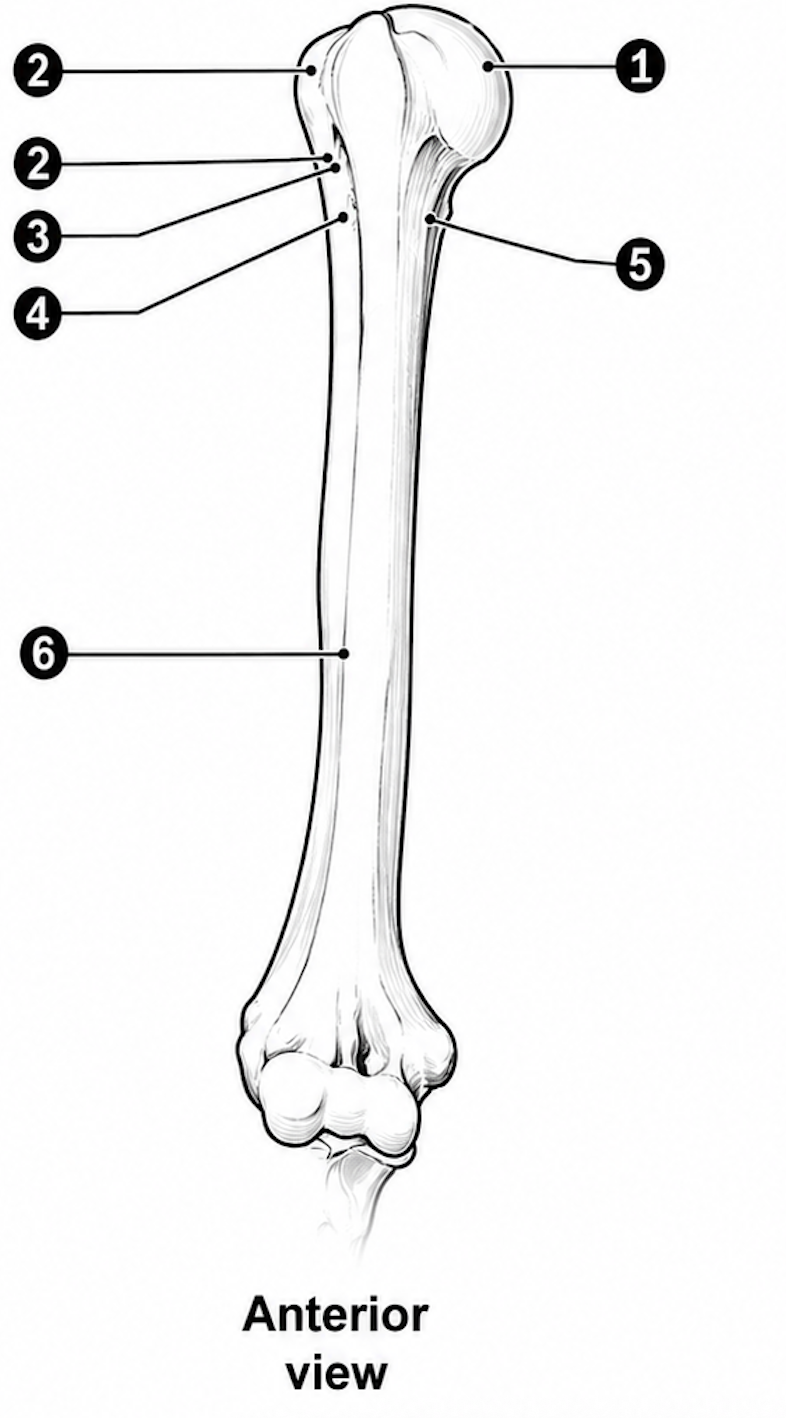
<p>label this diagram of a proximal humerus</p>

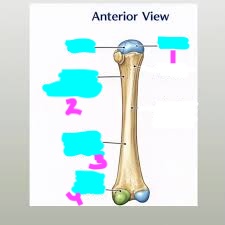
label this diagram of a proximal humerus

  1. head of the humerus: joins the glenoid cavity of the scapula at the shoulder joint

  2. greater tuberosity: insertion for supraspinatus, infraspinatus and teres minor (also the coracohumeral ligament)

  3. lesser tuberosity: insertion of subscapularis

  4. bicipital groove: between the tuberosities; for the tendon of long head of biceps

  5. anatomical neck: every head in anatomy has a neck

  6. surgical neck: a site named because it fractures relatively often

  7. deltoid tuberosity: insertion of deltoid
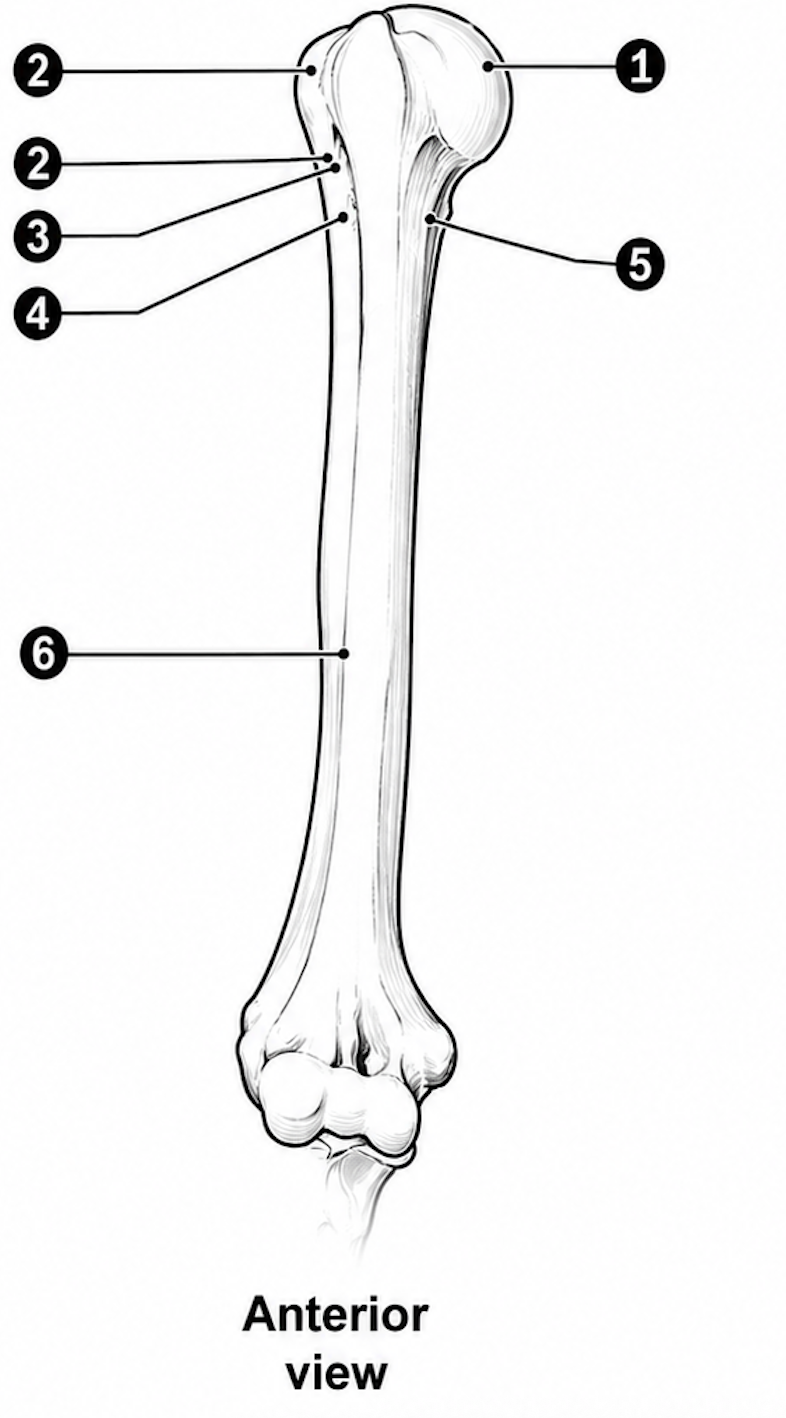
<ol><li><p>head of the humerus: joins the glenoid cavity of the scapula at the shoulder joint</p></li><li><p>greater tuberosity: insertion for supraspinatus, infraspinatus and teres minor (also the coracohumeral ligament)</p></li><li><p>lesser tuberosity: insertion of subscapularis</p></li><li><p>bicipital groove: between the tuberosities; for the tendon of long head of biceps</p></li><li><p>anatomical neck: every head in anatomy has a neck</p></li><li><p>surgical neck: a site named because it fractures relatively often</p></li><li><p>deltoid tuberosity: insertion of deltoid</p></li></ol><p></p>
3
New cards
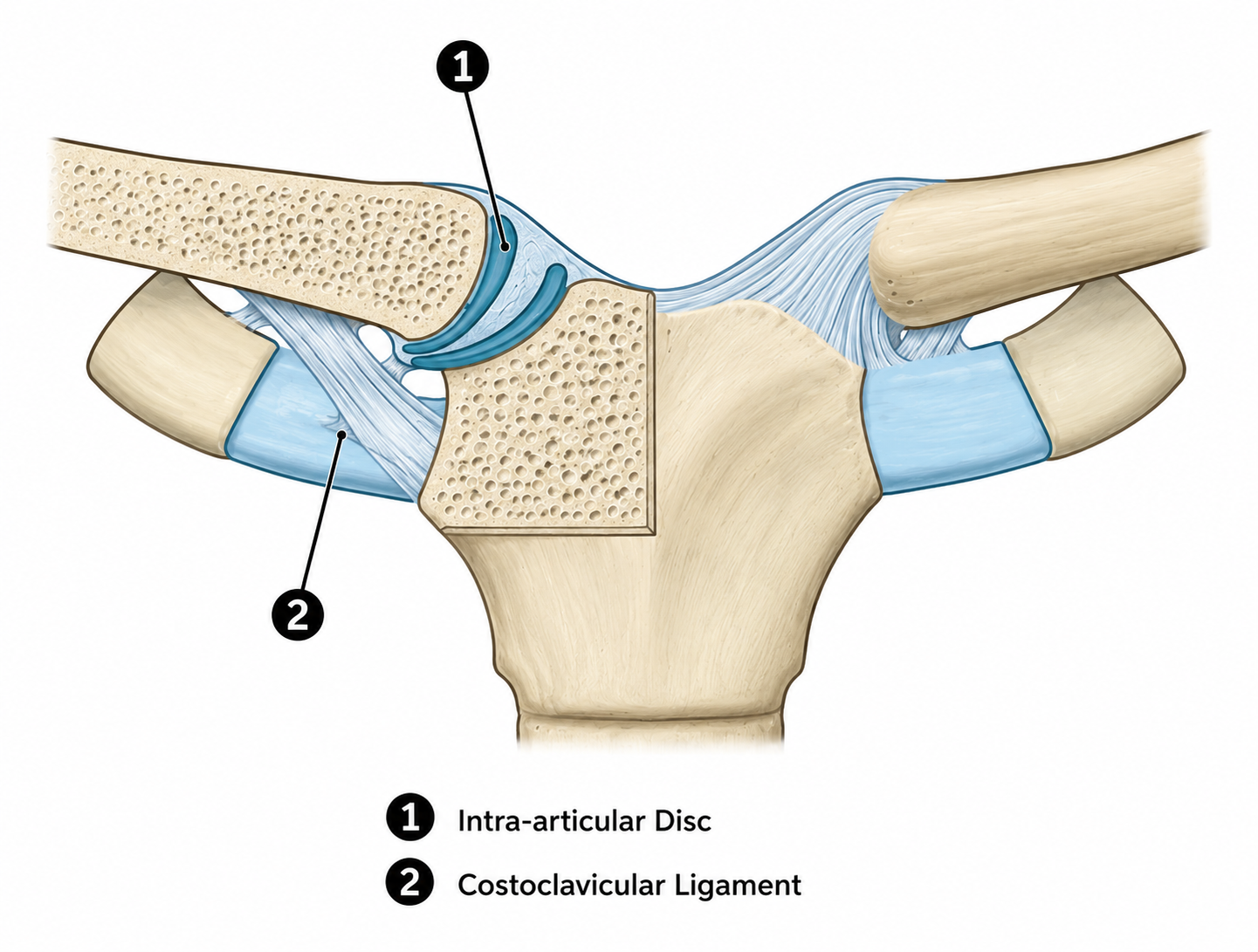
<p>label the sternoclavicular joint ligaments</p>

label the sternoclavicular joint ligaments

  1. intra-articular disc: divides the joint cavity into two compartments and stops clavicle dislocating medially and acts as a shock absorber for forces transmitted along the clavicle

  2. costoclavicular ligament: limits extreme clavicular elevation. when arm is raised overhead, this ligament becomes taut and prevents further elevation
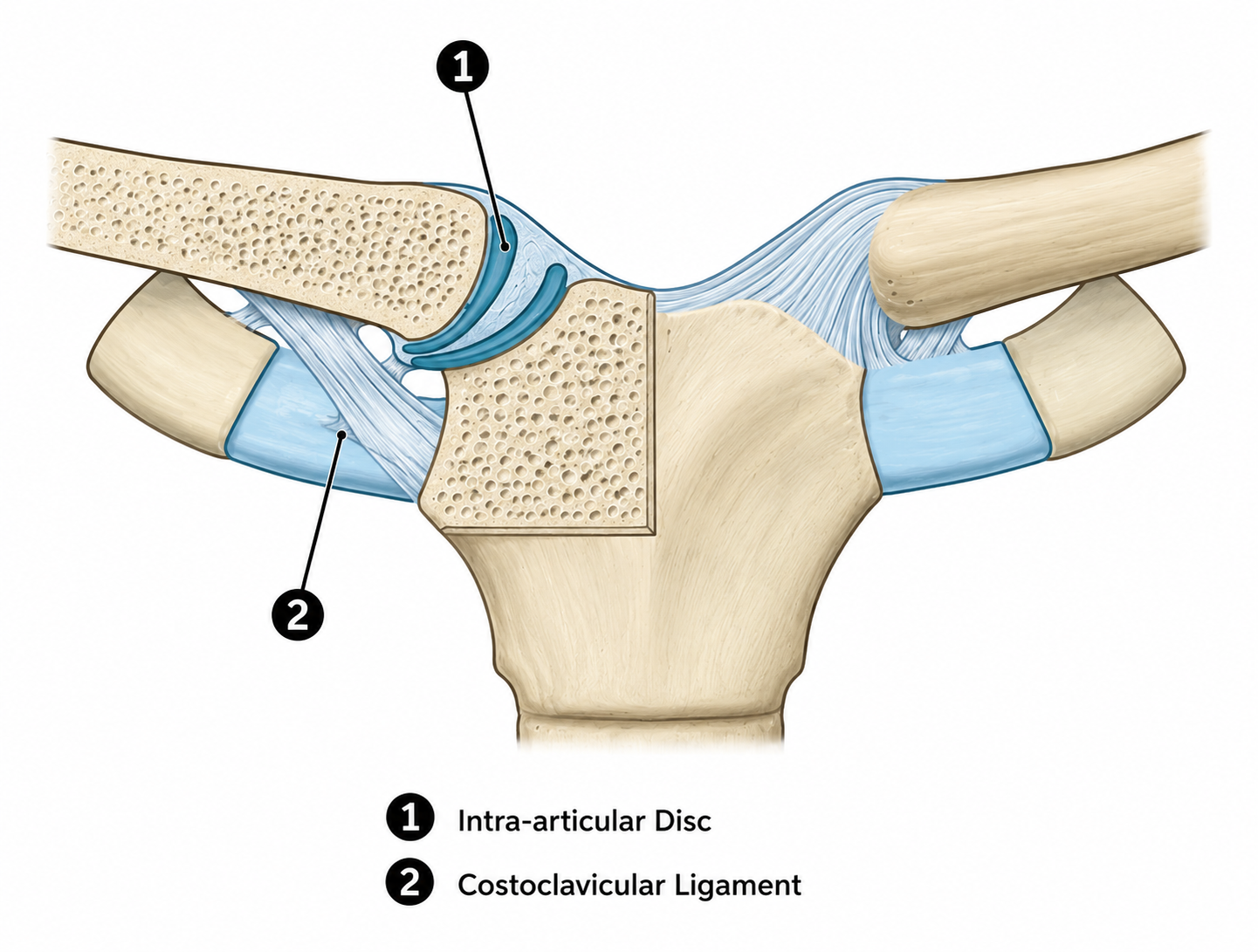
<ol><li><p>intra-articular disc: divides the joint cavity into two compartments and stops clavicle dislocating medially and acts as a shock absorber for forces transmitted along the clavicle</p></li><li><p>costoclavicular ligament: limits extreme clavicular elevation. when arm is raised overhead, this ligament becomes taut and prevents further elevation</p></li></ol><p></p>
4
New cards
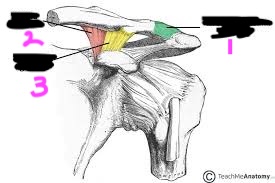
<p>label this diagram of the acromioclavicular joint ligaments</p>

label this diagram of the acromioclavicular joint ligaments

  1. acromioclavicular ligament: thickenings of the joint capsule above and below the acromioclavicular joint, limits elevation and depression at the acromioclavicular joint, providing horixontal stability.

  2. coracoclavicular ligaments: this ligament complex has two parts: conoid ligament: cone-shaped, attaches medially to the coracoid process, rotates clavicle posteriorly during full arm elevation, and the trapezoid ligament: quadrilaterial shape, attaches laterally to the coracoid process, transmits compression forces from the scapula to the clavicle, thus bypassing the acromioclavicular joint.
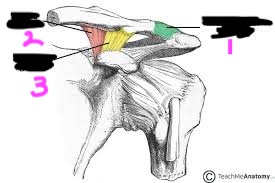
<ol><li><p>acromioclavicular ligament: thickenings of the joint capsule above and below the acromioclavicular joint, limits elevation and depression at the acromioclavicular joint, providing horixontal stability.</p></li><li><p>coracoclavicular ligaments: this ligament complex has two parts: conoid ligament: cone-shaped, attaches medially to the coracoid process, rotates clavicle posteriorly during full arm elevation, and the trapezoid ligament: quadrilaterial shape, attaches laterally to the coracoid process, transmits compression forces from the scapula to the clavicle, thus bypassing the acromioclavicular joint.</p></li></ol><p></p>
5
New cards
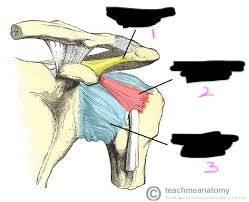
<p>label this diagram of acromioclavicular joint ligaments</p>

label this diagram of acromioclavicular joint ligaments

  1. coracoacromial ligament: stops no joint movement, because it joins two parts of one bone, which never move relative to each other. protects shoulder joint from above, forming a protective arch over the humeral head. prevents extreme superior dislocation of the humeral head.

  2. coracohumeral ligament: limits extreme humeral adduction, as well as lateral rotation, and helps support the humeral head when the arm hangs at the side.

  3. glenohumeral ligaments: limits extreme humeral external rotation. the inferior glenohumeral ligament is an important stabilizer when the arm is abducted.
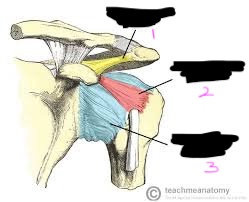
<ol><li><p>coracoacromial ligament: stops no joint movement, because it joins two parts of one bone, which never move relative to each other. protects shoulder joint from above, forming a protective arch over the humeral head. prevents extreme superior dislocation of the humeral head.</p></li><li><p>coracohumeral ligament: limits extreme humeral adduction, as well as lateral rotation, and helps support the humeral head when the arm hangs at the side.</p></li><li><p>glenohumeral ligaments: limits extreme humeral external rotation. the inferior glenohumeral ligament is an important stabilizer when the arm is abducted.</p></li></ol><p></p>
6
New cards
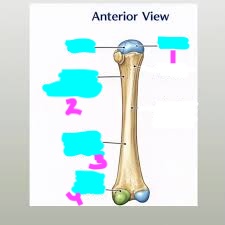
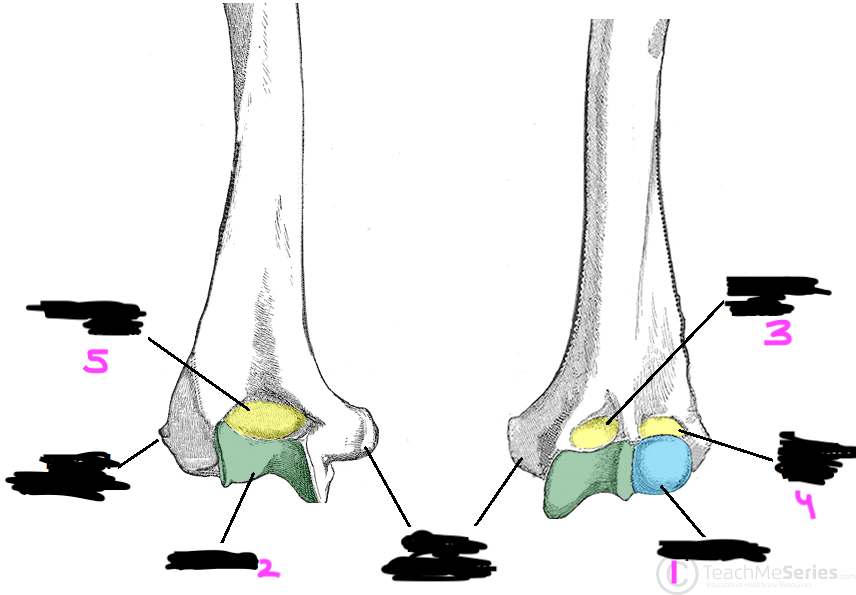
<p>label this diagram of the distal humerus</p>

label this diagram of the distal humerus

  1. capitulum: the rounded lateral condyle that articulates with the head of the radius

  2. trochlea: the spool-shaped medial condyle that articulates with the trochlear notch of the ulna

  3. coronoid fossa (anterior): receives the coronoid process of the ulna during elbow flexion

  4. radial fossa (anterior): receives the head of the radius during elbow flexion

  5. olecranon fossa (posterior): receives the olecranon process of the ulna during elbow extension
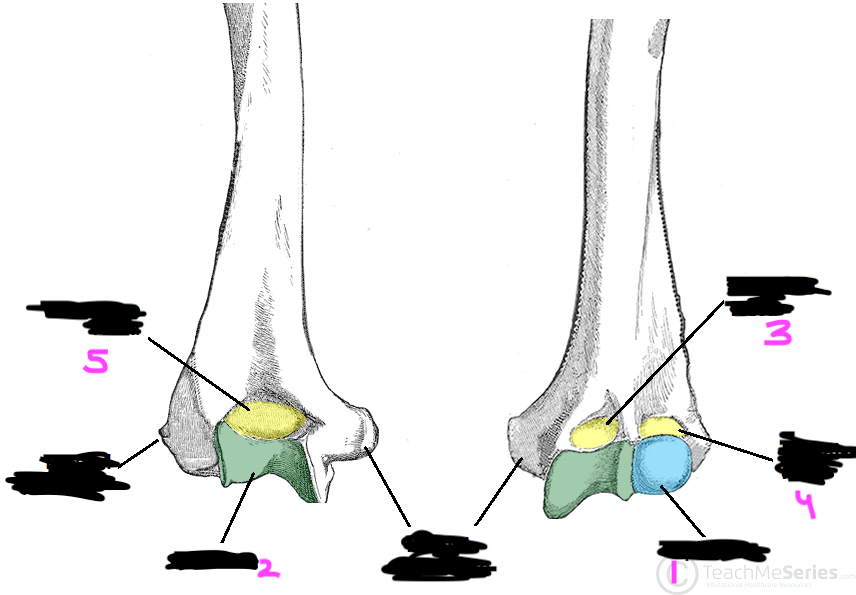
<ol><li><p>capitulum: the rounded lateral condyle that articulates with the head of the radius</p></li><li><p>trochlea: the spool-shaped medial condyle that articulates with the trochlear notch of the ulna</p></li><li><p>coronoid fossa (anterior): receives the coronoid process of the ulna during elbow flexion</p></li><li><p>radial fossa (anterior): receives the head of the radius during elbow flexion</p></li><li><p>olecranon fossa (posterior): receives the olecranon process of the ulna during elbow extension</p></li></ol><p></p>
7
New cards
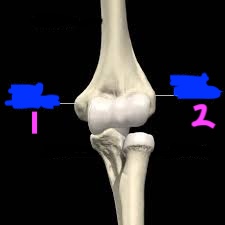
<p>label this diagram of the epicondyles of the humerus (right arm)</p>

label this diagram of the epicondyles of the humerus (right arm)

  1. medial epicondyle: origin for flexor muscles of the wrist and fingers

  2. lateral epicondyle: origin for extensor muscles of the wrist and fingers
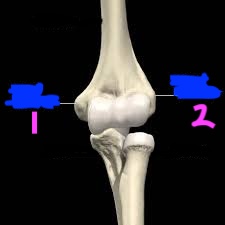
<ol><li><p>medial epicondyle: origin for flexor muscles of the wrist and fingers</p></li><li><p>lateral epicondyle: origin for extensor muscles of the wrist and fingers</p></li></ol><p></p>
8
New cards
<p>label this diagram of the radius</p>

label this diagram of the radius

  1. head of the radius: articulates with the capitulum of the humerus and the radial notch of the ulna

  2. radial tuberosity: insertion of the biceps brachii tendon

  3. styloid process of the radius: attachment for the brachioradialis muscle and radial collateral ligament

  4. ulnar notch (distal): articulates with the head of the ulna at the distal radioulnar joint
<ol><li><p>head of the radius: articulates with the capitulum of the humerus and the radial notch of the ulna</p></li><li><p>radial tuberosity: insertion of the biceps brachii tendon</p></li><li><p>styloid process of the radius: attachment for the brachioradialis muscle and radial collateral ligament</p></li><li><p>ulnar notch (distal): articulates with the head of the ulna at the distal radioulnar joint</p></li></ol><p></p>
9
New cards
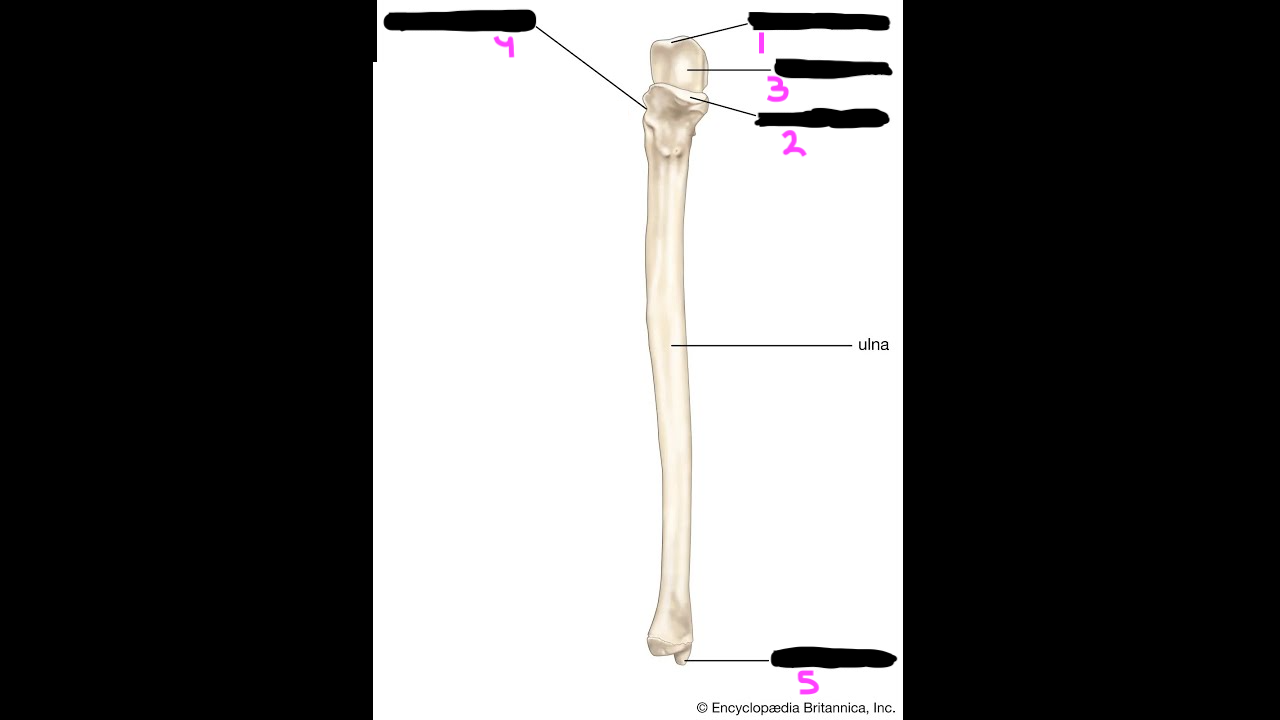
<p>label this diagram of the ulna</p>

label this diagram of the ulna

  1. olecranon process: forms the point of the elbow; insertion of the triceps brachii

  2. coronoid process: insertion of the brachialis muscle

  3. trochlear notch: articulates with the trochlea of the humerus

  4. radial notch: articulates with the head of the radius at the proximal radioulnar joint

  5. styloid proc ess of the ulna: attachment for the ulnar collateral ligament
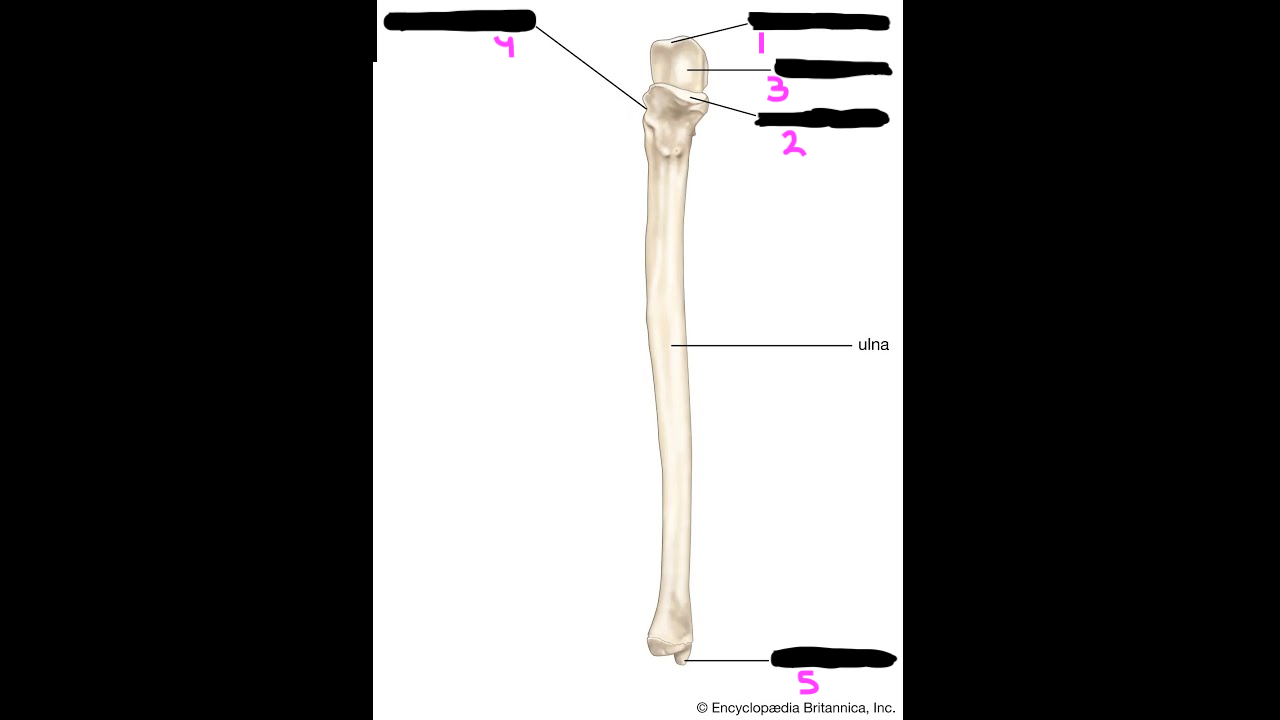
<ol><li><p>olecranon process: forms the point of the elbow; insertion of the triceps brachii</p></li><li><p>coronoid process: insertion of the brachialis muscle </p></li><li><p>trochlear notch: articulates with the trochlea of the humerus</p></li><li><p>radial notch: articulates with the head of the radius at the proximal radioulnar joint</p></li><li><p>styloid proc ess of the ulna: attachment for the ulnar collateral ligament</p></li></ol><p></p>
10
New cards
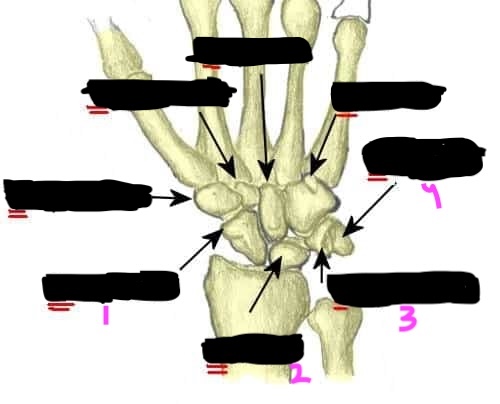
<p>label the diagram of these carpal bones (proximal row - lateral the medial)</p>

label the diagram of these carpal bones (proximal row - lateral the medial)

  1. scaphoid: most commonly fractured carpal bone

  2. lunate: articulates with the radius

  3. triquetrum: articulates with the ulna via the articular disc

  4. pisiform: a sesamoid bone within the tendon of flexor carpi ulnaris

memory aid - “Sally Left The Party”
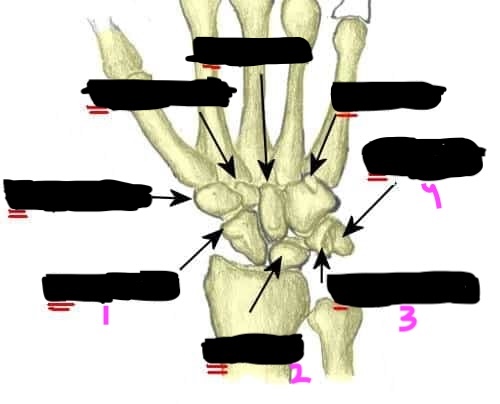
<ol><li><p>scaphoid: most commonly fractured carpal bone</p></li><li><p>lunate: articulates with the radius</p></li><li><p>triquetrum: articulates with the ulna via the articular disc</p></li><li><p>pisiform: a sesamoid bone within the tendon of flexor carpi ulnaris</p></li></ol><p>memory aid - “Sally Left The Party”</p>
11
New cards
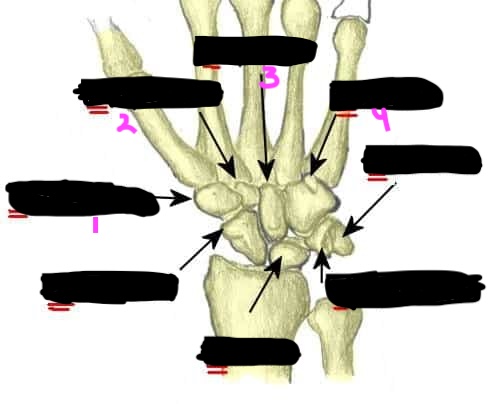
<p>label the diagram of these carpal bones (distal row - lateral to medial)</p>

label the diagram of these carpal bones (distal row - lateral to medial)

  1. trapezium: articulates with the base of the first metacarpal (thumb)

  2. trapezoid: articulates with the base of the second metacarpal

  3. capitate: the largest carpal bone

  4. hamate: has a hook-like process (hook of hamate) on its palmar surface

memory aid - “To Take Claire Home”
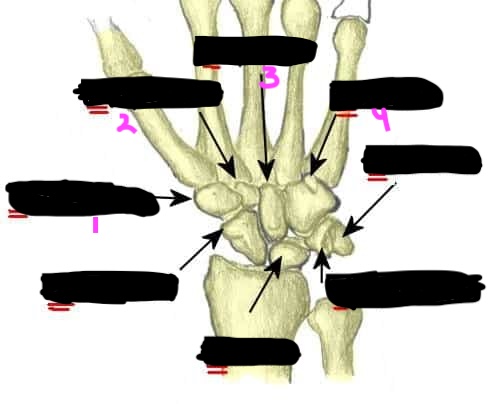
<ol><li><p>trapezium: articulates with the base of the first metacarpal (thumb)</p></li><li><p>trapezoid: articulates with the base of the second metacarpal</p></li><li><p>capitate: the largest carpal bone</p></li><li><p>hamate: has a hook-like process (hook of hamate) on its palmar surface</p></li></ol><p>memory aid - “To Take Claire Home”</p>
12
New cards
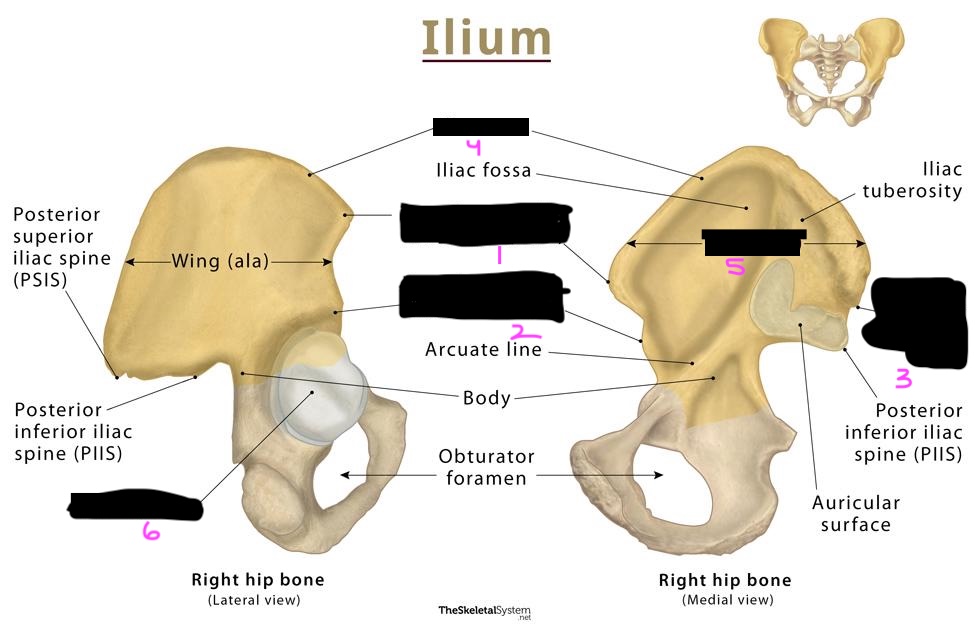
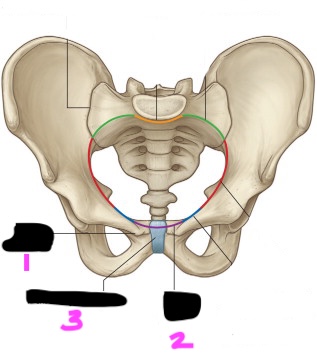
<p>label the diagram of the illiac bone features of the pelvis</p>

label the diagram of the illiac bone features of the pelvis

  1. anterior superior iliac spine (ASIS): for the origin of sartorius and the attachment of the inguinal ligament

  2. anterior inferior iliac spine (AIIS): for the origin of rectus femoris

  3. posterior superior iliac spine (PSIS): sort-of marks the sacroiliac joint (SIJ)

  4. iliac crest: runs between the ASIS and the PSIS - has many attachments e.g. abdominal muscles

  5. iliac blade: iliacus originates on its front, and the gluteal muscles originate on its posterior surface

  6. acetabulim: joins the head od the femur at the hip joint
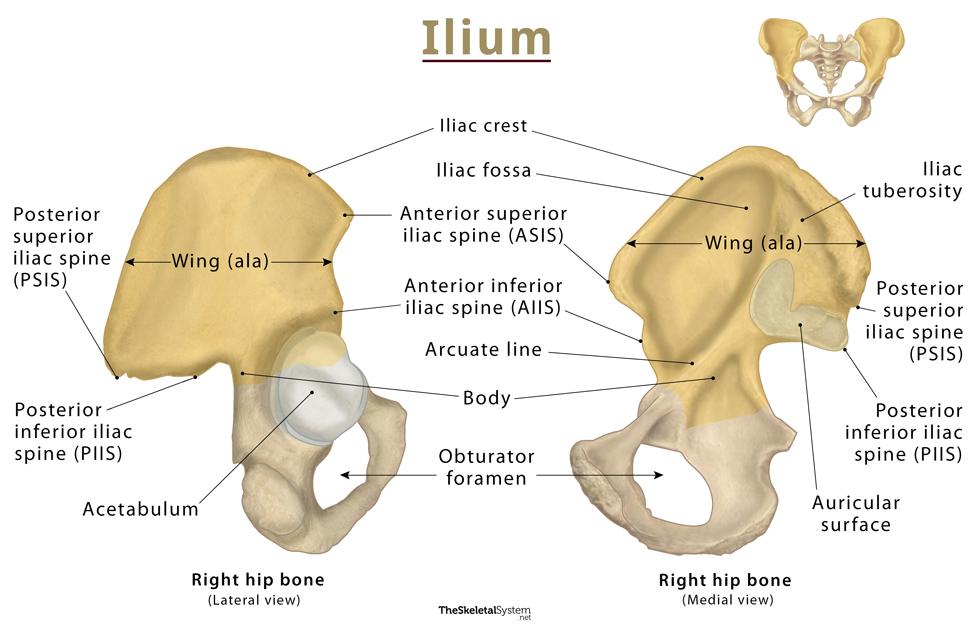
<ol><li><p>anterior superior iliac spine (ASIS): for the origin of sartorius and the attachment of the inguinal ligament</p></li><li><p>anterior inferior iliac spine (AIIS): for the origin of rectus femoris</p></li><li><p>posterior superior iliac spine (PSIS): sort-of marks the sacroiliac joint (SIJ)</p></li><li><p>iliac crest: runs between the ASIS and the PSIS - has many attachments e.g. abdominal muscles</p></li><li><p>iliac blade: iliacus originates on its front, and the gluteal muscles originate on its posterior surface</p></li><li><p>acetabulim: joins the head od the femur at the hip joint</p></li></ol><p></p>
13
New cards
<p>label this diagram of the pubic features on the pelvis</p>

label this diagram of the pubic features on the pelvis

  1. pubic tubercle: for the attachment of the inguinal ligament

  2. public crest: for the origin (the lower end) of rectus abdominis

  3. pubic symphysis: the joint between the left and right hip bones
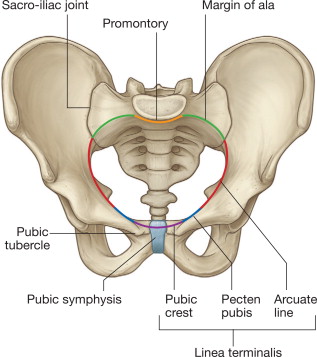
<ol><li><p>pubic tubercle: for the attachment of the inguinal ligament</p></li><li><p>public crest: for the origin (the lower end) of rectus abdominis</p></li><li><p>pubic symphysis: the joint between the left and right hip bones</p></li></ol><p></p>
14
New cards
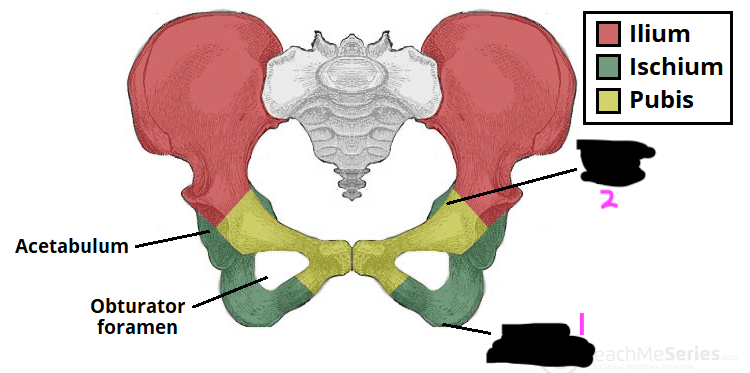
<p>label this diagram of the ischial features on the pelvis</p>

label this diagram of the ischial features on the pelvis

  1. ischial tuberosity: origin of the hamstrings and attachment site for the sacrotuberous ligament. you sit on this bony feature

  2. ischial spine: sacrospinous ligament attaches to it
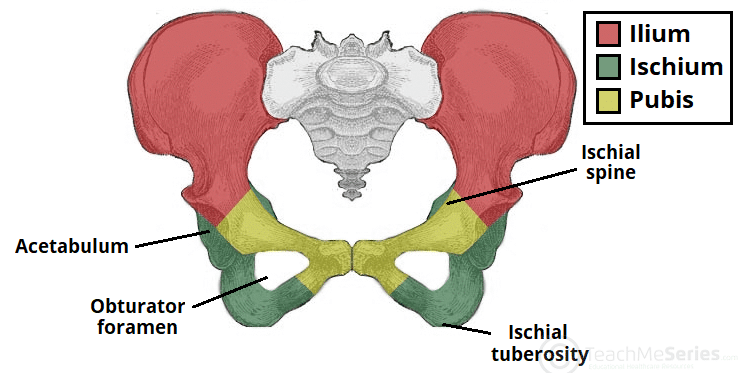
<ol><li><p>ischial tuberosity: origin of the hamstrings and attachment site for the sacrotuberous ligament. you sit on this bony feature</p></li><li><p>ischial spine: sacrospinous ligament attaches to it</p></li></ol><p></p>
15
New cards
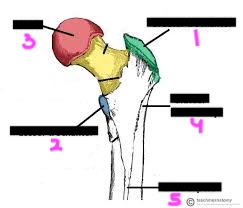
<p>label this diagram of the femur (proximal features)</p>

label this diagram of the femur (proximal features)

  1. greater trochanter: insertion of gluteus medius and minimus, as well as the 6 lateral rotators of the hip joint

  2. lesser trochanter: insertion of iliopsoas (psoas major plus iliacus)

  3. head of femur: joins the acetabulum at the hip joint

  4. gluteal tuberosity: insertion of part of gluteus maximus

  5. linea aspera: insertion of the hip adductors
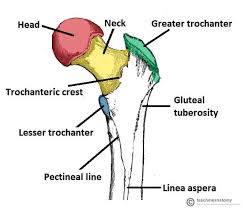
<ol><li><p>greater trochanter: insertion of gluteus medius and minimus, as well as the 6 lateral rotators of the hip joint</p></li><li><p>lesser trochanter: insertion of iliopsoas (psoas major plus iliacus)</p></li><li><p>head of femur: joins the acetabulum at the hip joint</p></li><li><p>gluteal tuberosity: insertion of part of gluteus maximus</p></li><li><p>linea aspera: insertion of the hip adductors</p></li></ol><p></p>
16
New cards
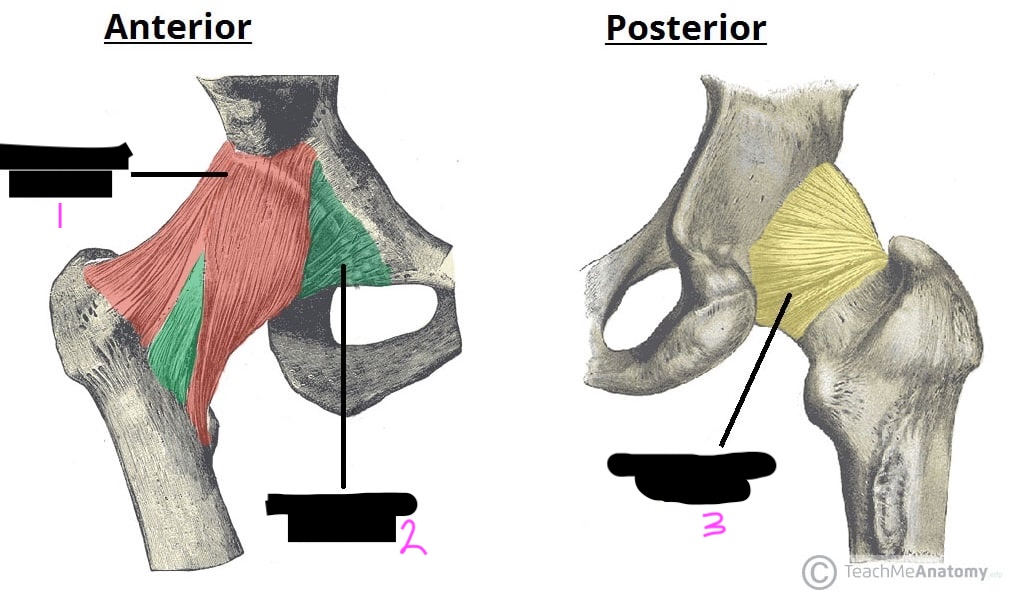
<p>label this diagram of the hip joint ligaments</p>

label this diagram of the hip joint ligaments

  1. iliofemoral ligament: stops extreme hip joint extension

  2. pubofemoral ligament: stops extreme hip joint abduction

  3. ischiofemoral ligament: stops extreme hip joint internal rotation
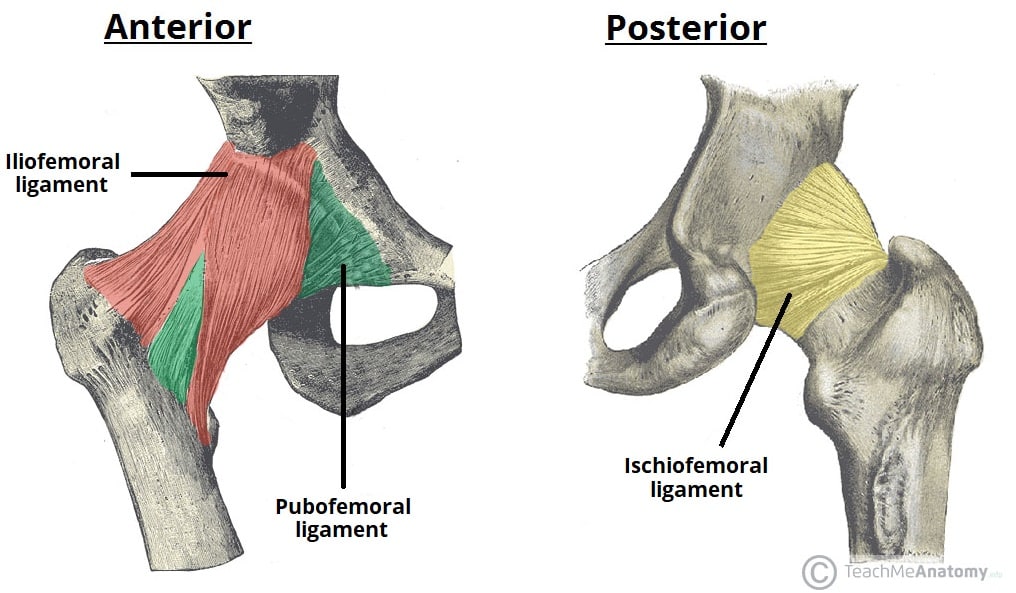
<ol><li><p>iliofemoral ligament: stops extreme hip joint extension</p></li><li><p>pubofemoral ligament: stops extreme hip joint abduction</p></li><li><p>ischiofemoral ligament: stops extreme hip joint internal rotation</p></li></ol><p></p>
17
New cards
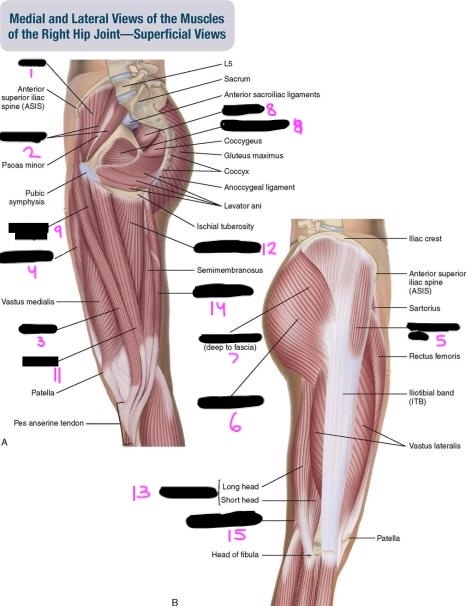
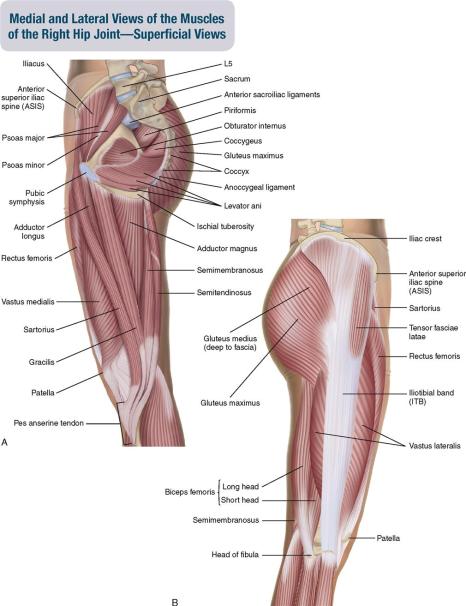
<p>label this diagram of the hip muscles</p>

label this diagram of the hip muscles

  1. iliacus: hip flexion

  2. psoas major: fip flexion

  3. sartorius: hip abduction, flexion, lateral rotation

  4. rectus femoris: hip flexion

  5. tensor fasciae latae (TFL): hip flexion, abduction, medial rotation

  6. gluteus maximus: hip extension, lateral rotation, adduction

  7. gluteus medius: hip abduction

  8. piriformis, obturator internus: laterally rotate the hip

  9. adductor longus: adduct and flex the hip

  10. gracilis: adduct and flex the hip

  11. adductor magnus: adduct and flex the hip

  12. long head of biceps femoris: hip extension

  13. semitendinosus: hip extension

  14. semimembranosus: hip extension

<ol><li><p>iliacus: hip flexion</p></li><li><p>psoas major: fip flexion</p></li><li><p>sartorius: hip abduction, flexion, lateral rotation</p></li><li><p>rectus femoris: hip flexion</p></li><li><p>tensor fasciae latae (TFL): hip flexion, abduction, medial rotation</p></li><li><p>gluteus maximus: hip extension, lateral rotation, adduction</p></li><li><p>gluteus medius: hip abduction</p></li><li><p>piriformis, obturator internus: laterally rotate the hip</p></li><li><p>adductor longus: adduct and flex the hip</p></li><li><p>gracilis: adduct and flex the hip</p></li><li><p>adductor magnus: adduct and flex the hip</p></li><li><p>long head of biceps femoris: hip extension</p></li><li><p>semitendinosus: hip extension</p></li><li><p>semimembranosus: hip extension</p></li></ol><p></p>
18
New cards
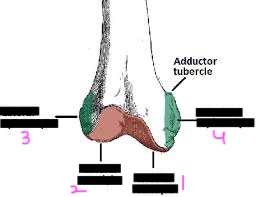
<p>label this diagram of the femur</p>

label this diagram of the femur

  1. medial femoral condyle: join the tibia at the knee joint

  2. lateral femoral condyle: join the tibia at the knee joint

  3. lateral femoral epicondyle: lateral collateral ligament, lateral head of gastrocnemuis, and origin of popliteus attach

  4. medial femoral epicondyle: medial collateral ligament and medial head of gastrocnemius attach
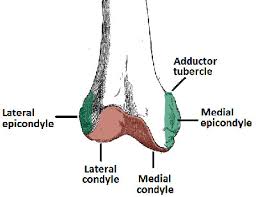
<ol><li><p>medial femoral condyle: join the tibia at the knee joint</p></li><li><p>lateral femoral condyle: join the tibia at the knee joint</p></li><li><p>lateral femoral epicondyle: lateral collateral ligament, lateral head of gastrocnemuis, and origin of popliteus attach</p></li><li><p>medial femoral epicondyle: medial collateral ligament and medial head of gastrocnemius attach</p></li></ol><p></p>
19
New cards
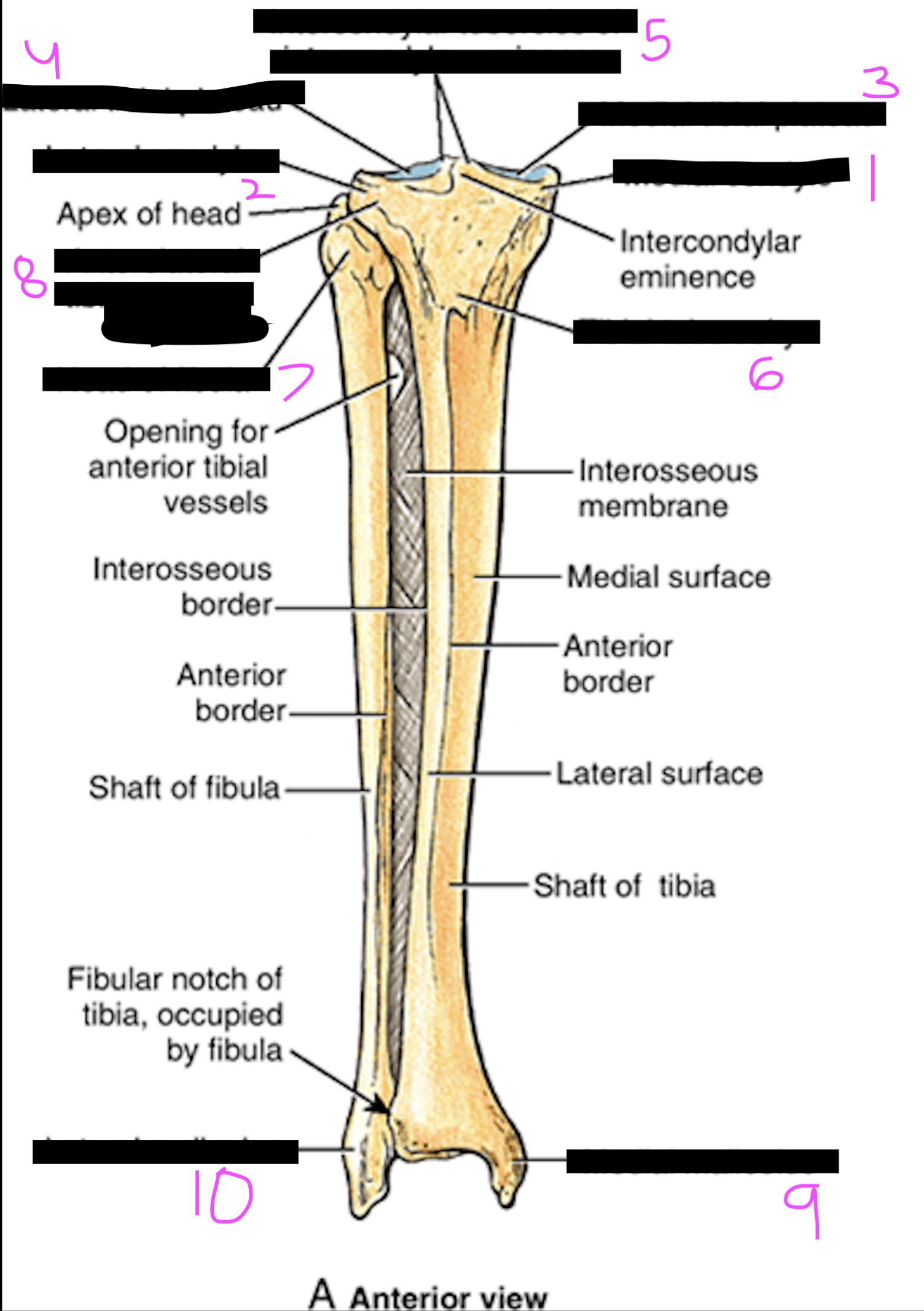
<p>label this diagram of the tibia and fibula</p>

label this diagram of the tibia and fibula

  1. medial tibial condyles: for articulation with the femur at the knee joint

  2. lateral tibial condyles: for articulation with the femur at the knee joint

  3. intercondylar eminence (4 tibial spines): for attachemnt of both ends of both the medial and lateral menisci

  4. tibial tuberosity: for attachment of the patellar tendon

  5. head of the fibula: for the attachment of the LCL and insertion tendon of biceps femoris

  6. gerdy’s tubercle: for insertion of iliotibial band

  7. medial malleolus: on tibia. mostly for attachment of the MCL of the ankle

  8. lateral malleolus: on fibula. mostly for attachment of th LCL of the ankle
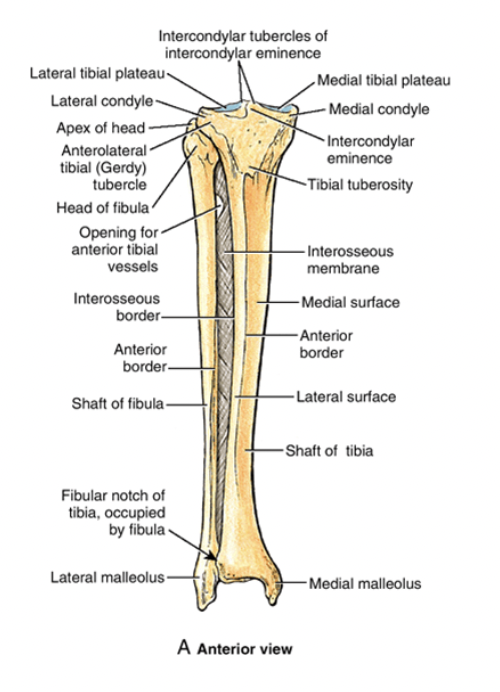
<ol><li><p>medial tibial condyles: for articulation with the femur at the knee joint</p></li><li><p>lateral tibial condyles: for articulation with the femur at the knee joint</p></li><li><p>intercondylar eminence (4 tibial spines): for attachemnt of both ends of both the medial and lateral menisci</p></li><li><p>tibial tuberosity: for attachment of the patellar tendon</p></li><li><p>head of the fibula: for the attachment of the LCL and insertion tendon of biceps femoris</p></li><li><p>gerdy’s tubercle: for insertion of iliotibial band</p></li><li><p>medial malleolus: on tibia. mostly for attachment of the MCL of the ankle</p></li><li><p>lateral malleolus: on fibula. mostly for attachment of th LCL of the ankle</p></li></ol><p></p>
20
New cards
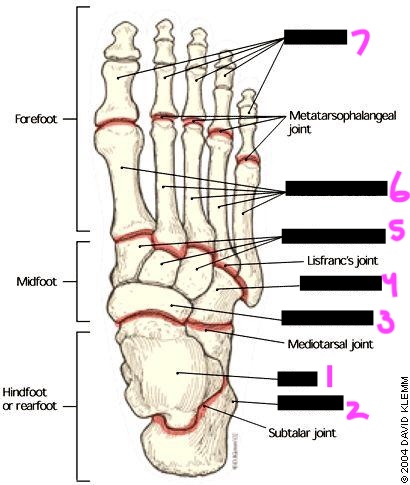
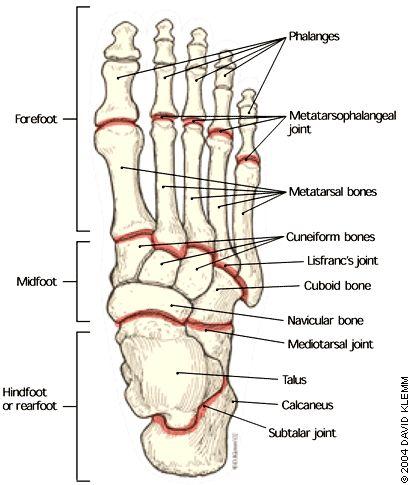
<p>label this diagram of the foot</p>

label this diagram of the foot

  1. talus: articulates with tibia and fibula at ankle joint

  2. calcaneus: heel bone, largest tarsal bone

  3. navicular: boat-shaped bone on medial side

  4. cuboid: cube-shaped bone on lateral side

  5. cuneiforms: three wedged-shaped bones

  6. metatarsals: five long bones of the midfoot

  7. phalanges: toe bones

<ol><li><p>talus: articulates with tibia and fibula at ankle joint</p></li><li><p>calcaneus: heel bone, largest tarsal bone</p></li><li><p>navicular: boat-shaped bone on medial side</p></li><li><p>cuboid: cube-shaped bone on lateral side</p></li><li><p>cuneiforms: three wedged-shaped bones</p></li><li><p>metatarsals: five long bones of the midfoot</p></li><li><p>phalanges: toe bones</p></li></ol><p></p>
21
New cards
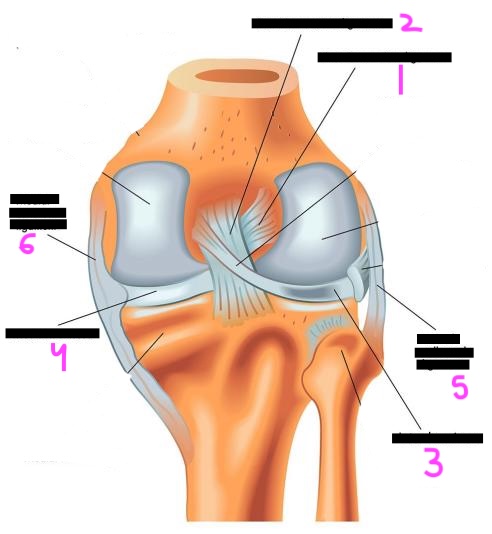
<p>label this diagram of the knee</p>

label this diagram of the knee

  1. anterior cruciate ligament: strops the femur sliding backwards on the tibia

  2. posterior cruciate ligament: stops the femur sliding forwards on the tibia

  3. lateral menisci: deepen the knee joint, increasing stability; act as shock absorbers

  4. medial menisci: deepen the knee joint, increasing stability; act as shock absorbers

  5. lateral collateral ligament: stops the leg from adducting at the knee joint

  6. medial collateral ligament: stops the leg from abducting at the knee joint
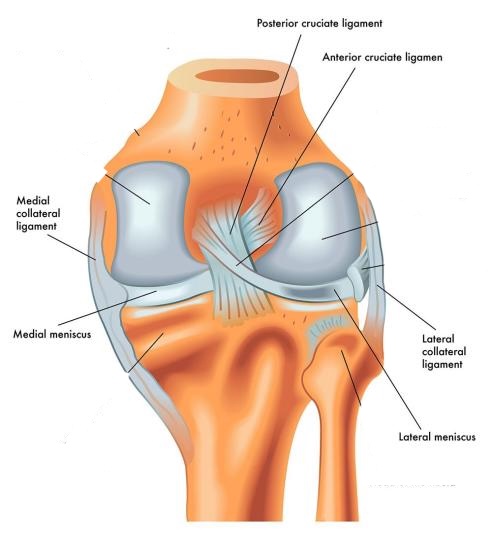
<ol><li><p>anterior cruciate ligament: strops the femur sliding backwards on the tibia</p></li><li><p>posterior cruciate ligament: stops the femur sliding forwards on the tibia</p></li><li><p>lateral menisci: deepen the knee joint, increasing stability; act as shock absorbers</p></li><li><p>medial menisci: deepen the knee joint, increasing stability; act as shock absorbers</p></li><li><p>lateral collateral ligament: stops the leg from adducting at the knee joint</p></li><li><p>medial collateral ligament: stops the leg from abducting at the knee joint</p></li></ol><p></p>
22
New cards
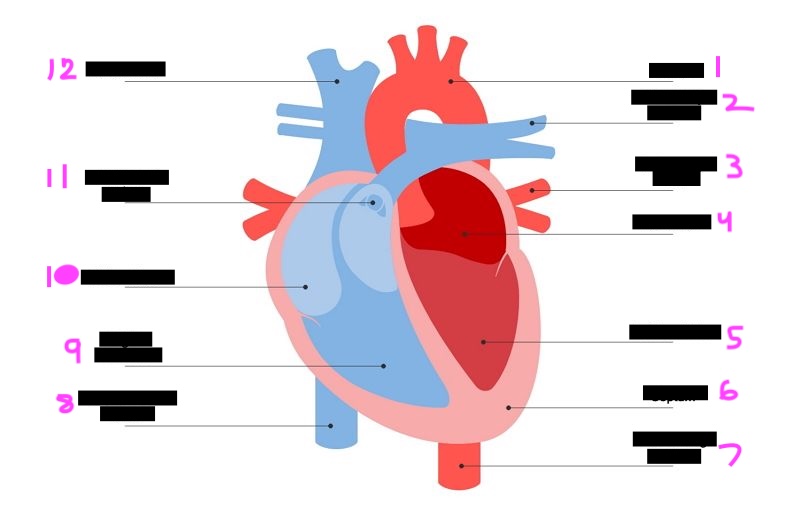
<p>label this diagram of the heart</p>

label this diagram of the heart

  1. aorta: carries oxygen-rich blood away from the left ventricle and distributes it to the rest of the body.

  2. pulmonary artery: branches (right and left) carrying blood to lungs for oxygenation

  3. pulmonary vein: return oxygenated blood from lungs to left atrium

  4. left atrium: upper left receiving chamber of the heart

  5. left ventricle: lower left pumping chamber with thickest muscular wall

  6. spetum: separate structures so they can perform their specific functions without interference

  7. decending aorta: the descending portion specifically feeds the lower body

  8. inferior vena cava: large vein bringing deoxygenated blood from lower body to right atrium

  9. right ventricle: lower right pumping chamber, sends blood to lungs

  10. right atrium: upper right receiving chamber of the heart

  11. pulmonary valve: three-cusped valve at exit of right ventricle

  12. superior vena cava: large vein bringing deoxygenated blood from upper body to right atrium
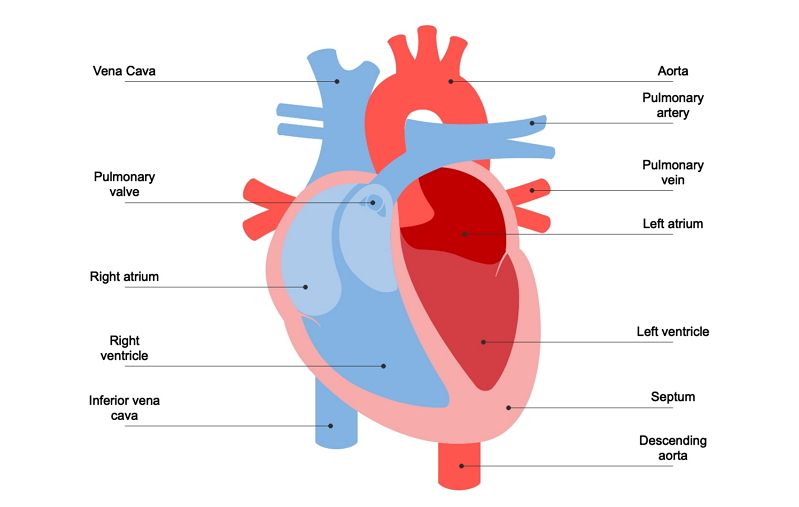
<ol><li><p>aorta: carries oxygen-rich blood away from the left ventricle and distributes it to the rest of the body.</p></li><li><p>pulmonary artery: branches (right and left) carrying blood to lungs for oxygenation</p></li><li><p>pulmonary vein: return oxygenated blood from lungs to left atrium</p></li><li><p>left atrium: upper left receiving chamber of the heart</p></li><li><p>left ventricle: lower left pumping chamber with thickest muscular wall</p></li><li><p>spetum: separate structures so they can perform their specific functions without interference</p></li><li><p>decending aorta: the descending portion specifically feeds the lower body</p></li><li><p>inferior vena cava: large vein bringing deoxygenated blood from lower body to right atrium</p></li><li><p>right ventricle: lower right pumping chamber, sends blood to lungs</p></li><li><p>right atrium: upper right receiving chamber of the heart</p></li><li><p>pulmonary valve: three-cusped valve at exit of right ventricle</p></li><li><p>superior vena cava: large vein bringing deoxygenated blood from upper body to right atrium</p></li></ol><p></p>
23
New cards
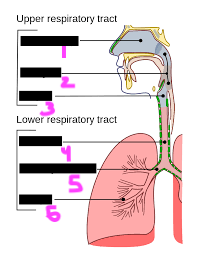
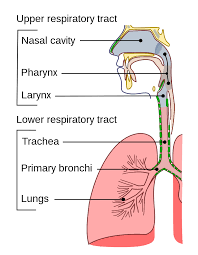
<p>label the diagram of the respiratory tract</p>

label the diagram of the respiratory tract

  1. nasal cavity: internal space of the nose

  2. pharynx: throat

  3. larynx: voice box

  4. trachea: windpipe

  5. bronchi: main air passages to lungs

  6. lungs

<ol><li><p>nasal cavity: internal space of the nose</p></li><li><p>pharynx: throat</p></li><li><p>larynx: voice box</p></li><li><p>trachea: windpipe</p></li><li><p>bronchi: main air passages to lungs</p></li><li><p>lungs</p></li></ol><p></p>
24
New cards
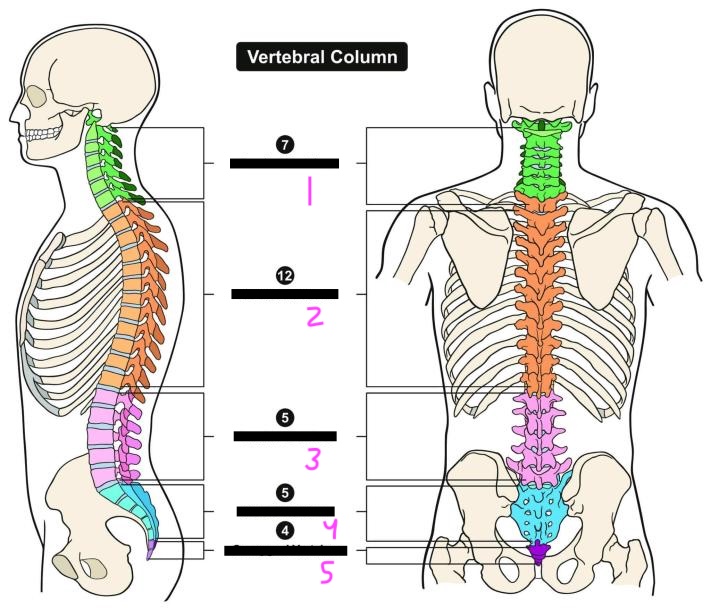
<p>label this diagram of the vertebral column</p>

label this diagram of the vertebral column

  1. cervical vertebra: smallest vertebrae; transverse foramina for vertebral arteries

  2. thoracic vertebra: articulate with ribs; limited mobility due to rib cage

  3. lumbar vertebra: largest vertebrae; bear most body weight

  4. sacral vertebrae: fused to form sacrum; articulates with pelvis

  5. coccygeal vertebra: vestigial tailbone
25
New cards
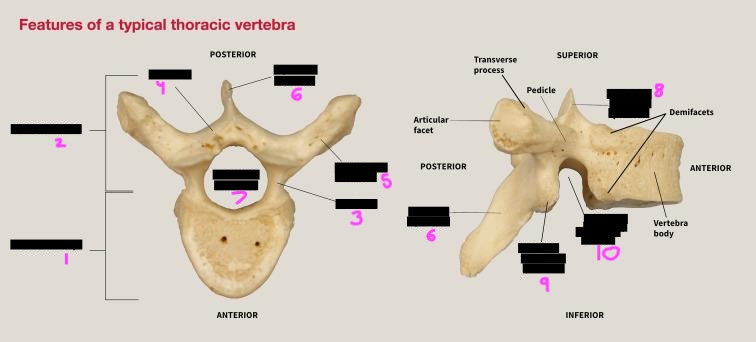
<p>label this diagram of the basic vertebral structures</p>

label this diagram of the basic vertebral structures

  1. vertebral body: the anterior weight-bearing part; attaches at the intervertebral joint to the vertebra above and below it

  2. vertebral arch: comprised of pedicles and laminae; forms the posterior boundary of the vertebral foramen

  3. pedicle: short, thick projection protuding posteriorly from each side of the body

  4. lamina: flat plates continuing from pedicles; attach to each other posteriorly in the midline

  5. transverse processes: prject laterally from where each pedicle meets its lamina; for muscle and ligament attachments

  6. spinous process: projects posteriorly from the midline junction of the laminae; for muscle and ligament attachments

  7. vertebral foramen: the central opening within the vertebral arch; when vertebrae are joined, forms the vertebral canal

  8. superior articular processes: project upward to articulate with the vertebra above at the zygapophyseal joints

  9. inferior articular processes: project downward to articulate with the vertebra below the zygapophyseal joints

  10. inferior vertebral notch: indentation on inferior surface of pedicle; when vertebrae join, forms the intervertebral foramina where nerves exit
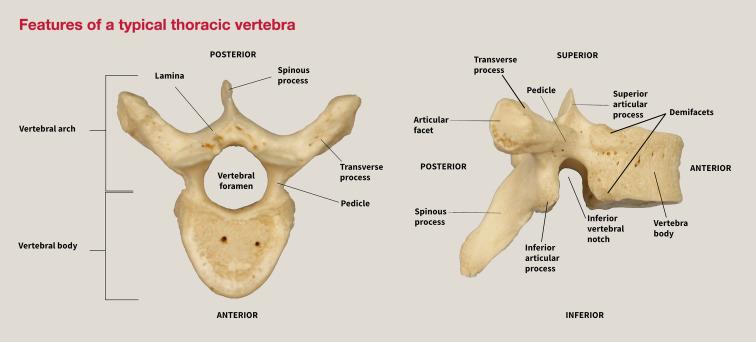
<ol><li><p>vertebral body: the anterior weight-bearing part; attaches at the intervertebral joint to the vertebra above and below it</p></li><li><p>vertebral arch: comprised of pedicles and laminae; forms the posterior boundary of the vertebral foramen</p></li><li><p>pedicle: short, thick projection protuding posteriorly from each side of the body</p></li><li><p>lamina: flat plates continuing from pedicles; attach to each other posteriorly in the midline</p></li><li><p>transverse processes: prject laterally from where each pedicle meets its lamina; for muscle and ligament attachments</p></li><li><p>spinous process: projects posteriorly from the midline junction of the laminae; for muscle and ligament attachments</p></li><li><p>vertebral foramen: the central opening within the vertebral arch; when vertebrae are joined, forms the vertebral canal</p></li><li><p>superior articular processes: project upward to articulate with the vertebra above at the zygapophyseal joints</p></li><li><p>inferior articular processes: project downward to articulate with the vertebra below the zygapophyseal joints</p></li><li><p>inferior vertebral notch: indentation on inferior surface of pedicle; when vertebrae join, forms the intervertebral foramina where nerves exit</p></li></ol><p></p>
26
New cards
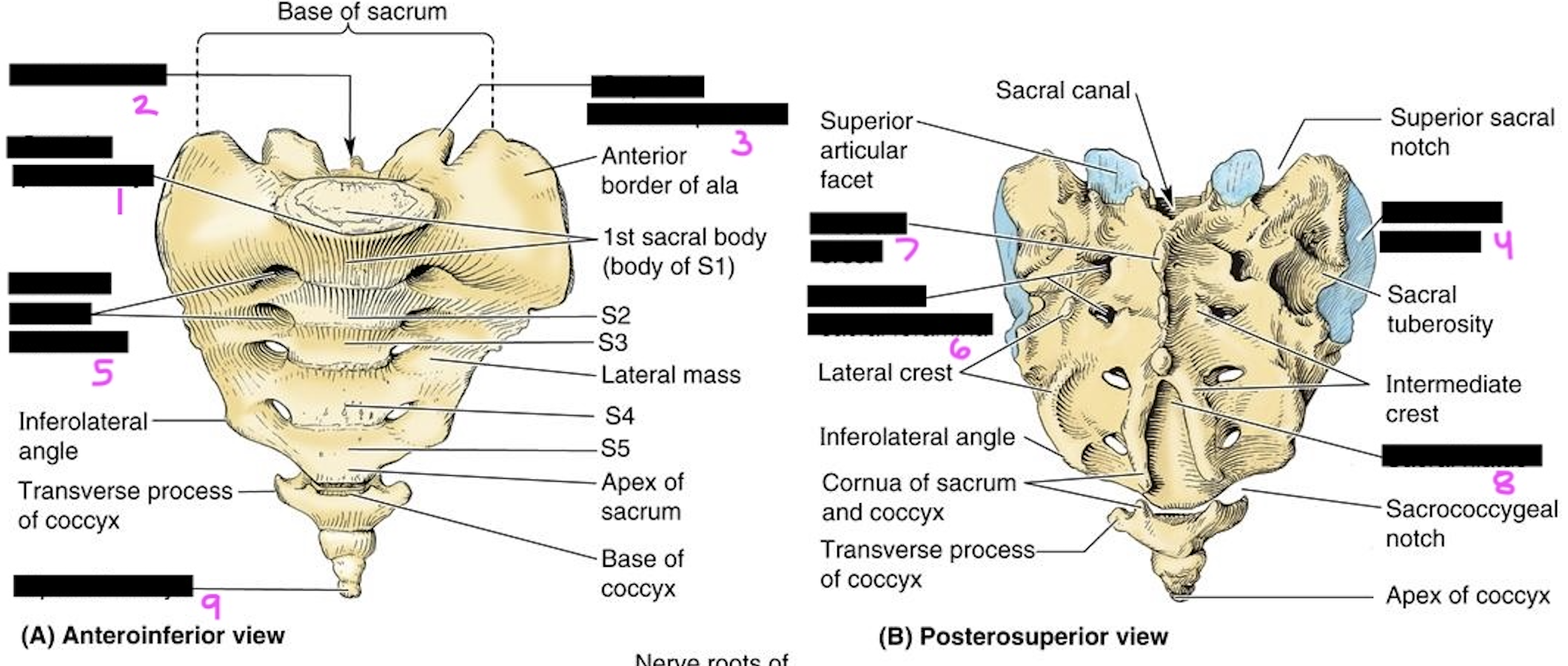
<p>label this diagram of the sacrum</p>

label this diagram of the sacrum

  1. sacral promontory: Prominent anterior edge of S1 body; important obstetric landmark

  2. Sacral canal: continuation of vertebral canal; contains cauda equina nerve roots

  3. superior articular processes: articulate with L5

  4. auricular surface: ear-shaped lateral surface for articulation with ilium at sacroiliac joint

  5. anterior sacral foramina: openings for anterior rami of sacral spinal nerves

  6. posterior sacral foramina: openings for posterior rami of sacral spinal nerves

  7. median sacral crest: fused spinous processes along midline posteriorly

  8. sacral hiatus: opening at inferior end of sacral canal; used for caudal epidural anesthesia

  9. apex of sacrum: inferior tip; articulates with coccyx
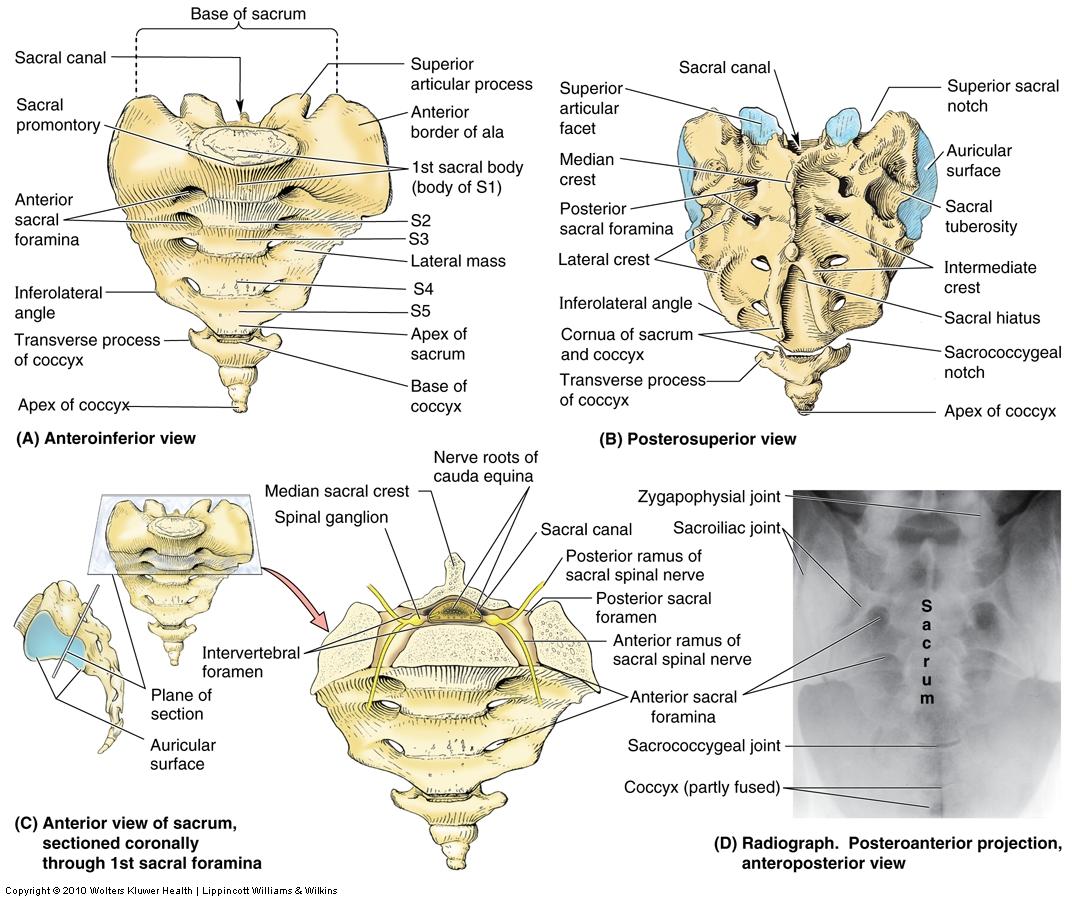
<ol><li><p>sacral promontory: <span>Prominent anterior edge of S1 body; important obstetric landmark</span></p></li><li><p>Sacral canal: <span>continuation of vertebral canal; contains cauda equina nerve roots</span></p></li><li><p>superior articular processes: <span>articulate with L5</span></p></li><li><p>auricular surface: <span>ear-shaped lateral surface for articulation with ilium at sacroiliac joint</span></p></li><li><p>anterior sacral foramina: <span>openings for anterior rami of sacral spinal nerves</span></p></li><li><p>posterior sacral foramina: <span>openings for posterior rami of sacral spinal nerves</span></p></li><li><p>median sacral crest: <span>fused spinous processes along midline posteriorly</span></p></li><li><p>sacral hiatus: <span>opening at inferior end of sacral canal; used for caudal epidural anesthesia</span></p></li><li><p>apex of sacrum: <span>inferior tip; articulates with coccyx</span></p></li></ol><p></p>