Marketing 302
 Call Kai
 Learn
Learn Practice Test
 Spaced Repetition
 Match
Match Flashcards
 Knowt Play
1/187

There's no tags or description
Looks like no tags are added yet.
Name | Mastery | Learn | Test | Matching | Spaced | Call with Kai |
|---|
No analytics yet
Send a link to your students to track their progress
188 Terms
Services traditionally viewed as having four distinctive features
intangibility
heterogeneity
inseparability
perishability
intangibility
you can’t see it, (Maids leave little chocolates or towel folding to show they were there), (insurance commercials show what could happen)
heterogeneity
variation (services are not the same) (people are different, customers are different) (differences between physicians with in a given hospital or different as their shift goes on) (Umps, the team winning will get more facorable calls so it ends quicker)
inseparability
produced and consumed at the same time (haircut, therapy, comedian) (if you had a bad experience, people won’t come back)
perishability
can’t be stored for later
problem when deman t fluctuates
Restaurant has 20 tables and is open for 5 hours
10 parties come to the restaurant each hours
50 parties come to the retaurant at 5pm, empty otherwise
Service providers generally want to smooth demand
shifting demand to other periods (reservations, special deals)
increasing acceptable waiting time
Combat wait time
Put baggage caresoul far away so the wait is included in the walk and they aren’t waiting for too long
Door close button, push button to walk across the street
Disney overestimate the wait time so people are happy when they get there qucker
Websites having a bar showing where the process is
Effective standardization via uniforms
Blue man group
Uniforms
some are some aren’t
uniforms ties the employees to the brand, so you don’t want them to do bad
uniforms increase perceived corp, responsibility for service quality
Shock
People said the would pay to not be shicked again
But when left aline with nothing to do, they were willing to do it
Services have tangible results
your hair looks different after a haircut
your body works better after surgery
sometimes customers are involve in the production of goods and sometimes they aren’t
Shoes, computers, build a bear
Snow plow, dry cleaners
TF: Services are more perishable than goods
true
Customer satisfaciton
high satisfaction can help your brand become customers first choice within the category
TF: Customers just need to be happy enough
True
Example of customer service
Zappos 10 hour long service call, ad with customer not wanting the product yet
Counter: places are designed to be mean to you
Managing satisfaction involves
Managing expectations, so that people are pleasantly surprised
Satisfaction =
Performance-Expectations
Attempts to manage expectations
Home depot, changed their slogan because people were expecting them to actually help them build stuff
Dominos, their under 30 min caused car crashes
Overpromising
Can cause anger, keep easy promises to keep people happy
Never make a promise you can’t keep
Bold promises are okay when
Are dangerous when
the consuption/service experience is ambiguous (this class will change your life")
Consumption/service experience is easy to evaluate (We will deliver this pizza in under 30 min)
Mange memories
Memories can be influenced by advertising viewed post experience
amusement park commercials will show the rides, not the lines
Picture of student studying (in reality you did not look like this)
The availability heuristic
We tend to treat the ease with which we can recall examples of an event as indicative of the frequency of that event
people asked whether there are more English words with k as the first letter or k as the third letter
how often does ___ occur, if you can come up with easy examples it’s likely to happen
helps explain why it seems like we always get stuck in the slow line
Traditional assumption
Consistent performance throughout a service encounter is optimal
at an amusement park, the first ride is as important to the customer’s evaluation as the last ride
TF: Certain moments of service.experience are especially likely to influence memories
True
Who reports more pain?
Participant 1 Rates pain as 5 at minute 1, 10 at minute 2
Participant 2 Rates pain as 10 at minute 1, 5 at minute 2
Participant 1
Child birth: after months it was less thant after a few days
Managing customer dissatisfaction
Want to retain mildly dissatisfied customers
Service recovery paradox
There are situations in which post-recovery satisfaction is greater than satisfaction prior to the service failure
Expectations following service failure tend to be pretty low
From this pov, mild service failures can actually be opportunities to increase satisfaction
Promotion (marketing communication)
Means by which firms attempt to inform, persuade, and remind customers
represent the voice of the company and its brands
it is here that we convert customer propositions into taglines, slogans, ads, etc
Who articulate the customer proposition?
manufactors work with ad agency’s account and strategy teams to develop a creative brief
a document that includes background info on the brand, category, targeted segment, budget, goals
Ad agency’s creative team interprets creative brief, proposes a campaign, and develops mockups
ad agency’s production team turns the mockups into an advertisement
Different level of ad agencies
Some large manufacturers will use an in house ad agency model Icoke, amazon, nike, apple)
benefits of speed, cost, consistency, control
Larger or more complex campaigns (commercials, complex social media campaigns) will often involve a separate production house
production house: firm specializing in film and tv production
Common misconception of commercials, advertising, marking communication
Misconception: Commercials=Advertising=Mkt communication
Reality:
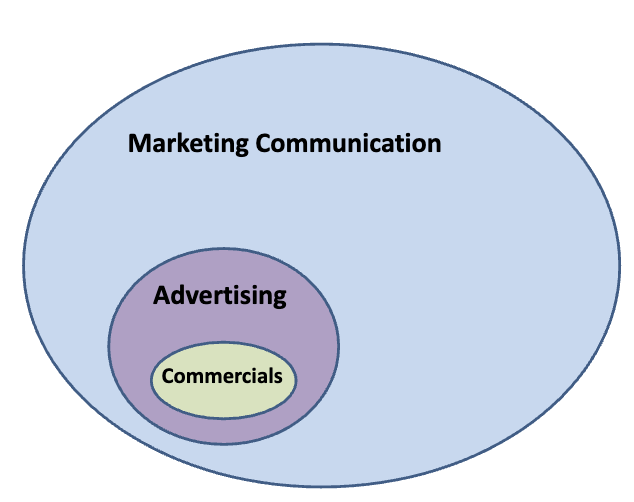
Advertising examples
print, web, broadcast ads
product placement
billboards
point of purchase displays
marketing communications mix
Customer/price promotions examples
coupons
rebates
games
gifts
samples
Marketing communications mix
events, sponsorships, experiences
games at football/basketball with companies
olympics, redbull
Marketing communication mix
direct and interactive marketing
Catelogs, check off what you wnat and send a check
Email marketing
cost per response
total cost/(percent response * number sent out)
Marketing communication mix
sales presenation, trade shows
auto shows, resturant trade show
b2b don’t want to do a commercial where most people that see aren’t in that category
Common marketing communications objectives
achieve basic awareness: do you recognize a brand
achieve top of mind awareness: assume you know the product, remind you during the context buwiser, watching a game you want a bud
achieve an information goal: want customers to know certain facts about your product, nutrients, how to cook turkey
achieve an image goal: the image they represent is aspirational, want to look like that, perfume
achieve a behavior goal: buy now
Measuring recognition vs recall
recognition: which of the following headache medications have you heard of? ()on head () head on ()forehead on
Recall: name the first five headache medications that you can think of: ()()()()()
Marketers’ interest in memory
Many ads not intended to encourage immediate purchase
many customer decisions are purely memory-based (picking a restaurant for dinner)
How much advertising is required?
need 20 exposures at least in the past
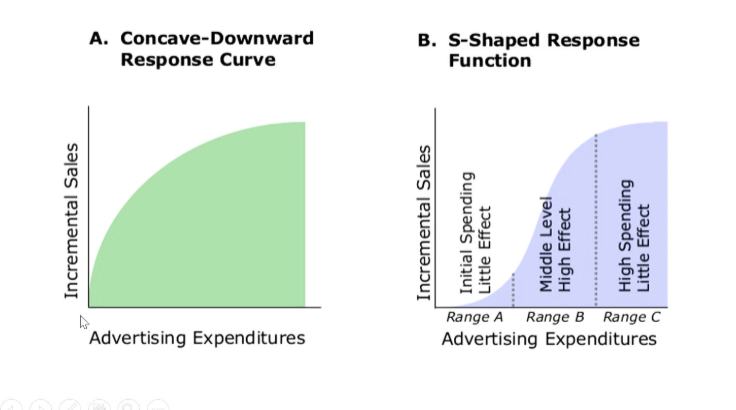
Two modern sales response models
concave downward response curve
s shaped response funtion
TF: with repetition, consumers can come to believe the claim that is being made
True
The sleeper effect
memory for content > memory for context
if you see something multiple times you will remember the content but not the context
spread of disinformation can occur even when the initial message is from a low-credibility source
message might not be immediately persuasive
but that can change with time
Bad way to debunk
repeat false statements
repeat true statements to make people remember
Mere exposure effect
participants are shown shapes
then are shown two shapes one of which was a previous shape
which have you seen before? half say the one they saw
which do you like better? most say the one they saw
reason why you want to show your product more and more even if you think they aren’t paying attention
Explains product placements (even if you don’t know the product, customers getting used to see it will make them like it better)
iPhone doesn’t allows villains to hold them
peloton didn’t control the context in satc when big died on it and it made people nervous
another example: if you see your face in candidates you will like that candidate better
Turning to new ad media
glass (put money in a glass and people couldn’t work it)
put trucks with ads infront of trump tower to get on the news
Native ad
try to blend in
when ads resemble editorial content, an advertiser risks implying the information comes from a non biased source, which is does not
don’t want customers to be mislead
now needs to disclose it’s an ad
Influencer marketing
risk: fire festival, lied about what it would be, influencers were sued for instagram posts, not disclosed as ad
social media platforms have built in sponsored content to tag, even if it’s not money and just gifts, it still needs to be discloused
TF: Paid media is the only way to reach customers
False
paid media
advertising you purchase
billboards, search ads, commerci
pay something to get your media out there
owned media
content you create on platforms you control
website, social media email campaigns
Earned media
publicity gained form others talking about you
word of mouth reviews, social media content, media/news coverage
ex: death of duo, got lots of views, people and other companies were jumping on the trend, everything is free for duolingo
why is earned media coverage so valuable
free (but need to do some thing people will talk about)
long lasting: unline paid media, not limited by campaign budget/duration
the pepsi tast challenge is 50 years, old but still talked about and knockoff brands do it too
build trust (info can come from unbiased, high quality sources)
Doesn’t activate persuasion knowledge (if consumers know they’re being advertised to, they will be more critical/skeptical of the marketing message
Benefits of unused coupons
coupons are like a reminder, and they spend more
even though only like 1% actually uses the coupon, or they forget it at home, or it’s expired
Evaluation of bundles
They are more likely to average than add
like adding a free gift, people said hamburger was more calories than hamburger and apple
Which of the following is true?
The mere exposure effect helps explain why product placements are effective
How are national brand manufacturers responding to death of brand management
value pricing
really new new products
mega brands and fighting brands vs private labels
building brand equity
Steps in advertising
set objectives
select tasks
set budget
develop message
test
evaluate response
set objectives
awareness, interest, desire, action
select tasks
increase awareness, attract switchers, increase repeat, post purchase behavior
set budget
percentage of sales (we give 10% of sales into advertising)
competitive parity (looking at what the competition does)
state of the art practice (use data to know how your ad will effect sales)
develop message
what is the copy or text of the message
message objectives, strategy, format, creativity, copy
top of mind and awareness questions
top of mind
when I ask you to think about executive mbs programs, which is the first executive MBA program that comes to mind?
harvard, wharton, kellogg, michigan, stanford
Awareness
what executive mba programs have you heard or seen promoted in the last year
harvard, wharton, kellogg, michigan, stanford
In what media do you recall hearing or seeing the promotion?
radio, tv, news print, magazine
test
copy testing
market testing
IRI data at right from 300+ tests in which test group sees twice as many ads as the control group
Evaluate response
compare levels of hierarchy of effects response variables before and after an ad compaign (with respect to original goals)
exposure (estimation of audience size) GRP: what percetage of the target market do you reach and how many times do they see the ad
awareness (immediate recall or recognition levels)
acceptance (comprehension, attitude, preference) positive or negativeRe
retention (post-hoc recall or recognition)
intentions and behaviors (purchase liklihood, trial, satisfaction, repeat)
What about the sales effects of advertising?
that’s important too but challenging
tough to separate out the effects of the rest of the marketing mix, competitors
measuring performance on hierarchy of effects response variables can help tease out what’s due to our advertising efforts and what’s due to other factors
Media planning
after deciding how to convey the client’s cusumer value proposition, the advertiser works with media buyers and the client to develop a media plan for the campaign
involves selecting desired reach, frequency
choosing among media types (TV, online, radio)
choosing a specific vehicle within a media type
primetime show vs superbowl
Reach and frequency
The percent of a revelant population exposed to a particular media campaign at least once during a specified time period
Frequency: the average number of exposures among those reached by the ad campaign
Does exposed = actually watching the ad?
no, exposed just means having an opportunity to see the advertisement
usually anywhere between 50% and 95% of people watching a program will actually see ads run during that program
Gross rating points
Commonly used to gauge the strength of an advertising campaign
generally considered to be the common currency of media planning
can be used across a number of platforms (TV, radio, newspapers, magazines)
total number of exposures = R x F
different ways to get teh same GRP
20% reach x frequency of 1 = 20 GRPs
10% reach x frequency of 2 = 20 GRPs
Reach vs Frequency
one circle equals people exposed to a particular ad
Max # of exposures that someone receives in the Low Reach, High Frequency world?
Min # of exposures?
Max # of exposures that someone receives in the High Reach, Low Frequency world?
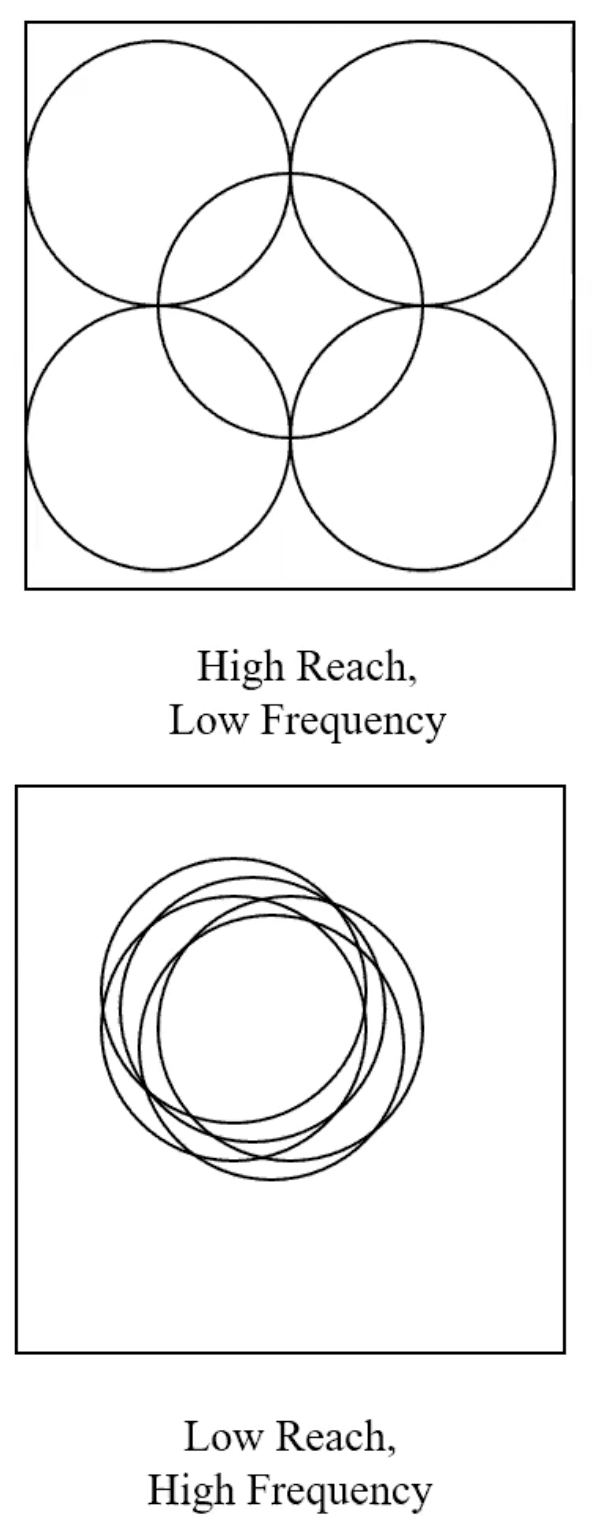
5 max
0 (outside of the circle)
2 max
0 min
there are 2 shows on which we would like to advertise
15% of households watch NCIS
10% of households watch This Is Us
5% of households watch both
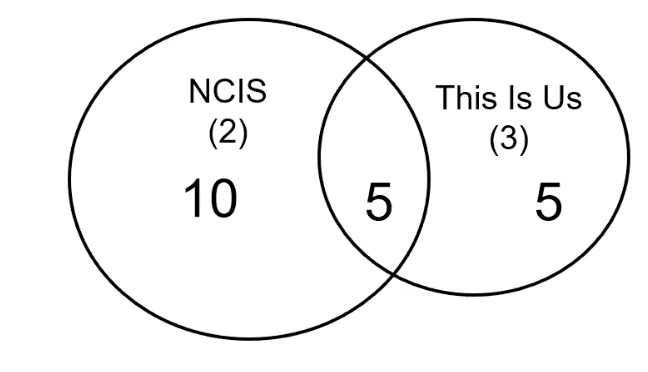
We want to run 2 spots on NCIS and 3 spots on This is Us
GRPs = total number of exposures = (10% x 2) + (5% x [2+3]) + (5% x 3) = 60
What is the reach of this campaign?
What percent of the population watches modern family?
What percent of the population sees the ad at least 6 times?
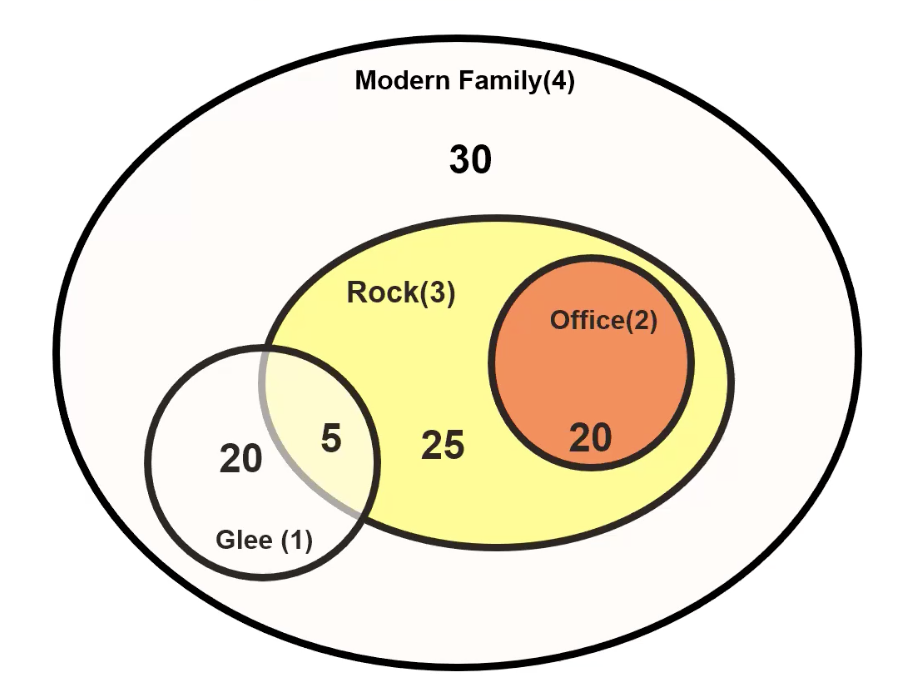
30% +20% + 5% + 25% + 20% = 100%
100%
50%
General recommendations of reach vs frequency
reach: generally, most important when launching a new product or when going after a poorly defined target market
frequency: generally, most important when there are strong competitors, a complex story to tell, or high consumer resistance
Are super bowl ads effective?
The ads are linked to an increase in sales when your close competitors are not advertising
much less effective if a category competitor is also advertising
coke vs pepsi
if you both advertise no one wins
some common arguments in favor of billboard advertising
high reach
high frequency
everyday on the way to and from work
you can’t skip or avoid a billboard
some people actually love them
Why put ads during football
something people want to watch live
usually at home focused on the screen
another example election
Upfronts in may
Networks get together and pitch their shows and the demographics they reach trying to sell the advertisers on commercial time
advertisers commit billions of dollars in ad purchases
have the option to pull portion of their committed purchases
75-90% of advertising inventory is committed in may
networks guarantee ads will reach a certain audience size
bring out celebrities
consider the ads before or after you, could make you look bad or people change the channel
How is viewership measured?
peoplemeters: attached to their tv and can see what is being view as well as check ins
Out of home viewing presents a challenge
device wouldpick up those audio codes that humans can’t here
portable people meters people can wear
People avoid ads
zapping: change channels
multi tasking: diverting attention to people, other media
physical zapping: leave room (4x common as zapping)
zipping: fast forward through recorded programs
Factors that increase zapping
actors older than 40
depict scenes of frustration
convey negative messages
annoying stimuli (bad dancing, voice, made-up words)
How do commercials influence enjoyment of the show?
people go to great lengths to avoid commercials, particularly bad ones
some recent work suggests that brief commercials might not be so bad
Media buying online
Cost per million
banner ads, social media, video
1-15 dallors
cost per click
search
1-5 dallors
depends on industry, keywords advertised
mesothelioma often most expensive, cancer that lawyers want their case
Most online ads are sold by auction
entire process completes in under 200 milliseconds
Participants in programmic ad buying
user/consumer: wants content, willing to tolerate ads
publisher: website or app with content, eans money by showing ads alongside content
ad exchange: marketplace where sellers (platform) list inventory and buyers (advertisers) make bids
Advertiser: wants to reach consumers, bid on impressions in real time through DSP
Demand side platform: software systme helping advertisers implement their bidding preferences, who to target, when and how often to target, how much to bid
Online advertising is quite accessible
target based on location, interests, language
split tests to identify the most receptive audience
Which of the following is true according to our reading advertising analytics 2.o?
More than one above
Surplus
We can think of producer surplus as price minus unit variable cost (like materials)
increase the price or decrease the variable cost
consumer surplus can be thought of as the difference between perceived value (or the maximum willigness to pay) and actual price paid
we’ll be motivated to increase producer surplus
Option for increasing producer surplus
Lower variable cost (change packaging)
be careful to not reduce quality or perceived quality which can lower willingness to pay and the price you can change
Hold overall package price constant, but shink total quality (chips, babybell)
Increase the price (but explain)
Faireness
Fairness concerns act as a constraint on profit seeking, but consumers feel firms are entitle to a fair profit, which they begrudgingly accept
unfair to exploit shifts in demand by raising prices (unacceptable morally and sometimes legally)
uping prices of shovel after a snowstorm\
hand sanatizer during pandemic
Uniform pricing in retail chains
grocery, drug, and mass merch chains charge nearly uniform prices across stores
movie tickets are all the same no matter the movie
imagine there are 5 consumers
abe is willing to pay up to $10
bob is willing to pay up to $9
carl is willing to pay up to $8
dan is willing to pay up to $7
ernie is willing to pay up to $6
if price = $10, total surplus is?
If price = $6, total surplus is?
If price = max wtp, total surplus?
10-5 = 5
(6-5)x5 =5
(10-5) + (9-5) + (8-5) + (7-5) + (6-5) = 15
price discrimination
selling a product/service at two or more prices that do not completely reflect a difference in cost
1st degree: seller charges each buyer their maximum willingness to pay (theoretical ideal for sellers)
2nd degree: seller charges less to buyers who buy in bulk
3rd degree: seller charges different amounts to different classes of buyers (often based on willingness or ability to pay)
pink tax, “different products”
gringo tax: cheaper in spanish
Old age discounts
they elderly pay less, but it is better to get that smaller amount from them than zero
it looks like you’re being nice, not that you want as much money as possible
Direct vs indirect price discrimination
Direct: offering different prices to different classes of buyers (3rd degree)
Indirect: offer a menu of prices or options to all customers and let customers elf-slect (2nd degree)
Many pricing schemes driven by indirect price discrimination (coupons, pricing fluctuations, versioning/premium products)
Requirements for a firm to price discriminate
Some level of market/scale economies/monopoly power
competitors don’t undercut prices
Must be able to identify and segment buyers with different demand elasticities
adults vs students
impatient vs patient
Must be able to maintain seperation of buyers to avoid arbitrage
adults can’t buy student tickets
airline passengers can’t trade tickets
Estimating demand curves
quantitative analysis of past prices, quantity sold
surveys: how likely would you by at x, y, z
price experiments in the field
every 10th customer gets 5% off coupon
price elasticity of demand
ex: price increases from $10 to $12
quantity decreases from 200 units to 180 unite
% change in quantity demanded/ % change in price
((180-200)/200)/(($12-$10)/$10)= -.50
How does price level affect price elasticity?
Price elasticity of demand generally becomes more elastic as price increases because it’s ratio of percentage changes
<1 it’s inelastic (less sensitive to price)
>1 elastic (more sensitive to price)
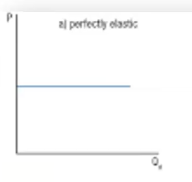
perfectly elastic = infinity
very price sensitive
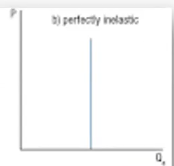
perfectly inelastic = 0